1535-9778/04/$08.00⫹0 DOI: 10.1128/EC.3.6.1627–1638.2004
Copyright © 2004, American Society for Microbiology. All Rights Reserved.
Gid8p (Dcr1p) and Dcr2p Function in a Common Pathway To
Promote START Completion in
Saccharomyces cerevisiae
Ritu Pathak, Lydia M. Bogomolnaya, Jinbai Guo, and Michael Polymenis*
Department of Biochemistry and Biophysics, Texas A&M University, College Station, TexasReceived 1 April 2004/Accepted 30 July 2004
How cells determine when to initiate DNA replication is poorly understood. Here we report that in
Saccha-romyces cerevisiaeoverexpression of the dosage-dependent cell cycle regulator genes DCR2(YLR361C) and
GID8(DCR1/YMR135C) accelerates initiation of DNA replication. Cells lacking bothGID8andDCR2delay initiation of DNA replication. Genetic analysis suggests that Gid8p functions upstream of Dcr2p to promote
cell cycle progression.DCR2is predicted to encode a gene product with phosphoesterase activity. Consistent
with these predictions, aDCR2allele carrying a His338 point mutation, which in known protein phosphatases
prevents catalysis but allows substrate binding, antagonized the function of the wild-typeDCR2allele. Finally,
we report genetic interactions involvingGID8,DCR2, andCLN3(which encodes a G1cyclin) orSWI4(which
encodes a transcription factor of the G1/S transcription program). Our findings identify two gene products with
a probable regulatory role in the timing of initiation of cell division.
Extensive studies have identified a large number of the com-ponents of the eukaryotic cell division machinery that bring about cell cycle transitions once cell division is initiated. How-ever, very little is known about the factors that determine when the cell begins a new round of cell division. Tight coordination between cellular “growth” and cell division is thought to de-termine the timing of initiation of cell division, thus becoming rate limiting for cell proliferation (23, 25). In the yeast Sac-charomyces cerevisiae various aspects of the cell’s physiology are monitored at a point called START in the late G1phase of the cell cycle (25), prior to DNA synthesis (in S phase). If cells pass through START, they initiate DNA replication and they are committed to complete cell division. START completion is also followed by the appearance of a bud on the cell surface, which will eventually give rise to the daughter cell (25).
Protein complexes of G1cyclins (Cln1-3p) with the Cdc28p cyclin-dependent kinase catalyze passage through START, with the Cln3p/Cdc28p complex functioning first in activating a large G1/S transcriptional program (29, 31). A detailed molec-ular understanding of the factors and processes that trigger the Cln3p/Cdc28p-mediated START completion is still lacking. Past attempts to identify START regulatory genes have pri-marily relied on alterations of cell size (16, 24, 30, 35) or resistance to the antimitogenic properties of pheromone (6, 8, 26). We have recently described a different approach to iden-tify gene products that alter the timing of START, which does not depend on cell size changes or the response to pheromone (1). Our method relied on the cell cycle-dependent surface localization of Flo1p, at the tip of the growing bud, after START completion. Cells that completed START faster than the wild type were selected by the appearance of Flo1p on the surface of a newly formed bud. Using this approach we iden-tifiedDCR2(YLR361C) andGID8(DCR1/YMR135C), among
others. DCR2 has not been studied previously. In a recent genome-wide study Gid8p was implicated in the glucose-in-duced degradation of fructose-1,6-biphosphatase and negative regulation of gluconeogenesis (27).
In this study we report that increased dosage ofGID8orDCR2 alters cell cycle progression, while loss ofGID8andDCR2delays START. We present evidence that Gid8p may function upstream of Dcr2p to positively control the timing of START. Finally, we report that Dcr2p may function as a phosphoesterase and that this function may be important for START completion.
MATERIALS AND METHODS
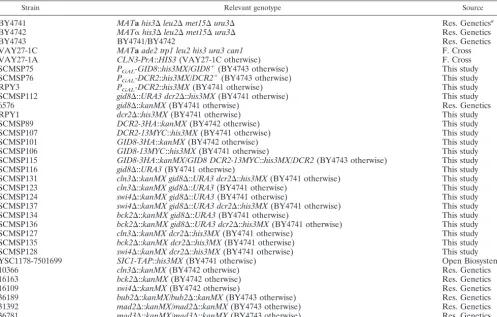
Media, strains, and plasmids.Media were prepared as described by Kaiser et al. (17), with the necessary biosynthetic requirements. All yeast molecular biol-ogy techniques were performed as described by Kaiser et al. (17), unless other-wise indicated. The strains used in this study are listed on Table 1. One-step gene replacements utilizing thehis3MXandkanMXcassettes were done as described by Longtine et al. (19). For other gene replacements,URA3was amplified by PCR with specific oligonucleotide primers carrying at their 5⬘ends sequences that corresponded to flanking chromosomal sequences upstream and down-stream of the open reading frame (ORF) that was replaced. The PCR products generated in this manner were then used directly in integrative transformations. The genotypes of all the strains were verified by PCR as described previously (12). The diploid strain coexpressing Gid8p-hemagglutinin (HA) and Dcr2p-Myc (SCMSP115) was obtained from a cross ofDCR2-HA(SCMSP89) and GID8-MYC(SCMSP106) strains. The Cln3p-PrA strain (VAY27-1A) and its otherwise isogenic untagged counterpart (VAY27-1C) were gifts from F. Cross (7). To generate the strains shown on Fig. 8 and Table 4, we crossed agid8 dcr2strain (SCMSP112) with strains lacking CLN3 (10366), BCK2 (16163), or SWI4
(16109). The resulting diploids were sporulated, and the segregants were ob-tained by random spore analysis and tetrad dissection (17). The phenotypes reported for each strain were obtained after examining several independent transformants or segregants for the strain in question.
TheCLN3-2D
-CEN plasmid p205 (see Fig. 1) and thePGAL-CLN3 low-copy-number plasmid pW16 (see Fig. 2) were gifts from F. Cross (5). The high-copy-number plasmids described in this report were isolated from a yeast genomic DNA library (4) as we previously described (1). Standard molecular biology techniques (28) with reagents from New England Biolabs (Beverly, Mass.) were used to characterize the plasmids isolated from our enrichment procedure (1). The plasmid inserts were sequenced with vector-specific primers from both ends. Sequencing was performed at the Texas A&M University Genome Technologies Laboratory. We then digested the plasmids with the restriction endonucleases indicated in Table 2. The products were gel purified by DNA agarose gel
elec-* Corresponding author. Mailing address: Department of Biochem-istry and Biophysics, Texas A&M University, 2128 TAMU, College Station, TX 77843. Phone: (979) 458-3259. Fax: (979) 845-4946. E-mail: [email protected].
1627
on September 8, 2020 by guest
http://ec.asm.org/
trophoresis to remove the small DNA fragments released from the digestion reac-tion. The purified products were then treated with T4 DNA polymerase to generate blunt ends and religated to produce the plasmid derivatives indicated in Table 2. These plasmid derivatives were then transformed into the BY4743 strain, and the budding indices of the transformants were evaluated (see Table 2).
To construct theDCR2-H338Apoint mutant allele (see Fig. 6), we used two complementary oligonucleotides that encoded the desired H338A substitution:
DCR2-H338A-FWD (5⬘-TTCCGTGGGCAATGGTATGGGGAAATGCCGA CGACGAGGGAAGCTTAACGCGCTGGCAG-3⬘) and DCR2-H338A-REV (5⬘-TGCCAGCGCGTTAAGCTTCCCTCGTCGTCGGCATTTCCCCATACC ATTGCCCACGGAA-3⬘). These were then used in two separate PCRs with plasmid 2-6 (⌬XhoI-SmaI) as the template and primers corresponding to se-quences flanking theDCR2ORF downstream (5⬘-CTGATGTCGCAGGACGA GTC-3⬘; used with theDCR2-H338A-FWD primer) and upstream (5⬘-TAACT TGTATAAAGCTGCGC-3⬘; used with theDCR2-H338A-REV primer). The two PCR products were then purified after agarose gel electrophoresis and used in a third overlap extension PCR (14) with the outside flanking primers. The product of this reaction was isolated and cotransformed into yeast cells together with plasmid 2-6 (⌬XhoI-SmaI), which was previously linearized by KpnI and SacI digestion (cutting at positions⫹34 and⫹712 of theDCR2ORF, respec-tively). The gap-repaired plasmid derivative was then recovered from yeast transformants by standard methods (17). The chromosomal insert spanning
DCR2(DCR2is on chromosome XII from position 849123 to 847387) was then sequenced from position 849643 to 846970 to verify the introduced H338A mutation and the absence of any other mutations. This plasmid was called
DCR2-H338A, and it was used in the experiments shown in Fig. 6 and 7.
Cell synchronization. For the elutriations shown in Fig. 1, the cells were collected at a pump speed of 62 ml/min and rotor speed of 2,400 rpm, by using a Beckman J6 M/E centrifugal elutriator, and cultured in synthetic complete (SC) glucose-containing media at 30°C. For the experiments shown in Fig. 2, the cells were grown and elutriated in SC-raffinose media at a pump speed of 33 ml/min and rotor speed of 2,400 rpm. After elutriation, galactose (at 2%, wt/vol) was used to induce expression of the gene underGALcontrol at time 0, as
indicated in the figure. For the experiments shown in Fig. 4, the cells were cultured in SC glucose-containing media and collected at a pump speed of 40 ml/min and rotor speed of 2,400 rpm.
For the arrest-and-release experiment shown in Fig. 1, the cells were cultured in SC glucose-containing media at 30°C and incubated with nocodazole (Sigma, St. Louis, Mo.) at 15g/ml for 4 h. They were then resuspended in drug-free media, and aliquots of the culture were collected for further analysis.
Budding index, DNA content, cell size, and doubling time measurements.The percentage of budded cells (budding index) was evaluated as described previ-ously (34). DNA content was evaluated by flow cytometry as described previprevi-ously (3). The mean cell volume of live unfixed samples was measured with a Beckman Coulter Z2 Channelyzer. The data were analyzed with the manufacturer’s Ac-cuComp software. The geometric mean is indicated in each case. For population doubling (generation) time measurements we used the Channelyzer to obtain cell numbers (N) at multiple time points (t) during the exponential growth of the culture. From the slope of the line obtained after plotting lnNversust, we got the specific growth rate constant of the culture (k). The culture’s doubling time (g) was then calculated from the formulag⫽ln 2/k.
Other techniques.Immunoprecipitations for HA- and Myc-tagged proteins were performed with kits from Pierce (Rockford, Ill.), according to the manufac-turer’s instructions. For immunoblotting, anti-HA (rabbit polyclonal) and anti-Myc (mouse monoclonal) antibodies were obtained from Abcam (Cambridge, Mass.) and used at a 1:5,000 dilution. The anti-Pgk1p antibody was from Molecular Probes (Eugene, Oreg.) and used at a 1:2,000 dilution. Protein A fusion proteins were detected with the peroxidase-antiperoxidase soluble-complex reagent from Sigma, used at a 1:1,000 dilution. The horseradish peroxidase-conjugated secondary anti-bodies used for immunoblotting were from Abcam, and they were used at a 1:10,000 dilution. The blots were processed with reagents from Pierce.
For fluorescence microscopy, unless otherwise indicated, we followed the protocols of the Botstein laboratory, as described at http://genome-www.stanford .edu/group/botlab/protocols.html/. DAPI (4⬘,6⬘-diamidino-2-phenylindole) was from Molecular Probes. All the secondary antibodies used in
immunofluores-TABLE 1. Strains used in this study
Strain Relevant genotype Source
BY4741 MATahis3⌬leu2⌬met15⌬ura3⌬ Res. Geneticsa
BY4742 MAT␣his3⌬leu2⌬met15⌬ura3⌬ Res. Genetics
BY4743 BY4741/BY4742 Res. Genetics
VAY27-1C MATaade2 trp1 leu2 his3 ura3 can1 F. Cross
VAY27-1A CLN3-PrA::HIS3(VAY27-1C otherwise) F. Cross
SCMSP75 PGAL-GID8::his3MX/GID8⫹(BY4743 otherwise) This study
SCMSP76 PGAL-DCR2::his3MX/DCR2⫹(BY4743 otherwise) This study
RPY3 PGAL-DCR2::his3MX(BY4741 otherwise) This study
SCMSP112 gid8⌬::URA3 dcr2⌬::his3MX(BY4741 otherwise) This study
6576 gid8⌬::kanMX(BY4741 otherwise) Res. Genetics
RPY1 dcr2⌬::his3MX(BY4741 otherwise) This study
SCMSP89 DCR2-3HA::kanMX(BY4742 otherwise) This study
SCMSP107 DCR2-13MYC::his3MX(BY4741 otherwise) This study
SCMSP101 GID8-3HA::kanMX(BY4742 otherwise) This study
SCMSP106 GID8-13MYC::his3MX(BY4741 otherwise) This study
SCMSP115 GID8-3HA::kanMX/GID8 DCR2-13MYC::his3MX/DCR2(BY4743 otherwise) This study
SCMSP116 gid8⌬::URA3(BY4741 otherwise) This study
SCMSP131 cln3⌬::kanMX gid8⌬::URA3 dcr2⌬::his3MX(BY4741 otherwise) This study
SCMSP123 cln3⌬::kanMX gid8⌬::URA3(BY4741 otherwise) This study
SCMSP124 swi4⌬::kanMX gid8⌬::URA3(BY4741 otherwise) This study
SCMSP137 swi4⌬::kanMX gid8⌬::URA3 dcr2⌬::his3MX(BY4741 otherwise) This study
SCMSP134 bck2⌬::kanMX gid8⌬::URA3(BY4741 otherwise) This study
SCMSP136 bck2⌬::kanMX gid8⌬::URA3 dcr2⌬::his3MX(BY4741 otherwise) This study
SCMSP127 cln3⌬::kanMX dcr2⌬::his3MX(BY4741 otherwise) This study
SCMSP135 bck2⌬::kanMX dcr2⌬::his3MX(BY4741 otherwise) This study
SCMSP128 swi4⌬::kanMX dcr2⌬::his3MX(BY4741 otherwise) This study
YSC1178-7501699 SIC1-TAP::his3MX(BY4741 otherwise) Open Biosystems
10366 cln3⌬::kanMX(BY4742 otherwise) Res. Genetics
16163 bck2⌬::kanMX(BY4742 otherwise) Res. Genetics
16109 swi4⌬::kanMX(BY4742 otherwise) Res. Genetics
36189 bub2⌬::kanMX/bub2⌬::kanMX(BY4743 otherwise) Res. Genetics
31392 mad2⌬::kanMX/mad2⌬::kanMX(BY4743 otherwise) Res. Genetics
36781 mad3⌬::kanMX/mad3⌬::kanMX(BY4743 otherwise) Res. Genetics
a
Res. Genetics, Research Genetics.
on September 8, 2020 by guest
http://ec.asm.org/
cence were from Jackson ImmunoResearch (West Grove, Pa.). The samples were examined with a Nikon Eclipse TS100 inverted fluorescence microscope.
For the phosphatase assays reported in Fig. 6, crude cell extracts were mixed with an equal volume of assay buffer containing 200 mM Tris-HCl (pH 7.8), 2 mM MgCl2, 20 mM dithiothreitol, and 40 mM 4-nitrophenylphosphate, prepared fresh each time. The protein concentration of the crude cell extract in the supernatant was determined by the Bradford assay with reagents from Sigma, according to the manufacturer’s instructions. To obtain the enzymatic rates, the absorbance was measured at 405 nm every 5 s for 1 min with a Beckman DU 530 spectrophotometer.
RESULTS
GID8and DCR2alter cell cycle progression when
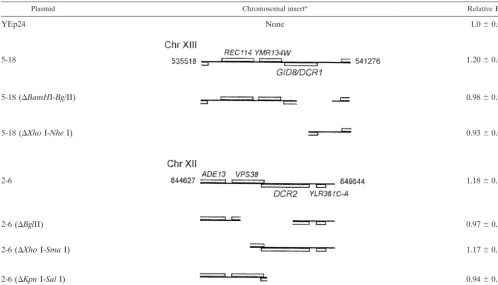
overex-pressed.We identified plasmids 5–18 and 2–6 in a screen for
cell cycle regulators (1). Both plasmids significantly increased the fraction of budded cells (budding index) without altering the overall generation time in asynchronous cultures (Tables 2 and 3). Within the chromosomal insert of plasmid 5–18 there
are the full-length ORFs of REC114, YMR134W, and YMR135C. Plasmid 2–6 carries VPS38, YLR361C, and YLR361C-A.
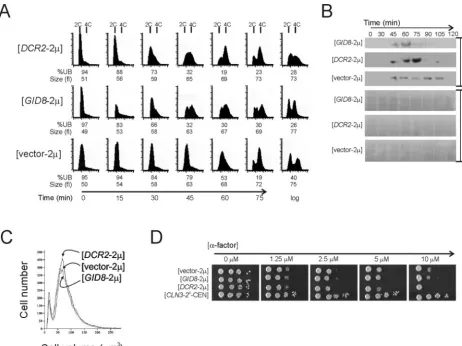
To identify the genes of interest, we disrupted individual ORFs by digestion with restriction endonucleases and religa-tion and, in transformants carrying these plasmid derivatives, we looked for budding index values similar to that for the wild type. Removing a BamHI-BglII fragment from plasmid 5–18, which disrupts onlyYMR135C(Table 2), led to the loss of the high-budding-index phenotype of the cells carrying this plas-mid derivative, implying thatYMR135Cwas the gene of inter-est on plasmid 5–18. Likewise, diginter-estion of plasmid 2–6 with BglII disrupted VPS38 and YLR361C, while digestion with KpnI and SalI disruptedYLR361C-Aand YLR361C. In both cases the plasmid derivatives did not increase the budding index (Table 2), and, since theYLR361CORF was the com-FIG. 1. Gid8p and Dcr2p affect cell cycle progression. (A) Synchronous cultures of BY4743 cells carrying the empty vector-2,GID8-2, or
DCR2-2were obtained by elutriation. At the indicated time points the DNA content was evaluated by flow cytometry. Cell numbers are plotted on theyaxis, and thexaxis indicates fluorescence intensity. Cell cycle progression was also monitored by determining the percentage of unbudded cells (%UB). Cell size was measured with a Channelyzer. (B) Cells carrying the indicated plasmids and a TAP-tagged copy ofSIC1were arrested with nocodazole for 4 h and then released into drug-free fresh SC-glucose-containing media at 30°C. Aliquots of the culture at the indicated times were then processed for immunoblotting against Sic1p fused to the tandem affinity purification (TAP) epitope, as described in Materials and Methods. The blots were also stained with Ponceau S to indicate protein loading. (C) The cell sizes for asynchronous cultures of diploid BY4743 cells in SC-glucose media at 30°C carrying the indicated plasmids are shown. For these samples, the geometric means and standard deviations for vector-2,GID8-2, andDCR2-2transformants were 76⫾2, 74⫾2, and 78⫾2, respectively. (D) Sensitivity to␣-factor of haploid BY4741 cells carrying the indicated plasmids was evaluated by spotting 10-fold serial dilutions of the corresponding cultures on solid media containing increasing concentrations of␣-factor. The plates were incubated at 30°C and photographed after 2 days.
on September 8, 2020 by guest
http://ec.asm.org/
mon ORF disrupted in these two cases, we concluded that it might be the gene of interest. We reserved the namesDCR1 andDCR2(dosage-dependent cell cycle regulators 1 and 2) for YMR135CandYLR361C, respectively, with the Saccharomyces Genome Database, according to their guidelines (http://www .yeastgenome.org/gene_guidelines.shtml). In the meantime, another group implicatedYMR135Cin proteasome-mediated degradation of fructose-1,6-biphosphatase and down regula-tion of gluconeogenesis and named itGID8(27). Hereafter, we refer to plasmids 5–18 and 2–6 as GID8-2 and DCR2-2, respectively. Based on reverse transcription-PCR experiments, cells carrying the high-copy-number plasmids overexpress GID8about 10-fold and overexpressDCR2about 2-fold (data not shown).
Next we examined the effect ofGID8andDCR2
overexpres-sion on cell cycle progresoverexpres-sion in a synchronous population of cells obtained by elutriation (Fig. 1). Cells carryingGID8-2 andDCR2-2had a shorter G1based on budding index and DNA content measurements (Fig. 1A). For example, 45 min after elutriation 79% of wild-type cells were unbudded, com-pared to only 32% of cells overexpressingGID8orDCR2(Fig. 1A).GID8- andDCR2-overexpressing cells also appear to ini-tiate DNA replication at a smaller size than wild-type cells (Fig. 1A; at 30 or 45 min after elutriation). These results suggest that synchronous cultures of cells containingGID8-2 and DCR2-2 complete START faster than wild-type cells, consistent with results obtained from asynchronous popula-tions of cells where overexpression of these genes increased the budding index (Table 2 and results below).
We also monitored the levels of the Cdk inhibitor Sic1p in cultures released from a nocodazole arrest (Fig. 1B). In cells carryingGID8orDCR2on a high-copy-number plasmid, Sic1p disappeared sooner (⬃15 min), indicative of a shortened G1 phase (Fig. 1B). Finally, asynchronous populations ofGID8 -and DCR2-overexpressing cells were neither smaller overall nor pheromone resistant (Fig. 1C and D), in contrast toCLN3 -overexpressing cells, which are smaller and resistant to pher-omone (6, 22).
Gid8p and Dcr2p affect cell cycle progression by regulating
START.GID8andDCR2 overexpression may alter cell cycle
progression either by directly shortening the G1phase, which leads to a high budding index due to a compensatory expansion of subsequent cell cycle phases, or by simply delaying mitotic progression (34). A mitotic delay can lead to a shorter G1 phase in the next cell cycle, presumably because it allows the cells to grow and reach the critical size for initiation in the next division faster. This is usually accompanied by an increase in the doubling time and cell size of the culture (20), as we have recently shown forSIK1overexpression (1), which we identi-fied in the same screen that yieldedGID8and DCR2. How-ever, GID8- and DCR2-overexpressing cells were not larger than wild-type cells (Fig. 1A and C), and they proliferated at the same rate as wild-type cells (94⫾3, 91⫾1, and 95⫾3 min for vector-2,GID8-2, andDCR2-2transformants, respec-tively, at 30°C in SC-glucose media).
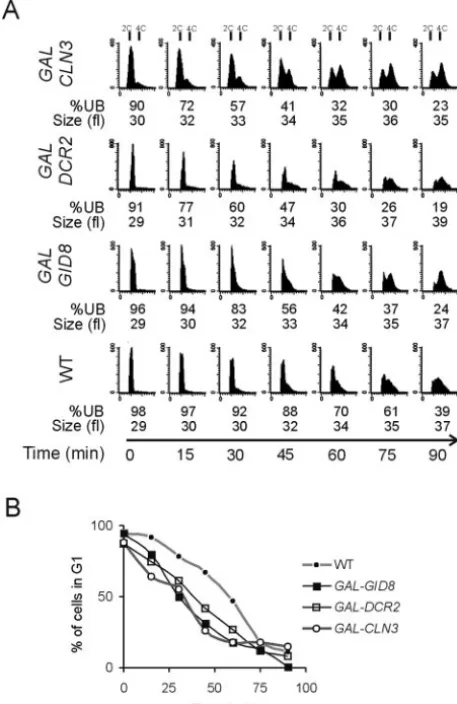
We then used heterozygous diploid cells where one copy of GID8orDCR2was under the control of a galactose-inducible promoter while the other was under the control of its native promoter. The cells were grown in raffinose-containing media before elutriation so that gene overexpression was not induced. Postelutriation, the cells were shifted to galactose-containing media to induce theGALpromoter and overexpress the gene of interest. Budding index as well as flow cytometry data indi-cated that, in the presence of galactose, the transition from the G1to S phase was accelerated inPGAL-GID8andPGAL-DCR2
strains (Fig. 2). The results obtained were similar to those whenCLN3was overexpressed in the same way, in cells car-rying a low-copy-numberPGAL-CLN3plasmid (Fig. 2). Thus,
we conclude that Gid8p and Dcr2p most likely affect cell cycle progression by regulating the completion of START.
IfGID8orDCR2overexpression somehow adversely affects progression through mitosis, this might become apparent in cells lacking checkpoint genes (1). In that case, checkpoint mutant cells may not be able to properly delay cell cycle pro-gression when GID8or DCR2 is overexpressed, with poten-FIG. 2. Overexpression ofGID8andDCR2accelerates completion of
START. (A) Wild-type diploid cells (WT), heterozygous for PGAL
-GID8⫹/GID8⫹ (GAL-GID8) or PGAL-DCR2⫹/DCR2 (GAL-DCR2) or
carrying aPGAL-CLN3-CEN plasmid (GAL-CLN3), were grown and
elu-triated in raffinose-containing media to obtain a synchronous early G1
population of cells in each case. Galactose was then added, and progres-sion through the cell cycle was evaluated as for Fig. 1. All the strains were in the BY4743 background. (B) The percentages of cells in G1from the
flow cytometry panels in panel A were calculated from the DNA histo-grams with the ModFit software (Verity Software House, Topsham, Maine).
on September 8, 2020 by guest
http://ec.asm.org/
tially catastrophic consequences. Bub2p and Mad2,3p are in-volved in mitotic spindle checkpoint activation by two independent partially redundant pathways, in response to mis-takes in spindle alignment (10, 18). However,GID8orDCR2
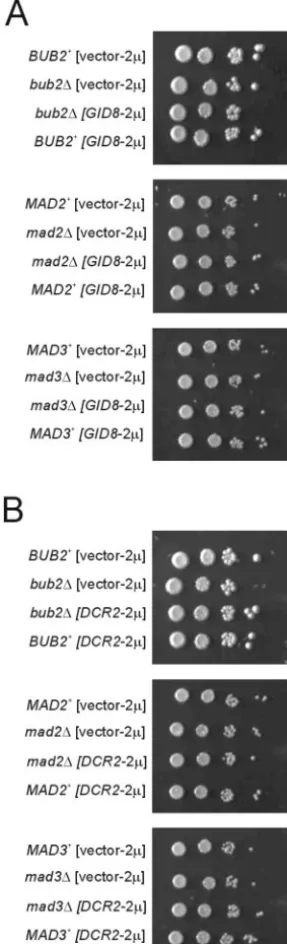
overexpression did not alter the viability ofbub2⌬,mad2⌬, or mad3⌬mutants (Fig. 3).
Although deletion ofGID8andDCR2, separately or in com-bination, had no effect on the budding index or the doubling time of the cells (Tables 3 and 4), we also examined cell cycle progression of the resulting loss-of-function mutants in syn-chronous cultures obtained by elutriation (Fig. 4). Combined loss ofGID8 and DCR2 led to a small but significant delay (⬃15 min) in the timing of initiation of DNA replication. These cells were also 10 to 15% larger than wild-type cells (Table 4). Loss ofDCR2 did not significantly delay START, but cells lackingGID8were delayed almost to the same extent as doublegid8⌬dcr2⌬cells.
Overall, all our data thus far suggest thatGID8andDCR2 have a positive role in G1and the timing of START.
Gid8p and Dcr2p functionally interact to regulate the G1/S
transition. We next examined if the GID8 and DCR2 gene
products may function in a common pathway to regulate the completion of START. We overexpressed one gene product in the absence of the other to see if it resulted in the loss of the high-budding-index phenotype associated with the overexpres-sion of the former gene product. Note that overexpresoverexpres-sion of Gid8p does not affect Dcr2p levels and vice versa (see Fig. 7). Interestingly, overexpression ofGID8did not increase the bud-ding index of dcr2⌬ cells (Table 3), indicating that Gid8p requires the function of Dcr2p to accelerate the G1/S transi-TABLE 2. Schematic representation of plasmids and their derivativesa
Plasmid Chromosomal inserta Relative Blb
YEp24 None 1.0⫾0.08
5-18 1.20⫾0.07
5-18 (⌬BamHI-Bg/II) 0.98⫾0.07
5-18 (⌬XhoI-NheI) 0.93⫾0.09
2-6 1.18⫾0.15
2-6 (⌬BglII) 0.97⫾0.15
2-6 (⌬XhoI-SmaI) 1.17⫾0.12
2-6 (⌬KpnI-SalI) 0.94⫾0.10
aGenomic fragment present in each plasmid. The ORF within each insert is drawn to scale, but the scale is not the same between different inserts. Translation from
the “Watson” (or “Crick”) strand is indicated by the placement of the ORF above (or below) the line that denotes the chromosomal insert. The number of the chromosome from which the insert is derived is indicated. The numbers on either sides of the full insert denote their respective chromosomal positions.
bThe relative budding index (BI) associated with each plasmid with respect to that for the empty vector. All the measurements were performed in SC-glucose media
at 30°C. The average and standard deviation from at least 18 different transformants (all in the BY4743 background) in each case are shown.
TABLE 3. Genetic interactions betweenGID8andDCR2
Straina Budding index (n; P)b
GID8⫹DCR2⫹(vector-2) ... 1⫾0.12 (19; 1)
GID8⫹DCR2⫹(GID8-2) ... 1.29⫾0.10 (18; 3⫻10⫺10)
GID8⫹DCR2⫹(DCR2-2) ... 1.14⫾0.12 (20; 5⫻10⫺4)
GID8⫹dcr2⌬(GID8-2) ... 1.05⫾0.09 (18; 0.1)
gid8⌬DCR2⫹(DCR2-2) ... 1.11⫾0.07 (19; 1⫻10⫺3)
gid8⌬DCR2⫹(vector-2) ... 1.03⫾0.12 (20; 0.5)
GID8⫹dcr2⌬(vector-2)... 1.02⫾0.08 (19; 0.5)
gid8⌬dcr2⌬(vector-2) ... 1.01⫾0.1 (32; 0.8)
GID8⫹DCR2⫹(vector-2)* ... 1⫾0.05 (30)
GID8⫹DCR2⫹(GID8-2)* ... 1.17⫾0.05 (30; 7⫻10⫺11)
GID8⫹PGAL-DCR2(vector-2)*... 1.23⫾0.10 (30; 8⫻10⫺9)
GID8⫹PGAL-DCR2(GID8-2)*... 1.22⫾0.08 (30; 3⫻10⫺10) aThe cells (all in the BY4741 background) were grown in SC media, at 30°C,
with glucose or galactose (*) as the carbon source. In these growth conditions, the generation times of all strains were indistinguishable from those of the wild type (94⫾3 min in glucose-containing media and 165⫾5 min in galactose-containing media).
bThe mean and standard deviation of the relative budding index, compared to
those for the wild type, are shown in each case. The numbers of individual cultures evaluated (n) and the probabilities associated with Student’sttest when the budding indices are compared to that for the wild type are shown in paren-theses.
on September 8, 2020 by guest
http://ec.asm.org/
tion. In contrast, Dcr2p does not depend on Gid8p to regulate START, sincegid8⌬cells containing theDCR2-2plasmid still had a higher budding index than wild-type cells (Table 3). Simultaneous overexpression of both genes, by introducing the GID8-2plasmid inPGAL-DCR2 cells and then growing the
cells in the presence of galactose, did not produce an additive effect (Table 3). Similar results (see Fig. 6) were also observed whenGID8was galactose induced andDCR2was on a high-copy-number plasmid. The simplest interpretation of our data
is that, to some extent, Gid8p may function in the same path-way with and upstream of Dcr2p to accelerate the G1/S tran-sition. This conclusion is further supported by additional ex-periments that we describe below, based again on budding index measurements (see Fig. 6). However, from the cell cycle profiles (Fig. 4) and additional experiments we describe below (see Fig. 8), combined loss of Gid8p and Dcr2p had the stron-gest phenotypic consequences, arguing against an exclusive linear pathway for these two gene products.
Subcellular localization of Dcr2p. Localization data for
Gid8p are available from a genome-wide database (15) (Gid8p was present in both the nucleus and the cytoplasm), but there is no record for Dcr2p’s subcellular localization in any data-base. Consequently, we epitope tagged Gid8p and Dcr2p with HA and c-Myc epitope tags (19). In both cases proteins of the expected size were detected from cell extracts after immuno-precipitations and immunoblotting with anti-HA and anti-Myc antibodies (Fig. 5). Cells carrying the epitope-tagged proteins were indistinguishable from the wild type, based on generation time, cell size, and budding index measurements (data not shown). Overexpression ofGID8in strains carrying a epitope-taggedDCR2allele still increased the budding index (data not shown). Since Gid8p requires the presence of functional Dcr2p (Table 3), the epitope-tagged Dcr2p probably retains function. Based on the granular staining pattern by immunofluorescence of the HA- or Myc-tagged Gid8p or Dcr2p, we conclude that Gid8p and Dcr2p are present in distinct foci throughout the cell (Fig. 5). Similar results were obtained with a strain carrying a green fluorescent protein-tagged DCR2 allele (data not shown). Despite the similar staining patterns obtained in cells carrying either Gid8p or Dcr2p fusion proteins, in cells coex-pressing both there was no evidence of colocalization (Fig. 5C). Attempts to coimmunoprecipitate Gid8p and Dcr2p from these cells were also unsuccessful (data not shown).
DCR2-H338Aantagonizes wild-typeDCR2.TheDCR2ORF is predicted to encode a 578-amino-acid protein of 66,463 Da. Motif searches suggested that Dcr2p may belong to a family of calcineurin-like metal-containing phosphoesterases (Evalue⫽ 1e⫺5, from CDART [11]), which includes protein phospho-serine phosphatases, nucleotidases, nucleases, sphingomyelin FIG. 3. Overexpression ofGID8(A) orDCR2(B) does not affect
the viability of cells lacking mitotic checkpoint genes. Growth of
bub2⌬/bub2⌬, mad2⌬/mad2⌬, and mad3⌬/mad3⌬ strains (all in the BY4743 background) carrying the indicated plasmids was evaluated by spotting 10-fold serial dilutions of the cultures on solid media. The plates were incubated at 30°C and photographed after 2 days.
TABLE 4. Proliferation parameters ofCLN3,BCK2,SWI4,GID8, andDCR2mutantsa
Strain gb Cell size
(m3)
WTc 1⫾0.02 36.6⫾1.6
gid8⌬ 1.01⫾0.01 37.1⫾1.6
dcr2⌬ 1.01⫾0.02 37.0⫾1.6
gid8⌬dcr2⌬ 1⫾0.03 42.0⫾1.6
bck2⌬ 1⫾0.02 45.6⫾1.7
bck2⌬gid8⌬dcr2⌬ 1⫾0.02 49.5⫾1.7
cln3⌬ 1.05⫾0.03 49.2⫾1.7
cln3⌬gid8⌬dcr2⌬ 1.05⫾0.02 54.3⫾1.8
swi4⌬ 1.08⫾0.01 48.4⫾1.7
swi4⌬gid8⌬dcr2⌬ 1.07⫾0.01 56.8⫾1.9
a
Cell numbers and cell sizes were obtained with a Coulter counter as de-scribed in Materials and Methods. The average and standard deviation from three independent liquid cultures in rich yeast extract-peptone-dextrose media are shown in each case. All the strains were in the haploid BY4741 background.
b
The generation times (g) of the strains shown are relative to that of wild type, which was 94⫾1.9 min.
c
WT, wild type.
on September 8, 2020 by guest
http://ec.asm.org/
phosphodiesterases, and 2⬘-3⬘ cyclic AMP phosphodiesterases. Within the conserved␣␣phosphoesterase structure there are sequence “signatures” common to these proteins. Among them is a GNHD/E sequence motif, thought to be important for the hydrolysis of phosphate esters in the active-site dinuclear metal center (36). Mutational analysis suggested that the His of the GNHD motif probably affects catalysis but not substrate binding inSer/Thr phosphatase and calcineurin (21, 36).
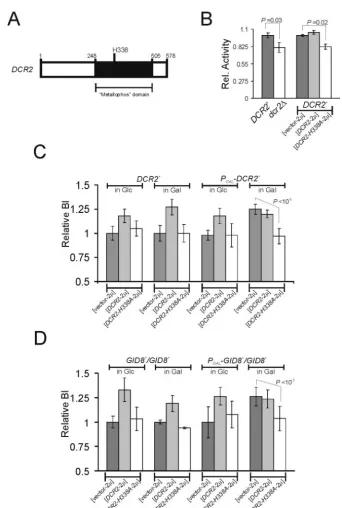
To test the possibility that Dcr2p may function as a phos-phoesterase, we introduced an H338A mutation in the GNHD
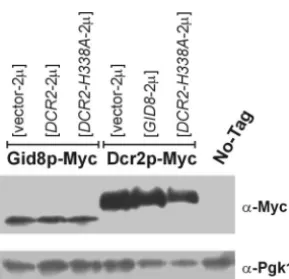
motif of Dcr2p (Fig. 6A). The presence of thisDCR2-H338A allele does not alter the endogenous levels of Dcr2p or Gid8p (Fig. 7). In phosphatase assays with 4-nitrophenylphosphate as a substrate, crude extracts from cells lackingDCR2or carrying theDCR2-H338Aallele had significantly lower (⬃20%) phos-phatase activity than extracts from wild-type cells (Fig. 6B). However, in the same assays extracts from cells overexpressing DCR2 had only minimally increased (⬃5%) phosphatase ac-tivity (Fig. 6B). This could be due to the high background of this crude assay.
FIG. 4. Loss ofGID8andDCR2delays completion of START. (A) Wild-type (WT) haploid cells andgid8⌬,dcr2⌬, andgid8⌬dcr2⌬cells were grown and elutriated in SC-glucose-containing media. All the strains were in the BY4741 background. At the indicated time points the DNA content was evaluated by flow cytometry. Cell numbers are plotted on theyaxis, and thexaxis indicates fluorescence. Cell size was measured with a Channelyzer. The percentage of G1cells was calculated from the DNA histograms with ModFit software (Verity Software House). (B) Cell cycle
progression was also monitored by determining the percentage of budded cells, from the samples shown in panel A.
on September 8, 2020 by guest
http://ec.asm.org/
We then examined the ability of theDCR2-H338Aallele to interfere with the two phenotypic attributes of the wild-type DCR2: first, overexpression of DCR2 increases the budding index; second,DCR2is necessary for GID8overexpression to increase the budding index. However, in cells carrying DCR2-H338A, overexpression of wild-typeDCR2 (Fig. 6B) or GID8 (Fig. 6C) did not increase the budding index. Therefore,DCR2-H338Ais an antimorph or dominant neg-ative, presumably because it encodes a mutant protein ca-pable of antagonizing the wild-type DCR2 gene product. These results are consistent with a putative role for Dcr2p as a phosphoesterase.
Functional interactions with other START regulators.Cells
carrying GID8or DCR2 high-copy-number plasmids do not have altered Cln3p levels (Fig. 8A), consistent with the fact that, for these cells, size and resistance to pheromone are similar to those for wild-type cells (Fig. 1). We then overex-pressedGID8andDCR2in cells lackingCLN3. Interestingly, in the absence of CLN3 GID8-2 and DCR2-2 did not in-crease the budding index, suggesting that Gid8p and Dcr2p may regulate cell cycle progression via Cln3p (Fig. 8B). Thus, a role for Gid8p and Dcr2p in G1might require Cln3p, but it does not lead to higher Cln3p levels.
We then deletedGID8and/orDCR2in cells lackingCLN3, BCK2, orSWI4. Bck2p activates START in a
Cln3p-indepen-dent manner (33), while Swi4p is a G1/S transcription factor (2). Cells lackingCLN3,BCK2, orSWI4proliferate at almost the same rate as wild-type cells in rich media, but these mu-tants are larger than wild-type cells (Table 4). Interestingly, mutants with deletions ofCLN3, BCK2, or SWI4as well as GID8andDCR2were even larger (Table 4). The growth rate of the triple mutants was similar to those of cells with a single CLN3,BCK2, orSWI4deletion in rich liquid (Table 4) or solid (Fig. 8C) media. Surprisingly, in the presence of high salt concentrations there were clear effects, with the triplecln3⌬ gid8⌬ dcr2⌬ and swi4⌬ gid8⌬ dcr2⌬ mutants growing very poorly (Fig. 8C). Cells with double mutations in GID8 or DCR2 and CLN3 orSWI4 proliferated normally, suggesting thatGID8and DCR2might have synergistic functions under these conditions. Slightly poorer growth was also evident in bck2⌬gid8⌬dcr2⌬cells, but the effect was not as pronounced (Fig. 8C). Therefore, Gid8p and Dcr2p are required for normal rates of cell proliferation under high salt concentrations and in the absence of Cln3p or Swi4p.
DISCUSSION
In this study we have shown that Gid8p and Dcr2p affect cell cycle progression by regulating the completion of START. We discuss these findings in the general context of START control. FIG. 5. Subcellular localization of Gid8p and Dcr2p. (A and B, top) Immunoblots showing HA- or Myc-tagged Gid8p and Dcr2p, immuno-precipitated from cell extracts of the corresponding strains. (Bottom) Cells carrying a single epitope-tagged copy of the product ofGID8orDCR2, expressed from its native chromosomal location, or untagged controls (BY4742 for the HA-tagged strains or BY4741 for the Myc-tagged strains) were photographed through phase optics (left) and by fluorescence microscopy. The nuclei (middle) were visualized by DAPI staining. Epitope-tagged Gid8p or Dcr2p (right) were visualized by immunofluorescence. (C) Cells coexpressing Gid8p-HA and Dcr2p-Myc were processed as described for panels A and B and compared to the untagged control strain (BY4743). The merged colored image was produced by false coloring the Gid8p-HA image green and the Dcr2p-Myc image red.
on September 8, 2020 by guest
http://ec.asm.org/
Why haveGID8andDCR2not been previously identified in various screens for START regulators? SinceGID8andDCR2 are not essential, they were not targeted by the classic cdc mutant screen done by Hartwell and colleagues, which focused on essential genes (13). Cells overexpressingGID8andDCR2
seem to initiate START at a smaller size than wild-type cells (Fig. 1A and 2A), similar toCLN3-overexpressing cells (Fig. 2A). However, unlike overexpression ofCLN3, overexpression of GID8 or DCR2 does not change the overall size of the population (Fig. 1C), probably because these cells continue FIG. 6. Dcr2p might function as a phosphoesterase. (A)DCR2is predicted to encode a polypeptide with a metallophosphoesterase (metallophos) domain. Numbers indicate amino acid positions of the predicted Dcr2p polypeptide. (B) Relative phosphatase specific activity from crude cell extracts (means⫾standard deviations;nⱖ3) from haploid cells. Where indicated, the strains were transformed with a high-copy-number plasmid carryingDCR2
(DCR2-2,DCR2-H338A(DCR2-H338A-2), or the empty high-copy-number vector (vector-2). (C) Relative budding indices (BI) ofDCR2⫹and
PGAL-DCR2⫹cells (in the BY4741 background) carrying the indicated plasmids. The averages and standard deviations from at least eight independent
transformants in each case are indicated. (D) Relative budding indices ofGID8⫹/GID8⫹andPGAL-GID8⫹/GID8⫹cells (in the BY4743 background)
carrying the indicated plasmids. The averages and standard deviations from at least eight independent transformants in each case are indicated.
on September 8, 2020 by guest
http://ec.asm.org/
growing to the same size as wild-type cells in subsequent phases of the cell cycle after START completion. They also retain sensitivity to the antimitogenic properties of pheromone (Fig. 1D). Consequently, they would have been missed by pre-vious approaches that relied on overall changes in cell size or resistance to pheromone for the identification of START reg-ulators (6, 8, 16, 24, 26, 30, 35). These properties ofGID8and DCR2mutants are important because they suggest that the list of START regulators may be larger than previously thought.
At this point, we can only speculate about the possible role(s) ofGID8and DCR2in START control. NeitherGID8 norDCR2mRNA levels are cell cycle regulated (29). Gid8p is predicted to contain LisH and CTLH domains (27). These domains have been previously associated with cytoskeletal functions (9). Recently, the mammalian cyclin E/Cdk2 sub-strate p220 (NPAT) was shown to regulate G1/S histone tran-scription through its LisH domain (32). It is important, how-ever, that no clear function can be deduced from the presence FIG. 7. Steady state levels of Myc-tagged Gid8p and Dcr2p in cells
carrying the indicated high-copy-number plasmids or the untagged control strain are shown on an immunoblot produced with an anti-Myc antibody. The corresponding levels of Pgk1p are shown as a loading control. All the cells were in the haploid BY4741 background.
FIG. 8. Functional interactions with other START regulators. (A) The steady-state levels of Cln3p-PrA are shown on an immunoblot, from cells carrying the indicated plasmids (in the VAY27-1A background) and the untagged control strain (VAY27-1C). The corresponding levels of Pgk1p are shown as a loading control. (B) Relative budding indices (BI) ofCLN3⫹/CLN3⫹andcln3⌬/cln3⌬cells (in the BY4743) background) carrying the indicated plasmids. The averages and standard deviations from at least eight independent transformants in each case are shown. The probability associated with a Student’sttest when the indicated samples were compared is shown. (C) Growth of the indicated strains was evaluated by spotting 10-fold serial dilutions of the cultures on solid rich media (yeast extract-peptone-dextrose [YPD]). The plates were incubated at 30°C and photographed after 2 (YPD) or 4 to 5 (YPD plus 1.2 M NaCl) days.
on September 8, 2020 by guest
http://ec.asm.org/
of these domains. Gid8p does not appear to colocalize with the cytoskeleton based on genome-wide localization data (15) and our own observations (Fig. 5). It was also recently suggested that Gid8p is involved in proteasome-mediated catabolite deg-radation of fructose-1,6-biphosphatase when cells are trans-ferred from a nonfermentable carbon source to glucose (27). However, since all our experiments did not involve such media changes and since the GID8 overexpression phenotype was evident in steady-state conditions in glucose-rich media, it is unclear what role (if any) this activity might play in the regu-lation of START.
Based on genetic evidence, Gid8p and Dcr2p may function through a common pathway, with Dcr2p being downstream of Gid8p (Table 3 and Fig. 6), to positively control the timing of START. It is also clear that Gid8p’s effects on overall cell proliferation may not solely depend on the presence of Dcr2p, because their combined loss produces more-severe cell size (Table 4) and viability phenotypes in the context of other cell cycle mutations (Fig. 8). The cell size enlargement whenGID8 andDCR2were both deleted was additive to that due toCLN3, BCK2, orSWI4deletions (Table 4). Combined loss ofGID8, DCR2, andSWI4orCLN3severely affects overall cell prolif-eration in high-salt conditions (Fig. 8C). The increase in the budding index of cells carrying GID8 or DCR2 high-copy-number plasmids appears to require the presence of CLN3 (Fig. 8B). Nonetheless, the synthetic effects observed in the plate growth assays on high salt suggest that Gid8p and Dcr2p may also have synergistic functions with Cln3p and Swi4p un-der these conditions.
The “output” of the Gid8p/Dcr2p pathway will likely involve some type of phospho-ester hydrolysis, since our data strongly point to a phosphoesterase activity of Dcr2p (Fig. 6). This activity could be directed to any one of several types of sub-strates (for example lipids, nucleic acids, and proteins). It will be an important goal of future studies to identify the sub-strate(s) of Dcr2p as well as any other factor(s) that impinges on Gid8p/Dcr2p and that is physiologically relevant for cell cycle progression. Overall, our data point to an important role for Gid8p and Dcr2p in the timing of START, and a better understanding of their function(s) at the molecular level will contribute to our understanding of the G1/S transition.
ACKNOWLEDGMENTS
We thank J. Miller for flow cytometry, A. Dhasarathy for help with tetrad dissections, and F. Cross for plasmids and strains.
This work was supported by a grant from the National Institutes of Health (R01-GM062377) to M.P.
REFERENCES
1.Bogomolnaya, L. M., R. Pathak, R. Cham, J. Guo, Y. V. Surovtseva, L. Jaeckel, and M. Polymenis.2004. A new enrichment approach identifies genes that alter cell cycle progression inSaccharomyces cerevisiae. Curr. Genet.45:350–359.
2.Breeden, L.1996. Start-specific transcription in yeast. Curr. Top. Microbiol. Immunol.208:95–127.
3.Bryan, B. A., E. McGrew, Y. Lu, and M. Polymenis.2004. Evidence for control of nitrogen metabolism by a START-dependent mechanism in Sac-charomyces cerevisiae. Mol. Genet. Genom.271:72–81.
4.Carlson, M., and D. Botstein.1982. Two differentially regulated mRNAs with different 5⬘ends encode secreted with intracellular forms of yeast invertase. Cell28:145–154.
5.Cross, F. R. 1990. Cell cycle arrest caused byCLN gene deficiency in
Saccharomyces cerevisiaeresembles START-I arrest and is independent of the mating pheromone signalling pathway. Mol. Cell. Biol.10:6482–6490.
6.Cross, F. R.1988.DAF1, a mutant gene affecting size control, pheromone arrest, and cell cycle kinetics ofSaccharomyces cerevisiae. Mol. Cell. Biol.
8:4675–4684.
7.Cross, F. R., V. Archambault, M. Miller, and M. Klovstad.2002. Testing a mathematical model of the yeast cell cycle. Mol. Biol. Cell13:52–70. 8.Edwards, M. C., N. Liegeois, J. Horecka, R. A. DePinho, G. F. J. Sprague, M.
Tyers, and S. J. Elledge.1997. HumanCPR(cell cycle progression restora-tion) genes impart a Far⫺phenotype on yeast cells. Genetics147:1063–1076. 9.Emes, R. D., and C. P. Ponting.2001. A new sequence motif linking lissen-cephaly, Treacher Collins and oral-facial-digital type 1 syndromes, microtu-bule dynamics and cell migration. Hum. Mol. Genet.10:2813–2820. 10.Fraschini, R., E. Formenti, G. Lucchini, and S. Piatti.1999. Budding yeast
Bub2 is localized at spindle pole bodies and activates the mitotic checkpoint via a different pathway from Mad2. J. Cell Biol.145:979–991.
11.Geer, L. Y., M. Domrachev, D. J. Lipman, and S. H. Bryant.2002. CDART: protein homology by domain architecture. Genome Res.12:1619–1623. 12.Giaever, G., A. M. Chu, L. Ni, C. Connelly, L. Riles, S. Veronneau, S. Dow,
A. Lucau-Danila, K. Anderson, B. Andre, A. P. Arkin, A. Astromoff, M. El Bakkoury, R. Bangham, R. Benito, S. Brachat, S. Campanaro, M. Curtiss, K. Davis, A. Deutschbauer, K. D. Entian, P. Flaherty, F. Foury, D. J. Garfinkel, M. Gerstein, D. Gotte, U. Guldener, J. H. Hegemann, S. Hempel, Z. Herman, D. F. Jaramillo, D. E. Kelly, S. L. Kelly, P. Kotter, D. LaBonte, D. C. Lamb, N. Lan, H. Liang, H. Liao, L. Liu, C. Luo, M. Lussier, R. Mao, P. Menard, S. L. Ooi, J. L. Revuelta, C. J. Roberts, M. Rose, P. Ross-Macdonald, B. Scherens, G. Schimmack, B. Shafer, D. D. Shoemaker, S. Sookhai-Mahadeo, R. K. Storms, J. N. Strathern, G. Valle, M. Voet, G. Volckaert, C. Y. Wang, T. R. Ward, J. Wilhelmy, E. A. Winzeler, Y. Yang, G. Yen, E. Youngman, K. Yu, H. Bussey, J. D. Boeke, M. Snyder, P. Philippsen, R. W. Davis, and M. Johnston. 2002. Functional profiling of theSaccharomyces cerevisiae ge-nome. Nature418:387–391.
13.Hartwell, L. H., J. Culotti, J. R. Pringle, and B. J. Reid.1974. Genetic control of the cell division cycle in yeast. Science183:46–51.
14.Ho, S. N., H. D. Hunt, R. M. Horton, J. K. Pullen, and L. R. Pease.1989. Site-directed mutagenesis by overlap extension using the polymerase chain reaction. Gene77:51–59.
15.Huh, W. K., J. V. Falvo, L. C. Gerke, A. S. Carroll, R. W. Howson, J. S. Weissman, and E. K. O’Shea.2003. Global analysis of protein localization in budding yeast. Nature425:686–691.
16.Jorgensen, P., J. L. Nishikawa, B. J. Breitkreutz, and M. Tyers.2002. Sys-tematic identification of pathways that couple cell growth and division in yeast. Science297:395–400.
17.Kaiser, C., S. Michaelis, and A. Mitchell.1994. Methods in yeast genetics. Cold Spring Harbor Laboratory Press, Cold Spring Harbor, N.Y. 18.Lew, D. J., and D. J. Burke.2003. The spindle assembly and spindle position
checkpoints. Annu. Rev. Genet.37:251–282.
19.Longtine, M. S., A. McKenzie III, D. J. Demarini, N. G. Shah, A. Wach, A. Brachat, P. Philippsen, and J. R. Pringle.1998. Additional modules for versatile and economical PCR-based gene deletion and modification in Sac-charomyces cerevisiae. Yeast14:953–961.
20.Lord, P. G., and A. E. Wheals.1983. Rate of cell cycle initiation of yeast cells when cell size is not a rate-determining factor. J. Cell Sci.59:183–201. 21.Mertz, P., L. Yu, R. Sikkink, and F. Rusnak.1997. Kinetic and spectroscopic
analyses of mutants of a conserved histidine in the metallophosphatases calcineurin and lambda protein phosphatase. J. Biol. Chem. 272:21296– 21302.
22.Nash, R., G. Tokiwa, S. Anand, K. Erickson, and A. B. Futcher.1988. The
WHI1⫹gene ofSaccharomyces cerevisiaetethers cell division to cell size and is a cyclin homolog. EMBO J.7:4335–4346.
23.Polymenis, M., and E. V. Schmidt.1999. Coordination of cell growth with cell division. Curr. Opin. Genet. Dev.9:76–80.
24.Prendergast, J. A., L. E. Murray, A. Rowley, D. R. Carruthers, R. A. Singer, and G. C. Johnston.1990. Size selection identifies new genes that regulate
Saccharomyces cerevisiaecell proliferation. Genetics124:81–90.
25.Pringle, J. R., and L. H. Hartwell.1981. TheSaccharomyces cerevisiaecell cycle, p. 97–142.InJ. D. Strathern, E. W. Jones, and J. R. Broach (ed.), The molecular biology of the yeastSaccharomyces. Cold Spring Harbor Labora-tory Press, Cold Spring Harbor, N.Y.
26.Reed, S. I.1980. The selection ofS. cerevisiaemutants defective in the start event of cell division. Genetics95:561–577.
27.Regelmann, J., T. Schule, F. S. Josupeit, J. Horak, M. Rose, K. D. Entian, M. Thumm, and D. H. Wolf. 2003. Catabolite degradation of fructose-1,6-bisphosphatase in the yeastSaccharomyces cerevisiae: a genome-wide screen identifies eight novelGIDgenes and indicates the existence of two degra-dation pathways. Mol. Biol. Cell14:1652–1663.
28.Sambrook, J., E. F. Fritsch, and T. Maniatis.1989. Molecular cloning: a laboratory manual, 2nd ed. Cold Spring Harbor Laboratory Press, Cold Spring Harbor, N.Y.
29.Spellman, P. T., G. Sherlock, M. Q. Zhang, V. R. Iyer, K. Anders, M. B. Eisen, P. O. Brown, D. Botstein, and B. Futcher. 1998. Comprehensive identification of cell cycle-regulated genes of the yeastSaccharomyces cer-evisiaeby microarray hybridization. Mol. Biol. Cell.9:3273–3297.
on September 8, 2020 by guest
http://ec.asm.org/
30.Sudbery, P. E., A. R. Goodey, and B. L. Carter.1980. Genes which control cell proliferation in the yeastSaccharomyces cerevisiae. Nature288:401–404. 31.Toone, W. M., B. L. Aerne, B. A. Morgan, and L. H. Johnston.1997. Getting started: regulating the initiation of DNA replication in yeast. Annu. Rev. Microbiol.51:125–149.
32.Wei, Y., J. Jin, and J. W. Harper.2003. The cyclin E/Cdk2 substrate and Cajal body component p220NPATactivates histone transcription through a novel LisH-like domain. Mol. Cell. Biol.23:3669–3680.
33.Wijnen, H., and B. Futcher.1999. Genetic analysis of the shared role of CLN3 and BCK2 at the G1-S transition inSaccharomyces cerevisiae. Genetics
153:1131–1143.
34.Zettel, M. F., L. R. Garza, A. M. Cass, R. A. Myhre, L. A. Haizlip, S. N. Osadebe, D. W. Sudimack, R. Pathak, T. L. Stone, and M. Polymenis.2003. The budding index ofSaccharomyces cerevisiaedeletion strains identifies genes important for cell cycle progression. FEMS Microbiol. Lett.223:253– 258.
35.Zhang, J., C. Schneider, L. Ottmers, R. Rodriguez, A. Day, J. Markwardt, and B. L. Schneider.2002. Genomic scale mutant hunt identifies cell size homeostasis genes inS. cerevisiae. Curr. Biol.12:1992–2001.
36.Zhuo, S., J. C. Clemens, R. L. Stone, and J. E. Dixon.1994. Mutational analysis of a Ser/Thr phosphatase. Identification of residues important in phosphoester-ase substrate binding and catalysis. J. Biol. Chem.269:26234–26238.