Iran J Public Health, Vol. 45, No.12, Dec 2016, pp.1595-1603
Original Article
Reliability and Validity of a Chinese Version of the Stroke Action Test: A
New Instrument for Assessment of Stroke Knowledge and Response
Mei HA
1, Xiaoling QIAN
2, Hong YANG
1, Jichun HUANG
1, *Changjiang LIU
31. School of Nursing, Chongqing Medical and Pharmaceutical College, Chongqing 400020, PR China 2. The Second Hospital of Lanzhou University, Lanzhou, PR China
3. Key Lab of Birth Defects and Reproductive Health of National Health and Family Planning Commission, Chongqing Population and Family Planning Science and Technology Research Institute, Chongqing 400020, PR China
*Corresponding Author: Email: [email protected]
(Received 22 Feb 2016; accepted 09 Jul 2016)
Introduction
According to the China Stroke Conference 2014, stroke is the first leading cause of death in China, with an increasing rate of 8.1% annually. Stroke threatens the development of economy, public health, and harmony of families for its high mor-tality, disability and recurrence. China bears the biggest burden of stroke in the world, and the rapidly aging population has further raised the morbidity and medical cost in China (1). Patients who disable after stroke not only experience the distress and discomfort, but also bear poverty-stricken life, since stroke may profoundly affect individuals’ physical, mental, and social
function-ing (2). The expenditure annually paid for stroke care is more than 40 billion RMB in China, which is a huge economic burden (3). According to the National Health and Family Planning Commis-sion of China in 2003, the direct medical cost for both ischemic stroke and hemorrhagic stroke ranks first compared with other chronic non-infectious diseases, such as hypertension, di-abetes, coronary disease, pulmonary heart disease and chronic rheumatic heart disease (1).
Calling emergency medical services (EMS) to ar-rive at hospitals earlier and receive thrombolytic therapies should be the first and most significant Abstract
Background: The public’s cognition of stroke and responses to stroke symptoms are important to prevent complica-tions and decrease the mortality when stroke occurs. The aim of study was to develop and validate the Chinese version of the Stroke Action Test (C-STAT) in a Chinese population.
Methods:This study was rigorously implemented with the published guideline for the translation, adaptation and va-lidation of instruments for the cross-cultural use in healthcare care research. A cross-sectional study was performed among 328 stroke patients and family members in the Department of Neurology in the Second Hospital of Lanzhou University, Gansu province, China in 2014.
Results: The Chinese version of the instrument showed favorable content equivalence with the source version. Values of Cronbach’s alpha and test-retest reliability of the C-STAT were 0.88 and 0.86, respectively. Principal component analysis supported four-factor solutions of the C-STAT. Criterion-related validity showed that the C-STAT was a sig-nificant predictor of the 7-item stroke symptom scores (R = 0.77; t = 21.74, P< 0.001).
Conclusion:The C-STAT is an intelligible and brief psychometrical tool to assess individuals’ knowledge of the ap-propriate responses to stroke symptoms in Chinese populations. It could also be used by health care providers to as-sess educational programs on stroke prevention.
action when stroke warning signs attack (4, 5). The earlier treatment of stroke is received, and the better recovery option will be achieved (6). However, most patients miss the optimal treat-ment chance of thrombolysis due to the hospital delay. A study surveyed 273 Chinese patients with acute ischemic stroke finds found that the average time from disease attack to treatment acceptance was 40.91 h; furthermore, for two-thirds of the patients, the mean time from hos-pital arrival to treatments was more than 4.5 h (7); however, it is inconsistent with the recom-mendation from the Chinese Acute Ischemic Stroke Treatment Guideline 2010, which recom-mends a 3 ~ 4.5-h treatment window after acute ischemic stroke onset.
The main reasons for the hospital delay of pa-tients with stroke are the same in China as in other countries, and the consistent reasons are the lack of knowledge of stroke warning signs and low utilization of an emergency ambulance (8-10). Nevertheless, these studies captured the participants’ stroke cognition using a self-made tool instead of an objective and valid assessment tool. Therefore, it is significant to develop and validate a Chinese measurement to evaluate the knowledge of stroke and appropriate responses when stroke happens.
The Stroke Action Test (STAT) has been devel-oped and tested to be a reliable and valid instru-ment in English population of American (11). As we all know, the ethnic and cultural adaptation and social tests should be primarily conducted before the use in an alien population.
Thus, the aims of the current study were to trans-late the STAT in Chinese and to test the psy-chometric properties of the Chinese version of Stroke Action Test (C-STAT) in a mainland Chi-nese population.
Materials and Methods
The reliability and validity assessment of the C-STAT was performed according to established guidelines for the translation, adaptation and va-lidation in cross-cultural researches (12).
Forward translation and backward translation The STAT was developed by Billings-Gagliardi and Mazor (11). The permission was released by the original authors before performing the Chi-nese translation and cultural adaptation of the instrument. In the first step, the forward transla-tion from English to Chinese was finished by two bilingual translators who had distinct background (one is adept at health care and the other excels in linguistics). A discussion was further con-ducted to solve the ambiguous words, phrases, and sentences among the two Chinese versions and the original version by a bilingual team of health care experts. Then, the unanimous Chi-nese format was developed. A blind back-translation was the second step, and two transla-tors were invited to finish it. The first translator is experienced in English colloquial speech while the other oversea Chinese is a health care provid-er. Both of them did not know the source of the STAT.
In this section, the equivalence of concepts, se-mantics and contents between the Chinese ver-sion and the English verver-sion was achieved in a consensus meeting. Given the different diet cul-tures, the Item 15, “I saw that he was trying to eat lunch, but pieces of his sandwich kept falling out of the right side of his mouth” , was revised to be “I saw that he was trying to take his lunch by himself, but food keep dropping out from right month side”. Again, the major-ity of the experts (91.7%) consistently agreed that the Items 3 (irregular heart beat), 8 (right hand hurting and feeling numb), 9 (sore finger joints), 11 (pale face and skipping heart beats), 13 (severe chest pain), 19 (frequent urge for urinate) and 23 (persistent chest pain) were the decoy symptoms rather than stroke symptoms or warning signs. Thus, these 7 decoy symptoms were excluded and 21 items constituted the final Chinese ver-sion.
Sampling and setting
in-clusion criteria were as follows: 1) age >18; 2) ability to write and read Chinese; 3) ability to have a talk; and 4) being willing to finish the test. People who had a confused sensation of orienta-tion and awareness were excluded. Before the data collection, two nurse students received a 30 min training course to unify the investigation procedures. This investigation was conducted during Apr 20, 2014-Sep 20, 2014. The average time of finishing the test was about 5-10 min.
Ethical aspects
Explanations were made to enhance participants’ understanding, and confidentiality and anonymity were guaranteed before the investigation. All par-ticipants signed a written informed consent. Ethic approvals were released by the ethic committee of the second hospital of Lanzhou University, and by the Chongqing Population and Family Planning Science and Technology Research Institute.
Instruments
The Stroke Action Test (STAT)
STAT contained 21-item stroke symptoms and 7 item non-stroke symptoms. It tested individuals’ knowledge of the right actions to stroke symp-toms. For scoring purposes, each correct answer received 1 point; each incorrect answer got 0 point. The higher scores suggested the better stroke knowledge and positive reactions to stroke warning symptoms. One of the stroke questions was like “He was trying to eat lunch, but pieces of his sandwich kept falling out of the right side of his mouth. That hadn’t ever happened before.” and one of the de-coy questions was like “His finger joints were sore, and then a finger locked-up so he couldn’t open his hand.” To evaluate the appropriate action to stroke, the respondent was asked to answer the question, “If this happened to you or an adult friend/relative, what would you do?”, by selecting 1 of 4 options: 1) call an ambulance; 2) see a doctor right away; 3) wait 1 hour and then decide; or 4) wait 1 day and then decide. It re-ported a Cronbach alpha value of 0.83 and good evidence confirmed the score validity (12).
Seven-item stroke symptoms
The measurement was a Chinese version com-posed of 7 sudden stroke symptoms and warning signs (5). The 7 items were as follows: 1) sudden difficulty in speaking and understanding, or slurred speech; 2) sudden shortness of breath; 3) sudden blurred vision in one or two eyes; 4) sudden severe headache with unknown causes; 5) sudden chest pain or heart palpitations; 6) sud-den dizziness, difficulty in walking, and loss of balance or coordination; and 7) sudden numbness or weakness of the face and/or limb(s) on one side of the body. The respon-dents were asked to answer two questions: 1) “Please judge whether the following 7 sudden symptoms are the stroke symptoms or not”, and 2) “How would you do first if someone near you, exhibited the following symptom?”
The choices for the second question were as fol-lows: 1) immediately take the patient to the hospital; 2) call a doctor for advice; 3) immediately call 120; 4) call their family members; and 5) take medication and/or wait and observe. Its reliability was 0.91 in this study.
Sociodemographic and Clinical Characteristics Demographic characteristics were collected, such as age, gender, marital status, education, monthly in-come, and medical histories of hypertension, di-abetes, stroke, cardiac diseases or/and hyperlipe-mia.
Data Analysis
items on the scale (13, 14). Items were accepted and remained if the I-CVI index was equal or more than 0.78 and S-CVI/Ave was equal or more than 0.90 (13, 15). The multi-rater kappa coeffi-cient was also employed to assess the agreement for each item (14). The content equivalence of the pre-final C-STAT was evaluated and modified by an expert panel including 2 physicians-in-charge in neurology, 6 neurological nurses-in-charge and 3 senior health care providers who were experts in cerebrovascular knowledge and health education. Each item was assessed by 1-4 points: 1= no relev-ance; 2= major revision to access relevrelev-ance; 3= relevance but needs minor alteration; and 4= very relevant and suc-cinct (15, 16). Reviews and comments of rating any points were asked to share. Any deleting or adding items were determined by the penal discussion. Finally, to calculate the construct validity, explora-tory factor analysis (EFA) was used to evaluate the factor structure of the C-STAT. With regard to the criterion validity of the C-STAT, a regression anal-ysis was used to reveal how well the C-STAT
could relate to the Chinese version of 7 item stroke symptoms, and a difference at P<0.05 level was considered statistically significant. Data were analyzed using SPSS 17.0 (SPSS Inc., Chicago, IL, USA).
Results
Basic information of participants
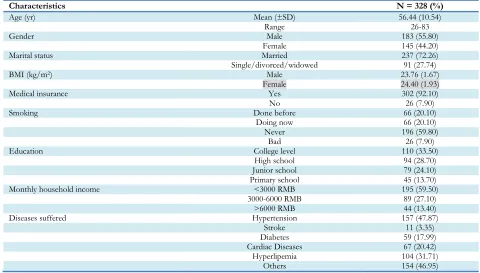
Three hundred twenty-eight valid copies were collected and the recovery rate was 93.7%. The average age of participants was 56.44 (SD=10.54) yr, ranging from 26 to 83 yr. More than half were male participants (55.8%) and two-thirds (72.3%) were married. The BMI of males and females was 23.8 (SD=1.67) and 24.4 (SD=1.93) kg/m2, re-spectively. Most participants (92.1%) had a medi-cal insurance. Participants of 62.2% had educa-tion levels of high school or above, and half of them (59.5%) had the monthly income less than 3000 RMB. In addition, one-third suffered com-orbidities (29.8%) (Table 1).
Table 1:Sociodemographic and clinical characteristics of the sample
Characteristics N = 328 (%)
Age (yr) Mean (±SD) 56.44 (10.54)
Range 26-83
Gender Male 183 (55.80)
Female 145 (44.20)
Marital status Married 237 (72.26)
Single/divorced/widowed 91 (27.74)
BMI (kg/m2) Male 23.76 (1.67)
Female 24.40 (1.93)
Medical insurance Yes 302 (92.10)
No 26 (7.90)
Smoking Done before 66 (20.10)
Doing now 66 (20.10)
Never 196 (59.80)
Bad 26 (7.90)
Education College level 110 (33.50)
High school 94 (28.70)
Junior school 79 (24.10)
Primary school 45 (13.70)
Monthly household income <3000 RMB 195 (59.50)
3000-6000 RMB 89 (27.10)
>6000 RMB 44 (13.40)
Diseases suffered Hypertension 157 (47.87)
Stroke 11 (3.35)
Diabetes 59 (17.99)
Cardiac Diseases 67 (20.42)
Hyperlipemia 104 (31.71)
Others 154 (46.95)
Reliability The test-retest reliability value was 0.86 in the
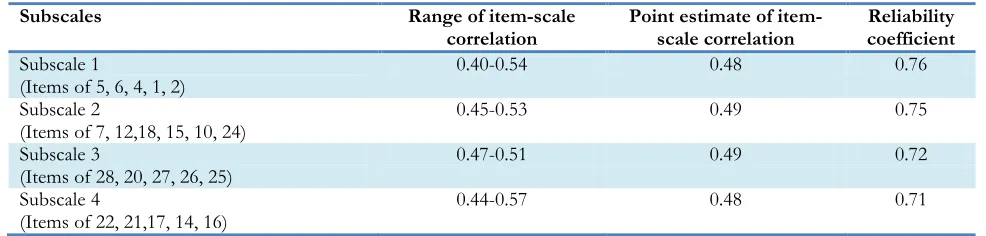
stable over time as the recommended test-retest reliability value was over 0.80 (17). The inter-item correlation for the C-STAT ranged from 0.06 to 0.56, and the item-total correlation values ranged from 0.40 to 0.57, indicating moderate correla-tions among the included items, subscales and
the entire instrument (18). The Cronbach alpha was favorable if it was more than 0.80 and was acceptable if over 0.70 (19, 20). In our study, the Cronbach alpha was 0.89 for the total items and it ranged from 0.71 to 0.76 for the four subscales (Table 2).
Table 2:Item-scale correlation and internal consistency
Subscales Range of item-scale
correlation Point estimate of item-scale correlation coefficient Reliability Subscale 1
(Items of 5, 6, 4, 1, 2) 0.40-0.54 0.48 0.76
Subscale 2
(Items of 7, 12,18, 15, 10, 24) 0.45-0.53 0.49 0.75
Subscale 3
(Items of 28, 20, 27, 26, 25) 0.47-0.51 0.49 0.72
Subscale 4
(Items of 22, 21,17, 14, 16) 0.44-0.57 0.48 0.71
Validity
Clinical experts of 11 were invited to review the instrument of C-STAT. Two-round panel reviews were conducted. After the 1st-round panel review and open discussion, experts suggest item 12 be revised and the 7 decoy symptoms [Items 3, 8, 9, 11, 13, 19, and 23] be removed, since the kappa values of the 7 decoy symptoms and the Item 12 were 0.08 and 0.74, respectively. The original Item 12, “My left leg started tingling as I sat watching TV. It was strange, almost like my leg was falling asleep. I tried rubbing and shaking my leg to make the problem go away, but it wouldn’t.” was revised to be “My left leg started feeling numbness as I sat watching TV. It was strange, almost like my leg was falling asleep. I tried rub-bing and shaking my leg but failed to make the problem gone.” In the second section, the revised Item 12 was 0.83, which was slightly lower than the ac-cepted level of 0.85 (21). On the whole, the 21-item C-STAT exhibited satisfactory content va-lidity, as the I-CVI ranged from 0.83 to 1.00 and the S-CVI/Ave was 0.93.
Additionally, exploratory factor analysis (EFA) was achieved using principal components analysis with varimax rotation method to extract the fac-tor structure of the C-STAT. The Kaiser-Meyer-Olkin (KMO) measure of sampling adequacy was 0.87, and Bartlett’s test of sphericity was
statisti-cally significant (χ2 = 1833.17, df = 210,
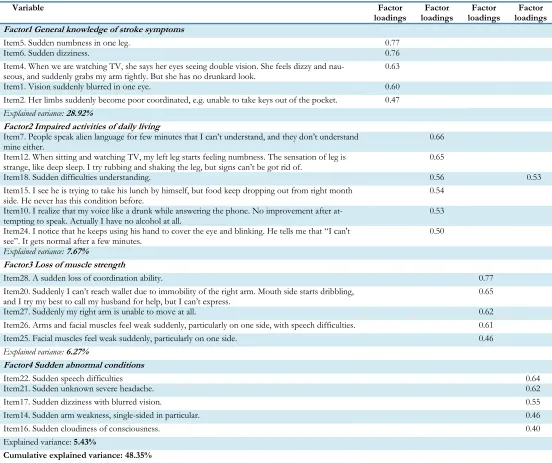
P<0.001). Therefore, it was an appropriate pro-cedure to perform EFA. Fours factors were set to extract and the eigenvalues were more than 1.00. Factors with loading weights were set at 0.40. The total instrument variance explained by the four factors was 48.35%. The 21 items were included in the four-factor solutions. Factor 1 included 5 items, which were named “General knowledge of stroke symptoms”; 6 items for Factor 2 “Impaired activities of daily living”; 5 items for Factor 3 “Loss of muscle strength”; and 5 items for Factor 4 “Sudden abnormal conditions”). The Item 18 was loaded into two factors that were the Factor 2 “Impaired activities of daily living” (factor load-ing=0.56) and the Factor 4 “Sudden abnormal condi-tions” (factor loading=0.53). Given the meaning and a relatively higher factor loading, the Item 18 was categorized in the Factor 2 “Impaired activities of daily living” (Table 3).
Furthermore, the criterion validity was used to explore the relationship between the 7 item stroke symptoms and the C-STAT using the re-gression analysis, and the significantly positive correlation between them was observed (r=0.77, t=21.74, P<0.001). The 7 item stroke symptom scores accounted for 59.30% of the variance of the C-STAT scores.
Table 3:Exploratory factor analysis for the C-STAT
Variable Factor
loadings
Factor loadings
Factor loadings
Factor loadings Factor1 General knowledge of stroke symptoms
Item5. Sudden numbness in one leg. 0.77
Item6. Sudden dizziness. 0.76
Item4. When we are watching TV, she says her eyes seeing double vision. She feels dizzy and
nau-seous, and suddenly grabs my arm tightly. But she has no drunkard look. 0.63
Item1. Vision suddenly blurred in one eye. 0.60
Item2. Her limbs suddenly become poor coordinated, e.g. unable to take keys out of the pocket. 0.47 Explained variance: 28.92%
Factor2 Impaired activities of daily living
Item7. People speak alien language for few minutes that I can’t understand, and they don’t understand
mine either. 0.66
Item12. When sitting and watching TV, my left leg starts feeling numbness. The sensation of leg is strange, like deep sleep. I try rubbing and shaking the leg, but signs can’t be got rid of.
0.65
Item18. Sudden difficulties understanding. 0.56 0.53
Item15. I see he is trying to take his lunch by himself, but food keep dropping out from right month
side. He never has this condition before. 0.54
Item10. I realize that my voice like a drunk while answering the phone. No improvement after
at-tempting to speak. Actually I have no alcohol at all. 0.53
Item24. I notice that he keeps using his hand to cover the eye and blinking. He tells me that “I can't see”. It gets normal after a few minutes.
0.50
Explained variance: 7.67%
Factor3 Loss of muscle strength
Item28. A sudden loss of coordination ability. 0.77
Item20. Suddenly I can’t reach wallet due to immobility of the right arm. Mouth side starts dribbling,
and I try my best to call my husband for help, but I can’t express. 0.65
Item27. Suddenly my right arm is unable to move at all. 0.62
Item26. Arms and facial muscles feel weak suddenly, particularly on one side, with speech difficulties. 0.61 Item25. Facial muscles feel weak suddenly, particularly on one side. 0.46 Explained variance: 6.27%
Factor4 Sudden abnormal conditions
Item22. Sudden speech difficulties 0.64
Item21. Sudden unknown severe headache. 0.62
Item17. Sudden dizziness with blurred vision. 0.55
Item14. Sudden arm weakness, single-sided in particular. 0.46
Item16. Sudden cloudiness of consciousness. 0.40
Explained variance: 5.43%
Cumulative explained variance: 48.35%
Discussion
The present study developed the Chinese version of C-STAT in a Chinese population and found that the C-STAT is an intelligible and brief psy-chometrical tool to assess individuals’ knowledge of the appropriate responses to stroke symptoms. In view of high-quality survival and family har-mony, it is crucial to prevent stroke from physical
328 participants who were either stroke patients or family members. The kappa value of 0.83-1.00 indicated that C-STAT had satisfactory linguistic equivalences compared with the original STAT in terms of items (18). Being different from the 28-item STAT, the C-STAT consisted of 21 28-items since the 7 decoy symptoms [Item 3, 8, 9, 11, 13, 19 and 23] were excluded. The Items 3, 11, 13 and 23 were the symptoms of heart disease, such as irregular heartbeat, heart fluttering and chest pain. The Items 8 and 9 were the symptoms of osteoarticular diseases like sore finger joints, right-hand hurting, and numbness while lifting weights. The Item 19 was the symptom of uri-nary bladder or kidney disease. The validity was enhanced after the removal of the decoy symp-toms.
The reliability was also good in the current study. The Cronbach alpha value of C-STAT of 0.89 was in line with the results reported in the Amer-ican population (Cronbach alpha 0.83) (11). The parameter of item-total correlation was based on the published articles (19), and the correlation value of 0.40-0.57 in this study indicated satisfac-tory discriminability of the items in C-STAT. The inter-item correlation for the C-STAT ranged from 0.06 to 0.56, suggesting that the multi-collinearity was minimized in this study. The cur-rent findings were consistent with the recom-mendation that the item-total correlation coeffi-cients should be greater than 0.30, while the in-ter-item correlation coefficients should be less than 0.70 (23, 24).
In terms of validity, the I-CVI ranged from 0.83 to 1.00 and the S-CVI/Ave was 0.93 after the second-round review. Thus, the content validi-ty of the C-STAT was acceptable in this study. In addition, construct validity was demonstrated by the principal components analysis of EFA. Com-pared with five factors that were automatically divided in terms of the total items, four factors were more satisfactory since each factor contains 5-6 items. Factor 1 mainly described the most common symptoms and warning signs of stroke, containing the Items 1, 2, 4, 5 and 6. Factor 2 indicated the impaired activities of daily living, containing the Items of 7, 10, 12, 15, 18 and 24.
These items depicted the scenes commonly hap-pened in daily life and were easy to be unders-tood, however, people who had an abnormal communication, understanding, sight and sensa-tion might negatively affect the activities of daily living. Factor 3 was related to the loss of muscle strength [Items 20, 25, 26, 27 and 28]. Common-ly, the loss of muscle strength could be explained by body disability and imbalance. Factor 4 was related to abnormal conditions that occurred suddenly [Items 14, 16, 17, 21, 22]. The sudden and urgent conditions were clustered in this fac-tor, and the medical terms were used. The C-STAT represented moderate item-scale correla-tions (r=0.40-0.57) and explained a total variance of 48.35%. Therefore, it may demonstrate more clear-cut factor loadings to the four-factor solu-tions, indicating its better factor structure in this study (18).
Furthermore, the test-retest reliability value of 0.86 was obtained in an interval of two wk, and that period might result in over-estimating the stability and reliability. The possible reason is the memory interferences of the first test response. In the future study, a longer interval should be used to assess the test-retest reliability. Addition-ally, the test of the convergent validity of the C-STAT with other valid measures (e.g. Coping Strategies Inventory) should be considered, to provide evidence-based operationalization of the C-STAT with other instruments (25).
There were two limitations in the present study. Firstly, a convenience sampling might limit the representativeness of the Chinese population and the generalizability of the results in this study. Secondly, the C-STAT was the first version trans-lated from the original STAT and comparable results or versions were lacking.
Conclusion
cognition of stroke and behavior models for res-ponding it, but also trace the improvements or changes over time (17).
Ethical considerations
Ethical issues (Including plagiarism, informed consent, misconduct, data fabrication and/or fal-sification, double publication and/or submission, redundancy, etc.) have been completely observed by the authors.
Acknowledgments
This work was supported by grants from the Chongqing Population and Family Planning Science and Technology Research Institute, Chi-na (cstc-jbky-1701309).
We would thank Prof. Billings-Gagliardi and Ma-zor who released the permission, and 11 expert panel members for commenting on the content validity. We also would like to show our gratitude for all the participants. The authors declare that there is no conflict of interests.
References
1. Wang YL, Wu D, Liao XL, Zhang W, Zhao XQ, Wang YJ (2007). Burden of strok in China. Int J Stroke, 2: 211-3.
2. Kathleen MM, Marianne S (2006). Stroke prevention and management in older adults. J Cardiovasc Nurs, 21(5 Suppl 1):S21-6.
3. Liu L, Wang D, Wong KS, Wang Y (2011).
Stroke and stroke care in China: huge burden, sig-nificant workload, and a national priority. Stroke, 42: 3651-4.
4. Moser DK, Kimble LP, Alberts MJ, Alonso A, Croft JB, Dracup K et al. (2006). ). Reducing delay in seeking treatment by patients with acute coronary syndrome and stroke: a scien-tific statement from the American Heart As-sociation Council on cardiovascular nursing and stroke council. Circulation, 114: 168-82. 5. Yang J, Zheng M, Cheng S, Ou S, Zhang
J, Wang N, et al (2014). Knowledge of Stroke Symptoms and Treatment among
Communi-ty Residents in Western Urban China. J Stroke Cerebrovasc Dis, 23: 1216-24.
6. Kleindorfer DO, Lindsell CJ, Broderick JP, Fla-herty ML, Woo D, Ewing I, et al. (2006). Community socioeconomic status and pre-hospital times in acute stroke and transient ischemic attack: do poorer patients have longer delays from 911 calls to the emergency department? Stroke, 37: 1508-13.
7. He HL (2013). Factors for Hospital Delay, Ad-verse Outcome, and Nursing Strategies for Patients after Acute Ischemic Onset. M.Sc. Thesis, He Nan University.
8. Lundelin K, Graciani A, Garcıa-Puig J et al (2012). Knowledge of stroke warning symp-toms and intended action in response to stroke in Spain: a nationwide population-based study. Cerebrovasc Dis, 34: 161-8.
9. Sun H, Chen S, Jiang B, Zhao X, Wu S, Liu Y, et al. (2011). Public knowledge of stroke in Chi-nese urban residents: a community question-naire study. Neurol Res, 33: 536-40.
10. Zeng Y, He GP, Yi GH, Huang YJ, Zhang QH, He LL (2012). Knowledge of stroke warning signs and risk factors among patients with previous stroke or TIA in China. J Clin Nurs,
21: 2886-95.
11. Billings-Gagliardi S, Mazor KM (2005). Devel-opment and validation of the stroke ac-tion test. Stroke, 36: 1035-9.
12. Sousa VD, Rojjanasrirat W (2011). Translation, adaptation and validation of instruments or scales for use in cross-cultural health care re-search: a clear and user-friendly guideline. J Eval Clin Pract, 17: 268-74.
13. Polit DF, Beck CT (2006). The content validity index: are you sure you know what's being reported? Critique and recommendations. Res Nurs Health, 29: 489-97.
14. Polit DF, Beck CT, Owen SV (2007). Is the CVI an acceptable indicator of content validity? Appraisal and recommendations. Res Nurs Health, 30: 459-67.
15. Waltz CF, Strickland OL, Lenz ER (2010). Mea-surement in Nursing and Health Research. 4th ed. New York: Springer Publishing Com-pany.
16. Lynn MR (1986). Determination and quantifica-tion of content validity. Nurs Res, 35: 382-5. 17. Paiva CE, Barroso EM, Carneseca EC, de Padua
RV, et al. (2014). A critical analysis of test-retest reliability in instrument validation stu-dies of cancer patients under palliative care: a systematic review. BMC Med Res Methodol, 14: 8.
18. Chien WT (2015). Testing the psychometric properties of a Chinese version of Dementia Management Strategies Scale. Neuropsychiatr Dis Treat, 11: 1663-75.
19. Cao X, Chen L, Diao Y, Tian L, Liu W, Jiang X (2015). Validity and Reliability of the Chinese Version of the Care Transition Measure.
PLoS One, 10: e0127403.
20. Polit DF, Hungler BP (1999). Nursing research: principles and methods. 6th ed. Philadelphia, JB: Lippincott.
21. Streiner DL, Norman GR (2008). Health Mea-surement Scales: A Practical Guide to Their Development and Use. 4th ed. Oxford: Ox-ford University Press.
22. Laosap J, Nimpitakpong P, Kongkaew C, Jedsa-dayanmata A (2012). Development and Vali-dation of An Instrument to Assess General Knowledge of Stroke. 1st Mae Fah Luang University International Conference, 1-8. 23. Nunnally JC, Bernstein RL (1994). Psychometric
Theory. 3rd ed. New York: McGraw-Hill. 24. Vivienne Wu SF, Courtney M, Edwards H,
McDowell J, Shortridge-Baggett LM, Chang PJ (2008). Development and validation of the Chinese version of the Diabetes Management Self-efficacy Scale. Int J Nurs Stud, 45: 534-42.