BOSNIAN JOURNAL OF BASIC MEDICAL SCIENCES 2009; 9 (4): 335-341
&
Abstract
Volume density of respiratory organs was studied in vitro in newborn babies at diff erent age of gestation (abort, immature, premature and mature) using stereometric method. Th e total of cases was subject to this study. Th e respiratory organs (trachea, lungs) were taken from autopsies of newborn babies exited from diff erent causes. For this purpose the tissues were fi xed in formalin () solution, cut serially in μ and μ slabs. Volume density of the respiratory system was assessed stereometricaly using Universal testing system Weibel M . We observed that volume density of epithelia, musculature and glands were proportionally present in the tracheal tissue. Cellular interstitial tissue is consistently increasing and cor-responds to the developmental stages of the newborn babies.
THE STUDY OF VOLUME
DENSITY OF TRACHEAL
GANGLIONS
IN VITRO
IN NEW BORN BABIES
WITH RESPIRATORY
DISTRESS SYNDROME
Ragip Shabani1*, Hilmi Islami2, Sadi Bexheti3,
Fehmi Zeqiri4, Ramadan Dacaj4, Ilir Kurtishi5,
Naim Haliti6, Ruke Beqiri7, Labinot Shahini1
¹ Department of Pathology, Faculty of Medicine, University of Prishtina,
Clinics Centre N.N. , Prishtina, Kosovo
² Department of Pharmacology, Faculty of Medicine, University of Prishtina,
Clinics Centre N.N. , Prishtina, Kosovo
³ Department of Anatomy, Faculty of Medicine, University of Prishtina,
Clinics Centre N.N. , Prishtina, Kosovo
⁴ Department of Gynecology, Faculty of Medicine, University of Prishtina,
Clinics Centre N.N. , Prishtina, Kosovo
5
Department of Physiology, Faculty of Medicine, University of Prishtina, Clinics Centre N.N. , Prishtina, Kosovo
6
Department of Forensic Medicine, Faculty of Medicine, University of Prishtina, Clinics Centre N.N. , Prishtina, Kosovo
7
Department of Histology, Faculty of Medicine, University of Prishtina, Clinics Centre N.N. , Prishtina, Kosovo
BOSNIAN JOURNAL OF BASIC MEDICAL SCIENCES 2009; 9 (4): 336-341Th e density of tracheal ganglions is greater in premature ages of immature and premature newborns (p<,). Decreased number of ganglion cells is observed in mature ages (p<,). Th is is caused by intensive ramifi cation of ganglions from serosa to deeper layers of trachea right to epithelium. Medium diameter of tracheal ganglions is greater in mature newborn babies and corresponds to develop-mental ages of babies.
KEY WORDS: trachea, ganglion, stereometry.
Introduction
The structure of ganglions found in the lungs is very complex; these structures are studied while mak-ing intracellular measurements in human material (). Neurophysiological studies of ganglions show at least - groups of neurons. Th ese neurons are inhibi-tory, excitainhibi-tory, sensory and interneurons. In some cases even more specialized neurons are found in pro-pria layer of the respiratory airways; initially thought to be sensory neurons, but functional definition of this neurons is still lacking. Data suggest that intrapul-monary ganglions may receive local sensory impulses as well as impulses from CNS. The presence of local sensory impulses in ganglions enables action of the refl ex activity directly without central part activation. Ganglions integrate sensory impulses for local control of smooth musculature. Postganglionic fibers spread to smooth musculature of trachea and glands (,). The studies conducted up to date were focused on morphology and physiology of tracheal and bronchial ganglions in diff erent species. e.g. mice (,), guinea pig (), weasel (), ship (), human (). Studies in humans have shown that intramural plexus of trachea and bron-chia is formed by the end of fetal period. In days old fetus, plexuses in external membrane of trachea and bronchia consist of a dense network of fi bers and nerve cells (mono or bipolar). After that, multipolar cells appear in intramural plexus (). Parasympathetic bronchial innervation in developed phase, shows that paraganglionar vagus nerves, which innervate smooth musculature of respiratory airways, are involved in breathing control before birth (). Tracheal ganglions are parasympathetic structures, but also contain sym-pathetic sensory fi bers. Th ese problems are explained by several immunohystochemical methods (). Nor-adrenergic nerve fibers are found around blood ves-sels in mucosa and smooth musculature of trachea, but are never observed near ganglion neurons ().
However numerous studies have not reached clear conclusion for tracheal ganglions in cats. Two plexus in dorsal wall of trachea are found in mouse. Th e fi rst one has delicate structure and is located in cervical part while the second one ( of all ganglions with
posi-tive AChE and nerve fi bers in thoracic parte) is more dense than those in cervical part. Th e same situation is observed in weasel (). Ganglion localization in trachea and bronchia is mainly on the lower surface of these or-gans and is associated with the activity of smooth mus-culature () and the presence of mucosal glands (). In recent years there were studies of volume and nu-meric density of diff erent tissues in human and animal objects, and of their role in certain pathologic condi-tions of central nervous system and respiratory system. Th e volume density is a relative variable, which shows how larger overall space occupies the observed space in volume units, while numeric density shows how many particles (neurons) are contained in volume unit (,).
Th e aim of this was paper is analyze the in vitro devel-opment of ganglion cells in respiratory airways, their morphology and pathogenesis in the respiratory distress syndrome (RDS) responsible for the high mortality in newborn babies, as well as numeric density of normal and pathologic neurons in the tracheobronchial sys-tem in newborn babies in diff erent weeks of gestations.
Material and Methods
Elaborate was performed in cooperation with the Gynaecology Obstetrics Clinic, Pathology Institute and Experimental Unit at Medical Faculty in Prishtina. For the purpose of this study we used material from autopsy of dead newborns at different weeks of gestation. The cases were grouped according to the level of development using criteria in Table .
Analyzed material was collected from trachea over bi-furcation level. A portion of material was used fresh for histoenzymatic analysis. Th e remaining tissue was fi xed in solution of buff ered formalin for histochemical methods. The following methods have been applied:
BOSNIAN JOURNAL OF BASIC MEDICAL SCIENCES 2009; 9 (4): 337-341
Histoenzymatic and histochemical research methods
Endoxyl method was used for detecting esterases. Th e preparations have been cut with kryotom Leicca CM in and μm thick slices. Th e samples fi xed in buff ered formalin were set in paraffi n blocs. Th e
serial slices are made in and μm. The slices have been stained using histochemical methods: Haema-toxylin-Eozin, Sevier – Munger modifi cation for nerve termini, Grimelius staining for argirophile granules, Luxol fast blue MBS method for myelinized fibers.
Stereometric method
Universal testing system Weibel M was used for stereometric analysis. Test-system is a system of straight lines and points. This should be super-imposed on morphological image for stereological count (). In this study, we used the test-system M by Weibel et al. (,), that has test-points, the test-line measures d and the test-area
mea-sures . d (Figure ). M test-system was mounted onto x WH Olympus Bx (Japan). This system has short lines with known length (d) and two test-points in each extrem-ity (Pp, test-points in total). Th e test-area is .d. Th e analysis have been done in fi ve testing points (Pt) and in serial tissue slices in and μm (Figure ).
Determination of volume density
Volume density is relative variable, which s h o w s h o w m u c h o v e r a l l s p a c e i s o c c u -pied by the observed space in volume units. We have used universal testing system Weibel M , the counting have been done in fi ve testing points (Pt). The calculation of the results is done using formula:
Vvf = Pf : Pt
where Vvf= volume density of the structure in observa-tion phase (mm); Pf= number of points of system in the observation phase.
Pt= overall number of points of the testing system
Th e determination of numeric density (of neurons)
Numeric density is relative stereological variable, which shows how many particles (neurons) are contained in volume unit.
Th e calculation is made according to Abercrrombie for-mula:
Nv=Na:t+D
Where Nv= numeric density, Na= number of neuron section, t= thickness of serial slices, D= medium diam-eter of neurons
BOSNIAN JOURNAL OF BASIC MEDICAL SCIENCES 2009; 9 (4): 338-341 Nf= the number of random points in the observed phaseAt= . x d
The obtained results were statistically processed in computer program GraphPad Instant , with t- comparing test of columns, unpaired t- test, paired t- test, Mann-Whitney test and Wilcox test
Results
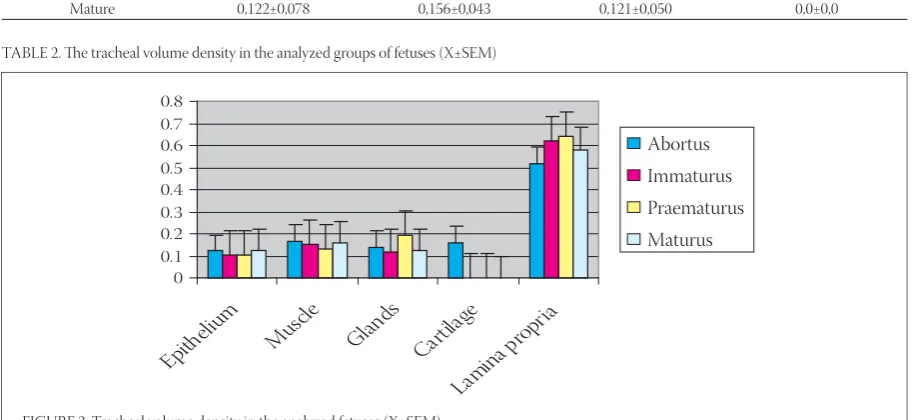
For this research we used material from autopsies of live borne babies deceased after birth and fetuses ex-ited in different weeks of gestations. Morphological study of tracheal ganglions at diff erent stages of fetal development, was made using histochemical and his-toenzymatic methods for choline acetyl-esterase and acetylcholine – esterase. See Figure (a, b, c, d, e, f,). Stereometric study has been made in serial sections of tracheal tissue, where presented density and medium di-ameter of ganglions, epithelium, glands, smooth muscu-lature, cartilage and interstitial was given in volume units. After statistical processing of the results obtained from the analysis of tracheal tissues of analyzed fetuses in diff erent ages of gestations, starting from the aborted, immature, premature and mature, we found that: inter-stitial in tracheal tissue has more dense presentation in volume tracheal unit, starting from early ages of newborn babies: the aborted, immature, premature and mature. In Table and Figure the data on density of epi-thelium, smooth musculature, glands and cartilages in different ages of maturity of fetuses is presented. Medium diameter of ganglions in the analyzed fetuses
(immature, premature and mature) is given in Table . Numeric density of tracheal ganglions in the analyzed fetuses is presented in Figure .
Discussion
Th e study shows that sympathetic nerve fi bers of the trachea stem from superior cervical ganglion and stel-late ganglion. Sympathetic fibers supply the trachea through tracheal laryngeal nerve from anastomo-sis of sympathetic ribbons and vagus nerve (). In
Epithelium Musculature Gland Cartilage Abort 0,121±0,026 0,163±0,105 0,136±0,041 0,161±0,213 Immature 0,104±0,028 0,154±0,018 0,115±0,025 0,0±0,0 Premature 0,106±0,020 0,132±0,029 0,191±0,224 0,0±0,0 Mature 0,122±0,078 0,156±0,043 0,121±0,050 0,0±0,0 TABLE 2. Th e tracheal volume density in the analyzed groups of fetuses (X±SEM)
Immature Premature Mature Mean (X) 14,58 17,25 22,91
BOSNIAN JOURNAL OF BASIC MEDICAL SCIENCES 2009; 9 (4): 339-341
our observation we have noted direct connections between some tracheal ganglions and branches of cervical ganglion cells (supra, medial and inferior). The supply with sensitive innervations of neurons in trachea and bronchi has been found in nodal ganglion and vagus jugular ganglion and in ganglions of poste-rior upper tracheal tracts. Th e morphology of neurons and tracheal ganglions was examined in guinea pig and rats (, ). Most neurons are multipolar, with short extension (fl agellate). Th e numbers of tracheal gangli-ons in the examined species are diff erent, e.g. in guinea pig - (x -), and rats - ( on average). In cats, - ganglions were observed. These results suggest that there is a correlation between the num-ber of nerve cells and the size of the respiratory system. In stereometric research of tracheal volume density of epithelial component, glands, musculature,
BOSNIAN JOURNAL OF BASIC MEDICAL SCIENCES 2009; 9 (4): 340-341 intense cell maturity of a pulmonary tissue after birth.Sympathetic fi bers from the cervical ganglions supply innervations to blood vessels, smooth musculature and mucosa, but were not found around or near the tra-cheal ganglions (). Some research is concerned with the presence of VIP in parasympathetic postganglion fibers where they control cholinergic neurotransmit-ters with prominence of postganglion fi bers. Th is has additional impact on ganglion transmission (). At terminals of preganglionar nerve the presence of SP is detected (). Th e examination of tracheal innervation in guinea pig, shows presence of non-adrenergic and non-cholinergic neurons. They are located in myen-teric esophageal plexuses and their axons supply the trachea (). By electrophysiological methods two types of neurons were found in tracheal ganglions. Th ese are present only in ganglions to which neurons send sympa-thetic impulses () and are connected with recurrent nerve steam and neurons with fast excitatory synaptic potential, located very close to smooth musculature (). Th e analysis of tracheal ganglions in guinea pig by elec-tronic microscopy, shows similarities with ganglion cells and with other spinal and parasympathetic nerve cells (). Th e entire surface of the ganglions is covered with one wrapping satellite. Blood vessels, myelin-ated and nonmyelinmyelin-ated nerve fi bers were found there. In morphological histoenzymatic study of respira-tory airways an increase in the enzymatic activity of choline acetyltransferase (HAT) and acetylcholine esterase (ACHE) was observed. Lower the weight of fetus (aborts – immature), the more pronounced is enzymatic reactivity in tracheal smooth musculature ganglions, serose glands and tracheobronchial epithe-lial cells. Earlier research provides data for enzymatic reactivity of HAT and ACHE in mature ages (). Enzymatic activity of HAT and ACHE is the most pres-ent in tracheal ganglion glands, at less developed stages,
while enzymatic reactivity decreases along with age Enzymatic activity is more expressed in serosa glands, in musculature and epithelium (the neuroepithe-lial bodies). In terminal bronchi in epithelium and subepithelium small and large granular vesicles in direct contact with nerve endings are noticed. Tra-cheal cartilage is not recorded in immature, prema-ture and maprema-ture because of limitations of stereo-metric network during observation phase in vitro. Denser terminals are noticed in the fetuses, which play chemoreceptive role for adaptation of musculature to-nus, regulation and adaptation of blood circulation dur-ing birth (). Th e nerve terminals in fern form which end in bronchial layer are sensorial and are stimulated by prolonging the bronchial wall. In bronchial smooth mus-culature cells the nerve endings are in claw form and are stimulated by changes in length of musculature fi ber ().
The results show that ganglion cells are noticed ini-tially in large number in tracheal serosa, with perivas-cular localization in early immature stages of fetuses. Penetration of ganglion cells into deeper tracheal lay-ers is focal. In the mature, mature postganglionar tra-cheobronchial fibers, which innervate more serosa and mucosal glands are noticed, while the muscula-ture and epithelium are partially innervated. The col-lected data from other authors are contradictory (, ). A characteristic of nervous system is that neurons from diff erent parts migrate into higher areas of nervous sys-tem. Neurons migrate radially and tangentially. It is con-sidered that one of the migration mechanisms of young neurons is made through radial fi bers of glia. In the early development, the nerve cells migrate close to mm per hours, whereas in the later stages of neurogenesis, for migration of cortical neurons nearly two weeks are need-ed (). In our studies, we observneed-ed neuronal perivascu-lar migration in the population of respiratory neurons.
Conclusion
On the basis of data obtained from morphological examination of trachea and pulmonary tissue in vitro at various stages of gestation development we found the following:
¡ Numeric density of tracheal ganglions is the largest at premature ages of immaturely and prematurely born babies (p<,). At mature (measured) ages there is a decrease in the number of ganglion cells (p<,).
Th is is explained by the given phase of intense ramifi cation of ganglions from serosa of deeper tracheal layers into epithelium. Average diameter of tracheal ganglions is greater in the mature age of newborn babies (measured), the value which corresponds to the developmental age of fetus.
BOSNIAN JOURNAL OF BASIC MEDICAL SCIENCES 2009; 9 (4): 341-341
References
() Baluk P., Fujiwara T., Matsuda S. Th e fi ne structure of the ganglia of the guinea-pig trachea. Cell Tissue Res. ; : -. () John W.M. Neurogenesis of patterns for neurogenesis of
gasping:noeud vital or noeuds vitals. J. Appl. Physiol. ; : -.
() Shabani R., Hundozi Z., Islami H. Evoluimi i dendësisë numerike neuronale në bëthamat dorsale motorike dhe solitare të nervit vagus në palcën e zgjatur te të porsalindurit. Praxix medica. ; : -.
() Kanemoto Y., Ishibashi H., Doi A., Akaike N., Ito Y. An electro-physiological study of muscarinic and nicotinic receptors of rat paratracheal ganglion neurons and their inhibition by Z-. Br. J. Pharmacol. ; : -.
() Shibata K., Taketani K. Excitatory eff ect of noradrenaline on rat airway parasympathetic ganglion neurons. Fukuoka Igaku Zasshi, ; : -.
() Moff att J.D., Dumsday B., McLean J.R. Non-adrenergic, non-cho-linergic neurons innervating the guinea-pig trachea are located in the oesophagus: evidence from retrograde neuronal tracing. Neu-rosci. Lett. ; :-.
() Coburn R.F., Kalia M.P. Morphological features of spiking and nonspiking cells in theparatracheal ganglion of the ferret. J. Comp. Neurol. ; : -.
() Perez Fontan J.J., Velloff C.R. Neuroanatomic organization of the parasympathetic bronchomotor system in developing sheep. Am. J. Physiol. ; : -.
() Dudzinska B., Wozniak W. Intramural plexuses in the trachea and bronchi of human fetuses. Folia Morphol. (Warsz). ; : -.
() Kummer W., Fischer A., Kurowski R., Heym C. Th e sensory and sympathetic innervation of guinea-pig lung and trachea as stud-ied by retrograde neuronal tracing and double-labelling immuno-chistochemistry. Neuroscience. ; : -.
() Bauluk P., Gabella G. Tracheal parasympathetic neurons of rat, mouse and guinea pig: partial expression of noradrenergic phe-notype and lack of inervation from noradrenergic nerve fi bres. Neurosci. Lett. ; : -.
() Kuder T., Kuchinka J., Nowak E., Szczurkowski A. Th e autonom-ic plexus in the trachea of the cat. Sup. An. Ant. ; : . () Baker D.G., McDonald M., Basbaum C.B., Mitchell R.A. Th e
ar-chitecture of nerves and ganglia of the ferret as revealed by acety-locholinesterase histchemistry. J. Comp. Neurol. ; : -.
() Choi H.K., Finkbeiner W.E., Widdicombe J.H. A comparative study of mammalian tracheal mucous glands. J. Anat. ; : -.
() Mouton P.R., et al. Stereologycal Leng Estimation Using Spherical Probes. J. Microscopy ; : -.
() Mouton P.R. Principles and practices of unbiased stereology:an introduction for bioscientis, Th e Johns Hopkins University Pres: Baltimore and London, .
() Mandarim-de-Lacerda C.A. What in the interest of normal and pathological morphological reseach to be quantitative? Th e ex-ample of the stereology. Braz. J.Morphol. Sci. ; :-. () Weibel E.R.et al. Practical stereological methods for
morphomet-ric cystology. J. Cell.Biol., ; : -.
() Weibel E.R. Stereological methods. In: Practical methods for bio-logicalmorphometry. London: Academic Press. ; vol . () Kalubi B., Yamano M., Ohhata K., Matsunaga T., Tohyama M.
Presence of VIP fi bres of sensory origin in the rat trachea. Brain Res. ; : -.
() Lees GM., Paccitti E.G., Mackenzie G.M. Morphology and elec-trophysiology of guinea-pig paratracheal neurons. Anat. Rec. ; : -.