145 |
P a g e
SIMULINK BASED PROPOSED MODEL FOR IMAGE
COMPRESSION AND COMPARISION WITH OTHER
IMAGE COMPRESSION TECHNIQUE
Saloni Singh
1, Utkarsh Shukla
2,
1Department of Electronics & Communication, P.S.I.T, Kanpur (India)
2
Department of Computer & Science, N.V.P.E.M.I, Kanpur (India)
ABSTRACT
In this research paper we compare various image compression techniques, and also proposed an image
compression technique. We also compare proposed model with other compression techniques. As we know that
Image compression is very necessary when required to reduce image size. Some of the information is lost during
image compression but basic information of image is retained as it is.
I INTRODUCTION
Image compression is much necessary to improve storage capacity of images and also for utilizing transmission
bandwidth. There are two types of image compression techniques lossless and lossy image compression
technique. In this paper we are discussing some of lossy image compression techniques. As the demand and
growth of digital imaging application increases for various application there is need of image compression is
also increases. As we well know that there are various techniques used for image compression, in this paper we
are discussing few of them as we are familiar with DCT (discrete cosine transform) which is very much similar
with the DFT. We are using simple model for DCT which is used for image compression. Similarly we are
discussing one more important technique for image compression is discrete wavelet transform (DWT) used for
image compression. We also proposed a model for image compression in which we are using simulink model
block processing. Each block in this model contains encoding and decoding methods. Encoding and decoding is
performed using 2D-DCT and IDCT respectively. We discuss each of these models in brief.
1.1 DCT (Discrete Cosine Transform) Based Image Compression
One dimensional DCT is only useful for processing of one dimensional signal but for image processing we need
146 |
P a g e
P (u, v) =Where P (u,v) represents 2D DCT of input signal p(x, y) and
C (u) = for u=0
= 1 for otherwise
2D-DCT is same as 1D-DCT, only difference is that it takes DCT for both Rows and Columns.
1.1.1 Algorithm
Step 1: Take image in workspace need to compress.
Step 2: Generate 8*8 DCT matrix .
Step 3: Now take DCT of each 8*8 block of matrix.
Step 4: In each block there are 64 elements, define mask matrix to select samples from these 64 elements.
Step 5: Now apply this mask to input image to take samples.
Step 6: Finally take IDCT of masked input image.
1.2 Discrete Wavelet Transform (DWT) Based Image Compression
Wavelets are signals which are local in time duration and scale and generally have irregular shape. Wavelets
have generally average value zero. Wavelets have the great advantage of being able to separate the fine details
in a signal. Very small wavelets can be used to isolate very fine details in a signal, while very large wavelets can
identify coarse details.
We are using haar model of wavelet compression, we are compressing image by taking all the terms to zero near
to the global threshold. As the global threshold is smaller there is less compression ratio and when there is large
global threshold, compression ratio is also larger but image quality also reduces.
II PROPOSED MODEL
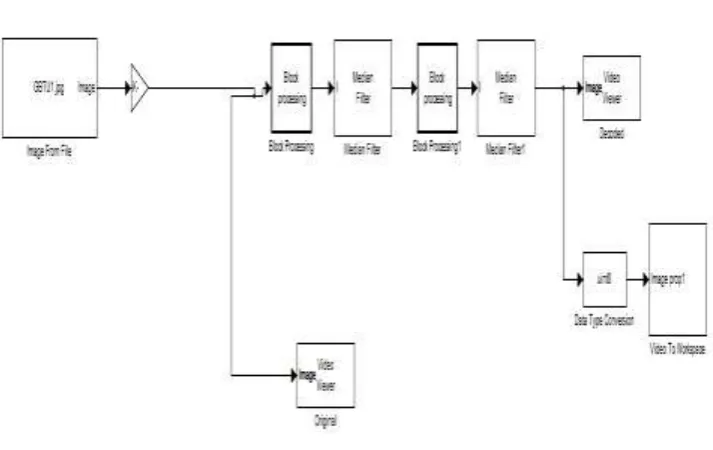
In this model each block processing have encode for compression and decode for decompression image but
finally when we get image is in compressed format and smaller in size. First we take DCT transform of an
image and then quantized that image. After Quantization we perform DC prediction of quantized image. In first
case we take two past values for DC prediction while in second case we take only single past value for
prediction. At the decoding time we further perform this operation. After block processing output we apply it to
the Median Filter Which provides smoothness to the image. After two block processing we get final Image to
147 |
P a g e
Fig 1: Proposed Model for Image Compression
III ANALYSIS OF SIMULATION RESULTS
3.1 Image Compression through DCT
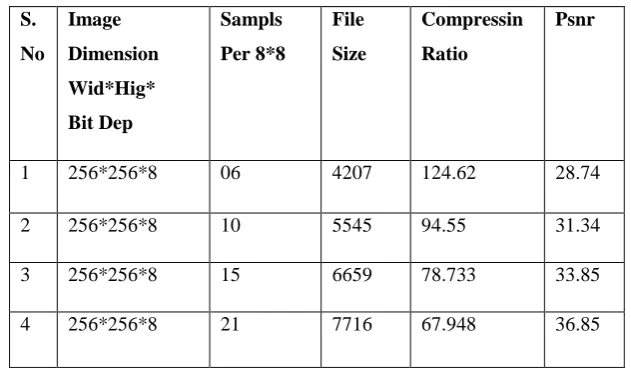
In this compression technique, we take samples of image through the mask matrix of 8*8. In first case we take 6
ones in 64 values, so that in each 64 values of image we get only 6 samples. We also analyze this technique for10, 15 &21 samples. Finally we get Image is compressed, as the number of samples increases image quality
improves but compression ratio reduces.
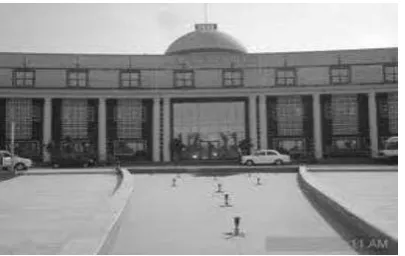
Original Image
Compression Ratio-61.3
File Size-8546
Table 1: Compressed Image Details For Different Number Of Sample.
S. No Image Dimension Wid*Hig* Bit Dep Sampls Per 8*8 File Size Compressin Ratio Psnr1 256*256*8 06 4207 124.62 28.74
2 256*256*8 10 5545 94.55 31.34
3 256*256*8 15 6659 78.733 33.85
4 256*256*8 21 7716 67.948 36.85
148 |
P a g e
Fig 2: Original Image Fig 3: DCT-06
Fig 4: DCT 10 Fig 5:DCT 15
Fig 6: DCT 21
3.2 Image Compression through DWT
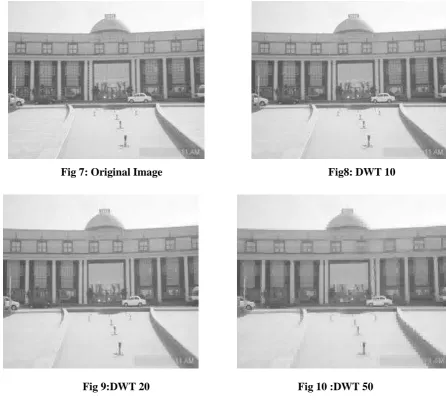
In this case we are analyzing this technique for different Global threshold values, as global threshold increases
149 |
P a g e
Original Image
Compression Ratio-63.914
File Size-8203
Table 2: Compression Ratio and PSNR for Different Global Threshold
Fig 7: Original Image
Fig8: DWT 10
Fig 9:DWT 20 Fig 10 :DWT 50
S.No Image Dimension
Wid*hig*Bit Dep
Global
Threshold
File Size Compression Ratio PSNR
1 256*256*8 10 7696 68.12 41.89
2 256*256*8 20 7361 71.225 35.66
3 256*256*8 50 6752 77.95 30.13
4 256*256*8 100 6167 85.015 27.62
5 256*256*8 150 5954 88.056 26.28
150 |
P a g e
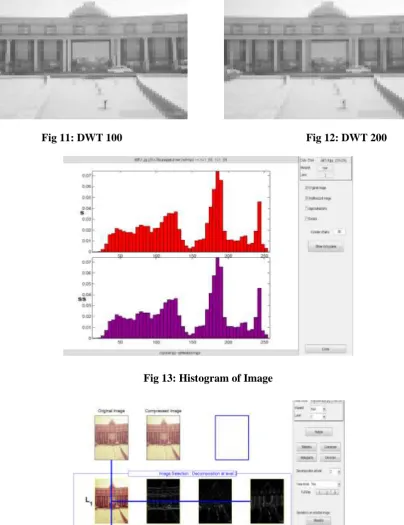
Fig 11: DWT 100 Fig 12: DWT 200
Fig 13: Histogram of Image
151 |
P a g e
3.3 Compression Through Proposed Model
As the details of original image and compressed image is given when comparing this image with the DCT
compressed image and DWT compressed image, we get that for same values of PSNR and Compression Ratio
we get somewhat better image as shown in Fig 5, Fig 10 & Fig 17.
Original Image
Compression Ratio-61.3
File Size-8546
Compressed Image
Compression Ratio-76.8
File Size-6827
PSNR-30.59
Fig 15: Original Image Fig 16: Compressed Image
152 |
P a g e
IV CONCLUSION
We analyze various image compression techniques such as that through discrete cosine transform, discrete
wavelet transform and compare this technique with our proposed model. Finally we get that for same values of
compression ratio and PSNR proposed model have better quality of image. Although we are using same discrete
cosine transform in our proposed model but in this model we use prediction for both encoding and decoding, so
that there is less error and better PSNR for same compression ratio.
REFERENCES
[1] Dipeeka O. Kukreja, S.R. Suralkar ,& A.H. Karode, “Performance Analysis of Various Image Compression
Techniques”,INTERNATIONAL JOURNAL OF SCIENCE, SPIRITUALITY, BUSINESS AND
TECHNOLOGY (IJSSBT), Vol. 1, No.1, March 2012.
[2] Pooja Kaushik and Yuvraj Sharma, “Comparison Of Different Image Enhancement Techniques Based Upon
Psnr & Mse”, International Journal of Applied Engineering Research, ISSN 0973-4562 Vol.7 No.11 (2012).[3] D. Lu & Q. Weng,” A survey of image classification methods and techniques for improving classification performance”, International Journal of Sensing Remote On: 21 April 2013.
[3] Etta D.pisaro,snuquan zong, “Contrast limted adaptive histogram equalization image processing to improve
the detection of simulated speculations in dense mammograms”.
[4] Rafael C. Gonzalez,”digital image processing”,2nd edition.
[5] M. Mozammel Hoque Chowdhury and Amina Khatun, “International Journal of Computer Science Issues,
Vol. 9, Issue 4, No 1, July 2012.
[6]Komal Vij, Yaduvir Singh, “Comparison Between Different Techniques of Image Enhancement”,
International Journal of VLSI and Signal Processing Applications, Vol. 1, Issue 2 , May 2011,(112-117)
,ISSN 2231-3133.
[7] Simarpreet Kaur Aulakh & Anu Sheetal, “Performance Analysis of WIMAX based OFDM System using
Various Modulation Techniques”, International Journal of VLSI & Signal Processing Applications, Vol.
2,Issue2,April 2012, ISSN 2231-3133, (181-188).
[8] Andrew B. Watson, “Image Compression Using the Discrete Cosine Transform”, Mathematica Journal, 4(1),
1994, p. 81-88.
[9] Ms.Seema Rajput , Prof.S.R.Suralkar, “Comparative Study of Image Enhancement Techniques”, IJCSMC,
Vol. 2, Issue. 1, January 2013, pg.11 – 21.
Biographical Notes
Mrs. Saloni Singh Is Presently Pursuing M.Tech Final Year In Electronics & Communication Engineering
Department Form P.S.I.T ,Kanpur,India.
Mr Utkarsh Shukla Is Presently Pursuing M.Tech Final Year In Computer Science Engineering Department