IMAGE PROCESSING SERVICES OVER NETWORKS
Deepika Pahuja
Assistant Professor, DAVIM
ABSTRACT
Image Processing can be used for distributed environment in order to provide image processing services over integrated teleradiology services networks for transmission of radiological patient images such as X-rays, CTS and MRI’s. Digital image processing over diffused networks integrates existing and new image processing software and leads to sophisticated execution scheduling mechanisms for the efficient management of computational resources within a disperse environment. It can also be extended to provide various added-value services, such as retrieving and managing image processing software modules, as well as advanced charging procedures based on quality of service. Disseminated Image processing can be viewed as the natural evolution of the legacy field of medical image processing providing a service over the emergent health care over wireless networks with efficiently conveying of information over vast networks..
I. INTRODUCTION
In past few years, advancement in information technology and telecommunications have acted as catalysts for
significant developments in the sector of health care. The advancement in technology had a particularly strong
influence in the field of medical imaging, where film radiographic techniques are gradually being replaced by
digital imaging techniques using matrix, and this has provided a drive to the development of integrated hospital
information systems and integrated teleradiology services networks which support the digital transmission,
storage, retrieval, analysis, and interpretation of distributed multimedia patient records [1]. One of the many
added-value services that can be provided over an integrated teleradiology services network in order to access
high-performance computing facilities for executing intensive image analysis and visualisation tasks
computationally [2]. Recently image processing tools in the market (IP)can fulfill particular needs of different
end user groups. They provide either a pool of user friendly software with embedded API‟s which are ready to
used by new in IP area, or offers programmer‟s libraries and visual language tools for the specialised IP
researcher and developer,. But still, we lack the common framework that will integrate all prior efforts and
developments in the field and at the same time provide added-value features that support and essential need
what we call a „service‟.
In the case of image processing, the major features which are required: computational resource management and
intelligent execution scheduling; intelligent and customisable mechanisms for the description, management, and
retrieval of image processing software modules; mechanisms for the “plug-and-play” integration of already
existing various different software modules; easy to access and transparency in terms of using software,
hardware, and network technologies; the sophisticated charging mechanisms based on quality of service; and,
methods for the integration with other services available within an integrated health telematics network. In this
for image processing services. It is based on a distributed, anonmsly, co-operating agent architecture [3]. It is
designed so that it can be modular, scaleable and extensible, and it can be readily implemented on different
hardware and software platforms, and over differently designed networks.
II. ARCHITECTURE
DIPE consists of a functional core which includes the stable disperse execution of IP algorithms, and
which can be extended for supporting other added-value services such as macros, resource
management, algorithm retrieval, charging, etc. Now, we describe the functional core of the system
and discuss the mechanisms and notions employed to allow integration of third party IP algorithms
and the development of new IP software. Finally, we describe the functional extensions of the core
which supports macro execution and resource management. DIPE has been developed to support
distributed medical imaging processing, an added-value service which is used for transmission of
radiological patient images like CTS within the integrated regional health telematics network,
currently under development by the Institute of Computer Science (ICS),Foundation for Research and
Technology - Hellas (FORTH), on the island of Crete [4].2. The architecture and implementation is
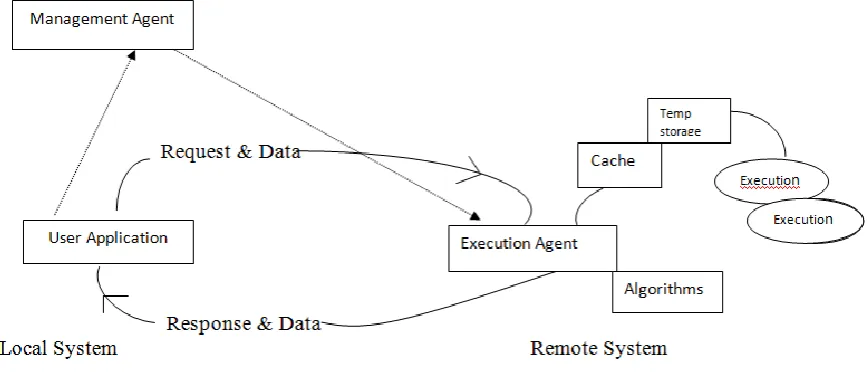
depicted in figure 1 which shows the communication within distributed systems at diverse places
Figure 1 Communication within Diverse Systems
The main part of the system composed of several communicating components: user applications, execution
agents, pools of IP algorithms, and management agents. The management agent is the central element whose
main purpose is to realise the network of individual modules (applications and execution agents) and initialise
the communication among them. However, the main body of messages is communicated directly among the
individual modules. The local cluster can be further expanded through a network of management agents, within
the same or even different organisations. Thus, the management agent ensures the scaleability of the
environment, a basic requirement of an integrated teleradiology services network [1]. Additionally, the
management agent authenticates users and provides unique image ids by using standard digital signature
The execution agent is responsible for the execution of a specific algorithm. It receives the requests for
execution through the management agent and creates a communication link with the requesting application in
order to receive further information and input data required for the execution (Figure 1). After this point, this
agent can proceed autonomously to the execution of the algorithm. It stores input data into a local cache area
and executes the requested algorithm. Output generated through the execution of the algorithm is sent back to
the agent. The execution agent is responsible to forward this output to the requesting application. In case there is
a network failure or the requesting application is not running any longer, the agent keeps the results of the
execution in temporary storage for delivery upon request. This ensures persistent algorithm execution
and enhances the robustness of the system. The user application is the front end of the system and consists
primarily of a customised graphical user interface. A virtual temporary storage management module ensures that
the application can handle synchronously a considerable number of large datasets. An important feature of the
user application is that it incorporates certain image processing algorithms that require real-time response, and
thus it is not sensible to redirect their execution to an agent or over the network. These include routines
necessary for image visualisation (e.g., zoom, focus, resize, contrast adjustment, etc.), as well as certain
algorithms for local, real-time image processing. Finally, the graphical user interface provides toolkits that
support the various functionalities of the environment (algorithm insertion, monitoring of the system‟s status,
resource management, macro composition and execution, etc.).
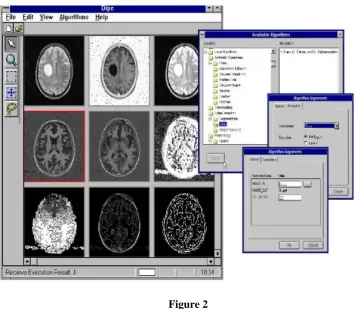
A typical screen of the application is shown in Figure 2.
Figure 2
The basic requirement that distributed image processing is readily implemented on various operating systems
and over heterogeneous networks poses certain implementation constraints. Thus, inter-process communication
object-oriented network programming toolkit for developing communication software [5]. DIPE is now
implemented on UNIX and Windows NT/95 workstations.
III. THE ALGORITHM REPOSITORY
The functional core of Distributed Image processing Environment is the set of available image processing
algorithms, private or public, local or network wide. An important feature of DIPE is that it allows easy
integration of third party algorithms, i.e. software modules where only an executable is available and the only
information known is the command line syntax, as well as the input and output data formats. The integration is
achieved through the algorithm wrapper, a single generic process. The wrapper converts input data from the
application format to the format that a specific IP algorithm requires, executes the algorithm and finally converts
the output data of the algorithm to the format of the user application. While the algorithm is being executed, the
wrapper is responsible to handle requests from the user application. Such requests include the termination or
pause of the execution, or the resumption of a previously paused execution. Additionally, DIPE provides a
library of ready-to-use routines for the development of new IP algorithms, which consists of basic routines
related to the starting and ending phases of the algorithm, as well as of routines that support a more
sophisticated mode of user-algorithm communication during execution.
In routine medical image processing, a common situation involves processing images
using the same set of algorithms often with a standard set of parameter values. DIPE
provides the mechanisms to simplify the complicated process of executing individual
algorithms sequentially, by grouping them together and thus creating a macro-algorithm
(macro). In general, the DIPE macro is a set of individual algorithms that may be performed independently on
the same or different data sets, or maybe performed sequentially. There is no constraint on the complexity of
algorithm combinations and the inter-relationships of their input and output data. The execution of a macro is
the responsibility of a special macro agent. The macro agent acts as a mediator for macro
executions. It consists of three main functional parts: the interface with the application, the interface with the
rest of the system(management and execution agents), and the module which is responsible for the management
of the macro execution. The macro agent models macros as a directed acyclic graph, thus enabling macro
decomposition and individual scheduling of its components.
IV. RESOURCE MANAGEMENT
Quality of service in DIPE is guaranteed by a sophisticated resource management and execution scheduling
mechanism. The scheduling of a requested algorithm execution to the most appropriate processing element (PE)
is a distributed decision making process based on the market metaphor, and is realised through the co-operation
of the execution agents [6, 3].
Upon request for an algorithm execution, the management agent initialises an „auction‟. The request is
forwarded to the appropriate „bidders‟, that is those execution agents that are able to perform the request. Each
consideration the load of the local PE, the possible existence of the required input data in its local cache vs. the
cost for transferring the data through the network, and the execution characteristics of the particular algorithm.
Then, each execution agent makes a bid to the management agent by returning the estimated „cost‟ of the
execution. The management agent evaluates all the bids it receives and assigns the execution to a particular
execution agent. It is important to note that the execution characteristics of each algorithm are drawn from its
execution profile, which includes information on size of input/output data, PE memory needed at runtime
(relative to input data) and time needed for execution(normalised to input data and PE). A good approximation
about the memory requirements and the execution time of an algorithm is derived from a statistical analysis
based on previous execution profiles of the algorithm.
V. DISCUSSION
DIPE has been designed and developed to offer image processing services over integrated health care services
networks, and to act as an integration platform for diverse image processing software. It exhibits a modular,
extensibleand scaleable architecture that ensures system robustness and execution persistence. A sophisticated
resource management and execution scheduling mechanism allows the medical expert to take full advantage of
geographically distributed computational resources. Future research will address the development of intelligent
and customisable mechanisms for the description, management, and retrieval of image processing software
modules, as well as charging mechanisms based on quality of service.DIPE is currently being extended through
its functional integration with other medical information systems that have been developed in our laboratory.
Important examples include CoMed [7], a desktop conferencing application which allows interactive real-time
co-operation among several medical experts, as well as TelePACS [4], an information system for medical image
management and communication.
DIPE is one of the diverse telematics applications incorporated in the regional health telematics network, which
is currently being developed by ICS-FORTH on the island of Crete.
REFERENCES
[1] S.C. Oprhanoudakis, E. Kaldoudi, and M. Tsiknakis, “Technological Advances in Teleradiology”, Eur. J.
Radiology, vol. 22, 205-217, 1996.
[2] S.C. Orphanoudakis, “Supercomputing in Medical Imaging” IEEE Eng Med Biol, vol.7, 16-20, 1988.
[3] P. Maes, “Modelling Adaptive Autonomous Agents”, Artificial Life Journal, ed. C.Langton, vol. 1, nos.
1&2, MIT Press, 1994.
[4] S.C. Orphanoudakis, M. Tsiknakis, C. Chronaki, S. Kostomanolakis, M. Zikos, and Y.Tsamardinos,
“Development of an Integrated Image Management and Communication System on Crete”. In: Lemke
HU, Inamura K, Jaffe CC, Vanier MW, eds. Proc. Of CAR‟95, Berlin, p. 481-487, 1995.
[5] D.C. Schmidt, “The ADAPTIVE Communication Environment: An Object-Oriented Network
Programming Toolkit for Developing Communication Software”, 12th Sun User Group Conference, San
[6] D.F. Ferguson, Y. Yemini, C. Nikolaou, “Microeconomic Algorithms for Load Balancing in Distributed
Computer Systems.”, . In Proceedings of International Conference on Distributed Systems (ICDCS 88).
San Jose,California: IEEE Press, 1988.
[7] M.Zikos, C. Stephanidis, and S.C. Orphanoudakis, “CoMed:Cooperation in Medicine”, Proceedings of