248 |
P a g e
A DETAILED ANALYSIS OF VARIOUS DENOISING
TECHNIQUES FOR CDNA MICROARRAY IMAGES
Chitra A
1, Sunitha R
2and Dr.H.B.Phaniraju
31
M.Tech student (Digital Electronics & Communication),
Rajarajeswari College of Engineering, Bangalore(India)
2Ph.D Research Scholar and Associate Professor, Dept. of ECE,
Rajarajeswari College of Engineering, Bangalore(India)
3Principal, Rajiv Gandhi Institute of Technology, Bangalore(India)
ABSTRACT
The image noises usually occur during the accusation or while transmission. It is necessary to remove the noise to provide further processing techniques like edge detection, segmentation, etc. In this paper the analysis is performed to remove salt and pepper noise, Gaussian noise and speckle noise using different Denoising techniques like standard median filter (MF), switched median filter (SMF), Progressive Switched Median Filter(PSMF), vector median filter (VMF), Decision Based Algorithm (DBA), Mean Filter, Weiner Filter (WF) and Wavelet based denoising using different coefficients are implemented.
The scope of the paper is to find better denoising method. The MATLAB based simulation is carried out for calculating the Mean square Error (MSE), Peak Signal to noise ratio (PSNR) and Mean Structural Similarity Index (MSSIM) values.The result obtained using Switched Median Filter and Decision Based Algorithm is performs better in removing Salt and Pepper Noise. Similarly for removing Gaussian noise and Speckle Noise by Wavelet transform.
Keywords-
Gaussian Noise, Mean Square Error (MSE), Mean Structural Similarity Index (MSSIM), PeakSignal To Noise Ratio (PSNR), Salt And Pepper Noise And Speckle Noise
I. INTRODUCTION
The microarray image is considered to be the next generation development in bioinformatics to monitor
thousands of genes simultaneously. A microarray image is an array of spots sequences arranged in the solid surface
of glass slide. Every spots contains multiple collection of single DNA sequence [1].
During the process of experiment the mRNA of the two tissue of interest is extracted and purified, then each of
the mRNA samples are reverse transcribed into its complementary Deoxyribonucleic acid (cDNA). They are labeled
with two different fluorescent dyes which results into two fluorescence tagged cDNA (green CY3, red CY5). The
tagged cDNA are hybridized in the glass slides.
The hybridized glass slide with fluorescent dyes is scanned at different wavelength where two different images
249 |
P a g e
electronic noise, dust on the glass slide, due to laser light reflection and so on. Hence it is necessary to remove thenoise for further processing [2-6].
In this paper a detailed comparative analysis of different Denoising techniques is implemented to remove salt
and pepper noise, Gaussian noise and speckle noise.
II. TYPES OF NOISE.
2.1 Salt and Pepper Noise
The salt and pepper noise is also called as impulse noise or spike noise. A typical variety of salt and pepper
noise in a cDNA microarray image is the salt and pepper noise which will have dark pixel in bright region and bright
pixel in dark region. The white pixel (salt) and black pixel (pepper) is the kind of disturbance to the image. The
noise density can be that of the salt and pepper noise in the image. The total noise density of nd in an M×N image is
nd×M×N pixel contains noise. In general, the complete noise density of salt and pepper is d then every salt noise
therefore the pepper noise is nd/2. The salt noise and pepper noise is different noise density nd1 and nd2, therefore
the whole noise density will be:
nd = nd1 + nd2 (1)
2.2 Speckle Noise
The in cDNA microarray imaging technique speckle noise will be present so it is necessary to remove the
speckle noise. Speckle noise is considered to be multiplicative noise can be represented by the equation as below:
N(i,j)=nf(i,j)m(i,j)+a(i,j) (2)
were n(i,j) represents the noisy pixel, nf(i,j) is considered to be noise free pixel, m(i,j) is the multiplicative
noise and a(i,j) is the additive noise respectively i, j are the spatial locations. Since the effect of additive noise is
considerably small when compared with multiplicative noise (2) we can write as:
n(i,j) = nf(i j) m(i,j) (3)
Where the speckle noise intensity nf(i,j) m(i,j) is close to Gaussian noise. The logarithmic transform of
multiplicative form equation in (3) to additive noise is as:
log n(i,j) = log nf(i,j) + log m(i,j) (4)
x(i,j)=y(i,j)+n(i,j) (5)
were log n(i,j) is the noisy image in the cDNA microarray image after the logarithmic compression is denoted as
x(i,j) and the log nf(i,j) ,log m(i,j) are the noise free pixel and the noisy component after the logarithmic
compression is y(i,j) n(i,j).
2.3 Gaussian noise
Gaussian noise is an additive in nature`, and it follows Gaussian distribution where each pixel in the noisy
image is the sum of the real pixel value and random, Gaussian distributed noise value. The noise is independent of
250 |
P a g e
III. STANDARD MEDIAN FILTER
The non-linear filter is widely used to remove noise in an image than the linear filtering techniques because
linear filtering technique will tend to remove the fine details of the image [7-12]. The standard median filtering
method for the image window size taken is 3×3 where the noise and the noise free pixels are in the window. The
median value is considered in order to replace the noisy pixel to noise free pixel.
The detection of noisy pixel and noise free pixel are by considering the value of the processed pixel values
which is between maximum and minimum value with in the selected window. The dynamic range of the impulse
noise is (0, 255). When the value is of the range (0, 255) it is considered to be corrupted by the impulse noise and
the remaining pixels are the same [10].
If the dynamic range of the pixel is not between (0, 255) then it is a noisy pixel and it is replaced by the median
value or the neighborhood value of the window. By replacing the median value of each window the impulse noise is
removed. Hence we get a noise free image. Similarly the Gaussian noise and speckle noise is removed with the
standard median filter.
3.1 Algorithm for Standard Median Filter.
STEP 1: Read the noisy image I.
STEP 2: Convert the color image to gray scale image G.
STEP 3: Pad G matrix with zeros at the boundaries to get matrix P
STEP 4: Taking 3×3 matrix of pixel from matrix P.
STEP 5: Arranging the pixel in ascending order from the 3×3 matrix.
STEP 6: Calculate the median pixel and replace in matrix B.
STEP 7: Repeat step 6 for the entire image.
STEP 8: Display the denoised output image.
STEP 9: Calculate the MSE, PSNR and MSSIM value.
IV. SWITCHED MEDIAN FILTER
The switched median filter (SMF) is popularly used to remove the impulse noise. The SMF will provide better
denoising in an image [12-14]. The switched median filter it switches for the certain condition. We take the window
size to be 3×3 in the matrix. Then we calculate the maximum value in the window Wmax, the minimum value
Wmin and the median value M.
When Wmin<M && M< Wmax, if this condition satisfies then we replace the fifth value in the window if not
the condition is checked if it is satisfied then the median value is replaced or else the mean value of the window is
251 |
P a g e
4.1 Algorithm for Switched Median Filter
STEP 1: Read the noisy image I.
STEP 2: Convert the color image to gray scale image G.
STEP 3: Pad G matrix with zeros at the boundaries to get matrix P
STEP 4: Taking 3×3 matrix of pixel from matrix P.
STEP 5: Calculate maximum pixel in the window Wmax.
STEP 6: Calculate minimum pixel in the window Wmin.
STEP 7: Calculate median in the window M.
STEP 8: Check the condition
Case A: If Wmin<M && M< Wmax put B(i,j)=0, then move to step9.
Case B: If Wmin<M && M< Wmax put B(i,j)=M, then move to step 9.
Case C: If Wmin<M && M< Wmax put B(i,j)=mean of window, then move to step9 STEP 9: Repeat step 8 for the entire image.
STEP 10: Display the denoised output image.
STEP 11: Calculate the MSE and PSNR value.
V. PROGRESSIVE SWITCHED MEDIAN FILTER
The Progressive Median Filter [15] initially the two image sequences are generated during the impulse
detection procedure. The first is a sequence of gray scale images represented as {{Xi (0)
}, {Xi
(1)} ,…… {X i
(n)} ….},
and binary image represented as {{Fi (0)
}, {Fi
(1)} ,…… {F i
(n)} ….}. If F i
(n)
=0 it is noise free, Fi (n)
=1 it is noisy. For
Xi(n-1) median value 3x3 window Mi(n-1) = Med Xj(n-1). Compute difference for Xi(n-1) and Mi(n-1) ,i.e. |Xi(n-1) -
Min(n-1)| < TD. In order to detect weather it is impulse or not the binary value of the flag should be as given in the
equation 7.1.
(6)
The threshold, TD is a pre-defined value. If Fi(n-1) < TD is noise free otherwise it is considered as noisy.
When the impulse is detected the Xi(n) is modified as in equation 7.2.
(7)
The Xi(n) =Mi (n-1)
N iteration is done or the same input pixel is replaces as Xi (n)
=Xi (n-1)
there by this
procedure the impulse detection is completed.
The second procedure is the Noise filtering the gray scale image is considered as {{Yi (0)}, {Yi (1)} ,……
{Yi(n)} ….} and binary image as {{Gi(0)}, {Gi(1)} ,…… {Gi(n)} ….} If Gi(n)=0 is noise free, Gi(n)=1 is noisy. For Yi (n-1)
252 |
P a g e
image. Replacing the value of the flag as zero and iterating to N times the noise is removed. In case if the impulse isobtained again then the Yi (n) is modified as in equation 7.3.
(8)
The Progressive Median Filter will remove the impulse noise effectively when compared to that of the
Median Filter.
5.1 Algorithm for Progressive Switched Median Filter
STEP1: Read image I
STEP2: Convert I to gray scale G.
STEP3: Detecting image as gray scale {{Xi (0)
}, {Xi
(1)} ,…… {X i
(n)} ….} and binary {{f i
(0)
}, {fi
(1)} ,…… {f i
(n)} ….}
STEP4: The fi(n)=0 it is noise free, fi(n)=1 it is noisy.
STEP5: For Xi(n-1) median value 3x3 window mi(n-1)=med Xj(n-1).
STEP6: Compute difference of Xi(n-1) and Mi(n-1), If |Xi(n-1) - Mi(n-1)| <TD then go to step 7.
STEP8: Xi(n) =Mi(n-1) N iteration is done and stopped.
STEP7: Xi(n) =Xi(n-1) N iteration is done and stopped.
STEP9: Noise filtering of Xi(n) , generate the gray scale image as {{Yi(0)}, {Yi(1)} ,…… {Yi(n)} ….} and binary
image as {{gi (0)
}, {gi
(1)} ,…… {g i
(n)} ….}
STEP10: The gi(n)=0 is noise free, , gi(n)=1 is noisy.
STEP11: For Yi(n-1) median value 3x3 window mi(n-1) = Med Yj(n-1)
STEP 12: If Gi(n-1) = 1then go to step 14.
STEP 13: Yi(n) =Mi(n-1) N iteration is done and stopped.
STEP 14: Yi(n) =Yi(n-1) N iteration is done and stopped.
STEP 15: Denoised output image.
STEP 16: Calculate the MSE and PSNR value
VI. DECISION BASED ALGORITHM
Decision Based Algorithm [25], [26] here the median value itself can be noisy, especially in the case of
high noise density. It is in this case, the pixel value is replaced by the mean of the neighborhood processed pixels. In
the 3×3 window above, indicates already processed pixel values, C indicates the current pixel being processed
indicates the pixels yet to be processed. If the median value of the above window itself is noisy, then, the current
pixel value will be replaced by the mean of the neighborhood processed pixels, that is, the mean. The values of the
pixels will not be taken into account since they represent unprocessed pixels. Take the 3×3 matrix of pixels from the
padded matrix P. Calculate maximum pixel in the window Wmax. Calculate minimum pixel in the window Wmin.
253 |
P a g e
Wmin<M && M< Wmax and C=W (2, 2) replace with median value else with mean value. Repeat for all possible3×3 matrix and replace all pixel with the median value. Thus the denoised output image is obtained.
6.1 Algorithm for Decision Based Algorithm
STEP 1: Read the noisy image I.
STEP 2: Convert the color image to gray scale image G.
STEP 3: Pad the G with zeros at the boundaries to form padded matrix P.
STEP 4: Take the 3×3 matrix of pixels from the padded matrix P.
STEP 5: Calculate maximum pixel in the window Wmax.
STEP 6: Calculate minimum pixel in the window Wmin.
STEP 7: Calculate median in the window M.
STEP 8: Calculate C=W (2, 2)
STEP 9: Check the condition if Wmin<C && C< Wmax and Wmin<M && M< Wmax and C=W (2, 2) replace
With retain the same pixel value, median value else with mean value.
STEP 10: Repeat for all possible 3×3 matrix and replace all pixel with the median value.
STEP 11: Denoised output image.
STEP 12: Calculate the MSE and PSNR value.
VII. VECTOR MEDIAN FILTER
The vector median filter (VMF) is a nonlinear filter [16], [17], [18]. The VMF is a well-researched and widely
used due to extensive modified that can perform in conjunction with it to avoid the damage to the noise free pixel. In
the vector median filter the noisy image is taken and the 3×3 window is considered for the complete image. Every
pixel in the matrix is considered to be checked for the conditions VMF = W(i) where 1< i ≤9 in the window. ║VMF
-W║ ≤ ║Wi - W║ for 1< i ≤9. If this condition satisfies then we replace with the obtained value. The complete
image follows the same process there by the impulse noise and the speckle noise is removed.
7.1 Algorithm For Vector Median Filter
STEP 1: Read the noisy image I.
STEP 2: Convert the color image to gray scale image G.
STEP 3: Pad G matrix with zeros at the boundaries to get matrix P
STEP 4: Taking 3×3 matrix of pixel from matrix P.
STEP 5: Considering every pixel as VMF, VMF=W(i).
STEP 6: If ║VMF -W║ ≤ ║Wi - W║ then B(i,j)=VMF.
STEP 7: Repeat step 6 for the entire image.
STEP 8: Display the denoised output image.
254 |
P a g e
VIII. COMPONENT MEDIAN FILTER
The Component Median Filter [19] defined on the statistical median concept. The operation is similar to the
median filter but here the separately the median values are replaced for major colors like Red, Green and Blue. Thus
by this method we get the noise removed image for color images. This filtering method is simple in construction and
it retains the image details for the three colors. This type of filtering takes place for mainly used to remove Salt and
Pepper noise.
8.1 Algorithm for Component Median Filter
Step 1: Read the noisy image I.
Step 2: If the noisy image is color, separate each plane using MATLAB commands. Each scalar component is
treated independently.
Step 3: Pad the G with zeros at the boundaries to form padded matrix P.
Step 4: Take the 3×3 matrix of pixels from the padded matrix P.
Step 5: Then sort the pixel values within the mask in ascending order.
Step 6: For each component of each point under the mask a single median component is determined.
Step 7: These components are then combined to form a new pixel.
Step 8: Obtain the output image.
Step 9: calculate the MSE, PSNR and MSSIM.
IX. MEAN FILTER
The mean filter technique is a widely used for removing noise it effectively removes the noise while blurs the image details [10]. The mean filtering method is a linear filtering type the mean value in the window will be replaced there by the noise with high values will be removed.
9.1 Algorithm for Mean Filter
STEP 1: Read the noisy image I.
STEP 2: Convert the color image to gray scale image G.
STEP 3: Pad G matrix with zeros at the boundaries to get matrix P
STEP 4: Taking 3×3 matrix of pixel from matrix P.
STEP 5: Calculating the mean value for the window and replace to matrix B.
STEP 6: Repeat step 5 for the entire image.
STEP 7: Display the denoised output image.
255 |
P a g e
X. WIENER FILTER
Wiener filter [35], [36] is a filter used to produce an estimate of a desired or target random process by
linear time-invariant filtering an observed noisy process, assuming known stationary signal and noise spectra, and
additive noise. The Wiener filter minimizes the mean square error between the estimated random process and the
desired process .Wiener filters are characterized as the following Assumption like signal and noise are stationary
linear stochastic processes with known spectral characteristics or known autocorrelation and cross correlation
Requirement are the filter must be physically realizable/ causal.
10.1 Algorithm for Wiener Filter
STEP 1: Read the noisy image I.
STEP 2: Convert the color image to gray scale image G.
STEP 3: Apply wiener filtering to the image G.
STEP 4: Denoised output image.
STEP 5: Calculate the MSE, PSNR and MSSIM value.
XI. WAVELET BASED DENOISING
The Discrete Wavelet Transform (DWT) [28-31] based image denoising has the following three steps. The
noisy image is considered as the input image and the two level of decomposition takes place after that the soft
thresholding [4] is applied also the wavelet coefficients are used. The reconstruction is obtained by Inverse Discrete
Wavelet Transform (IDWT). The Wavelet coefficients used are Haar, Daubechies, Symlet, Coiflet and
Biorthogonal. Using the Wavelet based noise removal the noise is effectively removed.
11.1 Algorithm for Wavelet Based Denoising
STEP 1: Read the noisy image I.
STEP 2: Convert the color image to gray scale image G.
STEP 3: Perform multistage decomposition of the image G by noise using wavelet transform.
STEP 4: Apply soft thresholding to the noisy coefficients.
STEP 5: Invert the multistage decomposition to reconstruct the denoised image.
STEP 6: median filtering is applied for the reconstructed image.
STEP 11: Repeat for other wavelet coefficients.
STEP 12: Display the denoised output image.
STEP 13: Calculate the MSE, PSNR and MSSIM value.
XII. EXPERIMENTAL RESULTS & DISCUSSION
The experiment carried out in the project is to removal of the different types of the noises. The different
256 |
P a g e
20%, 30%, 40%, 50%, 60%, 70% and 80%, here noise are considered separately. The experiment shows thecomparison of performance of the linear filtering method, nonlinear filtering method and the transform technique to
remove the noise in the images which is used in the real application in the field of medical images. The Performance
parameters like MSE, PSNR and MSSIM are calculated and tabulated for the tested images.
12.1 Results for Microarray Image
Themicroarray image with Dimension 512×512 of the format JPEG (Joint Picture Expert Group) is taken
as the original image which is in color are converted to gray scale for further filtering analysis
12.1.1 Result for Filtering of Salt and Pepper Noise in Microarray Image
(a) (b) (c) (d) (e) (f)
(g) (h) (i) (j) (k) (l)
(m) (n) (o) (p)
Fig12.1: a)Original image is Microarray image in color b) Original image converted to gray scale image c)
Microarray image corrupted with 10% salt and pepper noise d) Noise removed by standard median filter e)
Noise removed by SMF f) Noise removed by PSMF g) Noise removed by VMF h) Noise removed by CMF i)
Noise removed by DBA j) Noise removed by Mean filter k) Noise removed by wiener l)Noise removed by
Wavelet thresholding using Haar coefficient m) Noise removed by DB4 n) Noise removed by Sym4 o)Noise
257 |
P a g e
Table12.1: MSE for Different Density of Salt and Pepper Noise in Microarray Image
Filter
Salt and Pepper Noise
5% 10% 20% 30% 40% 50% 60% 70% 80%
MF 32.975 34.905 37.200 40.727 44.111 52.964 61.274 75.490 93.521
SMF 11.013 11.840 14.158 17.926 21.550 26.228 29.004 31.023 29.949
PSMF 12.305 20.157 31.235 38.772 43.112 50.694 57.584 69.213 86.958
VMF 33.128 34.950 36.434 39.671 44.570 52.299 61.444 76.734 89.718
CMF 37.534 42.142 36.548 40.604 70.089 76.104 78.820 77.489 72.129
DBA 11.006 11.846 14.216 18.097 22.279 28.163 32.779 37.694 40.669
Mean 39.407 39.870 37.801 35.357 31.800 29.269 26.196 24.585 22.939
WF 36.239 39.198 37.789 35.617 31.930 29.583 26.441 24.737 23.129
Wavelet based Denoising using coefficients
Haar 48.577 45.431 37.843 32.339 27.646 25.604 22.719 21.269 19.946
DB4 46.356 43.450 35.356 29.936 25.561 23.933 21.612 20.126 19.307
Coif4 45.246 42.800 34.156 28.468 24.589 23.072 21.063 19.648 19.034
Sym4 46.701 44.272 35.734 29.869 25.735 23.813 21.650 20.179 19.314
Bior3.3 49.712 50.169 41.937 34.671 29.025 26.490 23.909 21.754 19.314
The table 12.1 the Switched Median Filter gives less value of MSE which means that the error is less for this type of
filter. Similar to the SMF the Decision Based Algorithm performs better.
Table12.2: PSNR for Different Density of Salt and Pepper Noise in Microarray Image
Filter
Salt and Pepper Noise
5% 10% 20% 30% 40% 50% 60% 70% 80%
MF 32.948 32.701 32.425 32.053 31.685 30.890 30.258 29.351 28.421
SMF 37.711 37.397 36.620 35.595 34.796 33.943 33.506 33.213 33.366
PSMF 37.229 35.086 33.184 32.245 31.784 31.081 30.527 29.728 28.737
VMF 32.928 32.696 32.515 32.731 31.640 30.045 30.246 29.280 28.602
CMF 32.386 31.835 30.925 30.201 29.674 29.316 29.164 29.238 29.546
DBA 37.714 37.394 36.602 35.554 34.651 33.634 32.974 32.368 32.038
Mean 32.175 32.124 32.355 32.646 33.106 33.466 33.948 34.224 34.524
WF 32.539 32.198 32.357 32.614 33.088 33.420 33.907 34.197 34.489
Wavelet based Denoising using coefficients as:
Haar 31.266 31.557 32.350 33.033 33.714 34.047 34.566 34.853 35.132
DB4 31.469 31.750 32.646 33.368 34.054 34.304 34.783 35.093 35.273
258 |
P a g e
Sym4 31.437 31.669 32.599 33.378 34.025 34.362 34.776 35.081 35.271
Bior3.3 31.166 31.126 31.904 32.731 33.503 33.899 34.345 34.755 35.012
The table 12.2 the Switched Median Filter, Progressive Switched Median Filter, Decision Based Algorithm
performs better.
Table12.3: MSSIM for Different Density of Salt and Pepper Noise in Microarray Image
Filter
Salt and Pepper Noise
5% 10% 20% 30% 40% 50% 60% 70% 80%
MF 0.6248 0.6265 0.6392 0.6328 0.5953 0.5174 0.4053 0.2811 0.1746
SMF 0.8809 0.8899 0.8897 0.8594 0.7966 0.7020 0.5737 0.4357 0.3170
PSMF 0.8767 0.7932 0.7056 0.6497 0.6115 0.5545 0.4633 0.3499 0.2262
VMF 0.6244 0.6279 0.6414 0.4473 0.5967 0.5108 0.4020 0.2709 0.1730
CMF 0.6110 0.6140 0.6223 0.6180 0.5831 0.5070 0.3886 0.2870 0.2181
DBA 0.8809 0.8899 0.8894 0.8571 0.7909 0.6877 0.5514 0.4038 0.2811
Mean 0.6073 0.5664 0.4800 0.4137 0.3619 0.3263 0.2969 0.2733 0.2565
WF 0.6238 0.5626 0.4662 0.4077 0.3492 0.3166 0.2888 0.2659 0.2518
Wavelet based Denoising using coefficients as:
Haar 0.5079 0.4976 0.4139 0.3624 0.3149 0.2926 0.2702 0.2466 0.2323
DB4 0.6246 0.6055 0.5206 0.4538 0.4162 0.3787 0.3534 0.3224 0.3080
Coif4 0.6470 0.6225 0.5414 0.4759 0.43331 0.3922 0.3632 0.3288 0.3117
Sym4 0.6144 0.5952 0.5217 0.4562 0.4199 0.3839 0.3559 0.3256 0.3081
Bior3.3 0.6456 0.6079 0.5143 0.4473 0.4089 0.3773 0.3481 0.3238 0.3030
The table 12.3 the Switched Median Filter, Progressive Switched Median Filter, Decision Based Algorithm
performs better for there are near to 1 which means that the image similarity to that of the original image is closer.
12.1.2 Result for Filtering of Gaussian Noise in Microarray Image
259 |
P a g e
(g) (h) (i) (j) (k) (l)
(m) (n) (o) (p)
Fig12.2: a)Original image Microarray image b) Original image converted to gray scale image c) Microarray
image corrupted with 10% Gaussian noise d) Noise removed by standard median filter e) Noise removed by
SMF f) Noise removed by PSMF g) Noise removed by VMF h) Noise removed by CMF i) Noise removed by
DBA j) Noise removed by Mean filter k) Noise removed by wiener l)Noise removed by Wavelet thresholding
using Haar coefficient m) Noise removed by DB4 n) Noise removed by Sym4 o)Noise removed by coif4
p)Noise removed by bior3.
Table12.4: MSE for Different Density of Gaussian Noise in Microarray Image
Filter
Gaussian Noise
5% 10% 20% 30% 40% 50% 60% 70% 80%
MF 91.102 100.39 105.50 110.86 112.41 114.51 115.66 116.29 114.46
SMF 79.118 73.403 63.951 59.156 55.180 53.837 51.973 50.266 46.924
PSMF 109.40 113.37 111.87 113.07 112.86 114.12 114.73 114.98 112.48
VMF 88.394 97.332 108.25 109.89 114.39 112.71 115.94 116.77 118.70
CMF 79.920 79.633 78.842 77.924 76.216 74.399 71.313 65.357 45.902
DBA 79.705 75.475 67.976 65.262 61.656 60.883 59.141 58.044 54.856
Mean 45.258 39.762 33.394 30.428 28.977 28.094 27.524 26.339 25.342
WF 45.358 41.011 34.698 31.409 29.832 28.796 27.920 26.991 25.751
Wavelet based Denoising using coefficients as:
Haar 46.285 38.754 31.704 28.194 26.277 25.442 24.913 24.230 22.578
DB4 45.599 36.905 29.471 25.732 24.275 23.600 23.227 21.833 21.055
Coif4 43.740 34.985 27.895 24.718 23.321 22.796 22.415 21.181 20.381
Sym4 45.057 36.759 29.217 25.598 24.260 23.542 23.137 21.821 21.336
260 |
P a g e
The table 12.4 the wavelet based denoising using the coefficient coiflet of order 4 gives less MSE value.Table12.5: PSNR for Different Density of Gaussian Noise in Microarray Image
Filter
Gaussian Noise
5% 10% 20% 30% 40% 50% 60% 70% 80%
MF 28.539 28.113 27.898 27.682 27.622 27.542 27.498 27.475 27.543
SMF 29.148 29.473 30.072 30.410 30.712 30.820 30.973 31.118 31.416
PSMF 27.740 27.585 27.643 27.597 27.605 27.556 27.533 27.524 27.619
VMF 28.666 28.230 27.786 27.721 27.546 27.610 27.488 27.457 27.386
CMF 29.104 29.119 29.163 29.214 29.310 29.415 29.599 29.977 31.512
DBA 29.115 29.352 29.807 29.984 30.231 30.285 30.411 30.493 30.738
Mean 31.573 32.136 32.894 33.298 33.510 33.644 33.733 33.941 34.042
WF 31.564 32.001 32.727 33.160 33.383 33.537 33.671 33.818 34.022
Wavelet based Denoising using coefficients as:
Haar 31.476 32.247 33.119 33.629 33.934 34.075 34.166 34.287 34.593
DB4 31.541 32.459 33.436 34.026 34.279 34.401 34.471 34.739 34.897
Coif4 31.722 32.691 33.675 34.200 34.453 34.552 34.609 34.871 35.608
Sym4 31.593 32.477 33.474 34.048 34.281 34.412 34.487 34.742 34.839
Bior 3.3 31.343 32.191 33.033 33.473 33.810 33.952 34.167 34.329 34.491
The table 12.5 the wavelet based denoising using the coefficient coiflet of order 4 gives high PSNR value
which performs better than other filtering technique.
Table12.6: MSSIM for Different Density of Gaussian Noise in Microarray Image
Filter
Gaussian Noise
5% 10% 20% 30% 40% 50% 60% 70% 80%
MF 0.4826 0.3957 0.3191 0.2788 0.2527 0.2326 0.2219 0.2087 0.1990
SMF 0.3766 0.3108 0.2538 0.2341 0.2216 0.2144 0.2110 0.2067 0.2036
PSMF 0.2681 0.2603 0.2633 0.2526 0.2416 0.2298 0.2224 0.2116 0.2048
VMF 0.4843 0.3442 0.3185 0.2778 0.2557 0.2349 0.2205 0.2084 0.1994
CMF 0.7279 0.6771 0.5667 0.4754 0.3997 0.3324 0.2692 0.2066 0.1322
DBA 0.3732 0.3042 0.2450 0.2227 0.2039 0.2013 0.1977 0.1929 0.1890
Mean 0.5877 0.4971 0.4148 0.3725 0.3467 0.3278 0.3183 0.3108 0.3010
WF 0.5883 0.4792 0.3935 0.3537 0.3312 0.3119 0.3039 0.2978 0.2883
Wavelet based Denoising using coefficients as:
261 |
P a g e
DB4 0.5232 0.4913 0.4444 0.4219 0.3962 0.3789 0.3685 0.3621 0.3565
Coif4 0.5625 0.5229 0.4658 0.4397 0.4101 0.3933 0.3798 0.3729 0.3651
Sym4 0.5272 0.4948 0.4480 0.4239 0.4002 0.3846 0.3712 0.3651 0.3584
Bior3.3 0.5442 0.4990 0.4445 0.4136 0.3911 0.3763 0.3663 0.3583 0.3493
The table 12.6 the Component Median Filter performs better.
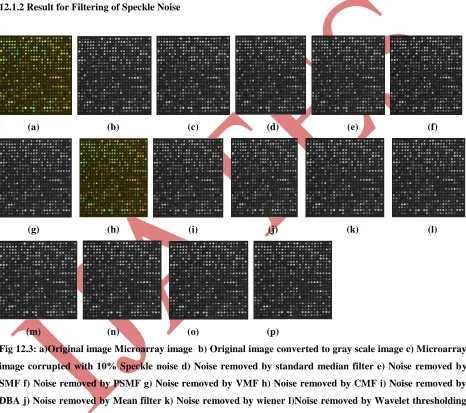
12.1.2 Result for Filtering of Speckle Noise
(a) (b) (c) (d) (e) (f)
(g) (h) (i) (j) (k) (l)
(m) (n) (o) (p)
Fig 12.3: a)Original image Microarray image b) Original image converted to gray scale image c) Microarray
image corrupted with 10% Speckle noise d) Noise removed by standard median filter e) Noise removed by
SMF f) Noise removed by PSMF g) Noise removed by VMF h) Noise removed by CMF i) Noise removed by
DBA j) Noise removed by Mean filter k) Noise removed by wiener l)Noise removed by Wavelet thresholding
using Haar coefficient m) Noise removed by DB4 n) Noise removed by Sym4 o)Noise removed by coif4
262 |
P a g e
Table12.7: MSE for Different Density of Speckle Noise in Microarray Image
Filter
Speckle Noise
5% 10% 20% 30% 40% 50% 60% 70% 80%
MF 51.760 59.830 68.920 76.220 81.547 85.728 87.948 91.648 93.700
SMF 45.967 59.861 72.946 82.133 88.198 90.410 90.503 91.393 91.724
PSMF 45.300 65.645 84.936 94.476 100.30 104.28 106.22 109.43 111.05
VMF 51.728 60.119 68.565 77.349 82.490 84.066 88.718 63.530 93.511
CMF 51.400 59.404 68.157 73.108 76.338 78.447 80.588 81.906 82.812
DBA 45.979 59.886 72.938 82.097 88.164 90.351 90.455 91.266 91.516
Mean 42.053 44.802 48.461 53.475 55.604 57.987 57.285 58.320 57.748
WF 35.298 39.428 43.863 48.824 51.756 54.086 54.125 55.383 55.031
Wavelet based Denoising using coefficients as:
Haar 54.140 55.559 56.761 59.090 59.513 60.083 59.294 58.877 57.977
DB4 54.347 56.582 58.373 61.760 62.262 61.866 61.279 60.690 59.572
Coif4 53.068 55.829 57.995 61.158 61.675 61.623 61.029 60.133 59.085
Sym4 53.669 56.031 57.939 61.075 61.721 61.312 60.867 60.337 59.121
Bior3.3 51.839 54.594 57.633 61.047 62.749 64.200 63.037 63.530 62.249
From the table 13.7 the Weiner Filter gives less MSE value.
Table12.8: PSNR for Different Density of Speckle Noise in Microarray Image
Filter
Speckle Noise
5% 10% 20% 30% 40% 50% 60% 70% 80%
MF 30.990 30.361 29.747 29.310 29.016 28.799 28.688 28.509 28.413
SMF 31.506 30.359 29.500 28.985 28.676 28.568 28.564 28.521 28.506
PSMF 31.569 29.958 28.839 28.377 28.117 27.948 27.868 27.739 27.675
VMF 30.993 30.340 29.755 29.246 28.966 28.884 28.650 30.101 28.422
CMF 31.021 30.392 29.795 29.491 29.303 29.185 29.068 28.997 28.949
DBA 31.505 30.357 29.501 28.987 28.677 28.571 28.566 28.527 28.515
Mean 31.892 31.617 31.276 30.849 30.679 30.497 30.550 30.472 30.515
WF 32.653 32.172 31.709 31.244 30.991 30.799 30.796 30.697 30.724
Wavelet based Denoising using coefficients as:
Haar 30.795 30.683 30.590 30.415 30.384 30.343 30.400 30.431 30.498
DB4 30.779 30.604 30.468 30.223 30.188 30.216 30.257 30.299 30.380
Coif4 30.882 30.662 30.496 30.266 30.229 30.233 30.275 30.339 30.416
Sym4 30.833 30.646 30.501 30.272 30.226 30.255 30.286 30.325 30.413
263 |
P a g e
From the table 12.8 The Weiner Filter gives high PSNR value which performs better as filtering technique.Table12.9: MSSIM for Different Density of Speckle Noise in Microarray Image
Filter
Speckle Noise
5% 10% 20% 30% 40% 50% 60% 70% 80%
MF 0.6923 0.6954 0.6641 0.6330 0.6036 0.5781 0.5568 0.5320 0.5142
SMF 0.8066 0.7128 0.5921 0.5162 0.4641 0.4357 0.4146 0.3973 0.3886
PSMF 0.7146 0.5891 0.4532 0.3864 0.3441 0.3214 0.3055 0.2905 0.2836
VMF 0.6909 0.6920 0.6630 0.6322 0.6016 0.5798 0.5488 0.5736 0.5145
CMF 0.6657 0.6828 0.6862 0.6781 0.6667 0.6474 0.6330 0.6204 0.6088
DBA 0.8065 0.7127 0.5920 0.5161 0.4637 0.4353 0.4142 0.3969 0.3876
Mean 0.6820 0.7047 0.7199 0.7115 0.7018 0.6878 0.6805 0.6654 0.6558
WF 0.7154 0.7310 0.7365 0.7240 0.7054 0.6894 0.6768 0.6603 0.6479
Wavelet based Denoising using coefficients as:
Haar 0.4440 0.4406 0.4388 0.4302 0.4312 0.4242 0.4257 0.4199 0.4259
DB4 0.5670 0.5643 0.5530 0.5465 0.5476 0.5444 0.5436 0.5350 0.5404
Coif4 0.5936 0.5949 0.5884 0.5855 0.5884 0.5822 0.5813 0.5744 0.5803
Sym4 0.5581 0.5578 0.5513 0.5474 0.5521 0.5467 0.5460 0.5390 0.5458
Bior3.3 0.5873 0.5936 0.5893 0.5838 0.5834 0.5790 0.5809 0.5736 0.5707
From the table 12.6 the Switched Median Filter performs better for there are near to 1 which means that the
image similarity to that of the original image is closer.
XIII. CONCLUSION
The scope of the paper is to retrieve the image after Denoising. The implementation was carried out using
Matlab 2011b. The Noise that was considered in the project is Salt and Pepper, Gaussian and Speckle noise. The
different filtering techniques were implemented to evaluate the performance of their noise removal in real
application images.
The image quality analysis parameters used in the project are MSE PSNR and MSSIM values. The
performance evaluation is done on the criteria that MSE value should be low and PSNR value should be high then
quality of image retrieving high, in the case of the gray scale images the value for PSNR ranges from 30 to 50 for
good performance of the image. The structural similarity of the image tested obtained after denoising which was
compared with the original image without noise. The MSSIM parameter for good quality of the image value should
264 |
P a g e
The result analysis shows that to remove the Salt and Pepper noise, the Decision based algorithm andSwitched Median Filter yields better performance. Similarly for Gaussian noise and Speckle noise the Wavelet
Transform obtained better removal noise. The MSSIM value is high for less noise density, whereas for high density
of the noises the perceptual image quality performance is poor. This paper achieves in evaluating to find the better
noise removal technique in real time applications.
13.1 Future Enhancement
This paper can further extended by implementing using different filters and it can be implemented in
hardware simulation using FPGA. Using the hardware implementation in the future may give a perfect
reconstruction using Wavelet Transform. Further implementation can be carried out for Edge detection,
Segmentation, or Pattern Recognition were for all these methods denoising is the preprocessing method. The
filtering techniques can be applied to the real application medical images.
REFERENCES
[1] M. Ki Kerr M. K, Martin M, and Churchill G. A.”, Analysis of variance for gene expression Microarray
data”, Journal of Computational Biology, vol No. 7, pp No. 819–837, 2001.
[2] Augenlicht, L. H. and Kobrin, D, “Cloning and screening of sequences expressed in a mouse colon tumor”,
Cancer Research, Vol No. 42, pp. 1088-1093, 1982.
[3] Augenlicht, L. H, Wahrman, M. Z, Halsey, H, Anderson L, Taylor J and Lipkin, “Expression of cloned
sequences in biopsies of human colonic tissue and in colonic carcinoma cells induced to differentiate in vitro
M.22”, Cancer Research, Vol No. 47, pp No. 6017-602, 1987.
[4] Schena M, Shalon D, Davis RW, Brown PO, “Quantitative monitoring of gene expression patterns with a
complementary DNA microarray”, Science, Vol No 270, pp. 467 – 470, 1995.
[5] Robert S. H, “Microarray Image Processing: Current Status and Future Directions”, IEEE Transactions Nano
bioscience, Vol No 2, pp No. 173-175, 2003.
[6] Yuk Fai Leung and Duccio Cavalieri, “Fundamentals of cDNA microarray”, Data Analysis and trends in
Genetics, Vol.19, Issue No.11, pp No. 649-659, 2003.
[7] Pawan Patidar, Manoj Gupta, Sumit Srivastava and Ashok Kumar Nagawat “Image De-noising by Various
Filters for Different Noise”, International Journal of Computer Applications, Vol No. 9, Issue No. 4, pp No.
0975 – 8887, November 2010
[8] C. Mythili and Dr. V.Kavitha, “Efficient Technique for Color Image Noise Reduction”, The Research Bullet
in of Jordan ACM , V o l . 2, January 2011.
[9] Juan Zapata and Ramon Ruiz, “On Speckle noise reduction in Medical Ultrasound Images”, Recent advances
in signals and systems, pp No. 126-131, 2009.
[10] B. Smolka, R. Lukac and K.N. Plataniotis, “Fast noise reduction in cDNA microarray images”, IEEE, 23rd
265 |
P a g e
[11] S Indu, C Ramesh, “A noise fading technique for images highly corrupted with impulse noise”, InternationalConference on Computing: Theory and Applications, (ICCTA), pp. 627–632, 2007.
[12] Umesh Ghanekar “A Novel Impulse Detector for Filtering of Highly Corrupted Images “ World Academy of
Science Engineering and Technology, Vol No.14, pp No. 352-355, 2008.
[13] Pei-Eng Ng and Kai-Kuang Ma, “A switching median filter with boundary discriminative noise detection for
extremely corrupted images”, IEEE Transaction on Image Process. Vol No. 15, Issue No. 6, pp No. 1506–
1516, 2006.
[14] J Xia, J Xiong, X Xu and Q Zhang, “An efficient two-state switching median filter for the reduction of
impulse noises with different distributions”, 3rd International Congress on Image and Signal Processing
(CISP), Vol No. 2, pp.639–644, 2010.
[15] W.Zhou and D.Zhang, “Progesssive Switching median filter for the removal of impulse noise from the highly
corrupted images”, IEEE transactions on circuits and systems II. Analog and Digital Signal Processing, Vol.
46, pp.78-80, 1999.
[16] R. Lukac, “Adaptive vector median filtering”, Pattern Recognition Letters, Vol No. 24, pp No. 1889–1899,
2003.
[17] K. Manglem Singh and P. Bora. Adaptive vector median filter for removal impulses from color images.
ISCAS ’03. Proceedings of the International Symposium on Circuits and Systems, Vol No. 2, pp No. 2:II–
396–II–399, may2003
[18] V.AnjiReddy and J.Vasudevarao, “Improved vector median filter for high density impulse noise removal in
microarray images,” Global journal of computer science, online ISSN: 4172 and print ISSN:
0975-04350, Vol No. 12, Issue No. 2, pp. No 37-40, January 2012.
[19] Harish and M.R.Gowtham, “The Component Median Filter for Noise Removal in Digital Images”
International Journal of Engineering Trends and Technology (IJETT), ISSN: 2231-5381, Volume 4, Issue 5,
pp. No 1830-1836, May 2013.
[20] Anisha Bhatia, “Decision Based Median Filtering Technique To Remove Salt And Pepper Noise In Images”
Proceedings of ITR International Conference, ISBN: 978-93-82702-26-9, 18th August 2013.
[21] Windyga S. P, “Fast Impulsive Noise Removal”, IEEE transactions on image processing, Vol. 10, No. 1,
pp.173-178, 2001.
[22] Jappreet Kaur, Manpreet Kaur, Poonamdeep Kaur and Manpreet Kaur, “Comparative analysis of Image
denoising Technique”, ISSN: 2250-2459, Vol No.2, Issue No.16, pp No. 296-298, 2006.
[23] S.Kother Mohideen, Dr. S. Arumuga Perumal and Dr. M.Mohamed Sathik. “Image De-noising using Discrete
Wavelet transform”, IJCSNS International Journal of Computer Science and Network Security, Vol No .8, Issue No.1, January 2008.
[24] S. Grace Chang, Bin Yu and M. Vattereli, “Adaptive Wavelet Thresholding for Image Denoising and
Compression”, IEEE Transaction Image Processing, Vol No. 9, pp. 1532-1546, September 2000.
[25] K.S.Srinivasan, and D.Ebnezer, “A New Fast and Efficient Decision based Algorithm for Removal of High
266 |
P a g e
[26] Madhu S. Nair, K. Revathy, and Rao Tatavarti, “Removal of Salt-and Pepper Noise in Images: A NewDecision-Based Algorithm”, Proceedings of the International MultiConference of Engineers and Computer
Scientists 2008 (IMECS 2008), ISBN: 978-988-98671-8-8, Vol No.1, March, 2008.
[27] Zhou Wang, Alan C. Bovik, Hamid R. Sheikh and Eero P. Simoncelli, “Image Quality Assessment: From
Error Visibility to Structural Similarity”, IEEE Transactions On Image Processing, Vol No. 13, Issue No. 4,
April 2004.
[28] R.Alagesan, and M.A.P.Manimekalai, “An Impressive Method to Remove High Density Salt-And-Pepper
Noise from Microarray Image” International Journal of Advanced Research in Electronics and
Communication Engineering (IJARECE), ISSN: 2278-909X, vol 2, issue 3, pp. No 337-340, March 2013.
[29] Hari Om and Mantosh Biswas, “A New Image Denoising Scheme Using Soft-Thresholding”, Journal of
Signal and Information Processing, Volume.3, pp.360-363, August 2012.
[30] Akhilesh Bijalwan, Aditya Goyal and Nidhi Sethi, “Wavelet Transform Based Image Denoise Using
Threshold Approaches”, International Journal of Engineering and Advanced Technology (IJEAT), ISSN:
2249 – 8958, Volume 1, Issue 5,pp. No218-221, June 2012.
[31] Sachin D Ruikar and Dharmpal D Doye “Wavelet Based Image Denoising Technique“, International Journal
of Advanced Computer Science and Applications, Volume. 2, Issue. 3, pp. No: 49-53, March 2011.
[32] Dagao Duan and Qian Mo, “A detailed preserving filter for impulse noise removal”, computer application
and system modeling (ICCASM), print ISBN: 978-1-4244-7235-2, Volume.2, pp. No: v2-265 - v2-268,
October 2010.
[33] James Church, Dr. Yixin Chen, and Dr. Stephen Rice “A Spatial Median Filter for Noise Removal in Digital
Images” proceedings of IEEE, vol .10, pages(s) 618-623, 2008
[34] S. Md. Mansoor Roomi , T. Pandy Maheswari and V. Abhai Kumar “A Detail Preserving Filter for Impulse
Noise Detection and Removal “ ICGST-GVIP Journal, Volume 7, Issue 3, pages(s) 51-56, November 2007.
[35] Anil K. Jain,”Fundamental of Digital Image Processing”, Published by Pearson Education, 2009.
[36] Rafael C. Gonzalez, Richard E. Wood and Steven L. Eddins, “Digital Image Processing using MATLAB,
Published by Pearson Education,2005.
[37] K. P. Soman, K. I. Ramachandran and N. G. Resmi, “ Insight into Wavelets from Theory to Practice”,
Pearson Education, third edition, 2011.
[38] Smolka B, Plataniotis and K.N. Venetsanopoulos A.N, “Nonlinear techniques for color image processing”,