Neural Network Programming
and
Portability
A rum u gam Siri Bavan
A thesis submitted for the degree o f
D octor o f Philosophy
o f the
U niversity of London
D ep artm en t o f C o m p u ter Science
U n iv ersity C ollege L ondon
ProQuest Number: 10609979
All rights reserved
INFORMATION TO ALL USERS
The qu ality of this repro d u ctio n is d e p e n d e n t upon the q u ality of the copy subm itted.
In the unlikely e v e n t that the a u th o r did not send a c o m p le te m anuscript and there are missing pages, these will be note d . Also, if m aterial had to be rem oved,
a n o te will in d ica te the deletion.
uest
ProQuest 10609979
Published by ProQuest LLC(2017). C op yrig ht of the Dissertation is held by the Author.
All rights reserved.
This work is protected against unauthorized copying under Title 17, United States C o d e M icroform Edition © ProQuest LLC.
ProQuest LLC.
789 East Eisenhower Parkway P.O. Box 1346
ABSTRACT
Artificial neural networks, inspired by the neural structure of the brain, is a rapidly expanding field of research based on algorithms to solve a wide spectrum of tasks including speech recognition, image processing, planning, optimisation and other pattern processing tasks. Although a growing number of neural models have been developed to support a variety o f applications, neural network programming is still mainly done using conventional languages.
This thesis investigates the problems concerned with the programming o f neural network models and their portability. The main goal of this thesis is to propose and develop a programming system that can facilitate the implementation of a range o f neural network models on a range of hardware. This led to the design and implementation of a programming system called NPS, and a specialised neural network implementation language called NIL. NIL, which forms the neucleus of the programming system NPS, is a low level, machine independent network specification language designed to map a spectrum o f neural models onto a range of architectures and thus supporting portability.
The neural network programming system NPS provides the user with a system consisting of:
• A programming language, NIL, to specify network models. • A utility, to save partially trained networks for further training.
• Libraries o f functions and algorithms, to aid the network construction and the execution o f standard models.
The neural network programming language NIL consists of two major components: • A network implementation sub-language, which provides mechanisms for
specifying the functions of the nodes and the interconnection topology of the network.
• A manipulation sub-language, which provides interactive control and modification facilities for use during the training and the recall phase of the network.
These sub-languages together produce a low level, machine independent network specification language that can be used to port neural network models.
To My Parents
Acknowledgem ents
The completion of this work owes much to many people. Firstly, I would like to express my gratitude to my supervisor - Prof. Philip Treleaven - for his guidance, constructive criticism, and help throughout the duration o f this research. Secondly, I would like to thank my second supervisor - Dr. M Lee - for his support and advice during this research.
I also acknowledge my colleagues in the Computer Science Department at University College London for their advice and constructive criticism. Especially, I wish to thank Marco Pacheco, Dr. Andrew Eliasz, and Dr. Chang Wang for reading the earlier versions of this thesis and making positive suggestions.
I am very much indebted to Science and Engineering Research Council (SERC) for their financial support during the first two years of this research project. I am also grateful to my research tutors - Charles Easteal and Dr. Russel W inder - and the Department of Computer Science at University College for the support and generosity shown towards me.
CONTENTS
1. I n t r o d u c t i o n ... 1
1.1 Neural C o m p u tin g ... 3
1.1.1 Artificial Neural Networks ... 4
1.1.2 Neural Network M o d e l s ... 7
1.2 Programming Systems for Neural Network ... 9
1.2.1 P o r t a b i l i t y ... 11
1.2.2 Programmability ... 12
1.3 Aims and Background to R e s e a r c h ... 13
1.3.1 NPS and NIL ... 14
1.4 Outline o f the T h e s i s ... 18
2. Neural Network Programming S y s t e m s ... 19
2.1 Classification o f Neural Network Programming Systems ... 20
2.1.1 Educational s y s t e m s ... 20
2.1.2 Research s y s t e m s ... 22
2.1.3 Commercial s y s t e m s ... 31
2.2 A s s e s s m e n t ... 36
3. The Neural Network Programming System, N P S ... 39
3.1 The Implemented S y s t e m ... 44
4. The Network Implementation Language, N I L ... 50
4.1 Motivations and R e q u i r e m e n t s ... 50
4.2 K e y w o r d s ... 53
4.3 Brackets and S e p a r a t o r s ... 53
4.4 Constant-Valued T o k e n s ... 53
4.5 Syntax and T y p i n g ... 54
4.6 A Network Implementation Language - N I L ... 54
4.6.1 The Network Specification S u b - L a n g u a g e ... 55
4.6.1.1 Link S ta te m e n ts ... 55
4.6.1.2 Definition of f u n c t i o n s ... 59
4.6.1.3 Output From C o m p ila tio n ... 64
4.6.2 Manipulation S u b - L a n g u a g e ... 64
4.6.2.2 Reading Inputs from Nodes ... 6 6
4.6.2.3 Reading Data from a F i l e ... 67
4.6.2.4 Creation and Deletion of L i n k s ... 67
4.6.2.5 Loading Initial Values on to the Input Links . . . . 68
4.6.2.6 Outputting R e s u l t s ... 68
4.6.2.7 Feeding New I n f o r m a t io n ... 69
4.6.2.8 Deleting and Creating N o d e s ... 69
4.6.2.9 Saving and Reloading N e t w o r k ... 70
4.6.2.10 Executing the N e t w o r k ... 70
4.6.2.11 Stopping and S t a r t i n g ... 71
4.6.2.12 Loops and C o n d i t i o n s ... 71
4.7 Semantic Properties ... 71
5. Implementation o f NPS and N I L ... 72
5.1 Implementation o f N I L ... 73
5.2 The NIL Translator ... 73
5.2.1 The Virtual (C-Machine) M a c h i n e ... 74
5.2.2 The Implementation of the Manipulation P a r t ... 77
5.3 The Prototype C o m p i l e r ... 78
5.3.1 Data Structures for U C L -N e u ro c o m p u te r... 79
5.4 Implementation o f N P S ... 81
6. Assessment of NPS and N I L ... 83
6.1 Assessment of N I L ... 83
6.1.1 Programmability ... 84
6.1.1.1 Specification of M odels... 84
6.1.1.2 Dynamic Properties of NIL ... 94
6.1.1.3 NIL as an Intermediate Language and its R e u s a b i l i t y ... 94
6.1.1.4 Comparison with another Language in its C l a s s ... 96
6.1.2 P o r t a b i l i t y ...100
6.1.2.1 Target machine in d e p e n d e n c e ... 100
6.1.2.2 Occam and N I L ...100
6.1.2.3 Translating high level languages into N I L ... 102
6.2 Assessment of NPS ...114
6.2.1.1 U s a b i l i t y ... 114
6.2.1.2 F a c i l i t i e s ... 115
6.2.1.3 S im p lic ity ... 116
6.2.2 P o r t a b i l i t y ... 116
7. S u m m a r y ... 117
7.1 C o n t r i b u t i o n s ... 118
7.1.1 P o r t a b i l i t y ... 118
7.1.2 Programmability ... 118
7.2 Future W o r k ... 119
R E F E R E N C E S ... 122
APPENDIX A - Syntax Definition of N I L ...127
APPENDIX B - Sample NIL P r o g r a m s ... 130
APPENDIX C - Comparison o f NIL with B I F ...147
APPENDIX D - Sample Output from the C o m p i l e r ... 163
APPENDIX E - C Representation of the Virtual Machine ...169
U S T OF FIGURES
Figure 1. Idealized View o f a Biological Neuron ... 3
Figure 2. Typical Artificial N e u r o n ... 5
Figure 3. Artificial Neural Network ... 6
Figure 4. A Simplified View of Network Programming 9
Figure 5. A Generalised Neural Network Programming System . . . . 10
Figure 6. Neural Network Programming System, NPS ... 15
Figure 7. A Typical Development Process in ANNE 26
Figure 8. SFINX Environment 28
Figure 9. CONE System 29
Figure 10. Neural Network Programming System, NPS 40
Figure 11. The Implemented System ... 45
Figure 12. UCL Neurocomputer ... 47
Figure 13. UCL N e u r o - C h i p ... 48
Figure 14. A Simple Network 56
Figure 15. Sequential Replication 56
Figure 17. A Regular Network 58
Figure 18. The Computational Model 60
Figure 19. NIL Translator ... 75
Figure 20. The C-Machine ... 76
Figure 21. A Node 76
Figure 22. An I/O Vector 76
Figure 23. Elements o f an I/O Vector 77
Figure 24. The Prototype Compiler 78
Figure 25. Structure o f a Node Program ... 79
Figure 26. Organisation of the Input Data 80
Figure 27. Organisation of the Output Data 81
Figure 28. Hebb/Hopfield Network 85
Figure 29. Exclusive OR Network 90
Figure 30. Kohonen’s Feature Map 92
LIST OF TABLES
TABLE I. A Classification of Neural Network M o d e l s ... 7
TABLE 2. Educational N N P S s ... 21
TABLE 3. Research N N P S s ... 23
TABLE 4. Commercial N N P S s ... 32
TABLE 5. K e y w o r d s ... 53
TABLE 6. Initial W e i g h t s ... 88
TABLE 7. Weights for Nodes in Hidden and Output L a y e r s ... 91
TABLE 8. Model_Names Table ... 108
TABLE 9. Network Layers for Model 1 ... 108
TABLE 10. Node Interface for Type I n p u t ... 108
TABLE 11. Node Interface for Type H i d d e n ...109
TABLE 12. Node Interface for Type O u t p u t ... 109
TABLE 13. N ode_l [1] - Node 1 of Layer 1 ... 109
TABLE 14. N ode_l [2] - Node 2 o f Layer 1 ... 110
TABLE 15. N ode_l [3] - Node 3 of Layer 1 ... 110
TABLE 17. Node_2[2] - Node 2 of Layer 2 ... I l l
TABLE 18. Node_2[3] - Node 3 o f Layer 2 ... I l l
TABLE 19. N ode_3[l] - Node 1 o f Layer 3 ... 112
TABLE 20. Node_3[2] - Node 2 o f Layer 3 ... 112
TABLE 21. Node_3[3] - Node 3 o f Layer 3 ... 112
TABLE 22. N ode_2[l] - Node 1 o f Layer 2 ... 113
TABLE 23. Node_2[2] - Node 2 o f Layer 2 ... 113
TABLE 24. Node_2[3] - Node 3 o f Layer 2 ... 114
TABLE 25. Weights for Nodes in Hidden L a y e r ...160
Chapter 1
This chapter introduces the research work conducted and the important background
concepts. These include an introduction to neural computing, and an investigation o f programming and portability o f neural network models and applications.
1. Introduction
The work described in this thesis represents a precursor of the PYGMALION project [Ange89] funded by ESPRIT II (project 2059) to build a general purpose neurocomputing platform (both programming environment and hardware). PYGMALION is a collaboration of major industrial and academic partners in Europe to produce a number o f applications, a programming environment and hardware to promote the exploitation of neural network technology.
Typically a neural network programming system consists of an integrated set of software and hardware tools for specifying and executing neural network models and applications. The major components of a typical system are:
• an algorithms library o f common neural network models;
• a special purpose high level language for programming network algorithms and applications;
• a graphic monitor for interactively building and controlling a network.
For programming neural networks, many current neural network programming systems provide a specialised language. These languages are usually very high level, often object oriented and with a C or Pascal syntax [Anza87, Guts8 8, Ange8 8] together with data types and functions specifically for neural networks. These high level languages are good for programming neural network applications, but frequently their portability is limited to a few machines due to the complexity of writing translators. In addition, these languages often do not have the explicit constructs or the structural features (such as explicit connectivity, parallel control, and specialised data structures) which are necessary for the efficient mapping of algorithms on parallel hardware.
particularly useful since C is a sequential language and hence will require excessive overheads to isolate codes that can be executed in parallel. This is due to the lack of explicit parallel control constructs or explicit parallel structure defining connectivity which are essential for isolating components that can be distributed and executed in parallel.
What we believe is required is a language with the following features:
1. Programmability: It must be general enough to be able to capture the features o f a range of neural (and semantic) network models. That is, it must be model independent. It must be a readable language so that the specification and testing of these models is easy. It must be based on a simple and general syntax and semantics so that complex models can be easily supported.
2. Portability: It must be based on simple syntax and semantics so that it can be used as a low level target language for higher level neural programming languages. By this, we mean that it should be almost at the same level as OCCAM to capture the general features o f sequential and parallel machines and hence support portability. This also implies that it must be simple to translate into assemblers of a range o f machines. This language should either have explicit parallel constmcts or features such as explicit connectivity and structure to support parallelism.
To put it more broadly, what we need is a language which is:
1. readable and expressive enough to be a programming language for implementing neural network models and applications;
2. simple and low level enough to be easily translated for a range of hardware;
3. simple and general enough to be a target language for higher level languages.
This thesis investigates the program m ability and portability of neural network models and their applications. Our main goal is to design and implement a neural network implementation language that can be both portable and programmable. In order to demonstrate the feasibility of our solution, that is, to demonstrate the capabilities of the language we use a simplified version of a programming system called NPS. The main purpose in designing and implementing NPS is to use it as a test-bed for assessing the
by providing a number o f support tools, it is NIL which tries to facilitate the programming of a range o f neural network algorithms and mapping of these algorithms on a range of hardware.
Having briefly stated the motivations and the goals of this thesis, the next section introduces the reader to neural computing as a prelude to subsequent sections which deal with programming systems for neural networks, and the aims and background o f this research.
1.1 N eural C om puting
Since the motivation for neural computing is biological neural networks, it is useful to review the properties of biological neural networks before introducing artificial neural networks. The brain deals with pattern matching and pattern manipulation with ease and efficiency that no electronic computer of the present generation can match. The brain performs these tasks not through a more powerful computational device in a sequential fashion but in a parallel fashion using a large network o f much slower primitive devices called neurons (or nerve cells). The brain is believed to be organised in a hierarchy with successively higher layers performing more complex and abstract operations on the input data. Each layer performs its processing of the input data before passing the result up to the next layer.
The neurons are the "processing elements" o f the brain. The human neocortex contains over 10 billion neurons with each neuron connected to thousands o f other neurons. The brain contains a vast number of different types of neurons each with slightly differing structure and properties [Shep79].
Dendrites Inputs
Summer
Figure 1 shows a "biological" neuron which has:
• several dendrites, which receive input from other neurons;
Soma
>ses
Axon Threshold Output
• a cell body, called the soma, which performs some processing (typically a threshold summation) on the information collected by the dendrites;
• a single axon which outputs the processed information, usually by the propagation o f a "spike" or action potential. The axon splits into various branches that make synapses onto the dendrites and cell bodies of other neurons. Artificial neural network modelling started in the early 1940s by Professor Warren McCulloch and Dr W alter Pitts [Rum8 6b]. This initial work on neural network modelling was given a significant encouragement in 1949 when Donald Hebb [Hebb49], published a paper postulating that learning in the brain may be achieved through the changing of the strength of these synaptic junctions. Specifically the more a particular synapse is used or activated, the stronger that connection becomes. This is termed
synaptic facilitation. As a result, a particular pattern, once established and learnt, can easily be refreshed in the future. It is this general principle that is the basis of artificial neural networks.
In 1957 Rosenblatt created a neural model called the perceptron [Rum8 6b] which showed remarkable promise as a computing device. The perceptron brought many people into the field of neural networks and generated great enthusiasm, until in 1969 Minsky and Papert published a book [Mins69] that showed the inadequacies o f the perceptron. They were so convincing that the research into neural computing slumped markedly, until in 1980 Hopfield produced a paper [Hopf82] that showed the potentials of the collective computational abilities of neural networks. Since then research into neural networks has expanded rapidly. During the past few years, there has been a great deal o f research into computational models which are inspired by the brain to deal with pattern recognition problems. These models are simply known as neural models and have been used in a number of applications with reasonable degree o f success. However, there is a great deal to be learnt about the real neural model in order to be able to produce a more efficient and meaningful model that can be nearly as good as the original one.
In the next section a brief introduction to artificial neural networks is presented which is followed by an overview of the common models and their properties. This is done so in order to give a clear view o f the type of processing that is required by a neural network programming system.
1.1.1 Artificial N eural N etw orks
two reasons why one would want to do this:
1. by using techniques inspired by the brain one hopes to solve pattern and image processing problems much more efficiently than by using the current methods.
2. it is also hoped that these neural models will lead to more powerful and fault tolerant hardware.
Current neural models are still extremely simple when compared with the brain, and use a simple summation and threshold device as the basic processing element in a layered network. A typical artificial neuron has a single output and several inputs, usually one from each neuron in the preceding layer.
Artificial neurons are the fundamental building blocks of neural networks. As shown in Figure 2, a neuron takes a set of inputs X, which are the equivalent o f the excitation or the inhibition signal levels of a neuron.
OUT
Figure 2. Typical Artificial Neuron
These are then acted upon by a set of associated weights W-, which correspond to the synaptic strengths of a neuron. The weighted sum of these inputs is then compared with a threshold value and an output is delivered depending on the result of thresholding. The weighting factors are analogous to the synaptic strengths.
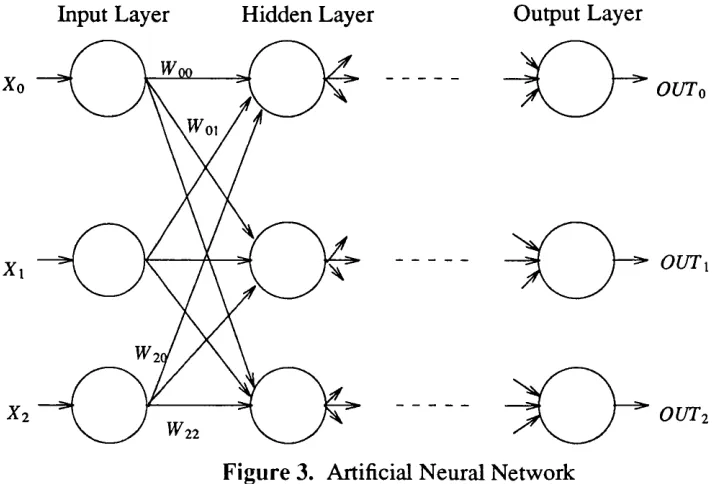
The artificial neurons are usually connected in a simple layered structure. Most models consist of either two or three layers of neurons since it has been shown that any continuous mappings can be achieved by a three layered system [Hect87]. The network shown in Figure 3 is a multi-layer network where each input X, to a neuron N }, in a layer
Input Layer Hidden Layer Output Layer
OUT i
^ O U T2
OUT o
F igure 3. Artificial Neural Network
next layer until a final set of outputs is generated. Multi-layer networks have proved to be more broadly applicable and general than single-layer networks [Wass8 8] because of their abilities to map any input to output patterns and capture the underlying features of the data space.
These networks can learn to map a specified input pattern to a specified output pattern. Once a mapping has been learned the network will provide the required output pattern when supplied with the appropriate or part of the appropriate input pattern.
is to the originally learned input pattern the better the chance that the correct output pattern will be selected.
1.1.2 N eural N etw ork Models
Over the past few years the research efforts in neural networks have produced a number of neural network models. Some of these models namely, Hebb/Hopfield [Hopf82], Boltzmann [Hint85, Hint8 6], Kohonen’s self-organising feature map [Koho84], Adaptive Resonance (ART models) [Gros8 8] and Back-Propagation [Rum8 6c] have become popular because of their applicability to practical problems. These neural network models in general can be classified into three major categories. They are associative memories, weak-constraint optimizers, and learning systems as shown in Table 1.
N eural N etw ork M odels
Associative Memories
Weak-Constraint Optimizers
Learning Systems
Supervised Unsupervised
examples: Hopfield Models Kosko’s BAM
examples:
Boltzmann Machine Hopfield/Tank Model examples: Back Propagation Boltzmann Machine examples ART Models Self-organising Map
T ABLE 1. A Classification o f Neural Network Models
In associative m em ories, the memory is organized as a storage o f pattern vectors. Presentation o f a part o f one of these stored vectors will enable the system to recall that whole vector. These Vector patterns are distributed and stored in the connections of the network. The values stored in these connections are simply referred to as connection weights and are calculated using some fairly simple non-iterative algorithms. Adaptive learning is usually not possible in such a system because all the pattern vectors must be stored at the same time. Later storage of an additional vector will necessitate the process of storing all the vectors again. In this respect, it is rather like a conventional programmable-read-only-memory (PROM). However, the aim here is to build fast- access fault and noise tolerant associative memories using networks of simple processing elements similar to neural networks. The binary Hopfield [Hopf82] model is a recent example of such models.
Typical neural network optimisation models include the Boltzmann Machine [Aart8 6] and the analog Hopfield model [Hopf85].
L earnin g system s are probably the most commonly used systems in neural networks. There are two major types of learning systems, namely, supervised and
unsupervised learning systems.
In supervised learn in g models the learning process is governed by a set of training pairs. A training pair is formed by an input vector and a desired output vector. The difference between the target output and the output the neural network produced constitutes an error. The learning process seeks to reduce this error by modifying the connection weights in a similar fashion as in a typical relaxation scheme. The multi layer perceptron with Back error Propagation and the Boltzmann Machine are well known examples of this kind. Their learning mles have their origin in the H ebb’s rule of learning (or some variations of it) which states the connection between two nodes that are highly activated at the same time should be strengthened. Basically, the change in the weight of a connection is proportional (with a proportionality constant k — the so called learning rate) to the product of source and destination neuron activation states: i.e Wu (t-+1) = Wij (t) + k*A; *Aj
In unsupervised learn ing models there is no "specified" target output; the neural network organises itself by applying some rules. This means that the network is only given input data and is expected to organise itself into some useful configuration in response to it. Such models grew out of an analysis of a simpler type o f adaptive pattern recognition network, often called Competitive Learning [Rume8 6]. Its development has lead to different models. One o f these as defined by Grossberg in [Gros8 8] corresponds to neural networks that self-organises stable recognition codes in real time in response to arbitrary sequences of input patterns. Rumelhart and Zipser have developed another model in [Rume8 6b] which is a regularity detection model. Their basic idea is that the set of units is divided into a number of disjoint clusters in which the units compete with one another in order to become active, i.e. to win the competition.
It should be noted that any supervised learning model (e.g. the Boltzmann Machine) can be converted into an unsupervised learning scheme by using the input itself to do the supervision. This kind of models have been used for image processing and speech recognition tasks [Hint84].
1.2 P ro g ram m in g System s for N eural N etw ork
Generally speaking, programming o f a neural network can be viewed as a two level process. They are:
• specification of the network topology and the functions o f the neuron. • execution of the network.
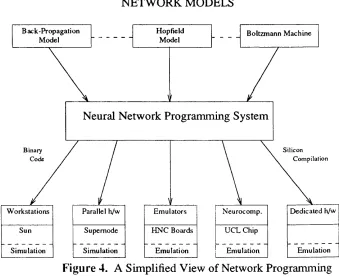
The role of the neural network programming system is to provide the user with facilities to accomplish these two tasks. Typically, a neural network programming system is an integrated suite of software tools, and possibly associated hardware, which enable the user to specify the neural network and map it on to the hardware for execution. A simplified view of programming a neural network can be described by the diagram shown in Figure 4.
NETW ORK MODELS
B ack-Propagation H opfield B oltzm ann M achine
M odel M odel
Neural Network Programming System
Silicon C om pilation
W orkstations Parallel h/w Em ulators N eurocom p. Etedicated h/w
Sun Su p em od e H N C Boards U C L Chip
Sim ulation Sim ulation Em ulation Em ulation Em ulation
Figure 4. A Simplified View of Network Programming
What this diagram tells us is that a neural network programming system accepts neural network models as input and transforms them into a suitable form (eg:-binary code) and maps them on to the desired hardware for execution.
Typically a neural network programming system consists of four major components (see Figure 5). These are:
Graphics ^ ^ High Level ^ ^ Algorithms
Monitor Languages
J
Library4
A
Y
Intermediate Level Language
V Compilers
<
Target Machine Codes
Tmcl Tmc2 Tmcn
F igure 5. A Generalised Neural Network Programming System
learning. These can be configured for a specific user application by providing the necessary parameters.
• A g rap h ic m o n ito r - provides the facilities for the user to express the network models in the form o f a network graph which can be then translated into either a high level language program or an intermediate language for further translation and eventual execution. This also provides an easy way of controlling and monitoring the network at run time.
• A high level language system - this system (language + compiler) allows the user to specify algorithms in the form o f a high level description and compile it into either graphic or intermediate form for eventual execution.
intermediate language compiler can be dedicated to a particular hardware if the role of this language is to provide a common form of representation for a particular architecture or be a common representation such as a virtual machine
that can be mapped on a range of hardware architectures.
O f these major components, the algorithms library, high level language, and the graphic monitor can be classified as programming tools. These are there to aid the user to communicate with the hardware system. On the other hand, the intermediate language serves a different purpose, which is portability. By being able to represent the network in a simple and general form, it is able to support portability. It must also be said that the high level language also deals with the aspects of expressibility and portability.
Having briefly introduced a general neural network programming system let us now look at two o f the major problems associated with neural computing on the whole and the neural network programming system in particular. These are programmability
and portability. A good system should offer the user the facilities for programming a range of neural network models and mapping them on a range o f hardware. These two major issues are not uniquely associated with neural computing. These issues concern computing in general. But in the case of neural computing it is more important because of the cost involved in producing application packages which are commercially acceptable. The next two sub sections considers these two issues in greater detail and tries to evaluate their importance.
1.2.1 Portability
Portability is considered to be an important issue because:
1. The implementation of a neural network model consists of two phases namely, training, and recall. It is generally accepted that the training phase consumes an excessive amount of time. This suggests that it is economically wise to train a system on a fast computer and use a low performance machine for the recalling phase. This stresses the need for a portable system.
machines.
3. The ultimate aim o f neural network modelling is to develop practical applications for industrial use. In this context, an application developer wants to be able to have the constructed application made available across a wide class o f users with varying computer platforms. This again demands portability.
1.2.2 P rogram m ability
Programmability of a particular system concerns the provision of tools for easy and efficient programming. In the case o f neural computing, major tools which contribute to programmability are the implementation languages (high and low level) and graphic monitors. O f these two major tools, we believe that the languages are more important as they are the ones which offer more freedom in terms of expression and control. In neural computing, we believe that programmability should also include model independence. This leads us to consider the following issues:
1. Conventional languages - Conventional languages like C, C++, and OCCAM are being used to implement neural network models and applications in many programming systems. The main advantage in using these languages to implement neural networks is that most of the conventional machines have compilers available for these languages. The disadvantage in using these languages are that they do not have specialised features for efficiently implementing neural network models. In addition, although they are portable across a wide range of sequential machines their portability across parallel machines is restricted.
parallelism.
3. Specialised Low level languages - First of all, having a specialised low level language which is similar to an assembler may help to port the network models across a range of machines, but it may not contribute to programmability. What would be more suitable is a language that can be both a target level language as well as a programming language. This will offer the user the best of both worlds. In the case of neural network programming, it is useful to have the facility o f programming at the intermediate level. These requirements lead us to a specialised low level language which is at a similar level as OCCAM so that programmability can be achieved.
In conclusion, our aims namely, portability and programmability demands a programming system where the user has the choice o f a number o f high level languages which can be compiled down to a common intermediate representation (intermediate level language) that can be mapped on to a range of hardware. In addition, this language should have the necessary basic features so that it can be used as a low level programming language for implementing a range of neural network models.
Having considered the issues o f portability and programmability and identified their importance in neural computing systems, the next section states the goals o f this thesis and presents a brief description of the research carried out in order to reach those goals.
1.3 Aims and B ackground to R esearch
As mentioned earlier the work described in this thesis represents a precursor of the PYGMALION project [Ange89] funded by ESPRIT II (project 2059) aimed at producing a general purpose neural network programming environment and applications.
The research reported in this thesis on the portability and programmability of neural networks was undertaken in conjunction with a complementary project on neurocomputer architectures [Pach91]. They started in October 1986 and aimed at producing a general purpose neural computing platform that could support:
• a wide range of neural network models and hardware; • applications based on neural network techniques;
Firstly, a primitive processing element (PE) which was to be the basic element of a massively parallel computer that supported neural computing [Pach8 8] was designed. The design of this PE was completed jointly with another student by the latter part of April 1987 and forms the basis of another PhD project in VLSI design [Pach91]. This PE was simulated at the register transfer level and configured in an array to form a network o f processors. Then the design and implementation of a neural network programming system to aid the development of various applications based on neural network models was undertaken. This led to the design of a neural network programming system called NPS. Analysis of this design showed that there were basically two major areas to be investigated, namely, the higher level and low er level of the system. The higher level consists of high level language(s), algorithms library, and the graphics monitor(s) as major components. We believe that these tools falls into the category of human computer interactions and ample attention is being focussed on this area [Hood87]. The lower level is concerned with portability and programmability at the intermediate level. We believe that, portability is the least investigated area in neural network computing and there was a need to address this problem because of the diversity in the available hardware for executing neural networks. On the issue of programmability, what we are looking for is a low level language which is capable of implementing a range of neural network models (i.e - model independence) and expressive enough to also be a programming language at the intermediate /low level. Programmability at the intermediate/lower level is an important requirement in neural network computing due to its dynamic nature and computational complexity. This initiated the design and implementation of a specialised low level language whose main aims are to support portability and program m ability.
1.3.1 NPS and NIL
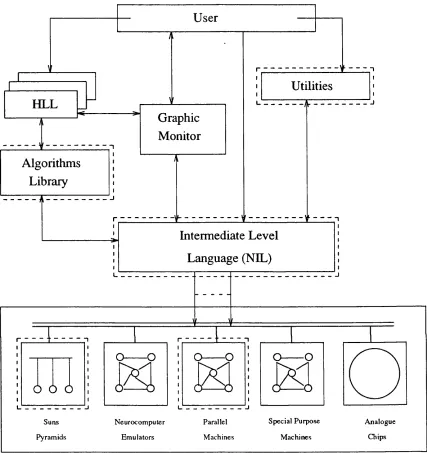
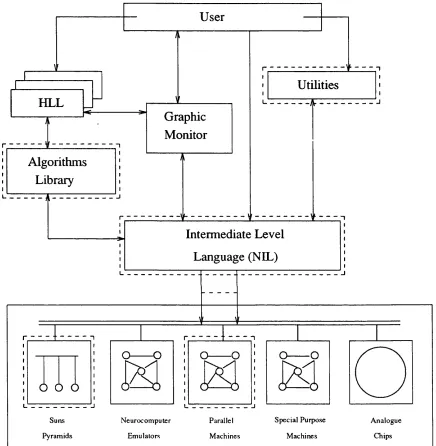
Having identified the major aims of the thesis, a full neural network programming system, NPS, was outlined. This system as shown in Figure 6 consists of:
• high level languages; a number of high level neural network programming languages (HLL).
• a graphic monitor for building and interacting with the running network.
User
i—
Utilities
HLL
i___ i-5
»-Graphic
Monitor
— i
--- v
---;
Algorithms
!
Library
U 1 --- i
i—
Intermediate Level
Language (NIL)
Sp ecial Purpose
M achines
A nalogu e
Chips
Suns N eurocom puter
Em ulators
Parallel
Pyramids M achines
Figure 6. Neural Network Programming System, NPS
• a utility system, comprising a set of useful tools such as context editors, debugging aids, and software to save the partially trained networks for further training and recall at a later time.
• an algorithms library, consisting of a set of popular models which can be executed by supplying the necessary parameters.
• a low level language, NIL, to build a spectrum of neural network models and applications and map them on a range of hardware.
• a utility, to save partially trained networks for further training and recall at a later time.
• a library, consisting of a set o f popular models which can be executed by supplying the necessary parameters.
• a facility, to generate a range o f target machine code for different architectures based on a simple virtual machine called the C-M achine.
• a neurocomputer architecture simulator based on the design specification mentioned in chapter 3. As part of the project, a compiler was implemented to map NIL on to this simulated architecture to test the practical feasibility o f mapping NIL on parallel hardware.
The main reason for including the C-Machine (a "C" based virtual machine) is to show that NIL can be mapped on to a range of conventional hardware. This is based on the fact that the majority of the currently available hardware (network of transputers, conventional machines such as Sun workstations, connection machine, and neural network hardware like HNC [Anza87]) support languages which use "C" language as their base.
The basic aim of the neural network programming system NPS as far as this thesis is concerned is to enable us to demonstrate the feasibility o f the proposed solutions by serving as a platform for demonstrating the portability and programmability aspects of NIL. This is why the currently implemented systen offers neither a high level language nor a graphic monitor.
NIL consists of two major components:
• A network implementation sub-language, which enables a network to be built by providing suitable statements for specifying the functions of the nodes and the topology of the network.
• A manipulation sub-language, which provides monitor, control and modification capabilities for the network.
The primary design aim o f the o f the network specification language NIL, is to support: • portability by being target machine independent.
• program m ability by being able to
a. represent a spectmm o f network models including neural networks (model independence).
b. express the connectivity and computations in a clear and concise manner.
c. to handle non-determinism. This is achieved by splitting the functions of a node into guarded processes and randomly selecting one o f the eligible processes for execution (see chapter 4).
The computational model on which NIL is based is formulated to support a variety of neural network models. NIL tries to provide capabilities such as implicit synchronisation and non-determinism to meet the basic needs of a network system and neural networks in particular.
NIL is believed to be capable of implementing a wide variety of network models in general and neural networks, and semantic networks in particular. We believe this general property is a significant advantage for the following reasons:
1. Being at the early stages of neural network modelling no one knows what the future models are going to be except that they will be based on network principles. So an intermediate network specification language should be general enough to represent network models o f any type to cater for the future needs.
2. Building applications based on neural network techniques may involve the use of different network models. This means that a general network language rather than a special purpose neural network language is useful in building such heterogeneous network systems.
1.4 O utline of the Thesis
Chapter 2
This chapter presents a survey o f systems fo r programming neural networks. This includes the descriptions o f some o f the well known systems. The main reason behind this survey is to ascertain the current state o f research in this area and to serve as a
background to our investigation o f neural network programming systems.
2. N e u ra l N e tw o rk P r o g ra m m in g S ystem s
The term "Programming Systems" refers to the collection o f software and hardware tools available to a system developer to build software systems. A neural network programming system provides facilities for network specification, testing and execution. These facilities may be provided in the form of a set of stand alone tools or as an integrated software/hardware package. A good programming system offers a systematic path for developing software by providing the necessary tools at every stage under a single environment. It is this approach that is adopted by most of the neural network programming systems for developing software [K0I0 8 8, Hans87, Paik87, Test8 8J. To specify and control the neural network most of the systems offer either a special purpose high level network specification and control language or a graphical system or both. Most of the debugging, run time control and manipulation is carried out with the aid of the control component o f this language and its graphical counter part. Apart from offering these high level tools as basic facilities and a few minor aids, the majority of the existing systems do not offer anything radical in the way of a debugging tool for parallel systems or intermediateAow level programming. Most of these systems are also dedicated to particular hardware. That is, they generate executable code for a specific hardware.
A few of these neural network programming systems have an intermediate level language so that the high level description of a network can be commonly represented in this form for further translation and execution on different machines.
2.1 Classification of N eural N etw ork P ro gram m in g Systems
Currently, neural network simulations are mainly done using tools which were developed for traditional computing on conventional machines such as C language on workstations. However, building, analysing, debugging, and maintaining a neural network is quite different from that o f a traditional sequential program. This is due to the fact that there is no single point o f control that can be traced in a parallel distributed system like the neural network. More specialised tools are needed to aid the developers to specify networks, observe their behaviour, identify faults, correct the problems, and retest the networks.
Although there is a certain degree of commonality among the different types of neural network programming systems, they can be broadly classified according to the specific purposes for which they are developed into three categories.
1. Educational systems 2. Research systems 3. Commercial systems 2.1.1 Educational systems
These are primarily intended for introducing neural computing to the novice users. Some of these are free whilst others are sold as commercial products. The majority of these packages are model dependent (i.e.- restricted to execution of a given set of popular models such as Hop field, Boltzmann, and Back propagation etc).
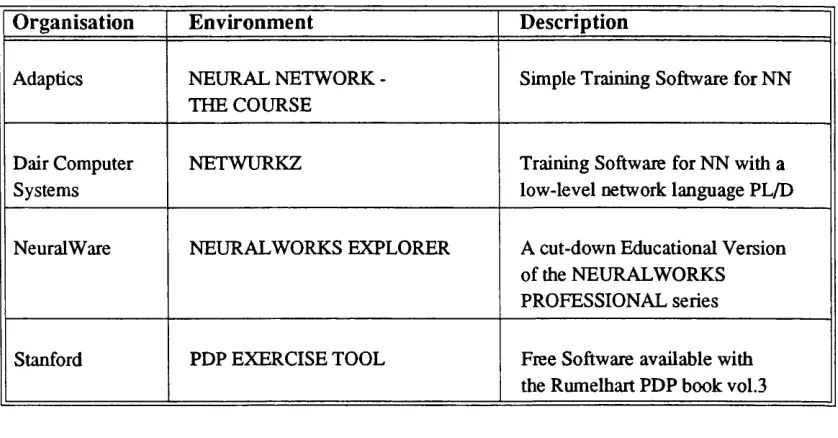
NNPSs in this category include Adaptics, Netwurkz, NeuralWorks Explorer, and the PDP Exercise Neural Network Tool. They are briefly summarised in Table 2.
N eural Network - The C ourse
Organisation Environm ent Description
Adaptics NEURAL NETWORK -
THE COURSE
Simple Training Software for NN
Dair Computer Systems
NETWURKZ Training Software for NN with a
low-level network language PL/D
NeuralWare NEURALWORKS EXPLORER A cut-down Educational Version
of the NEURALWORKS PROFESSIONAL series
Stanford PDP EXERCISE TOOL Free Software available with
the Rumelhart PDP book vol.3
TA BLE 2. Educational NNPSs N etw urkz
Netwurlcz [Netw87] is a neural network simulator, developed by Dair Computer Systems, available on IBM-PC computers. It is intended for people not familiar with neural networks. Associated with Netwurkz is a low-level network language PL/D which is based on list storage and representation. Netwurkz is itself implemented in PL/D. A best-fit pattern recognizer demonstrator program called "Spell" is also included.
N euralW orks E xplorer
NeuralWorks Explorer [Neur89] is a basic programming environment, developed by NeuralWare, available on the IBM PC, XT, AT, PS-2, Sun Microsystems SUN/3 and SUN/4 computers. It is an introductory package with several of the features of a more powerful package NeuralWorks Professional II (see later sections) marketed by the same company, but with fewer capabilities. Basically, this package provides a number of parameter driven neural network models and some example applications. A primitive graphical environment is also provided.
PDP Exercise N eural N etw ork Tool
parameters of these models can also be observed.
C om m ents
The main strengths of these educational NNPSs are that they are relatively cheap and usually adequate as training and educational tools for novice users. They guide the user through the basic neural network models, which are well described. M oreover the user can learn the effect of slight changes on various components and parameters (e.g. learning rate and threshold function) of a model. One of the best in this respect is the PDP Exercise Neural Network tool. Finally they provide the user with facilities for understanding the exact behaviour o f the model (such as running the network in a "slow- motion"), which is otherwise difficult to capture due to the dynamic nature o f neural networks.
However, because of the model-dependence o f these NNPSs, the user doesn’t have the flexibility required to experiment with new and novel neural network models. Moreover, since their purpose is educational and not intended as a tool for building commercial or research products these environments are usually slow in operation. In addition these NNPSs lack a proper user-friendly graphical interface. Finally these NNPS are appropriate only for small models; they are not effective in modeling neural networks with large number o f neurons (e.g. counter propagation model). But, as the major aim of these NNPS is educational these restrictions are minor.
2.1.2 Research systems
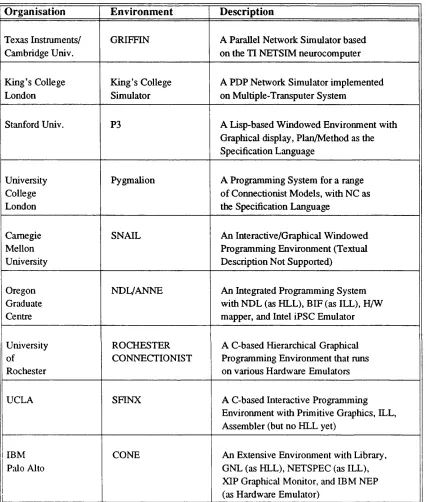
The group of research NNPS encompasses various experimental research environments. They include NETSIM [Test88,Gart87], the K ing’s College Simulator [Smit87], P3 [Zips8 6], SNAIL [Hood87], NDL/ANNE [Bahr87], Rochester Connectionist Simulator [Feld8 8], UCLA SFINX [Paik87], and IBM CONE [Hans87]. Some of them are hardware dependent whilst others are more general purpose and are not designed to run only on a specific target machine, although very often a specific hardware emulator is included. NNPSs under this category are summarised in Table 3.
NETSIM
O rganisation Environm ent Description
Texas Instruments/ Cambridge Univ.
GRIFFIN A Parallel Network Simulator based
on the TI NETSIM neurocomputer
King’s College London
King’s College Simulator
A PDP Network Simulator implemented on Multiple-Transputer System
Stanford Univ. P3 A Lisp-based Windowed Environment with
Graphical display, Plan/Method as the Specification Language
University College London
Pygmalion A Programming System for a range
of Connectionist Models, with NC as the Specification Language
Carnegie Mellon University
SNAIL An Interactive/Graphical Windowed
Programming Environment (Textual Description Not Supported)
Oregon Graduate Centre
NDL/ANNE An Integrated Programming System
with NDL (as HLL), BIF (as ILL), H/W mapper, and Intel iPSC Emulator
University of Rochester
ROCHESTER CONNECTIONIST
A C-based Hierarchical Graphical Programming Environment that runs on various Hardware Emulators
UCLA SFINX A C-based Interactive Programming
Environment with Primitive Graphics, ILL, Assembler (but no HLL yet)
IBM Palo Alto
CONE An Extensive Environment with Library,
GNL (as HLL), NETSPEC (as ILL), XIP Graphical Monitor, and IBM NEP (as Hardware Emulator)
TA B LE 3. Research NNPSs
Kings College Sim ulator
Kings College Simulator [Smit87], corresponds to a PDP network simulator implemented on a multiple Transputer system. The system is implemented via two processes : the user interface and the network simulator. The user interface provides functions to the user to analyse and simulate a PDP network. It supports all the PDP network models, taken from the book by Rummelhart et al [Rum8 6d, Rum8 6e]. It is probably the first system designed to simulate neural nets on a network o f transputers. The major facilities provided by this system includes, facilities to construct networks and map them on the hardware optimally, display network structures and unit status, and display simulation performance.
P3
The P3 system was developed by Zipser and Rabin as a simulation tool to aid the development of parallelly distributed processing models [Zips8 6, Trel8 8a]. P3 is a language centred system which is implemented in LISP and runs on a Symbolics 3600. Although it was not originally intended as a neural network development system, it has the necessary facilities and an inherent parallel structure that would map onto suitable neural network hardware. The major components of the P3 system are a plan language, a
method language, a constructor, and a simulation environment.
The plan language describes the collection of nodes (called units in P3) in a network model and specifies the connections between them. To do this, the language uses a small but rich set of statements. The three fundamental constituents of the plan language are a UNIT, a UNIT TY PE, and a C O NN ECT. The UNIT TY PE statement names and describes a kind of unit. The UNIT statement instantiates and names actual units. This statement can instantiate either a single unit or a whole array of units o f the same type. The CO NN ECT statement makes connections. Associated with each type of unit is a method which defines the computational behaviour of the units in the model program. This method is described in the method language which is an extension to LISP. After the plan and the associated methods have been specified the constructor
the behaviour of that parameter over the time can be measured. The simulator also provides the user with a display of nodes in an orientation of his/her choice.
The environment o f the network is handled by an appropriately defined environment unit which handles any input or output connections, and has a suitably defined method. Control over the update sequence of units is also handled in this manner via a control unit. W ithout this control unit each o f the units will be sequentially executed, but through this unit an asynchronous updating process can be simulated.
SNAIL
SNAIL is a an interactive graphical tool for designing and testing neural networks which was developed by scientists at Carnegie Mellon University [Hood87]. A neural network design in the SNAIL system consists o f a set of drawings. With these drawings, one can construct a network by selecting appropriate primitives for drawing neurons, synapses, etc. Labels can be attached to lines in order to reduce the number o f connecting lines, just as is done in electrical circuit schematics. In SNAIL modifications, deletions and additions of elements o f network can be made interactively and the consequences o f the change can be seen immediately. States of the network are shown by assigning different colours for different parameters and their current values. Windows can be created with parameter’s names and their values, and the user may modify any of these parameters. Parameter windows may also be created for abstract objects, such as neuron types, or a set of global simulation parameters, and the user can also modify any of these parameters. Parameter windows, once displayed will have their values continuously updated while the simulator is running. Neurons firing rate or synaptic strength over time can also be displayed by requesting a chart recorder window.
NDL/ANNE
ANNE (Another Neural Network Emulator) is a general purpose neural network simulation system, developed at the Oregon Graduate Centre for the Intel iPSC [Bahr87, Trel8 8a, Trel8 8b]. Although an emulator exists in the form of an Intel iPSC multi processor, the development environment is not dedicated to any particular hardware architecture (see Figure 7).
debugging
I--- 1
I 1
I i
mapped BIF
NDL BIF
PAD
mapper compiler
Figure 7. A Typical Development Process in ANNE
The user describes the network using a high level NDL (Network Description Language) which is then compiled into a low level generic BIF (Beaverton Intermediate Form) which is a common specification format designed to express network structures with both generality and compactness. Mapper is a tool for assigning the network structure (by graph partitioning) to a particular target machine architecture. It takes as its inputs a BIF file and a PAD (Physical Architecture Description) file describing a specific target machine architecture (which is the Intel iPSC hypercube in this case). The functions of the nodes for learning and computation are specified by pointers to C procedures. The output of the mapper is then used by ANNE which acts as a test bed and debugger for the neural network model described by BIF. Using ANNE the user has the ability to examine, modify or save pertinent data within the network, including the entire BIF specification of the network at any point in the simulation. It should be noted that, although the design of NDL/ANNE is intended to be hardware independent the only existing version runs on the Intel iPSC.
R ochester C onnectionist Sim ulator
models.
The overall system consists of a user program, a Graphics Interface and the Simulator, which corresponds to a run-time environment. The neural network is built in the simulator via the user program (written in C). The user has to define, via a data structure, each unit, its sites and links (sites at which incoming links are attached). This specification has the ability to give a description at different levels o f abstraction. The lowest level corresponds to a single-unit description; i.e. unit, sites and link functions. The next level corresponds to the description o f the connectivity pattern; i.e. specifying the links and the group of units. The highest (user-defined language) may be read in and compiled into units and links by "user-supplied" functions. The Simulator and Graphics Interface are independent. The Graphics Interface allows the user to display network information during simulation and aids for the network debugging process. Furthermore the user can examine the network before, during, and after it executes via a "simulation window".
UCLA SFINX
SFINX (Structure and Function In Neural Connections) is a neural network simulator environment, developed at UCLA’s Machine Perception Laboratory [Paik87, Trel8 8a], that allows researchers to investigate the behaviour o f various neural networks.
As shown in Figure 8, the SFINX structure is analogous to traditional language based systems. A neural network algorithm is specified in a high level textual language which is compiled into an equivalent low level language. Next this low level language is assembled into a binary data stmcture (defining the network) and is loaded into the SFINX simulator for interactive execution. In SFINX, network specifications have two basic parts:
• set of nodes - a node is a simple computing element, composed of: memory
storing the state of the nodes, and functions defining how signals are processed. • interconnections - defining the connectivity and the flow of data amongst the
nodes.
These network specifications are represented by virtual PEs, each comprising: • function pointer
SFINX
Simulator network
input
Assembler
neural-network
Compiler network
output
low level textual description high level
textual description
binary data structure
Figure 8. SFINX Environment
• vector of state registers
• vector associated weight/link_address(es)
Lastly, the front-end o f the SFINX simulator is a command interpreter, accepting SFINX shell scripts. These shell commands include: load, save, peek, poke, run, draw and set;
whose meanings should be fairly obvious. Once a network stmcture is created, these SFINX shell commands can be used to exercise the simulator, displaying and modifying the state of the network.
IBM CONE
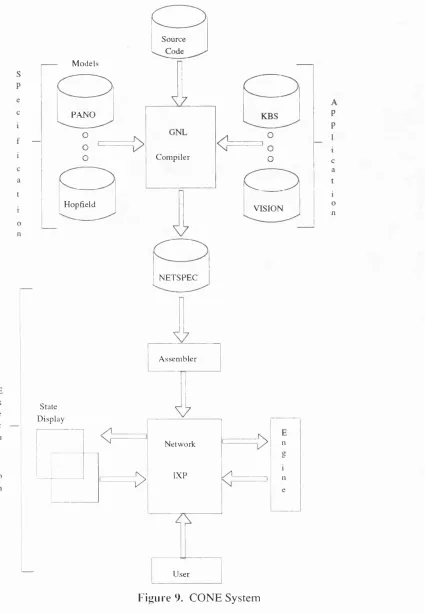
The IBM Computational Network Environment (CONE) [Hans87, Trel8 8a] is based on hierarchical and functional decomposition design methodology and consists of a high level General Network specification Language (GNL), a generic intermediate network specification (called NETSPEC), and an Interactive Execution Program (IXP). Neural network programs are specified in GNL and compiled into a machine independent intermediate form NETSPEC. This intermediate specification is then assembled into an executable form dependent upon the execution engine (see Figure 9).
To describe a network in GNL, the designer uses three fundamental primitives: • proc, which describes the functional processors.
Source
M o d e l s
PANO
Compiler
Hopfield VISION
NETSPEC
Assembler
Display
Network
IX P
User
Figure 9. CONE System n
• port, which specifies the point at which a path joins a proc.
scientific library of routines. The NETSPEC description is simply a parts lists of various primitive processors and a listing of the topology.
To run and manipulate the network, CONE provides an execution environment called NET Interactive Execution Program (IXP) that runs on a PC connected to the Network Emulation Processor (NEP). The IXP has three major components:
• a graphics display, • an operator interface, • a network engine.
The graphics display enable the operator to view the state of the network by selecting a set of procs o f interest. The operator can also vary the hierarchical depth for which the network procs are to be decomposed. The IXP operator interface is a command shell which controls the execution of the network engine and the display terminal. It has been developed in close association with the hierarchical GNL compiler. Thus, the IXP interface recognises the hierarchical decomposition of the network procs. The network engine provides a simple interface to the target hardware. The IXP has isolated the entire engine interface into a couple of low level functions. Thus, the IXP itself can be easily modified to support the inclusion of special purpose hardware for the network updates.
Com m ents
Most o f the NNPS in this category are hardware specific. In terms of execution speed, the advantages o f a hardware specific NNPS are obvious. Indeed, if the main purpose is to create a specific end-user application then NNPSs from this group will fit the bill well. They can provide complete solutions to specific problems. But when the aim is to build a general purpose portable NNPS capable of integrating novel applications, then a hardware independent NNPS seems to be a priority.
implicit specification is designed to take advantages of high degrees of regularity in connectivity patterns (as in low-level vision model). Because o f the restrictions imposed on the user it increases notably the space and time efficiency. The explicit specification provides a great deal more flexibility to the user by assuming only minimal constraints. But, because o f the massive amount o f details that is needed in explicitly specifying large irregular models, the user is restricted to specify only small neural networks in reality. Placing too much reliance on graphical facilities can also become a liability for NNPSs. An example is the SNAIL NNPS. Because SNAIL is graphics-dedicated (i.e. specification is by graphics only) the user is restricted to the design of neural network models with only a small amount o f neurons and interconnections which can be shown and specified visually.
Flexibility is the main strength of most of the research NNPSs. There are two aspects in this, viz., modelling flexibility and execution flexibility. Modelling flexibility is indicated by the degree of freedom a NNPS gives to the user in expressing a neural network model and application. This freedom depends on the expressive power of the specification languages used (e.g. high-level network primitives, description granulity, pre-imposed network structures and constraints, graphical/textual languages etc.). The Rochester Simulator is a good example of a NNPS that gives the user the power to construct specification at different levels of abstraction. A lowest level provides single units description; corresponding to units, sites and link functions. The next level describes the pattern of connectivity via a set of functions which specify the links and groups of units. A higher level gives the overall network specification. Execution flexibility is measured by the kind of facilities offered to the user during a simulation session. Regarding the generality, user-friendliness, and integration of tools, the IBM CONE is one of the best example. These tools are highly interactive and provides graphical display at any level of the specification; network as well as individual nodes. 2.1.3 C om m ercial systems
NNPSs in this categories have an overwhelming commercial orientation. They include ANSE and Mark III/IV, HNC ANZA & AXON [Guts8 8], SAIC ANSim & ANSpec, Cognitron [Fuku8 8], NESTOR, NeuralWorks and Professional II. A summary of these NNPSs is given in Table 4.
ANSE and M ARK III/IV
Organisation Environm ent Description
TRW ANSE commercial environment for
TRW neurocomputers Mark III, IV and V
Hecht-Nielsen Neurocomputer
ANZA sophisticated environment with
library, object-oriented HLL, for HNC neurocomputers ANZA and ANZA Plus
Cognitive Software
COGNITRON multi-window icon-driven
environment + LISP-like HLL for Macintosh
Nestor NESTOR DEVELOPMENT A NNPS for pattern recognition
and signal processing applications
NeuralWare NEURALWORKS
PROFESSIONAL II
Graphical environment for IBM PC and SUN, C Converter Available
Science Applications Int. Corp.
SIGMA/ANSpec commercial environment with
library, object-oriented HLL, for SIGMA/DELTA neurocomputer
TA BLE 4. Commercial NNPSs
editing, network storage and retrieval, and network implementation [Souc8 8].
ANSE is machine independent and it is compatible with the family of MARK computers, the most significant of which are the MARK III and MARK IV neurocomputers. The MARK III neurocomputer is a parallel processor implementing neurons as virtual PEs and virtual full-connectivity is supported. The MARK IV neurocomputer is a single high-speed pipelined uniprocessor, also implementing virtual PEs and virtual full-connectivity.
HNC ANZA & AXON