Original Research Article
Barriers to utilization of anganwadi services by pregnant women
and lactating mothers: a hospital based cross sectional study
in rural South Karnataka
Maria Jessy Jose, Avita Rose Johnson*, Anupa Thomas, Delfi Mendez, Cristeena Sebastian
INTRODUCTION
Maternal and child mortality is a public health challenge in developing countries, especially India. Currently, both remain unacceptably high with maternal mortality rate at 167 per 1,00,000 live births and infant mortality rate at 34 per 1000 live births.1,2 Globally, malnutrition is responsible for more than half of deaths of children under five. Inadequate antenatal and postnatal care and poor maternal nutrition during pregnancy and after birth can
affect the health and nutrition of the child.3,4 A key factor determining birth weight is poor maternal nutrition in pregnancy.5 To improve maternal and child well – being, the Government of India has been providing services through the Integrated Child Development Scheme (ICDS) since 1975.6 Under this scheme, the Anganwadis in villages throughout the country, provide a package of services for pregnant and postpartum mothers. This includes monthly supply of supplementary nutrition, organizing of health check-ups, immunization with
ABSTRACT
Background: Antenatal care and supplementary nutrition are evidence-based strategies to improve neonatal outcomes and birth weight, and are currently provided free of cost by the government in every village through the ICDS. This study aims to assess the utilization of Anganwadi services by pregnant and lactating mothers in a rural area and the various barriers to utilization of Anganwadi services.
Methods: A hospital-based, cross-sectional study was conducted among pregnant women (more than 28 weeks gestation) and lactating mothers (up to 6 months after delivery) availing maternal and child health services at a maternity hospital in a rural area of Ramnagara district in South Karnataka, using a pre-tested questionnaire.
Results: Awareness regarding Anganwadi services available for pregnant and lactating mothers like IFA, calcium and deworming tablets, TT and health check-ups was found to be poor. While more than half of the women had received health education from Anganwadi teacher, important topics like dangers signs, birth preparedness and essential antenatal care were not discussed.
Conclusions: Utilization of health care services at the Anganwadi was poor among the subjects. Supplementary nutrition was not utilized by 54% of pregnant women and 43% of lactating mothers. Those who had been visited by Anganwadi teacher at home and those who received nutrition education by the Anganwadi teacher had significantly higher consumption of supplementary nutrition. The common barriers to utilization were lack of awareness of services and perception of poor quality and hygiene of the supplementary nutrition.
Keywords: Anganwadi, Utilization, Pregnant women, Lactating mothers, Rural
Department of Community Health, St. John’s Medical College, Bangalore, Karnataka, India
Received: 03 April 2019
Revised: 17 May 2019
Accepted: 18 May 2019
*Correspondence:
Dr. Avita Rose Johnson, E-mail: [email protected]
Copyright: © the author(s), publisher and licensee Medip Academy. This is an open-access article distributed under the terms of the Creative Commons Attribution Non-Commercial License, which permits unrestricted non-commercial use, distribution, and reproduction in any medium, provided the original work is properly cited.
tetanus toxoid, distribution of iron and folic acid supplements (IFA), deworming tablet and health education.
Though antenatal care and supplementary nutrition are evidence-based strategies to improve neonatal outcomes and birth weight, and even though these are currently provided free of cost by the government in every village through the ICDS, there is a question of whether mothers actually utilize these services, and more importantly if they do not, then what could be the reasons for non-utilization.7 Therefore, this study aims to assess the utilization of Anganwadi services by pregnant and lactating mothers in a rural area and to assess the various barriers to utilization of Anganwadi services, in order to address these issues at the policy and service level, with the ultimate aim of improving utilization of Anganwadi services by mothers.
METHODS
This study was a hospital-based, cross-sectional study conducted among pregnant and lactating mothers at Snehalaya Hospital, Solur which is a missionary-run maternity hospital in a rural area of Ramnagara district in South Karnataka over a period of 2 months (March 2018– April 2018). Pregnant women in the third trimester (more than 28 weeks gestation) and lactating mothers (upto 6 months after delivery) availing maternal and child health services at the hospital were invited to be a part of the study. Based on a previous study, with 80% power and 5% absolute precision, the sample size was estimated to be 190.8 Convenience sampling technique was employed. Written informed consent was obtained from the study subjects. Women who were seriously ill were excluded from the study. A pre-tested, face-validated questionnaire was administered to collect socio-demographic and obstetric details, awareness about the Anganwadi, the various services provided by the Anganwadi, utilization of services, including supplementary nutrition and reasons for non-utilization of services. Pregnant women were asked about services available at the Anganwadi for pregnant women and their utilization of such services during their antenatal period. Lactating mothers were asked about services available at the Anganwadi for lactating mothers and their utilization of such services during their postnatal period. Ethical approval was obtained for this study from the Institutional Ethics Committee at St. John’s Medical College, Bangalore and permission to conduct the study was also obtained from the hospital in-charge. Data was entered in Microsoft Excel and analyzed using Statistical Package for Social Sciences [SPSS] v 16. Data was described using proportions, mean and standard deviation. Association between sociodemographic factors and utilization of services was calculated using Chi-square test and Mann-Whitney U test where applicable. A p<0.05 was considered to be statistically significant.
RESULTS
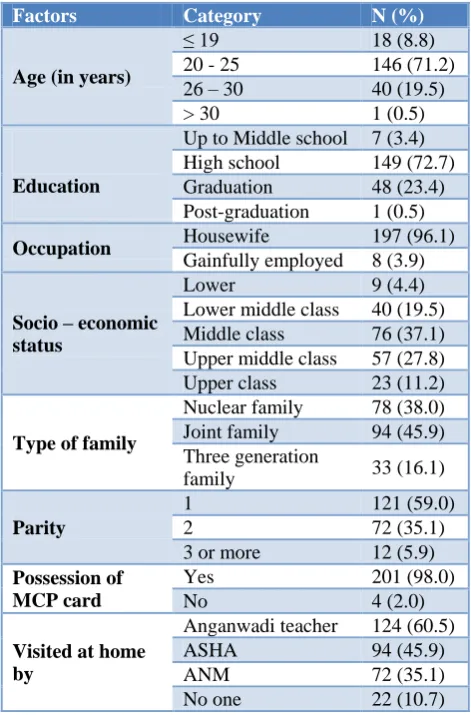
A total of 205 study participants were interviewed, 161 (79%) of whom were pregnant women in their third trimester of pregnancy and 44 (21%) were lactating mothers within six months of delivery. The mean age of the study sample was 23.0±3.0 years. Most women were in the age group of 21–25 years (Table 1). Majority of them had received high school education, were housewives, were from joint family, and belonged to
middle class (based on modified BG Prasad
socioeconomic scale). It was the first pregnancy for more than half of the subjects. Nearly all the women had a government Mother and Child Protection (MCP) Card. 89.3% of the subjects received at least one home visit by at least one of the grass-root level workers, most common being Anganwadi teacher (60%).
Table 1: Socio-demographic and obstetric details of the study participants (n=205).
Factors Category N (%)
Age (in years)
≤ 19 18 (8.8)
20 - 25 146 (71.2)
26 – 30 40 (19.5)
> 30 1 (0.5)
Education
Up to Middle school 7 (3.4)
High school 149 (72.7)
Graduation 48 (23.4)
Post-graduation 1 (0.5)
Occupation Housewife 197 (96.1)
Gainfully employed 8 (3.9)
Socio – economic status
Lower 9 (4.4)
Lower middle class 40 (19.5)
Middle class 76 (37.1)
Upper middle class 57 (27.8)
Upper class 23 (11.2)
Type of family
Nuclear family 78 (38.0)
Joint family 94 (45.9)
Three generation
family 33 (16.1)
Parity
1 121 (59.0)
2 72 (35.1)
3 or more 12 (5.9)
Possession of MCP card
Yes 201 (98.0)
No 4 (2.0)
Visited at home by
Anganwadi teacher 124 (60.5)
ASHA 94 (45.9)
ANM 72 (35.1)
No one 22 (10.7)
Table 2: Pregnant and lactating mothers’ awareness of Anganwadi services.
Pregnant women (n=161)
Lactating mothers (n=44)
N (%) N (%) Awareness of Anganwadi and its services
Aware of location of
Anganwadi center 136 (84.5) 40 (90.9)
Aware of the beneficiaries of Anganwadi
Pregnant women 128 (79.5) 39 (88.6)
Lactating mothers 87 (54.0) 32 (72.7)
Children under 6 years of
age 94 (58.4) 26 (59.1)
Adolescent girls 4 (2.5) 6 (13.6)
Aware of services available at the Anganwadi
Supplementary nutrition 137 (85.1) 40 (90.9)
Health education 48 (29.8) 12 (27.3)
Health check ups 43 (26.7) 28 (63.6)
Provision of IFA 18 (11.2) 15 (34.1)
Provision of Calcium 16 (9.9) 16 (36.4)
TT injection 23 (13.7) N.A
Deworming 14 (8.7) N.A
(Number in parentheses indicates percentage); N.A- not applicable.
Most of the study subjects had visited the Anganwadi at least once (71.4%) (Table 3). Utilization of suppl-ementary nutrition from the Anganwadi (for at least a month) was found to be fairly inadequate in both pregnant (46%) and lactating mothers (56.8%). 81(50%) of pregnant and 27(61.4%) of lactating mothers had received health education from the Anganwadi teacher on at least one topic, most commonly being nutrition. Most pregnant women did not receive health education on important topics like importance of ANC visits, need for institutional delivery and danger signs in pregnancy. Advice to pregnant women regarding birth preparedness was also inadequate with regards to preparing for birth, planning for institutional delivery and information about various maternity benefit schemes (Table 4). Only around one-third of lactating mothers received health education on topics like danger signs in the postpartum mother and newborn, breastfeeding, care of the newborn and family planning. The MCP card was not adequately utilized as a tool to educate the mother.
Utilization of health care services at the Anganwadi was poor among the subjects. But though IFA, calcium and deworming tablets, and TT were hardly utilized from the Anganwadi (1%), the women reported obtaining these, mainly from the hospital where the study was conducted (59%) and from the nearby government PHC (40%). Most of the women were motivated to utilize the Anganwadi services by the Anganwadi teacher, followed by the ASHA and ANM, but not by doctors and nurses (Table 3).
Table 3: Utilization of Anganwadi services by pregnant and lactating mothers.
Pregnant women* (n=161)
Lactating mothers** (n=44)
Utilization of Anganwadi services
Visited the Anganwadi
center 117 (72.7) 30 (68.2)
Home visit by Anganwadi
teacher 97 (60.2) 27 (61.4)
Received MCP card from
Anganwadi 29 (18) 6 (13.6)
Received supplementary
nutrition 74 (46) 25 (56.8)
Received health education from Anganwadi teacher on
Nutrition 78 (48.4) 26 (59.1)
ANC/PNC Visits 20 (12.4) 14 (31.8)
Danger signs- pregnancy/
postpartum 2 (1.2) 13 (29.5)
Institutional delivery 17 (10.6) N.A
Care of newborn 10 (6.2) 14 (31.8)
Breast feeding 41 (25.5) 16 (36.4)
Immunization 40(24.8) 21 (47.7)
Family planning 11 (6.8) 16 (36.4)
Received health care at Anganwadi
Weight checked 73 (45.3) 1 (2.3)
Received IFA tablets 2 (1.2) 0 (0)
Received Calcium tablets 2 (1.2) 0 (0)
Received TT injection 1 (0.6) N.A
Received Deworming tablet 4 (2.5) N.A
Motivated to avail services at the Anganwadi by
Anganwadi worker 115 (71.4) 25 (56.8)
ASHA 64 (39.8) 18 (40.9)
ANM 49 (30.4) 13 (29.5)
Doctor / Nurse 2 (1.2) 1 (2.3)
Family /Friends 41 (25.5) 10 (22.7)
*at least once during antenatal period **at least once during postnatal period; (number in parentheses indicates percentage) N.A- not applicable.
Table 4: Advice on birth preparedness for pregnant women by Anganwadi teacher (n=161).
N (%)
Advice on birth preparedness
Advised to prepare for birth 10 (6.2)
Advice regarding Institutional delivery 17 (10.6) MCP Card used as a tool for education 46 (28.6)
Advice regarding maternity benefit schemes
JSSK 50 (31.1)
JSY 6 (3.7)
Thayi Bhagya 17 (10.6)
barriers to utilization of supplementary nutrition were the belief that poor quality of food grains was being provided, and the perception that the food was unhygienic and meant for poor people (Table 5). The utilization of supplementary nutrition was significantly higher among younger women, among those who had been visited by Anganwadi teacher at home and those who received nutrition education by the Anganwadi
teacher (Table 6). Utilization of supplementary nutrition was not significantly associated with factors like education or occupation of the subject, socio-economic status, type of family, or number of pregnancies. The major barrier to utilization of health care services at Anganwadi was the lack of awareness of services like IFA, calcium and deworming tablets, TT and health check-ups.
Table 5: Reasons for non-utilization of supplementary nutrition by pregnant and lactating mothers (n=106).
Reasons Pregnant women (n=87) Lactating mothers (n=19)
Quality of food grains is poor 14 (16.1) 4 (21.1)
Food is unhygienic 7 (1.1) 1 (5.2)
Meant for poor people 4 (4.5) 1 (5.2)
Family not willing 0 (0) 1 (5.2)
No time to collect the food 0 (0) 6 (31.5)
Anganwadi is far away 0 (0) 5 (26.3)
Not aware that food is available at Anganwadi 8 (9.1) 3 (15.7)
(Number in parentheses indicates percentage).
Table 6: Association between socio-demographic factors and intake of supplementary nutrition by the women (n=205).
Categories Supplementary nutrition
P value
No (n=106) Yes (n=99)
Age–Median (IQR) 23 (22 – 26) @ 22 (20 – 25) @ 0.002**
Visit by Anganwadi teacher
Ever visited 39 (31.5) 85 (68.5)
<0.001*
`Not visited 67 (82.7) 14 (17.3)
Health education on nutrition
Received 26 (25.0) 78 (75.0)
<0.001*
Not received 80 (79.2) 21 (20.8)
* Chi – square test ** Mann – Whitney U test; (number in parentheses indicates percentage, except for @ where it indicates inter quartile range).
DISCUSSION
The effectiveness of a public health program depends on its utilization. In the present research, which studied the utilization of Anganwadi services by pregnant and lactating mothers, it was found that 84.5% of pregnant women and 90.9% of lactating mothers had heard of the Anganwadi in their village which was similarly found in a study done among women in an underprivileged area of Nagpur where 91.39% had heard about Anganwadi.9 The proportion of women who received at least one home visit by grassroot level workers was high (89.3%) as compared to Karnataka state (35.7%).10 However, in spite of having heard about the Anganwadi, and having been visited by grassroot level workers, the awareness of the various services available at the Anganwadi was found to be very low, except for supplementary nutrition. Majority were unaware that IFA, calcium and deworming tablets, TT and health checkups could be easily accessed at the Anganwadi. This finding is in contrast to the study done in Nagpur, where most women were aware of these services.9 Poor awareness translates into poor utilization, and this was demonstrated in our study, where awareness
and utilization of Anganwadi services, aside from supplementary nutrition was found to be abysmally low, when compared to NFHS – 4 where 67% of pregnant women and 60% of lactating mothers in rural Karnataka had received health check-ups at the Anganwadi.11 This was similarly found in a study in a rural area near Kochi, Kerala where awareness regarding Anganwadi services was low and only 19% of pregnant and lactating mothers utilized any of the Anganwadi services.12
In the present study, it was found that supplementary nutrition was the only service of the Anganwadi that was being highlighted and promoted to pregnant and lactating mothers.
and lactating mothers received supplementary nutrition.13,14 The barriers to utilization of supplementary nutrition by women in our study were lack of awareness, misconceptions about the provision of food in Anganwadi with respect to quality and hygiene and the perception that Anganwadi nutrition is meant only for the poor. This has public health implications because people of lower socio-economic status tend to aspire to lifestyles of those who are richer and tend to emulate their behaviors.15 Therefore, it is possible that when people of higher socio-economic class refuse to accept nutrition services from the government, the poor might also avoid the same, as they do not want to accept nutrition that is deemed unacceptable by those who can afford. A study among beneficiaries of 40 Anganwadi centers in Bhopal city similarly found dissatisfaction with the quality of food.16 Low quality of public health interventions is a common reason for non-utilization and is a waste of resources.17
The present study found that utilization of supplementary nutrition was significantly higher among women who had been visited by Anganwadi worker at home and those who had received nutrition education from Anganwadi teacher. This was similarly seen in a study across 28 Anganwadi centers in Aurangabad city where 100% of beneficiaries were visited at home and the utilization of supplementary nutrition by pregnant and lactating mothers was found to be 92.5%.18 This finding indicates that Anganwadi teacher plays an important role in overcoming barriers to utilization of Anganwadi services, by visiting and talking to women in their own homes and by educating them about various health topics and providing information about Anganwadi services.
Approximately half of the women had received health education from the Anganwadi teacher on at least one health topic, commonly nutrition, breast feeding, immunization and family planning which was found to be similar to a study done among beneficiaries in an urban area of Belgavi, North Karnataka.19 However, certain important topics that have direct impact on maternal and neonatal mortality like birth preparedness and essential obstetric care were not conveyed adequately to pregnant women. The proportion of women who possessed Mother and Child Protection card (MCP card) was 98% which was higher when compared with overall figures for the state of Karnataka (86.2%).10,9 Studies have shown that the MCP card can be effective as an education tool for mothers and their families, yet the MCP card was not used by the Anganwadi teacher as a tool to educate the mother on topics like birth preparedness, danger signs and essential obstetric care which are pictorially depicted in the MCP card.20
Most of the women were motivated to utilize the Anganwadi services by the Anganwadi teacher, followed by the ASHA and ANM, but not by doctors and nurses. This is a missed opportunity to inform pregnant and
lactating mothers about free, easily available and easily accessible community-based health services. Utilizing these services could reduce out of pocket expenditure, as nearly 60% of the women in the study were purchasing IFA and calcium tablets from private hospitals or pharmacies.
Those who had been visited by the Anganwadi teacher at home and those who received nutrition education by the Anganwadi teacher had significantly higher consumption of supplementary nutrition. This has important public health implications since it indicates that for a community-based health program like ICDS to succeed, the utilization by the beneficiaries could be improved if the Anganwadi teacher makes a concerted effort to reach out, visit, educate and inform the beneficiaries.
CONCLUSION
Awareness regarding Anganwadi services available for pregnant and lactating mothers like IFA, calcium and deworming tablets, TT and health checkups was found to be poor, except for supplementary nutrition. Utilization of supplementary nutrition from the Anganwadi was found to be inadequate in both pregnant (46%) and lactating mothers (56.8%). While 50% of pregnant and 61.4% of lactating mothers had received health education from Anganwadi teacher, important topics like dangers signs, birth preparedness and essential antenatal care were not discussed. Utilization of health care services at the Anganwadi was also poor among the subjects. Supplementary nutrition was not utilized by 54% of pregnant women and 43% of lactating mothers. Those who had been visited by Anganwadi teacher at home and those who received nutrition education by the Anganwadi teacher had significantly higher consumption of supplementary nutrition. The common barriers to utilization were lack of awareness regarding availability of supplementary nutrition and the perception of poor quality and hygiene of the food.
Recommendations
Awareness regarding services provided by the Anganwadi must be improved, through home visits by ASHA, ANM and AWW. During ANC and PNC visits, doctors and nurses should use the opportunity to encourage utilization of services from community-based health programs like ICDS. Anganwadi teachers should expand their focus of health education to include topics that can potentially save lives of mothers and their newborns like birth preparedness, danger signs and essential obstetric care, using MCP card as an educational tool.
ACKNOWLEDGEMENTS
Funding: No funding sources Conflict of interest: None declared
Ethical approval: The study was approved by the Institutional Ethics Committee at St. John’s Medical College, Bangalore
REFERENCES
1. National Institute for Transforming India. Maternal mortality rate (MMR) per 1,00,000 live births. Statistics. New Delhi: NITI Aayog; 2016. Available at: http://niti.gov.in/content/maternal-mortality-ratio -mmr-100000-live-births. Accessed on 3 January 2019.
2. National Institute for Transforming India. Infant Mortality Rate (IMR) per 1000 live births. Statistics. New Delhi: NITI Aayog; 2016. Available from: http://niti.gov.in/content/infant-mortality-rate-imr-1000-live-births. Accessed on 3 January 2019. 3. Smith LC, Ramakrishnan U, Ndiaye A, Haddad L,
Martorell R. International Food Policy Research Institute. The Importance of Women’s Status for Child Nutrition in Developing Countries. Washington, DC: IFPRI; 2003: Available at: http://www.ifpri.org/publication/importance-womens-status-child-nutrition-developing-countries. Accessed on 3 January 2019.
4. A study on the socio-economic determinants behind Infant mortality and Maternal mortality. The Indian Trust for Innovation and Social Change. New Delhi: 2006: Available at: http://planningcommission.nic. in/reports/sereport/ser/stdy_immm.pdf. Accessed on 3 January 2019.
5. Ravi S, Singh R. Brookings India. Nutrition in India: Targeting the first 1,000 days of a child’s life. Policy Brief.No.1. New Delhi: 2016: Available at: https://www.brookings.edu/wp-content/uploads/ 2016/10/20161023_PolicyBrief_2.pdf. Accessed on 3 January 2019.
6. Integrated Child Development Services Scheme. Supplementary nutrition. Ministry of Women and Child Development, India: ICDS; 2009: Available from: https://icds-wcd.nic.in/supplnutrition.aspx. Accessed on 3 January 2019.
7. International Institute for Population Sciences. National Family Health Survey (NFHS-3) 2005-06: India. Mumbai: IIPS; 2007. Available at: https://dhsprogram.com/pubs/pdf/frind3/frind3-vol1andvol2.pdf. Accessed on 3 January 2019. 8. Bariya B, Patel NA, Nayak S. Utilization of
Supplementary Nutrition Food Packets by Pregnant and Lactating Mothers in Urban Areas of Valsad, Gujarat. Healthline J. 2017;8(2):42-6.
9. Patil KS, Kulkarni MV. Knowledge and Utilization of Integrated Child Development Services (ICDS) scheme among women in an urban slum: a community based study. Indian J Forensic Community Med. 2016;3(4):267-71.
10. Rapid Survey on Children. Ministry of Women and Child Development, Government of India: RSOC; 2013 – 2014. Available at: http://wcd.nic.in/sites/ default/files/State%20RSOC.pdf. Accessed on 7 January 2019.
11. International Institute for Population Sciences. National Family Health Survey (NFHS-4) 2015-16: India. Mumbai: IIPS; 2017. Available at: http://rchiips.org/nfhs/NFHS-4Reports/India.pdf Accessed on 4 January 2019.
12. Francis PT, Paul N. Utilization of Anganwadi services in a rural population of Kerala. Indian Pediatr. 2017;54(1):65-6.
13. Singh D, Gaur KL, Sharma MP. Performance evaluation of Anganwadi Workers of Jaipur Zone, Rajasthan. Int J Eng Sci Invention. 2013;2(4):28-34. 14. Khan AA, Singh AK, Gupta SP, Singh JP, Khan H, Maheshwari S. Assessment of Supplementary Nutrition Service Utilization at Anganwadi Centers in Rural Area of District Bareilly. Indian J Forensic Community Med. 2016;3(1):20-4.
15. The World Bank. Rich and Poor: Opportunities and Challenges in an age of disruption. World Bank Group President Jim Yong Kim. 2018 Spring Meeting Positioning Speech, Washington DC. Available at: http://www.worldbank.org/en/news/ speech/2018/04/10/rich-and-poor-opportunities-and-challenges-in-an-age-of-disruption. Accessed on 3 January 2019.
16. Dandotiya D, Priya A, Toppo M, Melwani V, Sethia S. A Study on Utilization and Satisfaction of ICDS Services in AAnganwadis of Urban Bhopal. Ind J Youth Adol Health. 2018;5(1):30-3.
17. O'Donnell O. Access to health care in developing countries: breaking down demand side barriers. Cad. Saúde Pública. 2007;23(12):2820-34.
18. Thakare MM, Kuril BM, Doible MK, Goel NK. A study of functioning of Anganwadi centers of urban ICDS block of Aurangabad city. Indian J Prev Soc Med. 2011;42(3):253–8.
19. Mundodan JM, Metgud CS. Nutritional and health education services under integrated child development services in an Urban area of North Karnataka. Natl J Community Med. 2016;7(1):16-20.
20. Kalita G, Snowden H, Ghosh S. The effectiveness of the Mother and Child Protection card as a community management tool: A case study. UNICEF. 2006;14:26-7.