ANIMAL SCIENCE
Microbiological characterization of camel and sheep meat preserved by
refrigeration and lactic acid
Benaissa Atika*, Ould el hadj Khellil Aminata, Adamou Abdelkadder and Babelhadj Baaissa
Laboratory of Protecting Ecosystems in Arid and Semi-arid, University Kasdi Merbah Ouargla, Ouargla 30000, Algeria
Abstract
The microbial growth of certain bacteria contaminating camel and sheep meat, kept under refrigeration was evaluated. The samples were collected at the Ouargla slaughterhouse. The selected compartment for monitoring was the thigh (most demanded by consumers of the region). The shelf life of the two types of meats studied was five days against the total mesophilic aerobic flora, yeasts, enterobacteria and fecal coliform contamination whose percentages were respectively 30.26%, 26.55% , 22.74% and 20.44% for camel meat; 28.91%, 28.21%, 22.87% and 20% for sheep meat. The lactic acid concentration that ensures better conservation, was 4% for sheep meat while a concentration of 2% was sufficient for camel meat. The duration of cold preservation of both meats (treated and untreated) was nine days except for yeasts whose duration was seven days.
Key words: Meat, Dromedary, Sheep, Lactic acid, Conservation
Introduction
The richness of meat in water, proteins of high biological value makes it an essential food for a balanced diet. However, these vertues make it a favourable breeding ground for most microbes (Clinquart et al., 1999). Most of the germs contaminating carcasses after different stages of slaughter (skinning and evisceration) are saprophytes. These bacteria, yeasts and molds. are germs that cause alteration or putrefaction of meat. In addition, the presence of pathogens in food is often responsible for borne illness (Cottin et al., 1985). Food preservation is conservation of its edibility, taste and nutritional properties. This requires the prevention of microbial growth and retarding the oxidation of fats which cause rancidity (Bourgeois et al., 1991). Conservation at low temperature retards the growth of microorganisms. The majority of germs such as coliforms have limited metabolic activites at temperatures below 5°C (Craplet, 1966). It is the preferred method of preserving meat, and the best currently known
(Laurent, 1974).
Refrigeration is the storage of food at low positive temperatures. In general, the temperature is around 0°C to +4 °C. Refrigeration should be applied initially to fresh healthy foods. During this type of storage, water maintains liquid constitution (Bourgeois et al., 1996). Most bacteria grow rapidly in fresh non-acidic meat, fish and vegetables causing deterioration. Other forms of spores make them resistant to preservation techniques and resume their multiplication upon return to ambient conditions (Multon, 1984). The use of chemical additives to acidify the meat can preserve them in the best conditions. The addition of these agents is designed to optimize the preservati of food while conserving the organoleptic and nutritional qualities (Multon, 1984). Organic acids, such as lactic acid are widely used as condiments in food preparations. Lactic acid bacteria inhibit the growth of pathogenic microorganisms especially E. coli (Huxley, 1969; Houstma et al., 1986; Miller, 1994).
The present work aims to characterize the microbiological properties of meats from two species (camel and sheep) kept under refrigeration after undergoing treatment with lactic acid solutions at concentrations of 2% and 4% through Received 03 June 2013; Revised 19 December 2013; Accepted 24
sterile forceps. The weighing was determined using an analytical balance. Manipulations were carried out with a maximum asepsis (Bunsen burner lit bench for 15 minutes and washed with bleach).
Series of samples (for both meat origins camel and sheep) were deceived or in a solution of lactic acid 2%, 4% or sterile distilled water. A series of samples was left untreated (control). Each sample was placed (10 g) individually in a sterile bag and stored in a refrigerator at a temperature between 0 and 4°C.
Preparation of the initial suspension and decimal dilutions
The procedure was performed according to the French standard NF V-057-2. Ten gram of meat was introduced aseptically into a sterile "Stomacher" bag containing 90 ml of diluent (Water Buffered Peptone). After grinding and homogenization of the solution, the obtained initial suspension was subsequently diluted 1/100 (10-2), and 1/1000 (10-3) and one ten thousandth (10-4).
for 2 to 5 days (NF V 03-454).
Statistical analyses
Statistical analyses included two stages, (i) analysis of internal variability in each species of meat (camel and sheep) and (ii) comparative analysis to determine the variability between germs sought.
-The analysis of internal variability included-the description of included-the mean and standard deviation for each of the germ,
-Correlations between rates for each meat contamination (Pearson correlation).
Establishing a contingency table between germs sought in each species of meat. These analyzes were performed using the software XLStat (Addinsoft©)
Results and Discussion
Effect of the nature and treatment of meat on the evolution of the mesophilic aerobic flora total enterobacteria, coliforms and yeasts
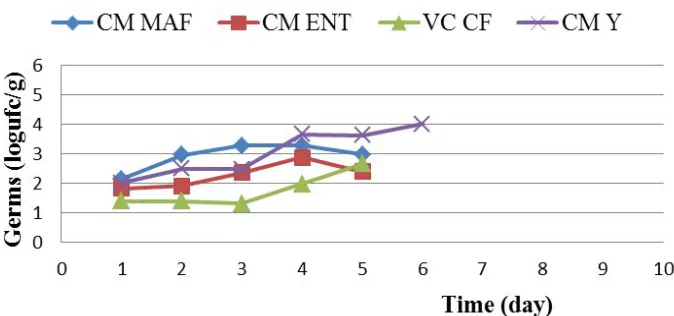
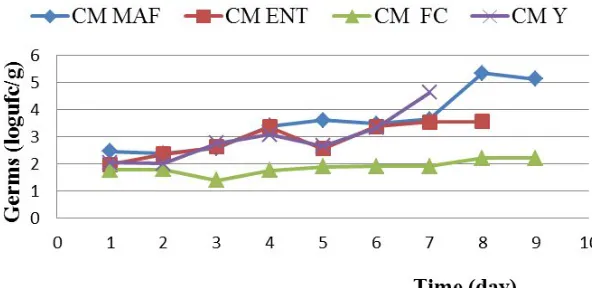
The results for the microbiological quality of meat, camel and sheep kept under refrigeration, namely the total mesophilic aerobic flora, fecal coliforms, Enterobacteriaceae and yeasts are summarized in (Figure 1).
Figure 1. Changes in germs over time in the
control camel meat. CM: Camel Meat, MAF: mesophilic aerobic flora total,
ENT: Enterobacteriaceae, FC: fecal coliforms,
Figure 2. Changes in germs sought over time in the control sheep meat
SM: Sheep Meat, MAF: mesophilic aerobic flora total, ENT: Enterobacteriaceae, FC: fecal coliforms, Y: yeast, d: day.
Overall, the rate of contamination maximum total mesophilic aerobic flora samples of camel meat is 3.17 ± 0.62 logufc / g (Figure 1), while that of sheep meat samples is about 3.27 ± 0.57 logufc / g (Figure 2). Values of the flora that we obtained in this study are consistent with those reported by Hamad (2009). According to this author, contamination rates were of the order of 1.79 logufc/cm2for camel meat and 3.08 logufc/cm2for the sheep meat. Camel meat has a maximum rate of contamination by enterobacteria 2.88 ± 0.71 logufc / g (Figure 1), relatively lower than that of the (3.35 ± 0.05 logufc / g). Our results were within the range of values reported by Hamad, (2009) whose results were 2.60 log10ucf/cm2 and 3.38 log10ucf/cm2 respectively for camel and sheep meat.
Fecal coliforms samples of sheep and camel meat reached maximum contamination levels of
3.21 ± 0.21 logufc / g and 3.65 ± 0.46 logufc / g, respectively. So, as the rates for yeast was 3.52 ± 0.62 log ufc / g and 3.66 ± 0.49 log ufc / g (Figure 1 and Figure 2).
The comparison of the maximum contamination by germs counted recorded on both studied meat left out that camel meat was less contaminated than the sheep. This could be explained by the difference in skinning techniques for animal skinning, despite the fact that these meats were processed in the same slaughterhouse.
The predominant flora of contamination for both meats was constituted by the total mesophilic aerobic flora reflecting their hygienic quality. The presence of fecal coliforms was indicative of poor hygiene and in particular defects that occur during evisceration because coliforms are saprophytes of the digestive tract of man (Basel et al., 1983).
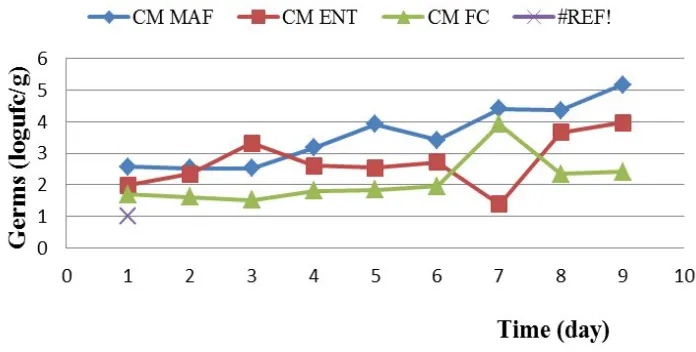
Figure 3. Changes in germs sought over time in processed
Figure 4. Changes in germs sought over time in processed sheep meat by lactic acid 2%
SM: Sheep Meat, MAF: mesophilic aerobic flora total, ENT: Enterobacteriaceae, FC: fecal coliforms,Y: yeast, d: day.
Immersion of meat before refrigeration in a solution of lactic acid 2% or 4% appeared to slow the multiplication rate of bacteria. The maximum rate of contamination of the camel meat rinsed with a solution of 2% lactic acid were respectively 5.12 ± 0.14 logufc/g, 3.54 ± 0.21 logufc/g, 2.20 ± 0.28 logufc/g and 4.63 ± 0.38 logufc/g. The duration of its conservation was seven days for yeast, eight days for Enterobacteriaceae and nine days for the
total mesophilic aerobic flora and coliforms (Figure 3).
Sheep meat was pretreated with a solution of 2% lactic acid storage before refrigeration, presented maximum contamination rate, total mesophilic aerobic flora of 3.38 ± 0.21 logufc/g of Enterobacteriaceae logufc/g 3.31 ± 0.32 of fecal coliforms logufc 2.52 ± 0.66 logufc/g and 3.97 ± 0.30logufc/g of yeast (Figure 3). The shelf life of the meat was seven days for these germs (Figure 4).
Figure 5. Changes in germs sought over time in processed camel meat by lactic acid 4%.
Figure 6. Changes in germs sought over time in processed sheep meat by lactic acid 4%.
SM: Sheep Meat, MAF: mesophilic aerobic flora total, ENT: Enterobacteriaceae, FC: fecal coliforms, Y: yeast, d: day.
A lactic acid concentration of 4% did not reduce the rate of contamination of camel meat by the total mesophilic aerobic, Enterobacteriaceae, coliforms and yeasts whose respective values were 5.17 ± 0.3 logufc / g, 3.98 ± 0.50 logufc / g, 3.93 ± 0.26 logufc / g and 4.65 ± 0.70 logufc/g, nor the duration of its conservation compared to the results obtained with concentration of 2%, except the shelf-life against enterobacteria which was extended to nine days (Figure 5).
Whereas in the presence of a lactic acid concentration of 4%, the maximum rate of contamination of sheep meat were of the order of, 4.94 ± 0.10 logufc/g for mesophilic aerobic flora total, 3.74 ± logufc 0.67/g for Enterobacteriaceae, 3.73 ± 0.84 logufc/g for fecal coliforms and 4.55 ± 0.27 logufc/g for yeasts (Figure 5). The shelf life of the sheep meat was nine days against the majority of organisms investigated (Figure 6).
The lower infection rates of the total flora, Enterobacteriaceae and coliforms in processed meat by lactic acid could be explained by the fact that organic acids inhibit pathogenic microorganisms. The latter cannot grow in foods at acid pH (below 4.5). The decrease in pH affects even the heat resistant spores (Bourgeois et al., 1996; Lyreal and Vierling, 1997).
The high rate of yeast in the treated meat could be explained by the selective effect exerted by organic acids on the microbial population. They inhibit pathogenic microorganisms but stimulate yeasts. Yeasts are extremely tolerant to changes of pH; they can grow at pH 4 to 6.Moreover, those germs can locally adapt their optimum pH. The pH is not a good indicator to control their development (Lyreal and Vierling, 1997).
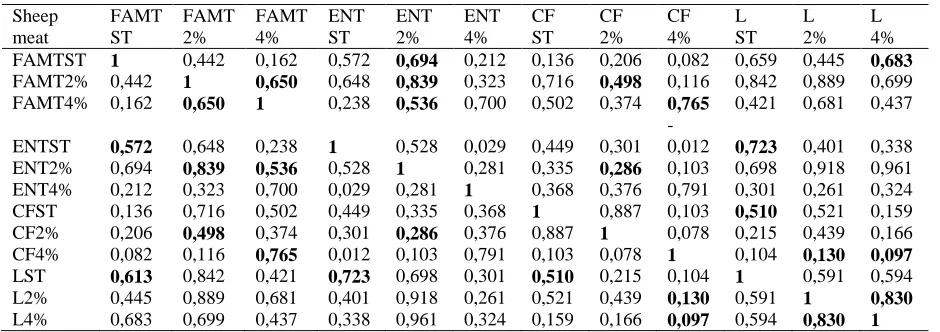
Table 4. Correlation matrix between the rates of infection in camel and sheep meat.
Sheep meat
FAMT ST
FAMT 2%
FAMT 4%
ENT ST
ENT 2%
ENT 4%
CF ST
CF 2%
CF 4%
L ST
L 2%
L 4% FAMTST 1 0,442 0,162 0,572 0,694 0,212 0,136 0,206 0,082 0,659 0,445 0,683
FAMT2% 0,442 1 0,650 0,648 0,839 0,323 0,716 0,498 0,116 0,842 0,889 0,699 FAMT4% 0,162 0,650 1 0,238 0,536 0,700 0,502 0,374 0,765 0,421 0,681 0,437
ENTST 0,572 0,648 0,238 1 0,528 0,029 0,449 0,301
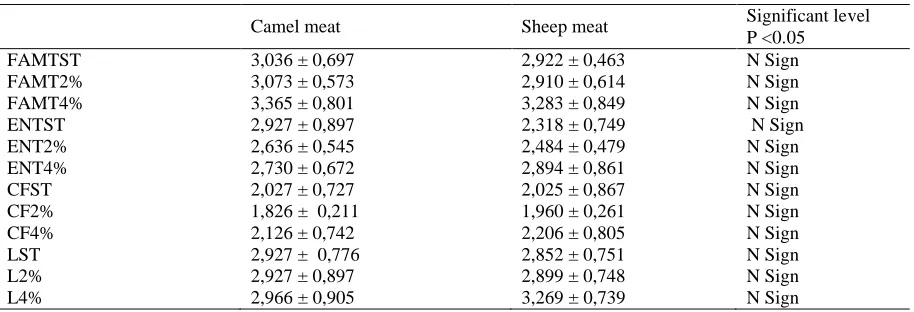
L2% 2,927 ± 0,897 2,899 ± 0,748 N Sign
L4% 2,966 ± 0,905 3,269 ± 0,739 N Sign
Infection rates by total mesophilic aerobic flora, enterobacteria, fecal coliforms and yeasts were not significantly different in both species of meat and when these meat were tree ted by lactic acid (Table 4). The correlations were generally not significantly in the two meats (Table 5).
Conclusion
The present study regarding meat from two different species (camel and sheep) aimed to highlight the preservative effect of a physical technique (refrigeration). The presence of certain flora from the first day was indicator of contamination of the carcasses during slaughtering operations and contamination of meat during cutting operations. The daily counts of these organisms were highlighting important points: (i) the difference in sensitivity of germs to refrigeration as well as treatment with lactic acid. (ii) the preservation of meat at a temperature between 0 and 4°C to slow the multiplication of germs without being able to destroy them. (iii) the storage temperature of meat which presented an undeniable effect in prolonging the shelf life of meat. (iv) the combination of two methods of conservation for improving the shelf life of meat, whatever the species (camel and sheep), and finally which could help more families to keep their surplus product directly without freezing. (v) a concentration of 2% sufficient to increase the shelf life of camel meat to nine days for the majority of bacteria sought, while a concentration of 4% was needed to achieve this length for sheep meat.
Acknowledgements
The authors would like to thank Ms. Zohra Bayoucef for her sincere and valuable assistance.
References
Basel, M. R., E. R. Richter and G. J. Banwart. 1983. Monitoring microbial numbers in food by density centrifugation. App. Env. Microbiol. 45(3):1156-1159.
Bourgeois, C. M., J. F. Mescle and J. Zucca. 1996. Microbiologie alimentaire: Aspects Microbiologiques de la sécurité et de la qualité des aliments. Tome I. Editions Lavoisier, pp. 241-251.
Bourgeois, C. M. and J. V. Leveau. 1991. Techniques d’analyses et contrôle dans les industries agro-alimentaires. 2nd Edition Lavoisier. p. 454.
Chene, C. 2006. Les moisissures dans les industries alimentaires Faculté Universitaire des Sciences Agronomiques. Inra Adrianor pp. 1-5.
Clinquart, A. J., J. Fabry and Casteels. 1999. La viande (Ed.). p. 76. Chapitre la viande et les produits de viande dans notre alimentation.
Cottin, J. H., C. Bizon and B. Carbonelle. 1985. Study of Listeria monocytogenes in meat from 415 cattle. Sci. Aliment 5:145-149.
Craplet, C. 1966. La viande de bovins. Tome I .Ed Vignot frère, Paris pp. 74-86.
Genin, G. 1965. Emplois de l’acide lactique et des lactates dans l’industrie alimentaire – Supplément Technique. p. 58.
Hamad, B. 2009. Contribution à l’étude de la contamination superficielle bactérienne et fongique des carcasses camelines au niveau de l’abattoir d’EL-OUED. Mémoire de Magister en médecine vétérinaire. pp. 29-30.
Houstma, 1993. Microbial contamination of chilled beef. In: Hygiène et technologique de la viande fraiche. Edition CNRS. pp. 109-132.
Huxley, H. E. 1969. The mechanism of muscular contraction. Science 164(886):1356-1365.
Larpend, J. P. 1997. Microbiologie alimentaire. Technique de laboratoire. Editions Lavoisier. p. 860.
Laurent, C. 1974. Conservation des produits d’origine animale en pays chauds. Ed presses universitaires de France. pp. 53-54.
Lyreal, G. and E. Vierling. 1997. Microbiologie et toxicologie des aliments. Editions Doin, pp. 54-82.
Miller, A. 1994. L’analyse microbiologique dans les industries. analyse microbiologique de la viande et des produits carnés. p. 147.