DEMOGRAPHIC RESEARCH
VOLUME 28, ARTICLE 1, PAGES 1-32
PUBLISHED 4 JANUARY 2013
http://www.demographic-research.org/Volumes/Vol28/1/ DOI: 10.4054/DemRes.2013.28.1
Research Article
The effect of education on second births in
Hungary: A test of the time-squeeze,
self-selection, and partner-effect hypotheses
Tamás Bartus
Lívia Murinkó
Ivett Szalma
Bernadett Szél
© 2013 Bartus, Murinkó, Szalma & Szél.
This open-access work is published under the terms of the Creative Commons Attribution NonCommercial License 2.0 Germany, which permits use, reproduction & distribution in any medium for non-commercial purposes, provided the original author(s) and source are given credit.
1 Introduction 2
2 Spacing of births: An economic perspective 3
3 The Hungarian context 6
4 Data and methods 8
4.1 The sample 8
4.2
4.3 Method Variables 10 9
5 5.1 5.2 5.3
Empirical analyses
The relationship between education and time to second conception Education and the transition to second conception
The partner effect hypothesis
13 13 15 18
6 Conclusions and discussion 21
7 Acknowledgements 23
References 24
The effect of education on second births in Hungary:
A test of the time-squeeze, self-selection,
and partner-effect hypotheses
Tamás Bartus1 Lívia Murinkó2 Ivett Szalma3 Bernadett Szél4
Abstract
BACKGROUND
In recent years, several studies have reported a positive effect of women’s education on the transition to second births. This finding contradicts the economic theory of fertility. Three explanations were proposed: the selection, the time-squeeze, and the partner effect hypotheses.
OBJECTIVE
We propose a modification of the economic theory to account for the positive educational gradient with regard to second births. We empirically examine the effect of women’s education on the timing of second births.
METHODS
We use a sample of women born between 1946 and 1983 from all three waves of the Hungarian Generations and Gender Survey (GGS) data. We estimate lognormal survival models of the timing of second births.
1 Associate professor, Corvinus University of Budapest; Research fellow, Demographic Research Institute,
HCSO. E-mail: [email protected].
2 Research fellow, Demographic Research Institute, HCSO. E-mail: [email protected]. 3 Researcher, Corvinus University of Budapest. E-mail: [email protected].
RESULTS
We find that female education reduces the waiting time to second conception in Hungary. The results remain robust after controlling for sample selection and cannot be explained away in terms of time-squeeze and the partner’s education.
CONCLUSIONS
We conclude that the relationship between women’s education and spacing behavior might be a causal one.
1. Introduction
In recent years, several studies have examined the relationship between education and the transition to second births (Kreyenfeld 2002; Gerster et al. 2007; Kravdal 2001; 2007; Klesment and Puur 2010; Mureşan and Hoem 2010; Billingsley 2011). In most of these studies, women’s education was found to have a significant positive effect on the transition to second births. This finding contradicts the economic theory of fertility, which argues that both quantum and tempo fertility is negatively related to education. The negative quantum effect arises because the shadow price of raising (high-quality) children is relatively high for educated women (Becker and Lewis 1973; Jones, Schoonbroodt, and Tertilt 2008). The negative tempo effect is due to the fact that wages rise with experience and postponement of childbearing minimizes the lifetime opportunity costs of career interruption (Mincer and Polachek 1974; Happel, Hill, and Low 1984; Montgomery and Trussel 1986; Taniguchi 1999).
postponement of the first child minimizes not only the lifetime foregone earnings of women but also helps the educated partner reach a high income level, reducing the cost of raising high-quality children.
The objective of this paper is to describe and explain the relationship between education and the transition to second birth in Hungary. Our research questions are: (1) Do women with higher education space births closer together? (2) Can the relationship between education and spacing of births be explained in terms of self-selection, time-squeeze, or the partner’s education? The relevance of the second question is related to the fact that while the selection, the time-squeeze, and the partner effect hypotheses assume that the relationship between education and spacing of births is a spurious one, there is some evidence (Gerster et al. 2007; Klesment and Puur 2010) that the relationship in question might be a causal one.
The Hungarian setting is interesting for two reasons. First, less effort has been made to examine the relationship between education and the transition to second birth in Central and Eastern European countries, which are infamous for their low level of total fertility (Spéder 2006; Thornton and Philipov 2009; Gerber and Berman 2010; Kapitány and Spéder 2010). Second, previous research into fertility in Hungary found that the fertility of college and university graduates exceeds that of high-school graduates (Husz 2006). A similar pattern was found for the relationship between education and the probability of delivering a second child within a five-year interval after the first birth (Spéder 2006).
The paper is organized as follows. In Section 2, we discuss the implications of the economic theory of birth timing as it relates to the relationship between education and the spacing of births. Since available evidence suggests that the relationship might be a causal one, we examine the mechanisms that might underlie a positive causal effect of education on the transition to second births. Section 3 situates the argument in the Hungarian context. In Section 4, we describe the data and methods we use to examine the relationship between education and fertility. The results of the analyses are presented in Section 5. Section 6 concludes.
2. Spacing of births: An economic perspective
of childless women. In other words, mothers pay a wage penalty for career interruption. If human capital rises with experience at a decreasing rate, the wage penalty is especially large if the career is interrupted at a young age (Taniguchi 1999). The postponement of childbearing is therefore a rational solution to the problem of minimizing the wage penalty. Educational differences in postponing behavior can be explained with the additional assumption that the rate at which wages are growing is relatively large in jobs typically filled in with highly educated individuals (Ross 1974). The postponement behavior of highly educated women is an attempt to avoid career interruption at the early stages of career when human capital is accumulated at a relatively fast rate. In contrast, the economic incentives to delay childbearing are much weaker among women with low education: there is no room for wage growth in unskilled occupations, thus the wage penalty is virtually zero for women with lower education.
The life-cycle model is predominantly concerned with the timing of first births. Without further assumptions, the wage penalty argument predicts that mothers are interested in postponing the second birth as well – a prediction which is at odds with previous research findings. This contradiction justifies the emergence of the time-squeeze, the self-selection, and the partner-effect hypotheses. However, the life-cycle model might explain the negative educational gradient if one takes into account the changes in the annual costs of raising children over the life-cycle and economies of scale; that is, the reduction of the costs of childrearing arising from spacing births close together (Newman 1983; Happel, Hill, and Low 1984).
educated parents since it works against the goal of avoiding the downward mobility of the children.
This extension of the standard wage penalty argument offers the following explanation for the positive educational gradient. When timing any birth, the life-cycle difference between annual earnings and annual losses matters, the latter including the wage penalty and the costs of raising children. When timing the first birth, young educated women face an upward sloping age-earnings profile which induce them to postpone the first birth. Given that the first birth was postponed, educated mothers who re-enter the labor market face a relatively flat age-earnings profile. Since they prefer highly educated children, the spacing decision will be more sensitive to the growth in the annual costs of raising children than to the wage penalty resulting from another career interruption. Educated women therefore find it rational to space births closer together.
Economies of scale. The costs of raising children can be divided into a fixed and a variable component: the size of the former is independent of and the size of the latter is proportional to the number of children. The larger the share of the fixed component, the smaller the increase in the total annual costs of raising more children upon the birth of an additional child.
There are several aspects of child-care activities which exhibit large fixed costs and small, even zero, variable costs. For instance,
“… one baby-sitter can care for several children, nursery schools often charge less for a second child from the same family, it is easier to make use of hand-me-downs, the mother can chauffeur two children to the same activity as easily as she can one, and so on.” (Ross 1974: 35)
The above examples also suggest that the share of fixed costs is large if the children are of similar age: nursery schools would not charge less for a second child if the first one is already in high-school, and parents might need to chauffeur young and older children to different activities. Spacing of births close together, therefore, can substantially reduce the costs of raising children.
that the economies of scale argument thus reverses the traditional argument that the time costs of raising children force women to postpone motherhood.
3. The Hungarian context
The dramatic decline in fertility in the former socialist countries is often explained in terms of institutional changes that have occurred during the transition to capitalism such as the increase in income inequalities, consumption aspirations and labor market uncertainties, the expansion of higher education, and the decline in free access to childcare (Kantorová 2004; Klasen and Launov 2006; Thornton and Philipov 2009). In this section, we situate the theoretical arguments presented in the previous section in the Hungarian context. First, we present some evidence that education indeed is a proxy for the steepness of age-earnings profiles. Second, we examine the implications of Hungarian family policy for the spacing of births.
Education and wage growth. A central assumption in our paper is that education reflects career opportunities, in general, and the rate at which earnings grow, in particular. The higher the rate at which wages are growing, the larger the incentives to postpone motherhood. The economic literature relies on the stylized fact that age-earnings profiles are relatively steep for educated women and relatively flat for women with poor education. We believe that these educational differences in age-earnings profiles apply to Hungary as well.
These observations support the theoretical assumption that the steepness of age-earnings profiles increases with female education. They also support the assumption of the partner-effect hypothesis that the partner’s education might be more important in fertility decisions than that of women. Among the highly educated, the age-earnings profiles are steeper for men than women. As a consequence, highly educated couples who postpone the first birth are likely to be able to raise two or even more high-quality children.
Hungarian family policy and the spacing of births. The economies of scale argument suggests that spacing births closer together can substantially reduce the time costs of raising children. The Hungarian family policy as well as the institutional constraints on reconciling family and work create additional incentives to space births closer together.
The Hungarian family support system is one of the most generous ones in international comparison if cash benefits are concerned, but falls behind regarding the availability of child-care and part-time or flexible work arrangements. The system of subsidies is complicated; our simplified overview follows Blaskó (2010).5 Maternity
leave is 24 weeks with 70% of the average daily earnings and no ceiling on payments. After maternity leave, mothers and fathers alike are entitled for parental leave until the second birthday of the child. The cash benefits of this parental leave amounts to 70 percent of what the parent earned in the previous year. However, parental leave cannot exceed 140 percent of the minimum wage. This means that the highest available cash benefit amount is close to the average earnings of women with secondary and primary education (see Figure 1 in the Appendix). After parental leave, insured parents are also entitled to a flat rate benefit until the child’s third birthday (uninsured parents are entitled to only this amount from the birth of the children until their third birthday). The total length of paid leave is thus 36 months, which is similar to the length of paid leave in the Czech Republic, Poland, and France, but is substantially longer than paid leave in Germany, Denmark, and the Netherlands (Korintus 2010).
The generous cash benefits women receive until the second birthday of the child might compensate for foregone earnings, apart from the wage penalty. However, the real price which mothers have to pay for this generosity is the difficulty of reconciling family and work. In international comparison, Hungarian women have limited access to either child care or flexible forms of employment. Although the vast majority of children aged three to six attend kindergarten, the rate of children aged zero to three attending nurseries is very low, about ten percent in 2006 (Blaskó 2010). This figure is similar to the attendance rate in some former socialist countries like the Czech Republic, Slovakia, and Poland, but substantially lower than the attendance rate in
5 Our exposition focuses on people with social security insurance; for details, consult Blaskó (2010) and the
Denmark, the Netherlands, and France. The low attendance rate is related to the fact that the capacity of nurseries in the 2000s was half of that in 1990 (Blaskó 2010). In Hungary the proportion of employees who work either part-time or home-based is one of the lowest in Europe (for details, consult Bajnai, Hámori, and Köllő 2009). Not surprisingly, the employment rate of mothers with children aged zero to three are also very low in international comparison (Blaskó 2010). Finally, although the difference between men and women in their rate of labor-force participation is not particularly high in comparison to other European countries (Frey 2011), attitudes towards the importance of women’s income and labor force participation exhibit the characteristics of the male-breadwinner model (Blaskó 2005; Szalma 2010).
Generous cash transfers together with limited access to flexible work and nurseries create substantial incentives for mothers to exhaust the three years of paid leave. This leads to a substantial depreciation of human capital and results in a male-female wage gap among qualified employees. Highly educated women therefore are likely to prefer leaving the labor force only once and spacing births close together over experiencing repeated spells of being in and out of the labor force.
4. Data and methods
4.1 The sample
The panel survey Turning Points of the Life Course was launched in 2001 and data collection was repeated in 2004 and 2008.6 The second wave of the survey corresponds
to the first harmonized wave of the Generations and Gender Survey (see Spéder 2001 for more information about the Hungarian survey and Vikat et al. 2007 about the GGS). For simplicity, we refer to this dataset as the three waves of the Hungarian GGS. The survey includes retrospective information on fertility, partnership, labor market, and education histories as well as cross-sectional information on the characteristics of partners. The target population included people aged 18-74 in 2001. Individuals were selected using a stratified two-stage sampling procedure: the strata were defined in terms of settlement size and gender and the primary sampling units were settlements. The number of participants dropped from 16,363 to 10,641 between the first and the third wave. Although weights adjusting for dropout are available, the subsequent analyses will not use them.
6 The first wave of data collection was conducted between November 2001 and March 2002, the second
The main sample for the subsequent empirical analyses include 5,890 women who were born between 1946 and 1983. Sample inclusion is independent of the number of completed waves. Since our objective is to examine the relationship between education and the time to second conception, we constructed a dataset of the dates of conceptions, partnership formations, and partnership dissolutions. The sample does not include respondents who got pregnant before turning 14 or respondents with incomplete or inconsistent life histories.7
The test of the partner effect hypothesis requires the matching of cross-sectional information on partner’s education to retrospective birth histories, provided that partnership status and the identity of the partner is the same at the time of conception and at the time of interview. Out of the 5890, we identified 2830 women who were partnered at the time of the first wave interview and who were partnered to the same partner when exposed to the risks of second conception. We label this subsample the partner sample. Due to its construction, the partner sample is selective. It excludes women who were not partnered when being at risk of a second conception. It also excludes women who were partnered at the time of first birth but the partnership dissolved subsequently, even if the disruption was followed by another cohabitation or marriage. The selective nature of the sample will be taken into account during data analysis.
4.2 Method
We will use event history or survival analysis to examine the effect of respondents’ education and partners’ education on the transition to second births. The separate modeling of this transition is subject to sample-selection bias: if education has a negative effect on the transition to first birth, education will be positively correlated with unobserved causes of fertility in samples of mothers (Kravdal 2007). For instance, if highly educated people face better career opportunities and therefore postpone first birth, family-oriented values or preferences for children must be, on average, stronger among educated mothers than among mothers with poor education. Otherwise, highly educated women would not enter the sample of mothers. The comparison of the fertility outcomes across educational categories in the sample of mothers therefore measures not only the true effect of education but also the effect of unobserved preferences or personality traits (Kravdal 2001).8
7 There are 6092 women born between 1946 and 1983 in the sample, out of which 202 were dropped. 8 We are also aware of the endogeneity problem. Partnership formation, for instance, is endogenous since the
In this paper, we will use the Stata module cmp (Roodman 2011) to estimate survival models with sample selection.9 The cmp module allows one to estimate
recursive systems of equations under the assumption that the equation-specific disturbances are correlated and follow a multivariate normal distribution.10 Because of
this distributional assumption, we estimate lognormal survival models. The lognormal model has two distinctive features (Klein and Moeschberger 2003). First, the model is formulated only in the accelerated failure time metric. As a consequence, the dependent variable is the natural logarithm of time to event and not the hazard rate. The second feature is that the hazard rate implicit in the lognormal model exhibits a non-monotonic duration dependence: the implicit baseline hazard first increases then decreases over time. Our choice for the lognormal model can be criticized on the grounds that we impose a specific form of duration dependence on our data instead of estimating it. However, lognormal duration dependence is consistent with the theoretical assumption that the timing of births is a utility-maximizing decision. Since the decision depends on several unobserved and possibly random factors, observed waiting times can be assumed to be normally distributed around the unknown optimal waiting time. Moreover, studies using the piecewise-exponential model often reported observed and baseline hazards which are first increasing then decreasing with process time (Blossfeld, Golsch, and Rohwer 2007; Kreyenfeld 2002; Kulu and Vikat 2007; Mureşan and Hoem 2010; Oláh and Fratczak 2004; Gerster et al. 2007).
4.3 Variables
The dependent variables in our study are related to the waiting time to second conception. Waiting time begins when delivering the first child and is measured in months. As explained above, this paper will model log durations instead of hazard rates. More specifically, we estimate interval-censored regression models on log durations. Interval-censored regression models require two dependent variables, indicating the lower and upper bounds of time intervals. Let t denote the number of months that elapses since the first birth until the second conception or the end of the observation period (censoring date). For uncensored durations, the lower and upper bounds are
partnership dissolution should be endogenous as well. Even education can be endogenous, since preferences for children, which were shaped during socialization, might affect educational decisions (Baizan and Martin-Garcia 2006; Jones et al. 2008). In this paper, we do not address these issues and we assume education and partnership formation to be exogenous.
9 We are, of course, aware of the widespread use of aML among demographers.
10 No assumptions are imposed on the variance-covariance matrix of disturbances. Systems involving more
ln(t-1) and ln(t), respectively, meaning that conception occurred between time points t-1 and t (Lillard and Panis 2003). For right-censored durations, the respective lower and upper bounds are ln(t) and ln(∞); meaning that the event did not occur during the observation period.
The key explanatory variables are the respondent’s and the partner’s education. Education is measured with the help of four educational levels: primary, vocational, secondary, and higher.11 Primary education refers to the first stage of compulsory
education, which typically begins at age six and traditionally lasts eight years. In this paper, the category “primary education” also includes people who have no formal education or who have incomplete primary education. After completing primary education, children would follow either the vocational, the academic secondary, or the vocational secondary track (by law, enrollment was compulsory until age 18 during data collection). In our analyses, secondary education embraces both vocational secondary and academic secondary education. Traditionally, primary and secondary education lasts eight and four years, respectively, but, during the transition, other forms like the “6+6” and “4+8” year combinations also emerged. Secondary education is completed by passing the Matura (or A-level) exam which is a necessary condition for college or university admission. In contrast, vocational schools do not offer the Matura exam. Throughout this paper, higher education refers to college and university graduates.
For reasons of simplicity, we treat education as a time-constant variable. When the first wave of the Hungarian GGS was administered in 2001, 15 percent of the women in our sample were enrolled in education. We treat this subset as if they had the degree provided by the current studies. On the basis of this assumption, enrolled women are treated as if they completed the current studies and then entered the labor market. For example, secondary education is assigned to students enrolled in secondary schools.
In regression analyses, we will also include indicator variables for birth cohort and several variables related to the age of the mother at first delivery. Birth cohorts are grouped into seven categories, the first including women born between 1946 and 1950 and the last including women born between 1976 and 1983. In order to control for the time-squeeze mechanism, we will include the age at first delivery centered around 3012,
the square thereof, and the interactions between the age variables and the education dummies. Since the fear of reaching the biological limits of fertility must be stronger for those who spend more time in education and postpone childbearing, the
11 For a good explanation of the Hungarian educational system, consult Kézdi, Köllő, and Varga (2009). 12 Subtracting 30 years from age at previous delivery resulted in a substantial decrease in the correlation
squeeze mechanism implies a negative effect of the interaction between higher education and the age at first birth.
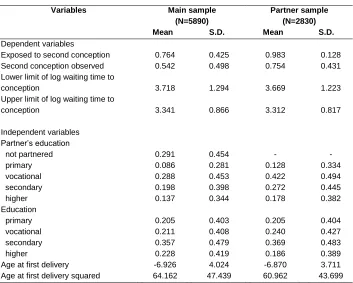
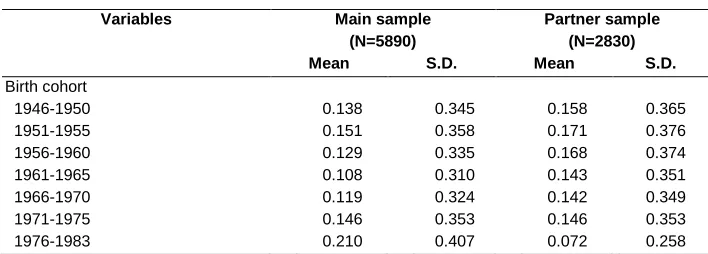
Table 1 presents the means and standard deviations of the variables in the full sample as well as in the partner sample. Recall that the latter sample is used to test the partner effect hypothesis. In the full sample, approximately three out of four women have become mothers and half of the mothers delivered two or more children. The probability of giving birth to the second child, conditional upon being a mother, is about 70 percent. The average waiting time to second conception is exp(3.341) = 28.25 months. The sample is relatively balanced in terms of education: the most frequent educational level is secondary (36 percent), the relative frequencies of the other educational levels range between 20 and 22 percent.
Table 1: Descriptive statistics for the main sample and the partner sample
Variables Main sample
(N=5890)
Partner sample (N=2830)
Mean S.D. Mean S.D.
Dependent variables
Exposed to second conception 0.764 0.425 0.983 0.128 Second conception observed 0.542 0.498 0.754 0.431 Lower limit of log waiting time to
conception 3.718 1.294 3.669 1.223
Upper limit of log waiting time to
conception 3.341 0.866 3.312 0.817
Independent variables Partner’s education
not partnered 0.291 0.454 - -
primary 0.086 0.281 0.128 0.334
vocational 0.288 0.453 0.422 0.494
secondary 0.198 0.398 0.272 0.445
higher 0.137 0.344 0.178 0.382
Education
primary 0.205 0.403 0.205 0.404
vocational 0.211 0.408 0.240 0.427
secondary 0.357 0.479 0.369 0.483
higher 0.228 0.419 0.186 0.389
Table 1: (Continued)
Variables Main sample
(N=5890)
Partner sample (N=2830)
Mean S.D. Mean S.D.
Birth cohort
1946-1950 0.138 0.345 0.158 0.365
1951-1955 0.151 0.358 0.171 0.376
1956-1960 0.129 0.335 0.168 0.374
1961-1965 0.108 0.310 0.143 0.351
1966-1970 0.119 0.324 0.142 0.349
1971-1975 0.146 0.353 0.146 0.353
1976-1983 0.210 0.407 0.072 0.258
Note: Age at first delivery is centered around 30.
5. Empirical analyses
The empirical analyses proceed in three steps. First, we present a simple description of the relationship between education and the waiting time to second conception. These analyses ignore the censoring of fertility histories of younger women. In the second step, we correct for this problem by estimating survival models of transitions to conceptions. Finally, we use survival models to examine the partner effect hypothesis.
5.1 The relationship between education and time to second conception
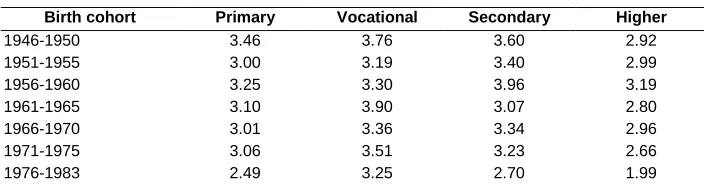
Table 2: Mean number of years between first birth and second conception by education and birth cohort
Birth cohort Primary Vocational Secondary Higher
1946-1950 3.46 3.76 3.60 2.92
1951-1955 3.00 3.19 3.40 2.99
1956-1960 3.25 3.30 3.96 3.19
1961-1965 3.10 3.90 3.07 2.80
1966-1970 3.01 3.36 3.34 2.96
1971-1975 3.06 3.51 3.23 2.66
1976-1983 2.49 3.25 2.70 1.99
The first thing to note is that the average time between first and second births ranges between two and four years. The relationship between the time to second conception and education nevertheless exhibits an inverted U-shaped pattern: within each cohort, women with primary and higher education space births closer together than women with either vocational or secondary education. The fact that it is highly educated women who space births the closest together – the same group which postpones the transition to motherhood – seems to be consistent with the time-squeeze hypothesis. It is also noteworthy that within each educational level, younger cohorts tend to space births closer together than older ones. The reduction of waiting time is about half a year for women with vocational education and one year for other educational levels.
Before generalizing the results from our sample to the population, one should keep in mind that data on waiting times are calculated using a probably selective sample of women. The sample is selective since it includes only mothers, and the factors affecting the probability of becoming a mother is not randomly distributed in our sample. It is well-known that women with higher education wait more to the first conception than their lower educated counterparts. For instance, out of 100 highly educated women born between 1976-1983, only 44 became a mother, as opposed to the 90 percent which characterizes members of the same cohort with primary education. This difference is due to the fact that the highly educated members of this cohort were too young to become mothers; they were only 18-25 years old at the time of the first wave and 25-33 at the time of the third wave of the Hungarian GGS.
5.2 Education and the transition to second conception
We now proceed to estimating two duration models for the waiting time to second conceptions. The first one is an interval-censored regression of log failure time to second births using the sample of mothers with one child. The explanatory variables include indicator variables for educational level and birth cohort, the age of mothers at first delivery centered around 30 and the square thereof, as well as interactions between education and the age variables. The interaction terms between educational levels and the age variables allows us to assess the time-squeeze mechanism, which implies that those women who spend more time in education and postpone childbearing tend to space births closer together. We have chosen higher education as the reference category. As a consequence, the time-squeeze mechanism implies that the interaction terms between education and age at previous delivery will be positive, meaning that women who spend less time in education and did not postpone the first birth much will wait longer until the second conception.
The first model addresses the issue of time squeeze but it does not address that of sample selection. To minimize selection bias, the conception equation, described in the previous paragraph, is estimated jointly with a selection equation. The dependent variable in the selection equation is an indicator variable marking mothers of one child. The independent variables include education and birth cohort. The link function for the equation is probit. The residuals of the conception and selection equations are assumed to follow a bivariate normal distribution.
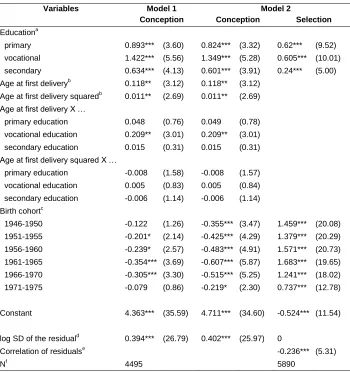
Table 3 presents the estimation results. One should keep in mind that coefficients reflect partial changes in log durations instead of changes in hazard rates, and a positive effect on duration is equivalent to a negative effect on the hazard rate. The positive main effects of the education variables in Model 1 thus mean that, compared to women with higher education, women with lower education tend to postpone the second birth. In other words, the positive coefficients are evidence for the hypothesis that highly educated women space births closer together than women with lower education.
Table 3: Education and waiting time to second conception
Variables Model 1 Model 2
Conception Conception Selection
Educationa
primary 0.893*** (3.60) 0.824*** (3.32) 0.62*** (9.52) vocational 1.422*** (5.56) 1.349*** (5.28) 0.605*** (10.01) secondary 0.634*** (4.13) 0.601*** (3.91) 0.24*** (5.00) Age at first deliveryb 0.118** (3.12) 0.118** (3.12)
Age at first delivery squaredb 0.011** (2.69) 0.011** (2.69) Age at first delivery X …
primary education 0.048 (0.76) 0.049 (0.78) vocational education 0.209** (3.01) 0.209** (3.01) secondary education 0.015 (0.31) 0.015 (0.31) Age at first delivery squared X …
primary education -0.008 (1.58) -0.008 (1.57) vocational education 0.005 (0.83) 0.005 (0.84) secondary education -0.006 (1.14) -0.006 (1.14)
Birth cohortc
1946-1950 -0.122 (1.26) -0.355*** (3.47) 1.459*** (20.08) 1951-1955 -0.201* (2.14) -0.425*** (4.29) 1.379*** (20.29) 1956-1960 -0.239* (2.57) -0.483*** (4.91) 1.571*** (20.73) 1961-1965 -0.354*** (3.69) -0.607*** (5.87) 1.683*** (19.65) 1966-1970 -0.305*** (3.30) -0.515*** (5.25) 1.241*** (18.02) 1971-1975 -0.079 (0.86) -0.219* (2.30) 0.737*** (12.78)
Constant 4.363*** (35.59) 4.711*** (34.60) -0.524*** (11.54)
log SD of the residuald 0.394*** (26.79) 0.402*** (25.97) 0 Correlation of residualse -0.236*** (5.31)
Nf 4495 5890
Notes: Coefficients from interval regressions of log durations until conceptions. See the text for details of the estimation method. Numbers in parentheses are t statistics. * p<0.05, ** p<0.01; *** p<0.001; two tailed tests assumed.
a The reference category is higher education.
b Age at first delivery is centered around 30. The square of age at first delivery is the square of that centered variable.
c The reference category is 1976-1983.
d The standard deviation of the residual in the selection equation is normalized to unity.
e Correlation coefficients are in fact the Firsher’s transformations, calculated as 0.5[ln(1+r) - ln(1-r)], where r is the correlation coefficient.
Now we address the question whether differences in spacing of second births across educational categories can be explained in terms of time-squeeze. The inclusion of interaction terms was motivated by this hypothesis. Due to the presence of the interaction terms and centering age at first delivery around 30, the main effects of education measure the effect of education in a population of women who became mothers at age 30. By the same token, the effects of age at first delivery and the square thereof are meaningful in a population of women with higher education. In both models, the coefficient of age at first delivery is about ten times larger than the coefficient of the squared term. Both coefficients are positive and significant. Therefore, there is a U-shaped relationship between the waiting time to second conception and age at first delivery, and waiting time is minimal if the first child was delivered at age 25.13 Since women with higher education tend to deliver the first child
when older than 25, they also tend to wait a longer time until the second birth. The pattern contradicts the time-squeeze hypothesis.
Additional evidence against the time-squeeze hypothesis is that the interaction terms between education and age at first delivery are not significant, with one exception: the interaction between vocational education and age at previous delivery is positive and statistically significant. This means that there is quite limited evidence that education would modify the effect of postponing the first birth on the spacing of births. Nevertheless, the time-squeeze mechanism is at work among women with vocational education. The sum of that interaction term and the main effect of age at first delivery are roughly 30 times larger than the main effect of the squared age term. This implies that women with vocational education would space the births closest together if they were about 30/2+30=45 years old when delivering the first child. Since there is a U shaped relationship between waiting time and age at first delivery, the postponement of childbearing reduces the waiting time among women with vocational education.
To summarize, we found evidence for the positive effect of higher education on the transition to second birth. Women with higher education space births closer together than women with lower education. This effect cannot be explained away with the help of the selection and the time-squeeze hypothesis. The former hypotheses can be rejected on the grounds that the estimates in Models 1 and 2 do not differ substantially, thus the educational effect cannot be attributed to unobserved factors which affect the waiting times to first and second births. The time-squeeze hypothesis is at odds with two findings. First, the relationship between age at first birth and waiting time to second conception exhibits a U-shaped pattern, and the time-squeeze effect applies only to
13 The minimum is obtained by dividing the coefficient of age at first delivery by -2 times the coefficient of
women who become mothers at a below-average age. Second, there is only limited evidence that the postponement of first birth would be conditional on education.
Another possible explanation for the positive effect of education on the transition to second birth is the partner effect hypothesis (Kreyenfeld 2002). We now turn to testing this hypothesis.
5.3 The partner effect hypothesis
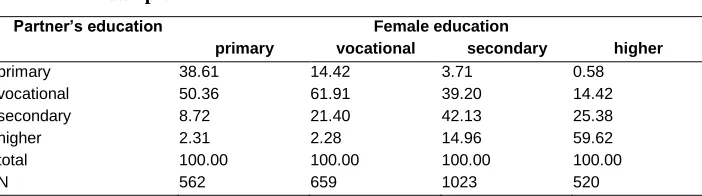
The partner effect hypothesis was examined using the partner sample (see Section 4.1). Before testing the effect of the partner’s education on spacing behavior, we first examined the extent of assortative mating. The distribution of partner’s education is presented in Table 4. The strength of educational homogamy depends on education: the chances of being partnered to a men with the same education is about 40 percent among women with either primary or secondary education, and about 60 percent among women with either vocational or higher education. The chances of living with highly educated men shows considerable variation. While 60 percent of college or university educated women were partnered to highly educated men, this proportion drops to 15 percent among women with secondary education, and to 2 percent among women with even lower education.
Table 4: Percentage distribution of partner's education in the estimation sample
Partner’s education Female education
primary vocational secondary higher
primary 38.61 14.42 3.71 0.58
vocational 50.36 61.91 39.20 14.42
secondary 8.72 21.40 42.13 25.38
higher 2.31 2.28 14.96 59.62
total 100.00 100.00 100.00 100.00
N 562 659 1023 520
Hungarian GGS, the ratio of the number of female college and university graduates to the number of men with the same educational level is three to two in the birth cohorts 1966-1983. This means that perfect educational homogamy cannot be achieved and half of the highly educated women must choose men with secondary education. This leads to an increasing competition among women with secondary education to find partners with higher or the same level of education. The first wave data suggests that the ratio of the number of female competitors to the number of male partners will again be three to two in the marriage market for men with secondary education. Therefore, half of the female competitors would most likely marry men with a lower education. The lesson is that women with tertiary and secondary education are disadvantaged in the marriage market since some of them must choose men with lower education.
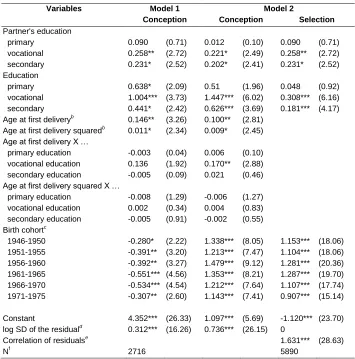
We now proceed to examining the effect of partner’s education on birth transitions. Again, we specify two models. Model 1 adds the partner’s education to the model which was labeled Model 1 in the previous subsection. Model 2 consists of two equations, which are estimated simultaneously. The first equation, labeled Conception, is the same equation as Model 1. The second equation, labeled Selection, is a probit model of being in the partner sample on female education and birth cohort. Similarly to the previous subsection, this equation is included in order to control for unobserved factors which affect both transitions to first and second births. Additionally, this equation also controls for possible sample-selection biases. Recall that the partner sample is not a random sample of retrospective event histories; due to its construction mechanism, it excludes unions that failed to survive until the first wave of data collection. The equations which constitute Model 2 are estimated simultaneously by allowing the equation-specific residuals to be correlated.
Table 5: Partner’s education and waiting time to second conception
Variables Model 1 Model 2
Conception Conception Selection
Partner's education
primary 0.090 (0.71) 0.012 (0.10) 0.090 (0.71) vocational 0.258** (2.72) 0.221* (2.49) 0.258** (2.72) secondary 0.231* (2.52) 0.202* (2.41) 0.231* (2.52)
Education
primary 0.638* (2.09) 0.51 (1.96) 0.048 (0.92) vocational 1.004*** (3.73) 1.447*** (6.02) 0.308*** (6.16) secondary 0.441* (2.42) 0.626*** (3.69) 0.181*** (4.17) Age at first deliveryb 0.146** (3.26) 0.100** (2.81) Age at first delivery squaredb 0.011* (2.34) 0.009* (2.45)
Age at first delivery X …
primary education -0.003 (0.04) 0.006 (0.10) vocational education 0.136 (1.92) 0.170** (2.88) secondary education -0.005 (0.09) 0.021 (0.46) Age at first delivery squared X …
primary education -0.008 (1.29) -0.006 (1.27) vocational education 0.002 (0.34) 0.004 (0.83) secondary education -0.005 (0.91) -0.002 (0.55)
Birth cohortc
1946-1950 -0.280* (2.22) 1.338*** (8.05) 1.153*** (18.06) 1951-1955 -0.391** (3.20) 1.213*** (7.47) 1.104*** (18.06) 1956-1960 -0.392** (3.27) 1.479*** (9.12) 1.281*** (20.36) 1961-1965 -0.551*** (4.56) 1.353*** (8.21) 1.287*** (19.70) 1966-1970 -0.534*** (4.54) 1.212*** (7.64) 1.107*** (17.74) 1971-1975 -0.307** (2.60) 1.143*** (7.41) 0.907*** (15.14)
Constant 4.352*** (26.33) 1.097*** (5.69) -1.120*** (23.70) log SD of the residuald 0.312*** (16.26) 0.736*** (26.15) 0 Correlation of residualse 1.631*** (28.63)
Nf 2716 5890
Notes: Coefficients from interval regressions of log durations until conceptions. See the text for details of the estimation method. Numbers in parentheses are t statistics. * p<0.05, ** p<0.01; *** p<0.001; two tailed tests assumed.
a The reference category is higher education.
b Age at first delivery is centered around 30. The square of age at first delivery is the square of that centered variable.
c The reference category is 1976-1983.
d The standard deviation of the residual in the selection equation is normalized to unity.
e Correlation coefficients are in fact the Firsher’s transformations, calculated as 0.5[ln(1+r) - ln(1-r)], where r is the correlation coefficient.
The estimation results for the other variables are virtually the same as the results presented in the previous subsection and in Table 3. Women with higher education space births closer together than women with lower education; since most of the interaction effects lack significance, we have no evidence that age at first delivery would modify the differences across education levels.
Our finding is that female education matters in spacing behavior even after controlling for partner’s education. This finding is consistent with those reported in Gerster et al. (2007) and Klesment and Puur (2010). While our study supports the classic income effect hypothesis, it does not support Kreyenfeld’s (2002) partner effect hypothesis that the relationship between female education and the transition to the second birth is spurious and is due to educational homogamy and the effect of male education. Given the available evidence, the relationship between women’s education and spacing behavior seems to be a causal one, and the partner effect hypothesis describes another mechanism which strengthens the correlation between higher education and the transition to second births.
6. Conclusions and discussion
men, a phenomenon known as educational homogamy or assortative mating (Becker 1981; Kalmijn 1998).
In this paper, we examine the relationship between education and the transition to second birth in Hungary, using three waves of the Hungarian Generations and Gender Survey (GGS). We estimate lognormal survival models which also control for both the time-squeeze and the selection hypotheses (Kreyenfeld 2002). Our results are as follows. First, women with higher education space the first and the second births closer together than women with lower education. This result is consistent with earlier results about the positive educational gradient concerning the transition to second and higher order births. Second, the education of the partner has the expected effect: women partnered to college or university educated men space births closer together than women partnered to men with either vocational or secondary education. However, the effect of female education remains significant, thus the effect of female education cannot be explained away in terms of the partner’s education. This finding is consistent with those reported in Gerster et al. (2007) and Klesment and Puur (2010), but it does not support the partner effect hypothesis. The relationship between women’s education and spacing behavior is likely to be a causal one, and the partner effect hypothesis describes another mechanism which strengthens the correlation between higher education and the transition to second births.
7. Acknowledgements
References
Baizan, P. and Martin-Garcia, T. (2006). Endogeneity and joint determinants of educational enrolment and first birth timing in France and West Germany. Genus 62(2): 89-117.
Bajnai, B., Hámori, Sz., and Köllő, J. (2009). The Hungarian labour market: European perspective. In: Fazekas, K. and Köllő, J. (eds.). The Hungarian labour market: Review and analysis 2009. Budapest: Institute of Economics HAS, National Employment Foundation: 44-94.
Becker, G.S. (1981). A treatise on the family. Cambridge, MA: Harvard University Press.
Becker, G.S. and Lewis, H.G. (1973). On the interaction between the quantity and quality of children. Journal of Political Economy 81(2): S279–S288. doi:10.1086/260166.
Billingsley, S. (2011). Economic crisis and recovery: Changes in second birth rates within occupational classes and educational groups. Demographic Research 24(16): 375-406. doi:10.4054/DemRes.2011.24.16.
Blaskó, Zs. (2005). Dolgozzanak-e a nők? A magyar lakosság nemi szerepekkel kapcsolatos véleményének változásai 1988, 1994, 2002. [Should women work? Changes in opinion about gender roles in Hungary 1988, 1994, 2002] Demográfia 48(2-3): 159-186.
Blaskó, Zs. (2010). Childcare and employment. In: Monostori, J., Őri, P., Molnár, E.S., and Spéder, Zs. (eds.). Demographic portrait of Hungary 2009: Report on the conditions of the Hungarian population. Budapest: HCSO Demographic Research Institute: 41-50.
Blossfeld, H.-P., Golsch, K., and Rohwer, G. (2007). Techniques of event history modeling using Stata: New approaches to causal analysis. Mahwah, NJ: Erlbaum.
Frey, M. (2011). Nők és férfiak a munkaerőpiacon, különös tekintettel a válságkezelés hatásaira. [Women and men on the labor market, with special attention to the effects of crisis management] In: Nagy, I. and Pongrácz, T. (eds.). Szerepváltozások. Budapest: TÁRKI: 17-49.
Transition. European Journal of Population 26(1): 3-31. doi:10.1007/ s10680-009-9196-.8
Gerster, M., Keiding, N., Knudsen, L.B., and Strandberg-Larsen, K. (2007). Education and second birth rates in Denmark 1981-1994. Demographic Research 17(8): 181-210. doi:10.4054/DemRes.2007.17.8.
Gustafsson, S. (2001): Optimal age at motherhood: Theoretical and empirical considerations on postponement of maternity in Europe. Journal of Population Economics 14(2): 225-247. doi:10.1007/s001480000051.
Happel, S.K., Hill, J.K., and Low, S.A. (1984). An economic analysis of the timing of childbirth. Population Studies 38(2): 299-311. doi:10.1080/ 00324728.1984.10410291.
Hoem, J.M., Kostova, D., Jasilioniene, A., and Mureşan, C. (2009). Traces of the Second Demographic Transition in four selected countries in Central and Eastern Europe: Union formation as a demographic manifestation. European Journal of Population 25(3): 239-255. doi:10.1007/s10680-009-9177-y.
Hotz, V.J. and Miller, R.A. (1988). An empirical analysis of life cycle fertility and female labor supply. Econometrica 56(1): 91-118. doi:10.2307/1911843. Husz, I. (2006). Iskolázottság és a gyermekvállalás időzítése [Education and the timing
of childbearing.] Demográfia 49(1): 46-67.
Jones, L.E., Schoonbroodt, A. and Tertilt, M. (2008). Fertility theories: Can they explain the negative fertility-income relationship? Cambridge, MA: National Bureau of Economic Research. (NBER Working Paper No. 14266) http://www.nber.org/papers/w14266.pdf.
Kalmijn, M. (1998). Intermarriage and homogamy: Causes, patterns and trends. Annual Review of Sociology 24: 395-421. doi:10.1146/annurev.soc.24.1.395.
Kantorová, V. (2004). Education and entry into motherhood: The Czech Republic during state socialism and the transition period (1970-1997). Demographic Research Special Collection 3(10): 245-274. doi:10.4054/DemRes.2004.S3.10. Kapitány, B. and Spéder, Zs. (2010). Fertility. In: Monostori, J., Őri, P., S. Molnár, E.,
Kézdi, G., Köllő, J., and Varga, J. (2009). The failures of “uncertified” vocational training. In: Fazekas, K. and Köllő, J. (eds.). The Hungarian labour market: Review and analysis 2009. Budapest: Institute of Economics HAS, National Employment Foundation: 95-147.
Klasen, S. and Launov, A. (2006). Analysis of the determinants of fertility decline in the Czech Republic. Journal of Population Economics 19(1): 25-54. doi:10.1007/s00148-005-0030-2.
Klein, J.P. and Moeschberger, M.L. (2003). Survival analysis: Techniques for censored and truncated data. New York: Springer.
Klesment, M. and Puur, A. (2010). Effects of education on second births before and after societal transition: Evidence from the Estonian GGS. Demographic Research 22(28): 891-932. doi:10.4054/DemRes.2010.22.28.
Korintus, M. (2010). Hungary. In: Moss, P. (ed.). International review of leave policies and related research 2010. London: Department for Business, Innovation and
Skills: 115-141.
Kravdal, Ø. (2001). The high fertility of college educated women in Norway: An artefact of the separate modelling of each parity transition. Demographic Research 5(6): 187-216. doi:10.4054/DemRes.2001.5.6.
Kravdal, Ø. (2007). Effects of current education on second- and third-birth rates among Norwegian women and men born in 1964: Substantive interpretation and methodological issues. Demographic Research 17(9): 211-246. doi:10.4054/ DemRes.2007.17.9.
Kreyenfeld, M. (2002). Time-squeeze, partner effect or self-selection? An investigation into the positive effect of women's education on second birth risks in West Germany. Demographic Research 7(2): 15-48. doi:10.4054/DemRes.2002.7.2. Kulu, H. and Vikat, A. (2007). Fertility differences by housing type: The effect of
housing conditions or of selective moves? Demographic Research 17(26): 775-802. doi:10.4054/DemRes.2007.17.26.
Lillard, L. and Panis, C.W.A. (2003). aML Multilevel Multiprocess Statistical Software. Version 2.0., Los Angeles, CA: EconWare.
Mincer, J. and Polachek, S. (1974). Family investments in human capital: Earnings of women. Journal of Political Economy 82(2): S76-S108.
Montgomery, M. and Trussel, J. (1986). Models of marital status and childbearing. In: Ashenfelter, O. and Layard, R. (eds.). Handbook of Labor Economics Vol. I. Amsterdam: North-Holland: 205-271.
Mureşan, C. and Hoem, J.M. (2010). The negative educational gradients in Romanian fertility. Demographic Research 22(4): 95-114. doi:10.4054/DemRes.2010.22.4. Newman, J.L. (1983). Economic Analyses of the Spacing of Births. American
Economic Review 73(2): 33-37.
Oláh, L.Sz. and Fratczak, E. (2004). Becoming a mother in Hungary and Poland during state socialism. Demographic Research Special Collection 3(9): 213-244. doi:10.4054/DemRes.2004.S3.9.
Roodman, D. (2011). Fitting fully observed recursive mixed-process models with cmp. Stata Journal 11(2): 159-206.
Ross, S.G. (1974). The timing and spacing of births and women’s labor force participation: An economic analysis. Cambridge, MA: National Bureau of Economic Research (NBER Working Paper No. 30). http://www.nber.org/papers/w0030
Spéder, Zs. (2001). Turning points of the life course: Research plan and questionnaire of the Hungarian Social and Demographic Panel Survey (HSDPS). Budapest: HCSO DRI. http://www.demografia.hu/letoltes/dpa/panel_koncepcio_a.pdf. Spéder, Zs. (2006). Rudiments of recent fertility decline in Hungary: Postponement,
educational differences, and outcomes of changing partnership forms. Demographic Research 15(8): 253-288. doi:10.4054/DemRes.2006.15.8. Szalma, I. (2010) Attitűdök a házasságról és a gyermekvállalásról. [Attitudes about
marriage and childbearing] Demográfia 53(1): 38-67.
Taniguchi, H. (1999). The timing of childbearing and women’s wages. Journal of Marriage and the Family 61(4):1008-1019. doi:10.2307/354020.
Appendix
In the Appendix, we present some evidence on the age-earnings profiles of men and women by education and birth cohort. We use the 1994-2008 waves of the Hungarian Wage and Earnings Survey (WES). The WES is collected annually, the sample includes 150,000-217,000 employees, depending on the year. (For a detailed description of the sampling design, consult Lovász 2008). An important feature of the survey is that no individuals are interviewed: all data on individual wages and personal characteristics are provided by the representatives of the sampled firms. Using the individual-level data, we created a quasi-panel dataset. There are 24 groups in the quasi-panel dataset, defined as the combinations of four educational levels, three birth cohorts (1966-1970, 1971-1975, and 1976-1983) and the two sexes. For each group, average net wages are observed in the period 1994-2008. The nominal earnings figures were transformed into real values using price-index data published by the Hungarian Central Statistical Office, the base year being 2011.
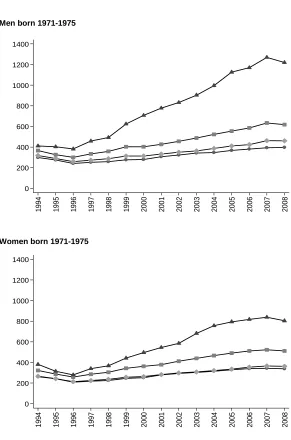
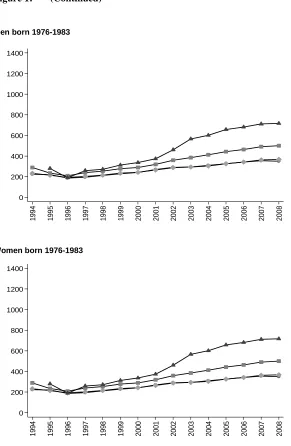
Figure 1 shows the real value of net monthly earnings in Euro by educational level for three birth cohorts and the two sexes separately.14 In 2011, the net minimum wage
was about 280 euros per month, thus each 200 unit on the Y axis represents about 70 percent of the minimum wage. The graphs show that the largest wage disparities can be found between people with higher education and people with secondary education, especially among men. The wage differentials became pronounced during the late 1990s and the 2000s. It is also striking that there is virtually no average wage difference between people with vocational education and people with primary education. People with secondary education enjoy a small wage advantage of about 90 Euro per month over people with poor education.
Wage differences between educational groups are affected by gender. On average, men with secondary education or less do not earn more than women with similar education. In contrast, college and university educated men born between 1966 and 1975 do enjoy a substantial wage advantage over women with the same educational level. The advantage of men seems to diminish as we move from older cohorts to younger ones.
Figure 1: Net real wages in Euro by educational level, gender and birth cohort, 1994-2008
Men born 1966-1970
0 200 400 600 800 1000 1200 1400
1994 1995 1996 1997 1998 1999 2000 2001 2002 2003 2004 2005 2006 2007 2008
Women born 1966-1970
0 200 400 600 800 1000 1200 1400
1994 1995 1996 1997 1998 1999 2000 2001 2002 2003 2004 2005 2006 2007 2008
Figure 1: (Continued)
Men born 1971-1975
0 200 400 600 800 1000 1200 1400
1994 1995 1996 1997 1998 1999 2000 2001 2002 2003 2004 2005 2006 2007 2008
Women born 1971-1975
0 200 400 600 800 1000 1200 1400
1994 1995 1996 1997 1998 1999 2000 2001 2002 2003 2004 2005 2006 2007 2008
Figure 1: (Continued)
Men born 1976-1983
0 200 400 600 800 1000 1200 1400
1994 1995 1996 1997 1998 1999 2000 2001 2002 2003 2004 2005 2006 2007 2008
Women born 1976-1983
0 200 400 600 800 1000 1200 1400
1994 1995 1996 1997 1998 1999 2000 2001 2002 2003 2004 2005 2006 2007 2008