Original Research Article
Challenges faced in handling the medico-legal cases in a selected
teaching hospital
Naseel N. Gurupur
1, Sunita Saldanha
1, Nagaraj Shet
1*, Prajna Sharma
2INTRODUCTION
Every doctor under law has to serve his patient and cannot refuse treatment making the health care services more complicated. Also as defined under law, every doctor has to fulfil certain legal requirements during his service by compulsion or voluntarily. Apart from routine and usual “clinical” cases, a doctor will come across certain „Medico-Legal‟ problems at one time or the other during the practice of his/her profession.1
A medico legal case (MLC) can be defined as “a case of injury or ailment, etc., in which investigations by the law-enforcing agencies are essential to fix the responsibility regarding the causation of the injury or ailment.” Injury is defined under section 44 IPC as “any harm whatever illegally caused to any person, in body, mind, reputation or property”.1
Reporting a MLC to the nearest police station after giving primary lifesaving medical care is one of the legal responsibilities of all doctors according to “section 39 of criminal procedure code of India.” This is to ensure that
ABSTRACT
Background: Doctor comes across certain „Medico-Legal‟ problems at one time or the other during the practice of his/her profession. Reporting a medico legal case (MLC) is one of the legal responsibilities of all doctors to ensure that immediate action is taken by the police and maximum evidence is collected by them. This study was undertaken to assess the knowledge and attitude of the staff in dealing medico-legal case in tertiary care hospital and to find the challenges faced by them while handling the medico-legal cases.
Methods: A cross sectional Study was conducted at Yenepoya Medical College Hospital, Mangalore among the Staff working in Accident and Emergency Department during the study period of 6 months.
Results: The study was conducted among 116 study participants, most 108 (93.1%) were in the age group of 20-29 years and 77 (66.4%) were females. It was seen that only 3 (2.6%) of them correctly answered 17-20 questions out of 20 questions that were asked. Knowledge regarding MLC case was much high among CMO compared to others which was statistically significant with p value <0.0001. Challenges faced by the study participants were patients or the patient party not willing for MLC, delayed treatment due to the confusion, answering the court, handling the police and the violent public in few cases.
Conclusions: Knowledge on dealing with MLC and a proper counseling session for patients of MLC cases can help to overcome various challenges faced while dealing with any MLC case.
Keywords: Medico-legal case, Knowledge, Attitude, Challenges
1
Department of Hospital Administration, Yenepoya Medical College, 2Department ofCommunity Medicine, Kanachur Institute of Medical Sciences, Deralakatte, Mangalore, Karnataka, India
Received: 21 May 2019 Revised: 30 July 2019 Accepted: 01 August 2019
*Correspondence: Dr. Nagaraj Shet,
E-mail: [email protected]
Copyright: © the author(s), publisher and licensee Medip Academy. This is an open-access article distributed under the terms of the Creative Commons Attribution Non-Commercial License, which permits unrestricted non-commercial use, distribution, and reproduction in any medium, provided the original work is properly cited.
immediate action is taken by the police and maximum evidence is collected by them.2 A health care provider dealing with a MLC case can be called to the court anytime to come with the medical records as an expert witness. This is of pivotal importance for the proceedings of the trial and any incompetence by the health care provider can result in grave consequences for both the Institution and self. Thus a doctors dealing with an MLC case must simultaneously exercise vigilance and proper documentation while providing primary and life saving treatment to the patient. This saves the doctor from unnecessary and needless allegations later and also to avoid embarrassment in the court and legal complications.3
As law is common to all, medico legal knowledge is an essence for a medical professional irrespective of their specialty.3 A good working knowledge of the law in this regard, coupled with a thorough understanding of the correct method of dealing with such cases helps one to build confidence over riding the fear of MLC.1
Hence this study was undertaken to assess the knowledge and attitude of the staff in dealing MLC in tertiary care hospital and to find the challenges faced by them while handling the MLCs.
METHODS
A cross sectional study was conducted at Yenepoya Medical College Hospital, Deralakatte, Mangalore among the staff working in Accident and Emergency Department during the study period of 6 months (September 2018 -February 2019). A structured questionnaire was administered among medical and nursing staff which included various criteria to assess the knowledge and attitude about medico-legal practices. Challenges faced in handling MLCs were assessed with an open ended questionnaire. Institutional ethical clearance was taken and informed consent taken from all the study participants.
Statistical analysis
The data collected was analyzed using SPSS software. Student t-test was used to find association between two variables.
RESULTS
Study was conducted among 116 study participants, of which 16 (13.8%) were nurses, 47 (40.51%) were interns, 31 (26.7%) were junior residents, 16 (13.79%) were consultants and 6 (5.2%) were CMOs. Most 108 (93.1%) were in the age group of 20-29 years and 77 (66.4%) were females (Table 1).
Knowledge of the study participants about MLC case
On assessing the overall knowledge of the study participants, it was seen that only 3 (2.6%) of them correctly answered 17-20 questions out of 20 questions that were asked. Most of them, 64 (55.2%), answered only half of the questions correctly. 44 (37.9%) of them answered 13-16 questions correctly and 5 (4.3%) of them answered only 5-8 questions correctly (Table 3).
Table 1: Socio-demographic characteristics of study participants.
Characteristics Frequency %
Age (in years)
20-29 108 93.1
30-39 7 6.0
40-49 1 0.9
Sex Female 77 66.4
Male 39 33.6
Designation
Nurses 16 13.8
Interns 47 40.51
Junior
residents 31 26.7
Consultant 16 13.79
CMO 6 5.2
Table 2: Distribution of study participants based on the knowledge of study participants.
Knowledge Frequency %
MLC is an injury, illness, suffering or death not due to natural cause. 83 71.6
Treating doctor is the one who decides if any case is MLC. 35 30.2
Deciding a case as MLC is based on detailed history of the patient, a thorough clinical
examination and sound professional judgment. 78 67.2
Sequence of action when dealing with an MLC case is first aid/ stabilization/
resuscitation, intimating the police and documentation subsequently. 87 75 MLC should be registered as soon as the patient is brought to the hospital. 99 85.3
Unexplained ICU death is considered as MLC. 56 48.3
Immediately intimate the police when a case is brought dead. 54 46.6
Inform police about drug/alcohol related death. 109 94
Knowledge Frequency %
Doctors cannot refuse to treat a MLC case. 82 70.7
Evidence collected through swabs was air dried. 26 22.4
Gastric lavage sample in poisoning case does not need any preservatives. 49 42.2 Rule of nine indicates measure of estimating the extent of burns, expressed as percentage
of total body surface. 107 92.2
SAFE kit is a forensic examination kit used in cases of sexual assault. 38 32.8 Samples and specimens that are collected for MLC will be handed over to the
investigating officer. 46 39.7
Executive magistrate, CMO or a police office can record the dying declaration. 42 36.2 Cause of death in MLC cases will not be mentioned in the death certificate. 14 12.1
Medical negligence is considered as MLC. 108 93.1
Registration of MLC case cannot be modified based on the request from the patient or
their relatives. 30 25.9
On comparing the knowledge of males and females, it was seen that males had better knowledge than females but this difference was not statistically significant with p>0.05 (Table 4).
Table 3: Distribution of study participants based on the knowledge of study participants.
No. of correct
responses Frequency Percentage
5-8 (25-40%) 5 4.3
9-12 (45-60%) 64 55.2
13-16 (65-80%) 44 37.9
17-20 (85-100%) 3 2.6
Total 116 100.0
Table 4: Comparison the knowledge of MLC among different sexes.
Sex Knowledge about MLC
mean (SD) P value
Female 11.75 (1.96)
0.091 Male 12.59 (2.70)
Table 5: Comparison the knowledge of MLC among different professions.
Designation Knowledge about MLC
mean (SD) P value
Nurses 11.69 (2.30)
<0.00001 Interns 11.77 (1.71)
Junior
resident 11.85 (2.26) Consultant 11.98 (3.14)
CMO 16.5 (1.64)
Nurses, interns and post graduates had same level of knowledge regarding MLC case but was much less than the knowledge of a CMO and this difference was found to be statistically significant with p<0.0001 (Table 5).
Attitude of the study participants about MLC case
A doctor needs to abide by the laws of the land while discharging his duties and has ethical and legal obligations. And also for the administration of law and justice, his service and knowledge may be required. As a caregiver or a lifesaver, he has to take care of medico legal aspects while discharging his duties.
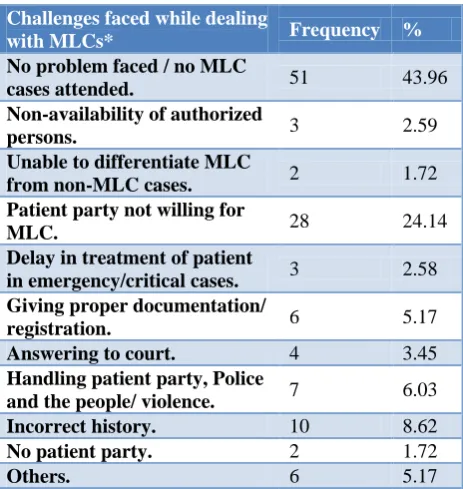
Table 6: Challenges faced by the study participants while dealing with MLC.
Challenges faced while dealing
with MLCs* Frequency %
No problem faced / no MLC
cases attended. 51 43.96
Non-availability of authorized
persons. 3 2.59
Unable to differentiate MLC
from non-MLC cases. 2 1.72
Patient party not willing for
MLC. 28 24.14
Delay in treatment of patient
in emergency/critical cases. 3 2.58 Giving proper documentation/
registration. 6 5.17
Answering to court. 4 3.45
Handling patient party, Police
and the people/ violence. 7 6.03
Incorrect history. 10 8.62
No patient party. 2 1.72
Others. 6 5.17
*multiple answers
either try to avoid the cases or try to get rid of them as soon as possible.
Challenges faced by the staff while handling the MLCs
Challenges faced by the study participants were unable to decide or differentiate between a MLC and a non MLC case, improper history, patients or the patient party not willing for MLC, delayed treatment due to the confusion, documentation and answering the court, handling the police and the violent public in few cases. Other difficulties faced were delay in intimation to police, giving consent that the patient is fit to give statement, financial issues especially in an insured patient, cases referred from other hospital (Table 6).
DISCUSSION
It was observed that out of 116 study participants including nurses, interns, junior resident, consultants and CMO, 93.1% belonged to the age group 20-29 years, 6% in the age group 30-39 years and only 0.9% in the age group 40-49 years, of which, 66.4% were females and 33.6% were males.
A study done by Makhani et al in Lucknow to assess the awareness among medical professionals about medical ethics and Medico Legal issues showed that out of 68 physicians who participated in the study, 7.35% belonged to the age group 25-35 years, 72.06% were in the age group 35-45 years and 20.59% in 45-50 years.4
A similar study was done by Kheir et alin Sudan to know the medico legal awareness among health professionals in 2016 and included doctors from all specialties.5 Out of 200 respondents, 47.2% were in age group 20-29 years, 25.4% in age group 30-39 years, 13.2% in 40-49 years age group and 14.2% were >50 years, among which 56.9% females and 43.1% males.
Another study done by Magda et alin Cairo, Egypt to study the handling of MLCs in government hospitals in 2017.6 The study included 452 physicians from 7 different government hospitals. Out of these, 66.6% were <30 years, 27% belonged to 30-39 years age group, 4% were 40-49 years old and 2.4% were aged >50 years.This study shows that the knowledge about MLC was better as the age increased which can be explained as increased experience, but the difference was very minimal and was not statistically significant. In this study, 66.4% were males and 33.6 % were females, where males had better knowledge than females but this difference was not statistically significant.
In our study, 71.6% gave correct response that MLC is an injury, illness, suffering or death not due to natural cause. Similar response was seen in the study done by Mahesh et al in Aurangabad in 2017 where 68.89% knew what a MLC case is.7
Correct sequence of action while dealing with an MLC case is to treat the patient for first aid/ stabilization/ resuscitation, intimating the police and then documentation. In this study 75% of them knew this answer correctly. In a study done by Magda et al, 66.2% of the study participants knew that police have to be intimated about a MLC case before discharging the patient.6
In the present study, 99 (85.3%) knew that the MLC should be registered as soon as the patient is brought to the hospital. In a similar study done by Kheir et al 98.5% of the study participants knew that the hospital is legally bound to maintain records.5 In a study done by Goel et al in Ghaziabad in 2017, 95.33% knew about record keeping.8
In another study done by Singh et al in Lucknow in 2011, only 55.46% knew the importance of record keeping.9 Similar findings were seen in another study done by Jambure et al were only 61.11% knew about maintaining the record.7,8 The difference in the results maybe because this study included even Nurses and CMOs who are experienced and highly exposed to MLC cases while the study done by Jambure et al was done only among interns and post graduates.
MLC files have to be kept in the hospital permanently and in this study 62.9% of them knew it. Other study participants responded that the files have to be kept for 2 years (4.3%), 5 years (11.2%) and 10 years (21.6%). In another study done by Kheir et al 94.5% told that the record should be maintained till the case is judged, 3% told 2years, 1% told 3 years and 1.5% told 5years.5
Immediately the police should be intimated when a brought dead case is received and this was answered by 46.6% of the study participants in this study. Similar finding was seen in another study done by Magda et al which showed that 57.3% of the study participants knew that in case of death in a MLC the dead body is not to be handed over to the relatives.6
Exhibits are preserved as evidence in MLC cases. In the present study only 16.4% of them were aware about this. In another study done by Magda et al, 77.4% knew that Medico Legal evidence is required for legal invest-igation.6
Out of 116 of the total study participants in this study, 70.7% of them were aware that a doctor cannot refuse to treat a MLC case. Similar findings were seen in a study done by Kheir et al were 87.9% of the study participants gave the same answer.5
study participants. Similar findings were seen, that is 41.67% of the study participants in the study done by Magda et al knew about preservation of gastric lavage.6
In the present study 92.2% of them knew that rule of nine indicates measure of estimating the extent of burns, expressed as percentage of total body surface. In another study done by Jambure et al only 67.22% of them knew what rule of nine is.7,8
Almost all in the present study, 108 (93.1%), knew that a medical negligence is considered as MLC. Similar findings were seen in the study done by Kheir et al were 98% of them knew that medical negligence was considered as MLC.5,9
On assessing the overall knowledge of the study participants in this study, out of 24 questions, only 2.6% of them correctly answered 17-20 questions, 64 55.2% of them answered only half of the questions correctly, 37.9% of them answered 13-16 questions correctly and 4.3% of them answered only 5-8 questions correctly. In a study done by Makhani et al, 20 questions were asked to assess the knowledge of the study participants and it was seen that only 2.9% of them answered almost all the questions correctly.4 The knowledge was better when compared to this study with 52.91% of them answering 13-16 questions correctly, 33.82% of them answered 9-12 questions correctly and 8.82% of them answered only 5-8 questions correctly. The latter study was done among experienced physicians and specialized doctors in indoor while this study also included interns and junior residents.
Unable to decide or differentiate between a MLC and a non MLC case, improper history, patients or the patient party not willing for MLC, delayed treatment due to the confusion, documentation and answering the court, handling the police and the violent public in few cases. These were the challenges that were faced by the study participants in this study while dealing with a MLC. Few other difficulties were delay in intimation to police, giving consent that the patient is fit to give statement, financial issues especially in an insured patient, cases referred from other hospital.
Similar difficulties were mentioned in another study done by Singh et al. Few of them were incorrect history, patient or patient attendant absconding, patient refusing for MLC and attending to court as witness.2
CONCLUSION
Doctors usually come across MLCs during their practice. Even then most of them do not have enough knowledge regarding the same. This has given rise to many challenges to be faced while dealing with a MLC. Hence knowledge on dealing with MLC can help to overcome
various challenges and for this various workshops, seminars and training can be conducted by the organization. A proper counseling session can be arranged for patients for all MLCs, so that they can have a better understanding and knowledge regarding the case. Medico-Legal training can be provided to all staffs before they are posted in Accident and Emergency Department in order to improve their knowledge and increasing their ability in recognizing and handling of MLCs. MLC protocols should be displayed in public areas of the hospital.
Funding: No funding sources Conflict of interest: None declared
Ethical approval: The study was approved by the Institutional Ethics Committee
REFERENCES
1. Chandrachud YV, Manohar VR. The Indian Penal Code. 31st Enlarged ed. Nagpur, India: Wadhwa and Company; 2006: 228.
2. Sampath P. Medico-legal cases: top facts you should know. Available at www.thehealthsite.com. Accessed 17 May 2019.
3. Raj VM, Vasudeva DS, Gagan S. Guidelines for Handling Medico Legal Cases. Int J Health Inform Med Res. 2014;1(1):1-5
4. Makhani CS, Petkar MR, Chavan KD, Rao TV. Awareness of Medical Ethics and Medico-Legal Issues amongst Medical Professionals. Indian J Forensic Med Pathol. 2011;4(4):151-6
5. Kheir AEM, Dafaalla M, Bashir AA, Abuelgasim NA, Abdalrahman I. Medico Legal awareness amongst health professionals in Sudan. Online J Clin Audit. 2016; 8(4):1-5.
6. Magda M, Azaba SMS, Shaimaa H, Ez-Elarabb HS. Study of handling of medico-legal cases in governmental hospitals in Cairo. J Forensic Legal Med. 2018;60:15-24.
7. Mahesh J, Ashlesha J. A study on Awareness and Knowledge about Medico Legal Issues among Interns and Post Graduate Students. Int J Current Med Applied Sci. 2017;17(1):9-12.
8. Goel P, Sharma P, Sharma P, Vaish S. Awareness about medico legal aspects and Consumer Protection Act (CPA) among dental fraternity. J Dent Specialties. 2018;6(2):131-5.
9. Singh AK, Singh K, Verma A. Study of medico-legal case management in tertiary care hospital. J Indian Acad Forensic Med. 2011;33(4):337-42.