www.ijatca.com 72
International Journal of Advanced Trends in
Computer Applications
www.ijatca.com
An ICA Based Feature Level Fusion of Iris and Ear
Biometrics
1
Chandini Sharma
Student
M.Tech Scholar, C.S.E. Department Adesh Institute of Engineering & Technology
Faridkot, Punjab, India [email protected]
2
Navdeep Singh Sethi
Assistant Professor C.S.E. Department
Adesh Institute of Engineering & Technology Faridkot, Punjab, India
Abstract:
In this paper, a new multimodal biometric system is introduced; this system aim to fuse iris and ear features. A new technique i.e. Independent Component Analysis (ICA) is implemented at feature level for feature extraction and fusion of iris and ear increase the accuracy of the authentication system. Additionally the feature reduction of iris and ear has been done by Genetic Algorithm (GA) and training of the system is done by Neural Network (NN). The performance evaluation of proposed method is done by using metrics like False Acceptance Rate (FAR), False Rejection Rate (FRR) and Accuracy in MATLAB environment.Keywords:
Independent Component Analysis (ICA), neural network (NN), Biometric Fusion, Iris, Ear.1.
I
NTRODUCTIONBio metric fusion is always done to enhance the security levels of the access in the modern world. Uni-modal biometric systems do not provide sufficient levels of accuracy and security and are not to prevent the attacks against data modification and authentication [1]. There has only been limited research done into the application of multimodal biometric systems. Most studies have only made use of small population size for their biometric samples [2]. This cannot be accurate enough, as a larger population size might produce a very different result.
A lot of previous work has already been done in the contrast of combining different biometric techniques which is termed as fusion of the biometrics [3]. The biggest problem in any fusion technique is the matching of the features after the extraction for better alignment of the feature value. There are a lot of algorithms which are available for the feature extraction but there is no such method mentioned through which we can align them all together [4]. To make the alignment of the features better optimization techniques could have been used. Previous research workers have put their effort in the combining different biometric techniques using
Optimization Techniques like BCO, ACO [5]. Neural Network is one of most advanced classifiers of this arena. Use of neural network would enhance the security system to a large extent [6].
Remaining paper is organized as Section II includes the proposed work methodology, Section III contains the results and implementation and Section IV contains the conclusion and future scope.
2.
W
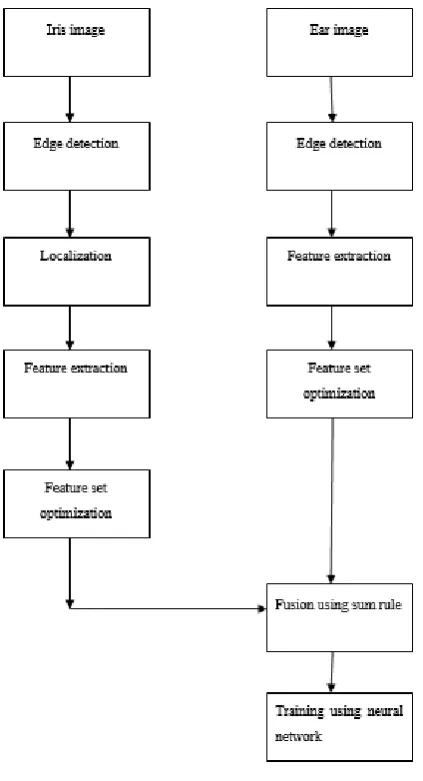
ORK MODELwww.ijatca.com 73 Figure.1 proposed work model
A.IRIS RECOGNITION
Step.1 Image acquisition
Image acquisition of iris biometric. Image acquisition of iris image is the first step of proposed technique which is collected from IIT Delhi Iris Image Database version 1.0.
Figure 3. Iris Biometrics
Step.2 Gray scale conversion
Intensity image I is given as:
I= R (.23) + G (.50) + B(.31)
Image I is then preprocessed with ICA. I is actually the hue- Saturation-Value color space. During conversion Red-Green-Blue color space is converted into HSV color space.
Step.3 Canny edge detection
Canny edge detector is applied to get the edges of the iris image. Edge detection is mainly done to get the useful data and to remove the extra part of ear biometric from this the edge gradient and direction can be determined:
G =
The edge detector returns a value for the first derivative in the horizontal direction (Gx) and the vertical direction (Gy).
Step.4 Iris localization using HCT
Iris localization is done mainly to get the pupil and outer part of iris biometric [6]. The first step of iris localization is to get the pupil and then the outer part of iris using following formula:
Horizontal Vertical
abs G G
G
whereGvertical is the convolution of image with Cvertical and Ghorizontal is the convolution of image with Chorizontal..
Step.5 Feature extraction using ICA
Then feature extraction will takes place. Independent Component Analysis (ICA) is a computational method to get hidden values of random variables. ICA basically designed for multivariate data. ICA is somewhat related to Principal Component Analysis (PCA). But it is capable when PCA fails. ICA will helps to find features of independent components [8].
Input: C1 (contrast function),
Z1 (whitened mixtures), β 1(convergence parameter), τ 1(number of iterations).
Output: W1 (separation matrix).
Auxiliary: α 1(an angle), n1 (number of sources), i1, j1,t1 (iteration indices).
Begin . Initialize W1 to the identity matrix.
W1 ← In1 .
Deflation approach: estimate each source sequentially. for i1 ← 1 to n1 do .
Iterate for the i-th source for t ← 1 to τ1 do .
www.ijatca.com 74 For each perpendicular direction.
for j1 ← i+1 to n1 do . Determine best contrast value.
if C1(wi↑jz) > C1(wiz) and C1(wi↑jz) > C1(wi↓jz) then .
Rotate the i-th and j-th rows of W accordingly (+α). wi,wj ← wi↑j,wj↓i else if C1(wi↓jz) > C1(wiz) and C1(wi↓jz) > C1(wi↑jz) then .
Rotate the i-th and j-th rows of W accordingly (−α). wi,wj ← wi↓j,wj↑i
end if
end for
end for
end for
Return W 1
End
Step.6 Iris Optimization using Genetic Algorithm
Initialize generation 0:
k := 0;
Pk := a population of n randomly-generated individuals;
// Evaluate Pk:
Compute fitness (i)
for each i∈Pk; do
{ // Create generation k + 1:
// 1. Copy: Select (1 − χ) × n members of Pk and insert into Pk+1;
// 2. Crossover: Select χ × n members of Pk; pair them up; produce offspring; insert the offspring into Pk+1;
// 3. Mutate: Select µ × n members of Pk+1;
invert a randomly-selected bit in each;
// Evaluate Pk+1:
Compute fitness(i) for each i∈Pk;
// Increment: k := k + 1; } while fitness of fittest individual in Pk is not high enough;
return the fittest individual from Pk
B.EAR RECOGNITION
Step.7: Image Acquisition
Image acquisition of ear biometric. Image acquisition of ear image is the first step of proposed technique which is collected from IIT Delhi Ear Image Database version 1.0.
Figure: 2 Ear Biometric
Step.8: Gray scale conversion
Repeat step.2
Step.9: Canny edge detection
Repeat step.3
Step.10: Feature extraction of Ear using ICA
Repeat step.5
Step.11 Optimization of biometric feature set using Genetic algorithm [5].
Repeat step.6
C.FUSION OF IRIS AND EAR BIOMETRICS
Step.12 APPLY SUM RULE
Based on the idea of sum rule based score level fusion , the generated matching scores of iris and ear data are summed up together to form a final fused score using sum rule and it can be described as [7]:
F score = F iris + F ear
Step.13 APPLY NEURAL NETWORK
Training using neural network will be done in following way:
setup NN and also prepare the subsequent factors as: number_of_layers; epochs;
learning_rate; permissible_error;
input: network, training set
do
for each image in training set
fuse the removed characteristics hooked on to a single characteristics matrix;
until a solitary characteristic of vector matrix is made;
do
train the given network regarding class labels as well as feature vectors;
until ending criterion epochs=2000 is fulfilled
output: a trained neural network.
Step.14
www.ijatca.com 75
3.
R
ESULTS ANDI
MPLEMENTATIONThe system is tested on iris/ear images obtained at IIT
Delhi database using MATLAB environment. The
below figures shows the implementation results.
Figure.4 Iris Database
Figure.5 Ear database
Calculate FAR
FAR = (Total Number of Samples−Number of
Samples that falsely accepted) / Total Number of Samples
Calculate FRR
FRR = (Total Number of Samples−Number of
Samples that Falsely Rejected) / Total Number of Samples
Calculate Accuracy 100− (FAR+FRR) %
Figure.6 Iris and Ear Biometric Fusion
Above graph shows the fusion of iris and Ear using proposed methodology that has been followed and for 1 image taken from each of iris and ear dataset will led to following parameter values.
The below figure shows the FAR, FRR and Accuracy value for proposed selected image of iris and ear. It has been shown that FAR= .88, FRR= .99 and Accuracy= 99.38 has been achieved.
Figure.7 Iris and Ear Biometric Fusion parameter values
4.
C
ONCLUSF
UTURES
COPEIn this paper, a new technique is generated at feature level for feature extraction and fusion of iris and ear verification system to increase the accuracy of the authentication systems. In this ICA features are extracted for iris and ear. This proposed method decreased the FAR as well as FRR, & has increases the system performance on the given data set. This system has been measured up to with the other bimodal system where score level fusion is done using the same modalities.
www.ijatca.com 76
REFERENCES
[1] Ashish Mishra, “Multimodal Biometrics it is: Need for Future Systems,” International Journal of Computer Applications, vol. 3, pp. 28-33, June 2010.
[2] Mingxing He , Shi-JinnHorng , Pingzhi Fan , Ray-Shine Run , Rong-Jian Chen , Jui-Lin Lai , Muhammad Khurram Khan, Kevin Octavius Sentosa , “Performance evaluation of score level fusion in multimodal biometric systems,” Pattern Recognition, vol. 43, pp. 1789-1800, May 2010.
[3] Shi-Jinn Horng, “An Improved Score Level Fusion in Multimodal Biometric Systems,” International Conference on Parallel and Distributed Computing, Applications and Technologies, pp. 239 - 246, Dec 8-11, 2009.
[4] Li Yuan, Zhichun Mu, “Ear recognition based on local information fusion,” Pattern Recognition Letters 33(2), pp. 182-190, 2012.
[5] Naveen Singh, Dilip Gandhi, Krishna Pal Singh, “Iris recognition system using a canny edge detection and a circular Hough transform,” International Journal of Advances in Engineering & Technology, May 2011.
[6] M.C. Shin, D. Goldgof, and K.W. Bowyer. “Comparison of Edge Detector Performance through Use in an Object Recognition Task”. Computer Vision and Image Understanding, vol. 84, no. 1, pp. 160-178, Oct. 2001. [7] Christel-loicTisse, Lionel Martin, Lionel Torres, Michel Robert, "Person Identification Technique Using Human Iris Recognition", Proc. of Vision Interface, pp. 294-299, 2002. [8] A. Basit, M. Y. Javed, M. A. Anjum, "Efficient Iris Recognition Method for Human Identification," proceedings of world academy of science, engineering and technology, vol. 4 feb.2005.