ADOPTION OF IFRS AND FINANCIAL STATEMENTS EFFECTS: The Perceived Implications on FDI and Nigeria Economy
Kenneth Enoch Okpala
Department of Financial Studies. College of Management Sciences Redeemer's University, Mowe. Ogun State. Nigeria.
[email protected] or [email protected]
ABSTRACT
The IFRS adoption is already an issue of global relevance among various countries of the world due to the quest for uniformity, reliability and comparability of financial statements of companies. This research paper investigated the effect of IFRS adoption on Foreign Direct Investment and Nigeria economy. The population consists of quoted companies in Nigeria Stock Exchange (Preparers) and Investment Analysts (Users). Stratified Random sampling method was adopted and primary data used to elicit responses with 123 structured questionnaires administered. Findings showed that IFRS has been adopted in Nigeria but only fraction of companies has implemented with deadline for the others to comply. It is perceived that IFRS implementation will promote FDI inflows and economic growth. It was recommended that all stakeholders should endeavour to have full implementation to reap benefits of the global GAAP and principle - based standards
Key-words: International Financial Reporting Standards, Financial Statements, Foreign Direct Investment, Economy
1.0 INTRODUCTION
Financial statements apart from stating the financial position of an organization, provides other information such as the value added, changes in equity if any and cash flows of the enterprise within a defined period time to which it relates (Iyoha and Faboyede, 2011). This information is useful to a wide range of users making informed economic decisions. The quality of financial reporting is indispensable to the need of users who requires them for investment and other decision making purposes. Financial reports can only be regarded as useful if it represents the “economic substance” of an organization in terms of relevance, reliability, comparability and aids interpretation simplicity (Penman, 1984). Ahmed (2003), stated that useful accounting information derived from qualitative financial reports help in efficient allocation of resources by reducing dissemination of information asymmetry and improving pricing of securities (Spiceland et al., 2001). To prepare and audit financial statements, some accounting convention and principles known as standards have been put in place by appropriate bodies set up for the purpose to encourage uniformity and reliability (Stainbank and Peeles, 2006). The implementation of IFRS would reduce information irregularity and strengthens the communication link between all stakeholders (Bushman and Smith, 2001). It also reduces the cost of preparing different version of financial statements where an organization is a multi-national (Healy and Palepu, 2001). Accounting standards ensures that important matters regarding preparation and presentation of financial statements as well as auditing same are not left to whim of the preparers and auditors. Before IFRS adoption era, most countries had their own standards with local bodies responsible for developing and issuance. The Nigerian Accounting Standards Board (NASB) was responsible for developing and issuing standards known as Statements of Accounting Standards (SAS) and in the new dispensation, the body was renamed Financial Reporting Council (FRC) of Nigeria as the regulatory body overseeing the adoption and implementation IFRS. The general objective of this research is to examine the effect of IFRS adoption on FDI and Nigeria economy. The main research questions upon which an attempt is meant to provide answers in the course of the study includes (i) is there any significant relationship between the adoption of IFRS and FDI? (ii) To what extent will IFRS adoption enhanced the uniformity, comparability, transparency and reliability of the financial statements of companies in Nigeria? And (iii) how does FDI inflow affect economic growth in Nigeria?
2.0 LITERATURE OVERVIEW
developing countries (Armstrong et al., 2007). The process of adoption received a significant boost in 2002 when the European Union adopted a regulation 1606/2002 requiring all public companies in the territory to convert to IFRSs beginning in 2005 (Iyoha and Faboyede, 2011). A number of African countries including Nigeria, Ghana, Sierra Leone, South Africa, Kenya, Zimbabwe and Tunisia among others have adopted or declared intentions to adopt the standards. In particular, Nigeria adoption of IFRS was launched in September, 2010 by the Honourable Minister, Federal Ministry of Commerce and Industry – Senator Jubriel Martins-Kuye (OFR) (Madawaki, 2012). The adoption was planned to commence with Public Listed Companies in 2012 and by end 2014 all stakeholders would have complied. As at today, banking sector has fully implemented. This is considered a welcome progress for developing countries especially some of those that had no resources to establish own standards.
There are proponents as well as opponents who have arguments for and against the global adoption of IFRS. According to Barth (2007), the adoption of a common body of international standards is expected to have the following benefits: lower the cost of financial information processing and auditing to capital market participants as users, familiarity with one common set of international accounting standards instead of various local accounting standards by Accountants and Auditors of financial reports, comparability and uniformity of financial statements among companies and countries making the work of investment analysts easy, attraction of foreign investors in addition to general capital market liberalization. Ball (2006) stated that many developing countries where the quality of local governance institutions is low, the decision to adopt IFRS will be beneficial. Lipsey and Chrystal (2003) noted that FDI often generates somewhat higher-paying jobs than might otherwise be available to local citizens, it generates investment that may not be possible with the local resources only, it links the recipient economy into the world economy in manners that would be hard to achieve by new firms of a purely local origin. According to Lipsey and Chrystal (2003) the FDI alters country’s comparative advantages and improves its competitiveness through technology transfer and effects myriad externalities, domestic investment which can alter a country’s volume and pattern of trade in many income enhancing directions. Countries that suffer from corruption, slow‐moving, or ineffectual government are likely to resistant the change (La Porta et al., 1999) but in such countries, the opportunity and switching costs are lower which makes the possibility of adopting IFRS advantageous. Kumar (2007) the foreign capital has the potential to deliver enormous benefits to developing nations. in addition to helping bridge the gap between savings and investment in capital-scarce economies, capital often brings with it modern technology and encourages development of more mature financial sectors. Capital flows have proven effective in promoting growth and productivity in countries that have enough skilled workers and infrastructure. Some economists believe capital flows also help discipline governments’ macroeconomic policies
2.1 Issues and Implications of IFRS on FDI and the Economy
The IFRS is a global GAAP, setting principles–based and globally accepted standard published by the IASB to support those who adopted in the preparation and presentation a high quality, transparent and comparable financial statements that will aid easy interpretation. Okoye & Akenbor (2012), the perceived challenges to be presented by IFRS adoption and implementation includes: the intrinsic problems of aligning with IFRS pointed out that international accounting clearly has a language problem (Ukpai, 2002), Adams (2004) claimed that where an accounting standard conflicts with government policy, the standard is revised such as the LIFO method of stock valuation not allowable for tax purpose in Nigeria, Another problem inherent with the adoption of IFRS is the universal tendency to resist change (NASB 2010). Gambari (2010) noted that the successful adoption of IFRS entails assessing technical accounting, tax implications, internal processes, and statutory reporting, technology infrastructure, and organizational issues. FDI has been defined in several ways. According to Kumar (2007Kumar (2007) FDI which involves building long-term relationships with enterprises in foreign countries can be made in several ways. First, and most likely, it may involve parent enterprises injecting equity capital by purchasing shares in foreign affiliates. Second, it may take the form of reinvesting the affiliate’s earnings. Third, it may entail short- or long-term lending between parents and affiliates. To be categorized as a multinational enterprise for inclusion in FDI data, the parent must hold a minimum equity stake of 10 percent in the affiliate (Kumar, 2007). Garkovic and Lavin (2002), noted that economic rationale for offering special incentive to attract FDI frequently is derives from the belief that foreign investment produces externalities in the form of technology transfer and spillovers. DeGregorio (2003), while contributing to the importance of FDI noted that it allows a country to bring in technologies and knowledge that are not readily available to domestic investors and increases productivity throughout the economy (Oyetoye et al., 2011). Jeffrey and Spaulding (2005) also stated that FDI advantage includes; circumventing trade barriers, hidden and otherwise making the move from domestic export sales to a locally-based national sales office and capability to increase total production capacity Opportunities for co-production, joint ventures with local partners, joint marketing arrangements. In recent times, it was revealed that FDI in Nigeria have been declining (NASB, 2010). According to NEF (2011) the trend shows that the value declined from $6.9 billion in 2007 to about $4.602 billion in 2008 and $3.94 billion in 2009 and $6.1b in 2010. The decline in 2010 was due to ongoing uncertainty related to the proposed Petroleum Industry Bill (PIB) as well as political unrest in the some section of the country. The new FDI was estimated at $6.8bin 2011. Nigeria is the third largest recipient of FDI in Africa after Angola and Egypt.
3.0 METHODOLOGY
The population of this study consist preparers and users of financial reports. The preparers are (183) active quoted companies in Nigeria Stock Exchange between 2002 and 2011 represented by Directors / Finance Managers responsible for the preparation of financial statements who are selected as respondents due to their involvement and knowledge of IFRS and can speak on behalf of the shareholders. The users of financial reports are investors represented by (225) Investment analysts firms identified from the list Capital market operators compiled by the Nigerian Stock Exchange (Iyoha and Faboyede, 2011). Investment Analyst are selected as respondents for the fact that they are principal users of financial reports (Clement and Tse, 2003 and Mangena, 2004), they have good investment knowledge which aids analysis of financial reports and decision making (Baker, 1998) and lastly they provide analytical information that meets the needs of their clients (Gebhardt et al., 2004). The Analyst’s financial report usage rate is higher than that of all other users. A sample of 123 persons was selected at random, representing 30% of the total population. The instrument was a 7 - term survey questionnaire with a - 5 Likert scale response options divided into two sections. Very Relevant (VR), Relevant (R), No Effect (NE) Irrelevant (I), and Very Irrelevant (VI). The validity of the questionnaire was confirmed by the Experts. Pilot survey was adopted for the reliability test and it yielded correlation coefficient of 0.88. It was structured in line with the research questions and hypothesis of the study. Pearson Product Moment Correlation Coefficient was used for data analysis
r = nΣxy – (Σx) (Σy)
√ n [Σx2 – (Σx)2] [nΣy2 – (Σy2)
4.0 DATA PRESENTATION, ANALYSIS AND INTERPRETATION
4.1 Test of Statistical Hypothesis
Hypothesis 1
Ho: There is no significant relation between IFRS adoption and implementation and FDI Inflows in Nigeria.
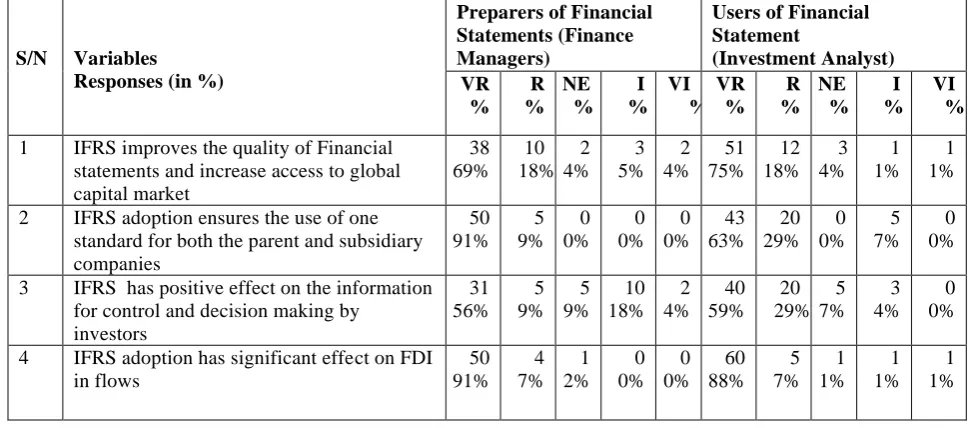
Table 1: (Section A) Response on key Issues relating to the relationship between IFRS adoption and implementation and FDI inflow into the Nigeria.
S/N Variables Responses (in %)
Preparers of Financial Statements (Finance Managers)
Users of Financial Statement (Investment Analyst) VR % R % NE % I % VI % VR % R % NE % I % VI %
1 IFRS improves the quality of Financial statements and increase access to global capital market 38 69% 10 18% 2 4% 3 5% 2 4% 51 75% 12 18% 3 4% 1 1% 1 1%
2 IFRS adoption ensures the use of one standard for both the parent and subsidiary companies 50 91% 5 9% 0 0% 0 0% 0 0% 43 63% 20 29% 0 0% 5 7% 0 0%
3 IFRS has positive effect on the information for control and decision making by
investors 31 56% 5 9% 5 9% 10 18% 2 4% 40 59% 20 29% 5 7% 3 4% 0 0%
4 IFRS adoption has significant effect on FDI in flows 50 91% 4 7% 1 2% 0 0% 0 0% 60 88% 5 7% 1 1% 1 1% 1 1%
Source: Field survey, August 2012
Table 2: Calculation of Correlation
Question 4 of questionnaire administered: IFRS adoption has significant effect on FDI in flows in Nigeria
Options
Preparers of Financial Reports (PFS) Users of Financial Reports (UFS)
Point (x)
Response (y)
xy x2 y2 Point (x) Response
(y)
x2 y2
VR 5 50 250 25 2,500 5 60 300 3,600
R 4 4 20 16 25 4 5 20 25
NE 3 1 3 9 1 3 1 3 1
I 2 0 0 4 0 2 1 2 1
VR 1 0 0 1 0 1 1 1 1
Σ 15 55 273 55 2,526 15 68 326 3,628
Source: Author’s Computation, August 2012
Table 3: Calculation of Correlation
Options AA Point (x) AA Response (y) AA (xy) AA (x2)
AA (y2)
VR 5 55 275 25 3,025
R 4 4.5 18 16 20.25
NE 3 1 3 9 1
I 2 0.5 1 4 0.25
VR 1 0.5 0.5 1 0.25
Σ 15 61.5 297.5 55 3,047
r = nΣxy – (Σx) (Σy)
√ n [Σx2 – (Σx)2] [nΣy2 – (Σy2)
Where: n = 5, Σx = 15, Σy = 61.5, Σxy = 297.5, Σx2 = 55, Σy2 = 3,047
r = 5(275.5) – (15) (61.5)
√5 [(15) – (15)2] [5(3,047) – (15)2] = 1,487.5 – 922.5
√ (2725 – 225) (15,235 – 225)
= 1,695 = 565 = 0.6522 r = 0.65 (65%) √ (50) (15,010) 866.31
Decision: Ther calculated of 0.65 is greater than 0.5 level of significance. The alternate hypothesis is accepted. There is significant relation between IFRS adoption and implementation and FDI Inflows in Nigeria
Hypothesis 2
Ho: The stock of FDI inflow does not lead to economic growth in Nigeria.
H1: The stock of FDI inflow leads to economic growth in Nigeria.
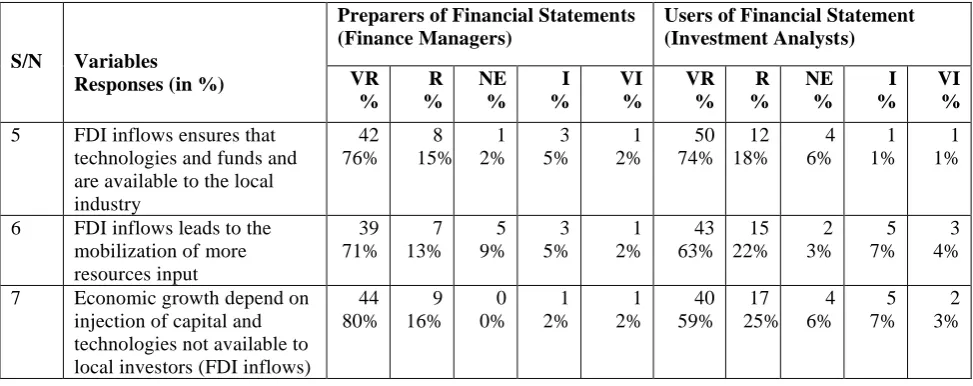
Table 4: (Section B) Response on key Issues relating to the relationship between FDI inflows and Economic growth the Nigeria.
S/N Variables
Responses (in %)
Preparers of Financial Statements (Finance Managers)
Users of Financial Statement (Investment Analysts) VR % R % NE % I % VI % VR % R % NE % I % VI %
5 FDI inflows ensures that technologies and funds and are available to the local industry 42 76% 8 15% 1 2% 3 5% 1 2% 50 74% 12 18% 4 6% 1 1% 1 1%
6 FDI inflows leads to the mobilization of more resources input 39 71% 7 13% 5 9% 3 5% 1 2% 43 63% 15 22% 2 3% 5 7% 3 4%
7 Economic growth depend on
injection of capital and technologies not available to local investors (FDI inflows)
44 80% 9 16% 0 0% 1 2% 1 2% 40 59% 17 25% 4 6% 5 7% 2 3%
Source: Field survey, August 2012
Table 5: Calculation of Correlation
Question 7 of questionnaire administered: Economic growth depend on the injection of capital and technologies not available to local investors (FDI inflows)
Options
Preparers of Financial Reports (PFS) Users of Financial Reports (UFS)
Point (x)
Response (y)
xy x2 y2 Point (x) Response
(y)
x2 y2
VR 5 44 220 25 1,936 5 40 200 1,600
R 4 9 36 16 81 4 17 68 289
NE 3 0 0 9 0 3 4 12 16
I 2 1 2 4 1 2 5 10 25
VR 1 1 1 1 1 1 2 2 4
Σ 15 55 259 55 2,019 15 68 292 1,934
Table 6: Calculation of Correlation
Options
AA Point (x)
AA Response (y)
AA (xy)
AA (x2)
AA (y2)
VR 5 42 210 25 1,764
R 4 13 52 16 169
NE 3 2 6 9 4
I 2 3 6 4 9
VR 1 1.5 1.5 1 2.25
Σ 15 61.5 297.5 55 1,948
Source: Author’s Computation, August 2012. (Note: AA = Average aggregate)
r nΣxy – (Σx) (Σy)
√ n [Σx2 – (Σx)2] [nΣy2 – (Σy2)
Where: n = 5, Σx = 15, Σy = 61.5, Σxy = 297.5, Σx2
= 55, Σy2 = 3,047
r = 5(275.5) – (15) (61.5)
√5 [(15) – (15)2] [5(1,948) – (15)2]
= 1,487.5 – 922.5 √ (2725 – 225) (9,740 – 225)
= 1,695 = 565 = 0.8191 r = 0.82 (82%) √ (50) (9,515) 689.75
Decision: Ther calculated of 0.82 is greater than 0.5 level of significance. The alternate hypothesis is accepted. The stock of FDI inflow leads to economic growth in Nigeria
4.1 Discussion of Result
The research work borders on determining the relationship between IFRS adoption and foreign direct investment inflow as basis for economic growth in Nigeria. The results of hypothesis tested revealed that there is a significant relationship between IFRS adoption and FDI in country. The issues include the rigorous process of conversion of existing record, the cost involve in training and employment of appropriate manpower, and the existing accounting infrastructure in the country. The implication of IFRS on the economy is the fact that financial reporting among the countries that have adopted standards is uniformity and comparability as well as the ease on interpretation of financial statements. This will in many ways boosted the investors’ confidence and leads to cross border financial transaction. The IFRS adoption will definitely enhance international accounting as a sub discipline within the field of accountancy (Glautier & Underdown, 2001). The survey also revealed that the adoption of IFRS will promote companies’ access to global capital markets thereby exposing them to cross-border investments. However, the responses revealed that IFRS adoption has neither made much impact in making timely and accurate reports available nor has it made the financial statements more reliable
4.2 Findings
The research findings are summarized as follows:
There is a significant relationship between IFRS adoption by companies and FDI in Nigeria.
The adoption of IFRS will increased the level of confidence of global investors and investment analysts in the financial statements of companies in Nigeria.
The adoption of IFRS is an effective tool for enhancing the uniformity and comparability of financial statements of companies in Nigeria.
That quoted companies which have adopted IFRS will be able to generate more funds from foreign sources.
There are still some challenges militating against the success adoption and implementation of IFRS but government has put adequate infrastructure and regulatory framework in place to address those issues.
IFRS adoption has not made much impact on making available timely and accurate financial reports.
4.3 Concluding Remarks
right direction. Although there are many issues and challenges facing the implementation, the benefits outweigh the challenge. With adoption, Nigeria companies will produce a more credible financial statements that will not only be uniformed but also provide a basis for better interpretation. The invariably will boost investors confidence and attract cross border financial transactions which is the basis for economic growth.
5.0RECOMMENDATIONS
From the findings of this study, the researcher hereby recommends the following steps to ensure a successful adoption and implementation of IFRS in Nigeria. Government and the regulators should ensure that there is availability of training facilities and materials for professional accountants on the concept of IFRS and issues relating to its implementation and conversion. Compliance with IFRS timetable should be mandatory and failure should be marched with appropriate sanctions. Government should Release more fund to FRC to educate all stakeholders with special reference to the academic to staff and accounting students who will uphold the future IFRS in the country and developing a plan to help properly equip the company for upcoming changes (Lewis and Pendril (1996). Professional accounting bodies in Nigeria should make IFRS training a part of MCPE at a reduce cost. While monitoring the IFRS implementation timetable, the government, the Central Bank of Nigeria and other regulatory bodies should ensure that ethical environment and corporate transparency are observed.
REFERENCES
1. Adams, P. (2004). Resolving Conflicts in Accounting System - Issues and Arguments; Lecture series;
London; August 12 – 13.
2. Alfaro, L., Chanda, A., Kalemli-Ozcan, S. & Sayek, S. (2006). How Does Foreign Direct Investment Promote Economic Growth? Exploring the Effects of Financial Markets on Linkages. Cambridge, MA, USA. NBER Working Paper No. 12522.
3. Armstrong, C., M. Barth, A. Jagolinzer, & E. Riedl. (2007). Market reaction to the adoption of IFRS in Europe. Working paper, Stanford University.
4. Baker, R. G. (1998). The market for information evidence from finance directors, analysts and fund managers. Accounting and Business Research, 29(1), 3-20.
5. [5]. Ball, R. (2006). International Financial Reporting Standards (IFRS): pros and cons for investors.
Accounting and Business Research. 36, 5-27.
6. Borensztein, E., J. De Gregorio, J. & Lee, J.W. (1998). How Does Foreign Direct Investment Affect Economic Growth? Journal of International Economics 45,115-135.
7. Clement, M. B. & Tse, S.Y. (2003). Do investors respond to analysts’ forecast revisions as if forecast accuracy is all that matters? The Accounting Review, 78(1), 227-249.
8. Courtis, J. K. (1992). The reliability of perception based annual report disclosure studies. Accounting and Business Research, 23(89), 31-43.
9. DeGregorio, J. (2003). The role of FDI and Natural Recourses in Economic Development. Working paper No. 196. Central Bank of Chile, Santiago
10. de Mello, L.R. (1999). Foreign direct investment-led growth: Evidence from time series and panel data. Oxford Economic Papers, 51(1), 133–151.
11. Gambari, Y. (2010). Issues in the Implementation of IFRS”; Accounting and Financial Reporting Issues; Toronto; CICA
12. GAB (2012).The State of IFRS in Africa: Is IFRS in Disarray. Governance Across Border. Retrieved: www.governancexborders.com
13. Garkovi, M. & Levin, R. (2002). Does FDI accelerate economic growth? University of Minnesota, Working paper, Miinesota.
14. Gebhardt. G., Reichadt, R. & Wittenbrink, C. (2004). Accounting for Financial Instruments in the Banking Industry: Conclusion from a Simulation Model. European Accounting Review. 13(2) 341-371
15. Glautier M.W.E. & Underdown. B. (2001). Accounting Theory and Practice (7th Ed.). Prentice Hall; Financial Times
16. Healy, P.M. & Palepum, K.C. (2001). Information asymmetry, corporate disclosure and the capital markets: a review of the empirical disclosure literature. Journal of Accounting and Economics, 31, 405-440.
17. Hossein, S.M. & Yazdan G. F. (2012). FDI and ICT effects on productivity growth in Middle East countries. Journal of Economics and Sustainable Development 3(8), 111-121.
18. Kumar, A. (January 30,2007). Does Foreign Direct Investment Help Emerging Economies?
Economist’s View. FRB Dallas. Retrieved:
http://economistsview.typepad.com/economistsview/2007/01/frb_dallas_does.html
20. Jeffrey, P.G. & Spaulding, R.B. (2005). Understanding Foreign Direct Investment (FDI) Going global, Citibank international business portal.
Retrieved: www.going-global.com/.../understanding_foreign_direct_inv
21. La Porta, R., F. Lopez-de-Silanes, A. Shleifer, & R. Vishny (1999). The quality of government.
Journal of Law, Economics and Organization 15, 222-279.
22. Lewis, J. & Pendril, K. (1996). Accounting System in International Trade; GAAP Compilations;
Second Series.
23. Lipsey, R. & A. Chrystal. (2003). Economics. 10th eds. Oxford University Press. New Delhi. 641-642.
24. Madawaki, A. (2012). Adopting International Financial Reporting Standards in Developing Countries: The Case of Nigeria. International Journal of Business and Management. 7(3). www.cosenet.org/ijbm.
25. Mangena, M. (2004). On the perceived importance of disclosure items in UK interim financial reports: Evidence from the investment analysts. Working paper series, Bradford University.
26. NEF (2011). Nigeria Economic Fact Sheet; Economic Section, United States Embassy in Nigeria.
Retrieved: http://www.nigeria.usembassy.gov.
27. Okoye, P.V.C. & Akenbor, C. O. (2012) Financial Reporting Framework in Nigeria and the Adoption of the International Financial Reporting Standards.
28. Oyetayo, E.O., Arogundade, K.K., Adebisi, S.O. & Oluwakayode, E.F. (2011). FDI, Export and Economic Growth in Nigeria. European Journal of Humanities and Social Sciences. 2(1), 66-86.
29. Spiceland, J.D., Sepe, J.F. & Tomassini, L.A.(2001). Intermediate Accounting. New York. McGraw- Hill.
30. Ukpai, N.A. (2002). The Snag in International Accounting Transactions. Journal of Accounting, 3(6), 214 – 22.
31. Nigerian Accounting Standards Board (2010). Adoption of International Financial Reporting Standards