http://www.ijcmph.com pISSN 2394-6032 | eISSN 2394-6040
Original Research Article
Pattern of epidemiological correlates among road traffic accident
in-patients of a tertiary care hospital of West Bengal, India
Satabdi Mitra, Indrajit Saha*,
Dibakar Haldar, Aditya Prasad Sarkar,
Gautam Narayan Sarkar
INTRODUCTION
The World Health Organization records indicate RTAs are the prime cause of death among those aged 15-29 years.1 About 1.2 Million people, each year, die on roads worldwide of whom fifty per cent being vulnerable road users.2
Increasing trend of RTAs take an enormous toll on individuals and communities at global, regional as well as
at country level, emanating from surge in (a) roadways, (b) vehicular traffic and (c) population.
In backdrop of a district town, where the wherewithal‟s of transportation is mostly rundown roadways disparaged by increasing vehicular traffic load, resulting in an accelerating trend of RTAs, the current study was conducted to assess the pattern of various predictor correlates of the outcome.
ABSTRACT
Background: Road traffic accident (RTA) is an emerging epidemic of current century perpetrated by a complex interaction of human, vehicle and roadways/environmental factors. The current study was conducted to find out the various determinants of outcomes of RTAs in a district of West Bengal, India.
Methods: A cross-sectional study was conducted over one year by face-to-face interviewing 384 RTA in-patients of
departments of General Surgery and Orthopedics of a rural tertiary level hospital of West Bengal, India selected via scheduled sampling. Information pertaining to demographic and correlates of RTA were collected. Follow-up telephonic interview was conducted after one month for ascertaining the final outcome. There were 16 non-respondents in the 2nd phase who were excluded during final compilation rendering the sample size to 368. With SPSS version 22.0, descriptive and inferential statistical analyses were done.
Results: 13.2% and 21.0% of study participants had death and disability respectively. On multinomial logistic regression assuming complete cure as reference outcome, both death and disability were revealed to have significant (<0.05) association to non-usage of protective devices, time of incidence (6AM to 6PM), poor road condition, sustaining multiple injuries and lapsing „golden hour‟ for treatment.
Conclusions: Stringent enforcement of legislations regarding various road safety measures, improving ply-worthiness
of roads and establishment of trauma care centre at the district are essential to induce road “safe systems”.
Keywords: Traffic accidents, Fatal outcomes, Multiple injuries, Death, Multinomial logistic regression Department of Community Medicine, Bankura Sammilani Medical College, BSMC, West Bengal, India
Received: 20 February 2018
Revised: 10 March 2018
Accepted: 17 March 2018
*Correspondence:
Dr. Indrajit Saha,
E-mail: [email protected]
Copyright: © the author(s), publisher and licensee Medip Academy. This is an open-access article distributed under
the terms of the Creative Commons Attribution Non-Commercial License, which permits unrestricted non-commercial use, distribution, and reproduction in any medium, provided the original work is properly cited.
METHODS
Study design and setting
A descriptive cross-sectional study was conducted over one year from 1st July, 2015 to 30th June, 2016 in the in-patient departments of General Surgery and Orthopaedics of a tertiary care level hospital of rural setting in the state of West Bengal, India.
Selection and description of study participants
The study was conducted among conscious and/or oriented in-patients who sustained any RTA injury and /or having any accompanying person at the time of interview. As per literature, 48.8% RTA victims had moderate to severe trauma index score (TIS).3 So, the sample size was computed using:
(Zα)2×p×(100-p)/L2= (1.96)2×48.8×51.2/5×5= 384.
[Where Zα=standard normal deviate at 95% confidence, p=prevalence, (100-p)= complement to prevalence, L=allowable error]. Factoring the 16 follow-up non-respondents; final sample size was 368. Data collection was done following scheduled sampling on assuming random pairing of the days for each week.
Study tools
Data collection was done by pre-designed, pre-tested questionnaire having three parts namely, a) part I: socio-demographics including human-vehicular-environmental factors, b) part II: care seeking and consequences of RTAs and c) part III: type and severity of injury based on clinical attributes.
Questionnaire containing both the open and close-ended questions in Bengali vernacular, was subjected to extant language validation protocols, with two forward and two backward translations in parallel by two language experts such that the meaning and contents of the items remained unaltered. Content validity was tested with thirteen subject matter experts from Department of Community Medicine of the Institution and content validity ratio (CVR) >0.54 was considered as per the number of subject matter experts. Pre-testing of the questionnaire was conducted in another District Hospital, (about 30KM from study area) among 30 road traffic accident in-patients over a period of one month.
Data collection
The study participants were interviewed face-to-face by principal investigator while visiting the respective in-patient departments for socio-demographics, presence of precipitating factors besides human and environmental attributes and care seeking. Clinical examination and corroboration with bedside ticket were done for assessing
pattern of injuries in details. All the 384 patients were attempted to be contacted for final outcome after one month. Among them, 16 were found not to turn up in telephonic conversation; hence the number of validated proforma stood at 368.
Ethics
The study was conducted after obtaining ethical clearance from Institutional Ethics Committee and written permission from Head of the Departments of General Surgery and Orthopaedics.
Informed consent was taken from study participants as written or by LTI, as applicable, and by guardian‟s assent in case of minors.
Statistics
Data were codified and entered in Microsoft Excel spread sheet and were checked for consistency. Outcome was categorized as death, disability (being temporary or permanent) and level of “positive to better health” part of the RTA-spectrum as complete cure, left hospital against medical advice (LAMA) or absconded. Analysis was done with the help of software SPSS 22.0 version, Epi InfoTM version 7 and Microsoft Excel for descriptive statistics like, mean, SD, median and inferential statistics as multinomial logistic regression, chi square tests etc. and p value <0.05 was considered significant at 95% of confidence interval.
RESULTS
Among the human factors, grave outcome resulted in significantly higher proportion among those who did not have protective devices, namely as full-coverage helmets and seat belts for mechanized two-wheelers and four-wheeler riders respectively as also for those who admittedly got distracted by talking or texting over mobile phone. Drunk-driving precipitated higher proportion of death and disability followed by inadequate rest and continuous driving (≥8 hours) by professional drivers. Nature of infirmity arising out of accident contributed significantly towards outcome whereas type of inflicted injury, being multiple over single as cut, fracture, amputation etc., receipt of first aid, receiving primary treatment at tertiary level, reaching health facility within „golden hour‟ i.e. 1 hour of incidence, also determined the outcome (though not significantly).
Among the total study population, death and disability resulted in 13.2% and 21.0% RTAs respectively. Multinomial logistic regression revealed, (setting complete cure as reference outcome), significant association (p<0.05) between occurrence of death with (a) non-usage of protective devices (AOR 5.845, 95%
C.I. 1.18-6.41), (b) time of occurrence as 6 a.m.-6 p.m. (AOR 1.61, 95% C.I. 1.00-2.68), (c) poor road condition (AOR 4.76, 95% C.I. 3.66-6.29), (d) high vehicular speed (AOR 1.98, 95% C.I. 1.54-2.75) and (e) drunkenness (AOR 2.32, 95% C.I. 1.75-5.03). Significant increment in disability was observed in reference to complete cure by factors like, (i) absence of protective devices (AOR 1.22, 95% C.I. 1.05-5.03), (ii)accidents between 6 AM-6 PM. (AOR 6.25, 95% C.I. 2.82-7.98) and (iii) ill-maintained roads (AOR 2.61, 95% C.I. 1.64-4.93) (Table 1).
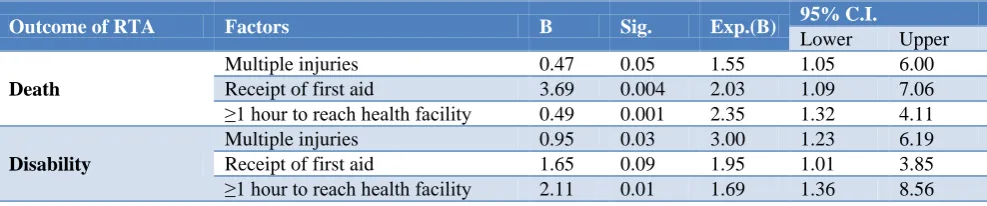
Regarding injuries and infirmities and care seeking, multinomial logistic regression (setting complete cure as reference) reflected significant association (p<0.05) between probability of death with (a) multiple injuries (AOR 1.55, 95% C.I. 1.05-6.00), (b) receipt of first aid (AOR 2.03, 95% C.I. 1.09-7.06) and (c) ≥1 hour time interval between accident and reaching health facility (AOR 2.35, 95% C.I. 1.32-4.11) whereas likelihood of disability was significantly (p<0.05) increased by (i) pattern of injuries (AOR 3.00, 95% C.I. 1.23-6.19) and (ii) lapsing „golden hour‟ to reach hospital (AOR 1.69, 95% C.I. 1.36-8.56) (Table 2).
Table 1: Multinomial logistic regression for human-environmental-vehicular attributes of RTA.
Outcome of accident Factors B Sig. Exp (B) 95% C.I.
Lower Upper
Death
Non-usage of protective devices 15.47 <0.001 5.85 1.18 6.41 Time between 6 a.m.-6 p.m. 0.18 0.04 1.61 1.00 2.68
Poor road condition 0.48 0.01 4.76 3.66 6.29
High speed 0.27 0.05 1.98 1.54 2.74
Drunkenness 0.39 0.001 1.95 1.75 5.03
Disability
Non-usage of protective devices 14.61 <0.001 1.22 1.05 5.03 Time between 6 AM-6 PM 0.47 <0.001 6.25 2.82 6.66
Poor road condition 0.30 0.03 2.61 1.64 4.93
High speed 0.96 0.09 1.91 1.27 7.57
Drunkenness 0.65 0.18 1.35 1.86 5.92
Table 2: Multinomial logistic regression for injury and care seeking attributes of RTA.
Outcome of RTA Factors B Sig. Exp.(B) 95% C.I.
Lower Upper
Death
Multiple injuries 0.47 0.05 1.55 1.05 6.00
Receipt of first aid 3.69 0.004 2.03 1.09 7.06 ≥1 hour to reach health facility 0.49 0.001 2.35 1.32 4.11
Disability
Multiple injuries 0.95 0.03 3.00 1.23 6.19
Receipt of first aid 1.65 0.09 1.95 1.01 3.85
≥1 hour to reach health facility 2.11 0.01 1.69 1.36 8.56
DISCUSSION Socio-demographics
The finding of the current study regarding male preponderance and majority of the victims being in productive age group are in conformity with studies by Jha et al, Singhand Kumar from a district hospital.3-5
In contrast to the present study Singh et al found majority of the RTA victims to hail from rural background.6
Environmental attributes
Analogous to the present study, Bhuyan and Ahmed revealed majority of RTAs in Assam in winter months though Swarnkar observed majority (58.9%) in summer.9,10 Regarding the days of week, the findings were similar to that by Pathak.7 However, Mishra et al observed more accidents on weekdays which was also found by Ghosh in Delhi.11,12 The busiest hours (6 AM to 6 PM) was the time of occurrence for majority RTAs in present study which was congruous to the findings by Shah from Ahmadabad and Singh from North-west India.6,13
Analogous observations regarding poor road condition were brought to the surface by Mishra et al.11 Type and speed of the vehicle involved in the study were in conformity with Pathak,Sharma et al from Gujarat and Trivedi et al.7,14,15 Head-on collision as predictor for high impact outcome was in close agreement with Singh et al.16
Precipitating factors
Significant association (p<0.05) concerning non-usage of protective devices in current study was consistent with Tripathy, Singh and Pathak.17,16,7 The commonest explanation for not using the protective devices was negligence due to overconfidence on driving abilities. Distraction and driver fatigue to predict grave outcome were corroborated by Singh,Shahand Bayen et al.16,13,18 In this study, drunk-driving emerged as important predictor involving both the risk of road crash as well as the severity of injuries sustained by both the pedestrians and drivers besides vehicular occupants; which was in concordance with Patil, Tripathy and Mishra from Western Nepal.19,17,11 Hypo-vigilance by drivers stemming from fatigue, especially for long distance drivers was corroborated by Mishraand Bayen et al.11,18
Pattern of injuries and nature of infirmities
Nature of injury and pattern of infirmity of the victims in the current study were similar to observations by Jhaand Gunjan et al from Central India.3,20
The ‘golden hour’ philosophy and RTAs
In respect to care seeking within Dr. Cowley‟s „golden hour‟ to predict outcome the present study findings were corroborated by Ansari and Lahiri.21,22
Outcome and determining factors
RTA outcome in the present study was similar to Dandona though lower death rate was reported from Punjab and Assam.23,24,9
Regarding predictors and precipitators in human-environmental and vehicular aspects, the current study
findings had similarities with studies by Pathak,Mishra, Tripathy and Mahajan.7,11,17,25
Regarding injury and care seeking behavior the findings of the study were in concordance to studies by Kiran, Sharma and Patil.24,14,19
The analytical approach adopted in the present study, in expressing the spectrum of RTA outcome separately in terms of death and disability as one extreme, while assigning the facet of complete cure as reference, is unique in the sense that usage of such multinomial logistic regression methodology was not found in any other studies in contemporary scientific literature despite extensive search.
Strength of the study
As the participants were contacted after one month, final outcome could be ensured. Multinomial logistic regression could explore exquisitely the weightage of grave outcomes in respect to the pattern and determinants of RTAs.
CONCLUSION
RTAs inflict sizable mortality and disability to its victims, as observed in this study, especially amongst those requiring hospital admissions. Various factors, be human-environmental like non-usage of protective devices, distraction, drunkenness, non-ply worthiness of the roads or be vehicular, and various injury and infirmity related factors besides care seeking/lapsing golden-hour surfaced as significant predictors of the outcome. Multinomial logistic regression, with setting complete cure as reference, emerged as a powerful analytical tool in revealing predictors & correlates. It flowed from the AORs that the predictors and correlates of RTAs were mostly preventable thus bolstering the concepts of “road-safety” and “golden-hour”. Hence, road safety education, stringency in legislations regarding usage of protective devices, prohibition of sale and consumption of alcohol on roads, up-keeping and regular maintenance of roads and vehicles are the imperative needs of the hour for the sake of saving thousands of lives and making them disability-free in future.
Limitations
The data were collected from in-patients only. Resultantly, a huge number of victims at both extremes of the spectrum of injuries-either being too minor without requiring admission and discharged on first-aid or day-care; or with injuries beyond the scope of this hospital and referred instantly to higher center, could not be covered.
Futureresearch
accident registry will help to enrich district accidentology for ensuring effective road safety.
ACKNOWLEDGEMENTS
Authors are highly indebted to all the study participants, their family members, nursing staff of Department of General Surgery and Orthopaedics.
Funding: No funding sources Conflict of interest: None declared
Ethical approval: The study was approved by the Institutional Ethics Committee
REFERENCES
1. WHO. Road Traffic Injuries Fact Sheet No.358, March 2013.
2. Road Accidents in India - Issues and Dimensions. Ppt. 2013. MORTH, Government of India. http://www.unescap.org/ttdw/common/Meetings/TI S/EGM-Roadsafety-2013/ppt/2.12.India.pdf. Accessed 10 January 2018.
3. Jha N, Srivastava DK, Roy G, Jagdish S. Epidemiological study of road traffic accident cases: A Study from South India. Indian J Comm Med. 2004;29(1):20-4.
4. Singh A, Bhardwaj A, Pathak R, Ahluwalia SK. An epidemiological study of road traffic accident cases at a tertiary care hospital in rural Haryana. Indian J Comm Health. 2011;23(2):53-5.
5. Kumar PVS, Srinivasan K. To study the socio demographic profile of road Traffic accident victims in district hospital, Karimnagar. Int J Res Dev Health. 2013;1(3):136–40.
6. Singh D, Singh SP, Kunran M, Goel S. Epidemiology of road traffic accidents in children in Chandigarh zone of North West India. Egyptian J Forensic Sci. 2016;6(3):255-60.
7. Pathak SM, Jindal AK, Verma AK, Mahen A. An epidemiological study of road traffic accident cases admitted in a tertiary care hospital. Med J Armed Forces India. 2014;70(1):32–5.
8. Chowdhury ASMJ et al. Road Traffic Accidents by 'Nasimon' and 'Karimon'-A Study in Faridpur Medical College Hospital. Faridpur Med Coll J. 2012;7(1):6-9.
9. Bhuyan PJ, Ahmed F. Road Traffic Accident: An Emerging Public Health Problem in Assam. Indian J Community Med. 2013;38(2):100–4.
10. Swarnkar M, Singh P, Dwivedi S. Pattern of trauma in Central India: An Epidemiological Study with Special Reference to Mode of Injury. The Internet J Epidemiol. 2009;9(1).
11. Mishra B, Sinha (Mishra) ND, Sukla SK, Sinha AK. Epidemiological Study of Road Traffic Accident Cases from Western Nepal. Ind J Comm Med. 2010;35(1):115–21.
12. Ghosh PK. Epidemiological study of the victims of vehicular accidents in Delhi. J Indian Med Assoc. 1992;90(12):309-12.
13. Shah A, Jarwani B. Study of patients of road traffic accidents arriving in emergency department [ED] of V.S hospital at Ahmadabad city, single centre pilot study. NHL J Medical Sci. 2014;3;(2):23-6.
14. Sharma D, Singh US, Mukherjee S. A study on road traffic accidents in Anand- Gujarat. Healthline. 2011;2(2):12-5.
15. Trivedi A, Rawal D. Prevalence of road traffic accidents and driving practices among drivers. Healthline. 2011;2 (2):72–5.
16. Singh RK, Gupta K, Kumar A, Singh GK, Singh A, Kumar S. Elucidation of risk factors in survivors of road traffic accidents in North India. Trauma and Orthopaedics. Hard Tissue. 2013;2(1):1.
17. Tripathi M, Tewari MK, Mukherjee KK, Mathuriya SN. Profile of patients with head injury among vehicular accidents: An experience from a tertiary care centre of India. Neurol India. 2014;62(6):610-7.
18. Bayan P, Bhawalkar JS, Jadhav SL, Banerjee A. Profile of non-fatal injuries due to road traffic accidents from an industrial town in India. Int J Crit Illn Inj Sci. 2013;3(1):8-11.
19. Patil SS, Kakade RV, Durgawala PM, Kakade SV. Pattern of road traffic injuries: A study from Western Maharastra. Indian J Community Med. 2008;1:56–7.
20. Gunjan B, Ganveer, Tiwari RR. Injury pattern among non-fatal road traffic accident cases: a cross-sectional study in central India. Ind J Med Sci. 2005;59(1):9-12.
21. Ansari S, Akhdar F, Mandoorah M, Moutaery K. Causes and effects of road traffic accidents in Saudi Arabia. Public Health. 2000;114:37–9.
22. Lahiri SK, Mandal P, Mandi P, Mitra SP, Chatterjee T. A study on cases contracting road traffic accidents in rural area and attending the Tarakeswar rural hospital, West Bengal. Indian J Prev Soc Med. 2005;36(3&4):94-101.
23. Dandona R, Mishra A. Deaths due to road traffic crashes in Hyderabad city in India: Need for strengthening surveillance. National Med J India. 2004;17(2):67-72
24. Kiran ER, Saralaya KM, Vijaya K. A prospective study on road traffic accidents. J Punjab Acad. Forensic Med Toxicol. 2004;4:12e16.
25. Mahajan N, Aggarwal M, Raina S, Verma LJ, Mazta SR, Gupta BP. Pattern of non‑fatal injuries in road traffic crashes in a hilly area: A study from Shimla, North India. Int J Crit Illness Injury Sci. 2013;3(3):190-4.