R E S E A R C H
Open Access
Distributed joint source-channel coding for
relay systems exploiting source-relay
correlation and source memory
Xiaobo Zhou
1*, Meng Cheng
1, Khoirul Anwar
1and Tad Matsumoto
1,2Abstract
In this article, we propose a distributed joint source-channel coding (DJSCC) technique that well exploits source-relay correlation as well as source memory structure simultaneously for transmitting binary Markov sources in a one-way relay system. The relay onlyextractsand forwards the source message to the destination, which implies imperfect decoding at the relay. The probability of errors occurring in the source-relay link can be regarded as source-relay correlation. The source-relay correlation can be estimated at the destination node and utilized in the iterative processing. In addition, the memory structure of the Markov source is also utilized at the destination. A modified version of the Bahl, Cocke, Jelinek, and Raviv (BCJR) algorithm is derived to exploit the memory structure of the Markov source. Extrinsic information transfer (EXIT) chart analysis is then performed to investigate convergence property of the proposed technique. Results of simulations conducted to evaluate the bit-error-rate (BER) performance and the EXIT chart analysis show that, by exploiting the source-relay correlation and source memory simultaneously, our proposed technique achieves significant performance gain, compared with the case where the correlation knowledge is not fully used.
Introduction
Wireless mesh and/or sensor networks having great num-ber of low-power consuming wireless nodes (e.g., small relays and/or micro cameras) have attracted a lot of atten-tion of the society, and a variety of its potential applica-tions has been considered recently [1]. The fundamental challenge of wireless mesh and/or sensor networks is how energy-/spectrum-efficiently as well as reliably the multi-ple sources can transmit their originating information to the multiple destinations. However, such multi-terminal systems have two practical limitations: (1) wireless chan-nel suffers from various impairments, such as interfer-ence, distortions and/or deep fading, (2) signal processing complexity as well as transmitting powers has to be as low as possible due to the power, bandwidth, and/or size restrictions of the wireless nodes.
Cooperative communication techniques provide a potential solution to the problems described above, due
*Correspondence: [email protected]
1School of Information Science, Japan Advanced Institute of Science and Technology, 1-1 Asahidai, Nomi, Ishikawa 923-1292, Japan
Full list of author information is available at the end of the article
to its excellent transmit diversity for fading mitigation [2]. One simple form of cooperative wireless communi-cations is a single relay system, which consists of one source, one relay and one destination. The role of the relay is to provide alternative communication route for transmission, hence improving the probability of suc-cessful signal reception of source information sequence at the destination. In this relay system, the information sent from the source and the relay nodes are correlated, which in this article is referred to as source-relay correla-tion. Furthermore, the information collected at the source node contains memory structure, according to the dynam-ics that governs the temporal behavior of the originator (or sensing target). The source-relay correlation and the memory structure of the transmitted data can be regarded as redundant information which can be used for source compression and/or error correction in distributed joint source-channel coding (DJSCC).
There are many excellent coding schemes which can achieve efficient node cooperative communications, such as [3,4], where decode-and-forward (DF) relay strategy is adopted and the source-relay link is assumed to be error
free. In practice, when the signal-to-noise ratio (SNR) of the source-relay link falls below certain threshold, suc-cessful decoding at relay may become impossible. Besides, to completely correct the errors at the relay, strong codes such as turbo codes or low density parity check (LDPC) codes with iterative decoding are required, which will impose heavy computational burden at the relay. As a result, several coding strategies assuming that the relay cannot always decode correctly the information from the source have been presented in [5-7].
Joint source-channel coding (JSCC) has been widely used to exploit the memory structure inherent within the source information sequence. In the majority of the approaches to JSCC design, variable-length code (VLC) is employed as source encoder and the implicit residual redundancy after source encoding is additionally used for error correction in the decoding process. Some related study can be found in [8-11]. Also, there are some liter-atures which focus on exploiting the memory structure of the source directly, e.g., some approaches of combin-ing hidden Markov Model (HMM) or Markov chain (MC) with the turbo code design framework are presented in [12-14].
In the schemes mentioned above, the exploitation of the source-relay correlation and the source memory structure have been addressed separately. Not much attention has been paid to relay systems exploiting the source-relay cor-relation and the source memory simultaneously. A similar study can be found in [15], where the memory structure of the source is represented by a very simple model, bit-flipping between the current information sequence and its previous counterpart, which is not reasonable in many practical scenarios. When the exploitation of the source memory having more generic structures, the problem of code design for relay systems exploiting jointly the source-relay correlation and the source memory structure is still open.
In this article, we propose a new DJSCC scheme for transmitting binary Markov source in a one-way single relay system, based on [7,14]. The proposed technique makes efficient utilization of the source-relay correlation as well as the source memory structure simultaneously to achieve additional coding gain. The rest of this article is organized as follow. Section ‘System model’ introduces the system model. The proposed decoding algorithm is described in Section ‘Proposed decoding scheme’. Section ‘EXIT chart analysis’ shows the results of extrinsic infor-mation transfer (EXIT) chart analysis conducted to eval-uate the convergence property of the proposed system. Section ‘Convergence analysis and BER performance eval-uation’ shows the bit-error-rate (BER) performance of the system based on EXIT chart analysis. The simula-tion results for image transmission using the proposed technique is presented in Section ‘Application to image
transmission’. Finally, conclusions are drawn in Section ‘Conclusion’ with some remarks.
System model
One-way single relay system
In this article, a single-source single-relay system is con-sidered where all links are assumed to suffer from Additive White Gaussian Noise (AWGN). The relay system oper-ates in a half-duplex mode. During the first time interval, the source node broadcasts the signal to both the relay and destination nodes. After receiving signals from the source,
the relay extracts the data even though it may contain
some errors, re-encodes, and then transmits the extracted data to the destination node in the second time interval.
The relay can be located closer to the source or to the destination, or the three nodes keep the same dis-tance with each other. All these three different relay loca-tion scenarios are considered in this article, as shown in
Figure 1. The geometric-gain [4]Gxy of the link between
the nodexandycan be defined as
Gxy =(
dsd
dxy
)l, (1)
where dxy denotes the distance of the link between the
nodexandy. The pass loss exponentlis empirically set at 3.52 [4]. Note that the geometric-gain of the source-destination linkGsdis normalized to 1 without the loss of
generality.
The received signals at the relay and at the destination nodes can be expressed as
ysr=
where x and xr represent the symbol vectors
transmit-ted from the source and the relay, respectively. Notations
Location A
Location B
Location C
nrandnd represent the zero-mean AWGN noise vectors
at the relay and the destination with variances σr2 and
σd2, respectively. The SNR of the source-relay and relay-destination links with the three different relay location scenarios, as shown in Figure 1, can be decided as: for
location A, SNRsr = SNRrd = SNRsd; for location B,
SNRsr=SNRsd+21.19 dB and SNRrd=SNRsd+4.4 dB;
for location C, SNRsr = SNRsd +4.4 dB and SNRrd =
SNRsd+21.19 dB.
Source-relay correlation
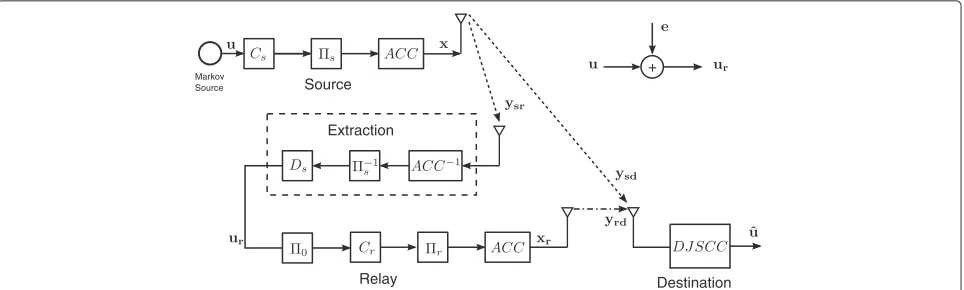
The diagram of the proposed relay strategy is illustrated in Figure 2. At the source node, the original information bits vectoruis first encoded by a recursive systematic
con-volutional (RSC) code, interleaved by s, encoded by a
doped accumulator (ACC) with a doping rateKs[16] and
then modulated using binary-phase shift keying (BPSK) to obtain the coded sequencex. After obtaining the received signalysrfrom the source, the relay performs the decod-ing process only once (i.e., no iterative processdecod-ing at the relay) to retrieveur, which is used as an estimate ofu.ur
is first interleaved by0and then encoded following the
same encoding process as in the originating node with a doping rateKrto generate the coded sequencexr.
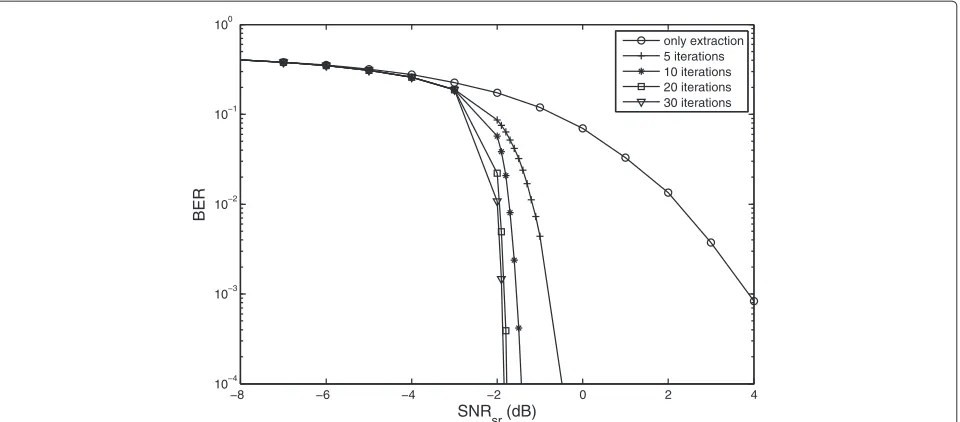
Errors may occur betweenuandur, as shown in Figure 3, compared to the cases where iterative decoding is per-formed at the relay node. Apparently, with more itera-tions better BER performances can be achieved at the relay node. However, this advantage becomes
negligi-ble in low SNRsr scenarios. Instead, the estimate of the
source information sequence is simplyextractedby
per-forming the corresponding channel decoding process just once. Consequently, the relay complexity can be signif-icantly reduced without causing any significant perfor-mance degradation by the proposed algorithm, as detailed in Section ‘Proposed decoding scheme’.
The source-relay correlation indicates the correlation
between u and ur, which can be represented by a
bit-flipping model, as shown in Figure 2. ur can be defined
asur = u⊕e, where e is an independent binary
ran-dom variable and ⊕ indicates modulus-2 addition. The
correlation betweenuanduris characterized bype, where
pe=Pr(e=1)=Pr(u=ur)[6].
Markov source
In this article, the source we considered is a stationary state emitting binary Markov sourceu = u1u2. . .ut. . .,
of which the transition matrix is:
A=[ai,j]=
a0,0 a0,1
a1,0 a1,1
=
p1 1−p1
1−p2 p2
, (5)
whereai,jis the transition probability defined by
ai,j=Pr{ut=j|ut−1=i}, i,j=0, 1. (6)
The entropy rate of stationary Markov source [17] is given by
H(S)= −
i,j∈{0,1}
μiai,jlogai,j, (7)
where{μi}is the stationary state probability.The memory
structure of Markov source can be characterized by the state transition probabilitiesp1andp2, 0 < p1,p2 < 1,
with which p1 = p2 = 0.5 indicates the memoryless
source, whilep1 =0.5 orp2 =0.5, and henceH(S) <1
indicate source with memory.
Proposed decoding scheme
The block diagram of the proposed DJSCC decoder for one-way relay system exploiting the source-relay
Extraction Source
Relay Destination
+
Markov Source
Figure 2Proposed relay strategy and its equivalent bit-flipping model.CsandCrare RSC code,sandrare random interleavers.ACCand
−8 −6 −4 −2 0 2 4 10−4
10−3 10−2 10−1 100
SNR
sr (dB)
BER
only extraction 5 iterations 10 iterations 20 iterations 30 iterations
Figure 3BER of the source-relay link over AWGN channel versus SNRsr.The doping rate at the source node isKs=1.
correlation and the source memory structure is illustrated in Figure 4. The maximum a posteriori (MAP) algo-rithm for the convolutional code proposed by Bahl, Cocke, Jelinek and Raviv (BCJR), is used for MAP-decoding of
convolutional code and ACC. Here,DsandDrdenote the
decoder ofCsandCr, respectively. In order to exploit the
knowledge of the memory structure of the Markov source, the source andCsare treated as a single constituent code.
Hence, it is reasonable to represent the code structure by a super trellis by combining the trellis diagram of the
source andCs. A modified version of the BCJR algorithm
is derived to jointly perform source and channel decoding over this super trellis at Ds. However,Dr cannot exploit
the source memory due to the additional interleaver0,
as shown in Figure 2.
At the destination node, the received signals from the
source and the relay are first converted tolog-likelihood
ratio (LLR) sequences L(ysd), L(yrd), respectively, and
then decoded via two horizontal iterations (HI), as shown
in Figure 4. Then the extrinsic LLRs generated fromDs
andDr in the twoHIs are further exchanged by several
vertical iterations (VI) through anLLRupdating function
fc, of which role is detailed in the following section. This
process is performed iteratively, until the convergence point is reached. Finally, hard decision is made based on the a posterioriLLRs obtained fromDs.
LLRupdating function
First of all, the correlation property (error probability occurring in the source-relay link)peis estimated at the
Figure 4The proposed DJSCC decoder for single relay system exploiting the source-relay correlation and the source memory structure.
ACC−1denotes the decoder of the doped accumulator.D
destination using the a posteriori LLRs of the uncoded
where N indicates the number of the a posterioriLLR
pairs from the two decoders with sufficient reliability.
Only the LLRs with their absolute values larger than a
given threshold can be used in calculatingpˆe.
After obtaining the estimated error probability using (8), the probability ofucan be updated fromuras
Pr(uk=0)=(1− ˆpe)·Pr(ukr =0)+ ˆpe·Pr(ukr =1),
(9)
Pr(uk=1)=(1− ˆpe)·Pr(ukr =1)+ ˆpe·Pr(ukr =0),
(10)
where uk andukr denote the kth elements of u and ur,
respectively. This leads to theLLRupdating function [6]
foru:
Similarly, the LLR updating function for ur can be
expressed as:
In summary, the general form ofLLRupdating function
fc, as shown in Figure 4, is given as
fc(x)=ln
(1− ˆpe)·exp(x)+ ˆpe
(1− ˆpe)+ ˆpe·exp(x)
, (13)
where x denotes the inputLLRs. The output offcis the
updatedLLRs by exploitingpˆeas the source-relay
corre-lation. TheVIoperations of the proposed decoder can be
expressed as interleaving functions corresponding to0, respectively.
Lua,D
s and L
u
e,Ds denote the a priori LLRs fed into, and
extrinsicLLRs generated byDs, respectively, both for the
uncoded bits. Similar definitions should apply toLua,D
rand
Lue,DrforDr.
Joint decoding of Markov source and channel encoderCs Representation of super trellis
Assume that theCs is a memory lengthvconvolutional
code. There are 2vstates in the trellis diagram of this code, which are indexed bym, m = 0, 1,. . ., 2v−1. The state
ofCsat the time indextis denoted asSct. Similarly, there
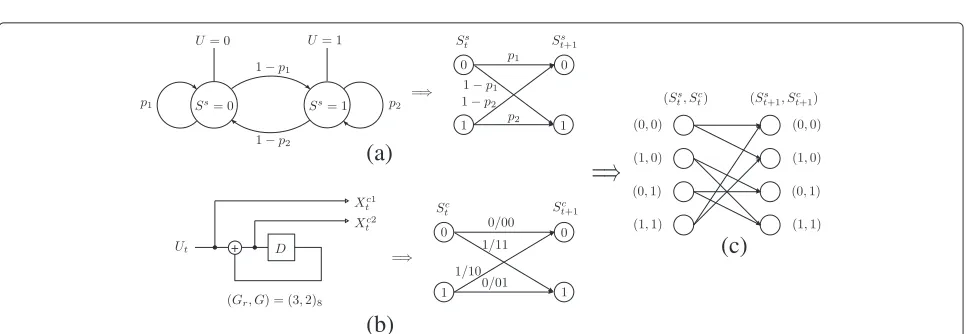
are two states in order-1 binary Markov source, and the state at the time indextis denoted asSstwithSst ∈ {0, 1}. For a binary Markov model described in Section ‘System model’, the source model and its corresponding trellis dia-gram are illustrated in Figure 5a. The output value at a time instanttfrom the source is the same as the state value ofSst. The trellis branches represent the state transition of which probabilities have been defined by (6). On the other hand, forCs, the branches in its trellis diagram indicate
input/output characteristics.
+
(a)
(b)
(c)
At time instantt, the state of the source and the state of theCscan be regarded as a new state(Sts,Stc), which leads
to the super trellis diagram. A simple example of combin-ing binary Markov source with a recursive convolutional code (RSC) with generator polynominald(Gr,G)=(3, 2)8
is depicted in Figure 5. At each state (Sst,Sct), the input to the outer encoder is determined, given the state of the Markov source. Actually, the new trellis branches can be regarded as a combination corresponding to the branches
of the Markov source and of the trellis diagram of Cs.
Hence, the new trellis branches represent both state tran-sition probabilities of the Markov source and input/output characteristics ofCsdefined in its trellis diagram.
It should be noticed that a drawback of this approach is the exponentially growing number of the states in the super trellis. However, ifCs is only a short memory
con-volutional code, the complexity increase is due mainly to the number of Markov source states. In fact, it is shown in Section ‘Convergence analysis and BER performance
eval-uation’ that, even with a memory-1 code used asCscan
achieve excellent performance. Therefore, the complex-ity is largely the issue of source modeling depending on applications.
Modified BCJR algorithm for super trellis
In this section, we make modifications of the standard BCJR algorithm [18] for the decoding performed over the super trellis constructed in the previous section. Here, we ignore momentarily the serially concatenated structure, and only focus on the decoding process performed over the super trellis diagram. For a convolutional code with memory lengthv, there are 2vstates in its trellis diagram, which is indexed bym, m = 0, 1,. . ., 2v−1. The input sequence to the encoderu = u1u2. . .ut. . .uL, which is
also a series of the states of Markov source, is assumed
to have length L. The output of the encoder is denoted
as x = {xc1,xc2}. The coded binary sequence is BPSK mapped and then transmitted over AWGN channels. The received signal is a noise-corrupted version of the BPSK mapped sequence, denoted asy= {yc1,yc2}. The received
sequence from the time indexes t1 to t2 is denoted as
yt2
t1 =yt1,yt1+1,. . .,yt2.
The aim of the modified BCJR algorithm is to calcu-late conditionallog-likelihood ratio (LLR)of the coded bits
{xct1}, based on the whole received sequenceyL1, which is
yielding the systematic output xct1 of the Cs being
k, k=0, 1.
In order to compute the last term in (16), three param-eters indicating the probabilities defined as below have to be introduced:
Substituting (20) in (16), we obtain the whole set of
equations for the modified BCJR algorithm. αt(i,m),
βt(i,m), γt(yt,i,m,i,m) are found to be functions of
both the output of Markov source and the states in the trellis diagram of Cs. More specifically, γt(yt,i,m,i,m)
represents information of input/output relationship
cor-responding to the state transitionSt = m → St = m,
specified by the trellis diagram ofCs, as well as of the state
transition probabilities depending on Markov source.
Therefore,γ can be decomposed as
γt(yt,i,m,i,m)=
Afterγ is obtained,αandβcan also be computed via
the following recursive formulae
Since the output encoder always starts from the state zero, while the probabilities for the Markov source starts from state “0” or state “1” is equal. Hence, the appropri-ate boundary condition forαisα0(0, 0)=α0(1, 0)=1/2 andα0(i,m) = 0, i = 0, 1;m = 0. Similarly, the bound-ary conditions forβ isβL(i,m) = 1/2v+1, i = 0, 1;m =
0, 1,. . ., 2v−1.
described above, we can obtain the conditionalLLRs for
representing the a priori LLR, the channel LLR and
the extrinsicLLR, respectively. The same representation
should apply to{xct2}.
EXIT chart analysis
In this section, we present results of three-dimensional (3D) EXIT chart [19-21] analysis conducted to identify the impact of the memory structure of the Markov source and the source-relay correlation on the joint decoder. The
analysis focuses on the decoderDssince the main aim is
to successfully retrieve the information estimates uˆ. As
shown in Figure 4, the decoderDs exploits two a priori
LLRs:Lca,Dsand the updated version ofLeu,Dr,Lua,Ds.
There-fore, the EXIT function of Ds can be characterized as
Iec,Ds =TDcs(Iac,Ds,Ieu,Dr,pe), (29)
whereIec,Ds denotes the mutual information between the extrinsicLLRs,Lce,Dsgenerated fromDs, and the coded bits
ofDs.Iec,Dscan be obtained by the histogram measurement
[21]. Similar definitions can be applied toIac,D sandI
u e,Dr.
The second parameter ofTDc s(·),I
u
e,Dr, represents
extrin-sic information generated from source-relay correlation. Meanwhile, the modified BCJR algorithm adopted by
Ds utilizes the memory structure of Markov source. At
first, we assume that the source-relay correlation is not exploited and only focus on the exploitation of source memory. In this case,Ieu,D
r = 0 and the EXIT analysis of
Dscan be simplified to two-dimensional. The EXIT curves
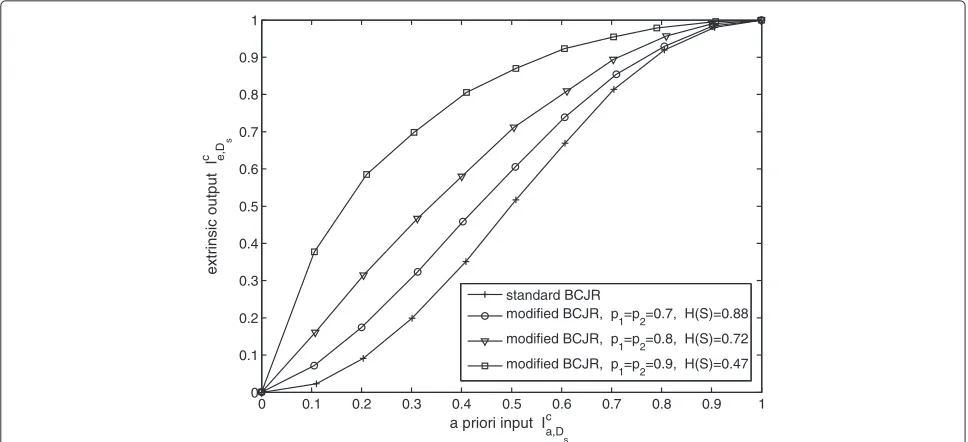
with and without the modifications described in the pre-vious section are illustrated in Figure 6. The code used in the analysis is a half rate memory-1 RSC with the gen-erator polynomials(Gr,G) = (3, 2)8. It can be observed
from Figure 6 that, compared to the standard BCJR algo-rithm, the EXIT curves obtained by using the modified BCJR algorithm are lifted up over the whole a priori input region, indicating that larger extrinsic information can be obtained. It is also worth noticing that the contribution of source memory represented by the increase in extrin-sic mutual information becomes larger as the entropy of Markov source decreases.
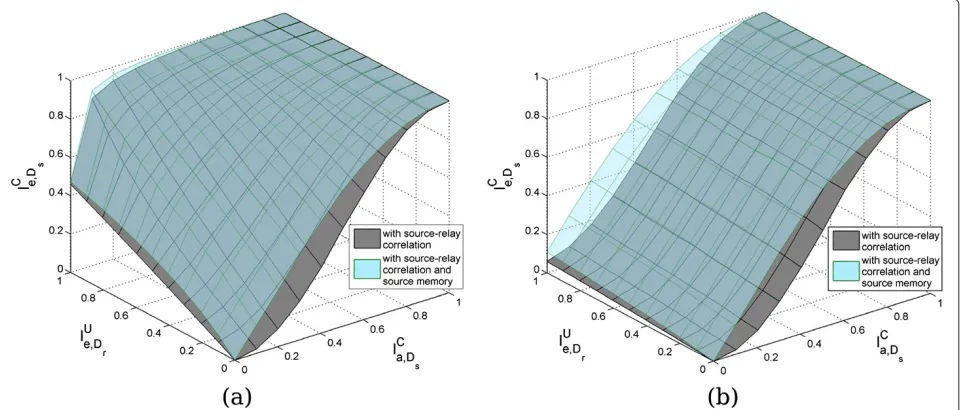
Next we conducted 3D EXIT chart analysis for Ds
to evaluate the impact of the source-relay correlation,
0 0.1 0.2 0.3 0.4 0.5 0.6 0.7 0.8 0.9 1
where the source memory is not exploited. The
corre-sponding EXIT planes of Ds, shown in gray, are
illus-trated in Figure 7. Two different scenarios, a relatively strong source-relay correlation (corresponding to smallpe
value) and a relatively weak source-relay correlation
(cor-responding to large pe value) are considered. It can be
seen from Figure 7a that with a strong source-relay cor-relation, the extrinsic information Iue,D
r provided by Dr,
has a significant effect onTDc
s(·). On the contrary, when
the source-relay correlation is weak,Ieu,D
r has a negligible
influence onTDc
s(·), as shown in Figure 7b.
For the proposed DJSCC decoding scheme, both the source memory and the source-relay correlations are exploited in the iterative decoding process. The impact of the source memory and the source-relay correlations on
Ds, represented by the 3D EXIT planes, shown in
light-blue, is presented in Figure 7. We can observe that higher extrinsic information can be achieved (EXIT planes are lifted up) by exploiting the source memory and the source-relay correlations simultaneously, which will help decoder
Ds perfectly retrieve the source information sequence
even at a low SNRsdscenario.
Convergence analysis and BER performance evaluation
A series of simulations was conducted to evaluate the convergence property, as well as BER performance of the proposed technique. The information sequences are gen-erated from Markov sources with different state transition probabilities. The block length is 10000 bits, and 1000 different blocks were transmitted for the sake of keeping reasonable accuracy. The encoder used at the source and
relay nodes, Cs and Cr, respectively, are both
memory-1 half rate RSC with generator polynomials (Gr,G) =
(3, 2)8. FiveVIs took place after everyHI, with the aim
of exchanging extrinsic information to exploit the source-relay correlation. The whole process was repeated 50 times. All the three relay location scenarios were evalu-ated, with respect to the SNR of the source-destination link. The doping rates are set atKs =Kr =2 for location
A, whileKs = 1, Kr = 16 for both the location B and C.
The threshold for estimatingpˆe[6] is set at 1.
Convergence behavior with the proposed decoder
The convergence behavior with the proposed DJSCC
decoder at the relay location A with SNRsd = −3.5 dB is
illustrated in Figure 8. As described in Section ‘Proposed
decoding scheme’, the decoding algorithms forDsandDr
are not the same, and thus the upper and lowerHIs are
evaluated separately. It can be observed from Figure 8b
that the EXIT planes of Dr and ACC decoder finally
intersect with each other at aboutIec,D
r =0.52, which
cor-responds toIeu,D
r = 0.59. This observation indicates that
Drcan provideDswithIeu,Dr =0.59 a priori mutual
infor-mation via theVI. Figure 8a shows that whenIeu,D
r =0, the
convergence tunnel is closed, but it is slightly open when
Ieu,D
r = 0.59. Therefore, through extrinsic mutual
infor-mation exchange betweenDsandDr, the trajectory of the
upperHIcan sneak through the convergence tunnel and
finally reach the convergence point while the trajectory of the lowerHIgets stuck. It should be noted here that since
ˆ
peis estimated and updated during every iteration, the
tra-jectory of the upperHIdoes not match exactly with the
EXIT planes ofDsand the ACC decoder, especially at the
(b)
Figure 8The 3D EXIT chart analysis for the proposed DJSCC decoder in relay location A, SNRsd=−3.5dB.(a)UpperHIwithfcfunction,(b) LowerHIwithfcfunction.
first several iterations. Similar phenomena is observed for the trajectory of the lowerHI.
Contribution of the source-relay correlation
The performance gains obtained by exploiting only the source-relay correlations largely rely on the quality of the source-relay link (which can be characterized bype), as
described in the previous section. Figure 9 shows the
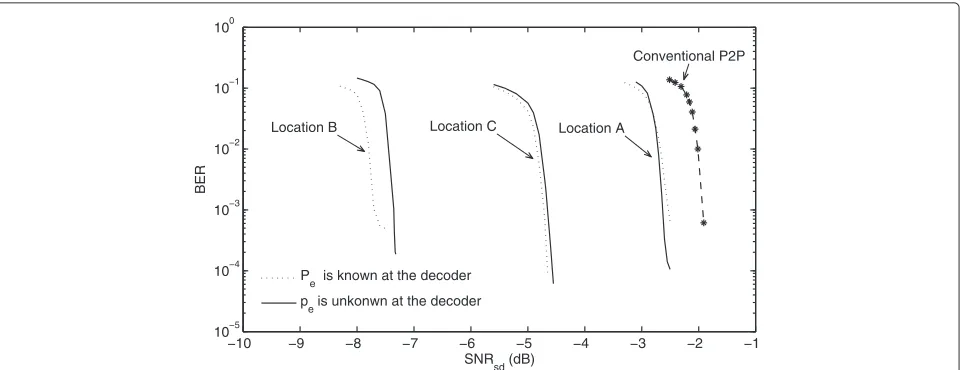
BER performance of the proposed technique whenpeis
known and unknown at the decoder, while the memory structure of Markov source is not taken into account. It can be observed that for relay location A and C, the BER performance of the proposed decoder is almost the
same when pe is known and unknown at the decoder.
However, for relay location B, convergence threshold is
−7.7 and −7.4 dB when pe is known and unknown at
the decoder, respectively, which results in a performance degradation of 0.3 dB. It can also be seen from Figure 9 that, the performance gains obtained by exploiting only
source-relay correlation (pe is assumed to be unknown
at the decoder) for the locations A, B, and C, over the conventional point-to-point (P2P) communication system where relaying is not involved, are 0.6, 5.4, and 2.6 dB, respectively. Among these three different relay location scenarios, the quality of the source-relay link with the location A is the worst and that with the location B is the best, if the SNRsdis the same. This is consistent with the
simulation results.
Location B Location C Location A
Conventional P2P
−9 −8 −7 −6 −5 −4 −3 −2 −1 10−5
10−4 10−3 10−2 10−1 100
SNR
sd (dB)
BER
conventional P2P p
1=p2=0.7, H(S)=0.88
p
1=p2=0.8, H(S)=0.72
p
1=p2=0.9, H(S)=0.47
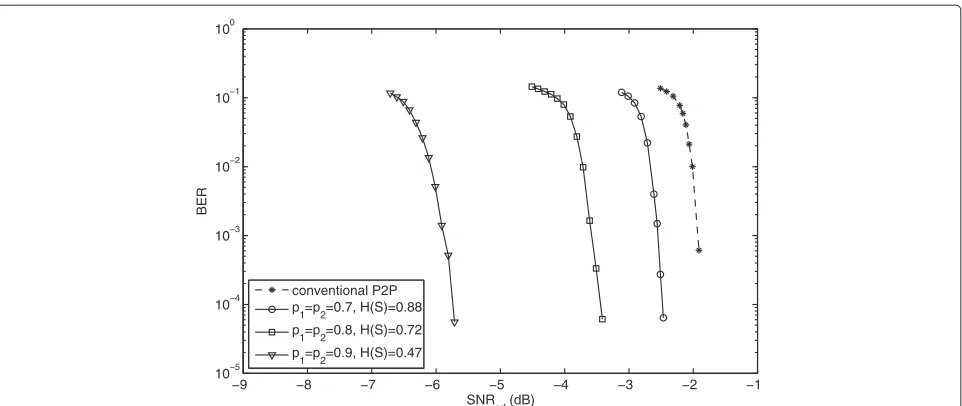
Figure 10The BER performance of the proposed DJSCC decoder for different Markov sources.Source-relay correlation is not considered, and hence the lowerHIis not needed.
Contribution of the source memory structure
To demonstrate the performance gains obtained by exploiting the memory structure of the Markov source, the BER curves of the proposed DJSCC technique, which only exploits the source memory structure (DJSCC/SM), and hencerelaying is not involved in the scenarios assumed in this section, are provided in Figure 10, whereKs = 1
was assumed. The BER curve of the conventional P2P communication system that does not exploit the memory structure of source is also provided in the same figure. It can be observed that the performance gain of 0.55, 1.5, and 3.6 dB can be obtained by DJSCC/SM exploiting the
memory structure of Markov sources with entropyH(S)
of 0.88, 0.72, and 0.47, respectively. This is consistent with the fact that as the entropy of the source decreases, the performance gain increases.
For the completeness of the article, performance com-parison between the DJSCC/SM and the technique pro-posed in [14], which is referred to as Joint Source Channel Turbo Coding (JSCTC), is provided in this section. The performance gains of DJSCC/SM over conventional P2P system are summarized in Table 1, together with the results of JSCTC as a reference. It can be found from the
Table 1 BER performance comparison between DJSCC/SM and JSCTC
Markov source parameters Gains over conventional P2P
p1 p2 H(S) JSCTC (dB) DJSCC/SM (dB)
0.7 0.7 0.88 0.45 0.55
0.8 0.8 0.72 1.29 1.5
0.9 0.9 0.47 3.03 3.6
table that with the both techniques, substantial gains can be achieved by exploiting the knowledge of the state tran-sition probabilities of the Markov sources. This indicates that exploiting the source memory structure provides us with significant advantage. It should be emphasized that JSCTC uses parallel-concatenated codes and employs two memory-4 constituent codes. On the other hand, our pro-posed system uses serial-concatenated codes and employs two memory-1 constituent codes. Nevertheless, the pro-posed DJSCC/SM technique outperforms JSCTC, even though the complexity with our proposed DJSCC/SM technique is much smaller than JSCTC.
BER performance of the proposed technique
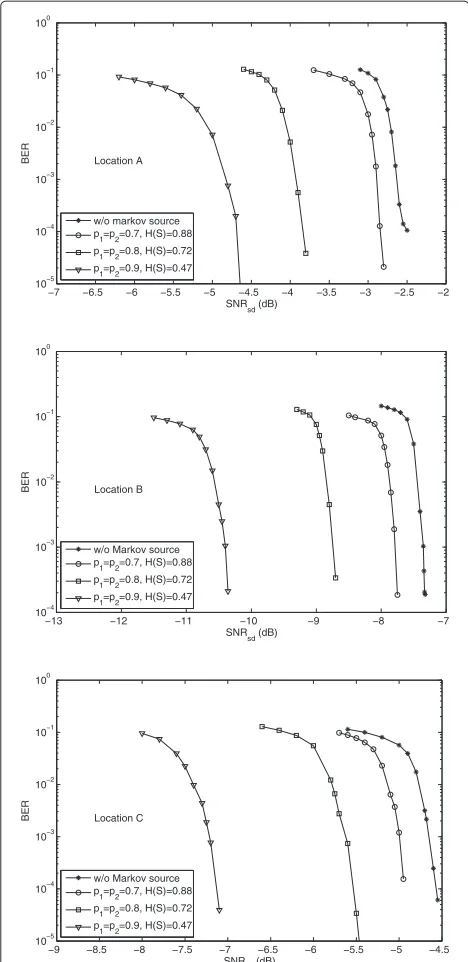
The proposed DJSCC technique exploits both the source-relay correlation and the memory structure of Markov source simultaneously during the iterative decoding pro-cess, thus more performance gains should be achieved. The BER performance of the proposed technique for dif-ferent Markov sources is shown in Figure 11. As a refer-ence, the BER curves of the techniques that only exploit the source-relay correlation are also provided, which are labeled as “w/o Markov source ”. The performance gains achieved by the proposed DJSCC technique are summa-rized in Table 2. It can be observed that by exploiting the memory structure of Markov source, considerable gains can be achieved.
Application to image transmission
−7 −6.5 −6 −5.5 −5 −4.5 −4 −3.5 −3 −2.5 −2
Figure 11The BER performance of the proposed DJSCC decoder for relay systems versusSNRof the source-destination link. Three different relay locations and three different Markov sources are considered.
correlation (DJSCC/SR) and DJSCC/SM are also pro-vided for comparison. Two cases were tested: (A) binary (black and white) image and (B) Grayscale image with 8-digits pixel representations. In (A), each pixel of the image has only two possible values (0 or 1). Binary images are widely used in simple devices, such as laser printers, fax machines, and bilevel computer displays. It is quite
straightforward that the binary image can be modeled as
Markov source. A binary image with 256×256 pixels and
state transition probabilitiesp1=0.9538 andp2=0.9480
is shown in Figure 12a as an example. The image data is encoded column-by-column. Figures 12b–e show the esti-mates of the image obtained as the result of decoding at
SNRsd = −10 dB with the conventional P2P technique,
DJSCC/SR, DJSCC/SM and DJSCC, respectively. As can be seen from Figure 12, with the conventional P2P trans-mission, the estimated image quality is the worst con-taining 43.8% pixel errors (see the figure caption), since neither source-relay correlation nor source memory is exploited. With DJSCC/SR and DJSCC/SM, the estimated images contain 19.4% and 8.1% pixel errors, respectively. The proposed DJSCC that exploits both source-relay cor-relation and source memory achieves perfect recovery of the image, with 0% pixel error.
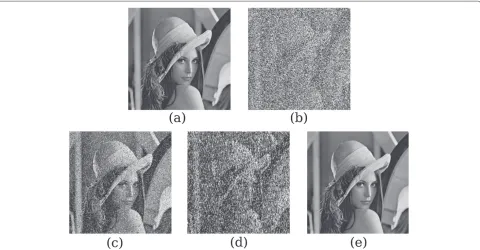
Grayscale images are widely used in some special appli-cations, such as medical imaging, remote sensing and video monitoring. An example of a grayscale image with
256×256 pixels is shown in Figure 13a, which is used in
the simulation for (B). There are 8 bit planes in this image: the first bit plane contains the set of the most significant bits of each pixel, and the 8th contains the least significant bits, where each bit plane is a binary image. The image data is encoded plane-by-plane and column-by-column within each plane, the average state transition
probabil-ities arep1 = 0.7167 and p2 = 0.6741. Figures 13b–e
show the estimates of the image, obtained as the result
of decoding, at SNRsd = −7.5 dB with the conventional
P2P, DJSCC/SR, DJSCC/SM, and DJSCC, respectively. It can be observed that the performance with DJSCC/SR (50.27% pixel errors) and DJSCC/SM (96.9% pixel errors) are better than that with conventional P2P (98.1% pixel errors). However, by exploiting source-relay correlation and source memory simultaneously, the proposed DJSCC achieves perfect recovery of the image, with 0% pixel error.
Conclusion
In this article, we have presented a DJSCC scheme for transmitting binary Markov source in a one-way relay system. The relay does not aim to completely eliminate the errors in the source-relay link. Instead, the relay only
Table 2 BER performance gains of the DJSCC over the technique that only exploits source-relay correlation
Markov source parameters Relay locations
p1 p2 H(S) A (dB) B (dB) C (dB)
0.7 0.7 0.88 0.3 0.45 0.45
0.8 0.8 0.72 1.2 1.4 0.9
Figure 12Image transmission for a binary image withp1=0.9538andp2=0.9480atSNRsd= −10dB.(a)original transmitted image,(b) conventional P2P (98.1% pixel errors),(c)DJSCC/SR (50.27% pixel errors),(d)DJSCC/SM (96.9% pixel errors),(e)DJSCC (0% pixel errors). The relay location is B.
extracts and forwards the source information sequence to the destination, even though the extracted informa-tion sequence may contain some errors. Since the error probability of the source-relay link can be regarded as source-relay correlation, in our proposed technique, the
LLRupdating function is adopted to estimate and exploit
the source-relay correlation. Furthermore, to exploit the memory structure of Markov source, the trellis of Markov source and that of the channel encoder at the source node are combined to construct a super trellis. A modified ver-sion of the BCJR algorithm has been derived, based on this super trellis, to perform joint decoding of Markov
source and channel code at the destination. By exploit-ing the source-relay correlation and the memory structure of Markov source simultaneously, the proposed technique can achieve significant gains over the techniques that only exploit the source-relay correlation, which is verified through BER simulations as well as image transmission simulations.
Competing interests
The authors declare that they have no competing interests.
Acknowledgements
This research was supported in part by the Japan Society for the Promotion of Science (JSPS) Grant under the Scientific Research KIBAN, (B) No. 2360170, (C) No. 2256037, and in part by Academy of Finland SWOCNET project.
Author details
1School of Information Science, Japan Advanced Institute of Science and
Technology, 1-1 Asahidai, Nomi, Ishikawa 923-1292, Japan.2Centre for Wireless Communications, University of Oulu, P.O. Box 4500, 90014, Oulu, Finland.
Received: 1 March 2012 Accepted: 30 July 2012 Published: 16 August 2012
References
1. Z Xiong, AD Liveris, S Cheng, Distributed source coding for sensor networks. IEEE Signal Process. Mag.21(5), 80–94 (2004) 2. H Li, Q Zhao, Distributed modulation for cooperative wireless
communications. IEEE Signal Process. Mag.23(5), 30–36 (2006) 3. B Zhao, MC Valenti, Distributed turbo coded diversity for relay channel.
Electron Lett.39(10), 786–787 (2003)
4. R Youssef, A Graell i Amat, Distributed serially concatenated codes for multi-source cooperative relay networks. IEEE Trans. Wirel. Commun.10, 253–263 (2011)
5. Z Si, R Thobaben, M Skoglund, On distributed serially concatenated codes. inProc. IEEE 10th Workshop Signal Processing Advances in Wireless
Communications SPAWC’09. (Perugia, Italy, 2009). 653–657
6. J Garcia-Frias, Y Zhao, Near-Shannon/Slepian-Wolf performance for unknown correlated sources over AWGN channels. IEEE Trans. Commun. 53(4), 555–559 (2005)
7. K Anwar, T Matsumoto, Accumulator-assisted distributed Turbo codes for relay system exploiting source-relay correlations. IEEE Commun. Lett. 16(7), 1114–1117 (2012)
8. R Thobaben, J Kliewer, Low-complexity iterative joint source-channel decoding for variable-length encoded Markov sources. IEEE Trans. Commun.53(12), 2054–2064 (2005)
9. J Kliewer, R Thobaben, Parallel concatenated joint source-channel coding. Electron. Lett.39(23 ), 1664-1666 (2003)
10. R Thobaben, J Kliewer, On iterative source-channel decoding for variable-length encoded Markov sources using a bit-level trellis. inProc. 4th IEEE Workshop Signal Processing Advances in Wireless Communications
SPAWC. (Auckland, New Zealand, 2003). 50–54
11. M Jeanne, JC Carlach, P Siohan, Joint source-channel decoding of variable-length codes for convolutional codes and turbo codes. IEEE Trans. Commun.53, 10–15 (2005)
12. J Garcia-Frias, JD Villasenor, Combining hidden Markov source models and parallel concatenated codes. IEEE Commun. Lett.1(4), 111–113 (1997) 13. J Garcia-Frias, JD Villasenor, Joint turbo decoding and estimation of
hidden Markov sources. IEEE J. Sel. Areas Commun.9, 1671–1679 (2001) 14. GC Zhu, F Alajaji, Joint source-channel turbo coding for binary Markov
sources. IEEE Trans. Wirel. Commun.5(5), 1065–1075 (2006)
15. K Kobayashi, T Yamazato, H Okada, M Katayama, Joint channel decoding of spatially and temporally correlated data in wireless sensor networks. in
Proc. Int. Symp. Information Theory and Its Applications ISITA. (Rome, Italy,
2008). 1–5
16. K Anwar, T Matsumoto, Very simple BICM-ID using repetition code and extended mapping with doped accumulator. Wirel. Personal Commun, 1–12 (2011 ). doi:10.1007/s11277-011-0397-1
17. TM Cover, JA Thomas,Elements of Information Theory,2nd edn. (John Wiley & Sons Inc., New York, 2006)
18. L Bahl, J Cocke, F Jelinek, J Raviv, Optimal decoding of linear codes for minimizing symbol error rate (Corresp.) IEEE Trans. Inf. Theory.20(2), 284–287 (1974)
19. M Tuchler, Convergence prediction for iterative decoding of threefold concatenated systems, in. Proc. IEEE Global Telecommunications Conf. GLOBECOM’02.2, 1358–1362 (2002)
20. S ten Brink, Code characteristic matching for iterative decoding of serially concatenated codes. Ann. Telecommun.56, 394–408 (2001)
21. S ten Brink, Convergence behavior of iteratively decoded parallel concatenated codes. IEEE Trans. Commun.49(10), 1727–1737 (2001)
doi:10.1186/1687-1499-2012-260
Cite this article as:Zhouet al.:Distributed joint source-channel coding for relay systems exploiting source-relay correlation and source memory. EURASIP Journal on Wireless Communications and Networking20122012:260.
Submit your manuscript to a
journal and benefi t from:
7Convenient online submission
7Rigorous peer review
7Immediate publication on acceptance
7Open access: articles freely available online
7High visibility within the fi eld
7Retaining the copyright to your article