R E S E A R C H
Open Access
Pilot contamination reduction in massive
MIMO systems based on pilot scheduling
Yucheng Wu
*†, Tong Liu, Meng Cao, Liang Li and Weiyang Xu
†Abstract
The pilot contamination caused by sharing the non-orthogonal pilots among users is considered to be a bottleneck of the massive multi-input multi-output (MIMO) systems. This paper proposes a pilot scheduling scheme based on the degradation to address this problem. Through computing the degradation of the users, the proposed scheduling assigns the optimal pilot sequence to the user who suffers from the greatest degradation in a greedy way. Moreover, the proposed scheme is further optimized with an extra set of orthogonal pilot sequences, which is called pilot scheduling scheme based on user grouping. Simulation results show that the target cell’s achievable sum rate of the proposed scheme is much higher than the random pilot scheduling (RPS) and the smart pilot assignment (SPA) schemes; also, our scheme can reduce the impact of shadowing fading on the target cell’s achievable sum rate effectively.
Keywords: Massive MIMO, Pilot contamination, Pilot scheduling, Greedy algorithm, User grouping
1 Introduction
Massive multi-input multi-output (MIMO) [1–3] is one of the key technologies in 5G, which can greatly boost the channel capacity, spectral efficiency, and connection density by utilizing a large number of antennas at the base station (BS). For a short coherence time, the same pilot sequences are usually assigned to users in differ-ent cells to save bandwidth, leading to the problem of pilot contamination [4]. When the number of BS antennas goes to infinity, the system capacity is largely limited by the inter-cell interference because of the pilot contamina-tion [5]. Therefore, pilot pollution has become one of the main reasons for the performance loss in massive MIMO systems.
Currently, pilot contamination reduction schemes in massive MIMO systems can be classified into three groups: channel estimation [6–11], precoding [12], and pilot scheduling [13–20]. In [6], pilot contamination was tackled by a multi-cell precoding method based on the minimum mean square error channel estimation. Under the assumption of spatially correlated channels, it has been found that the pilot contamination would disappear
*Correspondence:[email protected]
†Equal contributors
1College of Communication Engineering, Chongqing University, No.174
Shazhengjie, Chongqing, China
by exploiting the covariance information of user chan-nels and using a coordinated pilot assignment strategy among cells [7]. Alternatively, the concept of time-shifted pilots was proposed to avoid the inter-cell interference via rearranging the order of uplink pilot transmission in dif-ferent cells [8]. However, this asynchronous transmission scheme may result in strong interference when two closely located users in neighboring cells are transmitting or receiving simultaneously [9]. The sparse Bayesian learn-ing was employed to estimate not only the CSI but also the interference from neighboring cells [10]. A compres-sive sensing-based low-rank approximation scheme for channel estimation was proposed in [11], which exploits the fact that the degree of freedom of physical chan-nels is much smaller than the number of independent parameters.
Specifically, this manuscript focuses on the pilot scheduling because in essence, pilot contamination is incurred by the assignment of the same pilot sequences to users in neighboring cells [13]. Therefore, pilot schedul-ing considers how the system reassigns the pilot sequences to users so that the pilot contamination problem can be alleviated or even eliminated. In general, pilot schedul-ing schemes include time-shifted pilots, power control, fractional pilot reuse, and pilot coordination scheduling.
To avoid the inter-cell interference, the concept of time-shifted pilots was proposed to rearrange the order of uplink pilot transmission in different cells in the frame structure [14]. However, this asynchronous transmission scheme may result in strong interference when two closely located users in adjacent cells are transmitting or receiving simultaneously.
In power control method, the transmit power is con-trolled so that the user groups with large cross gains choose different transmission time slots or the transmit power of users assigned with the same pilot sequences is reduced [15]. Unfortunately, this method needs a control mechanism to make sure the pilot sequences are syn-chronous in adjacent cells; thus, it becomes inefficient or even inapplicable when the number of antennas at the BS grows large. In [16], the authors developed techniques based on existing long-term evolution measurements— open loop power control and pilot sequence reuse schemes, that avoid pilot contamination within a group of cell. While in [17], a power control problem to mini-mize D2D links’ data transmit power is formulated and an iterative scheme is adopted to solve the problem.
Fractional pilot reuse method introduces an extra pilot overhead to reduce the pilot contamination. Generally, this method can be classified into two categories. The first divides the cells into two groups. The cells in the same group are assigned with the same pilot sequences, but those in different cells are assigned with the orthogonal pilot sequences in order to mitigate the pilot contami-nation [18, 19]. The second category divides the users into two groups according to different levels of pilot con-tamination, namely the center users who suffer from the modest pilot contamination and the edge users who suffer from severe pilot contamination. A cell-center pilot group is reused for all cell-center users, while a cell-edge pilot group is applied for the edge users in the adjacent cells [20]. This method improves the quality of service (QoS) of the edge users at the cost of a slight rate loss of the center users.
Pilot coordination scheduling scheme reassigns the pilot sequences to users according to different levels of QoS. However, the cooperation among cells incurs an extra computational burden. The pilot coordination scheduling scheme includes pilot scheduling based on maximum pos-teriori estimation [21], smart pilot assignment (SPA) [22], and pilot scheduling based on greedy algorithm [23].
To obtain the maximum of the target cell’s achiev-able sum rate, exhaustive search is a simple way to find the optimal solution [24]. However, this method is of great complexity and limited by the system coherence time; thus, the random pilot scheduling (RPS) schemes are usually chosen instead [4]. As an alternative, SPA scheme aims to ensure fairness among all users in the target cell by maximizing the minimum uplink
signal-to-interference plus noise ratio (SINR) [22]. Both RPS and SPA do not take into account the users’ uplink require-ment, leading to a rate loss in the target cell’s achiev-able sum rate that users cannot meet the requirement of QoS adequately. To solve this problem, a pilot scheduling scheme based on the performance degradation is pro-posed in this paper. Specifically, the propro-posed scheme assigns the optimal pilot sequence to the user who suffers from the greatest degradation greedily by computing the performance degradation of all users. However, users with poor channel condition may have performance bottleneck problem, causing communication interrupted. Therefore, a pilot scheduling scheme based on user grouping accord-ing to different levels of pilot contamination is intro-duced when an extra set of orthogonal pilot sequences is available.
The rest of the paper is organized as follows. In Section 2, we briefly review the massive MIMO multi-cell multi-user system model, while Section3is devoted to detailing the pilot contamination, which is the main performance-limiting factor of massive MIMO systems. The proposed schemes, namely the pilot scheduling schemes based on performance degradation and user grouping, are discussed in Section 4. Our simulation results quantifying the benefits of our proposals are pre-sented in Section 5, while the conclusions follow in Section6.
Notation:Cindicates the set of complex numbers. Bold font variables represent matrices and vectors. (·)T and
(·)H denote the transpose and complex conjugate
trans-pose, separately. [A]mnis the element on themth row and
nth column of a matrixA.IMindicates an identity matrix
of sizeM×M. For a random vector x, x ∼ CN(μ,σ) means it follows a complex Gaussian distribution with mean μ and covariance σ. Finally, E{·} represents the expectation operator.
2 Methods
and SPA methods on the same conditions; also, it can reduce the impact of shadowing fading on the target cell’s achievable sum rate effectively.
3 System model
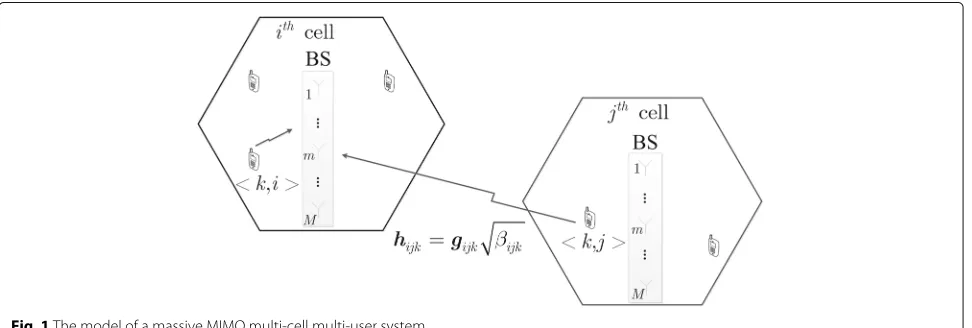
A multi-cell multi-user massive MIMO system is illus-trated in Fig.1, with each hexagonal cell having a central BS associated with M antennas to serve K (K M) single-antenna users. The channel vector hijk ∈ CM×1
denotes the link spanning from thekth user of thejth cell to the BS of theith cell, which can be formulated as
hijk =gijkβijk. (1)
The small-scale fading vectorsgijk ∈ CM×1are
statisti-cally independent for theKusers and complex Gaussian-distributed with a zero-mean vector and a covariance matrix IM, i.e., gijk ∈ CN(0,IM). Still referring to (1),
the large-scale fading coefficients βijk are the same for
the different antennas at the same BS, but they are user-dependent. Moreover, they relate to both the path loss and shadow fading, which can be modeled asβijk = (rijkZ/ijkR)α,
where Zijk represents the shadow fading, rijk is the
dis-tance between thekth user in thejth cell and the BS in the ith cell, andRis the cell radius. Thus, the matrix modeling the channel between all theKusers in thejth cell and the BS in thejth cell can be denoted by
Hjl=GjlD
1 2
jl, (2)
whereGjl∈CM×K is the matrix of fast-fading coefficients
between theMantennas of the BS in thelth cell and K users in thejth cell, andDjl ∈ CK×K is a diagonal matrix
whose diagonal elements areDjl
kk =βjlk. Furthermore,
the channel vectors are assumed to be constant during the coherence time and change independently in different coherence intervals.
4 Pilot contamination
In multi-cell multi-user massive MIMO systems, the BSs obtain the downlink channel estimate by exploiting the uplink pilot sequence within a coherence time. At the duration of data transmission, all users synchronously send uplink data to their corresponding BSs and the user data received at the BS in theith cell can be denoted as
yui =Pu L
j=1 K
k=1
hijkxujk+nui, (3)
wherexujk withE
xujk2 = 1 denotes the symbol trans-mitted from the kth user roaming in the jth cell, Pu
presents the uplink transmit power, and nui ∈ CM×1 denotes the additive white Gaussian noise (AWGN) vector associated withE
nui nuiH
=σ2 nIM.
On the other hand, all users transmit uplink pilot sequences to BSs simultaneously at the duration of pilot transmission. For a typical massive MIMO system, the pilot sequences used within a specific cell are orthogonal, but the same pilot group is typically reused in the adja-cent cells due to the limited number of orthogonal pilot sequences. Thus, the matrix of pilot sequences received at the BS of theith cell can be denoted as
ypi =Pp
⎛ ⎝L
j=1 Hiji
⎞
⎠+npi, (4)
whereypi ∈CM×τwithτ being the time duration of pilot transmission, and the matrixi=(φ1,. . .,φK)Tcontains
the transmitted pilot sequences satisfying the power con-straintiHi =IK.Ppis the transmit power of the pilots,
andnpi ∈CM×τ denotes the uplink channel’s noise vector. The BS of theith cell obtains an estimate of the chan-nel matrixHiiusing any conventional channel estimation
methods, for instance, the least square (LS) approach
which directly correlates the received pilot matrix with the local pilot matrix, i.e.,
ˆ
It can be readily seen that the channel estimate of the kth user in theith cell, namelyhˆiik, is a linear combination of the channels hijk for 1 ≤ j ≤ L, which includes the channels of the users in the other cells associated with the same pilot sequence. This phenomenon is referred to as pilot contamination. Given the estimated channel matrix
ˆ
Hiiand by adopting the low-complexity match filter (MF)
detector, the detected symbol arriving from thekth user in theith cell can be denoted as
∧
where vik denotes the kth column of n
p
indicates the orthogonality between channels of differ-ent users, and it is well known that when the number of M→ ∞, it is almost surely thatεuik→0. Therefore, when the number of BS antennas goes to infinity, we have
ˆ
Thus, the uplink SINR of thekth user in theith cell can be calculated by
When the number of BS antennas goes to infinity, we have
And the achievable uplink rate can be expressed as
Ciku =(1−μ0)E
log21+SINRuik, (10)
where 0< μ0<1 evaluates the spectral efficiency
reduc-tion caused by the pilot transmission. It is clear that the uplink achievable rate is limited by the pilot contamina-tion and cannot be increased by simply assigning more transmit power.
5 Proposed pilot scheduling scheme
In this section, the proposed pilot scheduling schemes based on the performance degradation and user group-ing will be discussed. First, we summarize the asymp-totic orthogonality between random vectors. Let x,y ∈
CM×1 be the two independent vectors with distribution CN(0,cIM), and then
where−→a.s. denotes the almost sure convergence.
5.1 Pilot scheduling scheme based on the degradation In this section, the pilot assignment for a target cell is firstly formulated as an optimization problem. Then, the pilot scheduling scheme based on the degradation is proposed to search for the optimization solution in a greedy way.
5.1.1 Problem formulation
First, we define a utility function which denotes the uplink achievable rate when the pilot sequenceφkis assigned to
the userUk, i.e.,
(Uk,φk)=CUuk(Uk,φk), (12) where (Uk,φk) means that the pilot sequence φk is
assigned to the userUk.{Fs:s=1,. . .,K!}denotes allK!
possibilities of pilot assignments, e.g.,Fs=
fs1,fs2,. . .,fsK denotes thesth assignment. We also assume that the pilot sequenceφkis assigned to thekth userUkin all other cells.
In massive MIMO systems, it is expected to maxi-mize the target cell’s achievable sum rate, which can be formulated as the following optimization problem
P: max
SINRuu
However, it is impossible to solve this optimization problem because the accurate channel estimate under pilot contamination is not available. Fortunately, the upper bound of the uplink SINR can be calculated by the large-scale fading coefficientsβijk
SINRuuk
As we know, the large-scale fading coefficients βijk
changes slowly and can be easily tracked by the BSs. Thus, the optimization problem can be transformed into
P: max
The proposed scheme gives a solution to this optimiza-tion problemPin a greedy way, which will be addressed in detail in the next subsection.
5.1.2 Pilot assignment
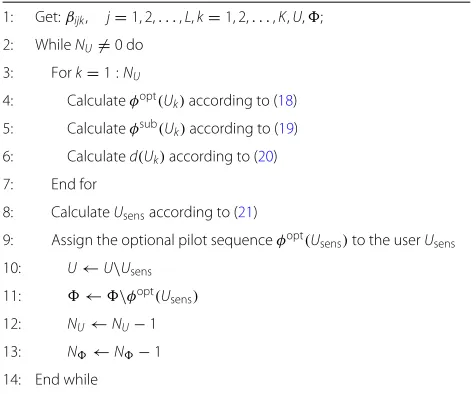
The proposed pilot assignment strategy maximizes the target cell’s achievable sum rate based on performance degradation of users who have not been assigned with pilot sequences. We consider the pilot assignment in a specific cell, i.e., taking the ith cell as the target cell, and the pilot assignment in other cells are independently managed by their corresponding BSs.
LetUdenote the set containing all users who have not been assigned with pilot sequences,NU denote the
num-ber of element in the setU, and indicate the available pilot sequence set, whileN is the number of element in the set . For userUk ∈ U, we first compute its optimal
pilot sequence, i.e., the pilot which can obtain the greatest utility function,
The suboptimal pilot sequence of userUkis defined as
the pilot that can obtain the greatest utility function when every available pilot sequence except the optimal pilot sequence is assigned to the user, i.e.,
φsub(U
Thus, the performance degradation of the userUk can
be computed as follows:
d(Uk)=
Next, we compute the degradation of every user who has not ever been assigned with pilot sequences. Among these users, we find the user who suffers the greatest degradation according to:
Thus, the userUsensis the most sensitive user in
cur-rent assignment scheme. Accordingly, the optimal pilot sequenceφopt(Usens)is then assigned to the most
sensi-tive user Usens. Afterwards, it is required to remove the
userUsensfrom the setU and remove the pilot sequence
φopt(U
sens)from the available pilot sequence set
U←U\Usens
← \φopt(U sens).
(22)
Also, the numbers of elements in setU and need to be updated as follows
NU ←NU−1
N ←N −1 (23)
These steps will be repeated until the set U is empty, namely all the pilot sequences are allocated. We summa-rize the proposed pilot scheduling scheme in Table1.
5.2 Pilot scheduling scheme based on user grouping The aforementioned pilot scheduling scheme based on the degradation improves the system performance with-out increasing computational burden. However, users with poor channel condition would have performance bottleneck problem, causing communication interrupted.
Table 1The proposed scheme based on the degradation
1: Get:βijk, j=1, 2,. . .,L,k=1, 2,. . .,K,U, ;
8: CalculateUsensaccording to (21)
9: Assign the optional pilot sequenceφopt(U
Accordingly, a pilot scheduling scheme based on user grouping is proposed when an extra set of orthogonal pilot sequences exist, referring to the idea in [25].
5.2.1 Basic idea
The scheme, which is a tradeoff between system perfor-mance and pilot overhead, divides the users into the center user group and the edge user group according to differ-ent levels of pilot contamination based on the large-scale fading. The proposed scheme assigns orthogonal pilot sequences to the edge users, while the center users reuse the same pilot sequences.
5.2.2 Pilot assignment
As we know from (10), the uplink asymptotic SINR only relates to the large-scale fading of users who reuse the pilot sequences. Thus, we define the users’ channel qual-ity which is the square of their corresponding large-scale fading
Ssigik =βiik2 . (24)
As a consequence, users are grouped according to the channel quality Ssigik. Here, we can make an assumption that the number of edge users in each cell is equal and Kje denotes the number of edge users, Kjc denotes the
number of center users, namely Kc = Kjc,Ke = Kje,
andj=1,. . .,L. Users with larger channel quality belong to the center user group, and they will reuse the same pilot sequences. On the other hand, users with poor chan-nel quality belong to the edge user group, and they are assigned with orthogonal pilot sequences.
As we know, center users still suffer from pilot contam-ination; thus, their SINR are the same as (10). Differently, edge users do not suffer from pilot contamination because they are assigned with orthogonal pilot sequences. SINR of edge users goes to infinity when the number of BS antennas goes to infinity. However, the proposed pilot scheduling scheme based on user grouping increases the pilot overhead, which is calculated by
μ0×
LKe+Kc
K ←μ0, (25)
whereKdenotes the number of users in each cell, which is the number of orthogonal pilot sequence set when FRPS (fully reused pilot scheduling) scheme is adopted.LKe+
Kcdenotes the number of orthogonal pilot sequence set
when the proposed scheme is adopted.
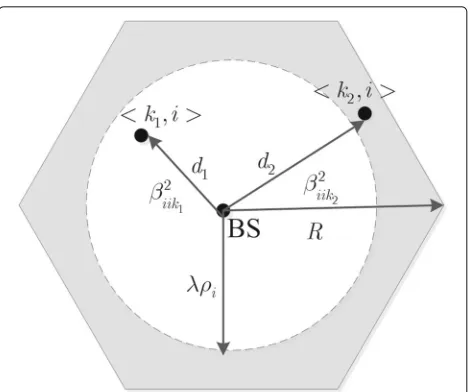
The proposed scheme improves the QoS of edge users greatly, however, with a lack of flexibility. Therefore, an improved pilot scheduling scheme based on user grouping is proposed inspired by the study in [26]. The improved scheme employs the grouping parameterλto choose the edge users dynamically. Figure2 describes the grouping parameter illustration of pilot scheduling scheme based
Fig. 2The grouping parameter illustration of pilot scheduling scheme based on user grouping
on user grouping, where the dashed area denotes edge area which meets the grouping requirements.
The improved scheme is able to improve the flexibility and accuracy simultaneously. When the grouping param-eterλis fixed, according to the improved scheme based on large-scale fading coefficients, the grouping criterion can be represented by
Ssigik ≥λρi→
Yes → center users
No → edge users , (26)
whereλρidenotes the grouping threshold value. The main
purpose of the improved scheme is to avoid that users with good channel conditions may be divided into edge user group or users with poor channel conditions are divided into center user group. As a result, we must take into consideration various factors including the user with best channel condition and the user with worst channel condition. Accordingly,ρican be written as
ρi=
maxSsigi1,Sisig2,. . .,SsigiK+minSisig1,Sisig2,. . .,SsigiK
2 .
(27)
As before, the improved pilot scheduling scheme based on user grouping incurs an extra pilot overhead, which is represented by
μ0
K ⎧ ⎨ ⎩
L
j=1
Kje+max{K1c,K2c,· · ·,kLc}
⎫ ⎬
⎭←μ0. (28)
Furthermore, a pilot scheduling scheme based on user grouping is proposed to optimize the scheme based on the degradation when an extra set of orthogonal pilot sequences is available. Under the improved pilot alloca-tion method based on user grouping, the average uplink reachable rates of the center users and edge users are
Cikuc= ⎛ ⎝1−μ0
K ⎛ ⎝L
j=1
Kje+max{K1c,K2c,· · ·,KLc}
⎞ ⎠ ⎞ ⎠
Elog21+SINRucik
Cikue= ⎛ ⎝1−μ0
K ⎛ ⎝L
j=1
Kje+max{K1c,K2c,· · ·,KLc}
⎞ ⎠ ⎞ ⎠
Elog21+SINRueik
(29)
whereE{·}denotes the expectation operation.
6 Numerical results
In this section, we investigate the performance of the scheme proposed in this paper through Monte-Carlo sim-ulations. A typical hexagonal cellular network withLcells is considered, where each cell has K users with single-antenna and a BS withMantennas. The center cell sur-rounded by other cells is considered as the target cell. The system parameters are summarized in Table2.
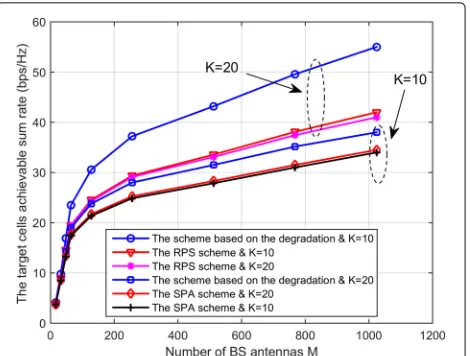
Figure3draws the target cell’s achievable sum rate when the number of BS antennasMincreases, where the results are obtained by 1000 independent simulation trials. It is evident that the proposed scheme outperforms the con-ventional approaches, for example, its gain over the RPS scheme is about 3.3 bps/Hz withM = 512 andK = 10. When the number of users in each cellK = 20, the pro-posed scheme performs even better with a gain about 9.5 bps/Hz.
Figure4 plots the target cell’s achievable sum rates of these three schemes when the shadowing fading increases
Table 2Basic parameters of system simulation
Parameters Values
Number of cellsL 7
Cell radiusR 500 m
Number of BS antennasM 16–1024
Number of users in each cellK [10, 20]
Path lossα 3.8
Average SNR 20 dB
Log normal shadowing fadingσshadow 0–8 dB
Spectral efficiencyμ0 0.05
The pilot transmission power 30 dBm
The data transmission power 30 dBm
Fig. 3The impact of the number BS antennas on the target cell’s achievable sum rate
with M = 256 and K = 10. It is evident that as the shadowing fading increases, the target cell’s achievable sum rate of conventional schemes declines continuously. In contrast, the rate of the proposed scheme is relatively stable at first and then grows slowly. This observation shows the robustness to the shadowing fading effect of the proposed algorithm.
Figure5 demonstrates the SINR of edge users in tar-get cell when the number of BS antennas M increases, where the results are obtained withK = 10 andKje= 1,
j = 1,. . .,L. For edge users, according to the result described by Fig.5, we can find that the scheme based on user grouping outperforms the scheme based on degra-dation by about 7.6 dB withM = 256. It is evident that the pilot contamination problem of edge users is reduced effectively by the strategy based on user grouping.
Fig. 5The impact of the number of BS antennas on the SINR of edge users in target cell
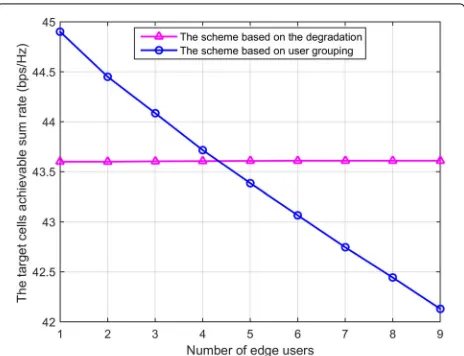
Figure6plots the target cell’s achievable sum rate when the number of edge usersKjeincreases withM=512 and
K = 10. From the result, it is readily observed that the scheme based on user grouping outperforms the scheme based on degradation when the number of edge users is less than 5. When the number of edge users is larger than 5, however, the cost of the pilot overhead cancels out the performance gain brought by user grouping. There-fore, careful attention needs to be paid when evaluating schemes based on user grouping and degradation.
Figure7shows the target cell’s achievable sum rate when the grouping parameter λincreases withM = 512 and K = 10. From the result, we can find that the improved scheme based on user grouping outperforms the scheme based on degradation when the grouping parameterλis larger than 0.5. While if the grouping parameterλis less
Fig. 6The impact of the edge user number on the target cell’s achievable sum rate
Fig. 7The impact of grouping parameter on the target cell’s achievable sum rate
than 0.5, the cost of the pilot overhead cancels out the performance gain brought by user grouping. Comparing the results of Figs. 6and7, it can be concluded that the improved scheme is of more flexibility and accuracy. More importantly, Figs.6and7show that the scheme based on user grouping can improve the system performance effec-tively if a reasonable number of edge users or grouping parameterλis selected.
7 Conclusions
In this paper, a pilot scheduling scheme based on the degradation is proposed to maximize the target cell’s achievable sum rate in massive MIMO systems. By exploiting the large-scale characteristics of fading chan-nels, the proposed scheme assigns the optimal pilot sequence to the user who suffers from greatest degrada-tion greedily. Because the users with poor channel condi-tion have performance bottleneck problem which causes communication interrupted, a pilot scheduling scheme based on user grouping is proposed according to differ-ent levels of pilot contamination. The simulation results show that the proposed scheme based on degradation can reduce the impact of shadowing fading on the system per-formance and improve the target cell’s achievable sum rate effectively. Furthermore, the pilot scheduling scheme based on user grouping not only solves the edge users’ pilot contamination problem but also improves the sys-tem performance if a reasonable number of edge users or grouping parameterλis selected.
Abbreviations
Acknowledgements
The authors would like to thank Dr. Wenjiang Feng of Chongqing University for providing the code of the RPS and SPA algorithms.
Funding
This work is supported by the National Natural Science Foundation of China under grant 61201177.
Authors’ contributions
YW, TL, and MC contributed to the main idea, designed and implemented the algorithms, and drafted the manuscript. LL and WX designed and carried out the simulation and analyzed the results. All authors read and approved the final manuscript.
Competing interests
The authors declare that they have no competing interests.
Publisher’s Note
Springer Nature remains neutral with regard to jurisdictional claims in published maps and institutional affiliations.
Received: 28 July 2017 Accepted: 11 January 2018
References
1. B Le, V Lau, E Jorswieck, N-D Dao, A Haghighat, DI Kim, T Le-Ngoc, Enabling 5G mobile wireless technologies. EURASIP J. Wirel. Commun. Netw.2015(1), 1–14 (2015)
2. HR Wang, YH Wang, YM Huang, LX Yang, Pilot contamination reduction in very large MIMO cellular network. J. Commun.29(2), 171–180 (2014) 3. J Zuo, J Zhang, C Yuen, W Jiang, W Luo, Energy-efficient downlink
transmission for multicell massive DAS with pilot contamination. IEEE Trans. Veh. Technol.66(2), 1209–1221 (2017)
4. TL Marzetta, Noncooperative cellular wireless with unlimited numbers of base station antennas. IEEE Trans. Wirel. Commun.9(11), 3590–3600 (2010)
5. J Hoydis, S Ten Brink, M Debbah, Massive MIMO in the ul/dl of cellular networks: how many antennas do we need?. IEEE J. Sel. Areas Commun.
31(2), 160–171 (2013)
6. J Jose, A Ashikhmin, TL Marzetta, S Vishwanath. Pilot contamination and precoding in multi-cell TDD systems, vol. 10, (2011), pp. 2640–2651 7. H Yin, D Gesbert, M Filippou, Y Liu. A coordinated approach to channel
estimation in large-scale multiple-antenna systems, vol. 31, (2013), pp. 264–273
8. F Fernandes, A Ashikhmin, TL Marzetta. IEEE J. Sel. Areas Commun, vol. 31, (2013), pp. 192–201
9. H Holma, S Heikkinen, OA Lehtinen, A Toskala. Interference considerations for the time division duplex mode of the UMTS terrestrial radio access, vol. 18, (2000), pp. 1386–1393
10. CK Wen, S Jin, KK Wong, JC Chen, P Ting, Channel estimation for massive MIMO using Gaussian-mixture Bayesian learning. IEEE Trans. Wirel. Commun.14(3), 1356–1368 (2015)
11. S Nguyen, A Ghrayeb, inWireless Communications and Networking Conference (WCNC), 2013 IEEE. Compressive sensing-based channel estimation for massive multiuser MIMO systems (IEEE, Shanghai, 2013), pp. 2890–2895
12. J Zuo, J Zhang, C Yuen, W Jiang, W Luo. Multicell multiuser massive MIMO transmission with downlink training and pilot contamination precoding, vol. 65, (2016), pp. 6301–6314
13. J Zuo, J Zhang, C Yuen, W Jiang, W Luo. Energy efficient user association for cloud radio access networks, vol. 4, (2016), pp. 2429–2438 14. WA Mahyiddin, PA Martin, PJ Smith, inVehicular Technology Conference
(VTC Fall), 2014 IEEE 80th. Pilot contamination reduction using time-shifted pilots in finite massive MIMO systems (IEEE, Vancouver, 2014), pp. 1–5 15. HR Wang, YH Wang, YM Huang, LX Yang, Pilot contamination reduction
in very large MIMO multi-cell TDD systems. J. Signal Process. (Xinhao Chuli).29(2), 171–180 (2013)
16. V Saxena, G Saxena, E Karipidis, inVehicular Technology Conference (VTC), 2015. Mitigating pilot contamination by pilot reuse and power control schemes for massive MIMO systems (IEEE, Glasgow, 2015), pp. 1–6
17. H Xu, N Huang, Z Yang, Pilot allocation and power control in D2D underlay massive MIMO systems. IEEE Commun. Lett.21(1), 112–115 (2017) 18. M Liu, X Chen, W Xu, inInternational Conference on Wireless
Communications & Signal Processing. Grouped pilot reuse for channel estimation in massive MIMO networks (IEEE, Chiang Mai, 2016), pp. 1–5 19. Z Zhao, Z Chen, Y Liu, inWireless Telecommunications Symposium (WTS), 2015. Cell sectorization-based pilot assignment scheme in massive mimo systems (IEEE, 2015), pp. 1–5
20. X Zhu, Z Wang, C Qian, L Dai, J Chen, S Chen, L Hanzo, Soft pilot reuse and multicell block diagonalization precoding for massive mimo systems. IEEE Trans. Veh. Technol.65(5), 3285–3298 (2016)
21. H Yin, D Gesbert, M Filippou, Y Liu, A coordinated approach to channel estimation in large-scale multiple-antenna systems. IEEE J. Sel. Areas Commun.31(2), 264–273 (2013)
22. X Zhu, Z Wang, L Dai, C Qian, Smart pilot assignment for massive MIMO. IEEE Commun. Lett.19(9), 1644–1647 (2015)
23. M Li, S Jin, X Gao, inWireless Communications & Signal Processing (WCSP), 2013 International Conference On. Spatial orthogonality-based pilot reuse for multi-cell massive MIMO transmission (IEEE, Hangzhou, 2013), pp. 1–6 24. AM Girgis, B Abdelhamid, S Elramly, inWireless Communications and
Networking Conference Workshops. Improved pilot sequences allocation in massive MIMO systems (IEEE, San Francisco, 2017), pp. 1–6
25. H-B Chang, I Rubin, Optimal downlink and uplink fractional frequency reuse in cellular wireless networks. IEEE Trans. Veh. Technol.65(4), 2295–2308 (2016)