Volume 2010, Article ID 234131,14pages doi:10.1155/2010/234131
Research Article
ESVD: An Integrated Energy Scalable Framework for
Low-Power Video Decoding Systems
Wen Ji,
1Min Chen,
2Xiaohu Ge,
3Peng Li,
1and Yiqiang Chen
11Institute of Computing Technology, CAS, Beijing 100190, China
2Department of Electrical and Computer Engineering, University of British Columbia, vancouver, BC, Canada V6T 1Z4 3Department of Electronics and Information Engineering, Huazhong University of Science and Technology, Wuhan,
Hubei 234131, China
Correspondence should be addressed to Xiaohu Ge,[email protected]
Received 1 April 2010; Accepted 6 June 2010
Academic Editor: Liang Zhou
Copyright © 2010 Wen Ji et al. This is an open access article distributed under the Creative Commons Attribution License, which permits unrestricted use, distribution, and reproduction in any medium, provided the original work is properly cited.
Video applications using mobile wireless devices are a challenging task due to the limited capacity of batteries. The higher complex functionality of video decoding needs high resource requirements. Thus, power efficient control has become more critical design with devices integrating complex video processing techniques. Previous works on power efficient control in video decoding systems often aim at the low complexity design and not explicitly consider the scalable impact of subfunctions in decoding process, and seldom consider the relationship with the features of compressed video date. This paper is dedicated to developing an energy-scalable video decoding (ESVD) strategy for energy-limited mobile terminals. First, ESVE can dynamically adapt the variable energy resources due to the device aware technique. Second, ESVD combines the decoder control with decoded data, through classifying the data into different partition profiles according to its characteristics. Third, it introduces utility theoretical analysis during the resource allocation process, so as to maximize the resource utilization. Finally, it adapts the energy resource as different energy budget and generates the scalable video decoding output under energy-limited systems. Experimental results demonstrate the efficiency of the proposed approach.
1. Introduction
With the growing popularity of portable video applica-tions, such as portable video smart phones, mobile video terminals such as PDA, and vehicle DVD devices energy consumption of video decoders becomes an important design requirement. Lots of compression codecs are issued for the several major video code standards, including MPEG4/2, H.264/3, and AVS. Generally, decoders focus on the performance while rarely support dynamic decoding process to meet the variable energy resources. However, most portable video application devices operate on batteries with limited-energy supply. The capacity of battery in portable devices is limited, as well as the usable capacity of the battery declines with using time. Thus, power should be used economically to provide longer service time. Then, how to make the video decoder adapt resource in handheld devices? How to maximum video decoding quality under battery constraint when playing on portable
terminals? This paper tries to answer above-mentioned questions.
In this paper, we proposed simple, energy-scalable video decoding algorithms for energy constraint terminals to save power and improve video quality. Moreover, we comple-ment these algorithms with device energy aware method to lengthen the available time of video services. This is implemented through maximizing the decoded available video frames at a given power budget. The algorithm, called ESVD, means an integrated energy-scalable video decoding framework for low-power video decoding applications. ESVD uses energy profiles as scalable management guideline. Each energy profile is equivalent to an energy constraint budget. On such ESVD, algorithms use utility theory to find the best energy levels for each of the subfunctions in decoding.
with the decoding process. Video decoder can work under
variable energy resources constraint marked with different
energy consumption budgets and provide a wide scope adjustable decoding energy output. Besides, it uses utility
theory to solve the tradeoff between decoding effect and
energy consumption, so as to obtain better performance in each energy levels.
This paper is organized as follows. Section2 describes
related work; Section3gives label and parsing method so as
to provide a sufficient conditions for the ESVD; Section4
describes the energy-scalable video decoding algorithms;
Section5evaluates them; and Section6concludes.
2. Related Work and Backgrounds
The contributions of the paper are related to several areas of work, which we consider in turn.
2.1. Designing Low-Power Video Encoders
2.1.1. Scalable Video Decoders on Terminals. De Schrijver
et al. [1] study the scalable video codec. They consider
the memory, processing power, and bridge these with amount of bandwidth which comes from video fragment. Thus, scalable function is from the encoded scalable video
bitstreams. Yanagihara et al. [2] propose CPU load-scalable
video decoder algorithm, it uses several DCT manipulations such as low-pass filtering and resolution conversion in DCT domain. The decoder aims at the application of multichannel multicast system. Their work is rudimental to ours. Landge
et al. [3] propose a systematic framework to optimize the
energy consumption. They are in view of wavelet-based video decoders and use generic computational complexity metrics derived from the frequency of execution of program basic blocks. Since the decoder often does not know beforehand the encoded streams, this scalable function is obtained postmanufacturing and is unique to each codec system.
2.1.2. Designing Low-Power Video Decoders. Masselos et al.
[4] design a low-power decoders based on the replacement
of the image block by the selected codeword in the
out-put image. Besides, they use efficient transformations to
the codewords to compensate for the quality degradation introduced by the small codebook size in the encoder side. This method reduces its memory requirements so that it gets
lower power consumption. Szu- Lee and Kuo [5] integrate
the encoder selected proper interprediction modes and then generate a video bit stream. This method enables the encoder to estimate the decoding complexity and choose the best inter prediction mode to meet the complexity constraint of the target decoding platform. In a word, these methods rely on the encoder to reduce resource consumption of decoder.
From integrated circuit aspect, Liu et al. [6] derive rapid
algorithm in IDCT, deblocking filter and prediction, which can reduce the processing cycles and reduce the memory size and access frequency. These methods are the main measures for lowering the power consumption. The work is also com-plementary to ours. The other low-power design techniques
include skipping computation in zero components, using lower constant multipliers, reducing transitions in the data path, and self-adaptive techniques. These methods acquire
good effects in IDCT and prediction compensation modules,
corresponding research examples include August and Ha
[7] in IDCT and prediction, Tsung- Tsai and Fang [8] in
VLC, and Xu and Choy in [9] self-adaptive prediction. We
combine thoughts in scalable decoder and methods in low-power design so as to achieve integration scalability and
efficiency.
2.1.3. Complexity Power Mapping in Video Decoders. From encoder aspect, researchers have developed how to measure
the power consumption in video encoders. He et al. [10]
analyze the rate-distortion (R-D) behavior of video encoding system under the energy constraint. Based on
power-rate-distortion (P-R-D) model in [10], they prove that power is
tightly coupled with rate, thus, to trade bits for joules and to perform energy minimization are rapid method to obtain
minimum energy [11]. Though these models are proposed
based on the encoder, they can be used for reference in low power decoding design. From decoder aspect, existing approaches use the complexity metrics as the main measure methods on the first step; these metrics include counting
the number of base operations [12], and memory access
frequency [13] and occupation. On the second step, use
mapping relations between complexity metrics and power or
energy consumption to evaluate the accurate loss value [10,
14]. We combine the complexity metrics and power mapping
methods, which in turn guide the control of optimal algorithm design to optimize the energy consumption.
2.2. Complexity Metrics in Video Codec
2.2.1. Complexity Evaluation in MPEG. It is largely rec-ognized that MPEG standards play a major role in the starting and development of multimedia communications
and applications [15]. From the compression ratio point
of view, MPEG possesses an important role of low-bit-rate video coding. From the complexity point of view, MPEG provides three tools to evaluate video codec complexity so that it controls the resources required at the decoder. Through these models, we can set boundaries on memory and computational requirements. The MPEG-4 standard
defines video buffering verifier mechanism, which includes
three virtual buffer models, named the video rate buffer
verifier (VBV), the video complexity verifier (VCV), and video reference memory verifier (VMV). There, the VCV model is applied to all macroblocks in an MPEG-4 video bitstream and is used to verify the computational power required at the decoder. The model is defined in terms of
the VCV MB/S decoding rate and VCV buffer size and is
applied to all MBs in the scene [16, 17]. It mainly aims
In VCV model, the computational complexity of the decoder is defined by bridging the data rate, and the number of MBs per second that the decoder has to decode. Indeed, the computational power consumption required by each MB decoding may largely vary with the MB types. According to
careful analysis in [16], the ways to measure the decoding
complexity of the encoded video data can be associated to the rate of the following parameters, including the number of MBs, the number of MBs per shape type such as boundary or transparent, the number of MBs per combination of texture and shape coding types, and the number of arithmetic instructions and memory Read/Write operations. Therefore, the number of MBs per combined coding type is a better method to represent the major factors determining the actual decoding complexity from the compressed data. Based
on this, an alternative VCV model is proposed in [18],
which allows a more efficient use of the available decoding
resources. The model indicates that the decoding complexity can be measured by a combination of the MB complexity
types and the number of MBs in corresponding different
types. Thus, the decoding complexity can be evaluated and characterized by a combination of scenes, shape, and texture coding tools. This model enhances the VCV model because of complementing some determining factors. Furthermore,
simplified control method in [18] can be adopted to
distinguish the various types of MBs in terms of decoding complexity, in which the complexity weights can be defined relatively to the most complex MB type in the context of each profile. This means MPEG-4 decoders in most critical cases can be a compliant decoder, making a better supplement of the video complexity verifier model.
2.2.2. Complexity Evaluation in H.264. H.264/AVC repre-sents many advanced techniques in standard video coding technology, and promises some significant advances of the state-of-the-art video coding techniques in a broad variety
of applications [19,20]. Compared to previous standards,
H.264/AVC is given with respect to the coding efficiency and
hardware complexity [21]. Indeed, assessing the complexity
of a video coding standard is not a straightforward task; the same is true of H.264/AVC. Though the complexity heavily depends on the characteristics of the platform on which it is implemented, there are still mapping metrics to
evalu-ate implementation complexity. Reference [21] analyse the
complexity of H.264/AVC based on the new versions of the executable H.264/AVC specification, which includes updated
tool definitions and can achieve a reduced complexity [22].
This analysis divided the H.264/AVC decoder into six parts, these are CABAC, RD-Lagrangian optimization, B-frames, Hadamard transform, deblocking filter, and displacement vector resolution. And it analyzes these parts in detail from the access frequency aspect and decoding time aspect.
2.2.3. Complexity Metrics in Video Codec. Generally speak-ing, the VCV model and the alternative VCV model are both based on measuring the decoding complexity in terms of the number of MB. The relative complexity weight for each MB complexity type is thus obtained as the ratio between the
maximum decoding time for each MB type and the highest maximum decoding time from all the MB types relevant in the decoder profile. This method is widely adopted in the
video codec, such as [23].
The measurement flow of video complexity evaluation systems such as video codec can be typically divided in several main steps.
(1) Algorithmic development phase. This first step focuses on algorithmic performance. The algorithmic spec-ification is typically released as a standard description plus
a software verification model [24]. In this phase, complexity
cost function in C-level analysis is needed. Efficient
imple-mentation based on each algorithm is adopted while it
guar-antees performance [25]. This phase focuses on deducing
complexity, leading to high performance and enabling low-power realizations in algorithm-specific complexity level.
(2) Evaluation flow phase which deals with the actual system realization is based on a specific platform. The true implementation complexity of the algorithm based on universal platform can be acquired. Can this stage determine the cost of each module or each algorithm in some series
terminals and, hence, its success and widespread diffusion or
not?
On the other hand, memory access consumption is another key factor in power consumption. In video decoding, the primary design goal is to reduce memory transfers between large frame memories and data paths. Many researches summarize the cost of a data transfer into a function of the memory size, memory type, and the access
frequency, such as [5,13,26]. The measure method is the
number of accesses per second instead of the clock frequency
[26]. To accurately calculate the dynamic cost in each frame
during decoding is a difficult job. Thus, in [12], they provide
the upper limit of memory consumption.
3. Parsing and Labeling Video Decoding
The main low-power techniques targeted at achieving lower consumed processing cycles and memory requirements are
both described and discussed in Section2. In this part, we
address in analysis how to partition the decoder so as to provide scalable output.
In most cases, there is not enough residual capacity of battery to enable portable devices users to watch any video programs at any time as they wish, because of the exhausting battery. At the same time, in general video decoding systems,
each module consumes a different amount of power and
can affect a different rating of video quality. That is, the
modules have different contributions in an environment
with energy/battery constraint. Therefore, there is a tradeoff
between maximum available lifetime of battery and mini-mum distortion caused by as possible as balanced decoding control.
Given that the residual capacity levels of battery can be substantial, it makes sense to schedule modules and
perform power management as if the scalable affected was
applications, are paid more efforts in improving robustness. For example, data partition techniques in H.264, decoder with little redundancy information or with little support from the encoder side. In this case, useful information can be introduced to help decoder. In this environment, there are three high-level control issues. The first is the MB types in coded data; the second is the detailed MB partition
infor-mation; the third is the effect of human visual properties on
single image. Based on these configurations, we present a set of energy-scalable algorithms for video decoding scheduling and energy management, aimed at minimizing power and maximizing video quality. The scheduling algorithms are intended to complement the scheduling criteria produced by the parsing and labeling control, such as priority, and fairness. In the following, we give the detailed parsing and labeling processing.
3.1. MB Type Information. In the first place, MB type infor-mation is considered as the primary criterion in decision since an intra MB is decoded without referencing any MB
in another picture [27], but may be referred to by other
inter MBs. Usually, intra MB is taken for more importance
than inter MB. Thus, the intra MB block is marked asL1(0),
the inter MB is marked asL1(1), and inter MB in B frame
is marked as L1(2), which are denoted in (1). It means,
from block type aspect, intrablocks and intra frames are assigned and processed in high energy profile comparing with interblocks. In fact, VCV also introduced MB type information as main decoding control term, which had been
discussed in Section2.2,
w1
where w1(·) is the results of paring MB type information.
(i,j) denotes the position index of an MB.
3.2. MB Partition Information. In the second place, the MB partition information is considered as secondary criterion in decision.
Each intramacroblock could be classified into several
modes including intra 4×4, intra 8×8, and intra 16×16.
Each intermacroblock in P frames could be partitioned into
inter 4×4, inter 8×8, inter 8×16, inter 16×8, and inter
16×16. In a word, there are following partition modes in
macroblock, these are 16×16, 16×8, 8×16, 8×8, 8×4,
4×8, and 4×4. Among these, if a block is partitioned into
4×4 mode, then it is the finest block and may be assigned
in top level profile; while if a block is in 16×16 mode,
it belongs to coarse block and is in bottom level profile. The MB partition information can be easily extracted after entropy decoding. Thus, the partition information becomes
a criterion in assigning the macroblock into different energy
profile. Here, for simplicity, we use the energy controlling parameters to mark the blocks or macroblocks so that we can
obtain a reasonable distribution in the energy profile.L2(x)
denotes the controlling level while L2(x) ∈ [L2(0),L2(4)],
and the values corresponding to MB partition information are in the following:
w2
Generally, a macroblock can be regarded as a
combina-tion of basic blocks which belong to different partitions. The
basic block is defined in 4×4 block in H.264 [19] and is
defined in 8×8 in MPEG2 [28] and AVS [29]. Hence, the
marked coefficient for a macroblock is deduced through the
partition results of basic blocks. Weighted sum method is adopted in this paper. For instance, a macroblock consists
of four 4×4 blocks in top left corner, two 4×8 blocks in
top right corner, two 8×4 blocks in bottom left corner, and
an 8×8 block in bottom right corner. Figure1shows the
partition results. Then, the final effected coefficient which
decides the macroblock into appropriate energy profile is
4×L2(0) + 2×
3.3. Effect of Human Visual Properties. In the third place,
the effect of human visual properties is considered as
third criterion in decision. In many video applications, clients would pay more attention to the regions of their interest. For example, if the shoulder and head video is always existed in video applications, the region of interest (ROI) of clients is usually the human face instead of the background. Thus, for the decoder, more resources including bits and computational power are desired to be allocated
reasonably according to the human subjective effects to
improve the overall visual quality [30]. From the objective
aspect, [31] gave a detailed segmentation strategies for an
image. The paper analyses main segmentation approaches for multimedia services from the viewpoint of their features. The first one consists in estimating segmentation scope through the position of the transitions and marks the separation between neighboring regions. This approach has been mainly successful for the temporal case and being applied to both spatial and temporal segmentation problems. The second approach consists in estimating the region through homogeneous elements according to the feature space. This approach has been mostly applied to spatial and spatial-temporal segmentation. Here, we applied the segmentation thoughts and ROI technology to the image region decision. We mark the region in image based on human’s attention degree. The technology of ROI is adopted
as an efficient tool for the reasonable classification of image;
it could be used to divide an image into several parts into
different level. When the available battery energy is not
enough, the ROI information is used to optimally allocate
the available energy to different parts of the image according
L(2) L(2)
Figure1: A example of MB partition information computing.
the blocks in central region is allocated to higher energy
profile than the surrounding region. As shown in Figure2,
the marks of the human’s attention degree are dispersal from central to surrounding regions, then the energy controlling
parameters can be marked as (3), where (i,j) denotes the
position index of an MB,
w3
These parsing and labeling configurations provide the
sufficient conditions for the following energy-scalable
algo-rithms. Then the energy profile scheduling and energy scalable management rely on the criteria produced by the parsing and labeling control, including priority, and fairness. In the next section, we develop a model of energy-scalable video decoding (ESVD).The overall energy consumption could be optimized after these methods, at the same time the ESVD can guarantee the best video decoding quality in energy constraint circumstance.
4. Energy-Scalable Video Decoding Model
In this model, different energy profiles are equivalent to
different energy consumption level, and video decoder runs
at these profiles. In this scalable energy profiles, the most obvious optimization goal is to maximize performance at a given power or energy budget. Given the complexity or the power budget of this environment, to reasonably design the algorithm for scheduling and for energy or power management, a global optimization solution is required.
Section 2 shows possible algorithms to maximize
per-formance at the target power. To simplify the problem, we construct parsing and labeling processing in video decoder in
first step, which is given in details in Section2. These provide
the foundation of ESVD. On the other hand, in most video decoding systems, especially for mobile applications, there is a limited system energy supply. Most of the services or functions in mobile devices have estimable power consump-tion. It means that the upper bound of the consumption can be acquired. Generally speaking, the total consumption is measured by the available battery capacity, that is, the energy consumption is inverse proportion to the available
battery lifetime. Strictly speaking, the energy consumption in general video processing applications results from a number of factors, including the number of functions in using regulations, operation systems, hardware, and battery life. Most researches distinguish between two types of power constraints, namely peak constraint and average constraint. Here, we propose another type of power constraints, which
is a bound constraintH(F). We useF ⊃ {fn}to represent
a function, in which fn represents the nth subfunction
in function F. H(F) represents the minimum energy
requirement required to implement a function F. For
video decoder, a bound of energy constraints also exists. It implies that the optimal energy control method can be obtained when the total energy consumption is deduced by the method tends to the energy bound as closely as possible. Of course, the video decoding function contains many subfunctions such as interpolation (INTP), deblocking filter (DF), entropy decoding (END), and inverse transform
(IDCT) [32]. According to bound constraint definition,
designing an optimal energy/power consumption video decoding system can be transferred to find the best control among these subfunctions to achieve lower power/energy consumption, so that we can prolong the available battery duration.
The above discussion shows the possibility to maximize
performance at different target power level. To resolve
the problem, we decompose it into two steps. First, we use parsing and labeling processing to map the subfunc-tions in unit of MB in video decoder, so as to generate scalable video decoding output. Second, we use power management algorithm to find the best configuration in subfunctions for each power profile and at the same time, maximizes overall performance while keeping lower power consumption.
4.1. Energy Scalable Management in Video Decoder. To compute the integrated weight of MB in order to assign it into appropriate energy profile, the proposed three decision
phases in Section3are in combined calculation. This needs a
mapping bridge between the levelsLk(i) in each phase. This
problem is solved as follows. Given a set ofNsubfunctions in
video decoding functionF in unit of MB, each subfunction
can run atMlevels, there isN×Mpower consumption level,
the subfunctions, at the same time it can maximize the decoding quality subject to the constraints: each scalable power consumptions in whole video decoding is less than
Eprofile(k) in each energy/power profile. Our approach is
to reduce the problem to a linear optimization problem. Overall, from parsing and labeling procedure, we map the labeling results on energy/power profiles orderly. To be specific, from the subfunctions, we select the subfunctions in order for MBs and in round robin manner for the whole video sequences decoding.
Here, to be simplified, linear weight control
f(MB)=a1 L1(k) +a2 L2(k) +a3 L3(k), (4)
where k1, k2 and k3 represent the effects on the total
performance for each phase, separately. We give a simple example firstly. Then the final value can assign the mac-roblock into appropriate energy profile. For instance, if the
video is encoded in AVS, assuming that the initial (a1,a2,a3)
is (c1,c2,c3) in empirical way and Lj(k) = k, thereby the
maximum marked coefficient for a macroblock is f(MB)=
c1i+c2
i+c3iand the minimum marked one is zero. We can
get the marked bound of a macroblock as [0, max(f(MB))].
Suitable levels can be classified either in theoretical way
or in empirical method, then there are different intervals
corresponding to the levels. (0,a1·max(f(MB))) represents
coarse level, (a1·max(f(MB)),a2 ·max(f(MB))) denote
half accurate level, and (a2 · max(f(MB)), max(f(MB)))
is in accurate level, for the sake of clarity, equal
config-uration is used, that is a1 = a2 = 1/3. For example,
given a coded frame, after entropy decoding, the mac-roblock information is extracted as follows, the type is
intra, the partition belongs to 8×8, the position lies in
central adjacency region, and Lj(i) = i still comes into
existence. Then the finial marked coefficient is calculated
through (4). It means that the labeling energy index
of this macroblock belongs to the corresponding energy profile.
4.2. Utility Function in Power Control Scheme. As a frame decoding is composed by subdecoding in unit of MB, MB encoding is also under common resource constrained. Each MB’s decoding is a competitor of battery energy for others. On the other hand, PSNR and bit rates are the measurement of decoding quality of all MBs. Ideally, an MB unit would
like to achieve normal quality of decoding effect while
expending a small amount of energy. In some cases, better
decoding effect or long duration decoding and playing are
in anticipantion even if the available battery capacity is not enough. For example, most mobile terminals can work
in different battery states including “Maximum battery life
mode,” “Battery optimized mode,” “Maximum performance mode,” and “Enhanced quality mode”. Each battery state corresponds to a battery working mode of the device. These states are widely used in mobile devices and terminals. It is desired that video decoder should provide corresponding decoding output to match these working states. Thus, it
Utility
Decoding effect Fixed power
Figure 2: Utilities as a function of decoding effect and power consumption.
is necessary to optimize the video decoding process under battery resource constraint. Obviously, it can be transformed
into a kind of tradeoffbetween obtaining better decoding
effect and obtaining lower energy consumption in
corre-sponding working state. Finding a good balance between the two conflicting objectives is the primary focus of the power control component of resource management. This
tradeoffis illustrated through the conceptual line in Figure2.
If the decoder power is fixed, the terminal would experience
high decoding effect which leads to increased reasonable
allocation of the system resources. If the decoding effect and
quality is fixed, increasing the power consumption expedites
the battery drain, which reduces the effective use of the
mobile terminal.
The optimal power control algorithm for video decoding systems should maximize the decoding quality. Traditionally, the object is to achieve acceptable PSNR as the measurement of decoding quality. However, this single target is not enough
for efficient video decoding. This is because the object on
power consumption is another important factor in applica-tions. It is clear that a high PSNR level at the decoding output
will result in better decoding effect. However, achieving a
utility function of an MB decoding unit, which is defined
represents the battery power consumption of the decoder
in normal state, whileEprofile(i,j) means the battery power
consumption in corresponding energy profile. Accordingly,
PSNRnormal(i,j) is the quality in full decoding state, while
PSNRprofile(i,j) represents the decoding quality in
corre-sponding energy profile. Utility as defined above combines
the decoding quality and power consumption. The effi
-ciency function yields the desirable properties. Assuming
perfect case ΔPSNRi,j → 0 and Δei,j → 0 means
the decoder is under the full-state decoding. The mobile terminal can work in “Maximum performance mode” or “Enhanced quality mode.” In this case, the decoding quality
will obtain maximum value. On the other hand, ui,j is
a monotonically increasing function of the Δei,j. That is,
in case of fixed target power consumption ei,j = Etarget,
for decoding schemes, the best strategy for MB encoding is to make a decision for each subfunction, so as to
acquire maximum utility ui. This suggests that, in order
to maximize utility, all MBs in the video decoding system
should try to improve the decoding effect while as possible
as less consume the energy. So that the utility function is
suitable for measuring power efficiency of video decoding
systems.
4.3. Energy Allocation Scheme Based on Macroblock Tracking.
As mentioned above, most mobile terminals provide many working states such as “Maximum battery life mode,” “Bat-tery optimized mode,” “Maximum performance mode” and so on. Accordingly, supposing that video decoder can provide corresponding decoding output to match these working
states. Each energy profileEprofile(k),k ∈ N corresponds to
a decoding level. Then the goal is to adjust the decoder state in unit of MB to obtain best decoding quality under energy
consumption budgetEbudget(k). Following the arguments in
(5), there is
For example, if there is video decoding data in CIF format,
then widthframe = 352, heightframe = 288, widthmb =
heightmb =16, and so forth. From the discussion above, all
MBs in a frame are parsed and labeled into different scalar
quantity, here we usew(i,j) to represent the final labeling
result of each MB. Then the MBs in a frame can be allocated
into different energy profile levels according to their labeling
results. As the decoder is divided into several levels in unit
of MBs, we relate these MBs with different decoding state
to realize fine allocation. Define that the number of decoder
states isγ, and then it is obviously that the number of MBs
is usually unequal toγ. This leads to an optimal problem.
That is, we should configure these MBs into suitable
decoding states to obtain better decoding quality. From (6),
we have
As mentioned above, we classify these MBs into three levels for the sake of simplicity and define that the MBs in the same level has the same energy budget. For each MB in
level 1, let the energy budget ise1, accordingly, for each MB
in level 2 and each MB in level 3, the energy budget bee2and
4.4. Decisions Using Learning Method. As we known, it is
difficult to obtain the accurate correlation between PSNR
and energy consumption level. Thus we use machine
learn-ing tools [33] to exploit the correlation and derive decision
table to classify the MBs into corresponding decoding levels. Machine learning method refers to the study of decoding states to acquire knowledge from experiences. It deduces new knowledge from existing rules and uses the analysis of a set of experiments or examples, for creating a set of rules to take decisions. Thus, the correlation problem is posed into two sub-problems: one is to collection the variation of PSNR and energy consumption in each decoding state; the other is to classify these data into suitable modes according to their utilities. In next section, we give the detail of subfunctions design in unit of MB. And carry out a performance evaluation of each subfunction in terms of its variation of PSNR and the variation of PSNR and energy consumption results.
5. Implementation During Video Decoding
The overall energy consumption could be optimized after these methods; at the same time the ESVD can guarantee the best video decoding quality in energy constraint circum-stance. For the sake of clarity, the whole energy constraints are summarized as the total summation of each function which the applications support. In practice, the functions cover a variety of applications. In contrast, the average power constraint can be imposed on the overall consuming power in universal user application circumstance.
Entropy decoding Scalable IDCT
Figure3: Illustration of the power scalable control video decoding system.
design a device resource perceptual module. This module implements a mapping bridge between the energy profile and the device available resource. This module includes two part functions. Part 1, user can specify the working state of video service. These states include “Maximum battery life mode,” “Battery optimized mode,” “Maximum performance mode,” and “Enhanced quality mode”. As mentioned above, each state corresponds to a battery working mode of the device. Part 2, to automatic adapt the working state of video service according to remaining battery capacity perception. For instance, “Maximum battery life mode” can be configured automatically when the residual capacity is under 30%, while “Enhanced quality mode” adopted automatically in the case of available battery capacity is above 80%. To be specific, when the result of part 1 and result of part 2 are not matched, that is, user configures the device as “Enhanced quality mode” but the residual capacity is under 30% at that time, the final available profile is based on perceptual remaining battery capacity results. That is to say, part 2 has higher priority than part 1, and user can manually specify the
working state only when the device resource is sufficient.
It is widely accepted that END, IDCT, INTP, and DF are the four main subfunctions in universal video decoder. Consequently, the following discussion is based on these four subfunctions. The implementation of each energy profile is
described in Figure3, and the modules are listed as follows.
5.1. IDCT SubFunction. The complexity of IDCT subfunc-tion in decoder has closed relasubfunc-tion with the inner non-zero parameters. Researches provide many scalable methods, for
example, [34] using different proportion subrectangles in
blocks to output scalable computation IDCT. In general,
the energy of the DCT coefficients is dissipated among the
zigzag scan of the block. The low-frequency component in left-upper corner has higher energy, while the high-frequency components in right-lower corner contain lower energy. Thus, we progressively omit the data along the inverse zigzag scan, from right-lower corner to the left-upper corner, so that obtain minimal output quality degradation and at
the same time achieve scalable energy consumption. Here, we classify the energy profile in IDCT subfunction into four degrees, including accurate-level, saving-level, coarse-level and non-IDCT. When accurate-coarse-level is selected, the whole parameters computation is implemented as shown
in Figure4(a). Many simplified methods can be used such
as 1D IDCT optimization so as to minimize the energy
consumption possible as. Figures 4(b) and 4(c) show the
cases of optimal-level and matching-level, separately. The
main difference between the two levels is the number of
computing parameters. The number implies corresponding processing levels.
5.2. Motion Compensation and Interpolation SubFunction.
Motion and residual information is generated from com-pressed bits after entropy decoding. Interpolation of ref-erence samples to generate a motion-compensated predic-tion is generally performed for each macroblock that is
intercoded [12] and occupies most complexity in
motion-compensated prediction. Thus, the average time required by the interpolation subfunction is approximate to a func-tion of the number of intercoded macroblocks. The most straightforward approach to classify this subfunction is to fully interpolate and fully compensation operations. In this level, quarter-pixel motion compensation is replaced by half-pixel operations, it forms a saving mode with little quality decline while computation is saved. Accordingly, substituted interpolation modes in unit of half-pixel and integral-pixel compensation by integer interpolation results are adopted in the other energy profile, separately.
5.3. Deblocking Filter SubFunction. Deblocking filter which is often referred to as a loop filter is the final stage of the decoding process. DF subfunction reduces the blocking
effect that is introduced by encoding the process at block
boundaries. Comparatively high complexity of the
subfunc-tion is in consensus. Even after a tremendous effort in speed
(a) (b) (c) Figure4: Data pruning patterns in IDCT.
0 1 2 3 4 5 6
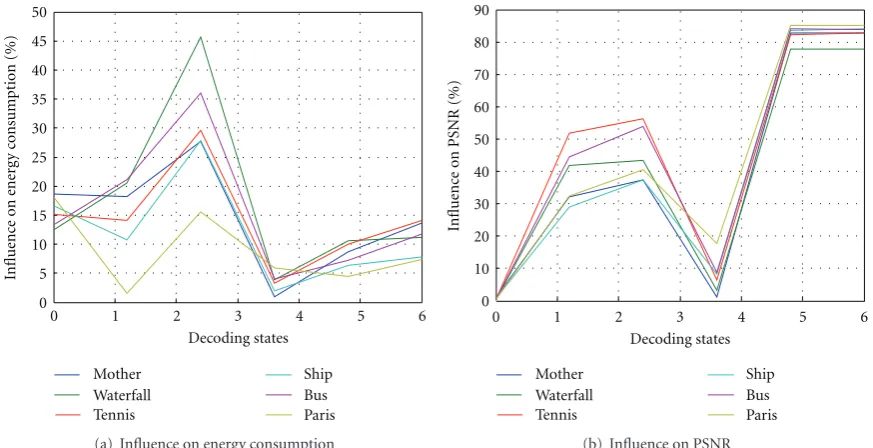
(a) Influence on energy consumption
0 1 2 3 4 5 6
(b) Influence on PSNR Figure5: Influence on energy consumption and PSNR under different decoding rules.
a decoder [35]. The complexity is mainly based on the
high adaptivity of the filter, which requires conditional and decisional processing on the block edge and sample levels, thus, there are many conditional branches in the filter which leads to excessive power consumption. At the same time, for a macroblock, the vertical filter begins from left-most edge and is followed from left to right by the three vertical edges; besides, the horizontal filter begins from top edge, and is followed by the three internal horizontal edges from top to bottom. Amount of relevant and candidate pixels should be loaded into the memory, this leads to additional power consumption either. Scalable energy can be achieved by classifying the filtering process into three levels, including full, half, and rough filtering. Among these, full filtering operation means that overall branch filtering is implemented for the macroblock. And, half filtering represents the oper-ation reduced in computoper-ational complexity, which can be achieved by taking into account the fact that the image area in past frames is already filtered, and thereby optimizing or omitting the filtering process accordingly. For the rough filtering, skip operation is used with low quality degradation,
while the lowest power consumption of the DF subfunction is required in this mode.
Besides, learning tools are used to analyze the data sets of decoder. The decision table will be used to determine the decoding modes of an MB. Inductive learning uses the analysis of data sets for creating a set of rules to take decisions.
1 2 3 4 5 6 7 Figure6: Stat. on energy consumption and PSNR for different video sequences in each decoding rule.
IDCT follows low-level; these three cases are brought into
correspondence with IDCT subfunction adjusting. Figure5
gives the influence on energy consumption and PSNR under
different decoding rules, separately.
Affiliated subfunction: discussion on error concealment
subfunction. Error concealment technique aims at obtaining a close approximation of the original signal or making the
output of decoder closely accepted by human eyes [36]. Most
error concealment techniques are based on block matching
algorithms [37] or adaptive techniques in unit of block such
as [38]. It can improve the decoding quality while it leads to
less computational complexity. Due to the energy consump-tion which lies in computaconsump-tion, memory occupaconsump-tion and
memory access, the effect of error concealment on additional
power consumption is more than that on complexity. Here, we classify the error concealment operation into three levels to adapt the scalable energy profiles. This classification is
based on scene and region change and on the unit of block. Thus, the macroblock can belong to three energy profiles, including accurate concealment in case of scene change, half concealment in case of regional variability, and coarse concealment when few and no movements take place.
Reference [39] gives an analysis of H.264/AVC decoder
in computational complexity, and [12] presents detailed
analysis in both computational complexity and memory occupation complexity. For the aspect of the complexity
in AVS video decoding, [32] is provided an approximate
estimation. Generally speaking, for most video decoders including H.264, MPEG4, AVS, and so forth, the computa-tional power allocation with emphasis on power-distortion
(P-D) [10] can be expressed in form of cost functions. We
100 90
(a) Energy Consumption in each decoding modes
100
(b) PSNR in each decoding modes Figure7: Influence on energy consumption and PSNR under different decoding modes.
in decoder. Through the objective function in (8), dynamic
scalable assignments provide a local quality optimum in each energy profile. Consequently energy scalable video decoding (ESVD) is achieved. An undeniable fact is that scalable video decoding leads to the quality degradation. Thus minimizing this degradation is another purpose in ESVD.
6. Experimental Results
6.1. Building Energy Consumption Information Database. In
this subsection, we use Application Energy Graphing Tool
[40], which can measure the battery power consumption of
an application over time, log and graph the resulting data. We use it to profile the energy distribution of the decoding modes. To calculate the energy consumption in the case of subfunctions modes, we assume that all other possible opera-tions among the subfuncopera-tions are running, expect the testing mode. It means it will occur in power control schemes in practices that decoding data will be ergodic to all basic sub-function units in despite of some skipped or simplified oper-ations. The reason is that compressed video data includes multifeatures, thus the decoding process varies with these features. For instance, for the same decoding program, the
decoding time is different among the typical sequences such
as mother, waterfall, tennis, ship, bus, and paris. Thus we use the typical video sequences as the test video set. The format is CIF and coded in AVS standard. We recycle the decoding process until the number of decoding frames obtains 15000
frames in each sequence. Figure 6 shows the total energy
consumption and corresponding PSNR in each decoding rule. The results are based on statistical experimental average.
The decision table will be used to determine the decoding mode of MBs, based on the information gathered during the preanalysis of the decoder. This process can be more accurate by the information update during the decoding
stage. Figure5depicts the process for building the decision
tables from the results in Figure6. For example, when the
decoder works on mode (1), decoding without deblocking
filter mode, little PSNR is lost but about 15% energy consumption saving can be obtained; when the decoder
works on mode (5), data pruning pattern in IDCT follows to
coarse-level, only around 10% energy consumption saving can be obtained but 85% PSNR losing occurs that is, when the energy budget is not full enough to support
full-mode decoding, full-mode (1) is a better choice than mode
(5).
6.2. The Performance of the ESVD Model. To evaluate the performance of the ESVD model and the energy scalable video decoding system, we implement the proposed ESVD model and energy scalability scheme in the AVS decoder software. The ESVD model is not limited to the video coding standards, and thus similar performance can be expected for other coding systems, such as H.264 and MPEG-4. We select stochastically “waterfall” CIF sequence at 128 kB/s and 25 fps as the testing sequence. We performed two sets of evaluations—one is for evaluating decoding scalability and the other for evaluating scalability quality. We let the decoder work under four modes. The energy consumption budgets are descending. The scalable results including PSNR and energy consumption shown in Figures
7 and 8 show the subjective quality in different decoding
modes, separately. Each mode corresponds to energy con-sumption budget ratio compared to the full decoding mode.
These experiments show the scalability and efficiency of
ESVD.
7. Conclusion and Future Work
(a) In 90% budget mode (b) In 80% budget mode
(c) In 70% budget mode (d) In 60% budget mode
(e) In 50% budget mode (f) In 40% budget mode (g) In full mode mode Figure8: Subjective quality in the different scalable modes.
It proposed a method to make the video decoder adapt resource under battery constraint, which can be widely used in handheld devices. At the same time, it gives a method to maximum video decoding quality when play-ing on portable terminals, through buildplay-ing a decodplay-ing
information database. The experiments demonstrate the
efficiency of ESVD. In future research, we will try to study
Acknowledgments
The authors acknowledge the support from the National Nat-ural Science Foundation of China (NSFC), contract/grant number: 60872007; National 863 High Technology Pro-gram of China, contract/grant number: 2009AA01Z239; The Ministry of Science and Technology (MOST), Inter-national Science and Technology Collaboration Program, contract/grant number: 0903; The NAP of Korea Research Council of Fundamental Science & Technology; The MKE (The Ministry of Knowledge Economy), Korea, under the ITRC (Information Technology Research Center) support program supervised by the NIPA (National IT Industry Promotion Agency) “(NIPA-2010-(C1090-1011-0004))”.
References
[1] D. De Schrijver, C. Poppe, S. Lerouge, W. De Neve, and R. Van De Walle, “MPEG-21 bitstream syntax descriptions for scalable video codecs,”Multimedia Systems, vol. 11, no. 5, pp. 403–421, 2006.
[2] H. Yanagihara, M. Sugano, A. Yoneyama, and Y. Nakajima, “Scalable video decoder and its application to multi-channel multicast system,” inProceedings of the International Confer-ence on Consumer Electronics (ICCE ’00), pp. 232–233, June 2000.
[3] G. Landge, M. Van Der Schaar, and V. Akella, “Complexity metric driven energy optimization framework for implement-ing MPEG-21 scalable video decoders,” inProceedings of the IEEE International Conference on Acoustics, Speech, and Signal Processing (ICASSP ’05), vol. 2, pp. 1141–1144, March 2005. [4] K. Masselos, P. Merakos, T. Stouraitis, and C. E. Goutis, “A
novel algorithm for low-power image and video coding,”IEEE Transactions on Circuits and Systems for Video Technology, vol. 8, no. 3, pp. 258–263, 1998.
[5] S.-W. Lee and C.-C. J. Kuo, “Complexity modeling for motion compensation in H.264/AVC decoder,” inProceedings of the 14th IEEE International Conference on Image Processing (ICIP ’07), vol. 5, pp. v-313–v-316, September 2007.
[6] T.-M. Liu, T.-A. Lin, S.-Z. Wang, and C.-Y. Lee, “A low-power dual-mode video decoder for mobile applications,”
IEEE Communications Magazine, vol. 44, no. 8, pp. 119–126, 2006.
[7] N. J. August and D. S. Ha, “Low power design of DCT and IDCT for low bit rate video codecs,” IEEE Transactions on Multimedia, vol. 6, no. 3, pp. 414–422, 2004.
[8] T.-H. Tsai and D.-L. Fang, “A novel design of CAVLC decoder with low power consideration,” in Proceedings of the IEEE Asian Solid-State Circuits Conference (A-SSCC ’07), pp. 196– 199, November 2007.
[9] K. Xu and C.-S. Choy, “A power-efficient and self-adaptive prediction engine for H.264/AVC decoding,” IEEE Transac-tions on Very Large Scale Integration (VLSI) Systems, vol. 16, no. 3, pp. 302–313, 2008.
[10] Z. He, Y. Liang, L. Chen, I. Ahmad, and D. Wu, “Power-rate-distortion analysis for wireless video communication under energy constraints,”IEEE Transactions on Circuits and Systems for Video Technology, vol. 15, no. 5, pp. 645–658, 2005. [11] Z. He, W. Cheng, and X. Chen, “Energy minimization of
portable video communication devices based on power-rate-distortion optimization,” IEEE Transactions on Circuits and Systems for Video Technology, vol. 18, no. 5, pp. 596–607, 2008.
[12] M. Horowitz, A. Joch, F. Kossentini, and A. Hallapuro, “H.264/AVC baseline profile decoder complexity analysis,”
IEEE Transactions on Circuits and Systems for Video Technology, vol. 13, no. 7, pp. 704–716, 2003.
[13] T.-H. Wang and C.-T. Chiu, “Low power design of high per-formance memory access architecture for HDTV decoder,” in
Proceedings of the IEEE International Conference on Multimedia and Expo (ICME ’07), pp. 699–702, July 2007.
[14] L. Nachtergaele, D. Moolenaar, B. Vanhoof, F. Catthoor, and H. De Man, “System-level power optimization of video codecs on embedded cores: a systematic approach,” Journal of VLSI Signal Processing Systems for Signal, Image, and Video Technology, vol. 18, no. 2, pp. 89–109, 1998.
[15] F. Pereira, “MPEG multimedia standards: evolution and future developments,” inProceedings of the 15th ACM International Conference on Multimedia (MM ’07), pp. 8–9, September 2007. [16] J. Valentim, P. Nunes, and F. Pereira, “Evaluating MPEG-4 video decoding complexity for an alternative video complexity verifier model,”IEEE Transactions on Circuits and Systems for Video Technology, vol. 12, no. 11, pp. 1034–1044, 2002. [17] J. Valentim, P. Nunes, and F. Pereira, “Evaluating
MPEG-4 video decoding complexity,” in Proceedings of the 2nd Workshop and Exhibition on MPEG-4, March 2001.
[18] J. Valentim, P. Nunes, and F. Pereira, “An alternative com-plexity model for the MPEG-4 video verifier mechanism,” inProceedings of the IEEE International Conference on Image Processing (ICIP ’01), vol. 1, pp. 461–464, October 2001. [19] T. Wiegand, G. J. Sullivan, G. Bjøntegaard, and A. Luthra,
“Overview of the H.264/AVC video coding standard,”IEEE Transactions on Circuits and Systems for Video Technology, vol. 13, no. 7, pp. 560–576, 2003.
[20] T. Stockhammer, M. M. Hannuksela, and T. Wiegand, “H.264/AVC in wireless environments,”IEEE Transactions on Circuits and Systems for Video Technology, vol. 13, no. 7, pp. 657–673, 2003.
[21] J. Ostermann, J. Bormans, P. List et al., “Video coding with H.264/AVC: tools, performance, and complexity,”IEEE Circuits and Systems Magazine, vol. 4, no. 1, pp. 7–28, 2004. [22] http://iphome.hhi.de/suehring/tml.
[23] R. Karri, D. J. Goodman, and R. Karri,System-Level Power Optimization for Wireless Multimedia Communication, Kluwer Academic Publishers, Dordrecht, The Netherlands, 2006. [24] S. Saponara, K. Denolf, G. Lafruit, C. Blanch, and J. Bormans,
“Performance and complexity co-evaluation of the advanced video coding standard for cost-effective multimedia commu-nications,”EURASIP Journal on Applied Signal Processing, vol. 2004, no. 2, pp. 220–235, 2004.
[25] K. Denolf, P. Vos, J. Bormans, and I. Bolsens, “Cost-efficient C-level design of an MPEG-4 video,” inProceedings of the 10th International Workshop on Integrated Circuit Design, Power and Timing Modeling, Optimization and Simulation, pp. 233–242, 2000.
[26] L. Nachtergaele, F. Catthoor, B. Kapoor, S. Janssens, and D. Moolenaar, “Low-power data transfer and storage exploration for H.263 video decoder system,”IEEE Journal on Selected Areas in Communications, vol. 16, no. 1, pp. 120–128, 1998. [27] N. Ling and N.-T. Wang, “Real-time video decoding scheme
for HDTV set-top boxes,”IEEE Transactions on Broadcasting, vol. 48, no. 4, pp. 353–360, 2002.
[28] L. Chiariglione, “MPEG and multimedia communications,”
[29] W. Gao, C. Reader, F. Wu, et al., “AVS—The Chinese Next-Generation Video Coding Standard,”http://www.avs.org.cn/ reference.asp.
[30] Y. Liu, Z. G. Li, and Y. C. Soh, “Region-of-interest based resource allocation for conversational video communication of H.264/AVC,”IEEE Transactions on Circuits and Systems for Video Technology, vol. 18, no. 1, pp. 134–139, 2008.
[31] P. Salembier and F. Marques, “Region-based representations of image and video: segmentation tools for multimedia services,”
IEEE Transactions on Circuits and Systems for Video Technology, vol. 9, no. 8, pp. 1147–1169, 1999.
[32] W. Ji, Y. Chen, C. Lei et al., “Module and distortion analysis for video decoding on mobile devices,” inProceedings of the 7th International Conference on Networking (ICN ’08), pp. 681– 685, April 2008.
[33] S. Russell and P. Norving, Artificial Intelligence: A Modern Approach, Prentice-Hall, Upper Saddle River, NJ, USA, 2nd edition, 2006.
[34] S. Peng, “Complexity scalable video decoding via IDCT data pruning,” inProceedings of the IEEE International Conference on Consumer Electronics (ICCE ’01), pp. 74–75, June 2001. [35] P. List, A. Joch, J. Lainema, G. Bjøntegaard, and M. Karczewicz,
“Adaptive deblocking filter,”IEEE Transactions on Circuits and Systems for Video Technology, vol. 13, no. 7, pp. 614–619, 2003. [36] Y. Wang and Q.-F. Zhu, “Error control and concealment for video communication: a review,”Proceedings of the IEEE, vol. 86, no. 5, pp. 974–997, 1998.
[37] M.-J. Chen, C.-S. Chen, and M.-C. Chi, “Temporal error con-cealment algorithm by recursive block-matching principle,”
IEEE Transactions on Circuits and Systems for Video Technology, vol. 15, no. 11, pp. 1385–1393, 2005.
[38] S.-C. Hsia, S.-C. Cheng, and S.-W. Chou, “Efficient adaptive error concealment technique for video decoding system,”IEEE Transactions on Multimedia, vol. 7, no. 5, pp. 860–868, 2005. [39] V. Lappalainen, A. Hallapuro, and T. D. Hamalainen,
“Com-plexity of optimized H.26L video decoder implementation,”
IEEE Transactions on Circuits and Systems for Video Technology, vol. 13, no. 7, pp. 717–725, 2003.