R E S E A R C H
Open Access
Lattice-coded cooperation protocol for the
half-duplex Gaussian two-way relay channel
Shahab Ghasemi-Goojani and Hamid Behroozi
*Abstract
This paper studies the Gaussian two-way relay channel (GTWRC), where two nodes exchange their messages with the help of a half-duplex relay. We investigate a cooperative transmission protocol, consisting of four phases: multiple access (MA) phase, broadcast (BC) phase, and two cooperative phases. For this setup, we propose a new transmission scheme based on superposition coding for nested lattice codes, random coding, and jointly typical decoding. This scheme divides the message of each node into two parts, referred to as satellite codeword and cloud center. Depending on the phase type, the encoder sends a linear combination of satellite codewords or cloud centers. For comparison, a rate region outer bound using a cut-set bound is provided. We show that the proposed scheme can achieve the capacity region in the high signal-to-noise ratio (SNR) regime. In addition, the achievable rate region is within 0.5 bit of the outer bound, regardless of all channel parameters. Using numerical examples, we show that our proposed scheme achieves a larger rate region than the best known 4-phase transmission strategy so far, called the Hybrid Broadcast (HBC) protocol by Kim et al. Our proposed scheme not only improves upon previous 2- and 3- and 4-phase protocols but also can perform superior at some cases to the introduced 6-phase protocol by Gong, Yue, and Wang (which has more complexity relative to our 4-phase protocol).
1 Introduction
In the last couple of years, cooperative communication and relaying has attracted great interest in wireless net-works and some scenarios have been studied from infor-mation theory perspective. The first model to study this problem, which consists of 3 nodes, is introduced by Van der Meulen [1]. Cover and El Gamal presented two cod-ing strategies for this model [2]. In addition to one-way relaying, two-way communication between two nodes or bidirectional relaying is of great interest. In the two-way relay channel (TWRC), there exists a relay that facili-tates exchange of messages between two nodes. In the full duplex mode, each node is able to transmit and receive simultaneously but in a half-duplex communication, each node can either receive or transmit data at each time slot. Due to practical constraints on wireless nodes, in this paper, we study the Gaussian two-way relay channel (GTWRC) in a half-duplex mode. In the literature, there exist many transmission protocols for the GTWRC in a half-duplex mode, see, e.g., [3–7]. Each transmission
*Correspondence: [email protected]
This work has been supported by the Iran N SF under Grant No. 93046836. Electrical Engineering Department, Sharif University of Technology, Tehran, Iran
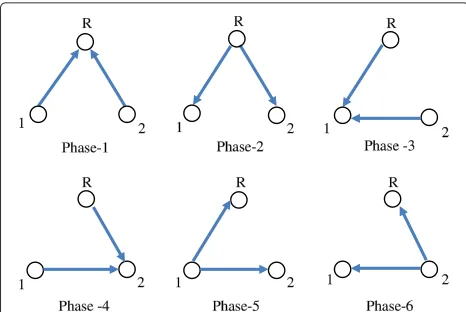
protocol consists of a sequence of phases (or states) where each phase is specified by the modes of the half-duplex nodes (transmit or receive) all together. For instance, in the 3-node half-duplex TWRC, there exist 8 possible states, out of which there are 6 useful phases as shown in Fig. 1 (the 2 phases in which all nodes are transmitting or all are receiving are not useful [8]).
The basic protocol for the TWRC, which consists of two phases (phase 1 and 2 of Fig. 1), is Multiple Access and Broadcast (MABC) protocol. In the first phase, which is referred to as the MA phase, two nodes simultane-ously transmit to the relay. In the second phase, i.e, the BC phase, the relay broadcasts a signal to both nodes. There are several practical coding schemes that investi-gate this protocol, see e.g., [9–13]. In the BC phase, the relay combines the data from both nodes and broadcasts the combined data back to both nodes. For this phase, there exist several strategies for the processing at the relay node, e.g., an amplify-and-forward (AF) strategy [5], a decode-and-forward (DF) strategy [5, 14], or a compress-and-forward (CF) strategy [15]. The AF protocol is a simple scheme, which amplifies the signal transmitted from both nodes and retransmits it to them, and unlike
Fig. 1Possible phases in the half-duplex two-way relay channel
the DF protocol, no decoding at the relay is performed. In the two-way AF relaying strategy, the signals at the relay are actually combined on the symbol level. Due to amplification of noise, its performance degrades at low signal-to-noise ratios (SNRs). The two-way DF relaying strategy was proposed in [5], where the relay decodes the received data bits from the both nodes. Since the decoded data at the relay can be combined on the symbol level or on the bit level, there has been different data-combining schemes at the relay for the two-way DF relaying strategy: superposition coding, network coding, and lattice cod-ing [16]. In the superposition codcod-ing scheme, applied in [5], the data from the two nodes are combined on the symbol level, where the relay sends the linear sum of the decoded symbols from both nodes. Shortly after the introduction of the two-way relay channel, its connection to network coding [17] was observed and investigated. The network coding schemes combine the data from nodes on the bit level using the XOR operation, see, e.g., [10, 18–22]. Lattice-based coding uses modulo addi-tion in a multi-dimensional space and utilizes nonlinear operations for data combining. Applying lattice codes over two-way relaying systems was considered in, e.g., [7, 12, 13, 23–25]. In general, as in CF or partial DF relay-ing strategies, the relay node does not need to decode the source messages but only needs to pass sufficient information to the destination nodes. A strategy based on symbol-wise network coding, in which two modulated symbols with different modulation types directly being mapped to a transmitted signal at the relay is investigated in [9]. A combination of bit-wise network coding and channel decoding is considered in [10]. A coding scheme based on distributed linear-dispersion space-time codes is considered in [11]. Nested lattice codes for the GTWRC in the symmetric and asymmetric case are considered in [12, 13], respectively. For the asymmetric case, based on a lattice partition chain, [12] shows that the achievable
rate region is within 0.5 bit from the capacity region for each user. Note that in [12] all nodes operate in full-duplex mode and there is no direct channel between the source nodes. Using a compress-and-forward strategy based on nested lattice codes, some new achievable rate regions for the GTWRC are provided [7] where it is assumed that all nodes operate in half-duplex mode without any direct link between the communication nodes. In the proposed scheme in [7], a layered coding is applied: a common layer is decoded by both receivers and a refinement layer is recovered only by the receiver which has the better channel condition. In [24] the GTWRC which operates in full-duplex mode is considered. Based on decoding non-integer linear combination of lattice codewords (instead of decoding linear combination of them), it is shown that the capacity region of the GTWRC under MABC proto-col is partially achieved [24]. However, it is shown that the MABC protocol may not perform well when the channel gains are asymmetric [3]. Thus, to improve performance and to achieve a larger rate region, protocols with more phases are proposed in the literature, e.g., [3, 6, 26–28].
The capacity region of relay channel with state infor-mation at the sources or at the relay is investigated in [29–36]. The relay channel and the cooperative relay broadcast channel controlled by random parameters are studied in [29]. It is shown that when the state is non-causally known to transmitter and intermediate nodes, the decode-and-forward can achieve the capacity region under some cases. The relay channel with state known non-causally at the relay is investigated in [30, 31]. Using Gelfand-Pinsker coding, rate-splitting and decode-and-forward, a lower bound on channel capacity is obtained for this channel and it is shown that for the degraded Gaussian channels, the lower bound meets the upper bound and thus the capacity region is achievable. The relay channel when the state is available only at the source is studied in [32–34]. By obtaining lower and upper bounds, it is shown that in a number of special cases, the capacity region is achievable. A partially cooperative relay broadcast channel (PC-RBC) with state is studied in [35] where two situations including availability of the state non-causally at both the source and the relay and only at the source are analyzed. The relay interference channel with cognitive source where only the source knows (non-causally) the interference from the interferer is considered in [36] and some achievable rate regions are obtained.
model, are considered in [3]. These protocols are referred to as Time Division Broadcast (TDBC) (phases 2, 5, and 6 of Fig. 1) and Hybrid Broadcast (HBC) (phases 1, 2, 5, and 6 of Fig. 1). If channel coefficients tend to symmetric-channel coefficients, then TDBC protocol has a poor performance compared with the MABC. But it is shown that at some cases, the achievable sum rate of HBC proto-col contains set of points that are outside the outer bounds of the MABC and TDBC protocols .
To achieve a larger rate region than the HBC protocol in [3, 37], a protocol that uses all possible 6 phases (shown in Fig. 1) is proposed in [27, 28]. Although increasing the number of transmission phases results in improvement of achievable rate region with respect to the HBC protocol, it has more complexity relative to a 4-phase protocol. In [8], by obtaining achievable rate regions and outer bounds for a 6-phase protocol, it is shown that it can achieve a larger rate region compared with other protocols at some cases. In [6], two protocols are investigated: MABC protocol and TDBC protocol. Using decode-and-forward, compress-and-forward, amplify-and-forward, and a new mixed-forward scheme, some achievable rate regions for these protocols are obtained. A 3-phase protocol, which is called Cooperative Multiple Access Broadcast (CoMABC) and consists of phases 1, 2, and 4 of Fig. 1, is pro-posed in [38]. Using doubly nested lattice codes, an achievable rate region for this scheme is obtained and it is shown numerically that the CoMABC outperforms the MABC and TDBC protocols in terms of sum rate in asymmetric channel conditions. The two-way relay-ing in a Gaussian diamond channel is considered in [39] and it is shown that lattice codes under certain conditions can achieve rate regions close to the outer bound.
In this paper, in contrast to [27], instead of increasing the number of phases in order to achieve a larger rate region than the HBC protocol, we propose a new 4-phase cooperative MABC protocol for the half-duplex GTWRC, including phases 1, 2, 3, and 4 of Fig. 1. First, consider the MABC protocol, which includes two phases, MA and BC phases. It is well known that lattice codes can achieve the capacity region of the MABC protocol within 0.5 bit [6, 12]. Thus, it seems that we do not need to consider GTWRC with more transmission phases (i.e., three or four or six phases). But, suppose that the link from the relay node to node 2 (1) is very weak (noisy) such that node 2 (1) can correctly decode the message of node 1 (2) at a very low rate. Thus, we require defining other phases to increase the rate. Now, consider the CoMABC protocol [38]. The CoMABC protocol consists of three phases: phases 1 and 2 are similar to the MABC proto-col and at the third phase, by cooperating between node 1 and the relay node, we send information to node 2. To explain why we must use the CoMABC protocol, suppose
that we are at the MABC protocol. At the end of sec-ond phase, the relay sends information bits to both nodes. Node 1 can recover its data while node 2, since has a weak link, can only decode the message of node 1 at a very low rate. Thus, to increase the data transmission rate, we use another phase to send data to node 2. Now, to explain our proposed scheme, again, consider the CoMABC protocol. Suppose that at the end of phase 2, node 1 can recover message of node 2 at a very low rate. Since at phase 3, we send no data to node 1, thus, we must define other phases to send extra data to node 1 to decode the mes-sage of node 2 at a higher rate. In our proposed scheme, at phases 3 and 4, we send some data to node 1 and node 2 to decode the message of the other node at a higher rate.
Our proposed protocol is denoted by 2-CoMABC. In phase 1 and phase 2, the protocol is similar to the MABC. In these phases, both nodes cannot completely recover the message of each other. Thus, we introduce two other phases. In phase 3 and phase 4, each node with the help of the relay and the other node tries to recover the mes-sage of the other node. These two phases are referred to as the cooperative phases. For the first time in this paper, we propose a scheme based on a “superposition coding for nested lattice codes” for the GTWRC. In superposi-tion coding, we divide the message of each node into two parts using nested lattice codes: satellite codeword and cloud center. Thus, if we want to recover a message, we must recover the satellite codeword and the cloud center simultaneously. In phase 1, based on the idea of com-putation coding [40], we recover a linear combination of messages. Due to structured codes, we can calculate the satellite codeword and cloud center for linear combina-tion of messages. Then, we send the satellite codewords to nodes in phase 2 using “random coding”. In phase 3 and 4, we send the cloud centers to both nodes. At the end of phase 4, we can recover both messages. Although we apply the superposition coding using nested lattice codes to the 2-CoMABC protocol, but one can use it to achieve better or same rate regions which are obtained at other papers. For example, we can apply it to the CoMABC protocol proposed in [38] and show that our proposed scheme includes the CoMABC scheme as a special case.
In summary, our main contributions are as follows:
• Proposing a new transmission scheme based on “superposition coding for nested lattice codes” and “random coding”.
• Analyzing the proposed protocol in a new cooperative transmission scheme and showing that our proposed scheme can achieve the capacity rate region in the high SNR regime and within 0.5 bit in general. • Improving the rate region of the 4-phase HBC protocol without increasing any complexity (in contrast to the proposed scheme at [27]).
The remainder of the paper is organized as follows. We present the channel model and the preliminaries on lat-tice codes in Section 2. In Section 3, first, we present the superposition coding for nested lattice codes and then we introduce and analyze our proposed scheme. In Section 4, an achievable rate region as well as a rate region outer bound based on the cut-set bound are provided. Using numerical examples, achievable rate regions of dif-ferent cooperative protocols are compared in Section 5. Section 6 concludes the paper.
Notations: LetC(x) = 12log(1+x). Logarithms are of base two. The random variables (RV) and their realiza-tions are denoted by capital and small letters, respectively.
x stands for a vector of lengthn, (x1,x2,. . .,xn). [x]+= max{x, 0}forx∈R.
2 Preliminaries: channel model and lattices
2.1 Channel model
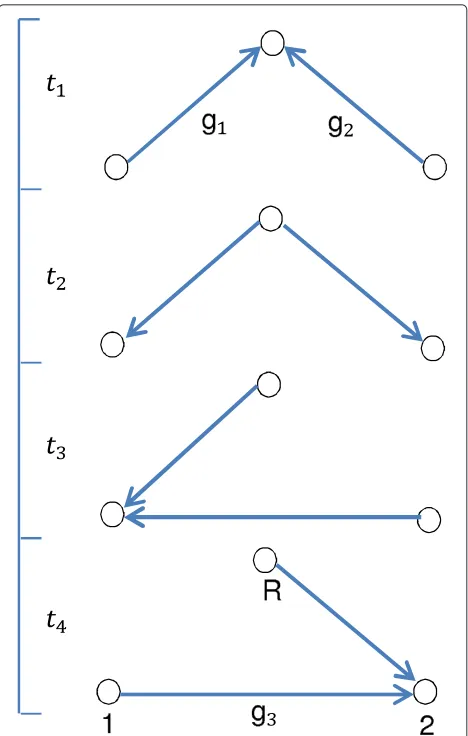
The channel model for the GTWRC via 2-CoMABC pro-tocol is shown in Fig. 2. This paper studies a GTWRC with four phases which operates in half-duplex mode, i.e., each node can only either listen or transmit at the same time. In this model, nodes 1 and 2 intend to exchange independent messagesW1∈
1, 2,. . ., 2nR1andW2∈1, 2,. . ., 2nR2 with the assistance of a relay (represented by noder). We denote the relative time duration of themth phase bytm where mtm = 1. For a given block sizen, we denote the normalized duration of themth phase bytm,n, and in achievability schemes, we must have lim
n→∞tm,n = tm [6]. The random sequencesXki ∈XiandYki ∈Yi, respectively, denote the channel input and output atkth channel use at nodei, fori ∈ {1, 2,r}. Note that the distributions ofXki
andYki depend on the value ofk, e.g., fork≤t1,n.n, we are in phase 1; fort1,n.n≤k≤
t1,n+t2,n
.n, we are in phase 2; fort1,n+t2,n
.n≤k≤t1,n+t2,n+t3,n
.n, we are in phase 3; and fort1,n+t2,n+t3,n.n ≤ k ≤ n, we are in phase 4 [6]. With a slight abuse of notation, assume that
X(im)denotes the random variable with alphabetXiduring phasem.
In the following, similar to [6], we define encoders, decoders, and associated probability of errors: letWS,T :=
Fig. 2The channel model for the Gaussian two-way relay channel via 2-CoMABC protocol in the half-duplex mode
Wi,j|i∈S,j∈T,S,T⊂Mdenote the set of messages from nodes in setSto nodes in setT. Note that if nodei does not have a message for nodej, then we haveWi,j=Ø. At node i, the encoder at channel use k is a function Xik
W{i},M,Yi1,Yi2,. . .,Yik−1
∈ Xi; the decoder at node iafter allnchannel uses produces an estimate of the mes-sageWj,iusing functionWj,i
Yi1,Yi2,. . .,Yin,W{i},M. The error event to decode the messageWi,jat the end of the block of lengthnis defined byEi,j:=
Wi,j=Wi,j(.)
, and the error event at node jin which node jwants to find wi at the end of phasem is denoted byEi(,mj). For a pro-tocol with phase durations{tm}, a set of ratesRi,jis said to be achievable if there exist encoders/decoders of block lengthn=1, 2,. . .with bothPEi,j
In this paper, we assume all links in the bi-directional relay channel are subject to independent, identically dis-tributed (i.i.d) white Gaussian noise. In the following, we describe the Gaussian channel model for the 2-CoMABC protocol. Communication process takes place in four phases: MA phase, BC phase, and two cooperative phases, as follows:
MA phase(phaset1):Y(r1)=g1rX1(1)+g2rX2(1)+Z(r1), BC phase(phaset2):Yi(2)=griX(r2)+Z(
2)
i ,i∈ {1, 2}
Cooperative phases(phaset3):Y(13)=gr1X(r3)+g21X(23)+Z( 3)
1 ,
Cooperative phases(phaset4):Y(24)=gr2X(r4)+g12X(14)+Z( 4)
2 ,
where all Gaussian noise sequences are zero mean with unit variance and the channel inputs are subject to average power constraints as the following:
1 nE
X(im)2≤Pi. for i=1, 2,r m=1, 2, 3, 4
In addition,gijis the channel gain between transmitter iand receiver j. We assume that the channel is recipro-cal such thatgij = gjiand each node is fully aware ofg1r, g2r, andg12(i.e., full CSI). Considering channel reciprocity, the channel coefficient between nodes 1 andris denoted collectively asg1, i.e.,g1r = gr1 = g1. Similarly, we have g2r=gr2=g2andg12=g21=g3.
2.2 Lattice definitions
Here, we provide some necessary definitions on lattices and nested lattice codes. Interested readers can refer to [40–42] and the references therein for more details.
Definition 1.(Lattice):Alattice(n)is a discrete
addi-tive subgroup ofRn. A lattice(n)can always be written in terms of a generator matrixG∈Rn×nas
(n)= {x=zG:z∈Zn},
whereZrepresents the set of integers.
Definition 2.(Quantizer):Thenearest neighbor
quan-tizer Q maps any pointx ∈ Rn to the nearest lattice point:
Q(x)=arg min
l∈x−l.
Definition 3.(Voronoi region): The fundamental
Voronoi regionof lattice(n)is set of points inRnclosest to the zero codeword, i.e.,
V0((n))= {x∈Rn:Q(x)=0}.
Definition 4.(Moments):σ2(n)which is called the
second momentof lattice(n)is defined as
σ2((n))= 1 n
V() x2dx
V()dx
, (1)
and the normalized second moment of lattice can be expressed as
G((n))= σ 2((n))
V()dx
2
n
= σ2()
V2n
,
whereV=V()dxis the Voronoi region volume.
Definition 5.(Modulus):Themodulo-operationwith
respect to latticereturns the quantization error as
xmod(n)=x−Q(x),
that maps x into a point in the fundamental Voronoi region and it is always placed inV.
The modulo lattice operation satisfies the following dis-tributive property [43]
xmod(n)+y
mod(n)=x+ymod(n).
Definition 6.(Quantization goodness or Rogers-good):
A sequence of lattices(n)⊆Rnisgood for mean-squared error (MSE) quantizationif
lim n→∞G
(n)= 1
2πe.
The sequence is indexed by the lattice dimensionn. The existence of such lattices is shown in [44, 45].
Definition 7.(AWGN channel coding goodness or
Poltyrev-good):LetZ be a length-ni.i.d. Gaussian vector,
Z∼N0,σZ2In
. The volume-to-noise ratio of a lattice is given by
μ (,)= (Vol(V)) 2/n
2πeσZ2 ,
where σ2
Z is chosen such that Pr{Z∈/V} = andIn is ann-by-nidentity matrix. A sequence of lattices is(n) Poltyrev-goodif
lim n→∞μ
(n),=1, ∀ ∈(0, 1)
and, for fixed volume-to-noise ratio greater than 1, Pr{Z∈/Vn}decays exponentially inn.
Definition 8.(Nested lattices):A lattice(n)is said to
benestedin lattice (cn) if (n) ⊆ (cn).(n) is referred to as the coarse lattice and(cn)as the fine lattice. The set of all points of a fine lattice(cn)that are within the fun-damental Voronoi regionV of a coarse lattice(n) form anested lattice code. The rate of a nested lattice code is defined as
R= 1 nlog
C(n)= 1
Erez et al. show that there exists a sequence of lat-tices that are simultaneously good for packing, cover-ing, source coding (Rogers-good), and channel coding (Poltyrev-good). In the following, we present a key prop-erty of dithered lattice codes.
Lemma 1.[41] The Crypto Lemma Let V be a
ran-dom vector with an arbitrary distribution overRn. IfDis independent ofVand uniformly distributed overV, then (V+D)mod is also independent of V and uniformly distributed overV.
Proof. See lemma 1 in [41].
3 Lattice-coded cooperation protocol
In this section, based on nested lattice codes, we propose an achievable rate region on the capacity region of the GTWRC. First, we present the superposition scheme for nested lattice codes that is a key to our code construction.
3.1 Superposition coding for nested lattice codes
Consider the following nested lattices:
(n) s1 ⊆
(n)
s2 ⊆(mn)⊆(cn). (2)
The coding lattice (i.e., fine lattice) (cn) provides the codewords, while the shaping sublattices (i.e., coarse lat-tices)(sn1)and(sn2)satisfy the power constraint. The set of points of fine lattice(cn)that lies in the fundamental Voronoi region of shaping lattice(sin) forms a codebook for nodei, i.e.,
and its rate is given by
Ri=
The meso-lattice [46] (mn) partitions the set of code-words for nodeiinto two parts. To clarify this discussion, we define two additional codebooks as follows:
C(n)
where the associated coding rates are
Ra =
Now, we can decompose each lattice codeword Vi ∈
C(n)
i by( n)
m into two points,Va,i(an individual codeword in each cloud, referred to as a satellite codeword) andVb,i (the cloud center associated with a nested lattice, referred to as a cloud center):
Vi=
The meso-lattice point Vb,i determines the cloud cen-ter in which Vi resides, whileVa,i identifies its location within the clouds (i.e., the individual codewords within the clouds). This scheme is similar to superposition cod-ing in the broadcast channel [47].
The following theorem presents the main result of this paper.
Theorem 1. An achievable region of the half-duplex
bidirectional relay channel with the 2-CoMABC protocol is the closure of the set of all points(R1,R2)satisfying:
In the following, the steps of the proof are presented. First, we provide a brief explanation of our coding and then present our scheme in more details. Without loss of generality, we assume that R1 ≥ R2. Since we need two codebooks, three nested lattices for generating these codebooks are required. One of the lattices, (cn), con-structs the codewords while the other two lattices (shap-ing lattices) satisfy the channel power constraints ((sn1) and(sn2)). Based on the idea of computation coding [40], at the end of phase 1, we decode two linear combinations of messages. In order to decompose these linear combina-tions, which are points of(cn), we define another lattice
(n)
m
In phase 2, we send the satellite codeword of the linear combinations to both nodes while in phase 3 and 4, we communicate the cloud center associated with the linear combination of codewords to node 1 and 2, respectively. Thus, at the end of phase 4, based on having the cloud center associated with a nested lattice and the individ-ual codeword in that cloud, we can fully find the linear combination of messages at both nodes. Using the later decoding, we can decode the message of each node at the opposite node. In the following, we present our scheme in more details.
3.2 Phase 1 (MA phase)
• Encoding:
By calculating the optimum phase durations,t1, t2,t3, and t4, we can determine the codeword length in each phase asn1= Tt1s,n2= Tt2s,n3= Tt3s, andn4= Tt4s, whereTs is the sampling interval. In the following, without loss of generality, we assume thatg12P1≥g22P2. In order to apply the rate splitting, we choose a chain of lattices as (2), such that(n1)
s1 ,( n1) s2 and(
n1)
m are Rogers-good and Poltyrev-good while(n1)
c is Poltyrev-good. The generation of these lattices is fully explained in [45].
To send the messagesWi i ∈ {1, 2}to the relay node, using a one-to-one mapping, we first map it to lattice codewordVi ∈ Ci(n1). Then, we construct the following sequence to transmit over the channel:
X(i1) = g1
i [Vi+Di] mod (n1) si ,
whereDiis a dither that is uniformly distributed over the Voronoi region of(n1)
si , i.e., Di ∼ Unif(Vsi). Since the channel gains from node 1 → rand 2 → r are differ-ent, and we also aim to decode the sum of codewords
V1andV2 at the relay node, we pre-amplify the trans-mit signals by g1
i. According to the channel power
con-straints, we choose the second moments of lattices as the following:
σ2(si) = g2
iPi i∈ {1, 2}.
• Decoding:
The relay aims to recover the linear combination ofVi’s instead of recoveringV1andV2, separately. Thus, the lat-tice scheme inherits the idea of computation coding [40] and physical-layer network coding [48]. To reach this goal, with receiving the sequence
Y(r1)=g1X(11)+g2X(21)+Z(r1),
the relay performs the following operations:
Y(d1)
r =αY
(1)
r −D1−D2
=αg1X(11)+αg2X2(1)+αZ(r1)−D1−D2
=V1+V2+αg1X(11)−(V1+D1)+αg2X(21)
−(V2+D2)+αZ(r1)
=V1+V2−Qs1(V1+D1)−Qs2(V2+D2) +g1(α−1)X(11)+g2(α−1)X(21)+αZ(r1)
=V1+V2−Qs1(V1+D1)−Qs2(V2+D2)+Zeff, where
Zeff=g1(α−1)X(11)+g2(α−1)X(21)+αZ(r1).
Due to the dithers, the vectors V1,V2,X(11),X( 1)
2 are independent and also independent ofZ(r1). ThereforeZeff is independent of V1 and V2. Now, we choose α such that the variance of the effective noise,Zeffis minimized. Hence, we obtain
αMMSE=
g12P1+g22P2 g12P1+g22P2+1
.
After calculatingY(d1)
r, we need to obtain estimations of
the following linear combinations:
Vr,1 = V1+V2−Qs2(V2+D2)
mod(n1) s1 , (7)
Vr,2 = [V1+V2] mod(sn21). (8)
To decode (7) using Y(d1)
r, we perform the following
operation:
Ydr,1 =
Y(d1) r
mod(n1) s1
= V1+V2−Qs1(V1+D1)−Qs2(V2+D2)
+Zeff
mod(n1) s1
= Vr,1+Zeff
mod(n1)
s1 (9)
where (9) is based on the distributive law of the modulo operation. Now, we use the minimum Euclidean distance lattice decoding [41, 49] to decodeVr,1, correctly. Thus, we get
Vr,1=Qc
Ydr,1
.
From (9), we can see that the estimation is incorrect if
Zeff∈/Vc. (10)
(10) shows that the estimation ofVr,1 is incorrect if the effective noiseZeffleaves the Voronoi region surrounding the true codeword, i.e.,Pe=Pr(Zeff∈/Vc).
To show thatPe=Pr(Zeff∈/Vc)goes to zero exponen-tially inn, we consider a Gaussian sequence,N0,σ2
ZIn
with the same second moment as Zeff, i.e., Z∗eff ∼
μ=
where (12) follows from (11), and (13) is based on Rogers goodness of (n1) Thus, we obtain the achievable rate region of link 1→ r and 2→ras
In order to decode the second term, (8), we assume that the estimation ofVr,1is correct. This assumption is valid ifR(1,1r)andR2,(1r)satisfy (14). Thus, we can calculateVr,2as:
s2 and the distributive law of the modulo operation.
Now, the relay node decomposes the linear combina-tions of messages,Vr,1andVr,2, as the following:
where (16) follows from (4) and the last equality follows from(n1) the cloud center, we perform the following operation:
Lb,1 =
where the last equality is based on the distributive law of the modulo operation. Thus using (18), we can decompose
3.3 Phase 2 (broadcast phase) First, we generate 2n2R(r2) sequences, with each element
i.i.d. according toN ∼(0,Pr)andR(r2)=max responding satellite codeword Va,1 can be determined easily. Using the knowledge ofva,1andLa,1 at node 1, it can decode the message of node 2 as:
Va,2= La,1−va,1
mod(n1) m .
From the argument of random coding and jointly typical decoding [50], we get
R(r2,1)≤Cg12Pr
. (20)
Similarly, node 2 with having V2 and thus its corre-sponding satellite codewordVa,2can findVa,1if
R(r2,2)≤Cg22Pr
. (21)
3.4 Phase 3 (first cooperative phase)
During this phase, only node 2 and the relay node trans-mit.
• Encoding:
In this phase, node 1 attempts to decodeVb,2to con-structV2using the decoded satellite codeword,Va,2from the previous phase. At the relay node, from phase 1, the following sequence is available:
L(r3)=Lb,2= to node 1, respectively, we have a conventional MAC and we can apply any capacity-achieving code. Note that
L(r3) =
L(23)+Vb,1
mod(n1)
s2 and the cardinality of the sets ofL(r3) andL(23) are equal (based on the Crypto lemma in [41, 51]). We assume that this cardinality is 2n3R(3). To construct codebooks at node 2 and the relay so that the sum of them with each other results in the same L(r3). Now, consider a multivariate Gaussian dis-tributionp
where ρ2r denotes the correlation coefficient between x2,i and xr for i ∈
1, 2,. . ., 2n3R(3)
. To generate the codebook at node 2, we use the marginal distribu-tionspx2,1 them, construct a codeword with each elementi.i.d. These sequences form a codebookC(n3)
2 for node 2. This enables node 2 to mapL(23)to a codewordX(23)L(23)∈C(n3)
2 . Now at the relay node, we generate the codebookC(n3)
r . In order to construct this codebook, supposeXi is set of allX2,i we generate 2n3R(3) sequences according to the marginal distributionp(xr|Xi). The relay mapsL(r3)to a codeword
r . Note that both mappings at the relay and node 2 are one-to-one correspondence.
• Decoding:
In this phase, the decoder of node 1 attempts to decodeVb,2 to construct V2. Note that node 1 already has Va,2 from phase 2. Since Vb,1 is known at node
From the argument of random coding and jointly typical decoding [50], we get
R(3)≤C
Also, using flow constraints, we have
t3R(3)=t1R2,(1r)−t2R(r2,1). (22) equal, is less than the sum capacity of the multiple-access channel, node 2 can transmit another sequence to node 1 in this phase. Suppose that X2(3) denotes this supple-mentary sequence. Given the data rate of X2(3) asR(2,13) , error probabilities vanish as n3 → ∞, if the following constraints are satisfied:
Using (22), the constraints in (23) and (24) can be rewritten as follows:
3.5 Phase 4 (second cooperative phase)
In this phase, we can use the explained scheme at phase 3. Since the message of node 2 is recovered by node 1 at phase 3, it can construct the following sequence, which the relay has it as well:
Lb,1= distribution. The correlation coefficient betweenX1and Xris denoted byρ1r, Var(X1)=P1and Var(Xr)=Pr. By using this distribution, we generate 2n4R(4)sequences, with each elementi.i.d. according top(x1,xr). We choose the first component of the generated sequence as a codeword for node 1 and the second component as a codeword for the relay node. These sequences form two codebooksC(n4)
1
, respectively, and send them to node 2. Thus, we have a conventional MAC and the capacity region is easily achieved. But, we can see that if individual rate of node 1 and the relay is less than the sum capacity of the MAC, node 1 in this phase can communicate another data sequence, denoted byX1(4). Thus, to correctly recover
X(r4) and (28) as the following:
R(1,24)≤Cg32P1
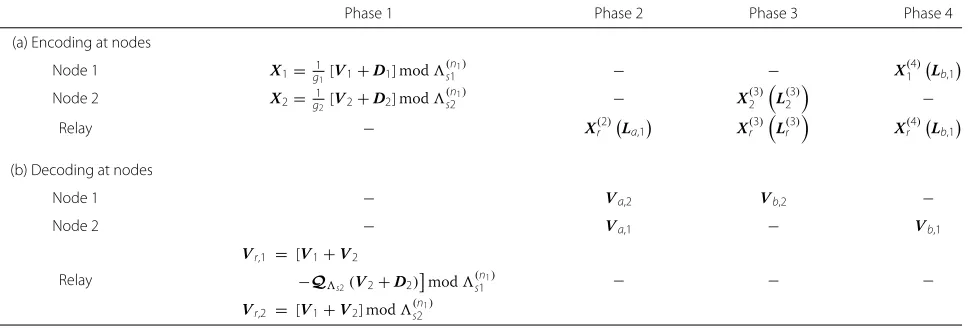
Encoding and decoding at nodes in four phases are explained with the help of Table 1.
Table 1Encoding and decoding at nodes
Phase 1 Phase 2 Phase 3 Phase 4
(a) Encoding at nodes
Node 1 X1=g11[V1+D1]mod(sn11) − − X(
(b) Decoding at nodes
3.6 Achievable rate region
From (14), (20), (21), (25), (26), (29) and (30), the following rate region is achieved:
R(1,1r) ≤ R∗1,r, (31)
Since there are outgoing data flows from node 1 to node 2 at phases 1 and 4, from (31) and (37), we get:
t1R(1,1r)+t4R(1,24) ≤ t1R∗1,r+t4Cg32P1. (39)
Similarly, there are information flows from node 2 to node 1 at phases 1 and 3. Thus, we get
From (36), (38), (39), and (40), we have proved theorem.
4 The rate region outer bound and capacity results
4.1 The rate region outer bound
In this subsection using the cut-set bound, we obtain an outer bound over the rate region of the half-duplex GTWRC. This bound can be derived from the half-duplex cut-set bound in [52].
Lemma 2.All rate pairs of the discrete memoryless
restricted half-duplex two-way relay channel, as shown in Fig. 2, that are achievable for some joint probability distributions
where all tmare non-negative subject to 4 m=1
tm=1.
Proof.For a half-duplex relay network withkphases in which the sequence of phases is fixed with fraction of time, any achievable rateRof information flow is upper bounded as follows [53]
R≤min
where a cut partitions nodes into two setsSandScsuch that the source nodes are inS, the destination nodes are inSc, andScis the complement ofS. Using this, we bound R1andR2. For communication rate from node 1 to node 2, i.e.,R1, we divide the nodes into two sets,S = {1}and
For the Gaussian model, we can upper bound the vari-ous mutual information terms as the following [53]
I
whereρ1r is the correlation coefficient betweenX(14)and Xr(4)andρ2ris the correlation coefficient betweenX(23)and Xr(3). Using these mutual information terms at the outer bounds, given in (41) and (42), we get:
R1 ≤ min
Linear resource allocation problem
In (45) and (46), phases t1, t2, t3, and t4 are not deter-mined. Since the capacity region, which should be the convex hull of all achievable rate pairs (R1,R2), has two dimensions, this region has no unique maximum and we cannot determine optimum values for phases. To solve this problem, we use an alternative metric that is com-monly used in [3, 6]. In this metric, we maximize the sum rate, i.e.,R1+R2. Thus, we have the following optimization problem witht1,t2,t3, andt4as optimization parameters:
We can easily transform this problem to a standard form and solve this optimization problem.
4.2 Capacity results
Corollary 1.The capacity region of the half-duplex
Gaussian two-way relay channel via the 2-CoMABC pro-tocol, as shown in Fig. 2, is achievable within 0.5 bit.
Proof. We first calculate the gap forR1. For calculating the gap forR1, if we compare the right-hand sides (RHS) of (5) and (41), the second term in both minimizations is the same and the first terms differ by at most12bit. To see this, we have:
where (48) is based on the fact that the maximum gap occurs at g12P1 the achievable rate region which is given by (5) and (6) is within 0.5 bit of the outer bound for each user regardless of channel parameters.
Now, we investigate the achievable rate region of the GTWRC via 2-CoMABC protocol in the high SNR regime.
Corollary 2.At high SNRs (i.e., g12P1 1and g22P2
1), the capacity region of the GTWRC via 2-CoMABC protocol is given by
R1≤min
Thus, we have:
By comparing this region with the outer bound in (45) and (46) forg12P1 1 andg22P2 1, we can see that the capacity region is achievable at high SNRs.
5 Numerical results
In this section, we compare the achievable rate region and the outer bound, in the sum rate sense, of the bidirec-tional coded cooperation protocols: the MABC protocol [3], the TDBC protocol [3], the CoMABC protocol [38], the HBC [3], the 6-phase protocol [27], and our proposed scheme, 2-CoMABC. Since we have studied a 4-phase protocol, and the MABC and TDBC protocols have two and three phases, respectively, we compare the achievable rate region of our protocol with the outer bound of MABC and TDBC protocols.
• MABC protocol (outer bound): The MABC protocol is a two-phase protocol (phases 1 and 2 of Fig. 1) where both users simultaneously transmit during the first phase and the relay alone transmits during the second. The outer bound of the MABC protocol is given by [3]: • TDBC protocol (outer bound): The second protocol
considers sequential transmissions from the two users followed by a transmission from the relay:
R1≤mint1CP1g12+g23,t1Cg23P1+t3Cg22Pr,
R2≤mint2CP2g22+g23,t2Cg23P2+t3Cg12Pr.
• In [38], using doubly nested lattice codes, an achievable rate region for three phases CoMABC protocol is obtained. The achievable rate region for this protocol is given by [38]
R1 ≤ mint1R∗1,r+t3Cg32P1,t2Cg22Pr
• HBC protocol (achievable rate region): The HBC protocol contains four phases (phases 1, 2, 5, and 6 of Fig. 1) which starts with the broadcast phases (5 and
6) followed by the MABC phases (1 and 2). In [3], it is shown that for the HBC protocol, the following rate region is achievable:
An outer bound for the HBC protocol using the cut-set bound is given in [3]. Since it is not clear that jointly Gaussian distributions are optimal, it is difficult to com-pute the outer bound of the HBC protocol numerically [3]. However, using the presented approach at [53], we can bound the given outer bound in [3] as the following for the Gaussian case:
• HBC protocol (outer bound)
R1 ≤ mint1Cg12P1+g32P1+t3Cg12P1,
• 6-phase protocol (achievable rate region) [27]
R1 ≤ R(1,24)+min
HBC protocol in [3]. Note that this improvement is due to increasing number of transmission phases from 4 to 6 (which induces higher complexity). Here, we numerically compare 2-CoMABC with the above-mentioned proto-cols. When we compare the sum rate outer bounds or achievable sum rates for different protocols, linear pro-gramming is used to optimize the portion of time allo-cated to each phase. In the following, for all nodes, we assume that the power constraint equals to P and we define SNRi=gi2Pfori∈ {1, 2, 3}.
We compare the sum rate in an environment with path loss. We assume the channel gains to beg1 =(1+d)−
γ
2, g2 =(1−d)−
γ
2 andg3=2−γ2, wheredis the position of the relay andγ is the path loss exponent.
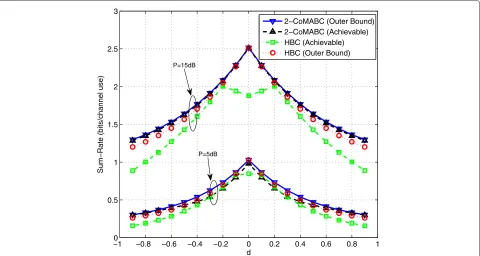
The achievable sum rate and sum rate outer bound with differentdfor HBC and 2-CoMABC protocols are given in Fig. 3. The figures are evaluated atP = 5 dB and 15 dB, respectively, withγ = 4 and ρ1r = ρ2r = 0.2. As we expected from Corollary 2, for 2-CoMABC, the inner bound meets the outer bound at high SNR and performs superior to the HBC protocol. Also at P = 15 dB, the achievable rate for 2-CoMABC protocol is larger than the HBC outer bound. ForP = 5 dB, there is a gap between the inner bound and the outer bound for 2-CoMABC pro-tocol. This gap atd = ±1 tends to zero due toR∗1,r → Cg12P1
orR∗2,r→Cg22P2
.
In Fig. 4, we compare the achievable sum rates and sum rate outer bounds with different path loss exponents
for 2-CoMABC and HBC protocols. The results are for γ = 2, 5 with P = 10 dB. Since we have normalized the channel gain at d = 0, the two groups of curves meet at this position. As we observe, for smallerγ, the gap between 2-CoMABC protocol and HBC protocol is significantly larger than the case of an environment with larger value of path loss exponent. Moreover, achiev-able sum rate region and sum rate outer bound of 2-CoMABC protocol is larger than that of HBC under any circumstance.
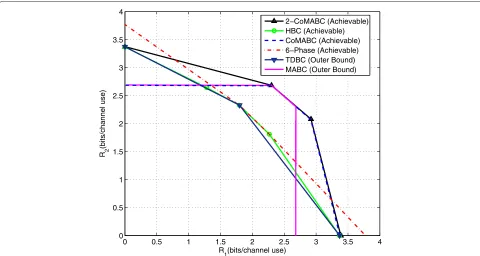
In Figs. 5 and 6, we compare the rate region of dif-ferent protocols in asymmetric and symmetric scenar-ios. For the asymmetric case, we see that the achievable rate region of our proposed scheme not only contains the achievable rate region of all previous protocols but it also contains some rates of the 6-phase protocol in [27]. For the symmetric case, the achievable rate region of our proposed scheme is completely better than all other protocols and it fully contains the rate region of them.
In Fig. 7, we compare the rate region of protocols in low SNRs, SNR1 = −3 dB, SNR2 = −4 dB, and SNR3 = 2 dB. As we observe, the performance of our transmission scheme via the 2-CoMABC protocol is similar to the 6-phase transmission protocol and both schemes achieve the same rate region. In addition, this rate region coin-cides with the outer bound of the TDBC protocol. Note that the achievable rate region using CoMABC protocol
−10 −0.8 −0.6 −0.4 −0.2 0 0.2 0.4 0.6 0.8 1
0.5 1 1.5 2 2.5 3
d
Sum−Rate (bits/channel use)
2−CoMABC (Outer Bound) 2−CoMABC (Achievable) HBC (Achievable) HBC (Outer Bound)
P=15dB
P=5dB
−1 −0.8 −0.6 −0.4 −0.2 0 0.2 0.4 0.6 0.8 1 0.2
0.4 0.6 0.8 1 1.2 1.4 1.6 1.8
d
Sum−Rate (bits/channel use)
2−CoMABC (Outer Bound) 2−CoMABC (Achievable) HBC (Achievable) HBC (Outer Bound)
γ=2
γ=5
Fig. 4Achievable sum rate region and sum rate outer bound vs. the relay position for different path loss exponents(ρ1r=ρ2r=0.2)
is zero and thus by the proposed scheme in [38], no rate region for this protocol can be achieved.
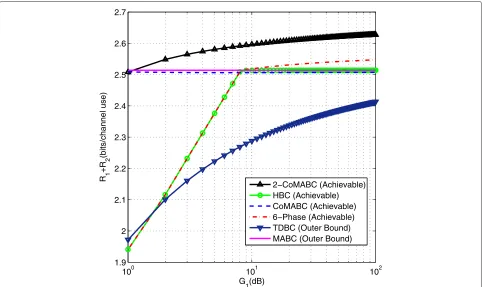
Finally, we compare the performance of HBC, 6-phase, CoMABC, TDBC, MABC, and 2-CoMABC protocols (in the sense of achievable sum rate) forP=15 dB,g2=0 dB,
g3= −5 dB with differentG1=g12. Figure 8 shows that the achievable sum rate for 2-CoMABC is larger than that of all other protocols. Note that in this example, 2-CoMABC protocol, which only uses four transmission phases, has a larger sum rate than the 6-phase protocol in [27].
0 0.5 1 1.5 2 2.5 3 3.5 4
0 0.5 1 1.5 2 2.5 3 3.5 4
R
1(bits/channel use) R 2
(bits/channel use)
2−CoMABC (Achievable) HBC (Achievable) CoMABC (Achievable) 6−Phase (Achievable) TDBC (Outer Bound) MABC (Outer Bound)
0 0.5 1 1.5 2 0
0.2 0.4 0.6 0.8 1 1.2 1.4 1.6 1.8
R
1(bits/channel use)
R 2
(bits/channel use)
2−CoMABC (Achievable) HBC (Achievable) CoMABC (Achievable) 6−Phase (Achievable) TDBC (Outer Bound) MABC (Outer Bound)
Fig. 6Achievable rate regions for six protocols in the symmetric scenario: SNR1=SNR2=SNR3=10 dB(ρ1r=ρ2r=0.3)
0 0.1 0.2 0.3 0.4 0.5 0.6 0.7
0 0.1 0.2 0.3 0.4 0.5 0.6 0.7
R1(bits/channel use)
R 2
(bits/channel use)
2−CoMABC (Achievable) 6−Phase (Achievable) TDBC (Outer Bound) HBC (Achievable) MABC (Outer Bound)
100 101 102 1.9
2 2.1 2.2 2.3 2.4 2.5 2.6 2.7
G
1(dB) R 1
+R
2
(bits/channel use)
2−CoMABC (Achievable) HBC (Achievable) CoMABC (Achievable) 6−Phase (Achievable) TDBC (Outer Bound) MABC (Outer Bound)
Fig. 8Achievable sum rates of different protocols. Channel parameters areP=15 dB,g2=0 dB, andg3= −5 dB
6 Conclusions
In this paper, the Gaussian two-way relay channel in the half-duplex mode, which operates in four phases, is studied. By using superposition coding, a scheme which achieves the outer bound within 0.5 bit is proposed. In this scheme, both structured codes and random coding have been used. In phase 1 (MA phase), we decompose the message of each user into two parts due to struc-tured codes. In phase 2 (BC phase) and phase 3 and 4 (cooperative phases), random coding is applied. In the high SNR regime, the proposed scheme coincided with the cut-set outer bound and thus the capacity region is achieved. Also, using numerical examples, we showed that our 2-CoMABC protocol performs superior to the well-known HBC protocol (which has the same number of transmission phases). Although in general the comparison for few examples may not provide a general insight on which scheme outperforms the others, similar behavior has been observed by evaluating the achievable sum rates and the achievable rate regions in many other examples with different channel parameters.
Competing interests
The authors declare that they have no competing interests.
Acknowledgements
This work has been supported by the Iran NSF under Grant No. 93046836.
Received: 25 November 2014 Accepted: 15 November 2015
References
1. E Van Der Meulen, Three-terminal communication channels. Adv. Appl. Probab.3(1), 120–154 (1971)
2. TM Cover, AAE Gamal, Capacity theorems for the relay channel. IEEE Trans. Inf. Theory.25(5), 572–584 (1979)
3. S Kim, P Mitran, V Tarokh, Performance bounds for bidirectional coded cooperation protocols. IEEE Trans. Inf. Theory.54(11), 5235–5241 (2008) 4. B Rankov, A Wittneben, Spectral efficient protocols for half-duplex fading
relay channels. IEEE J. Sel. Areas Commun.25(2), 379–389 (2007) 5. B Rankov, A Wittneben, inProc. 43rd Allerton Conf. Commun., Contr.,
Comput. Spectral efficient protocols for nonregenerative half-duplex
relaying (University of Illinois Monticello, IL, 2005)
6. S Kim, N Devroye, P Mitran, V Tarokh, Achievable rate regions and performance comparison of half duplex bi-directional relaying protocols. IEEE Trans. Inf Theory.57(10), 6405–6418 (2011)
7. S Smirani, M Kamoun, M Sarkiss, A Zaidi, P Duhamel, Achievable rate regions for two-way relay channel using nested lattice coding. IEEE Trans. Wireless Commun.13(10), 5607–5620 (2014)
8. K Ishaque Ashar, V Prathyusha, S Bhashyam, A Thangaraj, inProc. 50th
Allerton Conf. Commun., Contr., Comput. Outer bounds for the capacity
region of a Gaussian two-way relay channel (IEEE Monticello, IL, 2012), pp. 1645–1652
9. T Koike-Akino, P Popovski, V Tarokh, Optimized constellations for two-way wireless relaying with physical network coding. IEEE J. Sel. Areas Commun.27(5), 773–787 (2009)
10. S Zhang, SC Liew, Channel coding and decoding in a relay system operated with physical-layer network coding. IEEE J. Sel. Areas Commun. 27(5), 788–796 (2009)
12. W Nam, S Chung, YH Lee, Capacity of the Gaussian two-way relay channel to within 1/2 bit. IEEE Trans. Inf. Theory.56(11), 5488–5494 (2010) 13. MP Wilson, K Narayanan, H Pfister, A Sprintson, Joint physical layer coding
and network coding for bidirectional relaying. IEEE Trans. Inf. Theory. 56(11), 5641–5654 (2010)
14. TJ Oechtering, H Boche, inProc. ISITA. Optimal resource allocation for a bidirectional regenerative half-duplex relaying (IEEE Seoul Korea, 2006) 15. C Schnurr, TJ Oechtering, S Stanczak, inProc. 41st Annual Asilomar
Conference on Signals, Systems, and Computers. Achievable rates for the
restricted half-duplex two-way relay channel (IEEE Pacific Grove, CA, 2007) 16. J Zhao,Analysis and design of communication techniques in spectrally
efficient wireless relaying systems. (Master’s thesis, ETH Zurich, 2010)
17. R Ahlswede, N Cai, S-YR Li, RW Yeung, Network information flow. IEEE Trans. Inf. Theory.46(5), 1204–1216 (2000)
18. Y Wu, P Chou, S-Y Kung, inProc. 39th Ann. Conf. Inf. Sci. Syst. (CISS). Information exchange in wireless networks with network coding and physical-layer broadcast (The Johns Hopkins University Baltimore, MD, USA, 2005)
19. P Larsson, N Johansson, K-E Sunell, inProc. IEEE Vehicular Technology Conf.
(VTC). Coded bidirectional relaying (IEEE Melbourne, Australia, 2006)
20. P Popovski, H Yomo, inProc. IEEE Int. Conf. Commun. (ICC). Physical network coding in two-way wireless relay channels (IEEE Glasgow, Scotland, 2007), pp. 707–712
21. J Liu, M Tao, Y Xu, X Wang, inProc. IEEE GLOBECOM. Superimposed XOR: a new physical layer network coding scheme for two-way relay channels (IEEE Honolulu, Hawaii, 2009), pp. 1–6
22. Q Zhou, Y Li, F Lau, B Vucetic, Decode-and-forward two-way relaying with network coding and opportunistic relay selection. IEEE Trans. Comm. 58(11), 3070–3076 (2010)
23. I-J Baik, S-Y Chung, inProc. IEEE Int. Conf. Commun. (ICC). Network coding for two-way relay channels using lattices (IEEE Beijing, China, 2008), pp. 3898–3902
24. S Ghasemi-Goojani, H Behroozi, inProc. IEEE Inf. Theory Workshop (ITW). On the Ice-Wine problem: recovering linear combination of codewords over the Gaussian multiple access channel (IEEE Hobart, Australia, 2014) 25. S Ghasemi-Goojani, H Behroozi, Nested lattice codes for Gaussian
two-way relay channels. Available at http://arxiv.org/abs/1301.6291, Accessed Jan. 2013
26. P Zhong, M Vu, inProc. IEEE Int. Conf. Commun. (ICC). Partial
decode-forward coding schemes for the Gaussian two-way relay channel (IEEE Ottawa, Canada, 2012)
27. C Gong, G Yue, X Wang, A transmission protocol for a cognitive bidirectional shared relay system. IEEE J. Sel. Top. Sign. Proces.5(1), 160–170 (2011)
28. M Khafagy, A El-Keyi, M Nafie, T ElBatt, inProc. IEEE Int. Conf. Commun.
(ICC). Degrees of freedom for separated and non-separated half-duplex
cellular MIMO two-way relay channels (IEEE Ottawa, Canada, 2012) 29. A Zaidi, L Vandendorpe, P Duhamel, inIEEE Int. Commun. Conf. (ICC).
Lower bounds on the capacity regions of the relay channel and the cooperative relay-broadcast channel with non-causal side-information (IEEE Glasgow, Scotland, 2007), pp. 6005–6011
30. A Zaidi, SP Kotagiri, JN Laneman, L Vandendorpe, Cooperative relaying with state available non-causally at the relay. IEEE Trans. Inf. Theory.56(5), 2272–2298 (2010)
31. A Zaidi, SP Kotagiri, JN Laneman, L Vandendorpe, inProc. IEEE Information
Theory Workshop (ITW). Cooperative relaying with state at the relay (IEEE
Porto, Portugal, 2008), pp. 139–143
32. A Zaidi, S Shamai, P Piantanida, L Vandendorpe, Bounds on the capacity of the relay channel with noncausal state at source. IEEE Trans. Inf. Theory. 59(5), 2639–2672 (2013)
33. A Zaidi, L Vandendorpe, Lower bounds on the capacity of the relay channel with states at the source. Eurasip J. Wireless Commun. Netw. 2009, 1–23 (2009)
34. A Zaidi, S Shamai, P Piantanida, L Vandendorpe, inProc. IEEE ISIT. Bounds on the capacity of the relay channel with noncausal state information at source (IEEE Austin, TX, 2010), pp. 639–643
35. A Zaidi, L Vandendorpe, inProc. IEEE ISIT. Rate regions for the partially-cooperative relay broadcast channel with noncausal side information (IEEE Nice, France, 2007), pp. 1246–1250
36. A Zaidi, L Vandendorpe, inIEEE Int. Commun. Conf. (ICC). Achievable rates for the Gaussian relay interferer channel with a cognitive source (IEEE Dresden, Germany, 2009), pp. 1–6
37. S Ghasemi-Goojani, H Behroozi, A new achievable rate region for the Gaussian two-way relay channel via hybrid broadcast protocol. IEEE Commun. Lett.18(11), 1883–1886 (2014)
38. Y Tian, D Wu, C Yang, A Molisch, Asymmetric two-way relay with doubly nested lattice codes. IEEE Trans. Wireless Commun.11(2), 694–702 (2012) 39. S Bhashyam, A Thangaraj, inProc. 51th Ann. Allerton Conf. The Gaussian
two-way diamond channel (IEEE Monticello, IL, 2013), pp. 1292–1299 40. B Nazer, M Gastpar, Compute-and-forward: harnessing interference
through structured codes. IEEE Trans. Inf. Theory.57(10), 6463–6486 (2011) 41. U Erez, R Zamir, Achieving 1/2 log(1+SNR) on the AWGN channel with
lattice encoding and decoding. IEEE Trans. Inf. Theory.50(22), 2293–2314 (2004)
42. JH Conway, NJA Sloane,Packings, Lattices and Groups. (Springer-Verlag, New York, 1992)
43. B Nazer, M Gastpar, Computation over multiple-access channels. IEEE Trans. Inf. Theory.53(19), 3498–3516 (2007)
44. R Zamir, M Feder, On lattice quantization noise. IEEE Trans. Inf. Theory. 42(4), 1152–1159 (1996)
45. U Erez, S Litsyn, R Zamir, Lattices which are good for (almost) everything. IEEE Trans. Inf. Theory.51(16), 3401–3416 (2005)
46. M Nokleby, B Azhang, inIEEE Int’ l Conf on Comm. (ICC). Lattice coding over the relay channel (IEEE Kyoto, Japan, 2011), pp. 1–5
47. TM Cover, Broadcast channels. IEEE Trans. Inf. Theory.18(13), 2–14 (1972) 48. S Zhang, SC Liew, PP Lam, inProceedings of the 12th annual international
conference on Mobile computing and networking. Hot topic: physical-layer
network coding (ACM Los Angeles, CA, USA, 2006), pp. 358–365 49. G Poltyrev, On coding without restrictions for the AWGN channel. IEEE
Trans. Inf. Theory.40(9), 409–417 (1994)
50. TM Cover, JA Thomas,Elements of Information Theory, 2nd edn. (John Wiley & Sons, New York, 2006)
51. GD Forney, in41st Ann. Allerton Conf. Commun., Control Comput. On the role of MMSE estimation in approaching the information theoretic limits of linear Gaussian channels: Shannon meets Wiener (University of Illinois Monticello, IL, 2003)
52. MA Khojastepour, A Sabharwal, B Aazhang, inProc. 2nd International
Workshop on Information Processing (IPSN). Bounds on achievable rates for
general multi-terminal networks with practical constraints (Sringer-Verlag Palo Alto, CA, 2003)
53. M Khojastepour, A Sabharwal, B Aazhang, inGlobal Telecommunications
Conference, 2003. GLOBECOM’03. On capacity of Gaussian cheap relay
channel (IEEE San Francisco, USA, 2003), pp. 1776–1780
Submit your manuscript to a
journal and benefi t from:
7Convenient online submission
7Rigorous peer review
7Immediate publication on acceptance
7Open access: articles freely available online
7High visibility within the fi eld
7Retaining the copyright to your article