R E S E A R C H
Open Access
Low-complexity soft-decision aided
detectors for coded spatial modulation MIMO
systems
Cong Li, Jinlong Wang, Yunpeng Cheng
*and Yuzhen Huang
Abstract
In this paper, we present an efficient transmission scheme for multiple-input multiple-output (MIMO) systems, i.e., coded spatial modulation (SM) systems with soft-decision aided detector. To exploit the powerful error correction of channel coding, the key challenge of coded SM systems is on designing a reliable but low-complexity soft-output detector. Fighting against this problem, we first propose two soft-output detection algorithms by exploiting the features ofM-phase-shift keying (PSK) andM-quadrature amplitude modulation (QAM) constellations, namely, PSK-based soft-output detector (PBSD) and QAM-based soft-output detector (QBSD). Furthermore, to further enhance the performance of the two algorithms, we propose another two soft-output detection algorithms taking into account of counterpart maximum-likelihood (ML) estimate, namely, improved PSK-based soft-output detector (IPBSD) and improved QAM-based soft-output detector (IQBSD). The findings of this paper demonstrate that: (1) The
computational complexity of PBSD and QBSD algorithms are much lower than that of Max-Log-LLR algorithm at the expense of error performance. (2) Both the IPBSD and IQBSD algorithms achieve the same performance as
Max-Log-LLR algorithm with reduced computational complexity. In addition, a comprehensive performance and computational complexity comparison between the proposed algorithms and the Max-Log-LLR algorithm is provided to verify our proposed low-complexity soft-output detectors.
Keywords: Spatial modulation, Multiple-input multiple-output, Maximum a posteriori probability, Max-Log-LLR detector
1 Introduction
Spatial modulation (SM) has been identified as a new effi-cient multiple-input multiple-output (MIMO) technique, which was first proposed in [1]. The main principle of SM is that it jointly uses antenna indices and a conven-tional signal set to convey information and activates only one antenna to transmit the traditional modulated sym-bol in each time slot. The advantages of SM, such as the relaxation of antenna synchronization, the avoidance of inter-channel interference, and the reduction in tran-sreceiver complexity, make it become a topic of recent research [2–4]. In order to achieve these potential ben-efits, an adequate hard-decision detector for retrieving the information bits transmitted in the spatial and signal
*Correspondence: [email protected]
College of Communications Engineering, PLA University of Science and Technology, Nanjing, China
constellation diagrams is needed. A matched filter (MF) detection was first proposed in [1], which detects the antenna index and modulated symbol separately. In [5], the authors first investigated the optimum hard-output maximum-likelihood (ML) detector, which jointly detects the transmit antenna index and the modulated symbol. To achieve a better trade-off between the performance and computational complexity, various sub-optimal hard-output detectors based on ML and MF have been broadly investigated in [6–9], respectively.
Recently, to reduce the impact of channel fading and noise on bit error ratio (BER) performance, SM-MIMO systems with powerful channel coding, such as turbo codes and low-density parity-check (LDPC) codes, have gained rekindled interests [10–13]. A novel trellis coded spatial modulation (TCSM) scheme was proposed in
[10], where the concept of trellis coded modulation was applied to the spatial constellation of SM systems. While it achieves better performance than that of uncoded SM system over correlated channels, it performs even worse in uncorrelated channels. To circumvent the problem, a novel MIMO transmission scheme was developed in [11], where a trellis encoder and a SM mapper are jointly designed to take advantage of the benefits of both. In [12], the authors designed a spectral efficiency transmission scheme, labeled as bit-interleaved coded spatial mod-ulation (BICSM) with iterative demodulating/decoding, which provides substantial performance gains in all chan-nel conditions. In [13], LDPC codes were optimized to match SM-MIMO systems based on the extrinsic infor-mation transfer chart technique. Although these prior works have significantly improved the understanding of error performance of coded SM-MIMO systems, the key limitation is that all of them employ the optimum maxi-mum a posteriori probability (MAP) soft-output detector, the complexity of which is intractable when the number of transmit antennas is large or the modulation order is high. Hence, it is urgent to design low-complexity soft-output detectors for coded SM-MIMO systems.
Motivated by this observation, in a recent work [9], a low-complexity soft-output distance-based ordered detector (SODBD) was proposed; however, it signifi-cantly suffers from performance degradation compared to the optimal MAP soft-output detector. In addition, [14] investigated the soft-decision detectors conceived for SM and STSK systems, where the active antenna index and the modulated symbol are separately detected, respec-tively. Different from the prior works, in this paper, we shed a light on a universal low-complexity soft-decision aided detection algorithms for coded SM-MIMO systems. The main contributions of this paper are summarized as follows:
• For coded SM-MIMO systems with Gray-labeled
phase-shift keying (PSK), we first design a new calculation of log-likelihood ratio (LLR) method based on the hard-decision detector in [6], denoted as PSK-based soft-output detector (PBSD) algorithm. The analytical results demonstrate that the PBSD algorithm significantly reduces the searched signal
candidates fromNtMtoNt, and the computational
complexity of calculating the LLR of each bit is independent of the constellation size.
• For coded SM-MIMO systems with Gray-labeled
quadrature amplitude modulation (QAM) modulation, we propose a low-complexity
soft-output detector based on hard-limiter-based ML method proposed in [7], labeled as QAM-based soft-output detector (QBSD) algorithm. Compared to the Max-Log-LLR algorithm, it has much lower
computational complexity at the expense of performance loss.
• Another contribution of this paper is that we further
improve the above two soft-output detectors by adding a counterpart ML estimate to calculate the corresponding LLRs, namely, improved PSK-based soft-output detector (IPBSD) and improved QAM-based soft-output detector (IQBSD)
algorithms, respectively. The analytical results, along with numerical analysis, reveal that both of them achieve the same performance as Max-Log-LLR algorithm with reduced computational complexity.
The rest of the paper is organized as follows. Section 2 introduces the coded SM-MIMO system model. Section 3 presents a brief overview of the existing detectors con-ceived for coded SM-MIMO systems. In Section 4, the proposed low-complexity soft-output detectors are pre-sented. In Section 5, a comprehensive analysis of com-putational complexity for all the detectors is provided. Simulation results are presented in Section 6, and we make a conclusion in Section 7.
Notations.Upper/lower case bold symbols denote matrices/vectors. (·)H, (·)T, (·)∗, and (·)† represent the hermitian transpose, transpose, complex conjugate and pseudo inverse of a vector, respectively.p(a|b)denotes the probability density function (pdf ) of random variable aconditioned onb, Pr(·) represents the probability of a variable.⊕denotes the bitwise XOR operation.(·)and (·) denote the real and imaginary parts of a complex-valued quantity, respectively. round(a) is the operator that rounds the elementato its nearest integer. mod(a,n) denotes thatais computed modulusn.
2 Coded SM system model
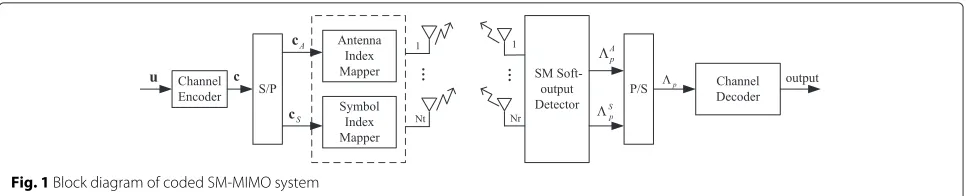
Fig. 1Block diagram of coded SM-MIMO system
which implies that the qth modulated symbol from the constellation M is transmitted from the jth transmit antenna. Taking into account of the code rateR, the total spectral efficiency isη = R(Q1+Q2) bits per channel use.
Assuming a quasi-static frequency flat fading channel, the received signal vector for coded SM-MIMO systems can be expressed as
y=Hx+n=hjsq+n, (2) and unit variance complex Gaussian random variable.n is a zero-mean additive white Gaussian noise vector with EnnH=σ2I
Nr×Nr.
At the receiver, to achieve the advantage of channel coding, a soft-output detector is employed, where the soft information for each coded bits is calculated based on the received signal. In coded SM-MIMO systems, the soft information consists of two parts, i.e., the soft information of antenna index bits and the soft infor-mation of modulated symbol bits. For the Log-MAP demapper, the soft information bits can be expressed in the form of the log-likelihood ratio (LLR). Without loss of generality, we define Ap and Sp as the a posterior LLRs of antenna index bits and modulated symbol bits, respectively.
3 Conventional soft-decision aided SM detectors Before introducing our proposed low-complexity soft-decision detectors, we first briefly summarize the con-ventional soft-output detectors for coded SM-MIMO systems, which are studied in Section 5 and Section 6 as a benchmark for assessing the performance versus compu-tational complexity trade-off of the proposed soft-output detectors.
Different from the hard-decision detectors which only estimate the active antenna index and the modulated sym-bol, the soft-output detectors also compute the reliability of the estimation. Unless otherwise specified, we define S0
i andSi1as the antenna index subsets, in which theith bit of each element is 0 and 1, respectively. Similarly,M0i andM1i denote the modulated symbol subsets where the ith bit of each element is 0 and 1, respectively. Hence, for the soft-decision aided detection, the classic Log-MAP algorithm is given by [12]
where A
represent the a posteriori LLRs for theith antenna index bitcA,iandith modulated symbol bitcS,i, respectively, Pr
are the a prior probability of the antenna index and the modulated signal, respectively, PrcA,n
and PrcS,n
denote the a prior probability of then-th bits of the antenna index and modulated symbol, respectively, and
By substituting Eq. (5) into Eq. (3) and Eq. (4), we have
A
To avoid the complex exponential and logarithmic oper-ations in the Log-MAP algorithm, we can resort to the simplified Max-Log-LLR algorithm as [15]
A
Note that the computational complexity of Max-Log-LLR algorithm has been significantly reduced; however, the number of multiplications and comparisons remains high, which is the order ofO(MNt).
4 The proposed low-complexity soft-decision aided SM detectors
In this section, we present our new low-complexity soft-output detectors in detail. Four different low-complexity soft-decision aided detectors are proposed, which are based on the following zero-forcing (ZF) output, that is,
rj=h†jy, (10)
whereh†j = h
H j
hHj hj andj∈ {1, 2,· · ·,Nt}.
4.1 Low-complexity soft-output SM detectors with Gray-labeledM-PSK
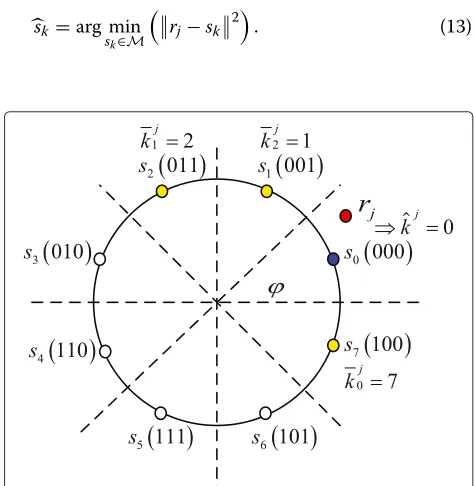
In this subsection, we propose two low-complexity soft-output detectors for coded SM-MIMO systems with Gray-labeledM-PSK. For easy illustration, we take the 8-PSK as an example; however, the proposed two algorithms are also adapted for arbitraryM-PSK modulation. The 8-PSK constellation is illustrated in Fig. 2, where the initial phase of the constellation isϕ, then thekth constellation point ofM-PSK can be expressed as
sk=exp
As indicated in [6], the optimal ML detection for SM-MIMO systems is given by
j,sk
By substituting Eq. (10) into Eq. (12) and performing some simple manipulations, the inner minimization in Eq. (12) can be further expressed as
sk=arg min
Now, by substituting the polar coordinate form ofrj =
wherekj represents the index of the constellation sig-nal nearest to the received sigsig-nal rj for thejth antenna (shown in Fig. 2). Hence, by exploiting the symmetric fea-tures ofM-PSK constellation, the estimated index of the modulated signal on the jth antenna can be expressed as [8]
Thus, the relationship between the phase of the received signal and the index of the modulated symbol can be concluded as
As a result, the estimated signal is given by
skj =exp
Before introducing our proposed PBSD algorithm, we first define X as the collect of skj, i.e., X =
sk1,sk2,· · ·,skNt
. Different from the Max-Log LLR algorithm, the element of the signal candidate list is diminished in the PBSD algorithm. In doing so, we first utilize (16) and (17) to estimate the modulated signal for each transmit antenna. Hence, the length of the signal candidate list is reduced fromNtMtoNt. In addition, the following equation
holds. Thus, by substituting Eq. (18) into Eq. (8) and Eq. (9), and limiting the searched signal space toX, the corresponding LLRs for theith antenna index bit and the modulated symbol bit under the proposed PBSD algo-rithm are given by.
A
As discussed in the above, when computing the LLRs of the modulated symbol bits, the proposed PBSD algorithm only finds the ML estimate of the symbol and ignores the counterpart ML candidate whoseith bit is contrary to the ML estimate. Therefore, this results in the perfor-mance gap between the proposed PBSD algorithm and the Max-Log-LLR algorithm. In this subsection, we propose a new improved algorithm based on the PBSD algorithm, namely, IPBSD algorithm, by taking the counterpart ML estimate into account when computing the LLRs of the modulated symbol bits.
By careful inspection of Eq. (9), we find that the item min
sq∈M,j∈S
y−hjsq2, i.e., the squared Euclidean distance from the received signal vector y to the nearest con-stellation point skj for the jth antenna, always appears
in Eq. (9). It is equal to either min
being 0 or 1. Hence, our aim is to find another signal point s
kji
resulting in the other minimum term in Eq. (9), which means that theith bit ofs
kji
is opposite to theith bit ofskj.
Moreover, as shown in Fig. 2, if the antenna index isj, the nearest signal point to the ZF outputrjiss0, the index of which iskj=0. Hence, the first bit ofs0is 0, and the near-est signal point torjwith the first bit being 1 iss7, that is, kj0 = 7. Similarly, for the second and third bits, we have kj1=2 andkj2=1, respectively.
Before introducing the detailed procedure of the pro-posed IPBSD algorithm, we first present the following lemmas for binary-reflected Gray-labeled constella-tions [16].
Lemma 1.For binary-reflect Gray Labelinggk →sk, by denotingbk=
bk0,bk1,· · ·,bkQ 2−1
as the binary represen-tation of the symbol index k with the most significant bit (MSB) as the leftmost bit, then,gkis given by
Lemma 2.For the binary-reflected Gray PSKgkj →skj,
where skj is the nearest signal point to the filtered signal rj,
bkj =
bk0j,bk1j,· · ·,bkQj2−1
is the binary representation of
kjwith the MSB as the leftmost bit. LetMgkji
i denote the constellation point subset where the ith bit of each point is contrary to the bit gikj, i.e., gikj =1−gikj, then the index of
the nearest constellation point to rjin subsetMg kj
Proof: The proof can be found in [16].
It is noted from Lemma 1 that for the ith bit of the modulated symbol, the candidate list Wi =
can be obtained without any comparison. To this end, the detailed procedure of the proposed IPBSD algorithm can be described as follows.
Step 1:The first step is to compute the ZF filtered
signalrjfor each transmit antenna based on Eq. (10).
Step 2:According to Eq. (16) and Eq. (17), the second step is to find the index of the modulated
signalkjand the estimated modulated symbolskj.
Afterwards, the binary representationbkjofkjcan be
achieved, and thus, we can get the Gray labeling
representationgkj from Eq. (21).
Step 3:After performing Step 2, we have obtained the estimated signal symbol, which results in both minimum terms in Eq. (8), while only one of the minimum term in Eq. (9). Hence, in this step, we need to find the signal points that result in another minimum term of Eq. (9) based on Lemma 2.
Step 4:Finally, the a posteriori LLR of the modulated symbol bits can be derived as
S
while the a posteriori LLR of the antenna index bits is the same as the proposed PBSD algorithm in Eq. (19).
4.2 Low-complexity soft-output SM detector with Gray-labeledM-QAM
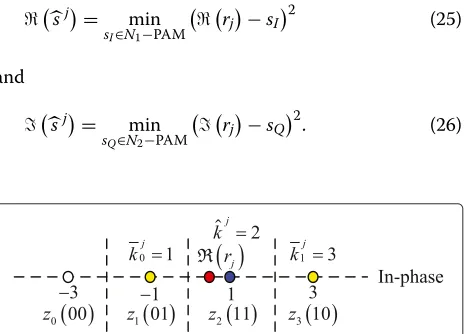
In this subsection, we design two low-complexity soft-output detectors for coded SM-MIMO systems with square or a rectangular QAM modulation, called QBSD and IQBSD algorithms. As pointed out in [17], a lat-tice constellation, e.g., square or rectangular QAM, can be regraded as a Cartesian product of two independent PAM signal sets, say N1-PAM and N2-PAM, where N1 andN2represent the number of in-phase and quadrature-phase points, respectively. Hence, the proposed QBSD and IQBSD algorithms are based on the two PAM con-stellations instead of the QAM. Without loss of generality, we take the 16-QAM for example, the first two bits “10” of the signal point “1001” determine the real part of the signal symbol, while the last two bits “01” decide the imag-inary part. The in-phase PAM constellation of 16-QAM and the illustration of the proposed algorithm are shown in Fig. 3, whererj
denotes the real part of the filtered signalrj.
4.2.1 QBSD algorithm
In the QBSD algorithm, we first estimated the modu-lated symbol based on the hard-decision detector in [7], from which the optimal ML detection can be equivalently expressed as
Since sI and sQ are from orthogonal dimensions, the inner minimizations in Eq. (24) can be decomposed into two optimization problems, that is,
sj= min
As the symbols ofN1-PAM are given by{2t+1} directly as (27) without employing the above set of comparisons.
Thus, the estimated signal is expressed as
sj= sj+Jsj. (29)
Let us defineU = s1,s2,· · ·,sNt, then, the
corre-sponding LLRs of thei-th antenna index bit and mod-ulated signal bit under the proposed QBSD detector are given by
Noting from Eqs. (30) and (31), we find that the length of the candidate list of the proposed QBSD detector is reduced fromNtMtoNt.
4.2.2 IQBSD algorithm
As the above discussion, the QBSD algorithm only cal-culates the ML estimated symbol, which results in one of the minimum of Max-Log-LLR algorithm in Eq. (9). Hence, the error performance of the QBSD algorithm is inferior to that of Max-Log-LLR algorithm. Against this observation, the aim of IQBSD algorithm is to eliminate the performance gap by searching the counterpart ML estimate.
As illustrated in Fig. 3, the ML estimate of the modu-lated signal is the pointz2in the 4-PAM constellation, in which the first and second bits are both “1.” Therefore, the constellation point with the first bit being 0 and nearest to the real part ofrj is the signal pointz1in the 4-PAM constellation. Moreover, the constellation point with the second bit being 0 and nearest to the real part of rj is the signal pointz3. Before describing the procedure of the IQBSD algorithm in detail, we first present the following lemma.
Lemma 3.LetNdenote the set of N1-PAM constellation points,kj is the index of the estimated symbolsj in
the N1-PAM constellation. Ng
kj i
i denotes the subset of the constellation points whose ith bit is contrary to the bit gikj, i.e., gkij = 1−gikj. Then, the index of the point in subset
Note that, if the bit belong to the imaginary part of the modulated symbol, we can only substitutem1withm2in Eq. (32), wherem2=log2(N2).
bit of modulated symbol can be represented as (33). On the other hand, if the bit belong to the imaginary part of the modulated symbol, the candidate list for theith bit of modulated symbol can be represented as (34).
Vi=
s1,· · ·,sNt,z
k1i +J∗I
s1,· · ·,z
kNti +J∗I
sNt.
(33)
Vi=
s1,· · ·,sNt,s1+J∗z
k1i
,· · ·,sNt+J∗z
kNti
.
(34)
Now, the detail process of the IQBSD algorithm will be discussed in the following. Please note that the following description is restricted to the real part of the signal; how-ever, the process of estimating the imaginary part of the signal is similar.
Step 1: The first step of IQBSD algorithm is the same as the IPBSD algorithm, i.e., calculating the filter
outputrjfor each antenna based on Eq. (10).
Step 2 After obtainingrj, the symbol
sjin theN1
-PAM constellation nearest to(rj)can be calculated
by Eq. (27).kjis the index of the symbolsjin
N1-PAM constellation, and the binary representation
of the indexkjisbkj =
bk0j,bk1j,· · ·,bkmj1−1
. Then,
the binary-reflected Gray labelinggkjcan be achieved
by Lemma 1.
Step 3: The objective of this step is to find the
counterpart ML estimatezkj
i
for thei th bit, where the
corresponding index is denoted askji. Considering
the symmetric structure of Gray-labeled PAM, we
can resort to Lemma 3 to find the signalz
kji
, which
only requires the binary representation of indexkj
and addition operation, instead of computing the Euclidean distance between all the signals with the
i th bit being opposite to that ofzkjand(rj).
Step 4: Finally, the a posteriori LLR of the antenna index bits can be derived as Eq. (30), and the a posteriori LLR of the symbol bits is obtained as
S p
cS,i
= 1
2σ2
min s∈V1
i
shj2
rj−s2−rj2
− 1 2σ2 min
s∈V0
i
hj2
rj−s2−rj2
,
(35)
wherej is the antenna index corresponding to the
modulated symbolsselected from the setViin
Eq. (33).
5 Complexity analysis
In this section, the computational complexity of the pro-posed soft-decision aided detectors and the Max-Log-LLR detector will be discussed in detail. Without loss of gener-ality, the computational complexity is evaluated in terms of the number of real multiplications, real additions, and comparisons, respectively.
5.1 Max-Log-LLR algorithm
The number of real multiplications and real additions for computing the termy−hjsq2is 6Nr and 6Nr −1, respectively. While for the Max-Log-LLR algorithm, the term y−hjsq2 needs to be calculated NtM times. In addition, the calculation of LLR for each bit needs one real multiplication and one real addition, respectively. Consid-ering that the number of bits in each spatial modulation symbol is log2(NtM), hence, the total number of real multiplications and real additions are given by
CMMax=6NrNtM+log2(NtM) (36)
CAMax=6NrNtM+log2(NtM)−NtM. (37) On the other hand, since the length of the candidate list is NtM, we need to find the minimum among all NtMcandidates for each bit. Hence, the total number of comparison operation is
CCMax=NtMlog2(NtM). (38)
5.2 PBSD algorithm
The computation of Eq. (10) needs 6Nr + 2 real multi-plications and 6Nr−2 real additions, respectively. While the acquisition of the modulated symbol for each trans-mit antenna needs 2 real multiplications and 2 real additions, respectively. Calculating the minimum term, which appears in the equations of calculating the LLRs in Eq. (18), needs only 4 real multiplications and 2 real additions. All the above terms need to be computed by Nttimes; thus, the total computational complexity of real multiplications and real additions of PBSD algorithm is given by
CMPBSD=6NrNt+8Nt+log2(NtM) (39)
CAPBSD=6NrNt+log2(NtM)+2Nt. (40) On the other hand, as the length of the candidate list is Ntand the comparison number of each bit isNt, therefore, the total comparison number of PBSD algorithm is
CCPBSD=Ntlog2(NtM). (41)
5.3 IPBSD algorithm
the antenna bits isNtas PBSD algorithm, while the length of the candidate list for computing the modulated bits is 2Ntunder the worst case. In addition, the computational complexity of calculating the index of the counterpart ML estimate from Eq. (22) can be neglected due to it needs only a few additions. Hence, the computational complex-ity of real multiplications, real additions, and comparisons for the IPBSD algorithm is given by
CMIPBSD=6NrNt+8Nt+log2(NtM)+5Ntlog2(M) (42)
CAIPBSD=6NrNt+log2(NtM)+2Nt+3Ntlog2(M) (43)
CCIPBSD=Ntlog2(Nt)+2Ntlog2(M). (44)
5.4 QBSD algorithm
By following similar analysis of the PBSD algorithm, the total number of real multiplications, real additions, and comparisons for the QBSD algorithm is given by
CMQBSD=6NrNt+11Nt+log2(NtM) (45)
CAQBSD=6NrNt+log2(NtM)+7Nt (46)
CCQBSD=Ntlog2(NtM). (47)
5.5 IQBSD
By following similar analysis of the IPBSD algorithm, the total computational complexity of the IQBSD algorithm can be expressed as
CMIQBSD=6NrNt+11Nt+log2(NtM)+5Ntlog2(M) (48)
CAIQBSD=6NrNt+log2(NtM)+7Nt+5Ntlog2(M) (49)
CCIQBSD=Ntlog2(Nt)+2Ntlog2(M). (50)
In order to make the complexity more intuitional, in Table 1, we have provided the computational complexity of all the proposed algorithms withNt = 16,M = 16, and Nr = 8. Furthermore, by summarizing the above complexity analysis and Table 1, we have the following two important remarks.
Remark 1.Different from other existing detectors, the length of the candidate list for PBSD and QBSD algo-rithms does not grow linearly with the modulation order M. Thus, it is suitable for coded SM systems with high spectral efficiency, i.e., high modulation order.
Remark 2.Compared with Max-Log-LLR algorithm, the proposed IPBSD and IQBSD algorithms further
Table 1Computational complexity comparison
Detectors Multiplications Additions Comparisons
Max-Log-LLR 12,296 12,040 2048
PBSD 904 808 128
IPBSD 1224 1000 192
QBSD 952 888 128
IQBSD 1272 1208 192
reduce the number of multiplications, additions, and com-parisons without loss of any performance. In addition, both achieve better performance than the PBSD and QBSD algorithms, respectively, with a neglected complex-ity overhead.
6 Simulation results
In this section, representative numerical simulations are provided to verify the proposed detectors under Rayleigh fading channels to verify the proposed detectors described in the previous sections. Unless otherwise stated, the fol-lowing set of parameters are used:Nt = 4 andNr = 2. The code length of LDPC is 360, and the code rate is R= 12. In addition, the signal to noise ratio is defined as
SNR= 10 lg
Eb
N0
= 10 lg
Es
ηN0
= 10 lg
Es
N0Rlog2(NtM)
, whereEsis the average energy of the transmit signal.
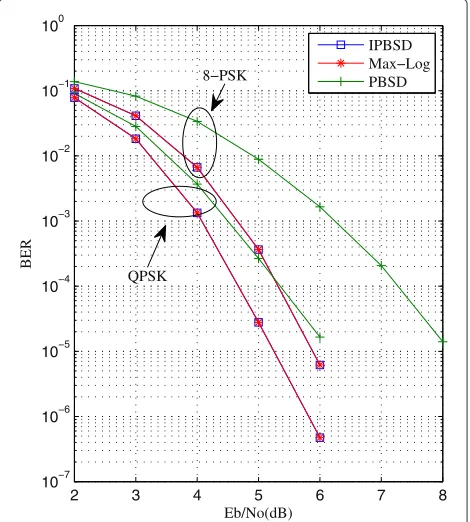
Figure 4 illustrates the performance difference between the proposed detectors and the Max-Log-LLR detector
2 3 4 5 6 7 8
10−7 10−6 10−5 10−4 10−3 10−2 10−1 100
Eb/No(dB)
BER
IPBSD Max−Log PBSD
QPSK
8−PSK
2 3 4 5 6 7 8 9 10 11 10−6
10−5 10−4 10−3 10−2 10−1 100
Eb/No(dB)
BER
IQBSD Max−Log QBSD
16−QAM
64−QAM
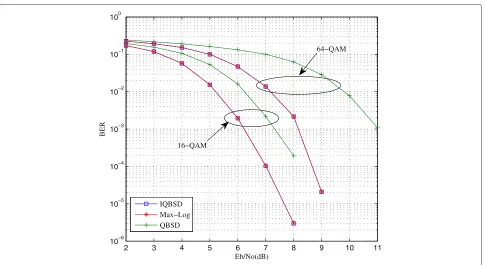
Fig. 5BER performance comparison between different detectors with QAM modulation
with quadrature phase-shift keying (QPSK) and 8-PSK modulations, respectively. As shown in the figure, com-pared to Max-Log-LLR algorithm, we find that the proposed PBSD algorithm suffers from about 1.5 dB per-formance loss at 10−3 BER when 8-PSK is employed. While when QPSK is employed, the performance gap is reduced to about 0.4 dB. In addition, we can see that the proposed IPBSD algorithm achieves the same perfor-mance as the Max-Log-LLR algorithm with lower compu-tational complexity regardless of the modulation order.
Figure 5 investigates the BER performance of coded SM-MIMO systems with 16-QAM and 64-QAM for different detection algorithms. Similar to Fig. 4, it is noted from Fig. 5 that the proposed QBSD algorithm attains much lower computational complexity than Max-Log-LLR algo-rithm at the expense of performance. For example, at 10−3 BER, the proposed QBSD algorithm suffers from 1 dB SNR loss when 16-QAM is employed, and the per-formance gap becomes large as the modulation order increases. On the other hand, no performance gap is observed between the proposed IQBSD and Max-Log-LLR detectors with any modulation order, which validates the effectiveness of our proposed soft-output detection algorithms.
7 Conclusions
In this paper, by exploiting the features of M-PSK andM-QAM constellations, we first have designed two novel low-complexity soft-output algorithms based on the
existing hard-decision detection algorithms. The com-putational complexity of the proposed two detections is much lower than that of Max-Log-LLR algorithm with a acceptable performance degradation. Motivated by this, to further enhance the performance of the two soft-decision aided detectors, another two improved algo-rithms were proposed, i.e., IPBSD and IQBSD detectors. The key idea of the two detectors is finding the coun-terpart ML estimate for each bit of the modulated sym-bol. The theoretical analysis and simulation results have shown that the proposed IPBSD and IQBSD detectors achieve exactly the same performance as that of Max-Log-LLR detector with reduced computational complexity.
Competing interests
The authors declare that they have no competing interests.
Acknowledgments
This work was supported by the National Science Foundation of China under Grant No. 61501507, and the Jiangsu Provincial Natural Science Foundation of China under Grant No. BK20150719.
Received: 29 July 2015 Accepted: 20 December 2015
References
1. R Mesleh, H Haas, S Sinanovic, CW Ahn, S Yun, Spatial modulation. IEEE Trans. Veh. Technol.57(4), 2228–2241 (2008)
2. M Di Renzo, H Haas, PM Grant, Spatial modulation for multiple antenna wireless system: a survey. IEEE Commun. Mag.49(12), 182–191 (2011) 3. M Di Renzo, H Haas, A Ghrayeb, S Sugiura, L Hanzo, Spatial modulation for
4. P Yang, M Di Renzo, Y Xiao, S Li, L Hanzo, Design guidelines for spatial modulation. IEEE Commun. Surv. Tutor.17(1), 6–26 (2014)
5. J Jeganathan, A Ghrayeb, L Szczecinski, Spatial modulation: Optimal detection and performance analysis. IEEE Commun. Lett.12(8), 545–547 (2008)
6. H Men, M Jin, A low complexity ML detection algorithm for spatial modulation systems withMPSK constellation. IEEE Commun. Lett.18(8), 1375–1378 (2014)
7. R Rajashekar, KVS Hari, L Hanzo, Reduced-complexity ML detection and capacity-optimized training for spatial modulation systems. IEEE Trans. Commun.62(1), 112–125 (2014)
8. C Li, Y Huang, M Di Renzo, J wang, Y Cheng, Low-complexity ML detection for spatial modulation MIMO with APSK constellation. IEEE Trans. Veh. Technol.59(1), 93–104. doi:10.1109/TVT.2015.2430855 9. Q Tang, Y Xiao, P Yang, Q Yu, S Li, A new low complexity near-ML
detection algorithm for spatial modulation. IEEE Wirel. Commun. Lett.
2(1), 90–93 (2013)
10. R Mesleh, M Di Renzo, H Haas, P Grant, Trellis coded spatial modulation. IEEE Trans. Wirel. Commun.9(7), 2349–2361 (2010)
11. E Basar, U Aygolu, E Panayirci, HV Poor, New trellis code design for spatial modulation. IEEE Trans. Wirel. Commun.10(8), 2670–2680 (2011) 12. M Koca, H Sari, inProceedings of IEEE PIMRC. Bit-interleaved coded spatial
modulation, (Sydney, NSW, 2012), pp. 1949–1954
13. H Liu, J Zheng, J Dou, B Bai, inProceedings of IEEE ICIST. EXIT-chart-based LDPC code design for spatial modulation, (Shenzhen, China, 2014), pp. 557–560
14. C Xu, S Sugiura, SX Ng, L Hanzo, Spatial modulation and space-time shift keying: optimal performance at a reduced detection complexity. IEEE Trans. Commun.61(1), 206–216 (2013)
15. W Koch, A Baier, inProceedings of IEEE GLOBECOM. Optimum and sub-optimum detection of coded data disturbed by time-varying intersymbol interference, (San Diego, CA, 1990), pp. 1679–1684 16. Q Wang, Q Xie, Z Wang, S Chen, L Hanzo, A universal low complexity
symbol-to-bit soft mapper. IEEE Trans. Veh. Technol.63(1), 119–130 (2014) 17. NC Beaulieu, A useful integral for wireless communication theory and its
application to rectangular signalling constellation error rates. IEEE Trans. Veh. Technol.54(5), 802–805 (2006)
Submit your manuscript to a
journal and benefi t from:
7Convenient online submission
7 Rigorous peer review
7Immediate publication on acceptance
7 Open access: articles freely available online
7High visibility within the fi eld
7 Retaining the copyright to your article