A Joint Solution to Scheduling and Power Control
for Multicasting in Wireless Ad Hoc Networks
Kang Wang
Department of Electrical and Computer Engineering, University of California, San Diego, La Jolla, CA 92093-0407, USA Email:[email protected]
Carla-Fabiana Chiasserini
Dipartimento di Elettronica, Politecnico di Torino, 10129 Torino, Italy Email:[email protected]
Ramesh R. Rao
Department of Electrical and Computer Engineering, University of California, San Diego, La Jolla, CA 92093-0407, USA Email:[email protected]
John G. Proakis
Department of Electrical and Computer Engineering, University of California, San Diego, La Jolla, CA 92093-0407, USA Email:[email protected]
Received 1 August 2003; Revised 7 May 2004
This paper jointly addresses the problem of power control and scheduling in ad hoc networks supporting multicast traffic. First, we present a distributed algorithm which, given the set of multicast transmitters and their corresponding receivers, provides an optimal solution to the power control problem, if there is any. The transmit power levels obtained by solving the optimization problem minimize the network power expenditure while meeting the requirements on the SINR at the receivers. Whenever no optimal solution can be found for the given set of multicast transmitters, we introduce a joint scheduling and power control algorithm which eliminates the strong interferers, thus allowing the other transmitters to solve the power control problem. The algorithm can be implemented in a distributed manner. Although the proposed scheme provides a suboptimal solution, simulation results show that the obtained solution is close to the global optimum, when it exists. When instead there is no optimal solution, our algorithm allows for a high number of successful multicast transmissions.
Keywords and phrases:wireless ad hoc networks, scheduling, power control, multicasting.
1. INTRODUCTION
Multicasting enables data delivery to multiple recipients in a more efficient manner than traditional unicasting and broadcasting. A packet is duplicated only when the delivery path toward the traffic destinations diverges at a node, thus helping to reduce unnecessary transmissions. Therefore, in wireless ad hoc networks, where radio resources are scarce and most devices rely on limited energy supply, multicasting is a highly desirable feature.
In this paper, we jointly address the problem of power control and scheduling in ad hoc networks supporting mul-ticast traffic. Power control is a fundamental issue since (i) it reduces the nodes’ power consumption and (ii) it in-creases the number of successful simultaneous transmissions
improve spatial channel reuse. The method proposed there applies specifically to CSMA/CA-based systems, and does not guarantee that the allocated transmission power levels are minimum.
With regard to scheduling and admission control in wire-less networks, several proposals have appeared in the litera-ture. In the context of ad hoc networks, a scheduling scheme which provides fairness in channel access and maximizes spa-tial reuse of bandwidth is presented in [10]. Admission con-trol and power concon-trol aspects are addressed in [11], where the authors present a distributed scheme which maintains the SIR of active radio links above their required thresholds while new users require for admission into the system. The distributed power control problem for multicast traffic in a cellular environment is first addressed in [12,13]. There, based on appropriate criteria, the base stations remove mul-ticast connections via an iterative procedure, until the target outage probability is met. We highlight that the algorithm in [12,13] uses the approach presented in [5], hence it requires iterations. Our work instead is based on flow control, and the distributed joint scheduling and power control algorithm that we propose does not require iterations.
The work closest to ours is the joint scheduling and power control scheme for ad hoc networks that has been presented in [14]. There, the key idea is that strong inter-ferers are eliminated so that the remaining nodes can solve the power control problem by using the algorithm in [5]. The scheduling scheme proposed in [14] is designed for uni-cast transmissions and does not apply to multiuni-casting; fur-thermore, it assumes the existence of a central scheduler and that each node knows the geographical position of all other nodes. Our work differs from [14] in dealing with a mul-ticast traffic scenario and in proposing a distributed algo-rithm.
We start by focusing on power control. We consider a given set of multicast transmitters and their corresponding receivers. Our goal is to determine the optimal values of transmit power so that the requirements on the SINR at the receivers are fulfilled while the total power expenditure is minimized. We describe the system model and the formu-lation of the power control problem inSection 2, while, in
Section 3, we present a distributed algorithm that yields the optimum solution. Next, inSection 4, we consider the situ-ation where, given the set of multicast transmitters and re-ceivers, the optimization problem does not have a solution. As in the case of unicast transmissions addressed in [14], we need a joint scheduling and power control algorithm which eliminates the strong interferers and allows the remaining nodes to solve the power control problem. The joint scheme that we propose is able to deal with one-to-many transmis-sions and can be implemented in a distributed manner. How-ever, since it uses “local” information, it gives a suboptimal solution. InSection 5, we show through simulations that the values of transmit power obtained by using the proposed algorithm are close to the optimum, when it exists. When there is no optimal solution, the presented results show that our scheme enables a high number of nodes to successfully transmit multicast traffic. We point out that, in this case,
the scheduling would be suboptimal even if every node had global information; indeed, the optimal scheduling that se-lects the maximum number of successful simultaneous con-nections is one of the classic NP-hard problems in graph the-ory [15].
2. AN LP FORMULATION OF THE POWER CONTROL
PROBLEM FOR MULTICASTING
We consider an ad hoc network composed of stationary nodes, each of them equipped with an omnidirectional an-tenna. Nodes access the channel by using a TDMA/CDMA scheme with a fixed time-slot duration, which accounts for the packet transmission time and a guard time interval. Links between any pair of nodes are assumed to be bidirectional.
We focus on the case of multicast traffic connections. We assume that for each traffic connection, the multicast tree has been already constructed and there is no conflict in the trans-mission setup, that is, each receiver is associated with only one transmitter at a time. We are not concerned with traffic routing from the multicast source to the destination. Rather, we focus on next neighbor transmissions, that is, sending packet traffic to the specified neighbors while meeting con-straints on the SINR at the intended receivers [14].
We consider a set of transmitters, denoted byS, and a set of receivers, denoted byR.SandRindicate the number of transmitters and receivers, respectively. Since we deal with multicasting, we have that S ≤ R; that is, each transmitter sends data packets to at least one receiver. We definePt
kas the transmission power of the generic nodek, and assume that a node cannot transmit at a power level higher than Pmax, that is, 0≤Ptk≤Pmax. Every transmitter causes interference to any receivers, and the amount of interference depends on the propagation attenuation of the transmitted signal. We as-sume that the signal attenuation over the radio channel is either constant or slowly changing, and that the receivers no-tify their propagation attenuation measurements to the asso-ciated transmitter. Feedback information is encoded with a strong error correction code so that they are always correctly received by the destination nodes.
We assume that interference caused by simultaneous transmissions is treated as noise. Let s(i) denote the node sending a packet to receiver nodei. Nodeireceives a trans-mission froms(i) successfully if the corresponding SINR at nodeiis equal to or greater than a given thresholdγi, that is,
as(i)iPts(i) σ2
n+ (1/L)
k=s(i)akiPkt
≥γi, (1)
whereakiis the propagation attenuation of the signal from transmitter k to receiveri,σ2
n is the noise power spectrum density, andLis the system processing gain.
Our first goal is to have the expression in (1) satisfied for all of the nodes inR. Thus, by definingγ=σ2
n[γ1,. . .,γR]T andPt=[Pt
1,. . .,PtS]T, we must have
whereAis anR×Smatrix given by
Notice that, for each row ofA, that is, for each receiver in R, there is only one positive entry which corresponds to the signal received from the intended sender. All other ele-ments are negative and account for the interfering transmis-sions.
Our second goal is to minimize the total transmission power. To this end, we formulate the following linear pro-gramming (LP) problem:
If a solution to problemPexists, this provides the optimal transmission power vector such that the total power expen-diture of the system is minimized. By using the following the-orem, we prove that, if there is a transmit power vectorPt which satisfies constraints (5), then a solution to problemP
exists.
Theorem 1. An optimal solution to problemPexists if and only if there is a solution to(5), that is, there is at least one set of transmission powers which ensures the successful reception at all of the receiver nodes.
Proof. The converse is obvious. In order to show that an op-timal solution to problem Pexists if there is a solution to (5), we note that the values of transmit power are bounded, since 0 ≤ Ptk ≤ Pmax,k = 1,. . .,S. Hence, an optimal so-lution to the LP problem exists by virtue of [16, Theorem 3.4].
3. AN OPTIMAL DISTRIBUTED SOLUTION TO POWER
CONTROL FOR MULTICASTING
In this section, we present a distributed solution to the opti-mization problemP.
We draw upon previous work on flow control. In partic-ular, we consider the approach used in [17], where the trans-mission rates of traffic sources are derived as a solution of an optimization problem. Each traffic source is associated with a
utility functionincreasing in its transmission rate and subject to bandwidth constraints. The network objective there is to maximize the sum of source utilities. The problem is decom-posed into several subproblems each of which corresponds
to a single traffic source. It is shown that, when the objective function is strictly concave, the solution to the original prob-lem can be obtained by solving the single source subprob-lems. The key of the approach presented in [17] is to use a dual formulation of the problem.
In our case, we start out by considering the following pri-mal problemP: continuously differentiable, strictly concave function, (ii) it decreases with the increase of Pt
k, and (iii) it is such that f(0)<0. The termf(Ptk) captures the idea that increas-ing the transmit power is not beneficial to the network system since it leads to higher energy consumption as well as inter-ference to neighboring transmitters. Clearly, solving problem
Pmaximizesf(Pt
k), while our goal is to minimize the total transmit power, that is, maximize−Ptk. However, later in this section, we will show that maximizingf(Ptk) is equiv-receiver charges for all of the transmitters, and the notation (v)kdenotes thekth element of a generic vectorv. The term
cT(APt−γ) accounts for the fact that the transmission power should be sufficiently large so that the target SINR is met at every receiver.
Then, we formulate the dual problem as follows:
D: min c Dc
. (8)
In general, the solutionPtthat is obtained by solvingDfor an arbitrarycis not primal optimal. However, according to the dual theory, there exists a dual optimal cost vector c∗ such thatPt∗is primal optimal [17]. Givenc∗, the first term in (7) is separable inPt, so we can decompose the maximiza-tion problem intoSsubproblems as follows:
The solution to thekth transmitter’s subproblem is given by [17]
Ptk= f−1
−cTA
k
, k=1,. . .,S, (10)
where f−1is the inverse of the derivative off. The global so-lution to problemDis obtained by combining the solutions to the single-transmitter subproblems.
In [17], a distributed, iterative algorithm is given which is proven to lead to the primal optimal solution, provided that the step-size parameter for the iteration is appropri-ately chosen. This algorithm can be applied to (7) with slight modifications. The iterative algorithm to be performed at the generic receiveriand senderk, for each multicast transmis-sion, is reported below. We indicate withnthe generic step of the iterative procedure and withδ >0 the step-size parame-ter [17].
Receiver’s algorithm
(1) Detect the signal received from each transmitter and estimate the SINR.
(2) Compute the receiver cost as ci(n) = ci(n −1)− δ(APt(n−1)−γ)i.
(3) Send the new costci(n) to all transmitters.
Transmitter’s algorithm
(1) Receive the costs from the receivers.
(2) Compute the new transmit power levelPkt by substi-tutingc(n) into (10).
(3) Transmit a packet by using the new value ofPtk.
Remarks
(i) Observe that receiveriincreases its cost if it finds out that its SINR threshold has not been met. Assuming that all other receivers do not vary their costs, this leads the transmit-ter associated withito increase its transmit power, and the interfering transmitters to lower their power. In fact, f−1is a decreasing function and the elements in matrixAare positive for the intended transmitters and negative for the interfering ones.
(ii) If we assume that a sender reaches only the nodes that are within its transmission range, we can consider that a transmitter causes interference only to the receivers in its proximity, and thus we can neglect small elements inA. This would also imply that a receiver needs to feedback the cost information just to the senders in its proximity.
Next, we show that when the algorithm converges to an optimum solution Pt∗, this maximizes f(Pt
i) as well as
−Pt
k. Whenever a feasible solution exists, it is well known that there exists a Pareto optimal solution to the unicast ver-sion of problem P[3], that is,Pt∗ ≤ Pt for any otherPt such thatAPt ≥ γ. For the multicast case,Ais no longer a square matrix. However, through the theorem below, we will show that the problem can be converted to the unicast ver-sion.
Theorem 2. For the multicasting problem defined above, if the inequalityAPt≥γhas a feasible solution (i.e., there is a
trans-mit power vector which can guarantee the target SINRs at all the receivers), then there is a unique maximizerPt∗such that
(i) it satisfiesAPt∗≥γ,
(ii) it maximizesf(Ptk)for any strictly decreasing function f.
Proof. Denote the set of receivers for senderkbyR(k). First, we consider a power vectorPt∗which satisfiesAPt∗≥γand maximizesf(Ptk) for a (not any) strictly decreasing func-tion f. We prove that, givenPt∗, for each senderk, there is at least one receiver inR(k) whose SINR is exactly equal to its target SINR. That is, by denoting such a receiver byr(k), we have (APt∗)r(k)=γr(k).
We prove this by contradiction. Suppose there exists a sender ksuch that all receivers inR(k) exceed their target SINR. We can reducePtk
∗
by a certain amount and leave the transmit power of the other nodes unchanged, so that at least one receiver inR(k) reaches exactly its target SINR while the other receivers still exceed theirs. Observe that, since the in-terference from transmitterkis reduced, the SINRs at all the other receivers are still met. Moreover, f being strictly de-creasing, the new power vectorPtincreasesf(Pt
k), which contradicts the assumption thatPt∗is a maximizer.
Now, we consider anS×Ssquare matrixAcreated by taking for every senderk,k ∈S, ther(k)th row ofA. Also, consider anS×1 vectorγcreated by taking ther(k)th ele-ment ofγfor 1≤k≤S. This is equivalent to considering the unicast transmission problem, for which we haveAPt∗=γ. In such a case,Ais a full-rank matrix if there exists a feasible power vector [18]. If so, we can writeP∗=(A)−1γ. For any feasible P, it must satisfyAP≥ γ, and thereforeP≥ P∗ [18].
This result shows that the optimal solutionP∗ is Pareto optimal for the multicast case too, that is, P∗ ≤ Pfor any otherPsuch thatAP≥γ.
By using the result proved above, we conclude thatPt∗ satisfiesAPt∗≥γ, is unique, and maximizesf(Pt
k) forany strictly decreasing function f.
To summarize, in this section, we presented a distributed power control algorithm which, whenever a solution to prob-lem Pexists, converges to the optimum power vector, thus minimizing the total transmission power.1
However, there are many situations where the power con-trol problemPhas no solution. In such cases, not all nodes in Sshould be allowed to transmit [14]. In the next section, we propose a scheduling algorithm that eliminates the strongest
1Note that any functionf(Pt
k) will converge to the optimal solution as
Start
Obtain local channel informationAk
(4) has solution
w/Ak?
ObtainAk by eliminating strong interferers
Is nodek
itself eliminated?
No
Yes
No Yes
(a)
Yes
No (f) (c)
Admitted transmit power set
toPkt
(4) has solution
w/Ak?
Not admitted, defer transmission
Figure1: Flow chart of the joint scheduling and power control al-gorithm.
multicast interferers and enables the nodes entitled to trans-mit to solve the power control problem.
4. A DISTRIBUTED JOINT SCHEDULING AND POWER
CONTROL ALGORITHM FOR MULTICASTING Here, we present a distributed scheduling scheme that en-ables the candidate senders to independently determine which node is allowed to transmit. While the eliminated nodes defer their transmissions, the entitled senders inde-pendently calculate their transmit power level by using a dis-tributed power control algorithm. Such an algorithm aims at meeting the SINR requirements at any receivers while mini-mizing the total power consumption. We want to point out that, unlike the distributed algorithm presented in the previ-ous section which converges to an optimal solution, the dis-tributed joint scheduling and power control algorithm de-scribed here provides a suboptimal solution.
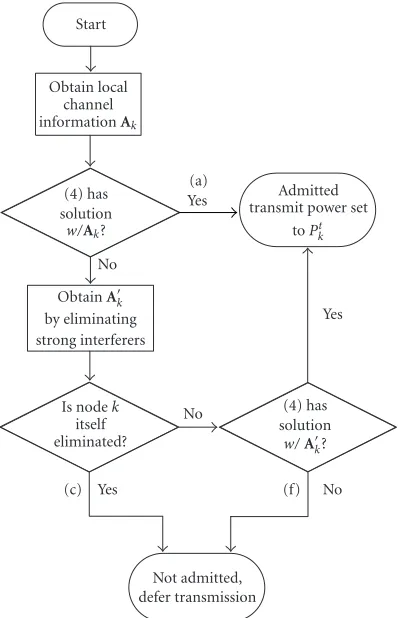
The joint scheduling and power control algorithm is de-scribed in detail below, and is summarized in the flow chart shown inFigure 1.
(1) Each node inSsends a test packet with power equal to Pmax.
(2) Each receiver detects the test packets from all transmit nodes nearby and estimates the corresponding channel
s1 a 11
a12
r1
a31
r3
r2
a21
a32
s2
a42
r4
a43
s3
Figure2: An example of a network with three multicast transmit-ters and four receivers. Each transmitter is connected to the in-tended receivers by solid lines and to the uninin-tended receivers by dotted lines.
attenuation. The receiver then sends a packet including all the estimated attenuation factors. As an example, consider the network shown inFigure 2, where trans-mitters are connected to the intended receivers by solid lines and to the unintended receivers by dotted lines. In this case, receiverr3estimates factorsa31anda32and then broadcasts this information tos1ands2.
(3) The generic nodek,k∈S, detects the packets from the receivers within its transmission range. From each of these receivers,kobtains the list of all possible interfer-ing transmitters and their attenuation factors toward the receiver. Looking atFigure 2, we have that trans-mitters1gets a packet from the intended receiversr1 andr2, as well as fromr3; therefore,s1is aware also of the signal attenuation froms2towardr1andr3. (4) The generic nodek,k ∈ S, transmits a packet with
power level equal to Pmax including the attenuation factors corresponding to all the receivers in its trans-mission range. In the example inFigure 2,s2sends a packet including the channel attenuation factors re-lated to its transmissions towardr1,r3, andr4. (5) Each receiver retransmits such a packet. Thus, every
nodek,k ∈S, can acquire information related to all the transmissions reaching the receivers that are within its transmission range. Referring to the example in
Figure 2, at this point,s1 knows all channel attenua-tion factors except the one related to the transmission froms3tor4.
(6) The generic node k, k ∈ S, can construct its own copy of the channel attenuation matrixAk. MatrixAk is based on “local” information and includes the chan-nel attenuation related to transmissions toward nearby receivers only. Hence, its dimension is expected to be small.
(7) The generic nodek,k ∈ S, tries to find the optimal transmit power vector by pluggingAkinto (4) and (5) and solving the power control problem.
(a) If there is a solution to the power control prob-lem, nodekis allowed to transmit, and its transmit power is set toPt
k.
maximum absolute value of negative elements in rowjto the minimum positive entry in row j. The MIMSRs are compared to a preset thresholdβ. If MIMSRj > β, then the jth row is eliminated from
Ak, and a newAkis obtained.
(c) If, by doing this, the row corresponding to node kis removed,kwill not participate in the current round of scheduled transmissions and defers its transmission to the next round.
(d) Otherwise, nodektries to solve the power control problem again by usingAk.
(e) If a solution exists, nodektransmits at powerPtk. (f) Else, it defers its transmission attempt to the next
round.
Remarks
(i) Note that the information exchange performed be-tween transmitters and receivers in the first five steps of the procedure above only requires “local” transmissions.
(ii) When a global solution to the optimization problem
Pexists, all nodes inSare allowed to transmit by the pro-posed scheme. However, the solution obtained through the joint scheduling and power control algorithm is suboptimal since it is based on “local” information. The more negligi-ble the elements ofAthat do not appear in the transmitters’ copies of the matrix are, the closer to the optimum the local solution is. We point out that the scheduling is suboptimal even if every node has global information. Indeed, the opti-mal scheduling that selects the maximum number of success-ful simultaneous connections is one of the classic NP-hard problems in graph theory [15].
(iii) The proposed algorithm defers the transmission of strong interferers. If everything remains the same, a strong interferer never gets the chance for transmission. This paper does not address the problem of fairness. However, it is not difficult to mitigate the fairness problem. For example, after a few attempts, a deferred source A can send out a special message to B, the source of the receiver that potentially will be severely interfered by A, and ask B to hold its transmission.
5. SIMULATION RESULTS
We derive the performance of the proposed joint scheduling and power control algorithm for a stationary network whose nodes are randomly spread over a 100×100 square region. We focus on a multicast group composed of 25 or 50 nodes, out of which one node is randomly chosen as the multicast source. We consider that the multicast tree is set up by us-ing the MIP scheme [19]. We assume that there are two sets of senders whose transmissions alternate over time. In each odd (even) slot, transmissions are performed by the nodes in the odd (even) layer of the tree, having at least one child. The nodes, which do not transmit in a time slot, act as receivers. An example of a simple multicast tree and of the correspond-ing transmission scheme is presented inFigure 3.
We assume that the propagation attenuation between the generic transmitterkand receiver jis equal toak j =1/dk jα, wheredk jis the distance between the two nodes, andαis the
A
B C D
E F G H
I J K L
M N
Sender Receiver
A B, C, D
F I, J
G K
H L
B E, F
D G, H
K M, N
Figure3: A simple multicast tree with the associated transmission scheme.
power decay factor that we take to be equal to 4. The target SINRγis set to 6 dB for any receiver,Lis equal to 8, andPmax is equal to 5×10⁷.
First, we consider the case where an optimal global solu-tion to the power control problem exists, that is, all candidate senders are allowed to transmit and hence go through step (a) in the flow chart inFigure 1. We compute the average total transmission power obtained through the distributed algo-rithm introduced inSection 4and compare it to the optimal global solution. Results forN=50 are presented inFigure 4. The plot shows that the suboptimal solution gives an average total transmit power that is less than the global optimal value. This is because the distributed algorithm is based on local in-formation, and therefore the transmitters neglect some of the existing interferers while solving the power control problem. As a consequence, the percentage of receivers whose SINR is less than the target threshold in the case of the suboptimal solution will be greater than zero, whereas it is equal to zero when the optimal solution is applied.
4 3.5 3 2.5 2 1.5 1 0.5 0
0 5 10 15 20 25
Thresholdβ
Optimal solution Suboptimal solution
A
ver
age
total
tr
ansmit
po
w
er
×106
Figure 4: Comparison between the average total transmit power obtained through our distributed solution and the optimal value, as a function ofβand forN =50 (a case where a global solution to the power control exists).
transmissions are successful when the optimal solution is ap-plied.)Figure 5also shows that the percentage of failed trans-missions is higher for smaller values of N. Indeed, in our distributed algorithm, each sender has only local informa-tion on channel attenuainforma-tion. For small values ofN, there are few transmitters; thus a sender is likely to have information only on the channel attenuation between itself and its as-sociated receivers since other transmitters are too far away. AsNincreases, this effect becomes less relevant and the at-tained transmission powers result to be closer to their opti-mum value.
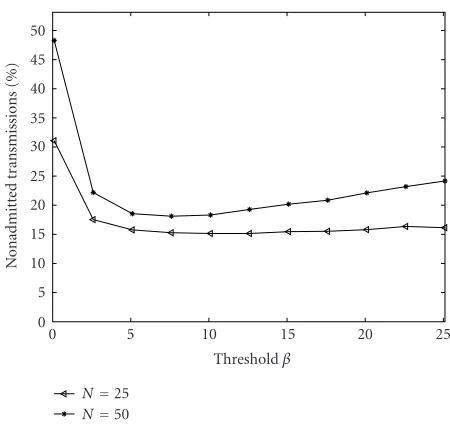
Next, we consider the case where there is no global solu-tion to the power control problemP.Figure 6shows that the average percentage of candidate senders that are not allowed to transmit by our scheduling algorithm, as a function of the threshold β. For small values ofβ, the number of not ad-mitted transmitters decreases as βincreases. However, after a certain point, the number of eliminated transmitters starts increasing again with the increase ofβ. This is because, when βis small, many interferers are eliminated at step (c) in the flow chart in Figure 1. On the contrary, as βincreases, no transmitter is eliminated at step (c), but many of the candi-date senders are not allowed to transmit at step (f) since they are unable to solve problemP.
Figure 6shows that the average percentage of candidate senders that are not allowed to transmit increases with N. The reason is that, as we doubleN, the number of receivers with which a transmission interferes increases more than twice. A sender with a large number of nonintended receivers is likely to have a large MIMSR, thus it cannot be admitted in the system. It follows that the number of not admitted nodes increases withN.
18 16 14 12 10 8 6 4 2 0
0 5 10 15 20 25
N=25
N=50
F
ailed
tr
ansmissions
(%)
Thresholdβ
Figure 5: Average percentage of failed transmissions, that is, re-ceivers whose SINR is less than the target threshold, as a function ofβand forN=25, 50 (a case where a global solution to the power control exists).
50 45 40 35 30 25 20 15 10 5 0
0 5 10 15 20 25
N=25
N=50
N
o
nadmitt
ed
tr
ansmissions
(%)
Thresholdβ
Figure6: Average percentage of candidate senders not allowed to transmit, as a function ofβand forN =25, 50 (a case where no global solution to the power control exists).
30
25
20
15
10
5
0
0 5 10 15 20 25
N=25
N=50
F
ailed
tr
ansmissions
(%)
Thresholdβ
Figure 7: Average percentage of failed transmissions, that is, re-ceivers whose SINR is less than the target threshold, as a function ofβand forN = 25, 50 (a case where no global solution to the power control exists).
case when intermediate values ofβare used. In fact, by look-ing atFigure 6, we can see that less transmissions are admit-ted for small as well as large values ofβ.Figure 7also shows that the percentage of failed transmissions is higher whenN is smaller. The explanation for this behavior follows the one given for the case inFigure 5.
Finally, we highlight that the results in Figures6and7
suggest that an appropriate value ofβcan be chosen, so that the network capacity is maximized. For example, in our net-work scenario, a good value forβis between 5 and 10.
6. CONCLUSIONS
In this paper, we addressed the problem of power control in ad hoc networks supporting multicast traffic and showed that this problem is similar to the one in the unicast environ-ment.
We first presented a distributed power control scheme based on flow control. Our scheme converges to the opti-mal solution that minimizes the network power expenditure while meeting the requirements on the SINR at the receivers if such an optimal solution exists. However, there are sets of multicast transmitters and receivers for which an optimal so-lution to the power control problem does not exist. Then, we introduced a distributed joint scheduling and power control algorithm that eliminates strong interferers and enables the entitled transmitters to solve the power control problem.
Simulation results show that, when an optimal solution exists, our distributed scheme allows for a high percentage of successful transmissions. When instead there is no optimal solution, the proposed algorithm enables a high number of nodes to successfully transmit multicast traffic.
ACKNOWLEDGMENT
This material is based upon research supported by the Na-tional Science Foundation under the Rescue project, Award number 0336190.
REFERENCES
[1] J. Zander, “Distributed cochannel interference control in cel-lular radio systems,”IEEE Trans. Vehicular Technology, vol. 41, no. 3, pp. 305–311, 1992.
[2] R. Yates, “A framework for uplink power control in cellular radio systems,”IEEE Journal on Selected Areas in Communica-tions, vol. 13, no. 7, pp. 1341–1347, 1995.
[3] D. Mitra, “An asynchronous distributed algorithm for power control in cellular radio systems,” inProc. 4th WINLAB Work-shop on 3rd Generation Wireless Information Networks, pp. 249–257, New Brunswick, NJ, USA, October 1993.
[4] L. Trajkovic and S. J. Golestani, “Congestion control for mul-timedia services,”IEEE Network, vol. 6, no. 5, pp. 20–26, 1992. [5] G. J. Foschini and Z. Miljanic, “A simple distributed au-tonomous power control algorithm and its convergence,” IEEE Trans. Vehicular Technology, vol. 42, no. 4, pp. 641–646, 1993.
[6] T.-C. Hou and V. O. K. Li, “Transmission range control in multihop packet radio networks,” IEEE Trans. Communica-tions, vol. 34, no. 1, pp. 38–44, 1986.
[7] L. Kleinrock and J. Silvester, “Optimum transmission radii for packet radio networks or why six is a magic number,” inProc. IEEE National Telecommunications Conference (NTC ’78), pp. 431–435, Birmingham, Ala, USA, December 1978.
[8] R. Ramanathan and R. Hain, “Topology control of multihop wireless networks using transmit power adjustment,” inProc. 9th Annual Joint Conference of the IEEE Computer and Com-munications Societies (INFOCOM ’00), vol. 2, pp. 404–413, Tel Aviv, Israel, March 2000.
[9] J. P. Monks, V. Bharghavan, and W.-M. W. Hwu, “A power controlled multiple access protocol for wireless packet net-works,” inProc. 20th Annual Joint Conference of the IEEE Com-puter and Communications Societies (INFOCOM ’01), vol. 1, pp. 219–228, Anchorage, Alaska, USA, April 2001.
[10] H. Luo, S. Lu, and V. Bharghavan, “A new model for packet scheduling in multihop wireless networks,” inProc. ACM/IEEE International Conference on Mobile Computing and Networking (ACM MOBICOM ’00), pp. 76–86, Boston, Mass, USA, August 2000.
[11] N. Bambos, S. C. Chen, and G. J. Pottie, “Radio link admis-sion algorithms for wireless networks with power control and active link quality protection,” inProc. 14th Annual Joint Con-ference of the IEEE Computer and Communications Societies (INFOCOM ’95), vol. 1, pp. 97–104, Boston, Mass, USA, April 1995.
[12] C.-G. Lof, “Power control in cellular radio systems with mul-ticast traffic,” inProc. 9th IEEE International Symposium on Personal, Indoor and Mobile Radio Communications (PIMRC ’98), vol. 2, pp. 910–914, Boston, Mass, USA, September 1998. [13] C.-G. Lof, “Distributed power control in cellular radio sys-tems with down-link multicast traffic,” inProc. International Workshop on Mobile Multimedia Communications (MoMuC ’98), Berlin, Germany, October 1998.
[15] S. Even, O. Goldreich, S. Moran, and P. Tong, “On the NP-completeness of certain network testing problems,”Networks, vol. 14, no. 1, pp. 1–24, 1984.
[16] R. J. Vanderbei,Linear Programming: Foundations and Exten-sions, Kluwer Academic, Boston, Mass, USA, 2001.
[17] S. Low and D. Lapsely, “Optimization flow control. I. Basic algorithm and convergence,”IEEE/ACM Transactions on Net-working, vol. 7, no. 6, pp. 861–874, 1999.
[18] N. Bambos, “Toward power-sensitive network architectures in wireless communications: concepts, issues, and design as-pects,” IEEE Personal Communications, vol. 5, no. 3, pp. 50– 59, 1998.
[19] J. E. Wieselthier, G. D. Nguyen, and A. Ephremides, “On the construction of energy-efficient broadcast and multicast trees in wireless networks,” inProc. 19th Annual Joint Conference of the IEEE Computer and Communications Societies (INFOCOM ’00), vol. 2, pp. 585–594, Tel Aviv, Israel, March 2000.
Kang Wang received his B.S.E.E. degree in 1996 from the Nanjing University of Posts & Telecommunications, China. He re-ceived his M.S.E.E. degree from the Ohio State University in 2000. He is currently a Ph.D. candidate and a Research Assistant at the University of California, San Diego (UCSD), California. His current research interests include routing and multicast pro-tocols for wireless ad hoc networks, power
efficient ad hoc network design, and the general areas of digital communications.
Carla-Fabiana Chiasserinigraduated with a summa cum laude degree in electrical en-gineering from the University of Florence in 1996. She did her graduate work at the Po-litecnico di Torino, Italy, receiving the Ph.D. degree in 1999. Since then, she has been with the Department of Electrical Engineer-ing, Politecnico di Torino, where she is cur-rently an Assistant Professor. Since 1999, she has worked as a Visiting Researcher at
the University of California, San Diego (UCSD), California. Her re-search interests include architectures, protocols, and performance analysis of wireless networks for integrated multimedia services.
Ramesh R. Raoreceived his B.S. degree in electrical and electronics engineering from the University of Madras in 1980, and his M.S. and Ph.D. degrees from the Univer-sity of Maryland in 1982 and 1984, respec-tively. Since then, he has been on the fac-ulty of the Department of Electrical and Computer Engineering, the University of California, San Diego (UCSD), where he is currently a Professor and Director of
the San Diego Division, California Institute of Telecommunica-tions and Information Technology. Prior to this appointment, he served as the Director of the UCSD Center for Wireless Communications and was the Vice Chair of Instructional Af-fairs in the Department of Electrical and Computer Engineering. His research interests include architectures, protocols, and per-formance analysis of wireless, wireline, and photonic networks for integrated multimedia services. He served as the Editor of the Information Theory Society Newsletter from 1993 to 1995,
and is the founding Web Editor of the Information Theory Society’s website. He was elected to the IEEE Information Theory Society Board of Governors (from 1997 to 1999, and from 2000 to 2002). He is the Editor for Packet Multiple Access of the IEEE Transactions on Communications and is a Member of the Editorial Board of the ACM/Baltzer Wireless Network Journal as well as IEEE Network Magazine.
John G. Proakisreceived the B.S.E.E. from the University of Cincinnati in 1959, the M.S.E.E. degree from MIT in 1961, and the Ph.D. degree from Harvard University in 1967. He is an Adjunct Professor at the Uni-versity of California, San Diego (UCSD), and a Professor Emeritus at Northeastern University. He was a faculty member at Northeastern University from 1969 through 1998, and held the following academic