Study on Electricity Generation through
biogas on small scale
Aksha Joshi1, Joslin Jose2, Nehal Bansiwal3, Nisha Soni4
BE Student, Department ofCivil, Bhagwan Mahavir College of Engg. & Tech., Surat, Gujarat, India1
BE Student, Department ofCivil, Bhagwan Mahavir College of Engg. & Tech., Surat, Gujarat, India2
BE Student, Department ofCivil, Bhagwan Mahavir College of Engg. & Tech., Surat, Gujarat, India3
Head of Department, Department ofCivil, Bhagwan Mahavir College of Engg. & Tech., Surat, Gujarat, India4
ABSTRACT: In a method of utilizing a methane-containing biogas by feeding the methane-containing biogas to a gas engine of a gas engine/generator assembly generating electricity, the steps of passing the biogas through a membrane separating installation to divide the biogas into a first gas stream having a higher methane content than the biogas fed thereto and a second gas stream enriched in CO2, feeding the first gas stream to the gas engine as fuel, and returning the
second gas stream to the source of the biogas.
KEYWORDS: Environmental, Biogas, Electricity, Methane, Organic Waste, Greenhouse Gases, Anaerobic digester, Manure, pollution.
I. INTRODUCTION
The present invention provides a process for the production of electric power, using a biogas as a fuel in an electric power producing turbine, wherein the biogas produced from a biomass in a gas generator is not subjected to a wet scrubbing step; and the biogas, after treatment according to the process, may be directly charged to an electric power producing combustion turbine.
Biogas is a combustible gas mixture produced during the anaerobic digestion of organic matter in an anaerobic biogas reactor (e.g. small-scale digester, biogas settler, digestion of organic waste, anaerobic baffled reactor, etc; see also anaerobic digestion, general factsheet). During anaerobic digestion, wastes are treated and degraded and biogas is produced. Anaerobic treatment also has the advantage over aerobic treatment of a smaller emission of greenhouse gases. Therefore, biogas is a renewable green energy source.
II. BACKGROUND OF INVENTION
1) Electrical Power and Energy Needs
In deciding whether or not to proceed with a project and to assist in deciding what type of project to proceed with the local site load must be determined. There must be some level of certainty of the amount of energy that can be produced and delivered to the power grid in order to complete an economic analysis.
2) Needs of household or business
Our society has grown very dependent on our use of electrical energy over the last century. It affects almost every aspect of our lives at home, at work, and at play. The average household in Alberta consumes approximately 650 kWh per month. Current customers served from the power grid will be able to determine their energy requirements by looking at their billing history. Larger loads will have a demand reading, which is an indication of the capacity required from the system to serve the load. Business requirements will take some additional effort in determining what the electrical requirements are. For Business there are generally more motor type loads, which draw significantly more “power” on start up than they do in their normal running condition. A detailed inventory of what loads, including the characteristics of the loads, are required for the business’s electrical system. The results of this inventory should be reviewed by a person knowledgeable in load diversity and load starting requirements so that the load capacity requirements are neither over or under estimated.
III. BIOGAS
Biogas consists mostly of methane (CH4, around 65-70%) carbon dioxide (CO2, around 25-30%) and varying quantities
of water (H2O) and hydrogen sulphide (H2S) and some trace amounts of other compounds, which can be found,
especially in waste dump biogas (e.g. ammonia, NH3, hydrogen H2, nitrogen N2, and carbon monoxide, CO). The
amount of each gas in the mixture depends on many factors such as the type of digester and the kind of organic matter. Diverse sludge composition requires diverse/specialized reactor designs to achieve a high conversion. Methane is the valuable component under the aspect of using biogas fuel. The calorific value of biogas is about 6 kWh/m3, which corresponds to abouthalf a liter of diesel oil and can be utilized directly as a heat source or to produce electricity. In all cases, the biogas must be dehumidified and purified before combustion; otherwise it can damage the gas engine.
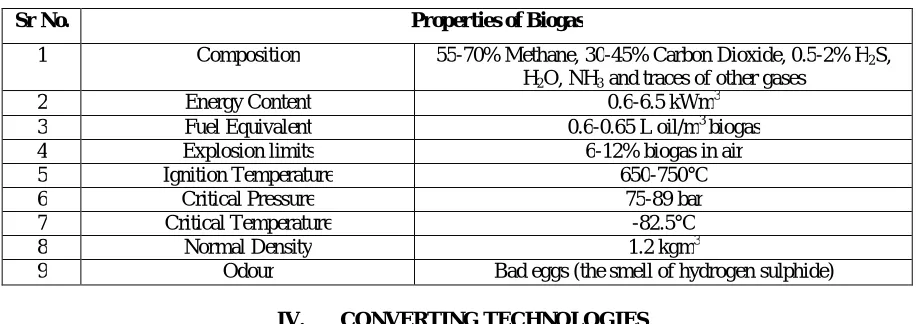
Table 1: Biogas properties Sr No. Properties of Biogas
1 Composition 55-70% Methane, 30-45% Carbon Dioxide, 0.5-2% H2S,
H2O, NH3 and traces of other gases
2 Energy Content 0.6-6.5 kWm3
3 Fuel Equivalent 0.6-0.65 L oil/m3 biogas
4 Explosion limits 6-12% biogas in air
5 Ignition Temperature 650-750°C
for biogas energy conversion are gas turbines and combustion engines. Combustion engines can be either internal combustion engine or external combustion engine. Combustion engines are popular as they are more efficient and less expensive than small gas turbines. However, gas turbines may be more efficient when operating in a cogeneration cycle producing heat and electricity. Cogeneration or Combined Heat and Power (CHP) describe the simultaneous generation of both electricity and useful heat. Heat engines (also thermal power plants) in general do not convert all of their thermal energy into electricity. In most cases, a bit more than half is lost as excess heat. By capturing the excess heat, CHP use heat that would be wasted in a conventional power plant, potentially reaching an efficiency of up to 89%, compared with 55% for the best conventional plants. This means that less fuel needs to be consumed to produce the same amount of useful energy. By-product heat at moderate temperatures can also be used in absorption chillers for cooling. A plant producing electricity, heat and cold is sometimes called trigeneration or more generally a polygeneration plant.
Required for One Engine
Units required for power-generation system:
1. Gas Holders
2. Inter connecting Piping
3. Gas Engine
4. Gas Scrubber for Removal of H2S
5. ChillerUnits
6. Blower
Selection of type of engine
Power can be generated from biogas from following:
1. Dual fuel engine
2. Gas Turbine
3. Gas Engine
Gas engine is more suitable and effective for present application.Among the three types of engine gas turbine is not used for bio gas fuel since it is not suitable for low capacity. Dual fuel engine is used in remote area where normal power supply is not available or erratic or erratic. This engine can be run either with diesel or with biogas & diesel combination. Dual fuel engine needs more maintenance and diesel storage.
Conversion to Electricity:
Fig.1 Schematic of a biogas plant used for power generation :
In most cases, biogas is used as fuel for combustion engines, which convert it to mechanical energy, powering an electric generator to produce electricity. The design of an electric generator is similar to the design of an electric
motor. Most generators produce alternating AC electricity; they are therefore also called alternators or dynamos. Appropriate electric generators are available in virtually all countries and in all sizes. The technology is well known and maintenance is simple. In most cases, even universally available 3-phase electric motors can be converted into generators. Technologically far more challenging is the first stage of the generator set: the combustion engine using the biogas as fuel. In theory, biogas can be used as fuel in nearly all types of combustion engines, such as gas engines (Otto motor), diesel engines, gas turbines and stirring motors etc.
Appropriate Combustion Engine
External combustion engine: Stirring Motors: In such motors, biogas is combusted externally, which in turn heats the stirring motor through a heat exchanger. The gas in the stirring motor hence expands and thereby moves the mechanism of the engine. The resulting work is used to generate electricity. Stirring motors have the advantage of being tolerant of fuel composition and quality. They are, however, relatively expensive and characterized by low efficiency. Their use is therefore limited to a number of very specific applications.In most commercially run biogas power plants today, internal combustion motors have become the standard technology either as gas or diesel motors.
Gas Turbines are occasionally used as biogas engines especially in the US. They are very small and can meet the strict exhaust emissions requirements of the California Air Resources Board (CARB) for operation on landfill and digester gases. Small biogas turbines with power outputs of 30-75 kW are available in the market. However, they are rarely used for small-scale applications in developing countries. They are expensive and due to their spinning at very high speeds and the high operating temperatures, the design and manufacturing of gas turbines is a challenging issue from both the engineering and material point of view. Maintenance of such a turbine is very different from well-known maintenance of a truck engine and therefore requires specific skills.
V. TECHNICAL PROCESS
Safe Operations: Safety of personnel, the public and of equipment is the primary concern in the design and operation of any interconnection.
Generation Process:
1.Determine the total amount of energy that the new biogas plant load and generator will require.
2.Determine the amount of total load that is required on site. This is available from your current electricity retailer or can be determined through an audit of the site.. Normally this is presented as a demand amount (kW) and an energy amount (KWh) on your electricity bill.
3.The total of 1 & 2 will represent the total site or local electric system load.
4.Based on the availability of generator prime mover (fuel source), determine the optimum size of generator to be used. The reliability requirements of the biogas plant and onsite generation should be considered in determining the optimum size.
5. Determine operating requirements of the plant and load. If at any time some of or the total site or local electric system load is required to be supplied without an interconnection to the grid a synchronous generator will be required. 6. An induction generator can be selected if there is no operational requirement to supply some of the local load
independent of the utility network or there is no thought of using the generator for facility stand by operations. 7. Proceed with the Interconnection process
8. Costs and Benefits of Small, Local Generation.
VI. BENEFITS OF BIOGAS FACILITIES TO THE SOCIETY
Generate revenue by selling electricity or gas:Biogas can be used to power co-generation units, which produce both heat and electricity. The heat can be used on site for heating buildings and/or the digester. The electricity can be used on site or sold to the grid.
Earn tax credits for renewable energy production:As society becomes more aware of green energy production there may be tax credits or even grants available to build renewable facilities. or premiums available for energy produced for biomass based energy.
Sell Green Tags, or carbon credits, the environmentally beneficial attributes of the renewable energy:As society becomes more aware of green energy production there may premiums available for energy produced for biomass based energy.
Eliminate odour issues: As our rural communities become more densely populated there is less tolerance for odors produced from manure. This issue is greatly reduced with the volatile compounds being “burned” in the digestion/generation process.
Earn tipping fee revenue for treating waste:Others in a reasonable proximity to a digester may be willing to pay a fee for the waste disposal service. At the same time these wastes become fuel to substrates while increase methane and electrical production.
Make compost sales revenue: The residual products for digestion can be used as low grade fertilizers and have also been used for livestock bedding.
Avoid regulatory penalties for manure management issues: The management of wastes using the digestion process greatly lowers the risk of a violation of environmental legislation. The Fisheries Act has some potential very harsh penalties.
Offset power & heating costs
Production of electricity within the plant operation can reduce or eliminate the risk of the volatility in electricity costs. Within Alberta we have seen typical average energy prices in the range of 5 cents a kwh but recent prices have been in excess of 12 cents per kwh.
Deferral of generation, transmission, and distribution infrastructure
Costs to society
There would be few costs to society in getting digester projects going. There may be some costs to governments in facilitating the acceptance and approval of these plants. There could be some costs in tax credits or grants in order to attract developers and facilitate development of the first few projects. Generally these projects should be self financing. There could be cost to the general public in premium payments for green energy.
Maintain infrastructure
The plant infrastructure for the development should be maintained by the developer. The electric system to which the development interconnects will not have additional wear and tear because of the development and as such should not require additional maintenance and as such there should be no additional maintenance costs.
Provide backup supplies
For plants which are very large in the order of 300 of 400 Mw there is impact on the system in that there has to be reserves to cover the loss of these large units. The unit sizes proposed with digester/generators is very small and as such will not require backup supplies. These units are essentially hidden in the load noise (constant changes in capacity required by loads) on the system and as such should not be a cost to society.
Advantages
1. Generation of renewable, green electricity
2. Low operating costs
3. Underground construction minimizes land use
4. Long life span
5. Reduces greenhouse gases
6. Increases family income by selling back electric energy to the electric power grid 7. On site use of heat
Disadvantages
1. Requires expert design, skilled construction and expert maintenance required 2. Biogas production below 15°C, is no longer economically feasible
3. High capital costs.
VII. CONCLUSION
These largely take the form of answers to the questions posed in the introductory section. They refer to the engine-alternator set investigated in this study and to units based on side-valve engines of similar size and design. The minimum modification that permits gas-fuelling of the engine, while leaving liquid fuel system unaltered, is the fitting of a venturi type gas feed adaptor. Such units are widely available, cheap and very simple to install.Starting and acceptable running of the engine are possible with biogases containing up to 30% CO2. Since raw biogasesFrequently
have higher CO, contents than this, some scrubbing facility will generally have to be provided. Alternatively, and Preferably, the engine might be fuelled simultaneously with a pilot quantity of petrol fiust sufficient to prevent rough running and raw biogas as the main fuel.
VIII. ACKNOWLEDGEMENT
REFERENCES
[1] Dubey A. K. (2000) Wet scrubbing for carbon dioxide removal from biogas. Annual report of Central Institute of Agricultural Engineering, Bhopal, India.
[2] Glaub J. C. and Digz L. F. (1981) Biogas purification processes. Biogas and alcohol fuels production. Vol. II. Biocycle Journal of waste recycling. Emmous the J P Press Inc
[3] Hagen M. and Polman E. (2001) Adding gas from biomass to the gas grid. Final report submitted to Danish Gas Agency.
[4] Kishore V. V. N. and Srinivas S. N. (2003) Biofuels of India. Journal of Scientific & Industrial Research, Vol. 62, 106-123, Jan.-Feb. [5] Mittal K. M. (1996) Biogas systems: Principles and Applications. New Age International (P) Limited, New Delhi.
[6] MNES Report (2001) Renewable Energy in India and business opportunities. MNES (Ministry of Non-conventional Energy Sources),
Government of India, New Delhi.