ISSN(Online): 2319-8753 ISSN (Print): 2347-6710
I
nternational
J
ournal of
I
nnovative
R
esearch in
S
cience,
E
ngineering and
T
echnology
(A High Impact Factor, Monthly, Peer Reviewed Journal)
Visit: www.ijirset.com
Vol. 7, Issue 4, April 2018
Deduplication on Encrypted Big data in Cloud
Sumedh Deshpande, Anupama Murkute, Saurabh Patil, Sachin Kamble, Prof. Swati Shekapure
Dept. of Computer Engineering, Marathwada Mitra Mandals College of Engineering, Pune, India
ABSTRACT: Cloud Computing provide services by rearranging different resources over internet. One of the service is datastorage. Data store in cloud is mainly in encrypted form. So traditional scheme has some weakness over security issue.So, in this paper to solve these issues with are taking help of hash code generation and double encryption techniques.
This helps us to Integrates with the cloud data deduplication with control access. Because of the authorized data holders who obtain the symmetric the encrypted data can also be securely accessed. Keys used for decryption of data. The results show the superior efficiency and effectiveness of the scheme for big data deduplication in cloud storage.
KEYWORDS: Cloud Computing, Data Encryption Security and Protection, Access control
I. INTRODUCTION
The important and popular cloud service is data storage service. Cloud users upload personal or confidential content data to a cloud service provider (CSP) data center and allow to keep this data. In addition, the loss of control over Personal data leads to high data security risks, especially data privacy leaks. Due to the rapid Development of data mining and other analysis technologies, the question of privacy becomes serious. Therefore, a good practice is to encrypted data in order to guarantee the security of the data and the privacy of the user.
II. LITERATURE SURVEY
Blowfish algorithm is use to provide encryption to the files Blowfish is a 64-bit block cipher with a variable-length key [1]
External adversaries which aim to extract secrete information As much as possible from public and private cloud [2]
Now, by taking advantage of the intra-user deduplication performed between clients and their DP, from a client point of view, the visibility of what is stored in the storage system is limited to his/her own account[3].
It is customary to define security in context like ours by using model involving game between two parties [4].
The advantage of deduplication unfortunately comes with a high cost in terms of new security and privacy challenges. Cloud deduplication is secure and efficient storage service which is as secure as block level deduplication [5]
III. PROPOSED SYSTEM
ARCHITECTURE
ISSN(Online): 2319-8753 ISSN (Print): 2347-6710
I
nternational
J
ournal of
I
nnovative
R
esearch in
S
cience,
E
ngineering and
T
echnology
(A High Impact Factor, Monthly, Peer Reviewed Journal)
Visit: www.ijirset.com
Vol. 7, Issue 4, April 2018
Data Holders
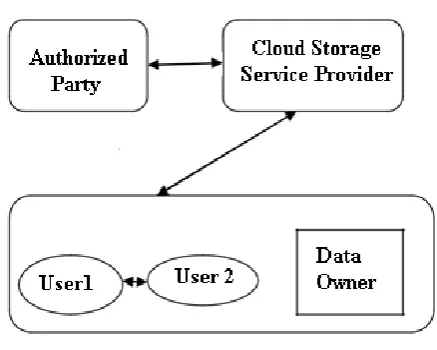
Fig 2: System architecture
1.1 CSP (Cloud Service Provider): The CSP (Cloud Service Provider) is allowing to data owner for storage services of data. It cannot be fully trusted. Therefore it is curious about the contents of stored data. It should perform honestly on data storage in order to gain profit.
1.2 Data Holder: The data holder can uploads and saves their data and files in the CSP. In this system is possible to number of data holders could save their files in encrypted raw data in the CSP. The file is regarded as data owner by the data holder that produces or creates theFile. The data holder is in normal form than the higher priority of owner.
1.3 AP (Authorized Party): An authorized party (AP) that is fully trusted by the data holders. The data holders to verify data ownership and handle data deduplication. It does not collude with CSP. In this case, CSP should not know the plain user data in its storage. AP cannot know the data stored in CSP.
IV. ALGORITHMS
Step 1: Data owner Select File
Step 2: Encrypt File (For encryption we use BlowFish).
Step 3: Upload file on cloud or store the file on secondary storage.
Step 4: CSP or Controller check the duplicate file available on cloud or secondary storage.
Step 5: If found then remove the duplication and maintain index.
Step 6: On non-duplicate data CSP again check resemblance detection of similar chunk.
Step 7: If resemblance found then reduce it create delta store.
ISSN(Online): 2319-8753 ISSN (Print): 2347-6710
I
nternational
J
ournal of
I
nnovative
R
esearch in
S
cience,
E
ngineering and
T
echnology
(A High Impact Factor, Monthly, Peer Reviewed Journal)
Visit: www.ijirset.com
Vol. 7, Issue 4, April 2018
Step 9: If resemblance found then reduce it store similar data in delta store.
Step 10: Finally, non similar data stored into secondary storage or Cloud storage
V. SYSTEM ANALYSIS
In our experimental setup, In table 1,find out different file upload and time required for time for uploading that file. In our experimental setup, in our system first is uploading file size and time for that file.
Sr.No File Size(Kb) Time(ms)
1 10351 226 2 17541 500 3 8500 140
Table1: File Uploading Time and Size
From above data, In graph 1,we can see file size of 1 is 10351 kb is required time uploading is 226 ms, and file size of 2 is 1751 kb is required time uploading is 500ms
ISSN(Online): 2319-8753 ISSN (Print): 2347-6710
I
nternational
J
ournal of
I
nnovative
R
esearch in
S
cience,
E
ngineering and
T
echnology
(A High Impact Factor, Monthly, Peer Reviewed Journal)
Visit: www.ijirset.com
Vol. 7, Issue 4, April 2018
Sr.No File Size(Kb) Time(Sec)
1 10351 22 2 25000 30 3 8000 10
Table 2: File downloading Time and Size
From above data, In graph 2,we can see file size of 1 is 10351 kb is required time uploading is 22 second, and file size of 2 is 25000 kb is required time uploading is 30 sec. and so on
ISSN(Online): 2319-8753 ISSN (Print): 2347-6710
I
nternational
J
ournal of
I
nnovative
R
esearch in
S
cience,
E
ngineering and
T
echnology
(A High Impact Factor, Monthly, Peer Reviewed Journal)
Visit: www.ijirset.com
Vol. 7, Issue 4, April 2018
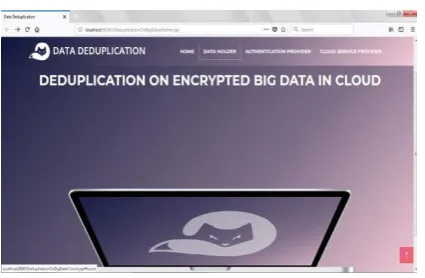
Home Page
Registration Page
File Uploading
VII. CONCLUSION
ISSN(Online): 2319-8753 ISSN (Print): 2347-6710
I
nternational
J
ournal of
I
nnovative
R
esearch in
S
cience,
E
ngineering and
T
echnology
(A High Impact Factor, Monthly, Peer Reviewed Journal)
Visit: www.ijirset.com
Vol. 7, Issue 4, April 2018
REFERENCES
[1] MsNehaKhatri – Valmik1, Prof. V. K Kshirsagar2 proposed paper on Blowfish algorithm.
[2] Chi Chen at. Al. proposed An Efficient Privacy-Preserving Ranked Keyword Search Method IEEE 2016.
[3] Chunhua Su at. al. proposed Analysis and Improvement of Privacy-Preserving Frequent Item Protocol for Accountable Computation Framework IEEE 2012.
[4] Cheng Huang and Rongxing Lu proposed EFPA: Efficient and Flexible Privacy-Preserving Mining of Association Rule in Cloud in IEEE 2015. [5] Bharath K. Samanthula at. Al. k-Nearest Neighbor Classification over Semantically Secure Encrypted Relational Data MAY 2015.
[6] Lichun Li at. al. Privacy-Preserving-Outsourced Association Rule Mining on Vertically Partitioned Databases in AUGUST 2016. [7] M. Bellare, S. Keelveedhi, and T. Ristenpart,