Original Research Article
Knowledge of antenatal care among mothers of infants in rural area of
Belagavi: a cross sectional study
Pragya Sinha, Praveena R. Gunagi
*
, R. G. Viveki, Manjunath Kamble, Sunanda Halki
INTRODUCTION
Antenatal care (ANC) is the care given to pregnant women so that they have safe pregnancy and healthy babies.1The objective of ANC is to promote, protect and maintain the health of the mother during the entire period of pregnancy. It helps to detect high risk cases, foresee complications and removes fear and anxiety associated with delivery.2 It is an opportunity to promote the benefits of skilled attendance at birth and to encourage women to seek postpartum care and counsel them about the benefits of child spacing.3 It plays an important role in safe
motherhood but its utilization varies across the country especially in the rural areas and urban slums.
The WHO estimates that every day, about 830 women die because of the complications during pregnancy and child birth.4 Maternal mortality ratio (MMR) in India is 130 per 100,000 live births (2014-16), and that of Karnataka is 108 per 100,000 live births (2014-16).5 This is far below the goal set in SDG-3 to be below 70 per 100,000 live births.6 To reduce MMR substantially and move towards elimination of preventable causes of maternal death, there should be increased coverage and improved quality care throughout pregnancy. Appropriate ANC is an integral
ABSTRACT
Background: Antenatal care (ANC) is the care given to pregnant women for safe pregnancy and healthy babies. It is the most effective health intervention for preventing maternal morbidity and mortality. Health knowledge is an important element which enables women to be aware of their health status and promotes service utilization which further improves the health of the beneficiaries. This study was conducted among mothers of rural area of Belagavi with an objective to determine the level of knowledge related to ANC and the factors associated with the same.
Methods: A cross-sectional study was carried out in February-April 2018 among mothers who had delivered within one year from date of study and who had registered and availed antenatal services in field practice area of Department of Community Medicine, BIMS, Belagavi. Sample size was calculated as 161. Mothers were selected using systematic sampling. Data was collected after obtaining an informed, written consent from the participants and was compiled, tabulated and analysed in MS Excel. The results are presented as percentage and proportions and chi square test has been applied.
Results: 50% participants had fair knowledge regarding ANC. The level of knowledge was found to be statistically significant with employment status and BPL status.
Conclusions: The study found adequate knowledge among majority of mothers.
Keywords: Knowledge, Antenatal care, Mothers, Rural, Belagavi
Department of Community Medicine, Belgaum Institute of Medical Sciences, Belagavi, Karnataka, India
Received: 28 August 2019
Revised: 08 October 2019
Accepted: 09 October 2019
*Correspondence:
Dr. Praveena R. Gunagi,
E-mail: [email protected]
Copyright: © the author(s), publisher and licensee Medip Academy. This is an open-access article distributed under the terms of the Creative Commons Attribution Non-Commercial License, which permits unrestricted non-commercial use, distribution, and reproduction in any medium, provided the original work is properly cited.
component of all the initiatives by the World Health Organization and the Government of India towards reduction of morbidity and mortality associated with pregnancy and childbirth.7 The popularity of ANC services in the rural community has been quite encouraging.8,9
The WHO recommends a minimum of four antenatal visits, comprising interventions such as iron, folic acid tablets and tetanus toxoid vaccination, screening and treatment for infections and identification of warning signs during pregnancy.1 As per data from NFHS-4 (2015-16), 67.3% women had antenatal check-up in first trimester and 70.9% women had at least 4 ANC visits in rural Karnataka. Whereas in rural Belgaum, 78.6% women had antenatal check-up in first trimester and 76% women had at least 4 ANC visits.10 Even though there is an improvement, it has not yet reached the target set by national health policy 2017, according to which the antenatal care coverage should be sustained above 90% by 2025.11
MMR still remains high even with improved access to maternal health care services.10 High MMR reflects poor coverage of ANC services, poor quality of care and inequity to access to health services.9
In order to improve maternal health, barriers that limit access to quality maternal health services must be identified and addressed at all levels of the health system. Knowledge of pregnant mothers may be major factor in determining the extent of antenatal services use.3Health knowledge is an important element to enable women to be aware of their health status especially during pregnancy and the importance of appropriate ANC.7,12A better informed woman is more likely to make appropriate decisions during obstetric emergencies, but many developing countries have women with poor education which is more prevalent in rural communities.13
This study was conducted to determine knowledge of mothers of rural areas of Belagavi regarding components of ANC such as registration of pregnancy, intake of prophylactic iron and folic acid tablets during pregnancy and identification of danger signs during pregnancy. This study was carried out with the objectives to know the awareness of antenatal care among mothers in rural areas of Belagavi and to study the factors associated with knowledge of ANC.
METHODS
The present cross-sectional study was carried out in February-April 2018, among mothers who had delivered within one year from the date of the study and who had registered and availed ANC services at rural field practice area of Department of Community Medicine, BIMS, Belagavi.
Sample size was estimated by considering the findings by Rani et al on clinical components of quality ANC in south India, the average prevalence of which comes as 88%.14 By taking absolute error of 5% the sample size was calculated to be 161, using the following formula,
n=
Where, n=sample size, P=prevalence, Q=100 P, and L=absolute error (5%)
Primary health centre (PHC) in our rural field practice area has 6 subcentres and caters to a population of 43,000. The study population was selected in proportionate to the number of total deliveries in each subcentre in the last 1 year. A list of mothers who had delivered within last 1 year of the commencement of the study was collected from each subcentre and the individual subjects were selected using systematic sampling with 5 as sampling interval. The next participant was selected for interview if the selected participant was not available. Women with psychiatric illness and those not willing to participate in the study were excluded from the study.
After obtaining an informed written consent from the eligible participant, she was interviewed at her residence or the anganwadi centre nearest to her residence using a predesigned and pretested questionnaire to get information on her socio demographic profile, knowledge on antenatal care and danger signs of pregnancy and awareness regarding PMSMA launched by the Government of India.
Every component in the knowledge section was given a score of 1 for the correct knowledge and then the total scoring was done. Those who scored below 50% were classified to have poor knowledge, 51-75% as fair and >75% as good knowledge. The participants who were found to have poor knowledge were informed regarding the right practices so that they would be able to adopt them in their future pregnancies.
The collected data was compiled and tabulated in MS Excel and analysis was done in SPSS 20.0 and MS Excel. The results have been presented as frequency, percentage, proportion and Chi-square test has been applied.
RESULTS
(38.5%) belonged to class IV socio-economic status according to modified B. G. Prasad classification. Out of 161, 116 (72%) mothers were BPL card holders (Table 1).
Table 1: Distribution of participants on the basis of socio-demographic variables.
Variables Frequency %
Age (in years)
16-25 117 72.7
26-35 44 27.3
Religion
Hindu 153 95
Muslim 8 5
Caste
SC/ST 22 13.6
OBC 41 25.5
Others 98 60.9
Educational status
Illiterate 5 3.1
Primary 4 2.5
Beyond primary 152 94.4
Occupation
Employed 9 5.6
Unemployed 152 94.4
Family type
Nuclear 38 23.6
Joint/3 generation 123 76.4
SES
1 5 3.1
2 26 16.1
3 34 21.1
4 62 38.5
5 34 21.1
BPL card
Yes 116 72
No 45 28
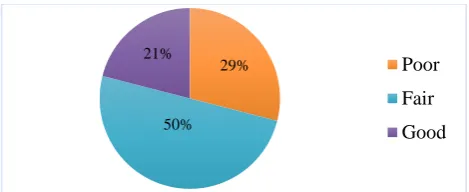
It was found that the knowledge score was poor in 47 (29%), fair in 81 (50%) and good in 33 (21%) of the participants (Figure 1).
Figure 1: Antenatal knowledge score of study participants.
Majority of the participants, 147 (91%) had correct knowledge regarding nutritious requirements during pregnancy while the least, 63 (39%) had correct knowledge regarding the blood tests to be done during pregnancy. 74 (46%) of the participants knew the recommended minimum number of antenatal check-ups. 139 (86%) participants knew that blood pressure (BP) should be checked in every antenatal visit and 142 (88%) knew that weight should be checked during every antenatal visit. 142 (88%) knew that Hb should be tested during pregnancy. Only 64 (40%) study participants knew the minimum number of IFA tablets to be taken during pregnancy and 136 (85%) knew the number of TT injections to be taken during pregnancy. All the study participants were aware of one or the other danger sign/symptom during pregnancy (Table 2).
Knowledge on antenatal care was better in housewives and BPL card holders and this was found to be statistically significant (p<0.05). None of the other socio-demographic factors were found to have a significant association with knowledge on ANC (Table 3).
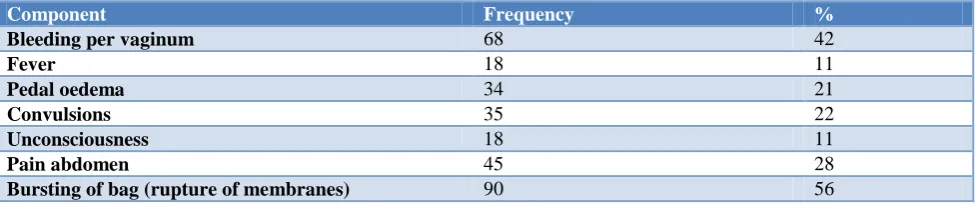
Regarding the correct knowledge about the danger signs during pregnancy, 68 (48%) were aware about bleeding per vaginum, 18 (11%) were aware about fever, 34 (21%) were aware about pedal oedema, 35 (22%) were aware about convulsions, 18 (11%) were aware about unconsciousness, 45 (28%) were aware about pain abdomen and 90 (56%) were aware about rupture of membranes as danger sign during pregnancy and the need to visit health setup during any of these events (Table 4).
Table 2: Distribution of participants on the basis of correct knowledge.
Component Frequency %
Recommended timing of antenatal registration 89 55
Minimum number of antenatal check-ups recommended 74 46
Should BP be checked on every visit? 139 86
Should weight be checked on every visit? 142 88
Danger signs and symptoms of pregnancy 161 100
Should Hb be tested during pregnancy? 142 88
Awareness regarding other blood tests to be done during pregnancy 63 39
Minimum number of IFA tablets to be taken during pregnancy 64 40
Number of TT injections to be given during pregnancy 136 85
Does one require more nutritious food during pregnancy? 147 91
29%
50% 21%
Table 3: Factors associated with knowledge on antenatal care.
Factors Score P value
Poor Fair Good
Age (in years)
0.682
<20 4 12 3
21-30 42 65 29
>31 1 4 1
Religion
0.169
Hindu 47 75 31
Muslim 0 6 2
Caste
0.849
SC/ST/OBC 17 32 14
Others 30 49 19
Educational status
0.218
Illiterate 2 3 0
Primary 3 1 0
Beyond primary 42 77 33
Occupation
0.025
Employed 2 2 5
Unemployed 45 79 28
Family type
0.445
Nuclear 8 21 9
Joint/3 generation 39 60 24
SES
0.231
High 20 28 17
Low 27 53 16
BPL card
0.010
Yes 38 61 17
No 9 20 16
Parity
0.488
Primigravida 18 34 17
Multigravida 29 47 16
Number of ANC visits
0.422
<4 3 11 3
≥4 44 70 30
Table 4: Distribution of participants on the basis of correct knowledge regarding danger signs during pregnancy.
Component Frequency %
Bleeding per vaginum 68 42
Fever 18 11
Pedal oedema 34 21
Convulsions 35 22
Unconsciousness 18 11
Pain abdomen 45 28
Bursting of bag (rupture of membranes) 90 56
DISCUSSION
In this study the knowledge regarding antenatal care was found to be fair in majority (50%) of the study participants. Bej conducted a study in New Delhi in which the knowledge among the pregnant females was found to be inadequate with score being 17%.2 In a study conducted by Iravva et al in Belagavi, it was found that
majority of the respondents, i.e., 296 (77.1%) had moderate knowledge, 66 (17.2%) women had poor knowledge and only 22 (5.7%) had good knowledge regarding birth preparedness and complication readiness.15
86.2% as found by Bej.2 In this study, the recommended number of antenatal check-ups were known to 46% of the study participants. In a study conducted by Gyawali et al, 75% of the participants had correct knowledge regarding the minimum number of antenatal visits required during pregnancy,while Eram et al found it to be 60% among the mothers in their studyandKaur et al concluded it as 89% in their study participants.16-18
86% of the mothers in this study were aware about the requirement and importance of BP measurement during antenatal visits as compared to 100% and 97.2% as found by Eram et al and Kaur et al respectively in their studies.17,18
In this study, 85% of the mothers had correct knowledge regarding the number of TT injections to be given during pregnancy as compared to 21.7% mothers in study conducted by Kaur et al and 90.7% of study participants as found by Bej.2,18
91% of the mothers in this study were aware regarding requirement of more nutritious food during pregnancy as compared to 85% as found by Eram et al and 49% as found by Ade and Sujatha respectively in their studies.17,19
In this study 25% of the participants were aware of meat being a rich source of iron and 42% claimed green leafy vegetables to be a good source of iron. In a study conducted by Nivedita et al. it was found that 79.74% knew that green leafy vegetables are good source of iron and 25.9% claimed meat to be good source of iron.20
In this study all the participants were aware about one or the other danger signs of pregnancy. Rupture of membranes was the most commonly perceived danger sign similar to the study conducted by Ade et al in which it was found that all of the respondents were aware about common danger signals and the most commonly perceived sign was leakage per vagina.19 In a study conducted by Elayarani et al, only 84% participants were aware of danger signs and pain abdomen was the most commonly perceived whereas only 2.5% were aware of rupture of membrane.21 Kaur et al concluded that 60% of mothers in their study were aware of danger signs.18
In our study knowledge on antenatal care was found to be significantly associated with occupation and availability of BPL card. In a study conducted by Patel et al, no statistically significant association was found between occupation, family type and awareness on antenatal checkup.12 Significant relationship was found between qualification and knowledge of women regarding antenatal care in a study conducted by Akhtar et al.3
CONCLUSION
This study found adequate knowledge among majority of mothers (71%). Knowledge on antenatal care was found
to be more among BPL card holders and housewives and this association was statistically significant. The gap in knowledge on antenatal care needs to be filled. Education, joint family and more exposure to the healthcare system enhance further knowledge of patients, thereby increasing service utilisation and improving health.
ACKNOWLEDGEMENTS
The authors would like to thank the institution, PHC in charge, medical officer at PHC, interns and the participants for allowing us to carry out this research and also for their support and participation.
Funding: No funding sources Conflict of interest: None declared
Ethical approval: The study was approved by the Institutional Ethics Committee
REFERENCES
1. Gupta RK, Shora TN, Verma AK, Jan R. Knowledge regarding antenatal care services, its utilization, and delivery practices in mothers (aged 15-49 years) in a rural area of North India. Trop J Med Res. 2015;18:89-94.
2. Punyatoya B. Knowledge, attitude and practices among pregnant women about antenatal care, danger sign during pregnancy and adopting family planning method. J Prevent Med Holistic Health. 2018;4(1):10-5.
3. Akhtar S, Hussain M, Iram M, Afzal M. Knowledge attitude and practice regarding antenatal care among pregnant women in rural area of Lahore. Int J Soc Sc Manag. 2018;5(3):155-62.
4. WHO Maternal Mortality Factsheet, 2016. Available at: http://www.who.int/mediacentre/facts heets/fs348/en/ . Accessed on 21 August 2019. 5. Maternal Mortality Ratio, NITI AYOG, 2017.
Available at: http://www.niti.gov.in/content/ maternal-mortality-ratiommr-100000-live-births. Accessed on 28 August 2019.
6. Park K. Sustainable Development Goals. Park’s text book of Preventive and Social Medicine. 25th edition. Jabalapur: Banarsidas Bhanot Publishers; 2019: 524.
7. Anupama A, Mehra N, Singh MJ. To Study the knowledge, attitude and practices regarding antenatal care among pregnant women in Haldwani block, district Naintal (Uttarakhand) India. JMSCR. 2017;5(4):20093-102.
8. Tiwari HC, Mishra R. The quality of antenatal care services in Shivrajpur block of district Kanpur: a community based survey. Int J Res Med Sci. 2014;2:485-8.
North Karnataka: a cross-sectional study. Nat J Res Community Med. 2019;8(2):167-70.
10. NFHS4 India Factsheet. Available at: http://rchiips. org/NFHS/pdf/NFHS4/India.pdf. Accessed 21 August 2019.
11. National health policy. Available at: mohfw.gov.in /sites/default/files/18888513351471416236.pdf Accessed on 28 August 2019.
12. Patel BB, Gurmeet P, Sinalkar DR, Pandya KH, Mahen A, Singh N. A study on knowledge and practices of antenatal care among pregnant women attending antenatal clinic at a tertiary care hospital of Pune, Maharashtra. Med J DY Patil Univ. 2016;9:354-62.
13. Sarker PR, Monoarul H. Awareness and practices on diet, weight management and antenatal care among rural pregnant women. Nutri Food Sci Int J. 2015;1(1):1-4.
14. Manju R, Bonu S, Harvey S. Differentials in the quality of antenatal care in India. Int J Quality Health Care. 2008:20(1):62-71.
15. Padaguggari IF, Shivaswamy MS, Chougule SB. A cross-sectional study on knowledge and practices regarding birth preparedness and complication readiness among pregnant women attending antenatal clinic at KLE'S Dr. Prabhakar Kore Hospital and Medical Research Center, Belagavi. Indian J Health Sci Biomed Res. 2018;11:254-9. 16. Gyawali K, Paneru DP, Jnawali B, Jnawali K.
Knowledge and practices on maternal health care among mothers: a cross sectional study from rural
areas of mid-western development region Nepal. J Sci Soc. 2013;40:9-13.
17. Eram U, Anees A, Tamanna Z. Knowledge regarding antenatal care services in mothers (15-49 Years) in rural areas of Aligarh. Int J Sci Stud. 2016;4(9):67-70.
18. Kaur A, Singh J, Kaur H, Kaur H, Devgun P, Gupta VK. Knowledge and practices regarding antenatal care among mothers of infants in an urban area of Amritsar, Punjab. Int J Community Med Public Health. 2018;5:1-5.
19. Ade A, Sujatha N. Awareness of antenatal care services and danger signals during pregnancy. Int J Health Sci Res. 2016;6(7):1-6.
20. Nivedita K, Shanthini FN. Knowledge, attitude and practices of pregnant women regarding anemia, iron rich diet and iron supplements and its impact on their hemoglobin levels. Int J Reprod Contracept Obstet Gynecol. 2016;5:425-31.
21. Elavarasan E, Padhyegurjar MS, Padhyegurjar SB. Cross sectional study of knowledge and awareness among MCH beneficiaries about antenatal and infant care in rural Tamil Nadu, India. Asian J Med Sci. 2016;7(1):59-64.