ABSTRACT
MU, WEI. A Schematic Representation for Cognitive Tool-Using Agents. (Under the direction of Dr. Robert St. Amant).
In artificial intelligence (AI) research, embodied systems have received increasing attention
since the 1990s. How to bridge the gap between raw sensorimotor data and symbolic representation
in a robotic agent is still an open question. The research described in this document is inspired by
theories in cognitive science, such as concept theory and embodied realism, as well as work in
robotics and AI. The general goal of this research is to build a system capable of acquiring and
maintaining semantic knowledge for higher-level reasoning, in particular reasoning about the use of
tools, from the embodied experience of a cognitive agent in a simulated environment or in the real
world. This research addresses cognitive theories of embodiment, the design of a general
computational architecture, and the design and implementation of AI techniques for solving
tool-using problems. One of the major contributions of this research is to provide a computational
architecture for an embodied agent that can capture semantic relations from its interactions with the
world, sufficient to support effective tool use both in short-term predictions and plan generation. As
a result, we have implemented an example of this architecture in an Action Schema Generator, or
ASG, which can automatically generate production rules and symbolic representations from a
simulated agent’s embodied experience without losing the capability of transferring the knowledge
backwards to its original numerical sensorimotor format. We have developed pragmatic methods to
evaluate the performance of ASG, at the component level and the system level, in simulated and
real scenarios, for tasks with and without tools. We also have compared our design with other
robotics and cognitive architectures, including behavior-based robotics, Neuroevolution, and
psychologically inspired architectures. We believe that our work can provide a general foundation
A Schematic Representation for Cognitive Tool-Using Agents
by Wei Mu
A dissertation submitted to the Graduate Faculty of North Carolina State University
in partial fulfillment of the requirements for the degree of
Doctor of Philosophy
Computer Science
Raleigh, North Carolina
2009
APPROVED BY:
_______________________________ ______________________________
Dr. Robert St. Amant Dr. Ronald P. Endicott
Committee Chair
________________________________ ______________________________
DEDICATION
To my parents,
Bo Yan
and
Fangsu Mu
,
my wife,
Hong Tian
,
for their endless love and support.
BIOGRAPHY
Wei Mu was born in Tianjin, China in 1979. He has received his Bachelor degree in the
Department of Computer Science and Technology from Tsinghua University in 2001. He continued
his study in the same department and has received his Master degree in 2004. Since then, he came to
United States for further studies and has been a full-time Ph.D. student in the Computer Science
ACKNOWLEDGMENTS
I would like to thank Dr. Robert St. Amant for giving his expert guidance throughout my
research. It was my early working experience with him in Information Sciences Institute that led me
into a whole new area in the research of Artificial Intelligence. Besides that, he’s taught me many
valuable things about teaching, learning, research and life that I may not have otherwise learned. I
am also very grateful for his kindness, patience, financial support and encouragement.
My thanks also go to Dr. James Lester, Dr. Michael Young, and Dr. Ronald Endicott for
their continuous assistance regarding both my research and this dissertation. I learned a lot from
their invaluable courses. Their profound knowledge, enthusiasm about research, and hardworking
spirit inspire my all the time in pursuing a doctoral degree.
I want to thank all my friends in the Knowledge Discovery Laboratory, for their many helps
to my research. I also like to thank all my Chinese friends in Raleigh, NC, for all the happy time we
have spent together.
TABLE OF CONTENTS
LIST OF TABLES ... vii
LIST OF FIGURES ... viii
Chapter 1 Introduction ... 1
Chapter 2 A Motivating Example ... 7
Chapter 3 A Cognitive Foundation for Tool Use ... 14
3.1 Concept Theory: Philosophical Foundations ... 15
3.2 Concept Theory: Embodied Reasoning ... 18
3.2.1 Image Schemas ... 18
3.2.2 Body schemas ... 21
3.3 Mental imagery ... 23
3.4 Summary ... 26
Chapter 4 Cognitive Robotic Architectures... 27
4.1 Examples of cognitive robotic architectures ... 27
4.2 Design Challenges for a Cognitive Robotic Architecture ... 30
4.2.1 System Inputs and Outputs ... 32
4.2.2 System Components ... 33
Chapter 5 System Description ... 36
5.1 Time Series Segmentation from Sensory Data ... 36
5.1.1 Piecewise Linear Representation ... 37
5.1.2 Algorithm Implementation ... 40
5.1.3 Coarse Selection ... 44
5.2 Prototype Construction ... 46
5.2.1 Concept Categorization ... 46
5.2.2 CLIQUE algorithm ... 47
5.2.3 Modified CLIQUE Algorithm ... 48
5.2.4 Prototype Definition and Description ... 54
5.3 Action Schema Discovery ... 57
5.3.1 Knowledge for Learning ... 58
5.3.3 Schema Generation ... 59
Chapter 6 Evaluation ... 63
6.1 Simulation Scenarios ... 65
6.2 Evaluation of Time Series Segmentation ... 70
6.3 Evaluation of Prototype Construction ... 76
6.4 Planning Program and System Evaluation ... 79
6.4.1 Evaluation on Scenario 1 – Approaching to a target ... 82
6.4.2 Evaluation on Scenario 2 – Turning towards a target ... 85
6.4.3 Evaluation on Combining the Scenario 1 and 2... 86
6.4.4 Evaluation on Scenario 3 - Pushing a target off a box ... 89
6.4.5 Evaluation on Scenario 4 - Stretching to push a target ... 93
6.4.6 Evaluation on Scenario 5 - Detecting a target ... 96
6.4.7 Evaluation on Scenario 6 – Sweeping a target... 98
6.5 Summary ... 103
Chapter 7 Integration and Comparison ... 105
7.1 Comparison with Behavior-based Robotics ... 105
7.2 Comparison with Neural Networks and Neuroevolution ... 107
7.3 Comparison with ACT-R and Soar ... 110
Chapter 8 Conclusion ... 112
Bibliography ... 115
LIST OF TABLES
Table 5.1 t-function values ... 40
Table 5.2 Algorithm of regression analysis... 41
Table 5.3 Algorithm for the segment test... 41
Table 5.4 Algorithm of coarse selection... 45
Table 5.5 Algorithm of CLIQUE ... 48
Table 5.6 Algorithm of build density space ... 49
Table 5.7 Algorithm of cluster growth ... 53
Table 5.8 Prototype Definition ... 55
Table 5.9 An example of prototype data ... 56
Table 5.10 An example of symbolic representation ... 57
Table 5.11 Structure of the action schema ... 59
Table 5.12 Approching action ... 59
Table 5.13 Symbol representation after differential analysis ... 60
Table 5.14 Algorithm of building action scehma ... 61
Table 5.15 Example of two action schemas ... 62
Table 6.1 Summary of data trials ... 66
Table 6.2 Time series segmentation errors of scenario 1 ... 74
Table 6.3 Validity measures between CLIQUE and modified algorithm ... 78
Table 6.4 Average validity ratios between modified algorithm and CLIQUE... 79
Table 6.5 Algorithm of forward planning ... 81
Table 6.6 Action plan of approaching to a target ... 82
Table 6.7 Action plan of turning towards a target ... 85
Table 6.8 Action plan of combining approaching and turning... 87
Table 6.9 Action plan of pushing a target ... 92
Table 6.10 Maximal distances in succussful plan ... 93
Table 6.11 Action plan of combining pushing and stretching... 95
Table 6.12 Action plan of sweeping a target off the corner ... 100
LIST OF FIGURES
Figure 2.1 Canis in Breve simulation ... 8
Figure 2.2 Sony Aibo (ERS-7) ... 9
Figure 2.3 Canis approaching to poke a ball ... 10
Figure 2.4 Generation of action schemas from sensorimotor data ... 13
Figure 3.1 OUT Schema ... 20
Figure 3.2 A robot arm’s original icon ... 23
Figure 3.3 Reaching a target with a stick ... 23
Figure 3.4 Examples of mechanical reasoning problems ... 24
Figure 3.5 Mental scanning experiment ... 25
Figure 4.1 Madcat architecture ... 28
Figure 4.2 Demonstration of Madcat ... 29
Figure 4.3 Reasoning consciousness model ... 30
Figure 4.4 System architecture ... 35
Figure 5.1 Example of white noise ... 39
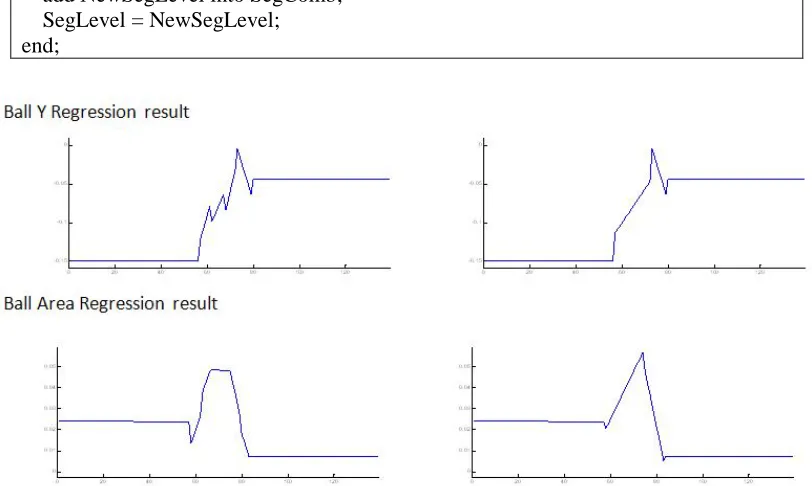
Figure 5.2 Primitive analysis on Aibo approaching a ball ... 42
Figure 5.3 Original sensor data of Aibo approaching a ball ... 43
Figure 5.4 Regression result of Aibo approaching a ball ... 43
Figure 5.5 Ball’s position in original data ... 44
Figure 5.6 Reducing the details in the regression result ... 45
Figure 5.7 An example of a density space ... 50
Figure 5.8 Contour map on threshold 1 ... 51
Figure 5.9 Contour map on threshold 4 ... 51
Figure 5.10 Contour map in modified algorithm ... 52
Figure 6.1 Example of raw data ... 66
Figure 6.2 Simulation pictures of scenario 1 ... 67
Figure 6.3 Simulation pictures of scenario 2 ... 67
Figure 6.4 Simulation pictures of scenario 3 ... 68
Figure 6.6 Simulation pictures of scenario 5 ... 69
Figure 6.7 Simulation pictures of scenario 6 ... 70
Figure 6.8 Approaching the target in center front ... 71
Figure 6.9 Distance and direction data from scenario 1 ... 72
Figure 6.10 Comparison between raw data and recovered data ... 73
Figure 6.11 Combination of the raw data and recovered data ... 74
Figure 6.12 Time series segmentation errors... 75
Figure 6.13 Time series segmentation errors in Sony Aibo robot ... 76
Figure 6.14 Cohesion and separation ... 77
Figure 6.15 Density spaces with different partition size ... 79
Figure 6.16 Action space of Scenario 1 ... 83
Figure 6.17 Successful areas of making contact ... 84
Figure 6.18 Successful areas of making contact with cloest match ... 84
Figure 6.19 Successful areas of turning towards the target ... 86
Figure 6.20 Successful areas of combining approaching and turning ... 88
Figure 6.21 Pushing the target on a small box ... 90
Figure 6.22 Pushing the target on a larget box ... 90
Figure 6.23 Pushing the target with a stick ... 91
Figure 6.24 Action space of scenario 3 ... 92
Figure 6.25 Stretch to push the target ... 94
Figure 6.26 Stretch to push the target with stick ... 94
Figure 6.27 Detecting the object in front of the box ... 97
Figure 6.28 Detecting no object in front of the box ... 97
Figure 6.29 Action plan of scenario 5 ... 98
Figure 6.30 Sweeping the target off the corner ... 99
Figure 6.31 Sweeping the target towards the corner ... 99
Figure 6.32 Successful area of sweeping the ball off the corner ... 102
Chapter 1
Introduction
Building intelligent agents, whether robots or computational systems, is a core pursuit for
many researchers in artificial intelligence. In classical AI research, intelligence is viewed as a matter
of abstract symbol processing (Pfeifer and Bongard, 2007). It is the algorithm or program that
matters, roughly speaking, in the classical view. However, when the focus shifts to the interaction
with the real world, as is necessary for robotic systems, classical approaches have “failed to deepen
our understanding of many intelligent processes” (Pfeifer and Bongard, 2007). Difficulties arise in
the areas of computer vision, robot object manipulation, locomotion, common sense understanding
of natural environments, and many other areas. Ironically, it’s areas that humans normally consider
difficult — playing chess, applying rules of logic, probing mathematical theorems — that are
considered successes for classical artificial intelligence, but reproducing our natural and effortless
everyday behaviors, like seeing, hearing, speaking, riding a bicycle, has proved notoriously hard.
The concept of embodied cognition was developed against this background, in the mid-1980s,
in both cognitive science and artificial intelligence. One perspective is represented by a series of
books by George Lakoff and Mark Johnson (Lakoff and Johnson, 1980; Lakoff, 1987; Johnson,
1987; Lakoff and Johnson, 1999), which focus on aspects of human cognition not previously
recognized as being important. Lakoff and Johnson argue that human rationality is embodied, that
the nature of the human mind is largely determined by the form of the human body. Bodily
experience influences what and how things can be meaningful for us, the way we comprehend and
be found in studies of human conceptual structure formation, linguistic performance, mental
activities, and so forth.
In artificial intelligence, especially in robotics, classical approaches have been heavily reliant
on sophisticated engineering models of the outside world. In other words, building a robot system
requires programmers to understand the conditions the robot will encounter, and then to spell out all
of the relevant information that is needed for the system to generate appropriate responses and
actions (Cowart, 2006). Unfortunately, this design task is very expensive. Often it is too expensive
to be done for what we might call semantically deep tasks. Also, because hand-built systems often
lack the capability of representing the “meanings” of their internal models (in the reflective sense
that human beings can reason about as well as with their concepts), robotic systems can find it
difficult to check the results and maintain the appropriate correspondences between their internal
models and the external world (Cohen and Beal, 2000).
Rodney Brooks brought his robotic embodiment perspective into artificial intelligence around
the same time as Lakoff and Johnson’s work, with a series of papers and books on both technology
and philosophy (Brooks, 1999). Brooks opposes the conventional approach to pre-storing
knowledge in designing robotic agents. Instead, he has built a series of robots based on a so-called
subsumption architecture and opened up a new area of designing robotic agents.
Since this work in the 1980s, a great deal of research has been based on an embodied
intelligence perspective. Of the work most relevant to this dissertation, Terry Regier used a
connectionist network and sequences of pictures to train the system learning the spatial relations
concepts, like in, out, from, to, on, off, front, back, above, and below (Regier, 1996). Arrabales
Moreno and Sanchis de Miguel proposed a computational model that can provide the functions of
consciousness, and they implemented some of the functions in a navigation system (Moreno and de
Miguel, 2006). Lewis and Luger designed a novel architecture based on Brooks’s subsumption
architecture and the Copycat program, which can develop a representation of its environment
through a continuing interaction with it (Lewis and Luger, 2000).
This research follows similar steps associated with the embodiment perspective. Specifically,
this research takes as a fundamental principle the idea that knowledge about the world should be
acquired from the robotic agent’s experience, not given by the designer. In other words, the goal of
this research is to design a computational system that can automatically discover useful knowledge
higher-level reasoning. If this is possible, we can argue that the results of the agent’s processing are
meaningful to the agent itself, and that this meaning is derived from the agent’s embodiment and its
interactions with the world. Compared to classical approaches, the aim of this research is shifted
from directly engineering the knowledge about the world into the system to the design of a general
architecture that can discover knowledge through the agent’s embodied experience.
Cognitive agents capable of general problem solving can be enormously complex, even given
historical limitations on results that AI systems have achieved. Our goal is more modest than the
construction of such an agent. The focus of the work is on a specific range of intelligent behaviors
associated with the use of tools. The goal of the project is to have a general-purpose framework that
can lead to effective tool-using behavior.
Why tool use? Development of general tool users is one of the key challenges for AI (Nilsson,
1995). Representing, classifying and recognizing tools by their functionality can provide us new
opportunities for understanding and eventually improving an agent’s interaction with the physical
world (Bicici, 2003). Further, because tool use is a capacity of many animals as well as human
beings, we have a wide range of possible targets for building a tool-using agent: a robot tool user
might have a pre-programmed behavior at its disposal, like some species of wasp (Oswalt, 1973); it
might be capable of a small range of tool-using tasks that can be flexibly adapted to the environment,
like orangutans (van Schaik et al., 2003); or it might be a general tool user like human beings (St.
Amant and Wood, 2005). There are many research projects in AI that have studied embodied
intelligence and its application in robotic tool use (Stoytchev, 2003; Acosta-Calderon and Hu, 2005).
This research will focus more the relationship between the embodied agent and its representational
structures, including what can be learned about general cognition via the development of a tool
-using agent in simulation and in a physical environment.
The general approach in this work will be to develop a computational system that will act as a
component in some cognitive architecture. For generality we leave this architecture unspecified, but
plausible candidates include general-purpose planning and reasoning systems, within the field of AI,
cognitive architectures such as Soar and ACT-R, within the field of cognitive science, and other
architectures that might be pursued in either of these disciplines. This cognitive system component
targets one of the critical aspects of functionality for a realistic cognitive agent: linking physical
The system described in this dissertation is designed to meet several criteria that, we believe,
make it effective:
• It should reflect a specific theory of concepts. Concepts have a long history and a great
deal of empirical information supporting different theories of how they are formed,
maintained, and applied.
• It should respect plausible cognitive constraints (Chapman, 1991). Because our work is
inspired by comparable behaviors over a wide range of biological “platforms”, our
interest is in tool-using capabilities that fall roughly within the same design space as
biological organisms.
• Representations of actions should be explainable and, in principle, open to analysis by
the agent maintaining such representations. This means that numerical techniques will be
judged at least partly on their being amenable to analysis.
To summarize, the main contributions of this research will be with respect to a general
component for a computational architecture that can capture embodied relations from the
interactions with the world, sufficient to support effective tool use. This is the foundation for the
design of any embodied agent, and should be useful for future research. The component will have
the following capabilities:
1. The automatic identification of similar patterns of behavior from numerical sensorimotor
data over time, in the form of conceptual prototypes.
2. The capacity to apply such prototypes toward the classification of new data; i.e., the
component will be capable of providing short-term predictions for its physical
interactions.
3. The use of such prototypes in the automatic identification of schematic actions.
4. The capacity to support a higher-level reasoning or planning system to effectively solve
problems in a given environment.
The resulting software, which we describe as an Action Schema Generator, or ASG, will be
validated on a set of robotic tool-use scenarios, mainly in simulation but in some cases using data
from a physical robot system. Evaluation is a difficult issue for cognitive agents, especially agents
developed to solve problems for which there are no well-established standard computational
solutions, and for which there is little to no quantitative data on solutions carried out by humans or
process that we believe is common in comparable research projects. First, we carry out an
evaluation of the components of the ASG, concentrating on an outline of their capabilities and
limitations with respect to performance. Second, we carry out a system-level evaluation,
demonstrating that the integration of components in a complete agent is sufficient to solve a range
of problems of interest.
One of the critical issues in building a component of a cognitive system is what we can learn
about the nature of problem solving during its evaluation. We believe that the following insights
into the nature of tool use are worth highlighting.
The scenarios that are part of the system-level evaluation of our work include tasks that
require tool use as well as task that do not. Some of the scenarios provide two different versions
(tool use and non-tool use) of what is essentially the same problem. We find no hard boundaries
between in the representations that the agent derives for the tool use and non-tool use cases. In fact,
the use of a tool can generally be seen as imposing a transformation on streams of information about
the preconditions or effects of actions. This observation is consistent with conventional views of
tool use in human cognitive research, in which a tool is viewed as amplifying some action or as an
extension of the body.
The agent described in this work does not carry out an explicit comparison between the
representations it develops for tool-using and non-tool-using tasks, in order to make the
transformation between pairs of behaviors explicit. Nevertheless there are clear implications that are
laid out for a hypothetical higher-level reasoning system to take advantage of. Two different types
of effects in tool use can be seen in our evaluation. For an example of the first type, consider the
behavior of reaching out, either holding or not holding a stick. The agent we have built generates
nearly identical representations for these two behaviors, with the only difference being the distance
from a targeted object that can be reached. The implication is that some tools provide a kind of
enhancement or transformation of the capabilities of the agent. For an example of the second type,
consider the behavior of blind person using a stick to tap the ground while walking. Two analogous
behaviors in the agent we have built, simulating two functionalities of a stick tool – probing and
striking, are based on representations that the agent is incapable of developing in the absence of a
tool. This observation suggests that some tools provide novel capabilities to the agent. Making such
distinctions clear can potentially help in designing a higher-level reasoning system of the tool-using
The remainder of this dissertation is structured as follows. Chapter 2 gives a motivating
example of the behavior of a simulated tool-using agent we have built, called Canis. Chapter 3
provides an overview of topics in cognitive science related to concept formation and manipulation.
Chapter 4 describes relevant work on cognitive architectures, with a focus on the requirements
briefly laid out above for the generation of action schemas from quantitative sensorimotor data in a
single cognitive architecture component. Chapter 5 describes the design and implementation of the
Chapter 2
A Motivating Example
One of the focus points of this research is on tool-using tasks. Tool use is commonly
associated with human intelligence, but it can also be seen in a range of animal species with widely
differing cognitive capabilities and architectures. If this research is to act as a step toward the
development of general tool-using agents, it is reasonable to ask what the scope of capabilities of
such agents should be.
A few catalogs of animal tool-using behaviors have been developed, for example for
chimpanzees (Whiten et al., 1999) and orangutans (Krutzen et al., 2005); Beck (Beck 1981)
provides a book-length survey of tool use across animal species. St. Amant et al. (in preparation)
have turned these textual descriptions of behavior into a more formal reference set of tool-using
tasks for robotic agents; their set covers the following types of tools, each accompanied by a set of
characteristic behaviors for using the tool type:
• Sponging tools.
• Probing tools.
• Collecting tools.
• Pounding tools.
• Wiping tools.
• Levering tools.
• Striking tools.
• Dabbing tools.
• Tickling tools.
• Combing tools.
• Hooking tools.
• Digging tools.
• Containing tools.
• Perforating tools.
• Protective gear.
One of the most common goals in the use of these tools, even of differing types, is to reach
objects that are otherwise inaccessible: they might be out of reach in free space, enclosed in a hole
with a small opening, embedded in a surface, placed in a location awkward to reach (e.g., even on
the inside of an agent), and so forth.
To motivate the research in this dissertation, it will be useful to walk through an example of
tool-using behavior as an illustration, so that different aspects of the behavior can be highlighted
along with their relationship to intelligence. We will describe a simple reaching task for a robot
agent, with a stick that acts as a surrogate for a probing, collecting, or dabbing tool.
Figure 2.1 Canis in Breve simulation
Most of the research in this project, for practical reasons, has been carried out in simulation.
One of the environments we use for training and evaluation is Breve (Klein, 2002), shown in Figure
2.1. Breve is a free, open-source software package that provides 3D simulations of multi-agent
realistic fashion, which means that agents in the simulated world can be configured to behave
largely as real objects do, following the laws of physics.
The agent implemented in the Breve simulation is called Canis. It is designed as a simplified
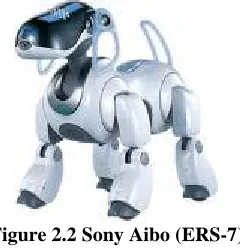
on-wheel version of Sony Aibo (ERS-7), a compact general-purpose dog-like robot (Figure 2.2).
Such a design, in the simulation, is to provide compatibility for future research. Although Breve is
not a real robotics system, it is an efficient platform for system prototyping and demonstration.
Similar to the Aibo, the Canis simulation agent is capable of moving forward and backward, and
turning (using its front wheels). Canis also has a head-neck structure that can stretch forward or
downward, and it has a simulated camera to capture the first-person view shown in the left-bottom
of the simulation window. In the tool-using tasks, a stick can be attached to Canis’ head, which
simulates a stick being held in the Aibo’s mouth. This level of simulation is not detailed enough to
capture grasping behavior or fine motor control over manipulated objects, but it should be sufficient
for an exploration of tool-using behaviors.
Figure 2.2 Sony Aibo (ERS-7)
In our example scenario1
Figure 2.3
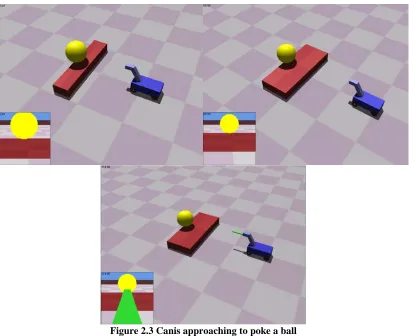
, a yellow ball has been placed on a brown box in front of Canis, as
shown in . Canis is capable of distinguishing the ball, its target, from the box, which is
just an object in the environment. Canis begins in a mode that involves no reasoning; it is carrying
out behaviors that allow it to gather and organize information about the effects of its actions on the
environment. Over a series of trials, Canis will move directly toward the ball to see what happens.
1
Figure 2.3 Canis approaching to poke a ball
a small box (upper left); a large box (upper right); Canis with stick with a large box (bottom)
There are three different variations in the settings of this scenario; we call each such variation
a situation. In the first situation, the ball is placed on the box close enough to the edge facing Canis
that when Canis approaches it can touch the ball with its nose. When this contact happens, the ball
is pushed off the box onto the floor. The trial stops, with this result counted as a success. In the
second situation, the ball is sufficiently far from the edge of the box that when Canis approaches, it
is blocked from reaching the ball by the edge of the box. Canis is on wheels and cannot climb, and
so this trial ends in failure. In the third situation, Canis is given a stick to hold in its mouth, pointing
directly ahead. Here when Canis approaches the ball, even if the ball were at the same location as in
the second situation, Canis is able to contact the ball with the end of the stick and push it onto the
floor, a success. There are two types of minor random variations added for each trial (these do not
result in different situations, but can be thought of as variability within a given situation). One type
a different distance from the box and acts at a different speed each time; another type of variation is
automatically added by the physical engine in Breve, which will produce noise for actions, which
sometimes may even affect the outcomes of the simulation.
This might seem to be a trivial set of situations for Canis to represent and distinguish
between; it is the kind of thing that human beings do naturally and without thinking about.
Nevertheless we put Canis under a number of constraints, not simply to make its job more difficult,
but to pose challenges that we believe are comparable to those solved by real animals, even very
simple animals, as well as by humans.
First, the information that Canis takes in about these situations comes in the form of streams
of un-interpreted continuous data representing both sensory and motor information. There are
potentially many such streams in any such situation or scenario. Here there are ten: different control
signals are applied; the distances to either the ball or the box are monitored; directions are
monitored; and so forth. How should Canis identify relationships across the streams as well as
between different parts of single and multiple streams over time?
Second, if Canis is to learn from its experiences in these scenarios then it must have some
way of encapsulating general information about them, for future re-use. As with streams of data that
may exhibit variation, Canis faces the problem of being able to distinguish between scenarios that
are in some sense similar to or different from each other. How should this information be
represented and organized?
In answering these questions, we follow the guidance of theoretical and practical experience
in cognitive science and artificial intelligence (areas we discuss in more detail in Chapter 3).
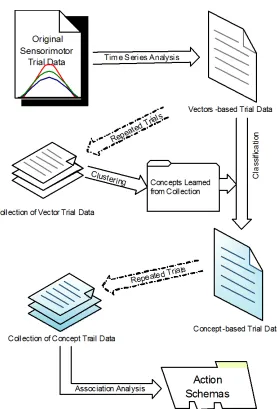
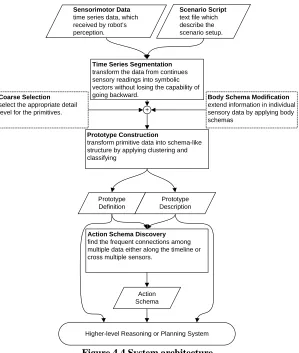
Broadly speaking, the goal of this research is to translate sensorimotor data into structured
representations of Canis’s actions and their effects on the environment. This happens in several
stages.
First, we must segment continuous signals into separate intervals, and apply appropriate
analysis in order to translate them into some form where the intervals can be compared. For
example, when Canis is not moving, its distance from a given location remains constant, but if
Canis begins to move to move toward that location, its distance decreases. Such qualitative
descriptions of distances as “unchanging” and “decreasing” need to be mapped consistently onto
Performing such an analysis on intervals is not enough. It often happens that relationships
hold across different sensory streams over a period of time, which means that we must find invariant
features over the discretized transformations of individual variables. Here is the idea of concepts
comes into play. As human beings, we form concepts during repeated experiences in order to
categorize, reason about, and communicate the meaning of those experiences. We will rely on
clustering techniques for this purpose, without looking deeply into the abstract nature of concepts.
By applying appropriate clustering techniques, we should be able to identify the relevant concepts
from repeated trials in this scenario, despite variation across the trials.
Automatically generated concepts are not simply for show; they will anchor key points over
time in trial data. Translating from discretized trial data into concept-based trial data provides
opportunities for the analysis of variation in the data. Essentially, we want to derive what we view
as the most important information for any robot agent, knowledge about actions, in a form that the
agent can reuse and potentially generalize. We rely on action schemas to represent this information,
which captures the pre-conditions and effects of an action, as is common in AI reasoning and
planning. Thus the last step of the analysis is to organize concept data into action schemas and
identify the most important action schemas in a scenario.
Figure 2.4 illustrates the entire process of translating sensorimotor data into concept-based
Chapter 3
A Cognitive Foundation for Tool Use
The ability to form and reason with concepts is critical to intelligent behavior. It is difficult to
explain how some decision or course of action is rational without the assignment of objects,
properties, and actions to discrete categories or concepts. Even when we simply speak of reasoning
about something, we rely on concepts. Unfortunately for us, the philosophical foundations of
concepts remain unresolved, even after millennia of consideration. Nevertheless it is possible, even
based on a partial and incomplete account, to ground intelligent behavior in the development and
manipulation of computational objects that we believe are sufficiently like concepts to act as
surrogates.
This chapter gives a brief history and selective overview of concept theory, from a
philosophical as well as cognitive science perspective. The goal is to motivate specific design
decisions for a cognitive architecture adequate to support intelligent tool-using behavior, by
reference to findings in the literature. The relevant observations can be summarized as follows:
1. Concepts need not have explicit (symbolic, propositional) definitions.
2. What a concept represents (its content) may depend on the embodiment and experience
of the agent that holds that concept.
3. Some limited set of common schematic relationships may be applicable in a general way
4. In the application of concepts to new situations, especially in situations that require
deciding what to do, simulation of the concept in its application to the situation is a
plausible part of understanding the situation.
The remainder of this chapter contains a brief survey of concept theory, expanding on the
points above and identifying some of their implications.
3.1
Concept Theory: Philosophical Foundations
The traditional view of concepts can be traced back to Plato and Socrates (Thagard, 2005), in
what has come to be known as the classical theory of concepts. According to classical theory,
concepts are complex mental representations whose structure encodes a specification of necessary
and sufficient conditions for their own application. In other words, concepts have a definitional
structure. One example is the concept bachelor, which can be defined as unmarried adult male.
Based on this definitional structure, classical theory explains categorization as a process of
checking all the constituents of a concept as applied to an object in question. If every property of the
object satisfies the criteria, the concept may be applied; if at least one doesn’t, then the concept may
not be applied. This theory can also explain the learning process in much the same way as
categorization – but it runs in reverse. That is, learning, on this view, is a constructive operation.
One simply adds features to the definition in light of new experience.
Most of the problems of classical theory derive from its commitment to definitions. It’s
obvious that not all concepts have a clear definition. A familiar way to illustrate the difficulty is to
ask, “Is the Pope a bachelor?” The Pope, the leader of the Catholic Church, meets the criteria above,
but many people would not find the concept of bachelor naturally applicable (Pinker, 1999).
Laurence and Margolis (Laurence and Margolis, 2003) go further: “Notice, however, that if a
concept has a definition, this definition will strongly constrain theoretical developments in science
and place a priori limits on what we are capable of discovering about the world. … A definition may
appear to capture the structure of a concept, but the appearance may only be an illusion which later
discoveries help us to see beyond.”
Classical theory also predicts that larger definitions should be more difficult for learning and
categorization, because of the large number of conditions that need to be considered. This proves to
be not always true as in the experiments, bachelor is not more difficult to learn than unmarried, and
definition is that people may apply concepts to counterfactual situations where the associated
features of classical theory do not apply (Kripke, 1980). For example, people may still apply the
concept gold to a piece of metal even if it is no longer yellow, in a phenomenon known as atypical
judgment.
Despite its limitations, classical theory dominated concept theory until the 1970s, when
serious alternatives began to be discussed. One result was a new theory, prototype theory (Rosch
and Mervis, 1975). Prototype theory gives up on the idea that a concept’s internal structure provides
its definition. Instead, prototype theory holds that a concept structure encodes a set of features that
the members of this concept tend to have. In simple form, the feature list is the result of a statistical
analysis over the members of that concept. Also in contrast with classical theory, for an object to be
in the extension of a concept it need not satisfy each and every property encoded in the concept's
structure, as long as it satisfies a sufficient number of them.
Two major advances were made by prototype theory. First, prototype theory doesn’t require
that concepts have explicit pre-supplied definitions. Instead, a “self-generated” feature list can give
the concept the explanatory ability. Because this list can be self-generated from samples of a
population of concept members, it provides flexibility. Second, in prototype theory, categorization
is taken to be a feature-matching process where an exemplar or individual is compared to a target
category for how similar they are. As long as enough features match, the item can be judged to fall
into the category. Unlike classical theory, prototype theory doesn’t require all the features to be
matched (Pinker, 1999).
Prototype theory can solve some problems faced by classical theory. Moreover, it has
empirical support from experiments. Among them, experiments show that human perform better in
categorization tasks with instances that rank high on a prototypical scale with respect to a given
concept. To explain this, Smith and Medin provided an “accumulator model” in which, the item
with more features in common will reach the critical value for a concept more quickly, and when
the critical value is reached, the system will judge the item belongs to the concept immediately
(Smith and Medin, 1981).
Another source of empirical support for prototype theory is typicality effects. Typicality
effects are a variety of psychological phenomena related to the fact that people willingly rate
subcategories for how typical or representative they are for a given category (Laurence and
bird than chickens are; i.e., they say robins are more "typical" birds. According to Eleanor Rosch,
categories may have hierarchical structures, which are called super-ordinate, basic, and subordinate
categories (Rosch and Lloyd, 1978). The distribution of properties of categories is predicted by
independent typicality rankings. The more typical a subordinate is judged to be, the more properties
it will share with other exemplars of the same category. For instance, robins are taken to have many
of the same properties as other birds, and, correspondingly, robins are judged to be highly typical
birds; in contrast, chickens are taken to have fewer properties in common with other birds, and
chickens are judged to be less typical birds. Another finding is that typicality has a direct reflection
in categorization. In cases where subjects are asked to judge whether an X is a Y, independent
measures of typicality predict the speed of correct affirmatives. Subjects are quicker in their correct
response to "Is a robin a bird?" than to "Is a chicken a bird?" Error rates, as well, are predicted by
typicality. The more typical the probe, relative to the target category, the fewer errors a subject will
make.
However, prototype theory has its own difficulties (Laurence and Margolis, 2003). The first
problem is that the prototype theory is subject to the problems of ignorance and error, just like
classical theory. People can possess a concept and yet have erroneous information about the items in
its extension or lack sufficient correct information to pick them out uniquely. The second problem is
that many concepts may simply lack prototypes for many reasons; some concepts may be
unfamiliar, for example, while others may simply be un-instantiated (Fodor, 1998). Lacking
prototypes means that people may have concepts without any statistical beliefs (feature list) or even
members. A third problem is that prototypes don't appear to compose in accordance with the
principles of a compositional semantics. Fodor illustrates the argument with the concept pet fish.
The pet prototype encodes properties that are associated with dogs and cats, and the fish prototype
encodes properties that are associated with things like trout, yet the pet fish prototype encodes
properties that are associated with goldfish and other small colorful fish. So it's hard to see how the
prototype for pet fish could be computed from the prototypes for pet and fish.
Other theories have appeared more recently, such as concept atomism, proposed by Jerry
Fodor (Fodor, 1998). Concept atomism is contrary to the theories above in that it doesn’t admit to
concepts having structure. Instead, it treats concepts as semantic primitives. Central to concept
atomism is the thesis that a concept's content is not determined by its relation to any other particular
between the symbol and what it represents. In concept atomism, a concept is activated when and
only when it judges the intentional object to be present. Feature lists are part of the perceptual
detection mechanisms that facilitate the process whereby symbol becomes activated in the system,
but they are not essential to the symbol. For example, birds might be identified by contingently
related features, like feathers, flies, and song, but these features are not part of the concept bird.
The most important contribution of concept atomism is that it changes the explanatory role of
concepts from internal structures to external relationships. This change means the theory can easily
solve the publicity and constancy problem, which indicates that concepts may change from time to
time or from person to person by confining idiosyncrasies to the perceptual detection mechanisms
and broader theoretical information outside the concept. Concept atomism can also solve the
problem of atypical judgments, including factual judgments and counterfactual judgments, by
claiming that those features are not part of the essence of the concept.
3.2
Concept Theory: Embodied Reasoning
Various different threads of thought have been based on the ideas and results described in the
previous section. Those threads relevant to this dissertation fall under a general category that we
may call embodied reasoning. By “embodied reasoning” in this context, we mean an account of
concepts that recognizes concepts are developed and maintained by human beings who are
embodied and situated in the physical world. The centrality of embodiment has implications for a
number of cognitive abilities, including representation, learning, and reasoning.
3.2.1Image Schemas
Mark Johnson and George Lakoff raised the idea that bodily experience influences what and
how things can be meaningful for human beings, the way human comprehend and reason about the
world, and the actions human take (Lakoff and Johnson, 1980; Johnson, 1987; Lakoff and Johnson,
1999). This opened up a new perspective on human cognition, and has received a good deal of
attention in various research areas, including artificial intelligence (Rakova, 2002).
To explain how embodied experience functions in our life, two types of imaginative
structures are presented in Johnson and Lakoff’s theory: image schemas and metaphorical
projection. The notion of “schema” is based on Immanuel Kant’s work. For Kant, schemas are
structures of the imagination; that is, schemas are fixed templates superimposed onto perceptions
term “image” implicates perception in all acts of conceptualization. Concepts develop from
representation of a perceptual conglomeration of multiple senses, including visual, auditory, haptic,
motor, olfactory, and gustatory experiences. Nevertheless, according to Johnson, image schemas are
neither propositional, nor rich concrete images, nor mental pictures. An image schema is a
recurring, dynamic pattern of our perceptual interactions and motor programs that gives coherence
and structure to our experience (Johnson, 1987). Thousands of times each day we feel, see, or
manipulate different kinds of image schemas, like containment (houses, cars, and boxes are all
containers), like force (which causes a door to stay open or results from contact with others), like
up-down orientation (which arises because we live in a gravitational field), and many others.
Mark Johnson introduces the theory of image schemas by first examining the question, “How
can anything be meaningful to a person?” In a traditional sense, linguistic meaning, which assumes
that only words and sentences have meanings and all of these meanings must be propositional, is the
primary issue in the philosophy of language and linguistics. Johnson terms this philosophical view
objectivism. Objectivism treats all meaning as conceptually and propositionally expressible in literal
terms that can correspond to objective aspects of reality, a perspective consistent with classical
concept theory. Johnson argues this is not enough because, first, meanings in natural language come
with figurative and multivalent patterns that cannot be reduced to literal concepts and propositions,
and second, the patterns and their connections are embodied and cannot be reduced to literal
concepts and propositions (Johnson, 1987).
For example, one of the most important concepts we recognize from infancy is force.
Thousands of times we move our body, manipulate other objects, and encounter obstacles; also we
feel force exerted on us. From these ceaseless events, we develop repeatable patterns that we can
recognize and carry out for interacting forcefully with our environment. These patterns are
embodied and give coherent, meaningful structure to our physical experience at a pre-conceptual
level, though we are eventually taught names for at least some of these patterns, and we can discuss
them in the abstract. But the meaning of such a pattern goes deeper than our conceptual and
propositional understanding.
Typically, an image schema will have parts and relations. The parts represent a set of entities,
and the relations represent the connection among different parts, like causal relations, temporal
show evidence of dynamic patterns of recurrent bodily experience. For example, Johnson examines
six types of “out” in English (Johnson, 1987):
1. Mary got out of the car.
2. Whenever I’m in trouble, she always bails me out.
3. I don’t want to leave any relevant data out of my argument. 4. Don’t you dare back out of our agreement?
5. Honda just put out its 1986 models. 6. We kicked him out of the club.
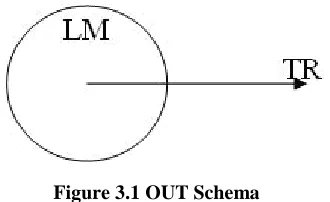
He argues that all of them relate to the IN-OUT schema shown in Figure 3.1. He identifies the
two parts as “landmark” (LM) and “trajectory” (TR). This schema clearly represents the visual
situation of the first sentence. Here the circle represents the car, and Mary moves along the arrow
out of the car. Since the car can’t be circular, of course, Mary can’t move along a straight line in
leaving the car, so this schema gives us only one idealized image. In the rest of the sentences,
Johnson explains the pervasive act of metaphorically extending a schema from the physical to the
nonphysical.
Figure 3.1 OUT Schema
Structure alone is not enough for image schemas to support rational inference. We can
perform mental operations on image schemas that are analogs of spatial operations. For example,
we can rotate mental image both in 2D and 3D situation, and it seems we can do that at a fixed rate
of approximately 60 degree per second, as observed by Shepard and Metzler (Rohrer, 2008). Lakoff
also indicates four primary schematic operations, called image-schema transformations (Johnson,
1987),
1. Path-focus to end-point focus: imagine the path of a moving object and then focus
attention on the point where it comes to rest or where it will come to rest.
2. Mutiplex to mass: imagine a cluster of objects. Now imagine moving away from the
cluster until the individual objects start to appear as a homogenous mass.
4. Superimposition: imagine a large sphere and a small cube. Now, increase the size of the
cube until the sphere can fit inside it. Now reduce the size of the cube until it fits back
inside the sphere.
Although the theory of image schemas is inspired by linguistic and philosophical evidence,
along with other research in the neurosciences, more evidence indicates activation patterns like
image schemas exist in both animal and human brains (Johnson and Rohrer, 2007). Research from
developmental psychology further suggests that infants come into the world with capacities for
experiencing image schema structures.
To summarize, image schemas can be characterized more precisely as (Johnson and Rohrer,
2007)
• recurrent patterns of bodily experience,
• that are “image”-like in that they preserve the topological structure of the perceptual
experience,
• operating dynamically in and across time,
• realized as activation patterns (or “contours”) in and between topologic neural maps,
• and are structures that link sensorimotor experience to conceptualization and language,
• support “normal” pattern completions that can serve as a basis for inference.
Even though image schemas are generated from physical body experience, they can be
applied to many other aspects of our lives, and they can help us to comprehend and make inferences
about other experience.
3.2.2Body schemas
Many researchers believe that humans and other animals maintain an internal representation
of their body so that they can perform actions with the physical world without thinking about it.
This representation is generally referred to as a “body schema”. Many studies have been done in this
area, in both cognitive science and artificial intelligence, but to our knowledge there have been no
connections made to explicit concepts.
Head and Holmes first introduced the concept of the body schema in the early 1900s and
described it as “(a) the mapping from proprioception and efferent copy (copy of motor command) to
body posture and motion, and (b) the mapping from tactile sensation to its originating position on
contains relationships between the body parts and their physical constraints (Acosta-Calderon and
Hu, 2005). General, the body schema can be understood as “an unconscious neural map of the
spatial relations among the parts of the body, in which multi-modal sensory information (e.g. visual,
somatosensory, and tactile) is integrated” (Nabeshima et al., 2005). There also exists a closely
related but distinct concept, the “body image”, which is “a consciously manipulable and
body-centered version of the body schema” (Nabeshima et al., 2005).
Many fundamental human abilities heavily rely on body schemas. Examples include imitating
the actions of other people or even other animals, carrying out body movements, spatial perception,
etc. It has also been found that the body schema is not static but can be modified and extended
dynamically in very short periods of time. Such extension supports humans in the learning of tool
use, as well as more general activities like driving a car. Experiments show that when people drive a
car they get the feeling that the boundary of the car is part of their own body.
Research on the concept of the body schema not only helps us in understanding human
intelligence, but it has also inspired work on robot system design, which is especially relevant for
tool use tasks. Boucard reviews robotics work in using body schemas (Boucard, 2005). One such
project is by Verena Hafner and Frederic Kaplan using an AIBO robot. They measure the
information distances between all possible pairs of sensors while the robot performs a slow walk
and while walking moves its head from side to side. They represent the result in a matrix, called
body map. After accumulated enough data, the body map shows that sensors that are informational
related are close to each other in a physical sense. In other words, the body map can put highly
related sensors into the same category without explicit knowledge about the actual position of these
sensors.
In other work, Stoytchev developed an extendable robot body schema based on the
Self-Organizing Body-Schema model (Stoytchev, 2003). The main idea is to link the configuration and
the sensors of a robot and represent them in one high-dimensional space (called cs-space). The
space also represents information about how changes in configuration affect changes in sensor
values, and vice versa. Therefore, the system can generate a step-by-step trace from one
configuration to another. Stoytchev extended the work by introducing an “offset” vector into the
space, so that when applied such a vector, his robot’s actions simulate the effect of using a stick-like
Figure 3.2 A robot arm’s original icon
(a) in cs-space, and the extended icons; (b), (c), (d) when different sticks is attached
Nabeshima et al. introduce a model of the body schema that relies on the integration in space
and in time of statically updated multisensory information (Nabeshima et al., 2005). They use the
combination of two associative memories, a gating neural network (GNN) and a non-monotone
neural network (NNN) to record the connection between visual information (a camera on the top of
the robot) and tactile information (the joint angles of the robot arms). After accumulating enough
experience, the robot executes the following steps in order to reach a target: “(a) generates paths
from locations of its hand and a target, (b) internally simulates the paths and selects an executable
one using the kinematic controller of its hand, (c) actually moves the hand along the path using the
controller, and (d) reaches and touches the target”. They extended the work to the use of a stick by
comparing and associating the visual patterns between actions with the stick and the actions without
the stick (see Figure 3.3), so that the system can generate plans for using stick with the same steps.
Figure 3.3 Reaching a target with a stick
3.3
Mental imagery
The nature of image schema theory is to provide a mechanism for people connecting the
bodily experience with conceptual reasoning. It mainly focuses on where the materials of mental
mechanism of how the brain actually does the reasoning using those experiences or concepts
(Gallese and Lakoff, 2005). Imagine being given the parts of a computer but no instructions for
putting the parts together. As a collection of psychological phenomena, mental imagery fills this
gap.
Mental imagery can be defined as “the mental invention or recreation of an experience that in
at least some respects resembles the experience of actually perceiving an object or an event” (Bertel
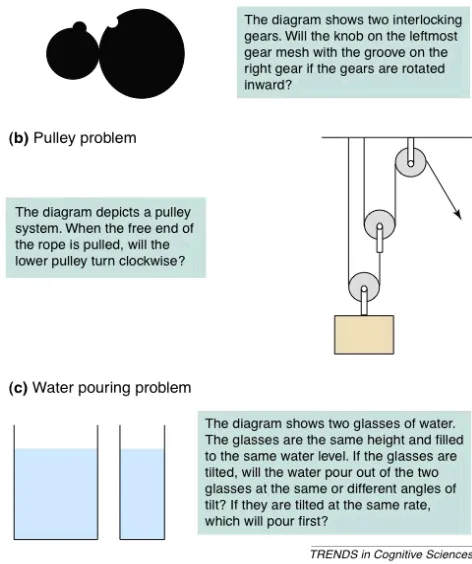
et al., 2006). Mary Hegarty has studied mechanical reasoning by mental simulation. Hegarty
(Hegarty, 2004) claims that a mental model (or situation model) is a representation that is
isomorphic to the physical situation that it represents, and the inference processes simulate the
physical processes being reasoned about (Figure 3.4). In other words, people will consciously
simulate what will happen when they are solving mechanical problems.
Figure 3.4 Examples of mechanical reasoning problems
Hegarty points out three properties in mental simulation:
1. People mentally simulate the behavior of complex mechanical systems piecemeal rather
2. Mental simulation is not based purely on visual information, but also incorporates
information about invisible entities and properties, such as force and density.
3. Mental simulation may involve motor representations as well as visual representations.
Another important research topic on mental imagery is the nature of mental imagery
representations, which has been debated for many years. The center of this debate is whether visual
mental images rely on depictive representations or whether they are purely propositional
representations (Kosslyn, 1999). This is critical because when researchers began to think about how
one could build a computational model to mimic imagery, one must specify a representation with
particular properties.
Stephen Kosslyn and Zenon Pylyshyn are two of the most important figures in this area. They
have done lot of research in mental imagery and hold opposite views in this debate. Kosslyn
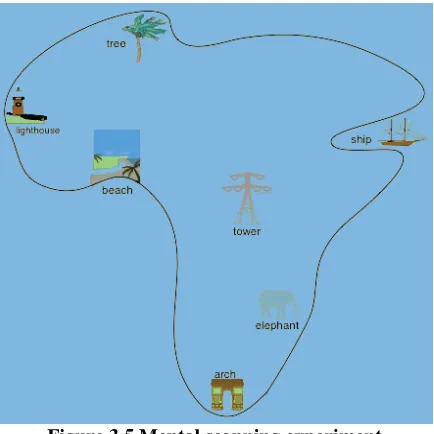
designed a series of experiments that focused on the so-called “privileged properties of depictive
representations”, which are not shared by propositional representations (Kosslyn, 1999). “Mental
Scanning” (Figure 3.5) is one of them. In this experiment, participants learned a map and then were
asked to imagine the map, fix their attention on a given landmark, and try to move to a second
named landmark in their image. The result shows the greater the distance between the two
landmarks, the longer the reaction time a participant needed.
Figure 3.5 Mental scanning experiment
In the latest progress in the debates, many results from neuroscience have been found to
surface of your visual cortex (Kosslyn, 1999). This idea has been fostered by the following findings:
(1) When a visual pattern is presented to the eye, a homeomorphic (continuously deformed)
mapping of retinal activity occurs in visual cortex. (2) Although it remains controversial, it has also
been reported that there is increased activity in retinotopically-organized areas of visual cortex
during mental imagery.
Pylyshyn (Pylyshyn, 2002) (Pylyshyn, 2003) argued that these findings tell us nothing about
the form of the representation, because imagery and vision might involve the very same form of
representation without it being pictorial in either case. Furthermore, Pylyshyn was concerned that
there may be an infinite regress in pictorial mental imagery: if something is interpreting the image,
what inside that something must be interpreting its interpretation of the image, and so on?
Although the debate about the nature of mental imagery is still not entirely resolved yet, it
doesn’t affect the idea that pictorial depiction is involved in mental imagery. The important thing
about this debate is that it helps us to recognize what kinds of properties are involved in depictive
representations but not in propositional representations. By analogy, when you program an
algorithm on computer, you can ignore the nature of a computer as a process of interactions between
electrons. Instead, you focus on a higher and more abstract level. That is, we can ignore the
underlying disagreement about whether a depictive representation is based on propositional
representations or is primitive; the evidence is compelling that depictive representations play an
important role in mental imagery.
3.4
Summary
From this body of literature we take the following guidelines for the research in this proposal.
1. Concepts need not have explicit (symbolic, propositional) definitions.
2. What a concept represents (its content) may depend on the embodiment and experience
of the agent that holds that concept.
3. Some limited set of common schematic relationships may be applicable in a general way
over the experiences of an agent.
4. In the application of concepts to new situations, especially in situations that require
deciding what to do, simulation of the concept in its application to the situation is a
plausible part of understanding the situation.
Chapter 4
Cognitive Robotic Architectures
Designing a complete cognitive robotics system means solving problems in many disciplines.
Even though this research mainly focuses on an intermediate layer of a robotic system, one that
links data to symbols, it requires efforts in the areas of time series analysis, schematic
representations, and data mining and machine learning. System architecture design becomes an
inevitable and critical issue.
4.1
Examples of cognitive robotic architectures
There are many different frameworks that have been used in robotic systems. Most
approaches up until the 1980s made use of a sense-model-plan-act framework. As criticized by
Brooks, those systems use representational schemes with fixed and predetermined interpretations
(Brooks, 1999). Brooks developed the idea of behavior-based robotics, which emphasizes the
integration of semi-independent layers that produce behaviors directly from input rather than each
contributing to a stage of the sense-model-plan-act framework (Lewis and Luger, 2000).
Brooks’s work opposes the conventional representation that explicitly pre-stores the
description of the interactions with the world and the intentions of the system. Instead, he claims
that all autonomous agents need to be situated and embodied, and he also argues that embodied
robots should “use the world as (their) own best representation” (Brooks, 1999). In order to test his
ideas, Brooks has built a series of robots based on a decomposition-by-activity subsumption
obstacles, like walls, and moving people, based on low-level considerations. At a higher level, the
robots might include goals such as the desire to approach given targets. With the robots and the
subsumption architecture, Brooks demonstrated his claim that a robot can continually create and
recreate relationships between the system and the world without relying on a central planning
facility to dictate commands, or encoding classical representations.
This research direction inspired a variety of new dynamical models of representation. One
example is the architecture designed by Joseph Lewis for robot control, an architecture that is both
dynamical and embodied.
Figure 4.1 Madcat architecture
Lewis’s project, “Madcat”, is inspired by a similar design in a previous project called
“Copycat” (Mitchell, 1993). Copycat was one of the first computer programs to attempt to capture
the dynamical processes from which symbolic or representation-based behavior can emerge.
Copycat solves analogy problems such as If "abc" becomes "abd" what does "ijk" become? One
aspect of its novel design is the “slipnet”, “a semantic network organized with spreading activation
and multiple kinds of links among its nodes, some of which can change in length”. In other words,
the slipnet’s internal topology will keep updating while the system is running. Madcat extends the
Copycat architecture to a robotic control system, producing a control architecture capable of
ongoing interaction with a dynamic environment. Figure 4.1 shows Madcat’s components in the
architecture and the relationships between them. “Codelets” encode four basic rules with high
priorities for a given set of sensor readings. The “coderack”is a stochastic priority queue where the
choice of the next codelet is made probabilistically with a bias toward the higher urgency codelets.
The workspace serves as the locus of structure-building activity of the codelets from the coderack.
contains nodes and links that dictate the data to which the codelets respond and the kinds of
structures they build. The slipnet topology changes in response to activity in the workspace but its
nodes and links remain fixed. The entropy reflects how well emergent structures fit into the data the
robot encounters and affects the biases of the system.
Figure 4.2 Demonstration of Madcat
With this design, the Madcat architecture first demonstrates that certain basic competencies,
roughly those of Brooks (Brooks, 1999), could be implemented using this emergent architecture.
The chosen behaviors are obstacle avoidance, wandering, and wall-following (Figure 4.2). The
second goal of the Madcat architecture is to generate emergent structures correlated with
environmental features. These support more effective real-time behavior.
Another interesting architecture design is the machine consciousness approach of Arrabales
Moreno and Sanchis de Migual (Moreno and de Miguel, 2006). They have analyzed the major
theories of consciousness and aimed for the design of a machine consciousness model, which they
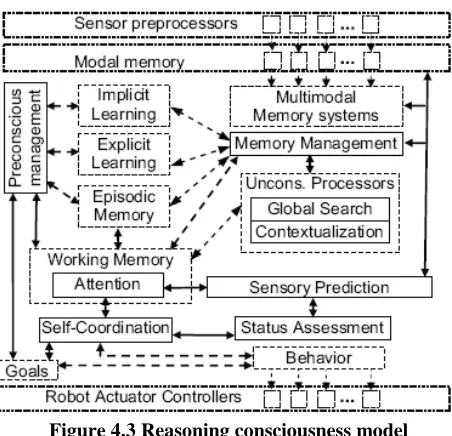
call CERA (Conscious and Emotional Reasoning Architecture). Human consciousness functions, as
identified by Baars, include adaptation, learning, contextualization, access to a self system,
prioritization, and recruitment of unconscious processors, decision making, error-detection,
self-monitoring, and optimization. Accordingly, Moreno and de Migual have defined a set of basic
modules intended to accomplish all of the functionality of reasoning consciousness. The defined
modules are as follows:
1. Attention module.
2. Status assessment module.
3. Global search module.
4. Preconscious management module.
5. Contextualization module.
7. Memory management module.
8. Self-coordination module.
Moreno and de Miguel discuss the functionality of every module. For example, “the
implementation of the attention module implies a mechanism that allows the robot to pay attention
to a particular object or event. This focus point should drive its perception, behavior and explicit
learning processes.” Figure 4.3 shows how different modules interact with each other. Also, they
consider “emotions” as a measure that provides an agent with a succinct evaluation of its
progression in achieving goals.
Figure 4.3 Reasoning consciousness model
This architecture allows the integration of different cognitive components into a single
autonomous system. It is designed to be a flexible research framework in which different
consciousness and emotion models can be integrated and tested. They test the system on the
Khepera robot for navigation tasks.
4.2
Design Challenges for a Cognitive Robotic Architecture
In a typical design of a robotic system, a perception module is usually present at the front of
the system, responsible for collecting and processing raw sensorimotor information, usually in
numerical formats. There might be a central control module, which usually deliberates over the
behavior of lower level modules and controls the general behaviors of the entire system through a