A Study on the causes for aversion to
mathematics by engineering students using
Fuzzy Cognitive Maps (FCMs)
A.Praveen Prakash
1, Esther Jerlin J
2, Bennilo Fernandes J
3Professor, Department of Mathematics, Hindustan University, Padur, Chennai, India1 Research Scholar, Department of Mathematics,Hindustan University, Padur, Chennai, India2 PG Student, Department of Electronics and Communication, Hindustan University, Padur, Chennai, India 3
Abstract:The quality of teaching and learning mathematics has been one of the major challenges and concern of the
educators. Mathematics is often considered as a subject that a student either understand or doesn‟t, with little in between. In reality, mathematics comprises of wide variety of skills and concepts. Mathematics education should enable engineering students to communicate their ideas in an unambiguous and understandable way and should equip themselves with the analytical skills as practicing engineers. It is a collection of tools that can be used to solve certain well-defined problems. Mathematical thinking and modeling give engineers the ability to approach new problems with confidence. There are around 570 engineering colleges in Tamil Nadu where students show their aversion in learning mathematics and they learn this subject without interest. More number of arrears is kept in this subject compared to other subjects. Students fail to understand the seriousness of this subject. This paper analyses the various causes for the aversion by the engineering students in learning mathematics given by the teachers using Fuzzy Cognitive Map (FCM) model.
Keywords:FCMs, Hidden pattern, fixed point, aversion.
I. INTRODUCTION
In modern world of science and technology mathematics plays a vital role. Mathematics is the indispensable tool for engineering curriculum. Its importance is noticed in all fields as called as Queen of Sciences. It is based on both logic and reality of the world.
But how far this subject is concentrated by the students in engineering is a question mark. Mathematics is science of pattern that engineers have to seek out whether found in numbers, space, science, computers, imaginary abstractions, or elsewhere. Knowledge and understanding of basic mathematics have always been challenging criteria for the engineering students.
The kind of less academic achievement in lower classes makes to have fear for the subject and it continues till the end. There are also various causes for the students to feel mathematics is a subject beyond their understanding and interest. The open statement given by most of the engineering students that number of arrears occurs only in mathematics which acts as a pathetic situation in this challenging and competitive world.
II. LITERATURE SURVEY
model using examples from real-world problem. Her book helps social scientists who are interested in finding out ways to emancipate the society. FCMs are used to model several types of problems varying from gastric-appetite behaviour, popular political developments etc. FCMs are also used to model in robotics like plant control.Her book consists of properties,definitions, strength and weakness of FCM model. For the study of political situation in any nation( i.e )
The prediction of electoral winner or how people tend to prefer a particular politician and so on and so forth involves not only a lot of uncertainty for this, no data is available. They form an unsupervised data. Hence she applied FCM model to Indian politics by taking an expert‟s opinion as six nodes (i.e) language, community, service to people, finance and media, party‟s strength and opponent‟s strength and finally working members for the party. Using these six nodes, several expert‟s opinion are obtained and found out the conclusion.
III.FUZZY COGNITIVE MAP (FCM):
In 1965, L.A. Zadeh has introduced a mathematical model called Fuzzy Cognitive Maps. After a decade in the year 1976, Political scientist R. Axelord used this fuzzy model to study decision making in social and political systems . Then B. Kosko enhanced the power of cognitive maps considering fuzzy values for the concepts of the cognitive map and fuzzy degrees of interrelationships between concepts. FCMs can successfully represent knowledge and human experience, introduced concepts to represent the essential elements and the cause and effect relationships among the concepts to model the behavior of any system. It is a very convenient simple and powerful tool, which is used in numerous fields such as social, economical and medical etc. illustrated by W.B.Vasantha Kandasamy in her book, “Application of Fuzzy Models in Social Sciences”. In this paper we recall the notion of Fuzzy Cognitive Maps (FCMs), which was introduced by Bart Kosko in the year 1986.This work is based on expert opinion collected throughout Chennai. The data was collected and assimilated from the people using a linguistic questionnaire and this linguistic responses were transformed into fuzzy data. It is important to note that, while doing fuzzy mathematical models, the fuzzy matrix make take its entries from the interval [-1.1]. Even then, they are known as fuzzy matrices. Therefore, it is understood that Fuzzy tools alone have the capacity to analyze these concepts further substantiating the choice of this method..
This paper consists of five sections. First Section gives the information about fuzzy mathematical model. Second Section gives the preliminaries of FCM. In Section three, we give the description of the problem .In section four, we analyze the problems of the engineering students using FCM. Final Section gives the Conclusion based on our study.
A. Preliminaries:
Fuzzy cognitive maps (FCMs) are more applicable when the data in the first place is an unsupervised one. The FCMs work on the opinion of experts. FCMs model the worlds as a collection of classes and causal relation between classes.
Definition 2.1.1: An FCM is a directed graph with concepts like policies, events etc as nodes and causalities as edges.
It represents causal relationship between concepts.
Definition 2.1.2: When the nodes of the FCM are fuzzy sets then they are called as fuzzy nodes.
Definition 2.1.3: FCMs with edge weights or causalities from the set {-1, 0, 1} are simple FCMs.
Definition 2.1.4: The edges eij take values in the fuzzy causal interval [-1,1]. eij = 0 indicates no causality, eij> 0
indicates causal increase Cj increases as Ci increases (Or Cj Decreases as Ci Decreases). eij< 0 indicates causal
decrease or negative causality. Cj decreases as Ci increases (and or Cj increases as Ci decreases). Simple FCMs have
edge values in {-1, 0, 1}. Then if causality occurs, it occurs to a maximal positive or negative degree. Simple FCMs provide a quick first approximation to an expert stand or printed causal knowledge. If increase (Or decr ease) in one concept leads to increase (or decrease) in another, then we give the value 1.If there exists no relation between the two concepts, the value 0 is given. If increase (or decrease) in one concept decreases (or increases) another, then we gives the value -1. Thus, FCMs are described in this way. Consider the nodes or concepts C1, …, Cn of the FCM. Suppose
the directed graph is drawn using edge weight eij {0, 1, -1}. The matrix E be defined by E= (eij ), where the eij is
matrix of the FCM. It is important to note that all matrices associated with an FCM are always square matrices with diagonal entries as zero.
Definition 2.1.5: Let C1, C2,…. Cn be the nodes of an FCM. Let A=(a1, a2,…., an ), where ai {0,1}. A is called the
instantaneous state vector and it denoted the on off position of the node at an instant ai =0 if ai is off andai=1 if ai is
on, where i = 1, 2, …, n.
Definition 2.1.6: Let C1 , C2 , …, Cn be the nodes of an FCM. Let C1 C2, C2 C3, …, Ci Cj, be the edges of the FCM (i
j). Then, the edges form a directed cycle. An FCM is said to be cyclic if it possesses a directed cycle. An FCM is said to be acyclic if it does not possess any directed cycle.Definition 2.1.7: An FCM with cycles is said to have a feedback.
Definition 2.1.8: Where there is a feedback in an FCM, i.e., When the causal relations flow through a cycle in a
revolutionary way, The FCM is called a dynamical system.
Definition 2.1.9: Let C1C2, C2 C3,…, Ci Cj, be a cycle when Ci is switched on and if the causality flows through the
edges of a cycle and if it again causes Ci, We say that the dynamical system goes round and round. This is true for any
node Ci, for i = 1, 2, …, n. The equilibrium state for this dynamical system is called the hidden pattern.
Definition 2.1.10: If the equilibrium state of a dynamical system is a unique state vector, then it is called a fixed point.
Consider a FCM with C1, C2, …, Cn as nodes. For example let us start the dynamical system by switching on C1. Let
us assume that the FCM settles down with C1and Cn on, i.e. the state vector remains as (1, 0, 0,…, 0, 1) this state
vector (1, 0, 0, …, 0, 1) is called the fixed point.
Definition 2.1.11: If the FCM settles down with a state vector repeating in the form A1
A2
… AI
A1. Thenthis equilibrium is called limit cycle.
IV.ASTUDYONTHECAUSESFORAVERSIONTOMATHSEXPERIENCEDBY ENGINEERING
STUDENTSUSINGFCMMODEL
By administering linguistic questionnaire and the expert‟s opinion we have taken the following ten concepts {C1, C2, ...,
C10}
A. The problems faced by the engineering students in India:
The problems faced by the engineering students in Tamil Nadu are taken as the concepts and as the main nodes for
our analysis. They are listed as follows:
C1- Memory loss
C2- Attention loss
C3- Lack of sufficient knowledge in basics
C4- Lack of sufficient application skills
C5- Lack of interest in unitizing sufficient time
C6- Lack of confidence
C7- Health problem
C8- Lack of sufficient practice
C9- Peer group pressure
C1. Memory loss:
Memory plays a significant role among the students in learning mathematics. They find hard to remember all the basic
rules, steps and formulae in storing, recalling and reproducing in their examination. Memory loss may be due to their
individual health condition, sleep deprivation, indulging in drinking, other distractions etc. Memory plays a vital role
on thinking with numbers.
C2. Attention Loss
Students with attention deficit disorder have particular problem like they fail to remain focused while learning. They
appear to be „dreamy‟ and pay no attention. They easily get distracted, lose their concentration and miss to listen how
the problem is solved. Thus they have poor listening skills and miss the key points.
C3. Lack of sufficient knowledge
For student, content knowledge is crucially important to the improvement in learning mathematics. Thorough
knowledge in content makes the student to think, reason out and apply in the asked problem. Lack of sufficient
knowledge makes the student to skip out the example problem and thus creates fear among them. While Studying, XI
and XII portions are not covered properly in many of the schools. Though, they score high marks in XII, they lack
knowledge of the fundamentals that they should have learnt in XI.
C4. Lack of sufficient application skill
On knowing the content knowledge does not tell that the students are well-versed in subject. Their application skill
proves their content knowledge in learning mathematics. If the student do not understand the content well then they are
not good at employing steps to solve the problem. Thus they lose their confidence level. The problem may emerge even
if the teacher fails to teach the application part of the theory he teaches.
C5.Lack of interest in utilizing time
As the proverb says „Time is precious‟ and „Time and Tide waits for no man‟ students who do not value the worth of
time, face many problems. They fail to pay attention in class, remembering the concepts and in analyzing the problems.
Due to the influence of media and peer- group pressure they indulge in various immoral and unwanted activities and
waste their time. They finally regret for the time lost.
C6.Lack of confidence
Confidence plays a vital role not only for the students but for each and every individual to face the unexpected
problems occurs in the world. Students who lack confidence level, experience fear and try to escape from learning,
recalling and applying them to solve the problem. The confidence level can be activated by giving continuous coaching,
friendly interaction with the students and paying attention to them.
C7.Health Problems
illegal activities. As a result they lose their concentration in studies. Family background also plays a major role in
affecting both physical and mental fitness of the students.
C8.Lack of sufficient practice
Students who fail to practice often experience failure in mathematics. They just think that having the content
knowledge is just enough and face their examination without practicing. A small alteration in question format will pose
a big problem to such a students. Naturally they fail to answer the question even if it is a simple one. “Practices make a
man perfect”. Only while practicing, knowing, understanding, recalling the concepts occurs. The worth of utilizing the
time in practice results in good performance.
C9.Peer-group pressure
Society consists of many relationships. Friends play the vital role in teen –age period. Peer-group pressure distracts the
individual both in good as well as in bad way. It is up to the individual who decides the way to choose. Most of the
engineering students keep arrears in mathematics due to their peer group pressure who involve in wrong activities like
mass bunking, drugs, alcohol addiction, and love affairs etc. which make them to consider the subject as bore and fail
to be present in the class. Instead they enjoy those hours in canteen, beach or cinema, etc. Student at this age get
affected a lot by peer-group pressure.
C10. Lack of logical and learning:
It involves the students to think and monitor their learning. Students should be motivated from the beginning to justify
their answers like why such steps take place and what is involved in carrying those steps. Lack of such criteria makes
the student to memorize the steps which they don‟t understand. Thus they lack in application skill and lose confidence
to attend any unfamiliar problem. For this the teacher should reinforce the students with different illustrations while
teaching.
B. Method of Determining Hidden Pattern
Let C1, C2, …, Cn be the nodes of an FCM, with feedback. Let E be the associated adjacency matrix. Let us find the
hidden pattern when C1 is switched on. When an input is given as the vector A1= (1, 0, 0, …, 0), the data should pass
through the relation matrix E. this is done by multiplying A1 by the matrix E. Let A1 E= (a1,…., an)with the threshold
operation that is by replacing ai by 1 if ai> k and ai by 0 if ai<k (k is a suitable positive integer). We update the
resulting concept. The concept C1 is included in the updated vector by making the first coordinate as 1 in the resulting
vector. Suppose A1 E
A2 then consider A2 E and repeat the same procedure. This procedure is repeated till we get aC. Analysis of the Problem
Using the linguistic questionnaire and the expert‟s opinion we have taken from the experienced teachers following ten
concepts {C1, C2, ..., C10} as nodes.
C1- Memory loss
C2- Attention loss
C3- Lack of sufficient knowledge in basics
C4- Lack of sufficient application skills
C5- Lack of interest in unitizing sufficient time
C6- Lack of confidence
C7- Health problem
C8- Lack of sufficient practice
C9- Peer group pressure
C10-Lack of logical reasoning power &Analytical skill
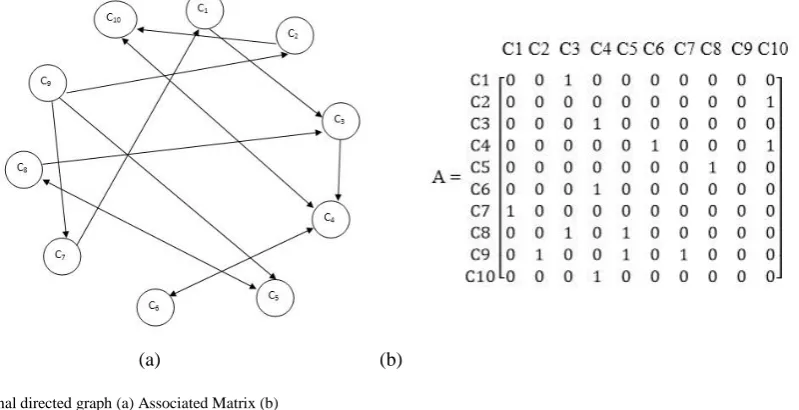
Now we proceed on to analyze the problems using FCM. Let us consider the ten concepts {C1, C2, ..., C10}
(a) (b)
Fig. 1: Relational directed graph (a) Associated Matrix (b)
Now using the matrix A of the Fuzzy Cognitive Map (FCM) the on state, we determine the hidden pattern. Suppose
(i) Let the initial input vector be
X0= {0 0 0 0 0 0 0 1 0 0}.
X0A = {0 0 1 0 1 0 0 0 0 0}
{0 0 1 0 1 0 0 1 0 0} =X1X1A = {0 0 1 1 1 0 0 1 0 0} =X2
X2A = {0 0 1 1 1 1 0 1 0 1} =X3
X3A = {0 0 1 3 1 1 0 1 0 1}
(0 0 1 1 1 1 1 0 1 0 1} =X4=X3X3 is the hidden pattern which is the fixed point.
(ii) Let the initial input vector be
X0= {0 0 0 1 0 0 0 0 0 0}.
X0A= {0 0 0 0 0 1 0 0 0 1}
{0 0 0 1 0 1 0 0 0 1} =X1X1A = {0 0 0 2 0 1 0 0 0 1}
(0 0 0 1 0 1 0 0 0 1} =X2=X1X1 is the hidden pattern which is the fixed point.
(iii) Let the initial input vector be
X0= {0 1 0 0 0 0 0 0 0 0}.
X0A = {0 0 0 0 0 0 0 0 0 1}
{0 1 0 0 0 0 0 0 0 1} =X1X1A = {0 0 0 1 0 0 0 0 0 1}
(0 1 0 1 0 0 0 0 0 1} = X2X2A = {0 0 0 1 0 1 0 0 0 2}
(0 1 0 1 0 1 0 0 0 1 }=X3X3A = {0 0 0 2 0 1 0 0 0 2}
(0 1 0 1 0 1 0 0 0 1} =X4=X3X3 is the hidden pattern which is the fixed point.
Where
Denotes the resultant vector after thresholding and updating.V. CONCLUSION AND SUGGESTIONS
While analyzing FCM, when the concept C8 “LACK OF SUFFICIENT PRACTICE” is kept in the on state, the other
concepts C3, C4, C5, C6, and C10 are also in the on state. When the concept C4 “LACK OF SUFFICIENT
APPLICATION SKILL” is kept in the on state, the other concepts C6, C10 are also in the on state. When the concept
C2 “ATTENTION LOSS” is kept in the on state, the other concepts C4, C6, C10 are also in the on state. These ten
attributes are inter-related to each other for the causes for aversion by engineering students in studying mathematics.
This implies that one should exercise self-discipline and concentrate in learning the subject Math‟s. The Teacher must
come well prepared to the class and facilitates the learning process by adopting innovative methods. The Institution
should provide the necessary infra-structure facilities function like the “Smart Classroom”, “In-service course to the
Above all the parents must provide a congenial atmosphere in the house and keep in motivating their children‟s in their
studies.
REFERENCES
[1] W.B.Vasantha Kandasamy and Smarandache Florentin, “Analysis of social aspects of migrant laborers living with HIV/AIDs using Fuzzy Theory and Neutrosophic Cognitive Maps”,Xiquan Phoenix.(2004).
[2] Axelrod,R, Structure of decision „The cognitive maps of political elites‟. Princeton University (1976). [3] Kosko,B.“Fuzzy Cognitive Maps”, International Journal of man-machine studies, Jan (1986). [4] Kosko B, “Neural Networks and Fuzzy System”, Prentice Hall of India (1997).
[5]Kosko,B. “Hidden patterns in Combined and adaptive Knowledge Networks” , International Conference of Neural Networks(ICNN-86) 377- 393,(1988).
[6]Vasantha Kandasamy W.B and Smarandache Florentin “Fuzzy Cognitive Maps and Neutrosophic Cognitive Maps”, Xiquan, Phoenix (2003). [7]W.B.VasanthaKandasamy and S.Uma, “Combined Fuzzy Cognitive Maps of Socio EconomicModel”Appl.Sci.Periodical,225-27(2000) [8]Gonzalez, J., Castillo, O., Aguilar, L., Performance Analysis ofCognitive Map-Fuzzy Logic Controller Model for Adaptive Control Application, Proceedings of the 2008 IEEE World Congress oncomputational Intelligence, WCCI2008, Hong Kong, 2008, pp. 23752381. [9] Transactions on FuzTsadiras, A. and Margaritis, K., Cognitive Mapping and Certainty Neuron Fuzzy Cognitive Maps, Information Sciences: an InternationalJournal, vol. 101, no. 1–2, pp. 109–130, 1997.zy Systems, vol. 16, no. 1, 2008, pp. 61-72
[10] Stach W., Kurgan L., Pedrycz W., and Reformat M., Genetic learning of fuzzy cognitive maps, Fuzzy Sets and Systems, vol. 153, no. 3,2005, pp. 371–401