ISSN: 2252-8938 95
Natural Immune System Response As Complexe Adaptive
System Using
Learning Fuzzy Cognitive Maps
Ahmed Tlili, Salim Chikhi
Department of Computer Science and its Applications, New Faculty of Information Technologies and Communication Abdelhamid Mehri University, Constantine, Algeria
Article Info ABSTRACT
Article history: Received Jun 4, 2016 Revised Aug 7, 2016 Accepted August 23, 2016
In the Natural Immune Systems NIS, adaptive and emergent behaviors result from the behaviors of each cell and their interactions with other cells and environment. Modeling and Simulating NIS requires aggregating these cognitive interactions between the individual cells and the environment. In last years the Fuzzy Cognitive Maps (FCM) has been shown to be a convenient tool for modeling, controlling and simulating complex systems. In this paper, a new type of learning fuzzy cognitive maps (LFCM) have been proposed as an extension of traditional FCM for modeling complex adaptive system is described. Our approach is summarized in two major ideas: The first one is to increase the reinforcement learning capabilities of the FCM by using an adaptation of Q-learning technique and the second one is to foster diversity of concept's states within the FCM by adopting an IF-THEN rule based system. Through modeling and simulating response of natural immune system, we show the effectiveness of the proposed approach in modeling CASs.
Keyword:
Complex Adaptive System Fuzzy Cognitive Maps Immune System Response Reinforcement Learning
Copyright © 2016 Institute of Advanced Engineering and Science. All rights reserved.
Corresponding Author: Ahmed Tlili,
Department of Computer Science and its Applications,
New Faculty of Information Technologies and Communication Abdelhamid Mehri University, Constantine, Algeria.
Email: [email protected]
1. INTRODUCTION
A Complex Adaptive System (CAS) [21] is defined as a collection of entities (agents), with simple rules of behavior, merged in a dynamic and unknown environment and able to adapt to it by learning experiences. The overall adaptation to the environment appears through the local behavior of entities that is adaptive.
Found in nature, many biological and social systems are similar to the CAS: the immune system, bird flocks, the cell, insect colonies, brain, economic markets etc.... All these systems are characterized by their two key concepts, namely the emergence of global behavior, which is due to of the lack of centralized control and measuring self-organization adaptation to the environment by relative learning.
In the Natural Immune Systems (NIS), emergent behaviors result from the behaviors of each individual cell and their interactions with the environment. Modeling NIS requires incorporating these adaptive interactions among the individual cells and the environment. Modeling approaches for NIS are grouped into two categories: mathematical models generally take the form of partial differential equations, and cell-based models simulate each individual cell behavior and interactions between them enabling the observation of the emergent behavior. This study focuses on the cell-based models of NIS, and mainly, the technical aspect of the fuzzy rule-based simulation method for NIS is described. How to implement the cell behaviors and the interactions with the environment into the computational domain is discussed. The system behaviors described in this paper are differentiations mechanism between self and no-self cells.
Lastly to get a better understanding why NIS is considered as complex adaptive system the following points may be relevant:
1. NIS is a decentralized system. 2. NIS mechanism is a cognitive task.
3. There are similarities between NIS and adaptive social insects colonies, e.g. ants and bees. 4. The overall behavior adaptation of NIS appears through the local behavior adaptation of each cell.
In the littérature, agent-based models (ABM) and cellular automata (CA) are two of the commonly used methodologies for modeling of NIS [16, 17]. The ABM are criticized for their complexity, by against the CAs are also criticized for lack of environment.
Recently, many studies have using FCMs and their multiple extensions [1-2,19], to model complex systems where CASs are a special case, and have given encouraging results [3-5]. In this paper we present an approach for modeling CASs based on one connection of the fuzzy cognitive maps (FCM) theory and adpative reinforcement learning algorithm Q-Learning, also linear weight adaptation method based on hebbianlearning algorithm [7] developed for neural networks is used to train FCM by updates only the initial weights of FCM.
2. RESEARCH METHOD
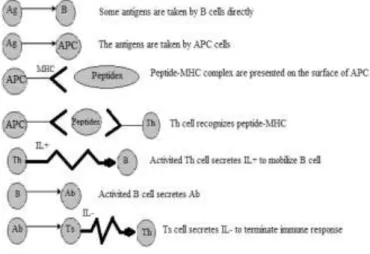
The Natural Immune System (NIS) is one of the most advanced and complex adaptive biological systems. In order to maintain independence and help in avoiding autoimmunity, a living organism must prevent invasion by numerous microorganisms and harmful substances from the environment, and must handle those that do enter. NIS has a double objective since it has to maximize harmful antigens elimination and at the same time minimize harm to self (autoimmunity). Immunity includes functions to distinguish between self and no self components (cells), and to remove the latter. The immune response process is depicted in Figure 5.
Figure 1. Natural immune response mechanisms
Immune responses are implemented by special cells called lymphocytes. These cells are furnished with a sort of antennas to recognize no self chemical structures (antigen determinants) not included among the self components.
B cells and T cells are two major types of lymphocytes and are derived from hematopoietic stem cells in the bone marrow. B cells are involved in the humoral immune response. They work chiefly by secreting substances called antibodies into the body‟s fluids. Moreover, T cells are involved in cell-mediated immune response and can be subdivided into two groups: the helper T cell (Th) and the suppressor T cell (Ts). Activation of T cells by antigen-presenting cells (APCs) in lymph nodes is a key starting event in many natural immune responses. Th cells are particularly important in the immune system. Because the Th cells can not recognize antigen directly, the antigen have to be processed by some other accessory cells (Antigen-Presenting Cells (APC)) in advance. The activation of Th cells depends on the interaction of T cell receptors (TCRs), which are molecules found on the surface of T cells that are generally responsible for recognizing
peptides bound to Major Histocompatibility Complex (MHC) molecules, with peptides that are displayed on the surface of antigen-presenting cells. T cell receptors scan the surface of antigen presenting cells for specific peptides bound to molecules of the MHC. If the specific peptides are found, the Th cell is activated, and secretes interleukin (IL+) and other various chemical signals. The secreted interleukin plays an important role in activating B cells. On the other hand, the suppressor T cell (Ts) can secrete suppressing signal interleukin (IL-) to inhibit the action of immune response.
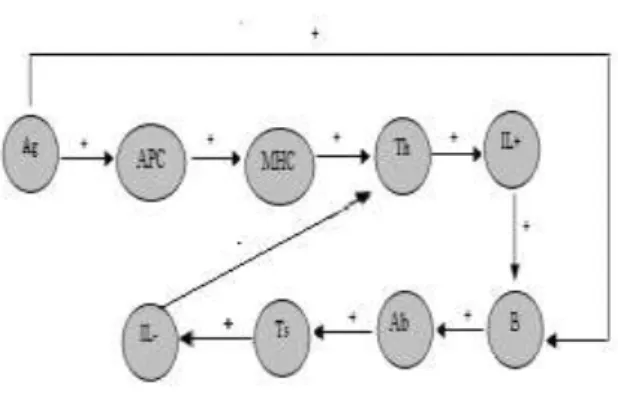
Figure 2. Our Complex adaptive artificial immune system (CAAIS) modeled in the background of the LFCM. Motor concept Th, after activation process, has two possible actions SELF and NO-SELF action as
response to environment.
Proposed framework for modeling and simulating natural immune system response as complex adaptive system is summarized in Figure 3. The main idea is a connection between the fuzzy cognitive maps and reinforcement learning. The first step is to model the system in the background of the proposed approach, i.e. the FCM. Then we describe the reflectors concepts, intermediates concepts and motors concepts, and in the last point of the first step, we determine and describe the relation or link between concepts with their values weight. In the second step, the system is capable of learning from experience with the environment using a reward-punishment procedure, called reinforcement learning based adaptive Q-learning algorithm (Figure 2).
Figure3. Framework of the proposed approach
Reinforcement learning is called on-line method in machine learning theory and the interaction between the learning NIS modeled and with environment, Figure 2, is its main source of intelligence. A most used RL algorithm is Q-Learning [9] in machine learning, works by learning an action-state value function that expresses cumulative reward of taking a given action in a given state.
Figure 4. The reinforcement learning model.
2.1. Fuzzy Cognitive Maps
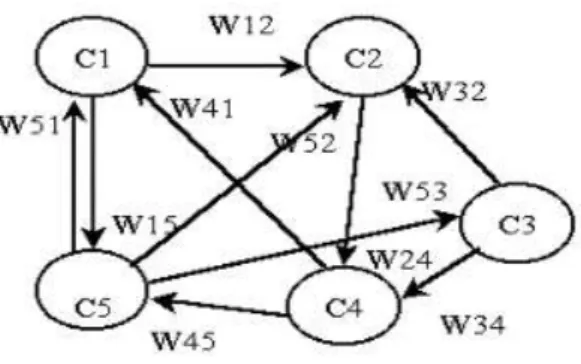
The term cognitive map (CM) appears for the first time in 1948's in article by E. Tolman [10] cognitive maps in rats and men to describe the abstract mental representation of space built by rats trained to navigate in the labyrinth. The term FCM (Fuzzy Cognitive Map) was introduced in 1986 by B. Kosko [2], to describe a simple extension of CMs by the combination of fuzzy logic and artificial neural networks. This robust combination given FCMs a structure similar to artificial recurrent neural networks (Artificial Recurrent Neural Network ARNN. FCMs (Figure 3) can describe the complex behavior of entities. They are represented as directed graphs whose nodes are concepts (classified into three types: sensory, motor and effectors) and the arcs represent causal relationships between these concepts. Each arc from one concept Ci to one concept Cj is associated with a weight wij reflecting a relationship of inhibition (wij <0) or excitation (wij > 0). Each concept is associated with a degree of activation, represent's the state at time t, and can be modified over time. The dynamics of an FCM can be summarized in one cycle (from t to t +1) by updating the activations vector.
Figure 5. An FCM as a graph
The following gives a formal description of an FCM [6]. K denotes one of the rings or , by δ one of the numbers 0 or 1, for V one of the sets {0, 1}, {-1.0, 1}, or [-δ,a]. Let (n, t0) ∈ IN² and k ∈ *+.
An FCM F is a sixfold (C, K, W, A, fa, R):
a. C = {C1,…,Cn} is the set of n concepts forming the nodes of a graph. b. K ⊂ C × C is the set of arcs (Ci, Cj) from Ci to Cj.
c. W: C×C→K
(Ci, Cj) → Wijis a function of C×C to IR associating a weight Wijto a pair of concepts(Ci, Cj), with Wij = 0 if (Ci, Cj) ∉ A, or Wij equal to the weight of the edge if (Ci, Cj) ∈ A. Note that W(C × C) = (Wij) ∈ Kn × nis a matrix of Mn (IR).
Ci →ai is a function that maps each concept Ci to the sequence of its activation degree at the moment t ∈ IN, ai (t) ∈ V is its degree of activation at the moment t. We Note a (t) = [(ai (t)) i ∈ [[1, n]]T the vector of activations at the moment t.
b. fa∈ (IRn) N is a sequence of vectors of forced activations such as for i ∈[1, n] and t ≥ t0 is the forced activation of the concept Ci at moment t.
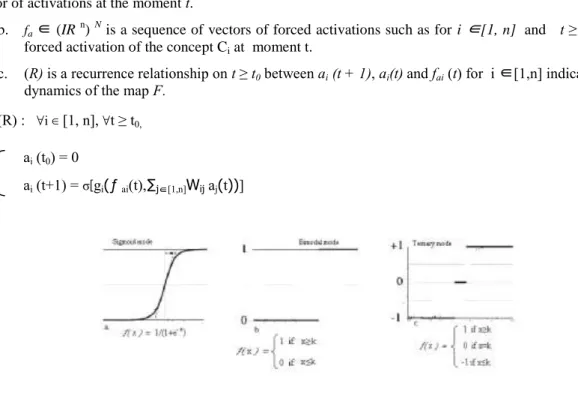
c. (R) is a recurrence relationship on t ≥ t0 between ai (t + 1), ai(t) and fai(t) for i ∈[1,n] indicating the
dynamics of the map F. (R) : ∀i ∈ [1, n], ∀t ≥ t0,
ai (t0) = 0
ai (t+1) = σ[gi(ƒai(t),∑j∈[1,n]Wij aj(t))]
Figure 6. Cognitive maps standardizing function.
The Mode represented by the function is to reduce the value of concepts within the range of values taken as the area and can be either binary, ternary and sigmoid. The value of each concept is calculated with original formula proposed by Kosko [2]:
Other alternatives are to take into account the past history of concepts and jointly proposed the following equation:
W
The Algorithm 1 shows the steps to follow for the calculation of the next input vector at each iteration.
Algorithm 1: Calculation of the output vector
Step 1: Read the input vector and weight matrix W
. Step 2: Calculate the output vector W
Step 3: Apply the transfer function to the output vector
Step 4: verify the conditions of termination of the algorithm 2.2. Basics Reinforcement Learning (RL)
The Markov Decision Processes (MDP) defines the formal framework of reinforcement learning [13]. More formally, an MDP process is defined by:
a. S, a finite set of states. s Є S
b. A, a finite set of actions in state s. a Є A(s) c. r, a reward function. r(s, a) Є R
d. P, the probability of transition from one state to another depending on the selected action. P (s '| s, a) = Pa(s, s').
The problem is to find an optimal policy of actions that achieves the goal by maximizing the rewards, starting from any initial state. At each iteration, the agent being in the state chooses an action, according to these outputs the environment sends either award or a penalty to the agent shown by the following formula: rk = h (sk, ak, sk+1).
To find the total cost, which is represented by the formula Σ h(sk,ak ,sk+1), the costs are accumulated at each iteration of the system. In [8] the expected reward is weighted by the parameter γ and becomes Σ γ h (si,ai,si+1) with 0 ≤ γ ≤ 1. The RL is to find a policy or an optimal strategy π*, among the different π possible strategies in the selection of the action. Considering that an optimal policy π exists, and then the Bellman [11] optimality equation is satisfied:
Vπ* = V*(si) = max {R(si,a) + δ(∑P(si→si+1,a) V*(si+1)}∀s∈S
Equation (2) sets the value function of the optimal policy that reinforcement learning will seek to assess:
V*(s) = max Vπ (s)
In Q-Learning algorithm technique [13], the agent, For any policy π and any state s ∈ S, the value of taking action a in state s under policy π, denoted Qπ(s,a), is the expected discounted future reward starting in s, taking a, and henceforth following π. In this case the function (3) can also be expressed for a state-action pair:
Q*(s,a) = max Qπ(s,a)
Q-learning is one of the most popular reinforcement learning methods developed by Watkins (1989) and is based on TD(0). It involves finding state-action qualities rather than just state values. Q-Learning
algorithm technique is to introduce a quality function Q represents a value for each state-action pair and Qπ
(s, a) is to strengthen estimate when starting from state s, executing action a by following a policy π: Qπ(s, a) = E Σγri and Q*(s, a) is the optimal state-action pair by following policy π* if Q*(s, a) = max Qπ(s, a) and
if we reach the Q*(si, ai) for each pair state-action then we say that the agent can reach the goal starting from
any initial state. The value of Q is updated by the following equation:
Q+1(si,ai) = Q (si,ai) + α[h(si,ai ,si+1) + γ arg max(Q (si+1,a)) – Q (si,ai)] 2.3. The adaptation of Learning Fuzzy Cognitive Maps
The rationale of the proposed immune response inspired LFCM is to foster learning capability and memory acquisition of the LFCM. To show how these two issues have been addressed, the Complex adaptive artificial Immune system has been considered and modeled in the background of presenting LFCM [15]. In immune response the ability to memorize most previously encountered antigens by B cells, enables it to mount a more effective reaction in any future encounters. This mechanism in the natural immune system is usually designed as the ability of adaptive learning and immune memory acquisition. This is the basis of mathematical adaptation of the Q-Learning algorithm in the sense of instructing the agent to consider optimally its history, ie the value of Q to aim to memorize the state visited by the agent. in others words, once the B cell identifies the interleukin substance from the Th cell concept, it divides into antibody synthetic cells, and finaly secretes the antibody (Ab).
The CASs are distinguished from other systems by their dynamic improvements in current policy for each interaction with the environment. So this is a local construction that does not require an assessment of the overall strategy. This observation leads us to overlook the value of the quality function Q in step (i+1). This translates mathematically by: Qn(si+1, a) = 0 and therefore equation (6) of the function Q becomes as follows:
Q (si, ai) = Q
(si,ai) + α [ri - Q
(si, ai)]
The value of Q enable system to mount a more effective action in any future encountered state already visited. So the Q value is designed to instruct the agent to consider optimally its historical past. If the agent is in a state already visited, with a Q value in the table of values, it will be directly exploited to move to the next state, otherwise it will explore the possible actions in this state according to their respective probabilities The following pseudo code provides an update of the value of Q function:
If r = 1 / / Award Q(si, ai) = Q
(si,ai) + α[1- Q
(si,ai)] If r = 0 / / Penalty
Q(si,ai) = (1 - α) Q(si,ai)
In our approach, if the states are represented after fuzzyfication by the concepts inputs or sensory concepts, the output vector is represented by the set of output concepts or effectors concepts that represent actions to perform in the environment after defuzzyfication. The motors concepts are the decision-making mechanism. The exploration of the actions is accompanied by an update of their probabilities according to the linear scheme [9]:
If r = 1 / / Award
P (si, ai) = P(si,ai) + β (1 - P(si,ai))
If r = 0 / / Penalty P(si, ai) = (1-β) P(si,ai)
2.4 Operational mechanism model
The mechanism to identify the nature of the antigen and the selecting of action to consider is summarized by the fuzzy rule based system. A set of IF-THEN linguistic rules, with the inputs and the outputs are composed of fuzzy statements, is the essential part of the fuzzy rule:
IF a set of conditions are satisfied THEN a set of results can be inferred
In this proposed approach, the weights, wij, are dynamic and can be modified according to reinforcement learning algorithm to permit the network to be trained by experience [20]. Based on the theoretical aspects described above, the pseudo code of Algorithm 2 summarizes our approach. Algorithm 2: Pseudo code of the proposed approach
Step 1: Read the vectork and weight matrixW
Step 2: Calculate the output vector k: kkk W Step 3: Apply the transfer functionto the output vector k
Step 4: Among the active concepts choose the one that has the highest value of the function Q, if not probability
Step 5: calculate the new output vector (output concepts) k Step 6: Depending on the response to the environment:
If r = 1 / / Award
(Updating the probability Pij and the Q value) Q (si, ai) = Q
(
si,ai) + α [1 – Q
(si,ai)] WCi,Cj) = WCi,Cj)
P(ai) = P(ai) + β [1 - P(ai)] If r = o / / Penalty
(Updating the probability Pij, the weight of the connection and the value of Q) Qk (s
i, ai)) = (1- α) Qk (si, ai) WCi,Cj) = W
Ci,Cj) +η [1 - W
Ci,Cj)] P(ai) = (1-β) P(ai)
Step 7: If the termination conditions are realized Stop. Otherwise go to Step 2.
3. RESULTS AND ANALYSIS
To evaluate the performance of our proposed approach, the simulation of the system was implemented in MATLAB, which comprises Fuzzification and defuzzification with FCM modeling [22]. Table 2 shows weight values between concepts after deffuzification process in the bimodal
mode. The main purpose of the immune system is to recognize all cells within the body and categorize those cells as self or non-self. Activation of T cells by antigen-presenting cells (APCs), with the accessory concept MHC, in lymph nodes is a key initiating event in natural immune responses. In this case the Th concept (Th cells) is considered as the motor concept and the all others concepts are considered as accessory concepts. T cells are able alone to differentiate between self and no self (antigens) cells. T cell receptors scan the surface of APC for specific peptides bound to molecules of the MHC. If the specific peptides are found, the Th cell is activated, so the no-self action is executed and the antibody will be secreted, otherwise the antigen is recognized as self cell then the self action is executed and the immune response is terminated.
Table 1. Concept Description of The CAAIS in LFCM Background Concepts Description
Ag Antigens (virus and bacteria) APC Antigen Presenting Cells MHC Major Histocompatibility Complex
molecule Th The Helper T cell
IL+ The interleukin positive signal secreted by Th cell
B B Cell
Ab Antibody produced by B cells Ts The suppressor T cell IL- The interleukin negative signal
secreted by Ts cell
The number of concepts has been reduced to 9 concepts thus to avoid the complexity of the CAAIS modeled in this LFCM type and for the proposed technique to be more clear to no specialist readers we use fuzzyfied binary mode. Concepts Ag and Ab are the Factor-concepts (sensory concepts and effectors concepts respectively), which represent the input and output concept (in term of interaction with the environment).
Table 2. Weight Values Between Concepts in the Bimodal Mode Concepts Ag APC MHC Th IL+ B Ab Ts IL- Ag 0 +1 0 0 0 +1 0 0 0 APC 0 0 +1 0 0 0 0 0 0 MHC 0 0 0 +1 0 0 0 0 0 Th -1 0 0 0 +1 0 0 0 0 IL+ 0 0 0 0 0 +1 0 0 0
B 0 0 0 0 0 0 +1 0 0
Ab -1 0 0 0 0 0 0 +1 0
Ts 0 0 0 0 0 0 0 0 +1
IL- 0 0 0 -1 0 0 0 0 0
The W matrix link associated to this model can be written as follows:
The FCM (Figure 2) has twelve edges and nine concepts with links excitatory (+1) of 'Ag' to 'APC','APC' to 'MHC', 'MHC' to 'Th', 'Th' to 'IL+', 'IL+' to 'B', 'B' to 'Ab', 'Ab' to 'Ts' and 'Ts' to 'IL-' , and linked inhibitor (-1) of 'Ab' to 'Ag', 'IL-' to 'Th' and 'Th' to 'Ag'.
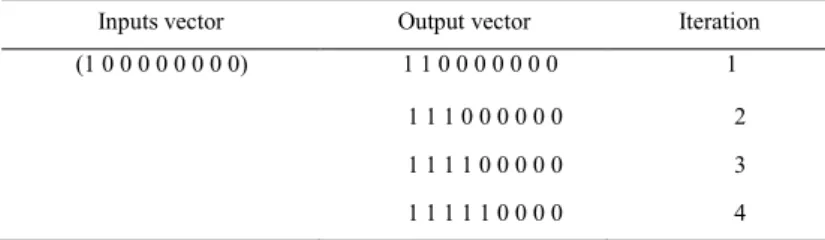
The concept is active if its value is equal to 1, otherwise it is inactive (binary mode). It is given an initial activation vector A = (1 0 0 0 0 0 0 0 0). Table I show‟s the values P(ai) of the probabilities of actions and values of the function Q updated at each iteration. Table II gives the output vector for all iterations in response to the environment.
Table 3. Action Probabilities and Q-Function Values ai P(ai) Q(si, ai) Value
self no-self
0.5 0.5
(Agi,self) (Agi,no-self)
0 0
Table 4. Vector Output at Each Iterations
Inputs vector Output vector Iteration (1 0 0 0 0 0 0 0 0) 1 1 0 0 0 0 0 0 0 1
1 1 1 0 0 0 0 0 0 2 1 1 1 1 0 0 0 0 0 3 1 1 1 1 1 0 0 0 0 4
At iteration n° 4 the immune system is facing a situation where it has two possible actions, if the state is not encountred, represented by the active concepts Th, the execution of the action SELF leads to the deactivation of Ag concept and execution of the action NO-SELF leads to the activation of the B concept (through IL+ concept) aims to neutralize the antigen but must choose one among them and this choice is guided either by the value of function Q, if the state is already visited or antigen already encountered, or by the value of the probability of the action if the first pass in this state. This mechanism to identify the nature of the antigen and the selecting action to consider is summarized by the following three fuzzy rule based system:
R1 : if Ag is Q(Ag,SELF) then Th is SELF-action
R2 : if Ag is Q(Ag, NO-SELF) then Th is NO-SELF-action.
R3 : if Ag is not Q(Ag, SELF) and Ag is not Q(Ag, no-self) then Th is action to perform selected according to the probability.
In this system based on rules the conditions of the first two rules R1 and R2 result that system has met the antigen before and classify it as a part of the self or no-self by the update table of Q values, for moreover the R3 rule requires the Th concept to exploit space of possible actions according to their respective probabilities.
4. CONCLUSION
The soft computing technique of fuzzy cognitive maps for modeling and simulating complex adaptive system has been discussed in this paper. A new connection between fuzzy system and reinforcement learning has been proposed for analyzing natural immune system response. In the artificial intelligence field the natural immune system NIS is argued that it is a complex adaptive system. Global emergent behaviors can be observed by applying local rules to individual cells as described by Holland in complex adaptive system theory. The complexity and criticism raised by the community in the area of modeling CASs by ABMs and CAs, led us to seek another approach, which is contained in same concepts inspired by the area of life. In psychology behavior is generally related to the concepts of emotions, perceptions and sensations. These key concepts of life can be supported by FCMs. CASs are therefore in the field of artificial life more than other areas of computing. The area of FCMs, despite the improvement made by different research teams in the world, remains an area dense, low-unified.
ACKNOWLEDGEMENTS
This paper is the result of a research project entitled "Modeling and implementing of complex adaptive systems" which was supported by the MISC laboratory of abdelhamid mehri University, Algeria. We thank all the laboratory teams and responsible for their cooperation and supports.
REFERENCES
[2] Kosko B., Fuzzy Cognitive Maps, International Journal Man-Machine Studies, 24:65-75, 1986
[3] Maikel León1, Ciro Rodriguez1, María M. García1, Rafael Bello1, and Koen Vanhoof „Fuzzy Cognitive Maps For Modeling Complex Systems‟. © Springer-Verlag 2010.
[4] Chrysostomos D. Stylios and Peter P.Groumpos. „Modeling Complex Systems Using Fuzzy Cognitive Maps'. IEEE transactions on systems, Man and cybernetics. January 2004.
[5] Tahar Guerram1, Ramdane Maamri2 and Zaidi Sahnoun2'A Tool for Qualitative Causal Reasoning On Complex Systems'. IJCSI International Journal of Computer Science Issues, Vol. 7, Issue 6, November 2010 ISSN (Online): 1694-0814.
[6] C. Buche, P. Chevaillier, A. N´ed´elec, M. Parentho¨en and J. Tisseau „Fuzzy cognitive maps for the simulation of individual adaptive behaviors‟ Wiley Online Library 2010
[7] Elpiniki Papageorgiou and Peter Groumpos. „A Weight Adaptation Method for Fuzzy Cognitive Maps to a Process Control Problem‟. Springer 2004
[8] Richard S. Sutton and Andrew G. Barto. „Reinforcement Learning: An Introduction‟. A Bradford Book The MIT Press Cambridge, Massachusetts London, England 2005
[9] “TSP Home page”, http://comopt.ifi.uni-heidelberg.d/software/TSPLIB/index.html [10]E. Tolman. Cognitive maps in rats and men. Psychological Review volume55 , 1948. [11]Thomas J. Sargent, Dynamic Macroeconomic Theory, Section 1.1-1.4.
[12]Wei Wang, Shangce Gao, Zheng Tang. 'A Complex artificiel immune system' Fourth International Conference on Natural Computation. 2008 IEEE.
[13]E.A. Jasmin. T.P. Imthias Ahamed. V.P. Jagathy Raj. „Reinforcement Learning approaches to Economic Dispatch problem‟. Elsevier_ 2011.
[14]Eva Volna1 'Neuroevolutionary optimization'. IJCSI International Journal of Computer Science Issues, Vol. 7, Issue 2, No 4, March 2010 ISSN (Online): 1694-0784.
[15]Ahmed Tlili, Salim chikhi 'Modeling Complex Adaptives Systems using Learning Fuzzy Cognitive Maps'. Internantional Journal of Computer Application IJCA. Volume 53 No 3 2012.
[16]Thorne, B. C., A. M. Bailey, D. W. DeSimone, and S. M. Peirce. Agent-based modeling of multicell morphogenic processes during development. Birth Defects Res. C Embryo Today 81:344–353, 2007. [17]Chavali, A. K., E. P. Gianchandani, K. S. Tung, M. B. Lawrence, S. M. Peirce, and J. A. Papin.
Characterizing emergent properties of immunological systems with multicellular rule-based computational modeling. Trends
[18]Immunol. 29:589–599, 2008.
[19]H. Atlan, “The living cell as a paradigm of complex natural systems,” Complexus, vol. 18, no. 6–7, pp. 764–766, 2003.
[20]Minakshi Sharma , Dr. Sourabh Mukherjee. "Fuzzy C-Means, ANFIS and Genetic Algorithm for Segmenting Astrocytoma –A Type of Brain Tumor".IAES International Journal of Artificial Intelligence (IJ-AI) Vol. 3, No. 1, March 2014, pp. 16~23.
[21]HOPFIELD, J. J. & TANK, D. W. (1986). Computing with neural networks: a model. Science 233, 625-633.
[22]Jean Holland. 'Studying Complex Adaptives Systems'. 2006 Springer Science + Business Media, Inc. [23]Beale, M. and H. Demuth, 1994. Fuzzy systems 27. Al-Emran A., P. Kapur D. Pfahl and G. Ruhe, 2010.
toolbox: For use with MATLAB PWS Publishing Studying the impact of uncertainty in operational Company.
BIBLIOGRAPHY OF AUTHORS
Ahmed Tlili was born in Constantine, Algeria on Mar 21, 1977. He received the Magister degrees from Elhadj Lakhdar University of Batna, Algeria, in 2007. In 2010, he joined the Department of Computer Science and its Applications, News Faculty of Information Technologies and Communication Abdelhamid Mehri University, Constantine as a student researcher. His interesting areas are Artificial Intelligence, software engineering, Neural network, Fuzzy logic and Fuzzy Inference System.