Experimental Study on Effective Utilization of
E-Waste in Concrete
S.P.Kanniyappan
1, C.Lavanya
2Assistant Professor, Department of Civil Engineering, Adhiparasakthi Engineering College, Melmaruvathur,India1
Assistant Professor, Department of Civil Engineering, Adhiparasakthi Engineering College, Melmaruvathur, India1
ABSTRACT: Electronic waste or E-waste is waste electronic and electrical equipment is an emerging issue posing serious pollution problems to the human and the environment. New effective waste management options need to be considered especially on recycling concepts. Now-a-days, the disposal of electronic waste becomes a tedious process as it is a non-degradable material. So by using those electronic wastes in concrete, we can achieve more strength and also it is economic in construction. This paper presents the results of an investigation to study the performance of concrete prepared with E-waste as a partial replacement of coarse aggregate.
KEYWORDS: Cement, Coarse aggregate, Fine aggregate, E-waste, Compressive strength, Split tensile strength and flexural strength.
I. INTRODUCTION
The generation of E-waste is the fastest growing area and the disposal poses a major problem in the related neighbourhood. The use of recycled plastic in the manufacturing of new plastic consumes considerable energy, raw material use and wear and tear on machinery. The use of recycled materials in construction applications is among the most attractive option because of the large quality demand, low quality requirements and widespread extent of construction. The use of E-waste plastic cement concrete aggregate has been focused in this investigation as a viable solution to the problem of recycling costs and high disposal costs. The various possibilities of recycling the plastics such as coke oven process, Thermal recycling, Mechanical recycling etc. The major challenge for the plastic waste recycling is the need for a continuous and stable supply of materials to be recycled and lack of cost effective technologies for recycling.
Several research works carried out to examine the possibility of reusing waste recycled glass in concrete and construction applications as an alternative solution to the growing quantity of waste recycled glass.
E-waste describes discarded computers, circuit boards, transistors, TV, broken electrical and electronic devices as shown in fig.1. Rapid technology change, low initial cost has resulted in a fast growing surplus of electronic waste around the globe. E-waste is one of the fastest growing waste streams in the world. In developed countries, previously, it was about 1% of total solid waste generation and currently it grows to 3% by 2015. In developing countries, it ranges 0.01% to 3% of the total municipal solid waste generation. Several tones of E-waste need to be disposed every year. Traditional landfill or stockpile method is not environmental friendly solution and the disposal process is also very difficult.
Looking to the global issue of environmental pollution by E-waste, research efforts have been focused on consuming this waste on massive scale in efficient and environmental friendly manner. Researchers plan to use E-waste in form of concrete ingredient as the concrete is second most sought material by human beings after water. E-waste in concrete will not only be its safe disposal method but adding admixtures may also improve the concrete properties like compressive, tensile and flexural strength.
be carried out for the concrete construction at particular place with the partial replacement of coarse aggregate by E-waste. The results of the studies will include the workability and characteristic strength of E-waste concrete.
Fig.1 shows the view of Electronic wastes or E-waste (a) Electronic chip boards (b) Chip removed electronicboards (c) Crushed electronic waste
(a) (b) (c)
II. EXPERIMENTAL INVESTIGATION
Materials used and its Properties
The materials used for this study were initially tested. The test was carried out for different materials such as aggregates and cement and their results were listed in tables.
Cement
Portland Pozzolana Cement (PPC) is manufactured by the intergrinding of OPC clinker with 10 to 25 per cent of pozzolanic material (as per the latest amendment, it is 15 to 35%). The pozzolanic materials generally used for manufacture of PPC are Calcined clay (IS 1489 Part 2 of 1991) or Fly ash (IS 1489 Part 1 of 1991). Portland Pozzolanacement of 53 grade confirming to IS 1489 was used in the present study. The properties of cement are shown in Table 1.
Table 1 Properties of Cement
Sl.No. Property Result
1 Standard consistency 26%
2 Initial setting time 40 minutes
3 Final setting time 8 hours
4 Specific Gravity 3.187
Coarse Aggregate
Crushed aggregate confirming to IS 2386(Part I)-1963 was used. Aggregates of size 20mm has been selected for the study. The properties of the coarse aggregate are shown in Table 2.
Table 2 Properties of Coarse Aggregate
Sl.No. Property Result
1 Fineness Modulus 2.88%
2 Aggregate crushing value 24.46%
3 Aggregate Impact value 26%
5 Water absorption value 2%
6 Flakiness index 6.75%
7 Elongation index 51.05%
Fine Aggregate
Natural sand with fraction passing through 4.75mm and retained on 600 micron sieve is used and will be tested as per IS 2386(Part I)-1963. The properties of the fine aggregate are shown in Table 3.
Table 3 Properties of Fine Aggregate
Sl.No. Property Result
1 Fineness Modulus 2.692%
2 Bulkiness of Sand 11.11%
3 Specific gravity 2.44
Mix Proportioning
Concrete mix design for this experiment was designed as per the guidelines of Indian standards. All the samples were prepared using nominal mix. M25 grade of concrete was used for the present investigation. The table 4 shows mix proportioning of concrete.
Table 4 Mix proportioning
Water Cement Fine Aggregate Coarse Aggregate
140 litres 310 Kg/m3 310 Kg/m3 620 Kg/m3
0.45 1 1 2
Fresh concrete
The fresh concrete is made with the nominal mix ratio as per design standards for M25 grade concrete and the workability of the concrete were tested. The properties of fresh concrete are given in table 5.
Table 5 Properties of Fresh concrete
Sl.No. Property For standard concrete For E-waste concrete
1 Slump value 50 mm True Slump
2 Flow value 30% 20%
3 Compaction factor 95.88% 88.26%
III.EXPERIMENTAL PROCEDURE
The specimen of standard cube of size 15cmx15cmx15cm and standard cylinder of size 30cm height and 15cm diameter and slab of size 10cmx10cmx50cm were used to determine the compressive strength, split tensile strength and flexural strength of concrete. These specimens were tested on 7th, 14th&28thdays with proportions of standard, 10%, 20% & 30% replaced E-waste concrete.
Experiments Conducted
The following experiments were conducted on the specimens casted.
Compression test
Split tensile test
Flexural test
Compression Test
strength. The cube specimen is of the size 15 x 15 x 15 cm were tested for compressive strength as per IS 516-1959 using a calibrated compression testing machine.
Split Tensile test
Split tensile strength of concrete is usually found by testing concrete cylinder of size 30cm height and 15cm diameter. The specimens were tested for its tensile strength as per IS: 516-1959 using a calibrated compression testing machine.
Flexural Strength Test
Flexural strength is the one of the measure of tensile strength of concrete. It is the ability of a beam to resist failure in bending. It is measured by loading un-reinforced slab or prism of size 10cm x 10cm x 50cm. The specimens were tested for its flexural strength as per IS: 516-1959 using a calibrated flexural testing machine.
IV.EXPERIMENTAL RESULTS
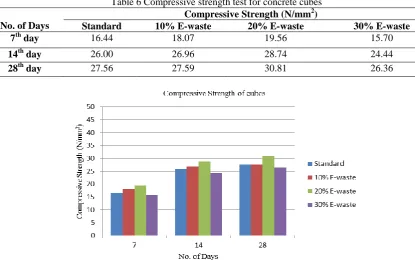
The Compressive strengthtest results of the hardened concretecubes for standard, 10%, 20% & 30% E-waste concrete for 7, 14 and 28 days were given in table 6 with its graphical representation.
Table 6 Compressive strength test for concrete cubes
No. of Days
Compressive Strength (N/mm2)
Standard 10% E-waste 20% E-waste 30% E-waste
7th day 16.44 18.07 19.56 15.70
14th day 26.00 26.96 28.74 24.44
28th day 27.56 27.59 30.81 26.36
The Split tensile strength test results of the hardened concrete cylindersfor standard, 10%, 20% & 30% E-waste concrete for 7, 14 and 28 days were given in table 7with its graphical representation.
Table 7 Split tensile strength test for concrete cylinders
No. of Days
Split Tensile Strength (N/mm2)
Standard 10% E-waste 20% E-waste 30% E-waste
7th day 3.18 3.50 3.82 3.37
14th day 4.77 5.12 5.41 5.06
The Flexural strength test results of the hardened concrete slabsfor standard, 10%, 20% & 30% E-waste concrete for 7, 14 and 28 days were given in table 8with its graphical representation.
Table 8 Flexural strength test for concrete slabs
No. of Days
Flexural Strength of Slabs (N/mm2)
For Standard 10% E-waste 20% E-waste 30% E-waste
7th day 4.00 4.00 4.20 4.00
14th day 4.60 4.80 5.07 4.40
28th day 5.20 5.40 5.50 3.63
V. CONCLUSION
In this project, the Compressive strength, split tensile strength and Flexural strength have been studied for various replacements of coarse aggregate by E-waste. From the results we have chosen the optimum percentage of replacement is 20%, which gives the strength more than the conventional concrete.
REFERENCES
[1] R.Lakshmi and S.Nagan, “Investigation on Durability Characteristics of E-Plastic Waste Incorporated Concrete”, Asian Journal of Civil Engineering (Building and Housing) Vol. 12, No. 6 (2011) Pages 773-787, April-2011.
[2] A.Bhogayata, K.D.Shah, B.A.Vyas, Dr.N.K.Arora, “Performance of Concrete by using Non-recyclable Plastic Waste and Concrete Constituent”, International Journal of Research and Technology, Vol.1, Issue No.4, June-2012.
[3] Hai-Yong Kang, Julie M. Schoenung, “Electronic Waste Recycling: A Review of U.S. Infrastructure and Technology options”, Resource, Conservation and Recycling, Vol.45, Pages 368-400, July 2005.
[4] Lakshmi.R, Sivagangaiand Nagan.S, “Studies on Concrete containing E Plastic waste” International Journal of Environmental Science, Volume 1, No 3, 2010.
[5] M Sivaraja, S Kandasamy and A Thirumurugan, “Mechanical Strength of Fibrous Concrete with Waste Rural Materials”, Journal of Scientific and Industrial research, Vol.69, Pages 309-312, April 2010.
[6] Shamsad Ahmad, “Techniques for Inducing Accelerated Corrosion of Steel in Concrete”, Arabian Journal for science and engineering, 2009.
[7] IS 10262: 2009 “Concrete Mix Proportioning – Guidelines”, Bureau of Indian Standards, New Delhi 110 002.
[8] M.S. Shetty, “Concrete Technology” Theory and Practice, S.Chand& Company Limited, Ram Nagar, New Delhi 110 055. [9] S.K. Khanna, C.E.G. Justo, “Highway Engineering”, Nemchand& Bros, Roorkee.