IBRAHIM, KHALED ZAKARYA. Slipstream Execution Mode for CMP-based Shared Memory Systems. (Under the direction of Dr. Gregory T. Byrd.)
Scalability of applications on distributed shared-memory (DSM) multiprocessors is limited by communication and synchronization overheads. At some point, using more processors to increase parallelism yields diminishing returns or even degrades performance. When increasing concurrency is futile, we propose an additional mode of execution, called slipstream mode, that instead enlists extra processors to assist parallel tasks by reducing perceived overheads.
We consider DSM multiprocessors built from dual-processor chip multiprocessor (CMP) nodes (e.g., IBM Power-4 CMP) with shared L2 cache. A parallel task is allocated on one processor of each CMP node. The other processor of each node executes a reduced version of the same task. The reduced version skips shared-memory stores and synchronization, allowing it to run ahead of the true task. Even with the skipped operations, the reduced task makes accurate forward progress and generates an accurate reference stream, because branches and addresses depend primarily on private data.
Slipstream execution mode yields multiple benefits. First, the reduced task prefetches data on behalf of the true task. Second, reduced tasks provide a detailed picture of future reference behavior, enabling a number of optimizations aimed at accelerating coherence events. We investigate a well-known optimization, self-invalidation. We also investigate providing confidence mechanism for speculation after barrier syn-chronization.
We investigate the implementation of an OpenMP compiler that supports slip-stream execution mode. We discuss how each OpenMP construct can be implemented to take advantage of slipstream mode, and we present a minor extension that allows runtime or compile-time control of slipstream execution. We also investigate the inter-action between slipstream mechanisms and OpenMP scheduling. Our implementation supports both static and dynamic scheduling in slipstream mode.
12-We extended slipstream mode to provide a confidence mechanism for barrier spec-ulation. This mechanism identifies dependencies and tries to avoid dependency vi-olations that lead to misspeculations (and subsequently rollbacks). Rollbacks are reduced by up to 95% and the improvement in performance is up to 13%.
by
Khaled Z. Ibrahim
A dissertation submitted to the Graduate Faculty of North Carolina State University
in partial satisfaction of the requirements for the Degree of
Doctor of Philosophy
Department of Electrical and Computer Engineering
Raleigh 2003
Approved By:
Dr. Eric Rotenberg Dr. Frank Mueller
Dr. Gregory T. Byrd Dr. Thomas M. Conte
Biography
Acknowledgements
First, I would like to thank God Almighty for his help to complete this work.
I owe an immense debt to my advisor Dr. Gregory T. Byrd. Without his direction, I would not have got my thesis to reach this shape. Dr. Byrd provided me continuous encouragement and patient advice that empowered me to move ahead. He was deeply engaged with me from the formative stage, through the refining of this work, to the final writing. His deep understanding both technically and personally makes me feel always respectful and grateful to him.
I would like also to acknowledge the help I received from Dr. Eric Rotenberg who was deeply involved in this work. I always found his critics very enlightening. He helped in developing and refining many parts of this work.
For their positive critiques, I feel very thankful to my advisory committee, Dr. Thomas M. Conte and Dr. Frank Mueller.
Contents
List of Figures viii
List of Tables x
1 Introduction 1
1.1 Motivations . . . 1
1.2 Research Objectives . . . 5
1.3 Contributions . . . 6
1.4 Thesis Outline . . . 7
2 Related Work 8 2.1 Latency Hiding Techniques . . . 8
2.1.1 Microarchitecture Approaches . . . 9
2.1.2 Prefetching . . . 10
2.1.3 Coherence Optimization . . . 10
2.1.4 Self-invalidation . . . 11
2.2 Synchronization Overhead Reduction/Hiding Techniques . . . 12
2.2.1 Critical Sections . . . 13
2.2.2 Barrier Synchronization . . . 13
2.3 Future Information Based Speculation . . . 14
2.3.1 Slipstream Paradigm . . . 14
2.3.2 Pre-execution/Pre-computation Paradigms . . . 15
3 Slipstream for Shared Memory Systems 16 3.1 Shared Variables vs. Local Variables . . . 17
3.2 CMP Based Shared Memory System . . . 17
3.2.1 Forming Shorter Stream . . . 18
3.2.2 L1/L2 Coherence for Slipstream . . . 20
3.2.3 Stream Synchronization . . . 21
3.2.4 Deviation Detection/Recovery . . . 24
4 Slipstream Software Support 25
4.1 ANL Macros . . . 25
4.1.1 Limitations . . . 28
4.2 OpenMP Support . . . 28
4.2.1 OpenMP Overview . . . 29
4.2.2 Requirements for Slipstream Mode . . . 30
4.2.3 Scheduling Strategies . . . 35
4.2.3.1 Static Scheduling . . . 35
4.2.3.2 Dynamic Scheduling and Guided Scheduling . . . 36
4.2.4 Slipstream Directives . . . 37
4.2.5 Slipstream-aware OpenMP Compiler . . . 38
4.2.5.1 Omni Compiler Overview . . . 38
4.2.5.2 Extending Omni Compiler . . . 40
5 Slipstream-based Latency Hiding 42 5.1 Simulation Environment . . . 43
5.2 Slipstream Prefetching . . . 44
5.2.1 Performance of Slipstream Mode with Prefetching only . . . . 46
5.2.2 Slipstream Prefetching with Dynamic Scheduling . . . 56
5.3 Slipstream Self-invalidation . . . 59
5.3.1 Transparent Load . . . 60
5.3.2 Future Sharers and Self-invalidation . . . 61
5.3.3 Performance of Transparent loads and Self-invalidation . . . . 62
5.4 Possible Enhancements . . . 65
6 Identification of Last Access or Write 66 6.1 Importance of Identifying Last Access or Write . . . 66
6.2 Assessing the Quality of a Signature . . . 67
6.3 PC-Based Last-Touch Prediction Schemes . . . 68
6.3.1 Implementation of a Signature Harvesting Scheme . . . 72
6.3.1.1 Convergence . . . 76
6.3.1.2 Accuracy of Signature Harvesting Scheme . . . 77
6.3.1.3 Requirements of the Harvesting Algorithm . . . 78
6.3.1.4 Accuracy of Slipstream Signature Collection . . . 78
6.3.1.5 Sensitivity to the Count of Branches . . . 79
6.4 Counter Signature . . . 81
6.5 Temporal Locality and Access Clustering for Cache Lines . . . 83
6.6 Tracking Last Touch/Write for CMP . . . 87
6.7 Identification of Lines to Be Accessed . . . 88
7 Slipstream-based Synchronization Speculation 96
7.1 Barrier Synchronization . . . 96
7.2 Barrier Speculation Overview . . . 98
7.2.1 Speculation Initialization . . . 98
7.2.2 Managing Speculative State . . . 101
7.2.3 Speculation Violations and Rollbacks . . . 102
7.2.4 Speculation Success and Committing Speculative State . . . . 102
7.3 Barrier Speculation Overheads . . . 103
7.3.1 Memory Updates . . . 103
7.3.2 Rollback and Flushing Corrupted Lines . . . 103
7.3.3 Lazy Context Switch of Coprocessor Registers and Speculation . . . 104
7.3.3.1 Overview of Lazy Context Switch . . . 104
7.3.3.2 Lazy Context Switch and Speculation Mechanism . 105 7.3.3.3 Proposed Solutions . . . 105
7.3.4 Dependency Violation Problems . . . 106
7.3.5 Livelock Under Speculative Execution . . . 107
7.3.6 Rollback Cost . . . 107
7.3.7 Reducing Speculation Overheads . . . 108
7.4 Confident Barrier Speculation and Slipstream Support . . . 109
7.4.1 Speculation Blocking . . . 109
7.4.1.1 Cache Overflow Blocking . . . 109
7.4.1.2 Kernel Enter Blocking . . . 110
7.4.1.3 Maximum Speculation Attempts Blocking . . . 110
7.4.1.4 Non-speculative Barrier . . . 111
7.4.2 Avoiding False Rollback . . . 111
7.4.3 Avoiding Anti-dependence Rollbacks . . . 112
7.4.4 Livelock Avoidance . . . 113
7.4.5 Avoiding True Dependency Rollbacks . . . 114
7.4.5.1 Avoiding Rollback Under Producer-Consumer Relation 114 7.4.5.2 Avoiding Rollback for Migratory Data . . . 116
7.4.5.3 Handling A-stream Requests . . . 118
7.5 Simulation Methodology and Results . . . 119
8 Conclusions and Future Work 131 8.1 Pros and Cons of Slipstream Execution Mode . . . 133
8.2 Future Work . . . 134
List of Figures
1.1 Relative speedup of two tasks per CMP (double mode) vs. one task
per CMP (single mode). . . 2
1.2 Execution time breakdown for Water-NS on 2, 4, 8, and 16 CMPs systems running in single and double modes. . . 3
3.1 Portion of a Red-Black SOR kernel. . . 17
3.2 Slipstream Synchronization Model . . . 23
4.1 Using AR BARRIER in OCEAN multigrid. . . 28
4.2 OpenMP Laplace solver . . . 31
4.3 Overview of Omni OpenMP Compiler . . . 41
5.1 Execution modes for CMP-based multiprocessors. . . 43
5.2 CMP based CC-NUMA system. . . 47
5.3 Speedup of single mode for 2, 4, 8, and 16 CMPs. . . 48
5.4 Speedup of slipstream and double modes, relative to single mode. . . 49
5.5 Execution time breakdown for single (S), double (D), and slipstream modes (A and R). . . 53
5.6 Breakdown of memory requests for shared data. . . 54
5.7 Execution time breakdown for single, zero-token global slipstream mode (dynamic scheduling). . . 58
5.8 Breakdown of memory requests for shared data (dynamic scheduling). 58 5.9 Slipstream-based self-invalidation. . . 62
5.10 Transparent load breakdown. . . 63
5.11 Accuracy of slipstream-based SI. . . 64
5.12 Performance of slipstream with transparent loads and SI, relative to the better of single and double modes. . . 65
6.1 Last access/write definition and different ambiguity types. . . 69
6.2 Ambiguity associated with different signature schemes (considering only write accesses) for a simple loop. . . 70
6.4 Last write ambiguity for different signatures. . . 74
6.5 Signature collection tables. At any given moment, there are no two identical pattern with stable state. . . 75
6.6 A difficult to collect signature scenario. . . 77
6.7 Accuracy of the harvesting scheme (for signatures collected by the R-stream). . . 78
6.8 Matching accuracy of the A-stream collected signature (relative to sig-natures collected by the R-stream). . . 80
6.9 Sensitivity of (PC, access word, and branch outcomes) signature scheme to changing the number of branch outcomes. . . 81
6.10 Matching accuracy between A-stream and R-stream for the counter signature. . . 82
6.11 Combined distribution of inter access-time for all applications considered. 84 6.12 Distribution of inter-interval for writes and both reads and writes access for the cache block. . . 90
7.1 Speculative tree barrier structure used in this study. . . 100
7.2 Lock-based speculative barrier. . . 101
7.3 Live-lock due to barrier speculation. . . 107
7.4 Slipstream based premature migration prevention. . . 116
7.5 Protecting migratory data from migration to speculative process. . . 117
7.6 Summary of the additional bits required in the cache and the directory per cache line. . . 119
7.7 Contribution of barrier and wait time to the total execution time. . . 121
7.8 Performance of different barrier speculation mechanisms. . . 122
7.9 Speculations attempts and rollback decomposition. . . 124
7.10 Rollack evicted lines for cached and uncached data. . . 125
7.11 Causes for speculation blocking for different schemes. . . 127
7.12 Decomposition of data read and written during speculation for different schemes. . . 128
7.13 Performance of barrier speculation with dependency checkingvs. using the CMP differently. . . 129
List of Tables
5.1 System parameters of the simulated machine. . . 44 5.2 NAS-NPB 2.3 and SPLASH2 Benchmarks used in this study. . . 45 6.1 Benchmarks used and their problem sizes. . . 71 6.2 Average percentages of signature ambiguities for all applications.
Per-centages within bracket exclude LU (C&NC) applications. . . 72 6.3 Maximum number of signatures and the maximum count of
interme-diate signatures for (PC, access word, branch outcome) signature. . . 79 6.4 Counter signature average access count and standard deviation. . . . 83 6.5 Number of cycles needed to achieve 80%, 90%, 95%, and 99% coverage
Chapter 1
Introduction
1.1
Motivations
Scalability for many parallel programs is limited by communication and synchro-nization overheads. A performance threshold is reached (for a fixed problem size), and applying more processors results in little or no speedup. The only means for moving beyond this threshold is to increase efficiency – to identify and remove bottlenecks and overheads and more effectively use the parallel computing resources.
In this work, we consider the use of a dual-processor chip multiprocessor (CMP) as the building block of a distributed shared memory multiprocessor. Examples of academic and commercial chip multiprocessors are the Stanford Hydra [38] and IBM Power-4 [20], respectively.
The philosophy behind putting multiple cores on one die is to extract more paral-lelism by executing more than one thread at once. Multiple threads are expected to provide more opportunities of parallelism that can keep more functional units busy, compared with having all the functional units in a unified processor. This design view continues the trend of concentrating more on compute-centric microarchitecture de-sign. Communications is always being thought as a separate design issue. Although evolved in the era when computations were more expensive than communication. This view is still driving the microarchitecture industry today.
2 4 6 8 10 12 14 16 0.8
1.0 1.2 1.4 1.6 1.8 2.0
Speedup of two tasks/CMP (Double) relative to one task/CMP (Single)
CMP Count
WATER-SP MG SOR CG WATER-NS OCEAN Single
Figure 1.1: Relative speedup of two tasks per CMP (double mode) vs. one task per CMP (single mode).
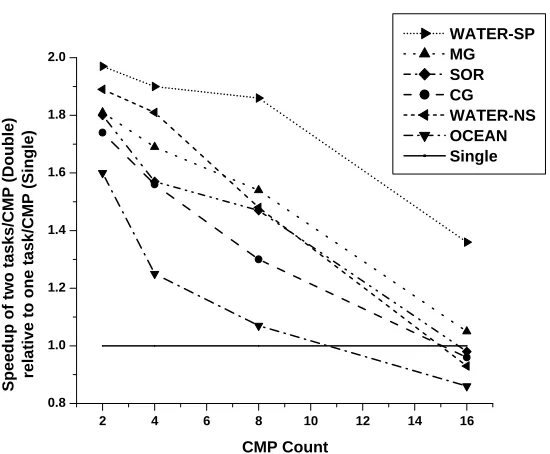
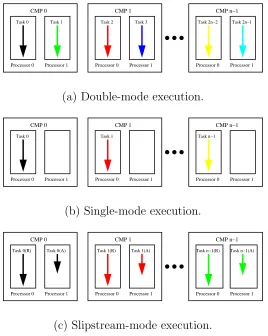
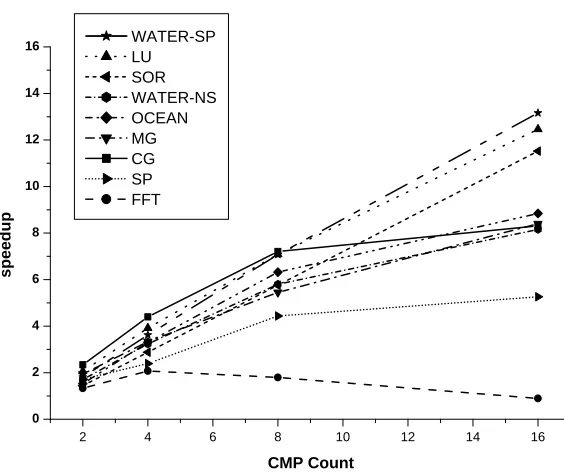
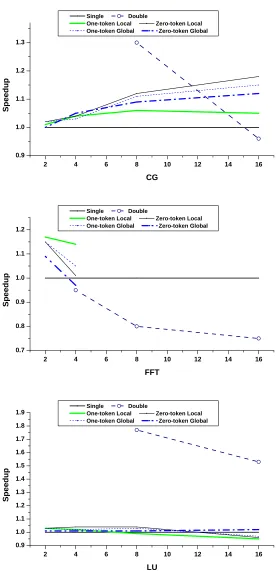
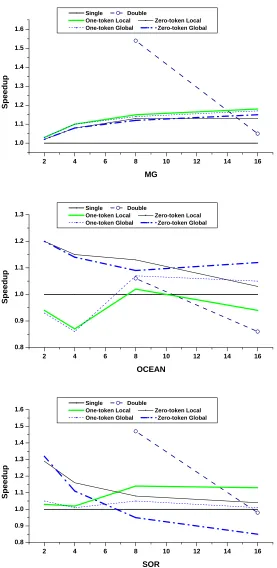
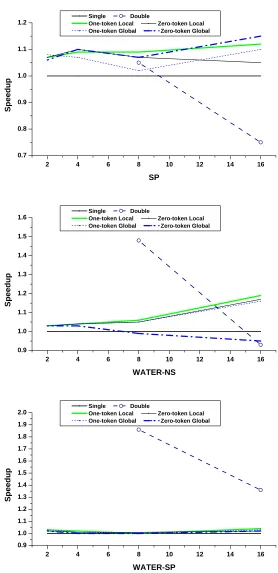
to each processor. As we approach the performance threshold, however, increasing concurrency does not help. Figure 1.1 shows the relative performance of assigning two tasks per CMP (double mode), compared to assigning only a single task, leaving one processor idle (single mode). Applying the additional processing power in the “traditional” way – that is, by increasing the task-level parallelism – does not neces-sarily result in large performance gains, especially as the number of CMPs increases. In fact, for some applications, performance degrades when using both processors for parallel tasks. Figure 1.2 shows the execution time breakdown for Water-NS as an example for applications that suffer a performance degradation when task level par-allelism is increased for 16 CMPs systems. We notice that the contribution of busy cycles to total execution time gets smaller when the degree of parallelism is increased. Overheads like synchronization and stall time also contribute more to the total exe-cution time. This explains the need to devote more attention to these overheads for higher a degree of parallelism.
pro-2-Single 4-Single 8-Single 16-Single 2-Double 4-Double 8-Double 16-Double 0
20 40 60 80 100
Normalized execution time breakdown
Busy Stall Barrier Lock
Figure 1.2: Execution time breakdown for Water-NS on 2, 4, 8, and 16 CMPs systems running in single and double modes.
pose using the second processor to reduce overhead and improve the efficiency of execution, rather than to increase concurrency. Instead of running a separate parallel task, the second processor runs a reduced version of the original task. The reduced task constructs an accurate view of future memory accesses, which is used to optimize memory requests and coherence actions for the original task. The resulting gains in efficiency can result in better performance than using the two processors for increased parallelism.
This approach is analogous to the uniprocessor slipstream paradigm [48], which uses redundant execution to speed up sequential programs. A slipstream processor runs two redundant copies of a program on a dual-processor CMP. A significant number of dynamic instructions are speculatively removed from one of the program copies, without sacrificing its ability to make correct forward progress. In this way, the speculative reduced program (called the A-stream, or advanced stream) runs ahead of the unreduced program (called theR-stream, or redundant stream). The R-stream exploits the A-stream to get an accurate picture of the future including both future values and branch outcomes.
instructions. We find that simply removing certain long-latency events – synchroniza-tion events and stores to shared memory – shortens the A-stream version of a task enough to provide timely and accurate predictions of memory accesses for the original R-stream task. Since it runs ahead, the A-stream generates loads to shared data be-fore they are referenced by the R-stream, prefetching shared data and reducing mem-ory latencies for the R-stream. This simple use of redundant computation requires very little hardware support; it is an additionalmode of execution for multiprocessor systems, rather than a new architecture.
With some additional support in the memory subsystem, A-stream accesses can also be used at the directory as hints of future sharing behavior. These hints can be used for coherence optimizations, such as self-invalidation (SI) [27]. To support SI, we introduce the notion of atransparent load to minimize negative effects of A-stream prefetches on coherence traffic. A transparent load, issued by the A-stream, does not cause the exclusive owner of a cache line to give up ownership prematurely. The load serves as an indication of future sharing behavior, and the memory controller uses this information to send invalidation hints to the exclusive owner of a cache line. The owner is advised to write back or invalidate its copy of the cache line when its last store is complete, so that future reads from other processors will find the most recent data in memory.
Using these two optimizations (prefetching and self-invalidation), slipstream im-proves performance for applications that have reached their scalability limit.
rollbacks and preserves the gains obtained by speculative execution.
We also address the problem of supporting slipstream execution mode for programs written using the OpenMP standard. The compiler can hide the details of slipstream execution, so that programs can transparently use slipstream mode to enhance per-formance. Specifically, one new directive and one runtime variable are introduced that enable compilation for slipstream mode. The use of slipstream mode and the slipstream synchronization mechanism are selected at runtime, so a single executable image can be used with and without slipstream support. If desired, a programmer can use the directive to specify slipstream parameters for distinct regions of the code.
1.2
Research Objectives
In this work, we investigate the following:
• Exploring the use of CMP for shared memory machines: CMP is intended to provide more opportunities for parallelism by having multiple threads utilizing the functional units. The use for these CMP chips in shared memory parallel computers needs more investigation.
• Investigating a scheme that addresses parallelization overheads: We aim at reducing the overheads of parallel programs by hiding the latency of accessing memory and also by hiding the effects of synchronization.
• Devising future-based predictors for shared memory machines: Future based prediction is recently proposed for a single node system. The potential of highly accurate information provided by these schemes is yet to be explored for shared memory machines.
• Investigating the role of shared vs. local data in parallel program writing to achieve simple and accurate future information predictors.
parallelization is gaining wider acceptance. Compiler-assisted parallelization may not, though, provide hardware-specific optimizations. In this work, we aim at enhancing the performance of applications written with OpenMP (a new widely accepted standard for writing shared memory programs) running on CMP-based shared memory system.
• Investigating different mechanisms for identifying last touch for shared memory programs. Identifying last touch is used to timed preemptive coherence actions on cache lines in several optimization, for instance, self-invalidation.
• Providing a confidence mechanism for barrier speculation. This helps to reduce misspeculation and rollbacks that can hurt performance.
1.3
Contributions
The main contributions of this work are
• Introducing a future-based speculation mechanism for shared memory machines composed of CMP chips. The proposed scheme is simple due to our observation of the rule of shared variables vs. private variables in shared memory program-ming.
• Introducing multiple software implementations to support this execution mode. Notably, we extend OpenMP standard to support slipstream execution mode, a new widely accepted standard.
• Illustrating how to use these future information for prefetching, a consumer-initiated communication. We also extend the scheme, using special memory transactions, to support a form of self-invalidation, a producer-initiated com-munication.
We proposed a last touch predictor that has a reasonable requirement along with very high accuracy.
• Designing a confidence mechanism for speculation after barrier synchronization. This mechanism reduces the chance of rollbacks. We also propose techniques to reduce the speculation cost/overhead.
1.4
Thesis Outline
Chapter 2
Related Work
In this chapter, we review approaches adopted to hide or reduce overheads of exe-cuting programs. Depending on the amount of observed (targeted) latency, different techniques are used. In this chapter, we aim to span different techniques that target these latencies while giving a special attention to memory latency. Memory latency is a problem that appears for both single processor machines and multiprocessor ma-chines. Scientific workloads represent a significant sector of workloads used on shared memory machines, which are our target research machines. While larger cache hierar-chies have proved to be effective in reducing these latencies, it is common for scientific workloads to spend large portion of their run time stalled on memory requests.
2.1
Latency Hiding Techniques
A bottleneck in obtaining a high utilization of CPU cycles is stall time incurred while accessing different units. This latency can be small, e.g., an L1 miss that hits in L2 or a floating point operation. This latency can be hidden using Microarchitecture techniques, such as, out-of-order superscalar. Much longer latencies are incurred to access memory. This memory latency is usually handled using prefetching and/or self-invalidation (for shared memory machines).
2.1.1
Microarchitecture Approaches
Instruction-level parallelism can be viewed as a small latency hiding technique, as it tries to overlap the execution of multiple instructions. If the execution of these instructions requires some additional latency, then enough work still exists to keep functional units busy.
Superscalar refers to the microarchitecture design that allows more than one in-struction to be executed in the same cycle. These designs may be based on an out-of-order core [49], or in-order core, for example VLIW [15].
An out-of-order microarchitecture tries to increase performance by dynamically scheduling instructions [49]. This architecture may overlap instructions that the com-piler cannot overlap as it has the runtime information that is not available to the compiler. On the other hand the scope of the scheduler is usually small (compared with that available to the compiler) and also it increases the hardware complexity.
Very-Long Instruction Word (VLIW) techniques try to extract and to exploit instruction level parallelism at the compiler level [15]. The advantage of doing it at the compiler level (vs. hardware level) is the larger scope that the compiler can look at to extract parallelism. The objective of VLIW is to eliminate complicated instruction scheduling and dispatching to achieve a faster, less expensive processor.
Simultaneous multithreading (SMT) [50] multiplexes resources between threads within a cycle. SMT tries to search for independent instructions from independent threads instead of extracting them from the same thread. The performance of an SMT can outperform an ordinary ILP processor if there is a lack of independent instructions in the same thread.
The decoupled access/execute (DAE) architecture [46] decomposes a program into two separate streams. A memory access stream slips ahead of an execution stream, and supplies data to it. DAE relies on finding decoupled instruction streams either at run-time or with the support of a compiler.
overlapping busy cycles.
2.1.2
Prefetching
Prefetching is a technique that reduces perceived memory latency by requesting cache lines before they are needed by the program. Prefetching may be guided by hardware prediction tables [10], by the programmer or compiler [30, 35], or by pre-computation [54, 5, 6, 12, 13, 29, 42, 43, 35].
Hardware Prefetching can be from processor side [10] or memory side [47]. In both cases, memory references are monitored to infer future prefetching opportuni-ties. These inferred references may be incorrect, thus causing cache pollution, and consuming more memory bandwidth.
In software controlled prefetching [35, 30], execution time is reduced despite the added instructions for prefetching. The challenge that faces this approach lies in the placement of prefetch instructions in the target applications. This can be complicated, if there is a large variability in memory access time.
Timing is a challenge to do effective prefetching, as data should be requested early enough to hide memory latency. The data should not be requested so early that the data prefetched will be replaced before being used. The required time to prefetch a block is usually variable. In uniprocessor case, this variability is due to memory state (contended or not) and bus bandwidth. In multiprocessor configuration, additional factors may come into play, such as data placement for distributed memory, memory state of the cache line, memory controller availability, network bandwidth, etc. Timing is more critical in the multiprocessor configuration- not only might prefetched block suffer replacement, it also may be invalidated by another process. This extra invalidation is an overhead that may hurt the performance of the other processes.
2.1.3
Coherence Optimization
to try to predict the next coherence action based on the current signature of coherence actions on a certain cache block. History-based techniques are used to correlate stable coherence patterns to future actions.
These predictors can be at the node or at the directory. They can also be address-based or PC-address-based. An example of node-address-based optimizations is proposed by Kaxiras [21]. In this optimization, a node that issues a non-atomic read-write sequence to the same cache block can request exclusive ownership of the line the first time it sees the read. This potentially reduces the communication overhead and also reduces the chance of stalling the processor. Mukherjee [36] proposes monitoring coherence actions at the directory and trying to correlate this with future actions. They found that cache blocks exhibits a predictable pattern of coherence actions. Mukherjee [36] reported the accuracy of a his proposed predictor but not the performance im-provement if it is used. Lai et al. [24] use a similar prediction technique and shows performance improvement due to the use of these predictors.
2.1.4
Self-invalidation
Self-invalidation (SI) [27, 25] is a technique to reduce the latency of coherence misses. SI advises a processor to invalidate its local copy of a cache line before a conflicting access occurs. When successful, this will reduce invalidation messages and writeback requests. A subsequent load from another processor will find the data in memory, rather than having to request a writeback from the owning cache. A subsequent store will acquire an exclusive copy from memory without having to invalidate copies in other caches.
Dynamic self-invalidation (DSI) [27] describes two methods for identifying lines for self-invalidation. One uses extra coherence states and the other uses version numbers to remember past conflicts. Past conflicts are used to infer future conflicts. Lines are self-invalidated at synchronization points.
last-touch prediction may require large hardware prediction tables because they are indexed by line address and must accommodate large working set sizes.
2.2
Synchronization Overhead Reduction/Hiding
Techniques
Synchronization is one of the bottlenecks for parallel program scalability. The con-tribution of synchronization to total execution time tends to increase as the number of processors increases, especially if problem size remains fixed. Two major synchro-nization constructs grasp the attention of researchers. The first one is locks and the second is barriers.
Synchronization primitives usually reflect some dependency constraints and shar-ing pattern characteristic. For example, locks are best used to synchronize access to shared memory locations that are migratory. Locks guarantee mutual exclusion and organize handing off during migration. The order of execution and migration is not strict. Dependency is not strict in the sense that there is no necessary global order of execution. The outcome exhibits an arbitrary execution order.
Barriers, on the other hand, are a bulk synchronization primitive. They synchro-nize many producer-consumer relations, effectively taking the place of many point-to-point synchronization events. The reason for using them is the ease of orchestrating programs. Barriers are also appropriate when a large data structure must be syn-chronized among multiple processes.
2.2.1
Critical Sections
Protecting critical sections using lock synchronization is a common practice in shared memory programs. The data protected in a critical section can be single variable or a large data structure like hash tables. If the data accessed is large or not written during the critical sections, then this critical section could have been concurrently executed by multiple processes.
When there is a low chance of collision of accesses (writes to the same cache line), it is beneficial not to serialize access to data. Instead, it is advisable to use atomic (lock-free) algorithms [51, 34]. If the collision probability is high (for example, same variables are accessed and are always written), then it is better to serialize using critical sections.
Rajwar et al. [40] advocate making the choice between atomic execution and serialization at the hardware level. Their point is that parallel programming difficulty makes programmer reasoning uneasy job. Martinez et al. [32] try to reduce the impact of serialization in critical sections by executing them speculatively in optimistic fashion (assuming no collision). Both techniques use the coherence protocol to detect violations. Violations trigger rollbacks and retries. Martinez et al. proposal does not provide dynamic switching to non-speculative mode if multiple violations occurs.
2.2.2
Barrier Synchronization
Barriers often contribute the most to synchronization time, especially for scientific computation benchmarks like SPLASH-2 [52]. The increase in barrier synchronization time is due to workload imbalance and the communication overhead associated with the release of the barrier. The fluctuation of arrival times for a large number of customers to the barrier results in increasing the average waiting time. Asynchronous operations, such as memory references and I/O operations, may also result in artificial workload imbalance.
value of a variable, speculating that it has already been produced. The success of speculation is due to the chance of having the values that are needed for loads to be already produced. If a production by the non-speculative process comes after con-sumption by the speculative process, the speculation fails and rollback is necessary. The penalty in the case of rollback can be higher than the benefit of speculation. This proposal provided a coherence protocol extension on bus-based symmetric multipro-cessor system.
Martinez et al. [32] use a similar optimistic approach in executing instructions after barrier synchronization. This proposal uses unmodified cache coherence protocol and propose an implementation on CC-NUMA system. It also provides a mechanism for speculation inside critical sections.
2.3
Future Information Based Speculation
Recently, program-based future information are proposed to assist speculative execution. This future information tackles both ILP bottlenecks and memory latency problem.
2.3.1
Slipstream Paradigm
2.3.2
Pre-execution/Pre-computation Paradigms
Pre-computation uses helper threads to compute the addresses of problem loads (loads that frequently miss in the cache) ahead of the full program [35, 13, 42, 54, 5, 6, 12, 29, 43]. Problem loads are explicitly identified and targeted, through profiling [43, 54] or dynamic identification mechanisms [42, 11]. Then, the computation slices that generate the addresses of problem loads are extracted from the full program either manually [54], by the compiler [29], or by hardware mechanisms [11]. Finally, microarchitectural threads are forked as needed to remove long latency operations from the critical path of the program, paying special attention to timely forking [11]. A different flavor of helper thread exploits intelligent memory architectures that have processors embedded in main memory [47]. A user-level thread implements memory-side prefetch algorithms in software. Prefetch predictions are stored in memory in-stead of in custom hardware tables, the tables are software-managed, and the prefetch algorithm is flexible.
Chapter 3
Slipstream for Shared Memory
Systems
Slipstream for shared memory system tries to use a compute-centric design in communicate-centric fashion. In this mode, we use one processor of the CMP chip to produce memory references that may benefit the other processor on the CMP chip. These memory references can be used to enable multiple optimizations as will be discussed in later chapters. The usefulness of these informations is affected by two axes: functional accuracy and timing accuracy. In this chapter, we address how to produce functionally accurate information for shared memory programs based on the observation of the roles of shared variables and private variables in program writing. We also present how to control the timing of using these information using a simple synchronization model.
myid = g e t i d ( ) ;
n p r o c s = g e t t o t a l p r o c s ( ) ; mymin = 1+myid ∗ n / n p r o c s ; mymax = mymin + n / n p r o c s − 1 ;
f o r( i=mymin ; i<mymax ; i ++)
f o r( j =1; j<n−1; j ++)
Y[ i ] [ j ] = (X[ i −1 ] [ j ] + X[ i + 1 ] [ j ] +X[ i ] [ j−1] + X[ i ] [ j + 1 ] ) / 4 ; BARRIER( n p r o c s ) ;
f o r( i=mymin ; i<mymax ; i ++)
f o r( j =1; j<n−1; j ++)
X[ i ] [ j ] = (Y[ i −1 ] [ j ] + Y[ i + 1 ] [ j ] +Y[ i ] [ j−1] + Y[ i ] [ j + 1 ] ) / 4 ; BARRIER( n p r o c s ) ;
Figure 3.1: Portion of a Red-Black SOR kernel. X,Y are shared variables. Control flow and address generation are only affected by private variables.
3.1
Shared Variables vs. Local Variables
Figure 3.1 shows a red-black implementation of an SOR (successive over-relaxation) kernel. Shared variables are indicated by bold capital letters. Loops are controlled by local variables, and their limits are a function of the task ID. Ignoring the stores to shared variables (X and Y) leads to incorrect algorithm results, but does not affect the control flow or the information about which memory locations are accessed or the types of the accesses. Because the A-stream and the R-stream have the same task ID,myid in our example, then they are expected to perform the same operations on the same portion of shared data.
3.2
CMP Based Shared Memory System
3.2.1
Forming Shorter Stream
Slipstream execution mode requires forming a shorter A-stream task for predictive purposes. An effective approach to reducing an A-stream is to remove its long-latency communication events. In shared memory multiprocessors, these are synchronizations (barriers, locks, and events) and accesses to shared memory (loads and stores). Two of these, synchronization and shared memory stores, can be skipped for many programs without affecting the control flow or the A-stream’s ability to predict access patterns for shared data.
In order to skip synchronizations, the system-provided routines for barriers, locks, and events (for example, the ANL macros [31] used by the Splash-2 benchmarks) are modified to support tasks running in slipstream mode. The A-stream tasks do not perform the synchronization routine, but the R-stream tasks execute them normally. Synchronization is used to define dependencies in accessing shared variables. Skip-ping these routines makes the A-stream speculative, since we cannot guarantee that the dependencies imposed by the synchronization will be met. We cannot allow values produced by the A-stream to be stored to shared memory, unless we have the ability to roll back that shared state to its previous value in case of a misspeculation. Our so-lution is to have the A-stream processor discard stores to shared memory. (The store instruction is executed in the processor pipeline, but it is not committed. Although the store is not committed, it may be converted into a prefetch-exclusive request, as discussed in Chapter 5.) The R-streams throughout the system are not corrupted by erroneous A-stream values, because local changes to shared variables are never stored and never made visible to the other tasks. This also shortens the A-stream further, since shared memory stores might otherwise incur long latencies due to invalidation requests and acknowledgments.
the data. If the producer changes the data before the synchronization, the copy loaded by the A-stream is invalidated and the R-stream will retrieve the correct value when needed. The A-stream prefetch is ineffective, from the R-stream’s point of view, but it does allow the A-stream to make progress and stay ahead of the R-stream.
Since the role of the A-stream is to collect access information and to prefetch shared data, we must be confident that using speculative data does not significantly affect control flow or address generation. Otherwise, the access patterns predicted by the A-stream will be inaccurate, and we may add to the memory traffic of the system by loading values that are unnecessary.
Fortunately, many parallel programs are written in the SPMD (Single Program, Multiple Data) style, in which each task executes the same code but accesses different portions of the shared data. These programs rely mostly on local variables for address computation and control flow determination. These programs use a unique task ID to identify the portion of the shared data accessed by each task. Barriers identify phases of execution and guarantee no inter-phase dependency violations. Parallel scientific numerical algorithms are good examples of this class of applications.
We have identified only three types of shared variables that typically affect control flow or address generation:
• Synchronization variables affect control flow, because they grant or deny access to regions of code. Variables that are referenced inside system-provided synchronization routines are no problem, because those routines are modified to skip references to the variables for the A-stream task. A user-defined synchro-nization variable, such as a simple flag variable, may cause a local divergence in control flow, because the A-stream might wait on the variable, while the R-stream might not. This divergence is only temporary, however. The A-R-stream may be prevented from moving far ahead of the R-stream, but the accuracy of its data accesses is not likely to be affected.
• Reduction variables, which are used to compute global values, such as the
determines whether the task should perform a store to the global minimum. The effect on control flow is localized and should not cause a divergence of the A-stream and R-stream. The accuracy of the information collected by the A-stream may be degraded, however.
• Dynamic scheduling relies on shared information to make a decision about which task or sub-task to execute next. These decisions are time-dependent, so it is likely that the A-stream would make a different decision, and access different data, than the R-stream that comes later. Dynamic scheduling can be accommodated in slipstream mode. If the scheduling code is identified, the A-stream may skip the code and wait for the R-stream to catch up (using the A-R synchronization mechanisms described below). Once a scheduling decision is made by the R-stream, the A-stream will again run ahead and collect data access information. The Barnes-Hut benchmark from Splash-2 is an example of a program that does its own dynamic scheduling. In that case, programmer intervention is needed to reduce the likelihood of A-stream divergence. How-ever, if dynamic scheduling is implemented by a compiler, as in the case of OpenMP [2] programs, then support for slipstream mode is transparent to the programmer.
These “problem” variables represent a small fraction of accesses. We will consider dynamic scheduling in depth in Chapter 5. All optimization that will be described on the following sections are for working set shared data (which do not belong to the above three classes). We may refer for conciseness to these working set shared data as shared data.
3.2.2
L1/L2 Coherence for Slipstream
be relaxed by allowing the A-stream to consume non-coherent shared data. This relaxation helps alleviate the effect of the A-stream contending with R-stream on the shared data in the L2. The A-stream in this case can consume stale data from L1. We do maintain inclusion, so that A-stream prefetches data if does not exist in the L2 cache.
To maintain this semantic, we differentiate between an L1 invalidation for co-herency with the other L1 cache and an invalidation due to an external event or replacement. For invalidation due to a write by the other L1 cache, the A-stream L1 cache controller keeps a speculative copy of the cache line. External invalidation or replacement will do an invalidation for both L1 caches. In this case, the line should be replaced from the L1 cache.
3.2.3
Stream Synchronization
Synchronization between an R-stream and its corresponding A-stream is required for two reasons. First, we must correct an A-stream that has taken a completely wrong control path and is generating useless data access predictions. Second, we want to limit how far the A-stream gets ahead, so that its prefetches are not issued so early that the prefetched lines are replaced or invalidated in the L2 cache before the R-stream uses them.
We require a single semaphore between each A-stream/R-stream pair to control their synchronization. For our experiments, we have assumed a shared hardware reg-ister, but any shared location that supports an atomic read-modify-write operation is sufficient. Using this semaphore, we control (a) how many synchronization events the A-stream can skip without waiting for the R-stream, and (b) whether the syn-chronization is local (involving only the companion R-stream) or global (involving all R-streams).
The initial value of the semaphore indicates how many sessions the A-stream may proceed ahead of the R-stream. As depicted in Figure 3.2, this can be viewed as creating an initial pool of tokens that are consumed as the A-stream enters a new session. When there are no tokens, the A-stream may not proceed. The R-stream issues tokens by incrementing the semaphore counter.
Two different types of synchronization – local and global – are enabled by con-trolling when the R-stream inserts a new token. If the R-stream inserts a token as it enters the barrier or wait routine, then the continued progress of the A-stream depends only on its local R-stream. If the R-stream inserts a token as it leaves the barrier or wait routine, then the continued progress of the A-stream depends on all of the R-streams participating in the synchronization. (In the case of a barrier, this is all of the R-streams waiting on the barrier. In the case of an event-wait, this is the R-stream that signals the event.)
To reduce the overhead of synchronization, we assume shared registers between the processors sharing a CMP. This register can be memory addressable. The semantics of the operations required on these registers are as follows:
INIT SEMA(sema id,init val). This operation is used to initialize a shared
reg-ister (identified by sema id) to an initial value (init val). This operation is simply implemented by moving an immediate value to a memory addressable register. This initialization must be done for each CMP running in slipstream mode.
PSEMA(sema id). This operation is used to decrementsema id semaphore. If the
Local: New token is inserted by R−stream
barrier synchronization. entering before
n Initial Tokens n Initial Tokens
Time
A−stream
Token Bucket
i+n i
R−stream
th barrier th barrier
A−stream R−stream
by R−stream barrier synchronization.
after exiting Token Bucket
Global: New token is inserted
Figure 3.2: Slipstream Synchronization Model; A-stream allowable progress is con-trolled by the number of tokens and the insertion type.
processor should be able to execute other system routines and handle interrupts. This operation is done only by the A-stream. This operation can also trigger releasing the stall of an R-stream, in case it was waiting on condition that is satisfied by the latest state of the register.
VSEMA(sema id). This operation is used to increment sema id semaphore. The
new state of the register may remove the stall of an A-stream if the value of the semaphore becomes greater or equal to zero.
WAIT(sema id,val). This operation checks the state of semaphoresema id against
val. If this is issued by an A-stream, then the check is if state[sema id]<val. If this is issued by an R-stream, then the check is if state[sema id]>=val. If the condition is satisfied, then calling stream is stalled; otherwise, it proceeds normally. As mentioned earlier, this stall should not prevent the processor from executing other processes or to service interrupts.
slipstream mode in the first place.
To enable the use of slipstream mode, the programmer selects slipstream-aware parallel libraries that control task creation, synchronization, and so forth. At run time, if the application user chooses slipstream mode, then the slipstream library routine creates two copies of each task, and assigns one copy to each of the processors on a CMP. Just as in double mode (with separate parallel tasks), each task has its own private data, but shared data are not replicated.
3.2.4
Deviation Detection/Recovery
The A-R synchronization points are also used to check for a deviating A-stream – that is, one that has taken a significantly different control path than the correct path, represented by the R-stream. The checking is very simple: if the R-stream reaches the end of a session before the A-stream, we assume the A-stream has deviated. The R-stream checks the number of tokens available against the initial token count. If the number of tokens equals the initial count, then the R-stream predict that the A-stream has not visited this synchronization. This check does not include any notion of whether the data access predictions from the A-stream have been accurate or not. The recovery mechanism is equally simple: the R-stream kills the A-stream task and forks a new one. This may be expensive, depending on the task creation model. In our experience, however, the benchmarks used do not require recovery, as they do not diverge.
3.2.5
Slipstream I/O
Chapter 4
Slipstream Software Support
In this chapter, we introduce the support needed for slipstream from the software side. We investigate two models representing two methods of writing shared memory programs.
The first model is based on macros that provide simple primitives for paralleliza-tion. To be efficiently utilized, these macros require an experienced programmer of shared memory programming. They also impose some challenge to porting applica-tions transparently to slipstream mode.
The second model represents compiler-assisted parallelization directives. This paradigm provides easy to use directives to instrument how a serial program can be parallelized. Most of the parallelization process is done by the compiler. This model relaxes some of the limitations imposed for porting applications to slipstream mode. It allows different scheduling techniques. It also facilitates changing the type of slipstream A-R synchronization for different phases of program execution.
4.1
ANL Macros
ANL [31] macros aim at providing a portable interface for writing parallel pro-grams. In this section, we overview necessary modifications for the ANL macros related to shared memory programming [19].
In slipstream mode, two processes are created, A-stream and R-stream. This pair of processes must share the same CMP. We use the IRIX system call sysmp(MP MUSTRUN, proc id) to force the necessary affinity for slipstream.
BARRIER. This function, besides synchronizing R-streams, serves to synchronize
A-stream with R-stream. They also serve as deviation checking and recovery points. A-stream does not exit these function unless at least one token exist in the synchronization bucket. The R-stream also checks if the A-stream has entered this routine before it by checking the number of tokens in the bucket compared with the initial value. If the R-stream detects a deviation, it may kill and refork another A-stream. In our implementation, R-stream waits for small number of cycles before invoking the recovery routine.
WAIT PAUSE. This macro serves as a second synchronization point between both
streams. This has the same mechanism implemented in BARRIER.
CLEAR PAUSE, SET PAUSE, LOCK, and UNLOCK. Only the R-stream
should execute these macros. A-stream skips them.
MAIN ENV. This macro carries out all the declarations in addition to slipstream
special declarations.
INIT ENV. This macro handles the runtime information about the desired
exe-cution mode (slipstream or otherwise). It also passes information about the synchronization method to the hardware. The shared memory address space is reserved in this macro also. The portion of shared memory space that requires special handling is conveyed to the hardware.
G MALLOC. This macro allocates shared data. To simplify the hardware support,
shared data is not overlapped with local data. If this function is invoked in the parallel region, the A-stream should synchronize with its R-stream to receive the same return of this function.
G FREE. This macro is used to deallocate shared memory. Only R-stream should
WAIT FOR END. This macro is used by the master to wait for all slaves to finish their assigned job. The master should not wait for A-stream completions.
GET PID. Both A-stream and R-stream should be returned the same process id.
LOCKINIT, ALOCKINIT, SLINIT, and SEMINIT. These macros initialize
synchronization variables and should be executed by R-stream only.
The following macros are introduced to provide extended functionality for slipstream explicit programming.
AR BARRIER. This macro translates to a barrier routine that should be respected
not only by R-streams, but also by A-streams. We used this macro with SPLASH-2 Ocean to prevent deviation of A-stream in multi.C functions as shown in Figure 4.1. The computed error value controls how the algorithms continue. Thus, this shared variable affects control flow and A-stream should be forced to synchronize with its R-stream (no matter what is the global syn-chronization method) to make the correct decision about how the algorithms continue.
IS A STREAM. This macro can be used to check if the code is to be executed by
A-stream.
IS R STREAM. This macro can be use to check if the code is to be executed by
R-stream. Along with the previous macros, programmer can explicitly specify portions of the code that need not be executed by A-stream. If the programming involves an I/O library that is not slipstream-aware, then it is advisable to protect these portions of the code with if(IS R STREAM).
AR SYNC. This macro is used to synchronize A-stream and R-stream so that the
LOCK( l o c k s−>e r r o r l o c k )
i f( l o c a l e r r > multi−>e r r m u l t i ) {
multi−>e r r m u l t i = l o c a l e r r ; }
UNLOCK( l o c k s−>e r r o r l o c k )
AR BARRIER( bars−>e r r o r b a r r i e r , n p r o c s )
g e r r o r = multi−>e r r m u l t i ;
Figure 4.1: Using AR BARRIER in OCEAN multigrid.
The four extension macros described above (except for AR BARRIER) were not explicitly used in porting applications used in this study. The macro IS A STREAM is inserted to protect execution of some of the I/O functions, for instance printf.
4.1.1
Limitations
ANL macros provide simple primitives for parallel programming. This leaves the space open for the programmer’s imagination to develop shared memory programs. The flexibility provided by ANL makes it harder to program and difficult to port all applications transparently to slipstream mode.
The limitations that face transparent porting of SPLASH-2 applications to slip-stream are:
• Difficulty for supporting programs with embedded dynamic scheduling. Barnes-Hut is an example of this class of applications.
• Identification of shared variables under some models may be difficult.
• Forcing the use of a single synchronization mode for the whole program.
4.2
OpenMP Support
par-allelization. The parallelization automation provided by this standard enables allevi-ation of the limitallevi-ations imposed on using slipstream with ANL macros.
4.2.1
OpenMP Overview
OpenMP [2] is an emerging directive-based standard for shared-memory parallel programming. It allows simple incremental parallelization for applications. OpenMP does not provide facilities to control data locality or coherence, as these features are platform dependent. Portability of OpenMP application puts the burden on the compiler and hardware to achieve decent performance.
While a compiler can do analysis to remove unnecessary synchronization and to optimize for locality of data accesses, the overhead of parallelizationvs. performance gain cannot always be determined at compile time. For example, we cannot determine if parallelizing a certain loop will be worthwhile without knowing the loop iteration count, which can be a runtime variable. Most data-parallel applications use the same code to solve different problem sizes. Likewise the upper limit of parallelization for decent performance is dependent on the runtime information like problem size and the underlying architecture. This encouraged the OpenMP standard to include environment variables to facilitate changing scheduling and the degree of parallelism at runtime.
Other researchers have proposed extensions to OpenMP to express architecture specific optimizations, such as data distribution directives for CC-NUMA [7] and software-DSM [33] systems. Such extensions may inhibit portability, but they can be ignored by systems for which they do not apply. They give the programmer another tool for tuning performance without explicitly modifying the application program.
OpenMP standard provides a tool to parallelize program in an incremental way. Figure 4.2 shows a fragment of a Laplace equation solver. The code is essentially a serial code augmented by pragma directives that control how this program is to be parallelized. This fragment includes some of the most commonly used pragmas in the OpenMP standard.
may correspond in one implementation to a fork for a number of processes.
Pragma for parallelizes the loop immediately following it. The number of itera-tions is assigned to the available processes, based on a certain scheduling policy. This pragma implies a barrier at the end of it unless a nowait statement is specified.
Pragma critical serializes the access to a section of code to guarantee mutual exclusion. Pragma barrier is an explicit barrier synchronization. Pragma master protects a section from being executed except by the master. Pragma single causes a section to be executed by only one process (usually the first to hit the section).
OpenMP also provides facilities for functional parallelism called sections. Each thread of execution is expected to execute one of these sections. These sections usually impose an upper limit of the degree of parallelism.
Other facilities are provided through pragma and/or runtime library calls to sup-port reduction operations, control scheduling, synchronize, and get/set thread infor-mation. To maintain portability, the OpenMP standard avoids having any hardware-specific pragma.
4.2.2
Requirements for Slipstream Mode
Slipstream support for OpenMP is mostly done through modifying the underlying library that manages threads of execution. The changes to the library are summarized as follows:
• Process creation: The compiler creates a pool of slaves at the start of running the program (probably equal to the number of processors). Slipstream mode is assumed to execute on a system with dual-processor CMP nodes. We as-sume that resources are allocated in CMP-based units. Following this resource dedication, the number of processes must be even.
double u [ XSIZE + 2 ] [ YSIZE+2] , uu [ XSIZE + 2 ] [ YSIZE + 2 ] ; l a p l a c e s o l v e r ( )
{
i n t x , y , k ;
double sum ;
#pragma omp p a r a l l e l p r i v a t e ( k , x , y )
{
f o r( k = 0 ; k < NITER ; k++){
/∗ o l d <− new ∗/
#pragma omp f o r
f o r( x = 1 ; x <= XSIZE ; x++)
f o r( y = 1 ; y <= YSIZE ; y++)
uu [ x ] [ y ] = u [ x ] [ y ] ; /∗ u p d a t e ∗/
#pragma omp f o r
f o r( x = 1 ; x <= XSIZE ; x++)
f o r( y = 1 ; y <= YSIZE ; y++)
u [ x ] [ y ] = ( uu [ x−1 ] [ y ] + uu [ x + 1 ] [ y ]
+ uu [ x ] [ y−1] + uu [ x ] [ y + 1 ] ) / 4 . 0 ; }
}
/∗ c h e c k sum ∗/ sum = 0 . 0 ;
#pragma omp p a r a l l e l f o r p r i v a t e ( y ) r e d u c t i o n (+:sum )
f o r( x = 1 ; x <= XSIZE ; x++)
f o r( y = 1 ; y <= YSIZE ; y++)
sum += (uu [ x ] [ y]−u [ x ] [ y ] ) ; p r i n t f ( ”sum = %g\n ” , sum ) ;
}
and which are private. The underlying thread model decides how to specify the shared vs. private virtual space. For UNIX processes, for example, it is a common practice to allocate shared virtual addresses in a contiguous space. For POSIX threads, on the other hand, shared space is not necessarily contigu-ous. In this case, it is the compiler’s job to guarantee that shared space is not interleaved with private space.
• Deciding execution mode: Slipstream is considered additive to normal mode. We assume that the same binary should run for both normal and slipstream mode. An application (or a kernel) declares its intent to run in slipstream mode by writing to a control register. By default, slipstream mode is deactivated. The application can have an argument to declare the user’s intent to activate slipstream mode.
• Stream synchronization: As discussed earlier, synchronization points have an impact on performance, as they control how far ahead we allow the A-stream to execute. Possible A-stream divergence is also checked during synchronization, and recovery is invoked if divergence is detected. In OpenMP, suitable points for this kind synchronization are the runtime barriers that are inserted due to parallelization constructs. Barriers used to do internal management by the library should not be skipped by A-streams and thus do not require stream synchronization/recovery.
performance in this case. • Explicit library calls
The following library calls are modified to reflect the current execution mode. We assume that execution mode (including AR-synchronization, if slipstream is activated) cannot be changed within a parallel construct. So, once this execution mode of a parallel region is established, it remains fixed to the end of this region. Inheritance of execution mode from a parallel region to a nested region within is implementation dependent. The default execution mode may also be implementation dependent.
1. Reduction: Reduction code can be executed as user code by the A-stream. Special consideration to the task count and and the task id should be taken into account. The A-stream may need to synchronize with its R-stream, if the outcome of the reduction operation will affect program control flow. For example, reduction can be used to compute a global error that affects the iteration or termination condition. This requires adding special types of reduction operations. In practice, termination and continuation are usually decided by the master thread and not in a parallel region, which alleviates the need to synchronize after a reduction operation.
even rely on thread count/id information.
• Parallel constructs
1. Single: Single section is executed by a single thread in the team (usually the first thread that enters this section). There is no clear way an A-stream can tell that its R-stream will execute this section, as it depends on the order in which R-streams reach this region. Executing by an A-stream that is not paired with the proper R-stream will cause unnecessary migration of data. Obviously, the chance of being lucky gets smaller as the number of CMPs increases. That is why these sections should be skipped by the A-stream.
2. Master: Unlike single, the R-stream to execute this section is predeter-mined a priori. The A-stream associated with the master can execute it.
3. DO/For: The execution for this construct is dependent on the scheduling methodology, as will be discussed in detail later.
4. Atomic: Atomic construct serializes access to data within this construct when there is a small chance for collision of accesses. It is advisable to ex-ecute this section by the A-stream, as the data prefetched by the A-stream are highly likely not to be migrated. It is still the programmer’s responsibil-ity to use this construct when advisable. Atomic construct can be used to protect a critical section, but performance, as well as optimizations based on common practice, may suffer.
5. Critical Section: Critical sections guarantee serialization of access to data when there is a high probability for collision. Unless dynamic self-invalidation is supported in slipstream mode, it may be advisable for A-streams to skip critical sections, as they may cause unnecessary migration of data.
has a static assignment policy. If dynamic policy is adopted, then the start of this section implies a synchronization between R-stream and A-stream. 7. Flush Directive: This directive aims at synchronizing shared variables and controlling their visibility. It is implied in many other constructs. For hardware cache-coherent systems, this construct maps to void, since the flush semantics are maintained with every transaction to the memory. This directive should be skipped by the A-stream, since it does not produce any shared variables, and thus should not affect the visibility.
4.2.3
Scheduling Strategies
Scheduling technique has an effect on the synchronization between A-stream and R-stream. Static scheduling provides the least restrictive model for slipstream. Other scheduling techniques impose additional synchronization points that may be viewed as additional restrictions or as useful synchronization points that allow more control of how far an A-stream should be ahead of its R-stream. This section is devoted to the interaction between A-stream and R-stream synchronization and scheduling techniques.
4.2.3.1 Static Scheduling
independently. Some of the optimizations enabled by the A-stream are tied with certain synchronization models. For example, slipstream self-invalidation is enabled when synchronization model is one-token global.
4.2.3.2 Dynamic Scheduling and Guided Scheduling
In dynamic and guided scheduling, the scheduler tries to optimize load balancing by assigning jobs based on the progress achieved by threads, the amount of work available, and the number of threads involved in solving the problem. Job assignment for the same loop may happen more than once. The programmer may specify a start block size for assignment to processes.
This decision of scheduling parameters (e.g., chunk size of loop iterations) can be problematic by itself. It may require having both a certain problem size and the num-ber of slaves in mind. This scheduling also does not respect cache affinity. Consider an application that has repetitive iterations: there is no guarantee under dynamic scheduling that the same thread will be assigned the same data across iterations. Static scheduling would have given, in this case, the same data to the same process (and same processor assuming no process migration). A proposed affinity scheduling extension [37] attempts to achieve the same result for dynamic scheduling. Cache affinity is not a problem for embarrassingly parallel applications. For this class of application, dynamic scheduling is apparently advantageous, especially if the same amount of data requires a significantly varying execution time. Finally, dynamic scheduling involves additional synchronization overhead, as the scheduling decision must be serialized using a critical section. This serialization is, in fact, a source of load imbalance.
decision, it declares this scheduling decision by writing it to a shared variable and then releases its A-stream by adding a token to the synchronization semaphore. The A-stream can then acquire the scheduling decision made by its R-stream and can start the work. Although this makes the A-stream lag its R-stream a little bit at the beginning, this is not expected to continue except for few cycles as the data communicated between both streams are cached in the L2 cache and the semaphore used for synchronization is a shared hardware register. Clearly, it is advisable to have a big enough amount of work, not only to allow the A-stream to get ahead of its R-stream, but also to reduce the impact of dynamic scheduling overheads.
This scheduling technique implies a more restrictive synchronization than zero-token global. This does not allow slipstream mode to work except for prefetching. The scheduling decision works as an additional synchronization point between both streams. This may disallow other slipstream optimizations, such as self-invalidation. This behavior can be desirable if the amount of work between two barriers is very large compared with the available cache, which can make the A-stream prefetches evicted before being used or cause replacement of data that is currently in use by its R-stream. These additional synchronization points can help reduce premature prefetches and reduce the frequency of evicting data before being referenced.
4.2.4
Slipstream Directives
To support slipstream mode the following directive is needed: #pragma omp slipstream [type [[,] tokens]]]
tokens) used in the SLIPSTREAM directive. The type argument may take an addi-tional value of NONE, which disables running in slipstream mode.
This directive will affect the parallel region within which it is declared. Using this directive in the serial part is interpreted as a global setting for the program until being overridden by a later directive in the serial region. Using the directive on a parallel region takes precedence but does not override the global setting. Global settings are restored upon exiting the parallel regions.
This directive can be used in conjunction with conditionalif statements, to restrict the use of slipstream only when the number of CMPs involved in solving the problem exceeds a certain limit.
4.2.5
Slipstream-aware OpenMP Compiler
In this work, we extended the Omni OpenMP [23] compiler to support slipstream execution mode. This compiler is freely available [1]. The compiler is supposed to work on IRIX 6.5 environment. We modified it to run on IRIX 5.3 available on our simulation environment.
4.2.5.1 Omni Compiler Overview
of work to execute or may serialize through a centralized entity to get information about its assigned job.
Omni compiler is an optimizing compiler for OpenMP. Among the objective of any optimizing compiler is to reduce parallelization overhead by adopting the following techniques:
1. Joining several regions into a single parallel region. There is an overhead asso-ciated with entering and exiting a parallel region. Under one model this may involve forking at entering and joining at exiting. If the implementation sup-ports having a fixed slave pool technique, then entering a parallel region involves task distribution and exiting involves a synchronization.
2. Redundant barrier removal. Each work-sharing construct by default implies a barrier routine at the end of it, unless the nowait directive is specified. It is beneficial to remove barriers that are not needed for data dependency.
3. Privatize variables, if possible, to reduce the need for coherence overhead and to improve data locality. The OpenMP standard does not support privatization for dynamically allocated variables.
4. Determine the trade-off of parallel execution and parallelization overhead and sequential execution. Parallel execution may result in a slower execution if insufficient work exists. This also involves executing small loops using the sec-tions construct. Although this optimization is highly desirable, it is difficult to achieve, as the iteration size of a loop is often determined by the problem size, which can be a runtime variable. Another dimension of the problem is that it may be worthwhile to parallelize a loop up to a certain degree of parallelism but the performance may degrade after that. The architecture can also be a decisive factor in determining communication overhead. Most compilers face a difficulty to reach a good decision at compile time.