Enhanced Network Life using Four-Level
Heterogeneous Clustering Scheme
Neetu Mehta 1, Meenakshi Yadav2
Research scholar, Department of Computer Engineering, SRM University, Sonepat, India1
Research scholar, Department of Computer Engineering, Bansathali Vidyapith, Tonk, India2
ABSTRACT: Wireless sensor network is investigated as prominent field of research due to its continuously expanding
applications. This area is still struggling various challenges, the major are resource limitation, security, self-organization and fault tolerance. To curtail the network lifetime is one of foremost area for researchers. Numerous cluster based approach are being used in homogenous and heterogeneous environment for energy conservation. The proposed protocol is using clustering approach and is based on four level heterogeneous models, making use of probability function used for cluster head election based on enduring energy of node which dynamically varies, resulting in balance energy consumption. The Simulation results shows that proposed protocol is showing enhancement in network stability, compared against existing scheme EDEEC and DEEC .
KEYWORDS: Heterogeneous, Clustering, Cluster head, Network lifetime, Energy
I. INTRODUCTION
Wireless Sensor Network (WSN) is considered to be one of the most significant technologies used for assessing several substantial features of environment. The micro sensor deployed may be used for sensing different parameters such as temperature, atmospheric pressure, rainfall, water level and body area parameter. [1] The teeny and present location sensor nodes comprised of four main segments; microprocessor, sensing unit, power unit and transceiver section. There are various types of sensors available in the market depending on its application such as pressure sensors, light sensors, temperature sensors, seismic and infrared sensors. These sensors sense physical parameters, process them and store the data. The sensed data is collected, aggregated and finally transmit to the sink which may be gateway to another network. The sensor node communicates with each other and to base station through radio/wireless communication. [2]
WSN is subject to various issues and challenges like resource limitation, fault tolerance and self-organization. Energy is being viewed as one of the key resource being utilized in communication, processing and performing sensing operations. As network operates in harsh environment and nodes are battery powered, energy conservation becomes one of the prime areas of concern for researchers. Number of energy efficient protocols has been developed in the past and still researchers are putting constant effort in this direction.
Cluster based routing protocols have emerged as key role player in enhancing energy efficiency. In clustering methodology, master node is chosen based on certain parameters like distance, location and energy of node. Member nodes perceive the information from environment, transfer the information to its master node (CH), then CH do summation of information, remove the redundant information and finally transfer data to the sink for further analysis [3].
are more likely to exhaust their energy. In order to avoid penalizing high energy nodes, the defined protocol dynamically adjusts the probability function for cluster head selection where after some rounds when remaining energy of high energy node comes in range of normal one, their election probability will be same as that of normal one i.e. they will be treated as normal node in terms of cluster head selection.
II. RELATED WORK
This section gives overview of various cluster based protocols, providing solution for enhancing network stability and energy conservation. LEACH [4] is cluster based approach used for homogenous environment where energy load is scattered by dynamically created cluster and further cluster head is selected according to prior optimal probability. Further PEGASIS [5] is chain based protocol where information is send and received through neighbouring node. HEED [6] is also clustering algorithm, being used for homogenous environment using cluster head based on residual energy of node and network topology.
SEP [7] maintains well distribution of energy. The two level of nodes are define here. The likelihood of becoming CH is higher for advance nodes than normal one. DEEC [8] is protocol where probability for selection of CH is on basis of two main parameters: remaining power of sensor node and average power of WSN. DDEEC [9] is improving further network performance by balancing the distribution of energy equally among nodes. Enhanced DEEC [10] is DEEC based protocol adding another level of heterogeneity. The selection of CH is based on threshold value computed by suggested fraction of cluster heads for the network and number of times node has become CH up to now.
EEHC [18] is energy efficient heterogeneous cluster scheme where cluster head is selected in distributed manner. The weighted election probability which is based on residual energy of node is used for selection of cluster head. The scheme is effective in increasing life time of network in comparison to LEACH. SDEEC [19] is routing protocol for heterogeneous network. This protocol is providing balanced cluster head election as it is using stochastic technique. EEICCP [20] is energy efficient inter cluster coordination protocol, based on multi hop clustering scheme which minimize energy usage by uniformly distributing loads of energy among all the nodes. EEICCP outperforms conventional protocols that send data directly to base station through their respective cluster head. Novel energy efficient multi hop protocol [21] for heterogeneous environment where every node elected itself as CH on basis of its preliminary energy comparative to others. Here global knowledge of energy is not required. It uses multi hop approach for data communication from cluster head to base station In Link aware clustering algorithm [22] cost effective routing pathway is used, in terms of reliability and energy efficiency. The cluster is formed using PTX (Predicted Transmission Count), clustering metric based on node status and link condition. SOSAC [23] is self-organized and smart adaptive clustering scheme using three sub procedures to alter fitness value with respect to time. Heterogeneous LEACH [24] was based on distributed routing protocol. It has been investigated the effect of heterogeneity of nodes in enhancing the network lifetime.
III.PROPOSEDALGORITHM
A. Design Considerations:
The protocol is using heterogeneous network model, in which nodes are categorized based on its energy level. As SEP, DEEC operate on two levels of nodes, the EDEEC support three level heterogeneity. The proposed protocol nodes classified as four types based on its energy. The model is using assumptions as follows
The sensor network area to be monitored is of dimension M X M. The randomly installed sensor nodes are motionless.
The locality of sink is at center of field having no resource constraint.
B. Description of the Algorithm:
The scheme is separated into following main parts 1. Node Deployment
2. Cluster Head Selection 3. Cluster Formation
4. Energy and Communication
B.1 Node Deployment
Procedure Node Deployment N:Number of sensor nodes
1.Intilize m,m0,m1 // fraction of advance, super and ultra-nodes 2. Initialize x, y, z
// x,y,z are energy enhancement factor
3. calculate no. of normal, advance ,super and ultra-nodes 3.Select random location for all types of nodes
4. Assign initial energy values 5. For nodes 1 to n
6.Initialize nodes type as Non- CH 7. All nodes belong to set G
// G set contains node eligible to become cluster head 8. End
B.2 Cluster head selection
Procedure CH selection; Initialize countCH=0 For I 1 to n
1.Calculate average energy of network Ea 2. Calculate alive nodes
3. Define their residual energy
4. if (node energy>Er)// Er is reference energy=.7*E0 5. Calculate probability of node Pi to become CH
// Pi for normal,advance,ultra and super is calculated based on residual energies of node 6.Else
7. Redefine Pi based on Er 8. Endif
9. Node belongs to Set G 10. Choose random number(0,1)
11.Calculate Threshold function Th of node 12.If rand num<Th
B.3Clusering
Procedure cluster formation 1.For all Non CH nodes 2.Begin
3. dist2= distance(mindisCH, node) 4. dist1=distance (node , sink) 5. if dist2<dist1
6.Node join mindisCH 7.END
B.4 Energy and Communication Procedure Communication; 1.If node=CH
2.collect data from CH members 3.Aggregate the data
4.Send data to base station
5 Compute energy consumption of CH 6. if node=Non CH
7.Trasmit data to CH
8. Compute energy consumption of node 9. END
IV.SIMULATIONRESULTS
The simulation studies involve comparing of proposed protocol with existing schemes two and three level. The various simulation parameters for getting results are mentioned in table 1
Parameter Value
Network field
No. of nodes
Eo
popt
Ԑmp
Ԑfs
100x100
100
0.5J
0.1
0.0013pj/bit/m4
Eelec EDA L 50nj/bit 5 nJ/bit/signal 4000 bits
Table 1: Simulation Parameters
Test Cases:-
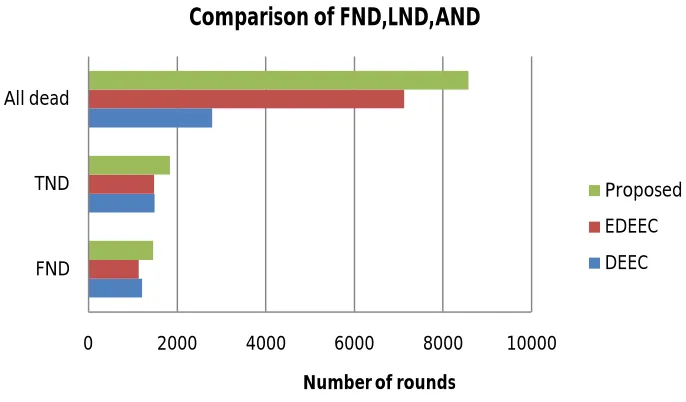
The cases are prepared based on varying the number of nodes of different types and also their energy enhancement factor. The protocols are simulated and their results are presented in table 2 and table 3.The network lifetime parameter considered are first node dead, tenth node dead and last node dead.
Case1:
Input No. of Nodes Protocols Network life time parameter
m = .5,m0 = .2, m1 = .7, x = 1.5, y = 2, z = 2.5
Normal=50% Advance=40% Super=7% Ultra=3% DEEC EDEEC Proposed FND 1240 1148 1374 TND 1446 1669 1952 AND 3188 7410 8118
Table 2: Comparison of FND, LND, AND for different protocols using case 1
Figure 1: Comparison of FND LND AND using case 1
Case2:
Input No. of Nodes Protocols Network life time parameter
m = .5, m0 = .3, m1 = .2, x = 1.5, y = 2, z = 2.5
Normal=70% Advance=24% Super=3% Ultra=3% DEEC EDEEC Proposed FND 1208 1124 1453 TND 1486 1469 1829 AND 2779 7121 8574
Table 3: Comparison of FND LND AND for different protocols using case 2
0 2000 4000 6000 8000 10000
FND TND All dead
Number of rounds
Comparison of FND,LND,AND
Proposed
EDEEC
Figure 2: Comparison of FND LND AND using case 2
V.CONCLUSION
The mentioned scheme is energy aware heterogeneous routing protocol possessing four levels of nodes. Further it is considered to be adaptive protocol where cluster head is selected dynamically in more balanced way. The said protocol is saving nodes of network, in turns improving network lifetime.
REFERENCES
[1] N.A. Pantazis, S.A. Nikolidakis and D.Vergados, “Energy-efficient routing protocols in wireless sensor networks: A survey” in IEEE
Communication Surveys & Tutorials vol. 15, No.2, Second Quarter, pp 551-591, 2013
[2] I.F. Akylidiz, W.L. Su, Y. Sankarasubramaniam and E. Cayirci,” Wireless sensor networks: A survey on sensor networks,” IEEE
Communication Magazine, vol. 40, no. 8, pp.102-104, 2002
[3] A. Norouzi and A. Halim,” An Integrative comparison of energy efficient routing protocols in wireless sensor network”, Wireless Senor Network, vol. 4 no.3, pp 65-75,2012
[4] Heinzelman, W., Chandrakasan, A., and Balakrishnan, H., "Energy-Efficient Communication Protocols for Wireless Micro sensor Networks,”
in Proc. of the 33rd Hawaiian International Conference on Systems Science (HICSS), January 2000
[5] S. Lindsey and C. Raghavendra, “PEGASIS: Power-Efficient Gathering in Sensor Information Systems,” IEEE Aerospace Conference
Proceedings, vol. 3, pp. 1125-1130, 2002.
[6] O. Younis and S. Fahmy, “HEED: A hybrid, energy-efficient, distributed clustering approach for ad-hoc sensor,” IEEE transaction on mobile computing, vol. 3, pp. 366-379, 2004
[7] G. Smaragdakis, I. Matta, A. Bestavros, “SEP: A stable election protocol for clustered heterogeneous wireless sensor networks ”,Second International Workshop on Sensor and Actor Networks protocols nad Application (SAPNA 2004), 2004
[8] L. Qing,Q. Zhu, M. Wang. “Design of distributed energy-efficient clustering algorithm for heterogeneous wireless sensor network,” Wireless
Sensor Network, vol. 2, no. 7, pp. 538-554, 2010
[9] B. Elbhiri, S. Rachid, S.E. Fkihi, D. Aboutajdine,” Developed distributed energy-efficient clustering for heterogeneous wireless sensor networks”, 5th International Symposium on I/V Communication and Mobile Network, 2010
[10] P. Saini, A.K. Sharma,”EDEEC: Enhanced distributed energy efficient cluster scheme for heterogeneous wsn”,1st international conference on parallel, distributed and grid computing (PDGC-2010)
[11] W. Heinzelman, A. Chandrakasan and H. Balaing scheme krishnan, “Energy efficient communication protocol for wireless micro sensor networks”, Proceedings of the 33rd Hawaii International Conference on System Sciences, 4-7 January 2000
[12] M. Hadijila, H. Guyennet and M. Feham, “A chain based routing protocol to maximize the lifetime of wireless sensor networks”, Wireless
Sensor Networks, vol. 5 no. 5, pp. 116-120, 2013
[13] S. Bandyopadhyay and E. Coyle,” An energy efficient hierarchical clustering algorithm for wireless sensor networks”, 22nd Annual Joint
conference of the IEEE Computer and Communication (INFOCOM 2003), san Fanscisco, pp. 1713-1723, 2003
[14] Heinzelman and B. Krishnan, “An application specific protocol architecture for wireless micro sensor networks”, IEEE Transactions on
Wireless Communications, vol. 1, pp 660-670, 2002
0 2000 4000 6000 8000 10000
FND TND All dead
Number of rounds
Comparison of FND,LND,AND
Proposed
EDEEC
[15] T.N. Quershi, N. Javaid, A.H. Khan, A. Iqbal, E. Akhtar and M. Ishfaq, “BEENISH: Balanced energy efficient network integrated super heterogeneous protocol for wireless sensor network “, International Workshop on Body Area Sensor Network, 2013
[16] R. Sheikhpour, S. Jabbehdari, A. Khadem-zadeh, “Comparison of energy efficient clustering protocols in heterogeneous wireless sensor network”, International Journal of Advance Science and Technology, vol. 36, November 2011
[17] V. katiyar, N. Chand, S. Soni, “Clustering algorithms for heterogeneous wireless sensor network” A: Survey”, International Journal of Applied
Engineering Research, vol. 1, no. 2, 2010
[18] D. kumar, T.C. Aseri and R. B. Patel,” EEHC Energy efficient heterogeneous clustered scheme for wireless sensor networks”, Computer
Communication, pp 662-667, 2009
[19] B. Elbhiri, R. Saadane, D. Abutajdine,” SDEEC: Stochastic distributed energy-efficient clusteringforheterogenous wireless sensor networks”, ICGST-CNR Journal, 2009
[20] S.Rani,J. Malhotra, R.Talwar,” EEICCP-Energy efficient protocolfor wireless sensor networks”, published in http://www.scrip.org/journal/wsn, 2013
[21] D. Kumar, T. C Aseri, R.B. Patel ,”A novel energy-efficient multi hop communication protocol for clustered heterogonous wireless sensor network”, Journal of Global Research in Computer Science,
[22] S. Wang, Z. Chen,”LCM:Aink aware clusteringmechanism for energy efficient routing in wireless ensornetworks”,IEEE Sensor Journal, 2013 [23] K. Lee, H. Lee,”A self organizied and smart-adaptive clustering approach for wireless sensor networks”, International Journal of Distributed
Sensor Networks
[24] G. Saminathan, T. Ponnuchamy, “EE-LEACH: Development of energy efficient leach protocol for data gathering in WSN”, Arumugam and
Ponuchamy EURASIP journal on Wireless Communication and Networking, pp 2-9, 2
[25] Sharma, V. Verma, “Heterogeneous LEACH for wireless sensor networks”, International Journal AdvancedNetworking and Applications, pp 1825-1829, 2013