Vol. 4, Issue 5, May 2016
Diversity Based Web Service
Recommendation using Clustering
Pooja Kumbhar, Prof G. S. Mate
PG Student, Department of Computer Engineering, JSPM’s RSCOE Savitribai Phule Pune University, Pune, India
Associate Professor, Department of Information Technology, JSPM’s RSCOE SavitribaiPhule Pune University, Pune, India
ABSTRACT: While dealing with the web services Quality of service (QoS) is most known and important aspect. QoS gives non-functional feature and also acknowledgment of the web services all over the World Wide Web. We make use of various filtering schemas together based on QoS values as well as pros of the present use of analysis of services. QoS explains non practical web service execution and gives service selection [3]. QoS is classified as group of user attentive attributes with reaction time, accessibility and reputation etc. The most common and preferable technique is collaborative filtering method. Here in this paper we introduce a new method for web recommendation which makes sure users QoS recommendations and also type of features in which user are interested web services. From observations of last few years’ utilization of online services shown that the users are very much interested and also QoS recommendations on web services area. At last, users ranking of web services is arranged by finding their scores and also quality of degrees occupied depending on online services graph through applying diversity aware web service ranking algorithm [6]. In projected system, web services clustering are done by making use of hierarchical clustering algorithm as well as web services which are organized by diversity based web service ranking algorithm. After the ranking of web services top k list of web services is generated to fulfill user’s requirement and QoS recommendations. Our method used for recommending web services to increase the performance and also quality of recommendation outcomes depending on hierarchical clustering.
KEYWORDS: Web service recommendation, hierarchical clustering, service usage history, diversity, web service
I. INTRODUCTION
Web services are being more popular in last few years and also hasan important part with different applications such as business application, e-commerce etc. there are number of web services present on web also the number of web applications will become a problem having tendency of service computing group [1]. Also the count of web services is present with comparable workings and different without any functional quality. To choosing effective web service which is able to fulfill the users non-functional as well as functional needs.
The recommendation system is concentrated on the concept of giving the proper recommendation that meets with the user’s needs. A common recommendations system must give small amount of regular papers that is further reduces the user’s interest. Though in realty user strictly entered by the papers written on the subject further the recommendation system us efficient to positioning them depending on references [4]. This system is not proper which outcome demonstrated similar pages more than once and not the different one.
Vol. 4, Issue 5, May 2016
In this paper, the top-k recommendation web service list is given to the user with the diversity of web services. The system takes into consideration functional and non-functional requirements of the user with the diversified recommendation list. User’s usage history is mined, through the text similarity and operation similarity. Then active user’s potential interest is calculated through the collaborative filtering approach. QoS preferences are mined from user’s usage history. Scores are calculated for each web service candidate through interest relevance and QoS utility. Ranking of optimal web services is done through diversity-aware web ranking algorithm.
II. RELATED WORK
Guosheng Kang et al. [1] illustrated a new technique for recommending web services to the clients. In this authors incorporated user’s probable QoS recommendations and also various quality features of user’s interest in Web services depending on exploring user’s history of the Web Service.
Min Gong et al. [2], gives service recommendation algorithm known as URPC-Rec (User Relationships Preferences Clustering and Recommendation). In this algorithm, basically, requested services depending on their history behaviorsused by clusters and after that specifications are given.
Yutu Liu, Anne H.H. Ngu, LiangzhaoZeng [3] developed method to overcome the issue of multi-user web service selection. System identifies the missing multi-QoS values based on historical QoS experience of user as well as after that select generally utilized technique for multi-user by our quick match technique.
Shagging Wang et al. [4] presented a new concentrated QoS expectation structure with location based regularization (LBR). Author initially added up in most popular Matrix Factorization (MF) method for values which is not given in expectation.
Wei Lo et al. [5] gave a methodto solve the issue of the “ensured” quality. To overcome this issue authorgiven a history record- based service minimization method called as Hire Some. Integrity of service arrangement is maximized bythistechniqueas well as by taking advantage of a web service’s QoS history records instead of developing the given QoS values endorsed by the provider of the service.
Lin Wenmin et al. [6], gives a method depending on idea of horizon to efficient and successfully select services for structure. Also minimize the amount of applicant services to be determined.
R.-H. Li, et al. [7], evolved an effective greedy algorithm to get near-optimal diversity depending on ranking along with the linear time and space complexity respectively size of the graph. Mohammad Alrifai et al. [8] gave a public, genuine and dynamic QoS calculation method for web services. Web services are chosen by executing and also by observing with a QoS registry in an assumed telephone service giving business application.
III.PROBLEM DEFINITION
In the system the web service recommendation with the verity by developing clustering method. Based on hierarchical clustering to the clustering method to cluster the service as well as diversity based web service ranking algorithm to rank the web service is used by system.
IV.IMPLEMENTATION DETAILS
A. Proposed System:
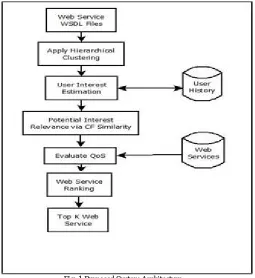
Input to the system is the web service WSDL files. Also the hierarchical clustering algorithm is created on the dataset. For determining the user interest in particular web service we have to study user history. By applying collaborative filtering (CF) method similarities are searched depending on possible related interest. QoS are calculated on the web services dataset from internet. For generating web service graph, ranking is performed based on QoS and user interest also depending on that outcomes are evaluated. At the end of process we will have the top k web services recommendations as an outcome of the system. The developed hierarchical clustering algorithm is designed on the cluster of the web services and WSDL files. It maximizes accuracy of a system.
Vol. 4, Issue 5, May 2016
Web services ranking: depending on the web service graph top-K ranked web services are gathered [1]. Web service graph has nodes and edges where node shows web service and edges are the network in them.
Fig. 1 Proposed System Architecture
B. Description of the Proposed Algorithm:
The proposed system implements the selection of web services through functional and non-functional evaluation using clustering.
STEP I: User Query Processing
Usage history dataset is mined to get the relevant web services related to the user query Similarity is evaluated as:
1) Term Frequency
, = ( , ) | |
where
t
j is thej
th term in the corpus; is the WSDL document of thei
th`Web service ;( , )is the occurrence number of
t
jin ; | | is the total occurrence number of all meaningfulterms in .
2) Inverse Document Frequency
, = | |
Vol. 4, Issue 5, May 2016
Where| | is the total number of WSDL documents, which equals to the number of Web services, i.e.,| | = ; |{ : }| is the number of documents where the term
t
jappears.3) Weight Calculation
, = ( , )∗ ( , )
A high weight in TF/IDF is achieved through a high term frequency and a low document frequency of the term in the whole collection of documents. The weights hence tend to filter out very common terms.
4) Cosine Similarity
= cos , = . ×
Where
|
w
i|
and|
w
j|
are the Euclidean length of the vectorw
i andw
j respectively, and the numerator is the dotproduct of
w
iandw
j.5) Web Service Similarity
, = +∅
STEP II: Collaborative filtering Similarity
Potential user interest is calculated using collaborative filtering. Web service recommendation system not only takes user’s usage history into consideration, but experiences of other web service users are also considered. Experience of other web service users can be used to predict the potential interest of the active user. Collaborative filtering approach is used to predict the potential interest of active user. In collaborative filtering approach, user similarity is calculated based on the web service invocation records of a set of users. Similar users share the common interests, so likely to use the web services with same functionality. The more commonly invoked web services two users have in their invocation records, the larger the user similarity between them.
The user similarity is computed by,
, = 2 | | + | |
Where and are the sets of web services used by user ui and uj respectively, is the set of web services used by both user and . If | | = 0, then user Sim(ui,uj) = 0. In collaborative filtering approach, web services used by similar users are recommended to the active user.
STEP III: Apply Hierarchical clustering
Clusters of web services which are closely related and similar to each other are created from historical user interest and potential user interest.
C. Clustering Algorithm
Agglomerative Hierarchical clustering
Vol. 4, Issue 5, May 2016
Algorithm 2: Hierarchical Clustering Algorithm- Input: Data vectors N
n
n
X
1 =1, group wise distance DIST (G, G’)
Output: Cluster of web services Process:
1)
A
// Active set starts out empty. 2) For n1...N do // Loop over the data.3)
A
A
{
xn
}
// add each datum as its own cluster. 4) end for5) A A // Store the tree as a sequence of merges. In practice, pointers. 6) while |A| > 1 do // Loop until the active set only has one item.
7) *
2 * 1
,
G
G
min DIST (G, G’)// choose pair in A with best distance.8)
A
(
A
\
G
1)
\
G
2// Remove each from active set.9)
A
(
A
G
1
G
2)
// Add union to active set.10)
(
G
1
G
2)
// Add union to tree. 11) end while12) Return: Tree
D. Detail flow of proposed system
Proposed System Flow:
Step 1: User inputs the query (Handling inputs).
Step 2: Usage history is checked and also check active user Session history.
Step 3: Historical user interest is collected from similarity evaluation.
Step 4: Apply hierarchical clustering on web services.
Step 5: Internet is searched to get the QoS preferences and potential user interest.
Step 6: Potential interest evaluation is done through collaborative filtering approach.
Step 7: Clusters of web services are created from collaborative filtered web services.
Step 8:QoSof web services is evaluate. It is consider in evaluation of diversity of web services.
Step 9: Diversified web service ranking is calculated.
Step 10: Top-K diversified web service list is generated.
Algorithm 3: Diversified Web Service Ranking
Input: Web Service Graph = ( , ), parameter , adjacency matrix A.
Output: A set of ranked Web services. 1: = ∅;
2: while | | ≤ do
3: = arg ∈( )(1− λ) + | { }− { }|;
4: = S ∪ { }; 5: end while 6: return ;
Vol. 4, Issue 5, May 2016
properties; algorithm presented is in charge of ranking procedure in which node having a maximum ranking score will be shown in top ranking list [1].
E. Experimental Setup
This system developed on Java framework (version jdk 6) and Netbeans (version 6.9) is used as a development tool on Windows platform. System is able to run on common machine also it does not require any specific hardware.
V. RESULT AND DISCUSSION A.Dataset
This system experimented over real-world Web Service Dataset. WS-DREAM engine is aggregate commonly available WSDL file on the Internet. Web services are analyzed by different distributed nodes by implementing aggregated QoS data. Normally previous work of systems is used real-world dataset to calculate performance by on web service.
B.Outcome
Figure 2 shows the precision graph of the proposed and present system. We can see by making use of clustering we have achieved higher precision while the previous system in which they have not made use of clustering are not more precise.
Figure 3 shows the Mean Absolute Error Graph which show the comparison in the systems i.e. the system with clustering and system without clustering. Due to the clustering the MAE rate of our system is reduced and it produces results faster than the other system.
Fig2.Precision Graph Fig 3. Mean Absolute Error Graph
VI.CONCLUSION AND FUTURE WORK
Vol. 4, Issue 5, May 2016
of web services for better efficiency. Ranking computation basically concentrates on the immediate neighborhood data of ‘S’ in web service graphs. Thus, further system requires implementing different ranking computations along with k-hop nearest neighbors.
In a future work, we can use social network history of present user’s for recommendations for the new user which will increase the scope of system.
REFERENCES
[1] Guosheng Kang, Mingdong Tang, Jianxun Liu, Xiaoqing (Frank) Liu, Buqing Cao, “Diversifying Web Service Recommendation Results via Exploring Service Usage History”, IEEE TRANSACTIONS ON SERVICES COMPUTING on Volume: PP; Year 2015.
[2] Min Gong, ZhaoguiXu, Lei Xu, Yanhui Li, “Recommending Web Service Based on User Relationships and Preferences”, Web Services (ICWS), 2013 IEEE 20th International Conference on Date of Conference:June 28 2013-July 3 2013.
[3] Yutu Liu, Anne H.H. Ngu, LiangzhaoZeng, “QoS Computation and Policing in Dynamic Web Service Selection”, WWW2004, May 1722, 2004, New York, New York, USA. ACM 1-58113-912-8/04/0005.
[4] Shangguang Wang, Ching-Hsien Hsu, Zhongjun Liang, Qibo Sun, Fangchun Yang, “Multi-user web service selection based on multi-QoS prediction”, Information Systems FrontiersMarch 2014, Volume 16, Issue 1, pp 143-152 First online: 04 October 2013.
[5] Wei Lo, Jianwei Yin, Shuiguang Deng, Ying Li, Zhaohui Wu, “Collaborative web service qos prediction with location-based regularization”, doi.ieeecomputersociety.org/10.1109/ICWS.2012.49.
[6] Lin Wenmin, Dou Wanchum, LuoXiangfeng, Jinjun Chen, “A History Record-Based Service Optimization Method for QoS-Aware Service Composition”, Web Services (ICWS), 2011 IEEE International Conference on Date of Conference:4-9 July 2011.
[7] R.-H. Li, J. X. Yu. “Scalable diversified ranking on large graphs”. IEEE Transactions on Knowledge and Data Engineering, Vol. 25, No. 9, pp. 2133-2146, 2013.
[8] Mohammad Alrifai, DimitriosSkoutas, Thomas Risse, “Selecting Skyline Services for QoS-based Web Service Composition”, WWW 2010, April 2630, 2010, Raleigh, North Carolina, USA.ACM 978-1-60558-799-8/10/04.
BIOGRAPHY
Ms.Pooja T. Kumbharbcurrently pursuing a ME degree in computer science technology from SavitribaiPhule Pune university. Completed B.E degree in computer engineering from PimpriChinchwad college of engineering under the SavitribaiPhuleuniversity,Pune June 2013.