MROCZKA, MARY ANN. Effects of Study Modality and Study Order on Learning Braille and Other Haptic Alphabets Used by Blind Persons. (Under the direction of Drs. Slater E. Newman and Michael S. Wogalter.)
Braille is the alphabet predominantly used today for total communication by blind persons; yet, its difficulty to learn prevents some from using it. This experiment compared learning of three alphabets used by blind persons, Braille, Moon and Fishburne. The effects of study modality (visual, haptic) and study order (random, alphabetical) were also investigated. Participants were given four study-test sequences to learn the names for each of the 26 symbols of one of the three alphabets. On test trials, all participants were tested haptically in different random orders. Results showed main effects for alphabet, study modality, trials and an interaction between trials and alphabet. Moon was easier to learn than Braille, which was easier to learn than the Fishburne alphabet. Visual study facilitated learning only with the Moon alphabet. Results are interpreted in terms of McGuire’s (1961) three proposed
BRAILLE AND OTHER HAPTIC ALPHABETS USED BY BLIND PERSONS
by
MARY ANN MROCZKA
A dissertation submitted to the Graduate Faculty of North Carolina State University
in partial fulfillment of the requirements for the Degree of
Doctor of Philosophy
PSYCHOLOGY
Raleigh 2005
APPROVED BY:
_______________________________ _______________________________
Dr. Brad Mehlenbacher Dr. James W. Kalat
_______________________________ _______________________________ Dr. Slater E. Newman Dr. Michael S. Wogalter
DEDICATION
This dissertation is dedicated to the two women for whom I was named.
I never knew my aunt Mary Mroczka. She died, when she was a teenager, as a result of a car accident. However, she was much loved and missed by her brothers. I believe that I have attained this educational level because of the perseverance that her brother, Joseph, passed on to me at a young age before his early death.
BIOGRAPHY
Mary Ann Mroczka was born to Virginia Lee and Joseph Andrew Mroczka on September 26, 1949 in Washington, DC. (Her mother and father met in “DC” after World War II; Virginia grew up on the outskirts of Waterloo, Iowa and Joseph was from Mayfield, Pennsylvania). She attended St. Anthony High School, taking all of the available math and science courses. She received a BS in Business Administration (Economics) from the University of Dayton in 1973; her courses emphasized contemporary urban and economic problems. Dr. Mroczka’s education continued at Southwestern Baptist Theological Seminary, where she received the Masters in Religious Education degree, with a
concentration in Adult Education, in 1977. Dr. Mroczka continued her theological studies at Colgate Rochester Divinity School/Bexley Hall/Crozer Theological Seminary and received a M.Div degree, with a focus on Counseling, in 1979. A job as Coordinator of the Mid-Hudson Graduate Center (Engineering and Computer Science) of Syracuse University demonstrated the need for human factors engineers to be skilled in the design the interface of information products. While preparing for doctoral studies, a BA in Psychology was awarded by Marist College in 1993; in addition, she was inducted into the Alpha Chi and Psi Chi honor
societies.
In order to support her academic work, she worked as a Teaching Assistant, job analysis consultant, manager of a NSF grant (visualization technology in environmental curricula), consultant in technology dissemination, Human Factors intern in software interface design and usability studies (IBM, Intel, Nortel), and full-time College Instructor. She completed the Educational Opportunity Institute certificate program. Most recently, she was the Program Associate for Diversity Program Development at the NC State Faculty Center for Teaching and Learning; in this role, she conducted faculty workshops on pedagogical issues, and designed and coordinated the campus-wide 2004 Diversity Symposium, Diversity: Enriching the Curriculum.
Dr. Mroczka and Ms. Beverly Williams gave a well-received presentation, Study Circles: Let’s Talk About Race, at the 2004 National Conference on Race and Ethnicity in Higher Education. She has been a facilitator of campus Study Circles on Race and Race Relations, a member of the Study Circles Steering Committee, and a contributor to the Study Circles II curriculum development project.
ACKNOWLEDGEMENTS
First of all, I thank the Holy Spirit for nudging me in the direction of doctoral study. Through it all, the Father has ordered my steps and, like a potter, has shaped this portion of my life to be so much more of an adventure than I had ever dreamed possible. The source of my strength and the strength of my life, Jesus, the Son of God, has often had to still many raging storms and part some deep waters so that I could go through to the other side.
I gratefully acknowledge the direction that Dr. Slater E. Newman has given me since I arrived at NC State in 1994. As a professor, he stressed the importance of the details of experimental design. As a research advisor, he continually combined a striving for excellence with a realistic appreciation for the fact that graduate students need to work (often more than one job) in order to eat. As a humanitarian, he has been active on campus and in the
community for the preservation of human rights. He epitomizes the ideal of a scholar and a gentleman. His wife, Patricia has often graciously offered her living room as a place for the writing and rewriting of the many drafts of this dissertation.
I am grateful to the members of my advisory Committee, Drs. Michael Wogalter, James Kalat and Brad Mehlenbacher. Not only did they work well together, they encouraged me to make connections between my two disciplines of ergonomics and cognitive
psychology.
research projects she has continued to be available to answer our varied questions about the field.
Since this research project necessitated the use of fonts, I am grateful to the Royal National Institute for the Blind (RNIB) in the United Kingdom for the on-line
availability of the Braille and Moon fonts. In addition, Claire Wilson generously shared her wisdom and experience with these alphabets with the Blink. I am indebted to Andrew
Neville, graduate student in computer science, for his software expertise in the creation of the Fishburne Font. We worked together at the Faculty Center for Teaching and Learning; he always made himself available to assist me with technological problems.
Of course, fonts alone do not make and display symbols. When it was discovered that the visual and haptic display windows were not the same size, graduate students Patrick Nyeste and Karl Kaufmann competently and graciously fixed this disparity over Labor Day weekend, without changing anything else on the display box. The search for an embosser was, in many ways, the most difficult part of this dissertation. The research was originally proposed with the offer of the use of the NC State Disability Services embosser. When that offer was withdrawn, a lengthy search led to an offer from Solutions for Humans; however, by the time the fonts were completed, that offer also was withdrawn. Thus, I am particularly grateful for Ms. Emily Valdez who persuaded her company, ViewPlus Technologies to produce the symbols for me. Not only did they emboss the symbols, they refused my offer of payment; without their helpfulness and generosity, this dissertation would not yet be
I am grateful to haptic alphabet researchers and practitioners at the Visual Impairment Centre for Teaching And Research, the School of Education, University of Birmingham, UK for sharing their methods and recent research findings. Dr. Michael McLinden and his colleagues have examined the use of the Moon and Braille alphabets in their country; I am pleased that our findings support each other’s work. Jenny Whitaker was also helpful by filling me in on the details of their procedures.
I am grateful to all the words of encouragement that were given to me along the way by family and friends; however a few stand out in my memory. Ms. Darnell Johnson, College of Humanities and Social Sciences, always offered a smile and a kind word, and often
provided pieces of chocolate on her desk. The Rev. Dr. William C. Turner, Jr., Ph.D., Duke Divinity School, has been a great supporter these last several years. When I finished my preliminary exams, he quietly assured me, “Just keep going, you will finish.” I must admit that there were times when I doubted; yet, his faith in the completion of this research
TABLE OF CONTENTS Page
List of Tables . . . ix
Introduction . . . 1
Prevalence of Blindness . . . 3
Alphabets for Use by Blind Persons . . . . 4
The Standard Paired-Associate Paradigm . . . 6
The Braille Alphabet . . . 7
Effects of Study Modality . . . . 8
Effects of Study Order . . . . 12
Comparison of the Braille and Fishburne Alphabets . . 14
Effects of Study Modality 14
Other Braille-Fishburne Studies . . . 15
The Moon Alphabet . . . 17
Rationale for the Experiment . . . 19
Method . . . 21
Participants . . . 21
Materials and Equipment . . . 21
Design . . . 23
Procedure . . . 24
Results . . . 25
Repeated Visual Conditions . . . 25
ANOVAs . . . 25
Hypotheses . . . 27
Structure . . . 29
Discussion . . . 32
Alphabet . . . 32
Study Modality . . . 35
Study Order . . . 36
Suggestions for Future Research . . . . 36
Concluding Statement . . . 39
References . . . 41
Tables . . . 45
LIST OF TABLES
Page
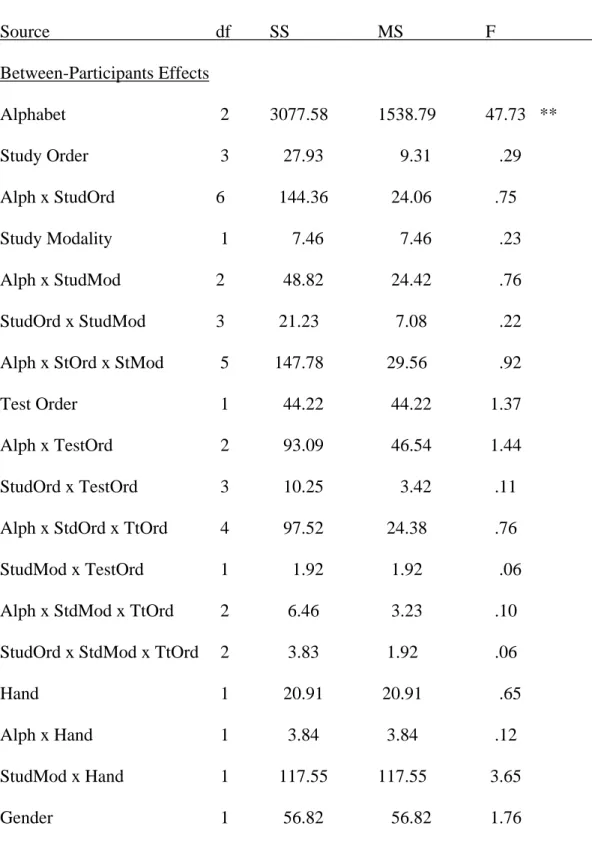
1. 3 x 2 x 4 x 2 x 2 x 2 x 4 MANOVA for number correct as a function of
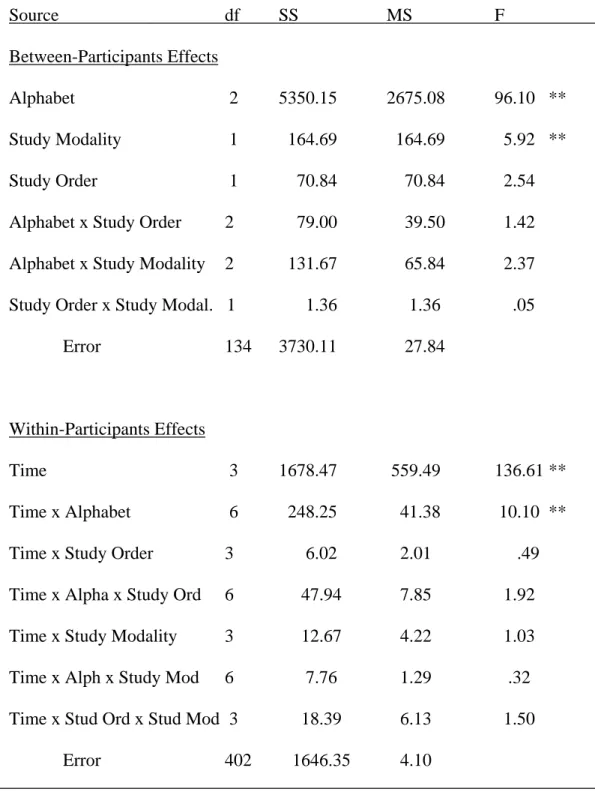
alphabet, study modality, study order, test order, hand, gender and trials . 45 2. 3 x 2 x 2 x 4 MANOVA for number correct as a function of alphabet,
The search for a means of communication for blind persons was marked by the purported influence of a French philosopher. During the latter half of the 18th century, Valentin Hauy was a young translator for foreign businessmen; he had read the work of philosopher, Denis Diderot, and became sympathetic to the plight of blind people. Hauy was impressed with the tactile discrimination skill of a blind beggar, Lesueur, who returned a large coin to Hauy, assuming that he had dropped it by mistake. Thus began the first blind-student and teacher relationship of record (Dixon, 2000).
Hauy’s first materials were letters embossed on small tiles. When Lesueur told his teacher that he could read the reverse side of letters that had been embossed on funeral cards, Hauy began production of these embossed reversed letters. However, this was a costly process in terms of time and money, and these first books for blind persons were also very large. In addition, there was the problem that the shapes were too complicated for easy recognition.
The next advance in the search for an alphabet for blind persons was made in 1821 by a retired French army captain. Charles Barbier, who had been acquainted with coded
messages during his military service, became interested in methods that might increase the rate of reading; he believed that illiteracy was partially due to difficulties with the use of the alphabet. Initially, he used a penknife to make puncture holes in paper. For battlefield purposes, he developed a system of ‘night writing’ to send messages in the dark. His code was based on the sounds in the French language, placed on a 7 x 7 grid. A sound was
embossed lines and curves of the Roman characters. However this system was not without problems. Since this system was phonetics-based, it led to unreliable spelling. Punctuation and numbers were not included. Writing was a slow process since some sounds required many dots, and the large number of dots made recognition more difficult. In addition, those sounds that required many dots were difficult to read because the reader’s finger might not cover all of them.
When Barbier demonstrated his code, one of the observers was Louis Braille. He had lost his eyesight nine years earlier in an accident in his father’s saddler shop. Frustrated with the current system, Braille proposed two major improvements. The cell was changed to a 2 x 3 matrix size. Also, rather than being sound-based, Braille moved to the use of the Roman alphabet. These two improvements continue to be characteristic of the Braille code to this day. It is currently the system most widely used for reading by blind persons (Dixon, 2000).
Moon and Fishburne are two other systems currently in use, Moon for reading and Fishburne for labeling. Each has been developed in response to the belief that they would be easier to learn than Braille. Though most such information is anecdotal, there is some corroborating experimental evidence, which will be presented below.
This introduction is divided into six sections. First, I will present some information about the incidence of blindness in the United States, and the extent of Braille usage. Next, I will briefly describe each of the three systems. Learning the names for symbols of an
alphabet is a paired-associate learning task. Thus, in the third section I will describe the typical procedure used in most of the experiments presented here.
facilitate stimulus discrimination will be examined. Then, several experiments comparing Braille and Fishburne will be presented, followed by the few studies comparing Braille and Moon. Finally, the experiment to be proposed will be presented along with the rationale for undertaking it.
Prevalence of Blindness
The American Foundation for the Blind (2005) reports that there are approximately 10 to 11 million blind and visually-impaired people in the United States. Of these, 1.3 million are legally blind and 55,200 of these are children. “Legally blind” refers to
clinically-measured acuity of 20/200 in the better eye with best correction or a visual field of 20 degrees or less. Visual impairment (approximately 9.5 million people) includes both severe and nonsevere functional limitation. Severe functional limitation refers to those who have said that they “are unable” to see words and letters in ordinary print, even with correction. Nonsevere functional limitation refers to people who have said that they “have difficulty” seeing words and letters in ordinary print. There are 5.5 million elderly individuals who are blind or visually impaired. The incidence rate is that every seven minutes, someone in the United States will become blind or visually impaired. The prevalence of the deaf-blind population in the United States is 10,000 (Rosenberg & Borg, 2001).
Alphabets for Use by Blind Persons
Braille is a means for blind persons to read and write, "total communication."
Although it is the most widely used alphabet for this group, it is not used by all. In 1986, only about 45,000 of the 1.7 million blind persons in U.S. reported the use of Braille for
communication. Only 5,500 of the 55,200 legally blind children used Braille.
While the original Braille code included dashes as well as dots, the Braille symbols are now composed of one to six dots that appear in a 2 x 3 matrix (see Appendix 1). There are two versions of Braille, contracted (uses symbols for some contractions) and
uncontracted (a symbol for each letter).
By 1990, the Braille alphabet system was composed of the literary code (i.e., the basic code) as well as specialized codes for mathematics, music, computers, and textbook notation. The difficulty of learning these different codes led to the formation of an
international Uniform Braille Code committee; the UBC is being designed to include all codes except the music code (Dixon, 2000). While Braille is the predominant alphabet currently used, research and field data indicate that it is neither easy to learn nor to use (Millar, 1997).
Some researchers in Britain (McCall & McLinden, 2001a) have conducted a survey of teachers of blind children regarding their use of the Moon code. This alternative to Braille is sometimes employed successfully with children who are unable to learn Braille, especially those with other disabilities (McCall & McLinden, 2001b). However, there are no
experimental data with this population to support this practice. Thurlow (1986) has reported that the Moon symbols were found to be easier both to discriminate from each other and to learn their names than the symbols from Braille and some other alternative alphabets. One proposed use for Moon is to serve as an initial training alphabet for visually impaired persons who have difficulty learning Braille. After some experience learning Moon, some
participants are better able to learn Braille than if taught Braille initially (Millar, 1997). A third alphabet, Fishburne, is the symbol system developed by S. B. Fishburne in 1972 as an alternative to Braille, especially as a code for labeling. In 1972, Fishburne learned that, of the then 1,700,000 blind persons in the United States, only about 45,000 had learned Braille. That information encouraged him to develop a new alphabet system that would be easier to learn and use than Braille. (Shafrath, 1986). The Fishburne system uses four
different symbols (dots, and vertical, horizontal and diagonal bars) in a repetitive pattern (see Appendix 3).
Most of this research on alphabets for blind persons has been done with Braille. There have been few studies in which learning of two or more of these alphabets has been
learning of the Fishburne alphabet has also occurred when participants (Ps) studied the items haptically and were then tested haptically (Newman et al, 1996; Snowden, Newman & Temple, 2001).
The paired-associate procedure has been the primary procedure employed in examining the processes involved in learning the names for the symbols of the Braille and other alphabets used by blind persons. McGuire's (1961) proposed model of paired-associate learning includes three stages: stimulus discrimination, response learning and associative learning. Visual (as compared with haptic) study modality as well as presenting the items alphabetically (as opposed to randomly) in study trials might facilitate the identification of structure as well as stimulus discrimination and/or associative learning.
The Standard Paired-Associate Learning Paradigm
This section describes the standard paired-associate learning procedure. An outline is presented of the usual variables that are present in this type of research when employed to explore how participants learn the names for the symbols of the Braille and Fishburne alphabets. Following this presentation, previous research is examined. As each study is presented, those areas in which the researchers varied the following procedure are discussed in detail.
standard-size Braille cell (2 columns, 3 rows) is 4 x 6 mm. The standard-standard-size Fishburne cell is 12 x 24 mm.
Usually, the participants are right-handed sighted undergraduate students in an Introduction to Psychology class. Sometimes, only a portion of the alphabet is presented for the participants to learn and, at other times, the whole alphabet is to be learned. Symbols are typically presented visually or haptically on study- and test trials; a different random order is used on each trial. Each symbol is presented one at a time, for a fixed amount of time (e.g., 5 or 10 s). On visual study trials, participants look at the symbol while a tape recorder presents the name of the symbol. On haptic study trials, participants feel the symbol, usually using the right (or preferred) index finger, while listening to the name of the symbol. In a similar manner on test trials, participants examine the symbol either visually or haptically and then say aloud the corresponding letter name of the symbol. On test trials, there is a fixed amount of time (e.g., 5 or 10 s) for participants to respond to each symbol. At the end of the
experiment, there is usually a post-experimental inquiry in which participants are asked questions about how they tried to learn the names of the symbol; one typical question asks whether they noticed the structure of the alphabet code.
The effects of several independent variables are studied. The usual dependent variables are the number of items correct on each trial and the overall total correct. The data are usually submitted to an analysis of variance procedure.
The Braille Alphabet
the response terms. The following summarizes those experiments in which the effects of study modality (visual, haptic) and study order (alphabetical, random) have been
investigated.
Effects of Study Modality
Newman et al. (1982) carried out a set of three experiments in which the effects of study modality were examined. In Experiment 1, participants paced themselves in learning the names for the first 10 symbols (A-J) of the Braille alphabet. The amount of study time and test time were recorded. For half of the participants, the symbols were presented visually on study trials and, for the rest, they were presented haptically. Half of each group was tested in the same modality and the other half in the other modality. Thus, there were four
conditions (VV, VH, HH, HV). On each trial, a different random order of presentation was employed. There were three study-test sequences.
Analyses were done for number correct, study time and test time. Here are the results: for number correct, all three main effects (study modality, test modality, trials) were
significant but none of the interactions were. Visual examination of the items during study trials and test trials enhanced learning and, of course, performance improved over trials. For study time, the effects of study modality, trials and their interaction were significant.
spent on test trials declined during training; and (4) this decrease was more marked for those who were tested haptically than for those who were tested visually. Of particular relevance to the study reported here is that performance was better under the VH condition than under the HH condition.
Since the use of a self-pacing procedure resulted in a confounding of time and accuracy, study time and test time were controlled in Experiment 2, which investigated the effects of study time (5 or 10 s) as well as study modality and test time (5 or 10 s). In all other respects, the procedure was the same as in Experiment 1, except that there were five rather than three study--test sequences.
The following significant effects were obtained: study modality, test modality, study time and the interaction between study modality and test time. As in Experiment 1, visual study led to better performance than haptic study, especially at the longer test time and being tested visually was accompanied by better performance than being tested haptically. As would be expected, overall performance was better when there was more time to study. Of special interest is that those who studied the items visually did better when tested haptically than those who studied the items haptically. This difference appeared on the first test and continued throughout learning.
It was expected that use of the large-size of Braille during the study trials might facilitate performance for those in the HH condition. Significant effects were obtained for study modality, study time and the interaction of study modality and study size. When the items were examined visually, performance was better than when examined haptically for standard Braille but not for large-size Braille, in accord with the prediction. Also, having additional study time was again facilitative. The authors concluded that the results in both experiments supported Tulving’s (1979) proposal that retrieval of an item is determined both by its discriminability and its encoding specificity (i.e., whether those cues present at
encoding are present at retrieval).
Hall and Newman (1987) examined the effects of several variables that, in the experiments summarized above had been shown to affect learning the names for Braille symbols. All seven variables were manipulated in this experiment to determine their relative importance for this learning task. They were study modality (visual, haptic) test modality (visual, haptic), study rate (5, 10 s), test rate (5, 10 s), study size (standard, large), test size (standard, large), and item set (A-J, K-T). There were three study-test sequences.
The results for number correct showed that three of the seven variables (study modality, item set, test modality) accounted for most of the variance. As in previous
experiments, studying the items visually, being tested visually and learning the A-J set led to better performance than studying the items haptically, being tested haptically and learning the K-T set. Furthermore, performance in the VH condition was again better than for those in the HH condition. Hall and Newman proposed that the results for both study and test
modality were in accord with both Tulving’s (1979) position combining stimulus
position. Freides proposes that participants translate each item into a code for the modality that is most adept for the task to be performed and that the more frequently items are presented in the most adept modality (whether on study trials or test trials,) the better the performance will be. For learning Braille, according to (personal communication, Freides, 1981), the visual modality is more adept than the haptic modality,
In a subsequent experiment (Newman, Stone & Craig, 1988), the independent variables were study modality (visual, haptic), test modality (visual, haptic) and study-test trial ratio (5:1, 3:3, 1:5). A 5 s rate was used on both study trials and test trials. For all conditions, the items appeared in a different order on each of the six trials, and two sets of orders were used, one set for half of the participants in each treatment.
The main dependent variable was the number correct on the sixth trial, which was a test for all 12 groups. All three main effects and the interaction of study modality x test modality were found to be significant. Studying the items visually, and being tested visually were better than doing either haptically, and the 5:1 and 3:3 means were higher than the 1:5 mean. The VV mean was substantially higher than the other three means and, as in the previous experiments, the VH mean exceeded the HH mean.
Newman, Sawyer, Hall and Hill (1990) examined the effect of the number and type of study modalities (visual, haptic or both) on learning the names for the A-J or K-T symbols. In addition to the VH and HH study conditions, there were two bimodality conditions,
prior to the first study trial. A 10 s rate was used on both study and test trials; and there were five study-test sequences.
The VH mean was higher than the two bi-modality means, which were higher than the mean for the HH condition. Newman et al. proposed that these results are interpretable using Freides' (1974) modality-adeptness hypothesis. They proposed, also, however, that the better performance of the VH as compared with the VOH and VAH conditions suggested that the availability of the haptic mode on the study trials may have reduced the effectiveness of the visual modality. Finally, as for the effect of item set, the A-J mean was higher than the K-T mean and this difference increased over training.
In all but one of the previous learning experiments, each test trial immediately followed a study trial. In this next experiment, Newman, Hall and Pullen (1992) used a mixed design to examine the effect of both study modality (visual, haptic) varied between- participants and test delay (none, 48 hours) varied within- participants. Participants were given one visual or haptic study trial to learn the A-J items and were then tested haptically both immediately and 48 hours later. A 10 s rate was used on both the study and test trials.
The results were clear-cut. The VH group did better than the HH group both immediately and 48 hours later. Performance declined significantly, and to about the same extent, for both study-modality groups. Thus, the advantage of studying the symbols visually (as compared with haptically), even when testing is done haptically, occurs early and lasts for a fairly long time.
Effects of Study Order
determined that the A-J items were more discriminable from one another than were the K-T items. The A-J items have fewer dots). Order of presentation (alphabetical, random) during study trials was the other independent variable. Thus, for some participants in each item-set condition, the items were presented alphabetically on each study trial; for the remaining participants the items were presented in a different random order on each study trial. For all participants, a different random order was used on each test trial, none of which had been employed during the study trials. (Thus the random group received the items in a different order on each study trial, but the alphabetical group did not.) Items were presented haptically on both study and test trials. There were five study-test sequences. The rate on both study and test trials was 10 s.
The effect of item set was significant; the effect of study order was not. The more discriminable A-J items were learned faster than the K-T items. Thus, as in previous research with items presented visually (McGuire, 1961) and auditorily (e.g., Plotkin, 1943) learning was found to be directly related to item discriminability.
Summary: Effects of Study Modality and Study Order
/encoding specificity position of Tulving (1979) as well as with Freides' (1974) modality adeptness position. Finally, in the one experiment on the effect of study order (alphabetical, random) none was found.
Comparison of the Braille and Fishburne Alphabets
The Fishburne system was designed to accommodate blind persons, who cannot learn to read Braille, to record short pieces of information (e.g., telephone numbers) and to make labels (medicines, canned goods). Rehabilitation teachers believe that Fishburne serves the needs of persons who have poor sensitivity in their fingertips (e.g., because of injury, burns, stroke, diabetes, arthritis) and older persons who otherwise would not be able to live
independently. Other anecdotal evidence includes that of a middle-aged man who refused to try to learn Braille but learned Fishburne to label his tapes and of a blind woman who, initially intimidated about learning Braille, found that success in learning the Fishburne system gave her the motivation to learn Braille (Young, 1970). However, such evidence need not serve as the sole basis for supporting the claim that the Fishburne system is easier to learn than Braille.
Effects of Study Modality
A thesis experiment by Stone (1993) examined the effects of both study modality and test modality (visual, haptic) on learning the names for all 26 letters of the Braille and
Analysis of variance showed significant effects of alphabet, study modality, test modality and for the study and test modality, and alphabet and study modality interactions. (Although overall performance was better with the Fishburne than the Braille alphabet, for the visual study than the haptic study conditions, and for the visual test than for the haptic test conditions, only when participants studied haptically and were tested visually was the Fishburne mean significantly higher than the Braille mean). Furthermore, the VH-HH difference was significant neither for Braille nor for Fishburne conditions.
Other Braille-Fishburne Studies
Several studies have compared learning of the Braille and Fishburne alphabets in which the items have been presented visually on both study trials and test trials (Newman & Hall, 1988; Newman et al., 1990; Newman, Bardi & Craig, 1989; Newman, 1992). In almost all instances, the Fishburne group did better, independent of the arrangement of items on study trials or test trials, or of the amount of study time.
Post-experimental inquiry data from most of these experiments have indicated that a much higher proportion of those who studied the Fishburne than the Braille alphabet reported noticing the structure among the symbols and using that information to learn the symbol names.
Both Braille and Fishburne alphabets were designed with a definite pattern to
horizontal, slanted). The structure follows a six-letter sequence: a single symbol (top, bottom, both) followed by a double symbol (top, bottom, both). Letters Y and Z are comprised of double-vertical dots at the top and bottom, respectively.
In the study by Stone (1993), participants had two study-test sequences to learn the names for all 26 letters. Overall performance was quite low. Thus, Snowden, Newman and Temple (2001) had participants learn 13 of the Braille or Fishburne alphabet over four study-test sequences. Items were presented haptically on both study and study-test trials at a 5 s rate, and participants responded orally.
Here are the results: performance was better for the Fishburne than for the Braille alphabet, and the difference increased over trials. On the last trial, the mean correct for the Fishburne condition was 85% and 49% for Braille.
Post-experimental inquiry data from previous experiments had suggested that the faster learning of the Fishburne than of the Braille alphabet may derive, at least in part, from earlier recognition of the structure of the Fishburne alphabet. It is possible, however, that it may have been due, at least partly, to greater discriminability of the Fishburne than of the Braille symbols.
important factor in accounting for faster learning of the Fishburne than of the Braille alphabet.
In summary, the Fishburne alphabet has been found to be easier to learn than Braille both visually and haptically. This appears to derive both from the greater discriminability of the Fishburne than of the Braille symbols and from a more discriminable alphabetical structure.
The Moon Alphabet
In addition to Braille, several other alphabet systems have been developed for text reading (book, magazine) and "total communication" use by visually-impaired persons. Some anecdotal evidence suggests that children, who could not learn Braille, did learn the Moon system easily. Moon is also reported to be easier to learn to read than Braille for persons with impaired touch, such as diabetics and elderly persons. Moon is also easier to learn for those adventitiously blind persons familiar with the English alphabet (Yeadon, 1979). McCall and McLinden (2001a) have suggested that the advantages of the Moon code (see Appendix 2) over the Braille code are that the Moon symbols are larger, that many of its symbols correspond to letters of the Roman alphabet, and that the Moon symbols can be enlarged without symbol legibility being affected.
Performance on each of these codes was significantly poorer, however, than on their larger-size versions used in Thurlow's previous experiments, though performance was better with Moon than with Braille.
Ease of visual learning the standard Braille and Moon alphabets was compared in a subsequent experiment (Experiment 11). Participants were given 1 minute to study a code visually and then were presented the 26 symbols, randomly arranged, and given 4 minutes to report aloud what each letter was. For Braille, the mean correct was 5.4 and for Moon it was 18.6. Similar results were obtained in previous studies where participants were given 1.5 minutes on the test.
Douglas, McLinden and McCall (2003) conducted research in England with dotted Moon symbols that were produced using raised dots rather than raised lines. This study was conducted in cooperation with the Royal National Institute of the Blind. A questionnaire was sent to 100 teachers, advisory teachers and teaching assistants who used lined-Moon
products. The 25 responding professionals raised questions about the transfer to dotted Moon. Evaluation was conducted with observations in 12 case studies with three groups of blind persons in England: high school, college and adult education students. The
methodology consisted of interview and video recording. All participants were able to learn dotted Moon but there was no conclusive evidence that the dotted Moon was harder (or easier) to learn than lined Moon.
of the same size. In addition, Loomis (1981) has found Braille symbols to be more legible than print letters as well as print letters made up of dots, when examined either haptically or visually.
Rationale for the Experiment
McGuire (1961) has proposed that paired-associate learning involves three processes, stimulus discrimination, response learning and associative learning. This analysis can be applied to learning the names for three alphabets used by blind persons (Braille, Moon, Fishburne) and to the effects of study modality and study order on learning these alphabets. It can be assumed that any variable that is likely to enhance any one of these processes is concomitantly likely to enhance overall paired-associate learning.
Studying items visually, as compared to haptically, can be expected to facilitate stimulus discrimination of the symbols for each of the three alphabets. In addition, for the Fishburne alphabet, it may enhance identification of its structure. For the Moon alphabet, stimulus discrimination and the associative process may be facilitated through visual study.
Presenting the items alphabetically on study trials can be expected to facilitate identification of the Fishburne structure. It is not clear whether alphabetical presentation would be facilitative for learning the other two alphabets.
Ease of learning each of the three alphabets will also be compared. Results from previous research have indicated that the Fishburne symbols are more haptically
Method Participants
One-hundred seventy sighted undergraduate students (106 females, 64 males) from Introduction to Psychology classes participated in this experiment and received research participation credit. Of these, there were 12 left-handed participants (four with each
alphabet). A balanced Latin Square was used to assign the first 144 participants to treatments. However, when the visual display window was enlarged (see below), the 26 visual study condition participants (that had been done with the smaller window) were repeated, and replaced the original ones. These were run in the same order as the first such participants.
Although some said that they had had some casual contact with Braille symbols on doors and near elevators, all stated that they had had no previous formal experience with Braille, Moon or Fishburne symbols.
This research was approved by the Institutional Review Board of North Carolina State University. A copy of the Institutional Review Board Application is found in Appendix 9.
Materials and Equipment
Each participant signed an Informed Consent Form (Appendix 10) and was given a copy to keep. One tape recorder was employed to present the letter names on the study trials and pace the experiment, and another was used to record each participant’s oral responses on the test trials.
Description of the Symbols
For each alphabet, all 26 symbols were presented sequentially, with only one symbol available for examination at a time. Each alphabet was embossed by a Tiger Embosser on computer paper ordinarily used in written materials for the blind and visually impaired. The Braille and Moon alphabets were made using standard fonts currently in use and available through the Royal National Institute for the Blind. For production of the Fishburne symbols, a graduate student in computer science made the font.
Previous Braille research has used symbols that were produced either by a Braille-writer or on tape or by a slate and stylus (i.e., pushing the dots onto tape, by hand). Current technology has advanced to the point where symbols can now be produced using a Braille font and an embosser (printer) that makes the dots in the standard matrix. In this manner and using the Braille font, any text can be translated into the Braille symbol system and
reproduced.
research did not use a font. Previous research by Thurlow (1986) used wires and small crystals to produce Moon symbols.
In some previous research, Fishburne symbols have been purchased from Fishburne Enterprises. The symbols were dots and lines that were embossed on self-adhesive tape (.5” wide, 1” long); they were available as single letters that could be combined by the user. This alphabet system has been used primarily for labeling rather than for text and reading
materials. In other research, participants visually studied the symbols on a piece of paper or thermoform, which ordinarily included a line thru the center of the symbol to help
participants learn the placement of each line or dot. For purposes of this experiment, a font was made using the High-Logic Font Creation software
(http://www.high-logic.com/fcp.html). Design
This experiment used a 2 x 2 x 3 x 4 mixed design. The between- participants independent variables were study modality (visual, haptic), study order (alphabetical or random), and alphabet (Braille, Fishburne, Moon). Three different random study orders were used; for each condition, the same random order was used on all four study trials. Trials (1st, 2nd, 3rd and 4th) was a within- participants variable. Two different sets of random test orders were employed to enhance the generalizability of this research. The random orders for both study trials and test trials are listed in Appendix 6.
conditions was the number of correct responses on each of the four test trials. The complete experimental design appears in Appendix 5.
Procedure
Informed consent (see Appendix 10) was obtained from each participant who also completed an index card with his/her name, date of birth, and Introductory Psychology professor’s name. Then, the experimenter read the procedural instructions (see Appendix 8) aloud at the beginning of the experiment. In these instructions, each participant was told the modality that would be used on the study trials (visual or haptic) and that all test trials would use the haptic modality.
Each participant received four study trials, each followed by a test trial. On the study trials, participants heard the name of the letter while they haptically or visually examined each symbol for 5 s. On the test trials, all participants examined each symbol with the index finger of their preferred hand, and orally responded with its name. On the random study trials, items were presented in the same random order on each trial. On all test trials, items were presented in a different random order on each trial and in different orders than on the study trials; there were two sets of random-order test trials. There was a 15 s interval between trials.
Results
In this section, the first analysis will examine whether there was a significant
difference in performance between those in the first 26 visual study conditions and their later replicates. An analysis of variance (ANOVA) examining the effects of each of the main between-participants independent variables (alphabet, study modality, study order), the two control variables (i.e., random study orders, test order), gender, hand and the within-
participants variable, trials, will next be presented. This will be followed by an ANOVA that includes the main between-participants independent variables and trials and then by separate analyses (t tests) for each of the nine hypotheses. Further comparisons between performance on the Fishburne and Moon alphabets will also be examined. For all of the ANOVAs and t tests, the number correct on each of the four test trials will be the dependent variables. An alpha level of .05 will be used in all of the analyses.
Repeated Visual Conditions
First of all, the performance of the participants in the 26 visual conditions that were repeated with the new visual display window was compared (t test) with that of the original 26 Ps in those visual conditions; no significant mean difference was found, t(50) = .63, p = .53, between the first group (M = 27.9) and the repeated group (M = 31.1). Therefore, the further analyses included all the haptic-study condition participants but only those visual-study condition participants who used the new visual display-window.
ANOVAs
hand (right, left), the within-Ps variable, trials (1,2,3,4) and their interactions. The dependent variable was the number correct on each test trial. The only significant effects were alphabet, F(2,89) = 66.4, p < .0001, trials, F(3,267) = 40.04, p < .0001, and Alphabet x Trials,
F(6,167) = 8.94, p < .0001. Since neither the effects of gender, hand, study order, test order nor any of their interactions were significant, these variables were collapsed for use in further analyses. Also, since there was neither a main effect nor an interaction with the random study orders, they were also collapsed in further analyses.
A 3 x 2 x 2 x 4 mixed ANOVA (Table 2) was performed to examine the effects of the main independent variables: alphabet, study modality, study order, trials and their
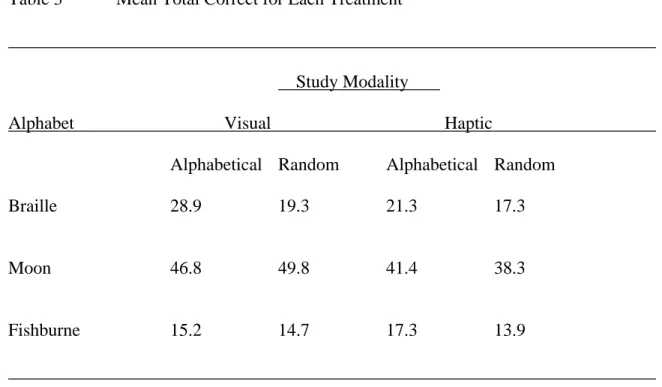
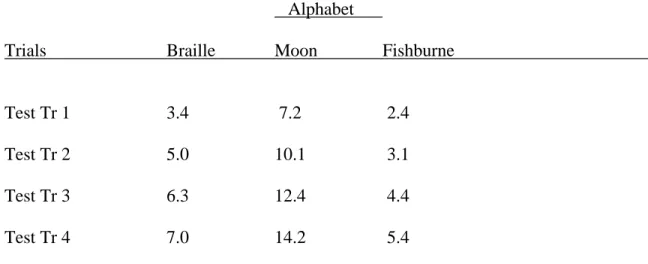
interactions. Again, the dependent variable was the number correct. The only significant effects were alphabet, F(2,126) = 77.89, p < .0001, study modality, F(1,126) = 5.18, p = .0246, trials, F(3,378) = 114.81, p < .0001, and Alphabet x Trials, F(6,378) = 10.15, p < .0001. The means for number correct for each treatment are found in Table 3.
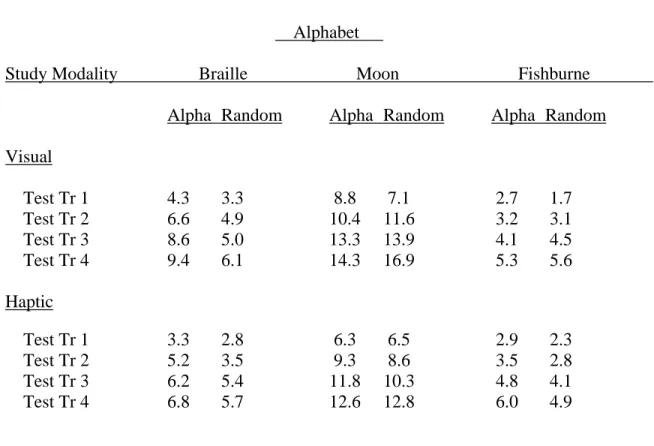
The main effect for study modality was also examined using a Tukey a procedure to determine the significant difference between the study modalities, both overall and for each test trial. The result for total number correct showed that mean performance with the visual (M = 29.1) was better than with the haptic (M = 25.0) study modality. When the data for each test trial were examined separately, the differences on the second, third and fourth test trials were the same as overall; however, there was no significant difference in performance based on study modality on the first test trial. The means for number correct for each treatment on each trial are found in Table 4.
Thus, the Moon alphabet was easier to learn than Braille and Fishburne, and Braille was easier to learn than Fishburne. Also, learning the names for the symbols was easier when the items were studied visually rather than haptically, even though all participants were tested haptically. Finally, as would be expected, participants’ performance for all groups improved over the four trials, with different rates of change on the three alphabets (see Table 5). Hypotheses
Next, the nine specific hypotheses were tested using t tests. Hypotheses I, II and III dealt with the effects of modality on learning each of the three alphabets: Braille, Fishburne and Moon, respectively. In each case, it was proposed that performance would be better for those who studied visually, as compared with haptically. This was confirmed, however, only with the Moon alphabet, t(46) = 2.24, p = .0301. Those who studied the Moon alphabet visually learned faster (M = 48.3) than those who studied it haptically (M = 39.8). However, visual study did not facilitate performance on the Braille, t(46) = 1.62, p = .11, and
each modality is found in Table 6. Thus, only with the Moon alphabet did learning occur faster under visual than haptic study conditions.
Hypotheses IV and V dealt with the effects of alphabetical study order on the learning of the Fishburne alphabet in both visual and haptic study modalities. It was proposed that performance would be better for those who studied the symbols arranged in alphabetical, rather than in random, order with both visual and haptic study modalities.
Neither hypothesis was confirmed; alphabetical study order did not facilitate performance on the Fishburne alphabet with either visual, t(22) = .18, p = .86, or haptic, t(22) = .93, p = .36, study modalities. Thus, for the Fishburne alphabet, learning was not affected by the order in which items were presented, either visually or haptically, on study trials.
Hypotheses VI and VII compared learning of the Braille and Fishburne alphabets, using each study modality. It was proposed that performance for those who studied the Fishburne items would be better than for those who studied the Braille items, whether study was done visually or haptically. Neither hypothesis was supported, though the difference for visual study was significant, t(22) = 3.26, p = .002, and that for haptic study was not, t(46) = 1.57, p = .12. Contrary to expectation, with visual study, the Braille mean (M = 24.1) was higher than the Fishburne mean (M = 14.9).
No hypotheses involving the comparison between the Fishburne and Moon alphabets had been initially proposed. Nevertheless, learning these two alphabets was compared for each modality. In each instance, performance by those who learned the Moon alphabet was better than the performance by those who studied the Fishburne alphabet, for both the visual, t(46) = 10.78, p < .0001, and haptic, t(46) = 7.78, p < .0001, study modality conditions. Structure
Responses to the final debriefing questions confirmed that all participants had no previous experience with Braille, Moon or Fishburne symbols. They all indicated that they had no preferred index-finger conditions that might have interfered with the haptic
examination of the Braille symbols. The participants reported also that they were able to hear the symbol names and, in the visual study conditions, see the symbols.
Many participants reported that they had tried to find a relationship between the shape formed by the pattern of dots and the shape of the corresponding letter of the alphabet. Of those participants who had studied the Moon alphabet, 63% (30) reported trying to associate the symbol with the shape of the Roman letter; twenty of these stated that they also had recognized the Moon structure of rotated symbols. In addition, 27% (13) of those who had studied the Braille alphabet and 15% (7) of those who had studied the Fishburne alphabet reported that they had tried to find a relationship between a symbol and its Roman letter. Thus, some participants who studied each alphabet tried to find a relationship between the symbol shape and the corresponding letter shape, whether or not it was present in that alphabet.
Summary
The main purpose of this experiment was to examine the rate of learning three alphabets used by blind persons and the effects of study modality (visual, haptic) and study order (random, alphabetical) on such learning. The major findings were: (1) learning was faster for the Moon alphabet than for the other two alphabets, (2) learning was faster for the Braille alphabet than for the Fishburne alphabet, (3) the visual, as compared with the haptic, study modality facilitated learning, and (4) the order of items used during the study trials had no effect.
However, the results were not always in accord with the overall findings.
Specifically, the visual study modality facilitated learning only with the Moon alphabet. This would indicate an interaction between study modality and alphabet; however, the analysis of variance indicated only a main effect for study modality.
Discussion
This section is divided into several parts. First, the purpose of the experiment is briefly summarized. Second, ease of learning each of the alphabets is discussed. Third, the effects of study modality and study order are considered. Fourth, suggestions for further research are proposed. Finally, implications of these findings for the learning of Braille will be considered.
As reviewed in the introduction, previous research has demonstrated that Braille symbols have been more difficult to discriminate from one another than both Fishburne and Moon symbols. In addition, learning the letter names for Moon and Fishburne symbols has been easier than for Braille symbols. Furthermore, the use of the visual study modality, as compared with the haptic study modality, has facilitated learning of both Braille and Fishburne alphabets. The alphabetical study order has also led to faster learning, especially with the Fishburne alphabet. However, previously, learning of the names for the symbols of these three alphabets has not been compared. This was done in the present experiment and the effects of both study modality and study order on learning the names for all 26 symbols of each of the three alphabets, across four test trials, was examined.
Alphabet
Moon
As hypothesized, this study demonstrated that the Braille alphabet was not as easy to learn as the Moon alphabet. (These results are consistent with those of previous experimental and survey research.) In this study, learning of the Moon alphabet was easier than learning of both the Braille and Fishburne alphabets, under both visual and haptic study conditions. This may have been due to facilitation of two of the three processes proposed by McGuire,
stimulus discrimination and associative learning. Since all of the participants were sighted and already familiar with the letters of the Roman alphabet, response learning (the third of the processes) would probably not have been involved.
As mentioned previously, stimulus discrimination refers to the process that enables distinguishing each symbol from every other symbol on a list. Since the Moon code is based primarily on use of five forms, each occurring in different rotations, and many participants reported noticing this structural characteristic, so doing may have contributed to facilitation of the stimulus discrimination process. (An example of this is that the right-angle corner represented the letters, l, e, m and y, in its successive rotations.)
Fishburne
A surprising result is that the Fishburne alphabet was not easier to learn than the Braille alphabet. In fact, the Fishburne was harder to learn than the Braille alphabet, though significantly so only when the items were studied visually.
How do we account for this different result from those of previous studies? One possibility is that it could have derived, at least in part, from between-experiment differences in the Fishburne stimuli and in their manner of presentation.
Previously, in several experiments in which the items were studied visually, they were presented simultaneously and participants were given a fixed amount of time (e.g., 4 minutes) to study them. In each of these studies also, each Fishburne symbol was presented in a small rectangle, with a line drawn through the middle of the rectangle. Thus, these characteristics may have provided participants with cues for spatial location of the dots and lines comprising the Fishburne symbols.
There have been two experiments, however, in which haptic examination was
employed and, in these, symbols were presented sequentially as in the present experiment. In both experiments, the Fishburne symbols were presented on tape rectangles; therefore, the spatial orientation cues were still available. However, our Fishburne items were presented sequentially but, without the border, spatial orientation cues were much less salient than in the prior haptic experiment.
Fishburne symbols and subsequent discrimination among the stimuli and, if so, whether this interfered or was facilitative.
Braille
As indicated above, the performance of the participants who studied the Braille alphabet was better than for those who studied the Fishburne alphabet. Since the Braille stimuli used in this experiment were similar to those used in previous studies, the
comparative advantage of the Braille alphabet may have been due to the poor quality of the Fishburne symbols, as suggested above. If so, the stimulus discrimination process may have been easier with the Braille than with the Fishburne symbols.
Study modality
The use of the visual study modality facilitated learning only with the Moon alphabet. Since an advantage of the Moon symbols in the associative process may have derived from the correspondence between a symbol and its Roman letter, it may be that the shape of a symbol was more salient with visual, than with haptic, inspection. Also, visual study may have facilitated recognition of the rotated use of some symbols; this pattern recognition of the alphabet’s structure could have facilitated the stimulus discrimination process. Thus, visual study of the Moon symbols may have facilitated both stimulus discrimination and associative learning.
Since performance was better when the items were studied visually, as compared with haptically, for only one of the alphabets, it is surprising that there was no statistical
Thus, the Moon difference did not provide enough support for a significant interaction between alphabet and study modality to occur.
Study order
Although there was no significant effect attributable to alphabetical study order, the means for five of the six conditions (all but Moon--visual) show some difference in the direction of favoring alphabetical, as compared with random, presentation of these symbols during the study trials. It had been proposed that alphabetical presentation would facilitate learning of the Fishburne symbols, since it was expected that this would enhance
identification of the structure of that alphabet. But that did not occur. Suggestions for Future Research
The results of this experiment, plus those of prior research, suggest several problems for future investigation. Three particular domains are (1) stimulus characteristics, (2) aspects of structure and (3) participant characteristics.
Stimulus Characteristics
In previous experiments, the Fishburne symbols were presented with a line through the middle and/or a border. Both were probably helpful to the participants in characterizing the symbols. In the present experiment, however, neither of these characteristics was available. Since in previous experiments, the Fishburne alphabet was learned faster than Braille but, in this one, Braille was learned faster, it is possible that these
One other difference for the Fishburne alphabet is that all of the stimuli in the present experiment were comprised of dots but, in previous research, some stimuli were individual dots and others were solid lines. It is not clear what effect, if any, this difference might have had. Future research could provide an answer. Analogously, the Moon stimuli in this
experiment were also comprised of dots but the outcome here was similar to that in one of Thurlow's experiments in which lines had been used. It still might be the case, however, that although performance was better with Moon than Braille in both experiments, the facilitation might be greater with one of the representations (i.e., dotted, lined).
Aspects of Structure
Some participants reported noticing various aspects of an alphabet’s structure. For Braille, it was that later symbols had more dots than earlier symbols. For Fishburne, it was the location of the symbol elements. For the Moon alphabet, it was the elements that comprised the symbol and their orientation. In previous research, especially with the
Fishburne alphabet, a fairly large percentage of participants reported noticing the structure of that alphabet and overall performance was quite good, as compared to the level of
performance in the present experiment. Thus, it seems reasonable to suggest that examination of factors that might affect the identification and use of structure would be of some interest. Here are three possibilities.
Study Time
identification and, concomitantly, learning would be enhanced, particularly for the Fishburne alphabet.
Simultaneous vs. Successive Presentation
In some previous studies comparing Braille and Fishburne, the entire alphabet was presented visually for a fixed period of time. Doing so (as compared with successive presentation) would be expected to permit earlier identification of structure for both alphabets, especially for Fishburne. Whether similar effects would occur for simultaneous presentation of alphabets for haptic examination seems less certain. Research comparing simultaneous vs. successive presentation of stimuli (visually or haptically studied) would seem warranted. Post-experimentally, of course, Ps would be asked about their perception of structure.
Providing Information about Structure
Participant Characteristics
In the present experiment, and in almost all of the prior laboratory research in this domain, participants have been sighted adults who are familiar with the Roman alphabet. This is of particular consequence for learning the Moon alphabet because of a
correspondence between some of the Moon symbols and the shape of the corresponding Roman alphabet letters. Future research comparing performance of those with varying amounts of experience with the Roman alphabet would be of interest. Whether such research would be valuable for the other two alphabets is uncertain.
Concluding Statement
Two results are of special interest: (1) faster learning of the Moon than of the Braille alphabet, and (2) faster learning under the visual-haptic than under the haptic-haptic
condition. Although Moon was learned faster than Braille, learning Moon for future use would appear to be of little advantage since, at the present time, there is not very much to read in Moon. Almost everything that there is to read is in Braille. However, there have been some recent developments in embossing technology (e.g., the Tiger Embosser) that could facilitate production of the Moon alphabet but whether or not that will result in a substantial increase in the amount of reading material is uncertain. Another possible value in learning the Moon alphabet is as an aid in learning Braille. There is some anecdotal evidence that this does occur. One suggestion is that those who have learned Moon (to what extent we do not know) do better in subsequently learning Braille, in some cases having failed to do
References
American Foundation for the Blind. (2005). Numbers of blind and visually impaired Americans in Blindness Statistics. Retrieved October 30 from
www.afb.org/Section.asp?SectionID=15.
Crotty, M. (2005). Personal communication with M.A. Mroczka. October 17.
Dixon, J.M. (ed.). (2000). Braille Into the Next Millenium. National Library Service for the Blind and Physically Handicapped: Washington, D.C.
Douglas, G., McLinden, M. & McCall, S. (2003). Case Study – An investigation into the potential of embossed ‘dotted’ Moon as production method for children using
Moon as a route to literacy. Visual Impairment Centre for Teaching and Research (VICTAR), School of Education, University of Birmingham, England.
(http://www.education.bham.ac.uk/research/victar/research/projects/ DottedMoon.htm)
Freides, D. (1974). Human information processing and sensory modality: Cross-modal functions, information complexity, memory, and deficit. Psychological Bulletin, 81, 284-310.
Freides, D. (1981). Personal communication with S.E. Newman. May 25.
Hall, A.D. (1980). The Effects of Stimulus, Response, and Associative Factors on the Paired-associate Learning of Braille. Unpublished master's thesis, North Carolina State University, Raleigh.
Hall, A.D. & Newman, S.E. (1987). Braille learning: Importance of seven variables. Applied Cognitive Psychology, 1, 133-141.
their teachers, and orientation and mobility specialists: Part 1. Journal of Visual Impairment and Blindness, 93, 600-606.
Loomis, J.M. (1981). On the tangibility of letters and Braille. Perception and Psychophysics, 29, 37-46.
McCall, S. & McLinden, M. (2001a). Accessing the National Literacy Strategy: The use of Moon with children in the United Kingdom with a visual impairment and
additional learning difficulties. British Journal of Visual Impairment, 19, 7-16. McCall, S. & McLinden, M. (2001b). Literacy and children who are blind and who have
additional disabilities - the challenges for teachers and researchers. International Journal of Disability, Development and Education, 48, 355-375.
McGuire, W.J. (1961). A multiprocess model for paired-associate learning. Journal of Experimental Psychology, 62, 335-347.
Millar, S. (1997). Reading by Touch. London: Routledge.
Newman, S.E. (1992). Children's learning of two alphabets used by the blind: Braille and Fishburne. British Journal of Visual Impairment, 10, 21-23.
Newman, S.E., Bardi, C.A. & Craig, R.A. (1989, March). Learning alphabets for the blind: Effects of study time and test order. A paper presented at the meeting of the
Southeastern Psychological Association. Washington, D.C.
Newman, S.E., Craig, R.A., Inman, L.K., Pitt, E.L. & McKinnon, M.A. (1990, April).
Effects of congruence of study- and test orders on learning alphabets for the blind. A Paper presented at the meeting of the Southeastern Psychological Association, Atlanta, G.A.
Journal of Visual Impairment and Blindness, 82, 148-149.
Newman, S.E., Hall, A.D., Foster, D.J. & Gupta, V. (1984). Learning as a function of haptic discriminability among items. American Journal of Psychology, 97, 359-372.
Newman, S.E., Hall, A.D. & Pullen, S.M. (1992). Remembering the names for visually and haptically examined Braille symbols. The British Journal of Visual
Impairment, 10(3), 101-103.
Newman, S.E., Hall, A.D., Ramseur, C.J., Foster, D.J., Goldston, D.B., Decamp, B.L., Granberry-Hager, S.P., Lockhart, J.L., Sawyer, W.L. & White, J.E. (1982). Factors affecting the learning of Braille. Journal of Visual Impairment and Blindness, 76, 59-64.
Newman, S.E., Mendat, C.C. & Ries, A. (2003). Alphabets for the Blind: Ease of Learning
and Discrimination. Unpublished manuscript. Newman, S.E., Mroczka, M.A., Mills, B.J. & Paine, C.S. (1996, August). Haptic Learning of
Two Alphabets Used by the Blind. A poster presented at the meeting of the American Psychological Association, Toronto.
Newman, S.E., Sawyer, W.L., Hall, A.D. & Hill, L.G.D. (1990). Braille learning: One modality is sometimes better than two. Bulletinof the Psychonomic Society, 28, 17-18.
Newman, S.E., Stone, C.V. & Craig, R.A. (1988, November). Modality Effects in Braille Learning. Paper presented at a meeting of the Psychonomic Society, Chicago, IL. Newman, S.E., Webb, D.C., Hall, A.D. & Craig, R.A. (1987, March). Experimental
meeting of the Southeast Psychological Society. Atlanta, GA.
Plotkin, L. (1943). Stimulus generalization in Morse Code learning. Archives of Psychology, 40, 287.
Rosenberg, J. & Borg, E. (2001). A review and evaluation of research on the deaf-blind from perceptual, communicative, social and rehabilitation perspectives.
Scandinavian Audiology, 30(2), 67-77.
Shafrath, M.R. (1986). An alternative to Braille labeling. Journal of Visual Impairment and Blindness, 80, 955-956.
Snowden, J., Newman, S.E. & Temple, L.J. (2001, March). Alphabets for the blind: Replication and minor extension. A paper presented at the meeting of the Southeastern Psychological Association, Atlanta, G.A.
Stone, C.V. (1993). The Effects of Study- and Test Modality on Learning Two Alphabets by the Blind, Braille and Fishburne. Unpublished master's thesis, North Carolina State University, Raleigh.
Thurlow, W.R. (1986). Some comparisons of characteristics of alphabetic codes for the deaf-blind. Human Factors, 28, 175-186.
Tulving, E. (1979). Relation between encoding specificity and levels of processing. In L.S. Cermak & F.I.M. Craik (Eds.) Levels of Processing in Human Memory. N.J.: Erlbaum.
Yeadon, A. (1979). Moon - a contemporary appraisal. Journal of Visual Impairment and Blindness, 73, 341-343.
Table 1 3 x 2 x 4 x 2 x 2 x 2 x 4 ANOVA for Number Correct as a Function of Alphabet, Study Modality, Study Order, Test Order, Hand, Gender and Trials
_____________________________________________________________________
Source df SS MS F
Between-Participants Effects
Alphabet 2 3077.58 1538.79 47.73 **
Study Order 3 27.93 9.31 .29
Alph x StudOrd 6 144.36 24.06 .75
Study Modality 1 7.46 7.46 .23 Alph x StudMod 2 48.82 24.42 .76 StudOrd x StudMod 3 21.23 7.08 .22 Alph x StOrd x StMod 5 147.78 29.56 .92
Test Order 1 44.22 44.22 1.37
Alph x TestOrd 2 93.09 46.54 1.44 StudOrd x TestOrd 3 10.25 3.42 .11 Alph x StdOrd x TtOrd 4 97.52 24.38 .76 StudMod x TestOrd 1 1.92 1.92 .06 Alph x StdMod x TtOrd 2 6.46 3.23 .10 StudOrd x StdMod x TtOrd 2 3.83 1.92 .06
Hand 1 20.91 20.91 .65
Alph x Hand 1 3.84 3.84 .12
StudMod x Hand 1 117.55 117.55 3.65
Alph x Gend 2 50.96 25.48 .79 StudOrd x Gend 3 40.14 13.38 .42 Alph x StudOrd x Gend 2 17.90 8.95 .28 StudMod x Gend 1 18.13 18.13 .56 Alph x StudMod x Gend 2 5.10 7.55 .23 StudOrd x StudMod x Gend 1 .00 .00 .00 TestOrd x Gend 1 21.56 21.56 .67 Alph x TestOrd x Gend 2 47.04 23.52 .73 StudMod x TtOrd x Gend 1 8.93 8.93 .28 Alph x StMod x TtOrd x Gnd 1 16.13 16.13 .50
Error 64 2063.23 32.24
Within-Participants Effects
Trials 3 520.66 173.55 42.54 **