Automated Rationing System Using
Raspberry Pi
Harshali P. Rane, Kavita S. Patil, AditiS. Chaudhari, Priyanka M.Pendharkar.
Under Graduate Students, Dept. of E&TC, Government College of Engineering, Jalgaon, India
ABSTRACT: Public distribution system i.e. rationing distribution is one of the issues that involves corruption and illegal smuggling of goods. In this paper we propose the concept of replacing manual work/job causing these irregularities in public distribution system (rationing distribution system in India) by automated system which can be installed at the ration shop with ease. In this automated system, we replace the conventional ration card by ATM card. Proposed system also uses ADHAR No (UID) for user’s authentication. Using such a system, Government would have all required control/monitoring over the transactions at ration shop. To involve Government in the process we proposed connecting the system at ration shop to a central database (provided by Govt.) via GSM module (SIM300D) and RS232.
KEYWORDS: AT Commands, GSM Module, magnetic Strip Reader, ATM Card. I. INTRODUCTION
A Ration Card is a document issued under an order or authority of the State Government, as per the Public Distribution System (PDS), for the purchase of essential commodities from ration shops. State Governments issue distinctive Ration Cards to Below Poverty Line. It helps save money by aiding in the procurement of essential commodities at a subsidized rate. However, there are concerns about the efficiency of the distribution process.
The present system in the ration shops is like the shopkeeper sees the ration book of the user and gives the quantity of grocery the user asks for. But there will not be proper regularity in issuing the grocery items to the user. Sometimes even there may be chance that different users take the grocery on same ration cards.This system having two drawbacks, first one is weight of the material may be inaccurate due to human mistakes and secondly, if the materials are not sold by the end of the month, they will sale to others without any intimation to the government and customers.
As the solution of above discuss problem, this paper discusses about an Automatic Ration Materials Distribution System based on Global System for Mobile communication (GSM) and ATM card Technology. ATM card technology is effectively used to solve some of them. ATM card acts as a ration card and other purpose such as RC book, insurance details, service details etc. GSM is used to communicate the information of material distribution between the two people or more than two persons to update the information which depends on the requirements.
II. RELATED WORK
Dhanojmohan,Rathikarani,Gopukumar, “Automation in ration shop using PLC’’,proposed a methodology for ration shop automation using embedded PLC. Further the updating to the government database about the stock available and the customer details were not carried out [1].
Recently,Vikramet.al. has proposed Smart Ration Card System. The smart card is modified as a smart ration card by coding Microprocessor chip present in it according to the requirement. The smart card contains unique barcode. When the consumer visits the ration shop, he has to show this card in front of barcode reader. Dealer verifies the smart card& accordingly delivers ration [2].
materials controller send the information to government office and customer through GSM technology. In this system microcontroller is used for executing the process [3].
A.N. Madur, Sham Nayse “Automation in Rationing System using Arm 7”, this system is based on radio frequency identification of customer. Here each customer is provided with RFID cards. In this system, by using RFID and by entering the password we can access. First user is authenticated, and then system shows the balance of person. User have to enter the amount of Kg he want to withdraw. System checks his account. If the user will have sufficient balance to withdraw the current amount, system will open the valve. Through valve grain will come and it will get weighted by weight sensor. Once the count reached the entered amount controller automatically shut down the valve and updates the account of the customer. The updated account information is send to the customer’s mobile using GSM module. In this system the data base of customers can be made with their account details, password etc. [4].
Rajesh C. Pingle, P. B. Borole “Automatic Rationing for Public Distribution System (PDS) using RFID and GSM Module to Prevent Irregularities”, In this automated system conventional ration card is replaced by smartcard in which all the details about users are provided including their AADHAR (social security) number which is used for user authentication. This prompted us to interface smart card reader (RFID Based) to the microcontroller (AT89C51) and PC via RS232 to develop such a system. Using such a system, Government would have all required control/monitoring over the transactions at ration shop. To involve government in the process we proposed connecting the system at ration shop to a central database (provided by government.) via GSM module (SIM900D) and RS232. Hence it is possible to prevent the corruption and irregularities at ration shop. This would bring the transparency in public distribution system and there will be a direct communication between people and Government through this system [5].
III.DESIGN AND IMPLEMENTATION
IV.
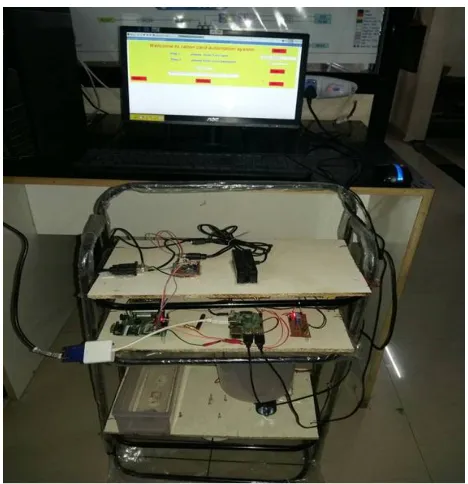
Raspberry pi is the heart of automatic rationing system. Here raspberry pi is used as a controlling element. It will control the movement of motor and hence controls the slider to open or close to give food grains and it also controls the solenoid valve to get liquid materials(here kerosene)as per the request given by customer.
Fig b. Complete Model of Automated Rationing System Using Raspberry Pi
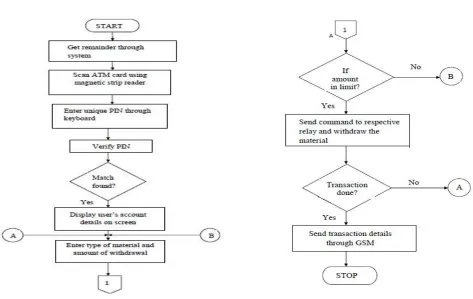
First the customers need to swap an ATM card which is then identified by magnetic strip reader which is interfaced with raspberry pi module to RX pin. Then user enters PIN through keyboard. Raspberry pi verifies whether the entered number is already present in the database. Once the verification is completed, raspberry pi sends the command to respective relay to give commodity as per the request. . GSM interfaced with raspberry pi module sends information in the form of SMS to the respective consumer. The proposed system requires one power supply of 12 V, 1A for driving Relay coils and 5v, 2.5A power supply to drive the raspberry pi.
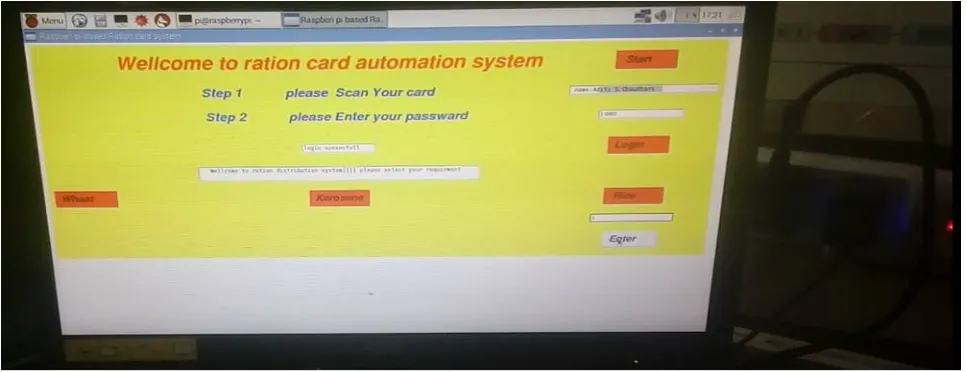
Fig c. system output on monitor screen of Automated Rationing Using Raspberry Pi
Fig c. shows the system output on monitor screen of Automated Rationing Using Raspberry Pi. System displays the user account as shown in fig c.
For implementing the above proposed automated solution, there are various hardware components that are requiredfor making the setup. Also proper software is required for making the application which would work along with thehardware.
A. Hardware:
1. Raspberry pi :
The Raspberry Pi is open hardware, with the exception of the primary chip on the Raspberry Pi, the BroadcomSoC (System on a Chip), which runs many of the main components of the board–CPU, graphics, memory, the USB controller, etc.Raspberry pi is the heart of automatic rationing system as illustrated in fig d shown below:
The Raspberry Pi 2 Model B is the second generation Raspberry Pi.it has:
A 900MHz quad-core ARM Cortex-A7 CPU
1GB RAM:
4 USB ports
40 GPIO pins
Full HDMI port
Ethernet port
Combined 3.5mm audio jack and composite video
Camera interface (CSI)
Display interface (DSI)
Micro SD card slot
VideoCore IV 3D graphics core[6].
2. SIM300 GSM module:
The GSM (Global System for Mobile communication) module consists of GSM modem. It is a standard developed by the European telecommunication standard institute to describe protocols for 2G digital cellular networks used by mobile phones. It accepts SIM cards, and operates over a subscription to a mobile operator, just like mobile phones. It uses frequencies between 890-915 MHz UL and 935-960 MHz DL (Band of 25MHz). Through this GSM modem, SMS is delivered automatically to the subscriber about availability of food grains at the ration distribution center and about the transaction.
The connection of GSM module with Raspberry pi is given in the following fig e. Receiver pin of GSM is connected to transmitter pin of raspberry pi and 12V supply is given to Vcc pin.
Fig e. Connections of GSM
3. Magnetic Strip Reader:
A magnetic stripe reader, also called a magnetic stripe reader, is a hardware device that reads the information encoded in the magnetic stripe located on the back of a plastic badge. Magnetic stripe readers can be read by a computer program through a serial port , USB connection, or keyboard wedge , and are generally categorized by the way they read a badge. For instance, insertion readers require that the badge be inserted into the reader and then pulled out.. Fig f. shows connection of magnetic strip reader to raspberry pi module.
4. SOLENOID VALVE:
A solenoid valve is an electromechanical device used for controlling liquid or gas flow. The solenoid valve is controlled by electrical current, which is run through a coil. When the coil is energized, a magnetic field is created, causing a plunger inside the coil to move. Depending on the design of the valve, the plunger will either open or close the valve. When electrical current is removed from the coil, the valve will return to its de-energized state. Fig. g shows the solenoid valve.
Fig g.
Solenoid Valve
5. DC Motors:
A DC Motor in simple words is a device that converts direct current (electrical energy) into mechanical energy.
For the proposed system, two motors are used to control the slider to open or close to give food grains as per requirements.Fig h. shows a dc motor.
Fig h.
DC motor
B. Software:
The Raspberry Pi has two versions of Python installed on it: Python 2.7 andPython 3. IDE is a set of tools for creating and testing programs. The Python IDE is called IDLE, and there are two versions of it: IDLE (which is for Python 2.7) and IDLE 3 (which is for Python 3). For the proposed system raspbian Jessie zip is downloaded from the official website of raspberry pi –https://www.raspberrypi.org/downloads/raspbian.After downloading the .zip file it is unzipped to get the image file(.img) for writing to SD card [7].
V. FLOWCHART
Fig i.Flowchart of Automatic Rationing System
VI.SIMULATION RESULTS
The Proposed system is implemented with Python programming in python 2.7 IDE installed on Raspberry Pi and tested for various performance parameters such as
1) Accuracy (error estimation):The accuracy is defined as the degree of closeness with which the instrument reading approaches the true value of the quantity to be measured [8]. The difference (subtract) between the accepted value and the experimental value is found, and then it is decided by the accepted value. For the proposed system Table no 1. shows the error calculations.
% error = (accepted - experimental) / accepted *100%
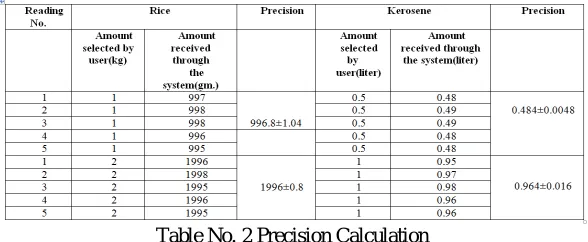
2) Precision:It is a measure of the consistency or repeatability of a series of measurements. Although accuracy implies precision, precision does not necessarily imply accuracy [8].The precision of a given measurement can be given by
Precision=1-(Xi-X̅)/Xi
X̅=Average or mean value Xi=i’th measured value
Table no 2. shows the precision of proposed system.This result may be reported as the mean, plus or minus the average deviation. For this proposed rationing system, this result would look like
(For 1kg measurements):996.8±1.04 (For 2kg measurements):1996±0.8 (For 0.5lit measurements):0.484±0.0048 (For 1lit measurements):0.964±0.016.
Table No. 2 Precision Calculation
3) Sensitivity:Sensitivity is a measure of the change in reading of an instrument for a given change in the measured quantity [8]. In our proposed rationing system, the amount of the withdrawal is decided with the help of software interrupt i.e. through time delay. Hence after the system has given the output, if certain amount is withdrawn from the system, output of our system will not get affected (or will not give any indication for that).But for customer’s satisfaction we can provide separate weighing machine. As the proposed rationing system is precise with minimum error about 0.3% there is no need of integrated weighing machine if the indication is not needed.
4) Temperature stability:To measure the temperature stability of proposed rationing system, the system is kept on for about 24 hours and following 8 readings are noted (refer to fig i.) and it is observed that the proposed system provides thermal stability very well. No considerable malfunctioning of the proposed system is observed.This is illustrated in Table no 3.
VII. CONCLUSION AND FUTURE WORK
The proposed system creates the transparency in public distribution system as the work becomes automatic. In proposed system we have used raspberry pi as a controller. It has in built graphic card. The benefit to an integrated GPU unit is that it is cheaper which in turn means a less expensive computer. Integrated graphic cards also generate much less heat and use drastically less power. Hence the proposed system is more efficient.This system is helpful to prevent malpractices at ration shop. The proposed system provides the facility of working 24×7 as no human interaction is needed
.
In proposed system, for user identification ATM cards are used, but in future for more security and prevention against malpractices and for better authentication of subscriber, a biometric system such as finger and palm print detection, eye ball movement scanning etc. can be used. Also the better quality of service can be provided by using image processing.
. The system can be connected to cloud computing system to manage the data base of users and provide reliable rationing system. In future proposed system with some modifications can create various job opportunities to manage the data over cloud application.REFERENCES
1. Dhanojmohan,Rathikarani,Gopukumar, “Automation in ration shop using PLC’’, international journal of innovative research in electrical, electronics, instrumentation and control engineering vol. 1, issue 8, pp.339-342, November 2013.
2. Vikramet. al. “Review on Smart Ration Card System”, (IJIRCCE),Vol. 4, Issue 9, pp.16151-16152, September 2016.
3. S.Valarmathy, R.Ramani “Automatic Ration Material Distributions Based on GSM and RFID Technology”, I.J. Intelligent Systems and Applications,pp.47-54, 2013.
4. A.N. Madur, Sham Nayse “Automation in Rationing System using Arm 7”, international journal of innovative research in electrical, electronics, instrumentation and control Engineering,vol. 1, Issue 4, July 2013.
5. Rajesh C. Pingle, P. B. Borole “Automatic Rationing for Public Distribution System (PDS) using RFID and GSM Module to Prevent Irregularities”,(IJRASET), Volume 3 Issue X, October 2015.
6. Raspberry pi Foundation UK registered charity 1129409, www.raspberrypi.org
7. Aaron Asadi, “Raspberry Pi for Beginners Second Revised Edition” Imagine Publishing Ltd, 33 Richmond Hill Bournemouth, Dorset BH2 6EZ 8. Albert D. Helfrick and William D. Cooper Modern Electronic Instrumentation and Measurement Techniques,Pearson/Prentice Hall of
India,pp. 43-59, 2007.
9. Mike Cook and Sean McManus, “Raspberry pi for dummies” Published by John Wiley & Sons, Inc., Hoboken, New Jersey.
10. S. Sukhumar, K. Gopinathan, “Automatic Rationing System Using Embedded System Technology”, International Journal of Innovative Research in Electrical, Electronics, Instrumentation and Control Engineering, 2013, Vol. 1, Issue 8, pp. 339-342
11. Y.Tejaswi, M.Veda Chary, “Rfid Based Access Card For Public Enrollment And Distribution System”, (IJSETR) Volume 2, Issue 9, pp. 1773-1776, September 2013.
BIOGRAPHY
Harshali Pramod Rane is a student of Electronics and Telecommunication at Government College of Engineering Jalgaon. She is a final year student of Bachelor of Engineering.
Kavita Sunil Patil is a student of Electronics and Telecommunication at Government College of Engineering Jalgaon. She is a final year student of Bachelor of Engineering.
Aditi Sunil Chaudhari is a student of Electronics and Telecommunication at Government College of Engineering Jalgaon. She is a final year student of Bachelor of Engineering.