Safe Drive Assistance System
Dipali Dilip Narwate
1, Prof.Rashmi Mahajan
2Student, Department of VLSI & Embedded System, Dr. D. Y. Patil School of Engineering, Lohegaon, Pune, India1 Professor, Department of VLSI & Embedded System, Dr. D. Y. Patil School of Engineering, Lohegaon, Pune, India2
ABSTRACT: According to the National Sleep Foundation’s 2005 Sleep in America poll 60% of adult drivers about
168 million people say they have driven a vehicle while feeling drowsy in the past year and more than one-third (37% or 103 million people) have actually fallen asleep at the wheel! In fact of those who have nodded off 13% say they have done so at least once a month. Four per cent approximately eleven million drivers admit they have had an accident or near accident because they dozed off or were too tired to drive. Alcohol is another major factor in traffic accidents. Based on data from the U.S. Department of Transportation National Highway Traffic Safety Administration (NHTSA) there was an alcohol-impaired traffic fatality every 51 minutes in 2015.This paper proposes a system which identifies the driver drowsiness condition as well as alcoholic condition. This system also detects driver’s seat belt condition.
KEYWORDS: Driver drowsiness, Alcohol detection, Seatbelt detection.
I. INTRODUCTION
The National Highway Traffic Safety Administration reported that driver fatigue is the main reason for 100,000 crashes. It results as 1,550 deaths, 71,000 injuries, and $12.5 billion in monetary losses. These figures may be very high since currently it is difficult to attribute accidents to sleepiness
No test to determine sleepiness of a person
State reporting practices are inconsistent. There is no training to identifying drowsiness. Every state currently addresses fatigue and/or sleepiness in some way in their crash report forms.
Self-reporting is unreliable.
Drowsiness is major factor in crashes attributed to other causes such as alcohol. About one million crashes are happened due to driver inattention/lapses every year. 10 to 30 per cent of all crashes are due to drowsy driving .[1]
Young people especially men, adults with children and shift workers are suffering to sleep related accident. According to the NSF’s 2002 poll:
Adults between 18-29 age are suffered to drive drowsy accident than other age group (71% vs. 30-64, 52% vs. 65+, 19%).
Men can drive as they are drowsy (56% vs. 45%) and women to fall asleep while driving (22% vs. 12%). Adults with children are suffered to drowsy condition than without children (59% vs. 45%).
Shift workers are more suffered to drowsy condition than the workers who work regular daytime schedule. (36% vs. 25%).
Sleep deprivation increases the risk of accident. According to a study of AAA Foundation for Traffic Safety results estimated as people who sleep six to seven hours a night are twice as likely to be involved in such a crash as those sleeping 8 hours or more, while people sleeping less than 5 hours increased their risk four to five times.
of drivers in fatal crashes who were alcohol impaired was highest for 21 to 24 year old drivers, at 28 per cent, followed by 25 to 34 year old drivers, at 27 per cent, and 35 to 44 year old drivers, at 23 per cent. The percentage of alcohol-impaired drivers in fatal crashes was 19 per cent for 45 to 54 year olds, 16 per cent of 16 to 20 year olds, 14 per cent for 55 to 64 year olds, 9 per cent for 65 to 74 year olds and 6 per cent for drivers over the age of 74.
Above table shows Total traffic and alcohol-impaired crash fatalities, 1985-2014 [2].
In Section II all system i.e. hardware and software is described. In Section III experimental results are presented. In section IV conclusion and acknowledgement is defined.
II.SYSTEM DISCRIPTION
The block diagram of Safe drive assistance system is shown in figure 1. The main purpose of this system is to detect the driver drowsiness, alcohol detection of driver, driver’s seat belt position and alert system. The working of this system is as follows
1] Alcohol detection test:
This system starts to work when the driver enters in a car. By using the alcohol detector it detect the alcohol level of the driver. If the alcohol level is higher than normal level then driver can’t start the car until alcohol level is decreased.
2] Driver’s seat belt position:
3] Driver’s drowsiness detection:
This is a real time monitoring system. This system monitors the driver condition i.e. drowsiness. Under this system camera monitors the driver then message signal from this camera send it to the hardware setup. Then result of this is alert system will get ON. Eye monitoring system is done through a MATLAB. Camera is used to record a video and connected to Raspberry Pi. Driver’s eye blinking rate is recorded if eye blinking rate is higher than buzzer will get ON and Vibration’s will get ON.
4] Alert system:
The driver assistance systems having the alert system to prevent the sleep-related and drink and drive accident.it consist of buzzer, vibration and speed controlling system.
The system decides whether the eyes are open or closed. When the eyes were detected closed for too long, a warning signal is issued. When eyes of driver are closed for longer time then alert system will get ON and alert the driver with a buzzer and vibration on positive detection.
The work was composed of various steps as under:
1. Face and eye detection
2. Eye blinking detection (open/close)
3. Warning system design
Algorithm
STEP 1: Alcohol detection of driver. If alcohol is not detected then go to step 3
STEP 2: If alcohol is detected then automatically locked the steering wheel. Go to step 7
STEP 3: Check the seat belt position. If seat belt is in closed position then go to step 5
STEP 4: If seat belt is in open position then buzzer will ON until seat belt is not closed. Then go to step 5
STEP 5: Check the driver’s eyelid condition. If eyelid is not blinking then driver condition is OK.
STEP 6: If driver’s eyelid is blinking at more rate then buzzer will ON and vibrations get started. and speed of vehicle is
controlled.
Fig.1 Block Diagram of System
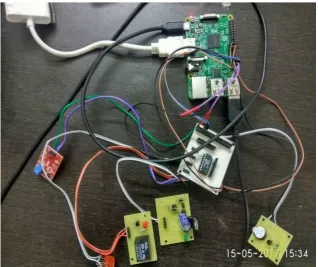
Figure 2 shows the top view of the hardware assembly
III. EXPERIMENTAL RESULT
A. Hardware Result
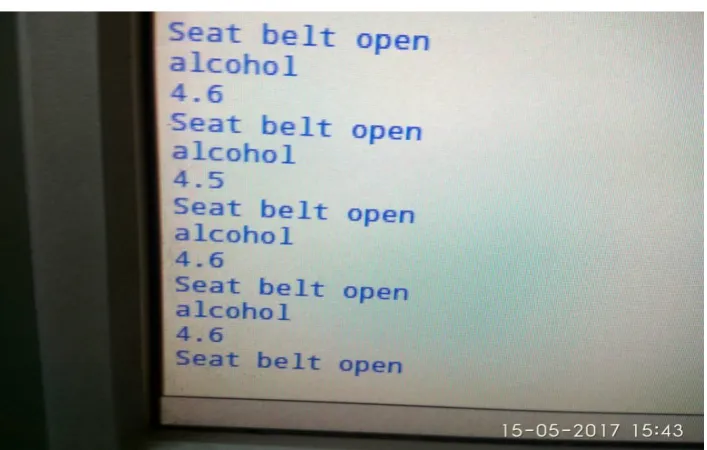
Alcohol detection test results are shown below: all level i.e Low, Medium, High, of alcohol is detected and displayed
Fig 3. Alcohol Detection
Driver’s seat belt position is also detected.
B. SOFTWARE RESULT
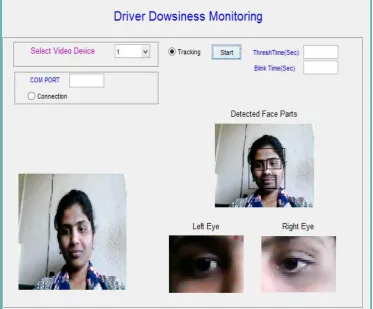
Results of the eye monitoring system are taken by using the MATLAB software.
Fig. 5 Detection of eye blinking
IV. CONCLUSION
This system which a combination of alcohol detection system, seat belt position system, driver drowsiness checking system and automatic speed controller. This system can check the other function like traffic condition, weather condition, wheel condition in future.
WORK’S COMPARATIVE ANALYSIS
Alcohol detection test is passed i.e. alcohol level is high then alert system will on i.e. steering wheel will get locked automatically.
ACKNOWLEDGMENT
REFERENCES
[1] http://drowsydriving.org/about/facts-and-stats/ [2] http://www.iii.org/issue-update/drunk-driving
[3] A. I. Pack, A. M. Pack, E. Rodgman, A. Cucchiara, and D. F. Dinges,“Characteristics of crashes attributed to the driver having fallen asleep,” Accident Anal. Prevention, vol. 6, pp. 769–775, 1995.
[4] P. H. Langlois, M. H. Smolensky, B. P. Hsi, and F. W. Weir, “Temporal patterns of reported single-vehicle car and truck accidents in Texas, U.S.A. during 1980–1983,” Chronobiol. Int., vol. 2, no. 2, pp. 131–140, 1985
[5] J. A. Horne and L. A. Reyner, “Sleep related vehicle accidents,” Brit. Med. J., vol. 6979, pp. 565–567, 1995
[6] G. Maycock, “Sleepiness and driving: the experience of U.K. car drivers,” Accident Anal. Prevention, vol. 29, no. 4, pp. 453–462, 1997. [7] E. Fujita, Y. Ogura, N. Ochiai, T. Miao, T. Shimizu, K. Murata, T. Kamei, Y. Ueno, and S. Kaneko, “Experimental study on prediction of sleep
during wakefulness,” in Proc. 1st Int. Symp. Adv. Technol. [8] Vibration Sound, Hiroshima, Japan, 2005, pp. 282–287.
[9] T. Inagaki, “Design of human-machine interactions in light of domain dependence of human-centered automation,” Cogn., Technol.Work, vol. 8, no. 3, pp. 161–167, 2006.
[10] T. Inagaki, “Smart collaborations between humans and machines with mutual understanding,” Annu. Rev. Control, vol. 32, pp. 253–261, 2008. [11] HAVEit (Highly Automated Vehicles for Intelligent Transport) Project, “The future of driving,” Deliverable D61.1 Final Rep.
[12] M. Ohsuga, Y. Kamakura, Y. Inoue, Y. Noguchi, K. Shimada, and M. Mishiro, “Estimation of driver’s arousal state using multi-dimensional physiological indices,” in Proc. 9th Int. Conf. Eng. Psychol. Cognitive Ergonomics, 2011, pp. 176–185.
[13] T. A° kerstedt, M. Ingre, G. Kecklund, A. Anund, D. Sandberg, M. Wahde, P. Philip, and P. Kronberg, “Reaction of sleepiness indicators to partial sleep deprivation, time of day and time on task in a driving simulator The DROWSI Project,” J. Sleep Res., vol. 19, no. 2, pp. 298–309, 2010