ABSTRACT
SATAM, DNYANADA SHANKAR. Design and Material Considerations for High
Performance Army Combat Uniforms. (Under the direction of Drs. Hoon Joo Lee & Nancy Cassill.)
As the saying goes, “Necessity is the mother of invention”, the military requires new modifications in its uniforms to surmount the climatic conditions and to reduce threat of various warfare agents during their mission. The requirement of the hour is for the Army Combat Uniform (ACU) to be better-protective, more breathable uniform fabrics which also have superior mechanical properties. The purpose of this research is to study the design of ACU specifically with the new technologies and materials that could be used for their manufacture.
The design of the ACU is governed by its protective functions, quality, and cost. Along with protection, the key performance features identified include high tensile strength, light weight, fire-resistance, moisture management, and temperature control. The current uniforms are composed of nylon-cotton blended (50/50 NYCO) woven fabrics while the use of nonwoven fabrics has been limited in the manufacture of ACUs. This research presents the parameters required to use nonwoven fabrics and Computer Aided Design (CAD) for the production of the ACU. This work considers the necessity of domestic mass production of defense materials.
of these properties along with enhanced durability and wash resistance. In addition, many nonwovens can be ultrasonically bonded to create seams that are impervious to penetration of chemical-biological warfare agents. This research also proposes the idea of incorporating smart textiles into the ACU. A method of producing oleophobic fabrics which can make the uniform protective against chemical-biological warfare agents has also been experimented during the course of this research.
Design and Material Considerations for High Performance Army Combat Uniforms
by
Dnyanada S Satam
A thesis submitted to the Graduate Faculty of North Carolina State University
in partial fulfillment of the requirements for the degree of
Master of Science
Textiles
Raleigh, North Carolina 03/16/09
APPROVED BY:
________________________ ____________________________
Dr. Hoon Joo Lee Dr. Nancy Cassill
Chair of Advisory Committee Co-Chair of Advisory Committee
___________________________
Dr. Michelle Jones
DEDICATION
♥
BIOGRAPHY
Dnyanada Satam was born on February 27, 1986 in Mumbai, India. Her parents are Shankar and Deepa Satam and she has a younger brother Pranav. Dnyanada grew up in Mumbai, India where she graduated with a Bachelor of Technology in Fibers and Textile Processing from Institute of Chemical Technology (ICT), Mumbai, India, one of the leading schools for Chemical Technology globally, in 2007. To get a wholistic industry exposure, she undertook an internship at a technical testing laboratory - Texanlab, India.
She moved to Raleigh, North Carolina in Fall 2007 to pursue her Master‟s in Textile Technology and Management at North Carolina State University. She was inducted in Phi-Kappa-Phi Fraternity for maintaining an overall GPA of 4.0 during her Master‟s degree. As a student delegate for the program „Doing Business in the International Marketplace‟-Mexico she learnt about the culture and effective trade practices in an international marketplace and participated in Expo ANTAD international trade show in Guadalajara, Mexico. In Summer 2008 she was an applied research intern at INVISTA S.à.r.l. She worked for the consumer brand LYCRA® fiber on technical projects, data analysis and market research for new product development.
ACKNOWLEDGMENTS
I would like to take this time to thank the following people who have been influential to my academic and personal life.
I would like to thank Dr. Hoon Joo Lee for accepting me as a research assistant and for serving as my advisor and guiding this research. I am highly indebted for her insightful advice and encouraging words which helped me meander through my graduate research. Thank you for being the voice of reason and also for telling me in the beginning, “You have to do this.”
I want to express my gratitude to my co-chair Dr. Nancy Cassill for her continued guidance, for both professional and personal, and support throughout this entire process that has made this an incredible learning experience. Thank you for your enthusiasm about my idea, high standards, and belief in my ability.
Dr. Michelle Jones for her cheerful encouragement and point of view throughout this research. I sincerely appreciate her willingness to serve on my committee.
Prof. Nancy Powell, Dr. Euigyung Jeong and Jung Hyun Park for their incredible help during my research, Priya Malshe for conducting many laboratory tests needed for this study and Jeff Krauss and Judy Elson for allowing me to spend hours in their labs.
Heartfelt thanks to my lab mates Vamsi and Jinmei for their help and Mr. Rob Cooper and Ms. Tywanna Johnson for their patient support.
Many individuals outside of NC State contributed to this project. I sincerely appreciate and thank Dr. Eugene Wilusz at Natick, MA for his continued guidance and support throughout this research. As well as, Mr. Francisco Martinez at Natick, MA, Ms. Tammy Lester at N.C. Department of Commerce, Ms. Teresa Bouchonnet at N.C. Military Business Center and Ms. Mary Lynn Landgraf at U.S Department of Commerce for providing me contacts, answering many of my questions and providing many useful documents and insights.
Thanks to my friends Khushboo, Neha, Prachi, Priya, Pruthesh and Venu for making my stay at Raleigh and graduate school enjoyable. I appreciate your patience and understanding as I finished my research and thank you for your sympathetic ear during difficult times. Akanksha and Shruti, you were there when I needed stress relief and encouragement, but knew when to give me space. Your continued support and encouragement were above and beyond, as well as highly appreciated! Thank you all for your understanding and wonderful friendship throughout this journey!
TABLE OF CONTENTS
LIST OF TABLES ……… xi
LIST OF FIGURES ……….. xii
INTRODUCTION ……….………… 1
Purpose of this study ………...……… 3
Significance of this study ………..……….. 5
Limitation of this study ………...……… 6
REVIEW OF LITERATURE ………. 7
New product design ……….……… 7
Opportunity identification and concepts ………...……… 10
Design ………..………. 11
Testing ………..………...…. 12
Introduction (Product Launch) ………..……… 13
Product life cycle management ……….… 14
Functional apparel ………..…. 15
Watkins design process ………..…. 16
Analyze ………..………..…. 17
Definition ………...………..……….… 18
Evaluate and implement ………..…… ..…... 19
Development in military clothing ……… 19
History of US army uniforms ……… 20
Requirements for combat uniforms for current battlefield scenario ……...…. 23
Physiological monitoring ……….. 24
Thermal management ………... 24
Signature management ……… …………. 26
Chemical and biological defense management ……….… 28
Flame resistance ……… ……...…. 29
Environmental defense ………... 30
Body armor ………..…. 30
Specifications, standards, and handbooks for testing ACU‟s ………...…… 31
Federal standards ………..…… 31
Non-government publications………... 31
National fire protection association ………...……... 32
Physical requirements for the ACU ………..… 33
Nonwoven production in the US …..……….….…. 34
Major nonwoven market segments ………... 35
Nonwoven fabric technologies ………...….. 36
Overview of smart textiles ………..…… 42
Smart textiles in the military …….……… 45
Mass customization ………. 46
Development of technologies in mass customization ………...……… 48
Body scanning and garment modeling ………... ... 49
Digital pattern design ……….... 49
Garment modeling and simulation ……… 50
Computer Aided Process Planning (CAPP) ………... 50
Contact angle and wettability ………..… 51
Contact angle hysteresis ………...…. 56
RESEARCH METHODOLOGY AND EXPERIMENTAL ……….… 57
Purpose of this Study ………...… 57
Research design ………... 59
Phase I ……….………... 60
Phase II………... 61
Phase III …..……….………. 67
Experimental ……….……….…. 67
Materials ………..………... 67
Grafting PAA on nylon-6 surface ………..………... 68
Grafting of fluoroamine on PAA-grafted nylon-6 surface…………... 69
Grafting of 1H, 1H, 2H, 2H-Perfluorodecyltrimehtoxysilane on PAA- grafted nylon-6 surface ………. 70
Test methods for fiber and fabric testing………... 71
Tensile strengths of nonwoven fabric ………... 71
Fiber modulus and tenacity testing ………...………….……... 72
AATCC test method 61Test No. 2A ….. ……….. 72
Contact angle measurements ...……….…. 73
Preparation of prototype sample……….... 73
Definition of terms………... 74
RESULTS ………..………..…... 76
New product design process for military uniforms ……….…..…….. 77
Opportunity identification and concept ……….... 78
Design ………... 83
Testing ……….. 86
Introduction ………... 87
Product lifecycle management ……….. 88
Use of nonwovens for manufacturing the Army Combat Uniforms ……..…. 89
Smart textiles for the Army Combat Uniforms ………... 91
Bio-feedback and wearable health monitoring ………. 93
Application of RFID technologies to the ACU …………..………….. 94
Concept screening matrix ……….... 95
Concept scoring matrix ………... 99
Preparation of superhydrophobic and superoleophobic surface ………. 102
Testing the current ACU for superhydrophobicity and superoleophobicity ……… 102
Testing the treated nonwoven fabric for superhydrophobicity and
superoleophobicity ……… 105
Testing the treated Nylon-cotton (NYCO) fabric for superhydrophobicity and superoleophobicity ……….. 106
Prototype sample Fabric Testing ……….… 108
ASTM D3822 ………... 108
ASTM D1117 ………... 109
ASTM D5034 ………... 110
Comparison of nonwoven fabric vs. the ACU physical requirements ………. ……….... 111
Computer Aided Manufacturing (CAM) ………. 112
Ultrasonic sewing ……….... 113
Preparation of prototype sample ……… ... 115
House of Quality Matrix ………. .... 120
SUMMARY,CONCLUSIONS AND RECOMMENDATIONS .………....….……….. 124
Summary ………. 124
Conclusions ………. 126
Recommendations ………... 129
Future work ………. 130
Stimulus package ……….. 132
REFERENCES ……….……….. 133
APPENDICES ……….. 148
Appendix A- Survey instruments ……… 149
LIST OF TABLES
Table 1: Examples of hazard threats and their effects ……….…..….. 23
Table 2: Physical requirements for the ACU ………...……….. 33
Table 3: Compensation costs for apparel manufacturing ……….... 48
Table 4: Manifold pressures ……… .... 68
Table 5: Concept screening matrix ……...………... 97
Table 6: Concept scoring matrix ……….…. 100
Table 7: Contact angle measurements for NYCO fabric that is currently used for the ACU ………..………. 103
Table 8: Contact angle measurements for nonwoven fabric treated with fluoroamine ………..…... 104
Table 9: Contact angle measurements for nonwoven fabric treated with 1H, 1H, 2H, 2H-Perfluorodecyltrimethoxysilane ………... 106
Table 10: Contact angle measurements for NYCO fabric treated with 1H, 1H, 2H, 2H-Perfluorodecyltrimethoxysilane………... 107
Table 11: Results for ASTM D3822 ………...…. 109
Table 12: Results for ASTM D1117 in machine and cross direction ……….. ... 109
Table 13: Results for ASTM D5034 in machine and cross direction ………... 111
LIST OF FIGURES
Figure 1: Characterization of new products………... 8
Figure 2: New product & service design process …………..……….……... 9
Figure 3: Ideal form of a product life cycle ………... 14
Figure 4: Aesthetic-functional continuum ………... 16
Figure 5: Watkins‟s design process ……….… 17
Figure 6: Market segments and share for non-woven fabric mills industry in the US during 2008 ………..………. 35
Figure 7: Property map of drape and strength- qualitative ……….. 40
Figure 8: Contact angle and wettability ………... 52
Figure 9: A drop on the flat surface showing the positions of surface tension at different interfaces ……….... 53
Figure 10: Apparent contact angle on a rough surface ……….... 54
Figure 11: A liquid drop behavior on a rough surface according to (a) Wenzel Model and (b) Cassie-Baxter Model ……….. 55
Figure 12: Self-cleaning effect due to super hydrophobicity ……….. 56
Figure 13: Conceptual framework of overall research ……….... 60
Figure 14: Design process for opportunity identification and design phase ……….... 62
Figure 15: Graft of PAA on nylon-6 ……….... 69
Figure 17: 1H, 1H, 2H, 2H-Perfluorodecyltrimethoxysilane on
PAA-grafted nylon-6 ………. 71
Figure 18: The photographs above show the difference in environment between Iraq and Vietnam ………... 84
Figure 19: 2 µl water and dodecane droplet on 1H, 1H, 2H, 2H Perfluorodecyltrimethoxysilane – grafted – PAA – grafted-nylon nonwoven fabric ……….... 105
Figure 20: Process of mass customization based on intelligent design and manufacturing ………... 113
Figure 21: Pattern layout for the ACU jacket using Gerber Acumark® software ….. 116
Figure 22: Patternlayout with seam allowance for ultrasonic sewing …………... 117
Figure 23: Pattern layout for cutting machine ……….….... 118
Figure 24: Pictures of the prototype sample ……….... 119
Figure 25: Basic framework for the House of Quality Matrix ……….... 120
Figure 26: House of Quality Matrix for ACU design process ………. 121
Chapter 1
Introduction
“Clothing is our most intimate environment. What makes it a unique environment is that it is carried everywhere with an individual, creating its own room and its own climate within the larger climate of our surroundings” (Watkins, 1995, xv). Military individuals rely on clothing for protection as well as life support. Military clothing must perform a broader range of functions than most other types of clothing. Since the Second World War improvements in fabric technology have led to dramatic changes in clothing worn by soldiers. Military clothing is no longer viewed as just a means of identification and protection against the elements but is now considered as an integral part of the soldier‟s fighting kit. There is a growing awareness of the importance of clothing in enhancing the performance of soldiers and protecting their lives during combat (Muran, 2005). Such awareness has prompted militaries around the world to step up their research and development efforts to create the ideal combat uniform.
designer must also be aware of the basic mission related requirements and their influence on the design and the comfort and fit requirements. Thus, the process of New Product Design is of utmost importance for the development of army combat uniforms.
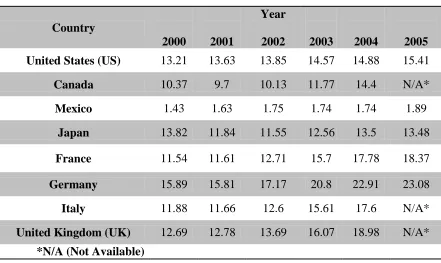
The U.S. military is second largest in the world, after the People‟s Liberation Army of China. As of April 2007, about 1.4 million people were on active duty in the U.S. military with a nearly 50/50 split between males and females (2005 est.) (U.S. Department of Defense). To cater to these huge needs, mass production which requires a large labor force is necessary. However, there has been a constant decrease in the number of workers employed in the U.S. apparel industry since the last quarter of the twentieth century due to globalization in the textile industry. This has led to global sourcing and offshore manufacturing (Plunkett Research Ltd., 2007). Meanwhile, labor costs have steadily increased worldwide (U.S Bureau of Labor Statistics, 2008). Due to the continuous growth in labor costs, it is expected that manufacturing units will prefer more mechanized processes, which require less labor. Labor costs can be saved during sewing operations using automated assembly techniques as a consequence domestic production of military clothing will be available.
soldiers face include domestic and foreign terrorism, peace keeping, nation building, low and high density conflicts, special operations, military operations in urban terrain and worldwide climatic conditions (Tassinari and Leitch, 2004). Smart textiles can provide protection to safeguard the troops in these modern battlefield environments. In this research the potential design considerations for Army Combat Uniforms have been studied in terms of application of new materials and production technologies for manufacture of these uniforms.
Purpose of this Study
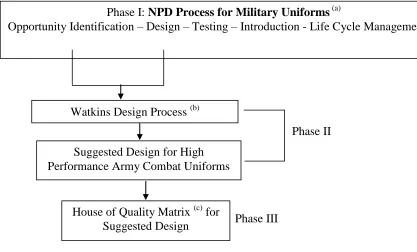
process serve as conceptual framework to study the NPD process for military uniforms and materials and technologies for manufacture of the ACU respectively.
The objectives of this study for the three phases are as follows: Phase I
1. Study the New Product Design Process (adapted from Urban and Hauser, 1993) for military uniforms.
Phase II
2. Collect information on the current Army Combat Uniform (ACU), including their current features and issues.
3. Study the current threats to the soldiers, by studying the battlefield environment. 4. Discuss the materials and technologies identified, as an opportunity for changes in the
ACU and thus study the opportunity identification phase for the ACU.
5. Propose a method for preparing superhydrophobic and superoleophobic surface and prepare a prototype sample showing superhydrophobic and superoleophobic characteristics.
6. Suggest a model for mass customization of ACUs
7. Study of novel sewing techniques for manufacture of ACUs
8. Compare the potential designs vs. the current ACU using a concept evaluation matrix. Phase III
The overall research question for this study is: “How can incorporation of nonwovens, smart textiles, and mass customization in the manufacturing of the ACU enhance the functionality of the combat uniforms?” Specific research questions developed from the overall research question are:
1. Should nonwoven fabric be used instead of woven fabric for the manufacture of the ACU?
2. What features could be incorporated into an ACU to make it more functional?
Significance of this Study
Limitation of this Study
1. The high performance combat uniform designed during this study has not been tested for all of the criteria suggested in this research.
Chapter 2
Review of Literature
New Product Design
New Product Design (NPD) is a term that describes the complete process of bringing a new product or service to market. It can be divided into two stages. The first stage can be termed as the “truth-seeking” early stage, which evaluates the novel products‟ prospects, and eliminates the risky ones. The second stage can be termed as the “success-seeking late stage”, which focuses on maximizing the value of products which are being developed (Bonabeau, Bodick, & Armstrong, 2008). New product design is essential for the organic growth of a company. The main reasons for needing of NPD are: increased competitive pressures deregulation and globalization, exploding product variety, shorter product life cycles shrinking time to market, demand for products that are high performance, and price pressure (IMB & SAP, 2005).
Figure 1. Characterization of New Products
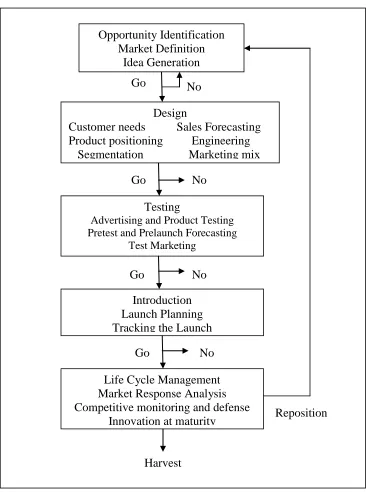
NPD process is becoming increasingly risky, expensive and reliant on disparate knowledge bases that are spread across multiple firms. Urban and Hauser in their book “Design and Marketing of New Products” (1993), describe the NPD process as a five step decision process which includes the steps referred to as: opportunity identification, design, testing, introduction, and life-cycle management.
Ne
wne
ss t
o Com
pa
n
y
High High
Low
Newness to Market
Repositioning Line
Extensions Core
Product Revision New Product
Lines Innovation
Changes to Augmented
Figure 2. New-Product-and-Service Design Process
Source: Urban and Hauser, Design and Marketing of New Products (1993), pg. no. 38, Prentice-Hall, Inc., New Jersey.
Harvest
Life Cycle Management Market Response Analysis Competitive monitoring and defense
Innovation at maturity Reposition Introduction
Launch Planning Tracking the Launch
Design
Customer needs Sales Forecasting Product positioning Engineering Segmentation Marketing mix
Testing
Advertising and Product Testing Pretest and Prelaunch Forecasting
Test Marketing
No Go
Opportunity Identification Market Definition
Idea Generation
Go No
Go No
The decision process is a set of sequential activities that minimize risk and maximize creativity. The first step in the decision process is opportunity identification which defines the best market to enter and generates ideas that could be the basis of entry. Once the opportunity is identified the next phase is the design stage that includes converting the ideas into a physical and psychological entity through engineering, advertising and marketing. The third stage in the decision process is testing which serves as a market analysis for both the product and its advertising. If the testing is successful the product is launched due to which it goes to the introduction stage of the decision process. The product may be introduced on the full-scale basis or market-by-market basis. The final stage in the decision process is the life cycle management that maintains the profitability. At the end of the mature phase the product is either repositioned or redesigned. Use of the decision process enables the new product teams to meet the consumer needs.
Opportunity Identification and Concepts
products (set of products that are substitutes for one another are found). The market profile analysis is used to screen the potential markets from a large number of markets. After market definition the organization develops ideas for products to take advantage of identified opportunities. A large number of ideas are generated through direct searches, technological innovation, exploratory consumer studies, facilitating lead user solutions, integration of technology and marketing, national development programs, alliances, acquisitions, and licensing. A screening process is used to select a few good ideas from those generated. This complete step can be coined into a single term called the “Discovery Stage” (Cooper, 2002)
Design
After opportunity identification and market selection, the next step in the NPD process is to design the product physically and psychologically exploit the market opportunity creating benefits for its customers. The Core Benefit Proposition is a short and to the point statement that states the unique benefits that the product provides the customers and also the benefits required to meet and surpass the competition. The design process comprises of three sub-processes: opportunity identification, refinement, and evaluation (Urban and Hauser, 1993).
the project is developed along with a proposed plan of action for stage 2. This is described as the Building Business Case stage or the homework stage. The three main components of the business case are product and project definition, project justification and project plan-the path forward. It is the last stage before the third stage of product development, wherein the actual detailed design and development of a new product or production process takes place. After the development stage the proposed new product is verified and validated with tests and trials in the marketplace, lab, and plant. The final stage of the stage gate process is the launch stage, in which commercialization of the product takes place via market launch and full production start-up (Cooper, 2002).
The Voice of the Customer (VOC) is the stated/unstated needs of the customer. It is a process used to gather feedback from the customer to develop a successful product. Understanding VOC can occur at any of the five stages of the NPD process. It is generally done through product value analysis, focus groups, and sample surveys. VOC can not only solve problems by capturing consumer needs but also lead to other product opportunities.
Testing
The testing stage validates the viability of the product considering the product itself, its production process, customer acceptance and economics. This stage includes the following set of activities (Cooper, 2001):
User or field trials of the product: Tests the product functions under actual use conditions and estimates the potential customers‟ reactions to the product.
Trial, limited, or pilot production: Tests the production processes and are used to determine the precise production costs.
Pretest market, test market, or trial sell: Studies the consumer reaction and the effectiveness of the launch plan.
Revised business and financial analysis: Checks the economic viability of the product based on revenue and cost data.
Introduction (Product Launch)
Product Life Cycle Management
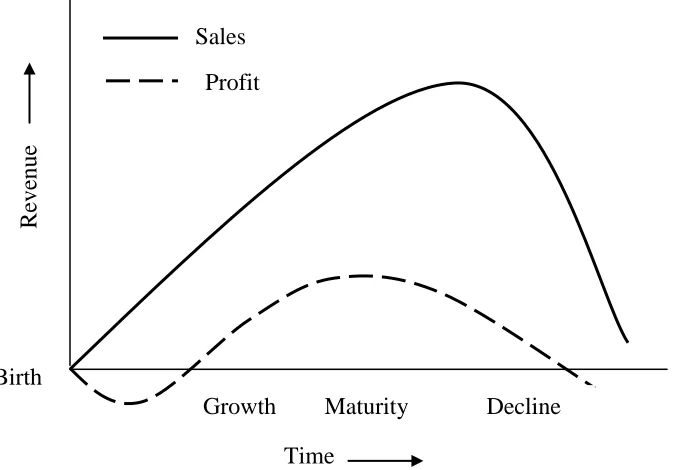
Product life cycle is a tool to trace the stages of a product‟s acceptance from its introduction to demise. The product life cycle theory studies the introduction, growth, maturity, and decline stages of the process.
Figure 3. Ideal Form of a Product Life Cycle
Source: Urban and Hauser, Design and Marketing of New Products (1993), pg. no. 559, Prentice-Hall, Inc., New Jersey.
The introduction stage is characterized by high costs, low sales volume, and no/little competition. In this stage the demand for the product has to be created and the customers have to be prompted to try the product. During the growth stage costs are reduced due to
Sales Profit
Birth
Growth Maturity Decline Time
R
eve
economies of scale and the sales volume increase significantly, which leads to profitability. Competition for the market begins to increase as new players enter the market. In the mature stage, the product is well established in the market, and the sales volume is at its peak. Due to an increase in competition each player seeks to differentiate from its competitors using brand differentiation and feature diversification. Sometimes, despite the best management, the product demand will decline. In the case of intense competition, only the firms with unique core competencies will survive (Cooper, 2002; DRM Associates, 2002).
Functional Apparel
Figure 4. Aesthetic-Functional Continuum
Source: May-Plumlee, Traci and Pittman, Amanda. (2002). Surgical Gown Requirements Capture: A Design Analysis Case Study. Journal of Textile and Apparel Technology and Management, 2, 1-10.
With the increasing technological developments that lead to new hazards, creating functional protective clothing has become increasingly challenging. According to Watkins (1995), military clothing is a form of functional apparel which has a very complex design process. This is because the clothing meets a variety of needs and serves a variety of purposes, thus, each situation generates a wide variety of conflicting criteria.
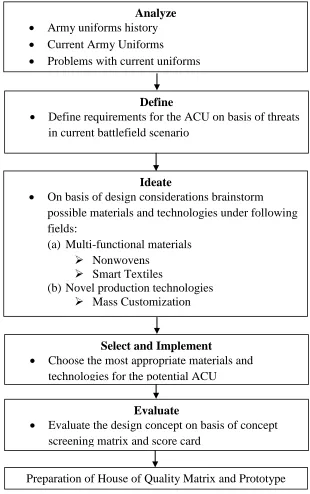
Watkins‟s Design Process
nature of the problem being solved. Each step builds on those that precede it; the designer is continually uncovering more information and gaining new insights into the problem.
Figure 5. Design development process for functional apparel
Source: Watkins, S. M. (1995). Clothing: The Portable Environment (2nd ed.). Ames, IA: Iowa State University Press.
Analyze
The analysis stage of the design process is responsible for design inspiration. It involves basic exploratory research that familiarizes the designer with the needs of the product users and the problems associated with the product. Direct observation is one of the most basic data collecting methods. It involves going to the site of work or recreation, where protective apparel is needed, and watching both the people and environment to obtain relevant information. Other data collecting methods include: participant observation, indirect observation, direct communication, and laboratory simulation. In addition to these methods, literature review helps in learning the areas related to the design problem and the language of the field. This allows the designer a greater opportunity to talk with the specialists and read the literature of the field, in order to generate a more complete analysis.
According to Watkins, the analysis stage needs to include an investigation of the design setting (the environment), individuals associated with the project, and materials that
Analyz e
Define Ideate Select Implement Evaluat
are available for use in the design setting. Designers face a difficulty with the analysis stage that can never be complete. The most difficult decision for a designer is when to stop the analysis process and move on.
Definition
The definition of design problem provides the designer with a statement of goals that the designer needs to meet to solve the problem. After sorting through the information collected in the analysis phase, the most essential elements of the problem are determined and defined. If the definition is ill-conceived the designer may ultimately work to solve the wrong problem. Definition forms the basis of subsequent design ideas and the final design product.
Ideation
generation complete. There is never only one correct answer; a better design can always be developed.
Select
Many designers believe that the most creative design behavior takes place during the idea selection phase, rather than the ideation stage. The designs generated during the ideation stage are broken down into small concepts, or attributes, so that creative recombination can take place. During the selection stage it is important to prioritize criteria, which are the basis for the design selection.
Evaluate and Implement
Evaluation involves taking a critical look at the decisions made during the design process through numerical ratings. These ratings are based on tests conducted with many subjects or the informal, subjective opinion of the designer. Evaluation techniques include observation, interview, questionnaires, laboratory testing, and field testing. Implementation is the point where the product evolves from the process, and the chosen ideas are put to work.
Development in Military Clothing
matching or aesthetically contrasting colors. It was reasoned that this practice provided a feeling of unity among troops. This influence extended to the general public, which was the source of new recruits (Wichmann, 2006). With the improvements in the firepower, range, and accuracy of weapons, the First World War finally ended the expensive practice of furnishing colorful uniforms. This occurred because the colors made the troops easily visible targets, which lead to increase casualties. Uniforms of varying shades of khaki and grey were used in World War II, but the cut and outline appearance of the different armies were distinctive, which helped in identifying the armies from different nations.
Camouflage clothing was developed to reduce the visibility of soldiers for their protection. Modern uniforms are more suited for combat in modern conditions, and the uniform design is governed by factors like utilitarian necessities of the war and economic frugality (Military uniform, 2008). Many modern military forces utilize a system of combat uniforms that make it difficult to detect the soldier, both during daytime and at night, even with the assistance light amplification devices, such as night-vision goggles. These “digital” print uniforms provide a “splotched” appearance that leads to visual concealment in variety of surroundings.
History of the U.S. Army Uniforms
woodland pattern camouflage, with matching trousers, and a field cap was introduced. In 1988, a hot weather version of the BDU was introduced. Also, for operations in the Middle East a Desert Camouflage Uniform (DCU) was introduced (Cole, 2007).
On June 14, 2004 the Army Combat Uniform (ACU), consisting of a coat, trouser, black beret or matching patrol cap, moisture wicking T-shirt, moisture wicking socks, and brown combat boots was officially established as the combat and garrison uniform for the Army. The color scheme composed of gray, tan and sage green digital pattern. The ACU has a single-breasted coat, with integrated blouse bellows for increased upper body mobility, and a plastic zipper closure that can be opened from either the top or the bottom. A front placket covers the zipper, and is secured by hook-and-loop (Velcro TM) fasteners. The coat has a Mandarin collar that can be worn up or down. On each sleeve, near the shoulder, there is a slanted pocket with a hook-and-loop covered flap closure, which has an integrated infrared identification square on the outside. Below each sleeve pocket there is an elbow pouch for an internal elbow pad insert (Cole, 2007).
Requirements for Combat Uniforms for Current Battlefield Scenario
Understanding the types of hazards and threats that a soldier has to face in the ever changing defense domain is an important, and the most basic step for developing uniforms and protection system. Military uniforms need to protect the user from different threats and hazards, and also provide comfort properties. The design process of a military uniform is a complex system that requires a systematic approach. This approach starts with identifying the user‟s needs (including hazard and threat identification). Table 1 lists few examples of common threats and their effects (Gomes, 2008).
Table 1. Examples of hazard/threats and their effects
Threat or Hazard Effect
High environmental temperature Heat stress (e.g. heat stroke, heat exhaustion) Cold environmental temperature Cold stress (e.g. frostbite, hypothermia)
Identify location of soldier Detection
Chemical Damage through skin, eyes and inhalation
Biological Damage through skin and inhalation
Flame Melting of material to skin or burns
Fragmentation Ballistic impact, blunt force trauma
Ballistic Ballistic impact, blunt force trauma
In this section, the features that are necessary to be incorporated into the ACU for modern war-fighting scenarios are discussed.
Physiological Monitoring
For operational success in extreme environments it is critical to know a soldier‟s physiological status on the battlefield to predict that soldier‟s performance. Both health and performance of a soldier can be impaired in adverse environmental conditions. Commanders and combat medics require real-time physiological status and readiness information of soldiers to support operational decisions. Getting such information leads to quick identification and location for treating the casualties on the battlefield. Currently the army uses battle simulation software to predict the operational outcomes based on input variables such as mission, terrain, and climate. However, for accurate outcomes, predictions require to be on individual or unit-level basis. The solution for this problem is the development of physiological status monitoring (PSM) systems that can provide remote situational awareness and life-sign detection based on heart-rate, respiration rate, and other performance status indicators (Military operational medicine research program, 2009).
Thermal Management
person, and a negative heat balance occurs if the person is warmer than the environment (Naval Aerospace Medical Institute, 1991). Thermal management can either be active requiring a power source, or passive, requiring no power source.
Passive Thermal Management
In a hot environment evaporative cooling can be used for thermal management. Any fabric that can be worn next to the body and that allows sweat from the body to be wicked to the outer surface of the fabric can facilitate evaporative cooling. The US military used polypropylene fabrics as the next-to-skin layer for many years, but currently the US military uses Polartec® Power Dry®, which has a bi-component construction. This bi-component construction moves at least 30% more moisture away from the skin than single component fabrics. In a cold environment insulation that can trap warm air around the body is an important feature for a protective clothing system. The current military protective clothing for cold environments is a multi-layer system like the US Army‟s new generation III Extended Cold Weather Clothing System (ECWCS). This is a seven-layer, 12-component system that keeps the soldiers comfortable, dry, and warm in extreme conditions. The system protects troops from temperature ranging from -51oC (-60oF) to 4oC (40oF) (Kennedy, 2007). Active Thermal Management
fluid that can remove up to 180 watts of body heat from the torso (Natick, 2006). The US military has not yet adopted active thermal management in cold environments, but this could be done through electric resistive heating by applying voltage to series of conductive yarns and as current is passed through them, heat is produced.
Signature Management
Signature management masks all the elements that make the soldier stand out in front of the enemy. The sub-categories of signature management include visual, infrared, olfactory and auditory.
Visual
Camouflage patterns provide the least amount of contrast between the soldiers and their background when viewed by the enemy thus blending the soldiers into the background. Historically, the US military branches wore the same type of camouflage uniforms until the digital camouflage pattern MARPAT was released by the Marines. This digital pattern resembles computer pixels, but from a distance it blends into the background faster than any other current camouflage design (Stone, 2001).
Infrared
temperature of the object. Texplorer® has developed a garment called Ghost® that incorporates metalized fibers which reduce IR emissions and thus lower the temperature gradient. Night vision devices use the near-IR (NIR) spectrum that is reflected by the objects. NIR is managed by selecting dyestuff that mimics the spectral reflectance of the different environments of the soldier (Dugas, Zupkofska, & Kramer, 2004).
Olfactory
Human odor originates from bacteria living on skin that expel waste in the form of odorous gas. The olfactory target indicator identifies the area where the soldier is using the sense of smell. Metallic compounds based upon metals such as silver and copper that exhibit antimicrobial properties can be used with the fabrics to reduce the odor of the soldier as well as to improve his/her health. X-Static®, a silver-coated textile fiber that provides permanent anti-odor and antimicrobial properties is currently being used in US military socks and T-shirts. It not only provides odor elimination, but also helps in temperature regulation, instantaneous static reduction, and is also used for wound care (Jowers, 2006).
Auditory
Chemical and Biological Defense (CBD) Management
Protection against chemical liquids, vapors, and bio-aerosols is the basic function of a chemical and biological defense system, and a breach in this system may lead to serious injury or loss of life. It is generally observed that increased protection against chemical and biological warfare leads to lower comfort and breathability. Historically, butyl rubber and activated carbon have been used as CBD materials. Though butyl rubber is a chemical-resistant impermeable elastomer, it is not breathable and could cause soldiers to overheat. Activated carbon has an extremely large surface area and high adsorptive properties for high boiling point gases and vapors (e.g. nerve agents). It has very low removal efficiency for low boiling point gases (e.g. blood gases such as cyanogens chloride) and choking agents (e.g. phosgene and chlorine), but this can be improved by impregnating it with heavy metals and triethylenediamine. The main shortcoming of using activated carbon is that it is required in large amounts, which leads to increases in weight and it has a limited functional life.
1H-perfluorooctylamine. The water contact angles measured were as high as 178o. Plasma polymerization is used for chemical modification of material surfaces that leads to better functional properties. Radio frequency plasma discharges containing simple fluorinated gases and vapors have been proven to impart water-repellency (hydrophobicity) to textiles, but the oil-repellency (oleophobicity) imparted by these treatments is to a very smaller degree. Willis (2008) used pulsed electrical charges containing perfluoroalkylated monomers as textile finishes for imparting oil-and-water-repellency. Augustyn, Brunye, Mahoney, & Kramer (2008) have studied the various factors and analyzed the trade-offs and interdepencies of different parameters involved in CBD equipment design that are related to human physical and cognitive performance while using the CBD equipment.
Flame Resistance
against Flash Fire Simulations Using an Instrumented Manikin is used for checking the flame resistance of an ACU.
Environmental Defense
An ideal combat uniform needs to windproof, waterproof and breathable to protect the soldiers from wind, rain and snow. Many technologies like finishing, laminated film and fiber encapsulation are used to impart resistance to water and wind.
Body Armor
Specifications, Standards and Handbooks for Testing ACUs
The ACU is tested for according to following specifications and standards. In this section the standard tests have been listed.
Federal Standards
i. FED-STD-4 -Glossary of Fabric Imperfections
Non-government Publications
AATCC Standards
i. AATCC Test Method 8 –Colorfastness to Crocking: AATCC Crockmeter Method ii. AATCC Test Method 15 –Colorfastness to Perspiration
iii. AATCC Test Method 16 –Colorfastness to Light iv. AATCC Test Method 20 –Fiber Analysis: Qualitative
v. AATCC Test Method 20A –Fiber Analysis: Quantitative
vi. AATCC Test Method 61 –Colorfastness to Laundering, Home and Commercial, Accelerated
vii. AATCC Test Method 81 –pH of the Water-Extract from Bleached Textile
viii. AATCC Test Method 135 –Dimensional Changes of Fabrics after Home Laundering
xi. AATCC Evaluation Procedure 2 –Gray Scale for Staining
xii. AATCC Evaluation Procedure 8 –AATCC 9- Step Chromatic Transference Scale xiii. AATCC Evaluation Procedure 9 –Visual Assessment of Color Difference of
Textiles
xiv. AATCC Smoothness and Appearance Replicas ASTM International
i. ASTM D-737 –Standard Test Methods for Air Permeability of Textile Fabrics ii. ASTM D-1424 –Standard Test Methods for Tearing Strength of Fabrics by Falling-
Pendulum Type (Elmendorf) Apparatus
iii. ASTM D-1683 –Standard Test Methods for Failure in Sewn Seams of Woven Apparel Fabrics
iv. ASTM D-3775 –Standard Test Methods for Warp End Count and Filling Pick Count of Woven Fabric
v. ASTM D-3776 –Standard Test Methods for Mass per Unit Area (Weight) of Fabric vi. ASTM D-5034 –Standard Test Methods for Breaking Strength and Elongation of
Textile Fabrics (Grab Test)
vii. ASTM D-6413 –Standard Test Methods for Flame Resistance of Textiles (Vertical Test)
National Fire Protection Association
Physical Requirements for the ACU
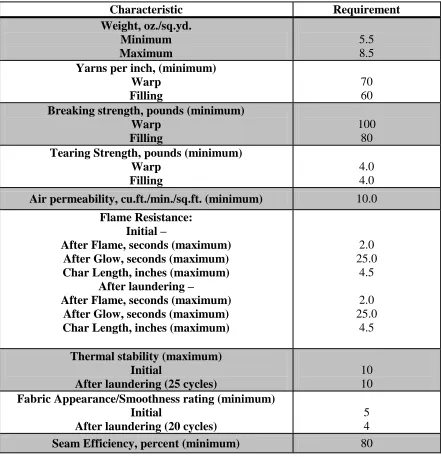
This section lists the physical requirements for the fabric use for manufacturing of ACU (this information was retrieved from documents received from Natick).
Table 2. Physical requirements for the ACU
Characteristic Requirement
Weight, oz./sq.yd. Minimum Maximum
5.5 8.5 Yarns per inch, (minimum)
Warp Filling
70 60 Breaking strength, pounds (minimum)
Warp Filling
100 80 Tearing Strength, pounds (minimum)
Warp Filling
4.0 4.0 Air permeability, cu.ft./min./sq.ft. (minimum) 10.0
Flame Resistance: Initial –
After Flame, seconds (maximum) After Glow, seconds (maximum) Char Length, inches (maximum)
After laundering –
After Flame, seconds (maximum) After Glow, seconds (maximum) Char Length, inches (maximum)
2.0 25.0 4.5 2.0 25.0 4.5 Thermal stability (maximum)
Initial
After laundering (25 cycles)
10 10 Fabric Appearance/Smoothness rating (minimum)
Initial
After laundering (20 cycles)
5 4
Nonwoven Production in the U.S.
Nonwovens today are witnessing a tremendous boom in market as the most highly engineered fabrics. Manufactured at high speeds and low costs, nonwovens yield performance better than their woven and knit counterparts in many applications (Vaughn, 2000). The global production of nonwovens in 2006 reached 5.63 million tons, which is equivalent to $20 billion (USD) and equals approximately 140 million square meters. Tonnage has increased at an average annual growth rate of 7.6% per year from 2001-2006. The export volume of the U.S. nonwovens is twice the import. However, there has been a quick growth in the U.S. nonwoven imports compared to exports, due to foreign operations established by the U.S. nonwoven producers (European Commission, 2005).
producers seem to be a potential to support the domestic production of U.S. military uniforms.
Major Nonwovens Market Segments
According to the IBISWorld Industry Report (2008), “Non-woven Fabric Mills in the U.S.”, the health and medical products manufacturing industry is expected to be the largest market for non-woven fabrics. This growing market segment that includes medical supplies, medical gowns, hygiene masks, wipes, packaging, blankets, and hygiene products is expected to make up more than a quarter of industry sales during the year. Figure 6 shows the market segment and share for the U.S. non-woven fabric industry.
Figure 6. Market segments and share for Non-woven Fabric Mills industry in the US during 2008
The construction industry utilizes another major portion of non-woven fabric products. This market segment was expected to account for around 18.9% of industry sales in 2008. The automotive manufacturers that utilize non-woven fabrics in roof linings, engine insulations, trunk liners, air filters, etc. accounted for 14.5% of industry demand in 2008. Apparel manufacturing accounted for about 7.8% of industry revenue in 2008 and it mainly includes protective clothing manufacturing segment, particularly against fire and chemicals. Exports accounted for approximately 17.9% of industry revenue, which increased from 13.9% in 2002. The main reason for this increase is the demand for high-quality non-woven products from downstream manufacturers in China, Canada, and Mexico (IBISWorld, 2008).
Nonwoven Fabric Technology
Nonwovens can mimic the appearance, texture and strength of a woven fabric. In combination with other materials they provide a spectrum of products with diverse properties, and are used alone or as components of apparel, home furnishings, health care, engineering, industrial and consumer goods. For applications in military uniforms, a fabric should meet certain requirements, such as superior strength, comfort, flame retardancy, and bacterial barrier. Nonwovens, being highly engineered, can combine all these properties in one fabric. If nonwoven manufacturing techniques are selected correctly, the resultant fabric can easily match the required standards. The main nonwoven production steps web formation and web bonding and the different techniques to carry out these steps are described below. Web Formation
Dry laying- The important web laying technologies under this category are air laying, and carding.
Air laying- Air laying refers to the nonwoven web forming technique which overcomes the high fiber orientation by capturing the short fibers from an air stream and collecting them on a moving belt/screen (Nelson, 1992).
Wet laying- Wet laying is similar to air laying, only fibers are suspended in water and collected on a moving belt. This step needs excess water to be removed from the web prior to bonding.
Spunbonding- Spunbond fabrics are produced by depositing extruded, spun filaments onto a collecting belt in a uniform random manner, followed by bonding the fibers. Compared to meltblowing, spunbonding produces coarser fibers (Kamath, Dahiya, & Hegde, 2004(b)).
Web Bonding
Chemical bonding- Chemical bonding techniques use adhesives to provide structural integrity to nonwoven webs. The commonly used adhesives are chemical binders, which are generally water-borne latex, as they are economical, easily applied, and effective. Vinyl materials like polyvinyl acetate, polyvinylchloride, styrene/butadiene resin, butadiene, or their combinations are used for preparation of latex binders. Fabric properties like stiffness/softness, water affinity, elasticity, durability, and ageing are governed by the chemical composition of the binder. Binder composition also determines solvent resistance, cross-linking nature, and adhesive characteristics (Johnson, 1992).
Mechanical bonding- The mechanical bonding technologies for nonwoven webs are needle punching, stitch bonding, melt-blowing, and hydroentangling.
Stitch bonding- Stitch bonding is a bonding technique which consolidates fiber webs by putting stitches in the web. This helps in interlocking of the structure and provides the necessary integrity to the nonwoven web (Kamath, Dahiya, & Hegde, 2004(a)).
Melt-blowing- Melt blowing is a process that produces fibrous webs directly from polymers or resins using high-velocity air to attenuate the filaments. It is used almost exclusively to produce microfibers rather than fibers which are of the size of normal textile fibers. Melt-blown microfibers generally have diameters in the range of 2 to 4 µm, although they may be as small as 0.1 µm and as large as 10 to 15 µm (Kamath, Dahiya, & Hegde, 2004(c)).
Hydroentangling- Hydroentangling, hydraulic needling, or spunlacing refers to the nonwoven bonding technique which employs high pressure water jets to entangle fibers and provide the necessary fabric integrity.
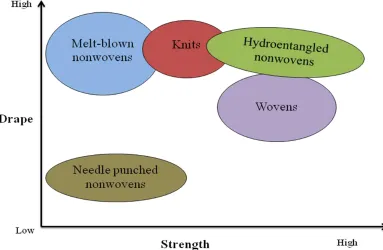
As shown in Figure 7, it can be emphasized that among all the nonwoven bonding techniques, hydroentangling can be best put to use for producing military uniforms. While other bonding techniques such as chemical bonding, needle punching, or thermal bonding result in a papery feel, hydroentangling retains a soft fabric-like structure.
The important requirements to be met by a fabric for military uniforms include strength, comfort, flame retardancy, bacterial-barrier etc. A hydroentangled nonwoven is strong, comfortable, and conformable and may be used as a potential option for military uniforms.
Figure 7. Property map of drape and strength-qualitative Source: Kamath,M.G., Dahiya,A., and Hegde, R.R. (2004(d)). Spunlace
(Hydroentanglement). Retrieved on May 29, 2008 from Web site:
Thermal bonding- Thermal bonding can be defined as a bonding technique for nonwoven webs wherein a thermoplastic element, in the form of a film (continuous or fibrillated), fiber or powder (but not aqueous dispersion of film forming, emulsion polymerized polymers), is integrated into the web (Rogers, 1992). The bonding is initiated by thermal energy and no fluids need to be evaporated (except when using wet-laid webs). Thermal bonding may be done by calender bonding, through air bonding, ultrasonic bonding, or infrared bonding
Calender bonding- This process involves the use of a calendar with a hot metal plate. Depending on the engraving on the heating rolls, the bonding may be area or point bonds. Bonding occurs through simultaneous application of heat and pressure. The heat causes the fiber to become thermoplastic and the pressure enhances mechanical bonding by forcing the binder polymer to flow in and around the carrier fibers (INDA, 2008).
Through air bonding- This technique involves the application of hot air to the nonwoven web. Hot air flows just above the nonwoven through holes which is sucked through the open conveyor apron that supports the nonwoven as it passes through the oven.
without affecting the carrier fibers. Bonding occurs upon removal of the energy source when the binder solidifies.
Overview of Smart Textiles
Materials that can actively monitor and optimize themselves and their performance on a continuous basis with their adaptive capabilities and integrated designs are called “smart materials”. Over the last few years smart materials have made their way into the textile world. Smart textiles can be referred to as high-tech textiles, which sense and respond to environmental stimuli in a controlled or predicted manner (Tao, 2001). These stimuli can be mechanical, thermal, chemical, magnetic, biological, or of any other form. Zhang and Tao (2001) classified smart textiles in three groups, passive, active and very smart textiles. Passive smart materials are sensors that can anticipate environmental conditions. Active smart materials have both sensors and actuators, due to which these materials sense the stimuli from the environment and also react to them. The very smart materials are in the developmental stage, which would go a step further and will be able to adapt their behavior according to the stimuli from the environment.
million in 2005, and is expected to grow to $642.1 million by 2008 at a Compound Annual Growth Rate (CAGR) of 28.3% (Venture Development Corporation (VDC), 2006). The U.S market for smart textiles was estimated to be $78.6 million in 2007, and is expected to reach $391.7 million in 2012 at a CAGR of 37.9% (BCC Research, 2007). The U.S. is the key player in development of smart technologies, mainly because of large defense research and development budgets.
Smart textiles can be made from smart fibers by incorporating sensors into the base fabric, or by applying smart coatings to the fabric. Developments in polymer technology have made it possible to provide smart fibers having attributes such as conductivity, phase change, Quantum Tunneling Composites (QTCs), shape memory, energy absorption, and anti-microbial polymers.
Electrical conductivity can be built into textiles by using polyaniline or polypyrrole polymers. Electroactive polymers are also able to react to electrical stimuli (Technical Textiles Market, 2005). To incorporate electronic functions to textiles, the electronic components can be integrated into the finished garments, or conductive fibers or yarns can be woven or knitted into the clothing. The garments or fabrics that have electronics and interconnections stitched or woven into them are called as electronic textiles (Meoli and May-Plumlee, 2002).
martensite phase, where they can be easily deformed and, upon heating, the structure changes to the austenite phase, which is the parent phase as the material “remembers” its original phase. The SPMs show shape memory properties because of the polymer structure and morphology, and the effect of the thermal transition temperature, which triggers glass transition or melting point (Lendline, 2003). Phase Change Materials (PCM) are hydrocarbon polymers with different chain lengths, in the form of gels, powders, and liquids, that enable fibers and fabrics to act as latent heat-storage materials. This depends on the change of physical state of the PCMs. The PCMs melt and absorb heat when the temperature increases and reaches melting point. Due to this, the flow of thermal energy through the fabric is inhibited and the temperature is maintained (Ying, Kwok, Li, Zhu, & Yeung, 2004).
Smart textiles represent technology that has applications across a wide range of sectors including transportation, construction, healthcare, food and packaging and defense. In this paper we will be discussing the application of smart textiles in the military and specifically to army uniforms.
Smart Textiles in Military
Mass Customization
During the twentieth century, mass production was well established in both the textile and apparel industries (Anderson, 2004). This led to standardization of apparel production for the markets with stable demand but less product variety. Mass production has helped textile firms achieve the economies of scale for large product runs. Today, the demand requires smaller batch sizes since consumers want more variety in their selection of apparel. The industry needs a breakthrough in apparel manufacturing to accommodate this change (Bae, & Plumlee, 2004; Tu, Vonderembse, & Ragu-nathan, 2004)
consumer-driven model and a consumer co-design of apparel for mass customization have been created and researched (Anderson-Connell, Ulrich, & Brannon, 2002; Ulrich, Anderson-Connell, & Wu, 2003).
Surveys show that consumer dissatisfaction related to misfit is increasing: 62% in men and 50% in women (DesMarteau, 2000; LaBat and Delong, 1990). According to Plunkett Research, Ltd. (2007), 30% of the clothes purchased online are returned due to lack of fit. The major fit problems are thought to be caused by the sizing systems and pattern grading (Ashdown and Dunne, 2006). Therefore, development of improved technologies in Computer Aided Design (CAD) can provide the solutions to apparel industries (Bye, LaBat, & DeLong, 2006). Technologies such as three dimensional (3D) body scanning and Computer Aided Manufacturing (CAM) can also reduce fit problems and make mass customization viable (Chi and Kennon, 2006).
Employment in the Apparel Industry
Table 3. Compensation costs for the apparel manufacturing (Unit: USD/hr)
Country
2000 2001
Year
2002 2003 2004 2005
United States (US) 13.21 13.63 13.85 14.57 14.88 15.41
Canada 10.37 9.7 10.13 11.77 14.4 N/A*
Mexico 1.43 1.63 1.75 1.74 1.74 1.89
Japan 13.82 11.84 11.55 12.56 13.5 13.48
France 11.54 11.61 12.71 15.7 17.78 18.37
Germany 15.89 15.81 17.17 20.8 22.91 23.08
Italy 11.88 11.66 12.6 15.61 17.6 N/A*
United Kingdom (UK) 12.69 12.78 13.69 16.07 18.98 N/A* *N/A (Not Available)
Source: U.S. Bureau of Labor Statistics, Retrieved on 20 November, 2008,
ftp://ftp.bls.gov/pub/special.requests/ForeignLabor/industrynaics.txt
Development of Technologies in Mass Customization
design, garment simulation and information technology. Since there have been significant technological advances in this field, we provide a brief introduction about them.
Body Scanning and Garment Modeling
Body scanning technology supports automation in the garment industry and Computer Aided Design (CAD) systems are used for mass customization to integrate the measurement information and apply it to the patterns accordingly (Istook, 2002). A conceptual model which automatically transfers body scanning data to commercial CAD/CAM software in order to decrease the complexity of data exchanges emerging from body scans was created by Carrere, Istook, Little, Hong, & Plumlee (2001). Computerized 3D body enables customers to modify the body model to match their own body shape on the internet during online shopping and helps apparel manufacturers easily communicate with their customers in the ordering process (Cho, Okado, Hyejun, Takatera, Inui, & Shimizu, 2005).
Digital Pattern Design
which reduces the labor requirements (Yang, Zhang, & Shan, 2007). Research has also been carried out to customize individual patterns by gradual mapping from 3D models to 2D patterns without considering the physical or mechanical properties of the fabric such as drape (Yunchu and Weiyuan, 2007).
Garment Modeling and Simulation
In mass customization, it is important for the customers to see their garment design immediately. The aim of garment modeling (or construction) and simulation is to visualize the apparel design with accuracy in a short amount of time. Garment simulation involves various technologies such as mechanical simulation, collision detection and rendering. The collisions between simulated garments and human bodies have been the major bottlenecks in cloth simulation, Zhang and Yuen (2002) focused on solving this problem and presented a coherence-based method for collision detection. Using these technologies, the three dimensional nonwoven fabric geometry in terms of fabric weight, fiber orientation and mixture of fiber density, fabric thickness and void spacing of the fabric can also be predicted (Ko and Pastore, 1992).
Computer Aided Process Planning (CAPP)
the intelligent agent to control the balance of the workflow. Chen, Racine, & Swift (1998) and Chan, Hui, & Yeung (1998) used a genetic algorithm to keep the balance of workflow. Wong, Chan, & Ip (2000) used a genetic algorithm to arrange the sequence between the spreading machine and the cutting machine. Czarnecki (1999) used the dual robot work cell to control the UPS. Based on these efforts, the speed of mass production has been improved greatly. In the past, research was concentrated on how to improve the efficiency of CAD system for the designer specialist. Today, it is important to consider how to help the common customer such as the soldiers who order uniforms online to design as a specialist.
Contact Angle and Wettability
Complete wetting In Equilibrium No wetting at all
Figure 8. Contact angle and wettability
Source: Lee, H.J. and Michielsen, S. (2006). Lotus-effect: Superhydrophobicity. Journal of Textile Institute, 97, 455-462.
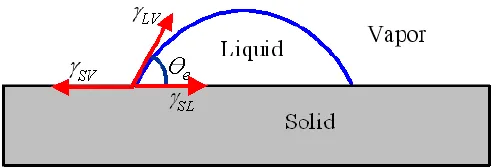
Young‟s equation gives the relation between the surface tension and contact angle as follows (Pal, Weiss, Keller and Müller-Plathe, 2005):
Figure 9. A drop on the flat surface showing the positions of surface tension at different interfaces
Source: Lee, H.J. and Michielsen, S. (2006). Lotus-effect: Superhydrophobicity. Journal of Textile Institute, 97, 455-462.
Figure 10. Apparent contact angle on a rough surface
Source: Lee, H.J. and Michielsen, S. (2006). Lotus-effect: Superhydrophobicity. Journal of Textile Institute, 97, 455-462.
According to Wenzel, the liquid fills the grooves on the rough surface and thus, the liquid contact angle at a rough surface can be stated as:
Here, r is the ratio of the total wet area of a rough surface to the apparent surface area in contact with the water droplet (r > 1). The liquid is comes in contact with the rough surface if the Young contact angle is smaller than a critical contact angle θc.
Figure 11. A liquid drop behavior on a rough surface according to (a) Wenzel Model and (b) Cassie-Baxter Model.
Source: Lee, H.J. and Michielsen, S. (2006). Lotus-effect: Superhydrophobicity. Journal of Textile Institute, 97, 455-462.
The Cassie-Baxter model also includes porous surfaces and is thus an extended form of Wenzel model. According to this model, the liquid does not fill in the grooves of the rough solid and thus it sits on a composite surface made of solid and air. Cassie-Baxter model suggest that (Cassie and Baxter, 1944):
Where f1 is the surface area of the liquid in contact with the solid divided by the
projected area, and f2is the surface area of the liquid in contact with air trapped in the pores