University of Windsor University of Windsor
Scholarship at UWindsor
Scholarship at UWindsor
Electronic Theses and Dissertations Theses, Dissertations, and Major Papers
9-21-2018
A Study of the Relationship Between Teachers’ Perceptions of
A Study of the Relationship Between Teachers’ Perceptions of
Principals’ Transformational Leadership Practices and Teacher
Principals’ Transformational Leadership Practices and Teacher
Morale in Elementary Schools in Southern Ontario
Morale in Elementary Schools in Southern Ontario
Chinyere Saka University of Windsor
Follow this and additional works at: https://scholar.uwindsor.ca/etd
Recommended Citation Recommended Citation
Saka, Chinyere, "A Study of the Relationship Between Teachers’ Perceptions of Principals’
Transformational Leadership Practices and Teacher Morale in Elementary Schools in Southern Ontario" (2018). Electronic Theses and Dissertations. 7567.
https://scholar.uwindsor.ca/etd/7567
A Study of the Relationship Between Teachers’ Perceptions of Principals’ Transformational
Leadership Practices and Teacher Morale in Elementary Schools in Southern Ontario
By
Chinyere O. Saka
A Thesis
Submitted to the Faculty of Graduate Studies
through the Faculty of Education
in Partial Fulfillment of the Requirements for
the Degree of Master of Education
at the University of Windsor
Windsor, Ontario, Canada
2018
A Study of the Relationship Between Teachers’ Perceptions of Principals’ Transformational
Leadership Practices and Teacher Morale in Elementary Schools in Southern Ontario
By
Chinyere O. Saka
APPROVED BY:
__________________________________________________
P. Boulos
Department of Philosophy
__________________________________________________
G. Rideout
Faculty of Education
__________________________________________________
D. Stanley, Advisor
Faculty of Education
DECLARATION OF ORIGINALITY
I hereby certify that I am the sole author of this thesis and that no part of this thesis has
been published or submitted for publication.
I certify that, to the best of my knowledge, my thesis does not infringe upon anyone's
copyright nor violate any proprietary rights and that any ideas, techniques, quotations, or any
other material from the work of other people included in my thesis, published or otherwise, are
fully acknowledged in accordance with the standard referencing practices. Furthermore, to the
extent that I have included copyrighted material that surpasses the bounds of fair dealing within
the meaning of the Canada Copyright Act, I certify that I have obtained a written permission
from the copyright owner(s) to include such material(s) in my thesis and have included copies of
such copyright clearances to my appendix.
I declare that this is a true copy of my thesis, including any final revisions, as approved
by my thesis committee and the Graduate Studies office and that this thesis has not been
ABSTRACT
This research seeks to find a relationship between teachers’ perceptions of principals’
transformational leadership practices and teacher morale in elementary schools. To this end, a
correlational research design was conducted in this study to identify the strength and nature of
the relationship between the two variables (teachers’ perceptions of principal’s transformational
leadership practices and teacher morale). Two surveys were administered to elementary school
teachers. The independent variable, teachers’ perceptions of principals’ transformational
leadership behavior, was measured using the Leadership Practices Inventory (LPI). The
dependent variable was teacher morale, and the Purdue Teacher Opinionaire (PTO) was used to
measure this variable. The population consisted of 1556 teachers from the 56 elementary
schools. The results indicated a strong positive correlation between teachers’ perceptions of
principal’s leadership practices and teacher morale. A multiple linear regression was also
conducted to determine what kinds of transformational leadership practices influenced teacher
morale most. The results showed that the practice “Model the way” correlated most strongly with
DEDICATION
ACKNOWLEDGMENTS
I would like to express my gratitude to my supervisor Dr. Darren Stanley, whose
enthusiasm, encouragement, and care helped me throughout this thesis. Dr. Stanley’s constant
feedback, coaching, and support throughout the thesis process have been invaluable, and the time
he took out of his tight schedule to meet with me throughout the process is greatly appreciated.
Thank you, Dr. Stanley!
I would like to thank Dr. Glenn Rideout for his insightful comments and encouragement
throughout my study. In addition, my thankfulness goes to Dr. Pierre Boulos for being part of my
committee.
I am very thankful to all the elementary school teachers in Greater-Essex District School
Board (GECDSB) who completed the survey. I am very thankful to Mr. Jeff Hillman (GECDSB
superintendent) and his assistant Beth Silverio for their supports, and a special thank you to the
members of the Academic Data Center and the librarians of the University of Windsor.
My sincere thanks also goes to my loving husband (Adewale), who supported me in
every ramification to get this done. My thanks go to my sons (Moshood and Sallam) for their
TABLE OF CONTENTS
DECLARATION OF ORIGINALITY ... III
ABSTRACT ... IV
DEDICATION ... V
ACKNOWLEGMENTS ... VI
CHAPTER 1: INTRODUCTION ... 1
Purpose of the Study ... 3
Hypotheses ... 3
Significance of the Study ... 4
Problem Statement ... 4
Definition of Terms and Important Concepts ... 5
CHAPTER 2: LITERATURE REVIEW ... 8
The Significance of School Leadership ... 9
Leadership Practices ... 9
Types of Leadership Style ... 11
Dimensions of Transformational Leadership ... 16
High and Low Teacher Morale ... 20
Factors Affecting Teacher Morale ... 22
Relationship between Leadership Behavior and Teacher Morale ... 26
CHAPTER 3: METHODOLOGY ... 38
Introduction ... 38
Research Design ... 38
Participants ... 39
Instruments ... 39
Leadership Practices Inventory ... 40
Reliability. ... 40
Validity ... 41
Purdue Teacher Opinionaire... 42
Reliability ... 44
Validity ... 44
CHAPTER 4: DATA ANALYSIS FINDINGS, AND IMPLICATIONS ... 46
Limitations ... 54
CHAPTER 5: DISCUSSIONS AND RECOMMENDATIONS……….. 55
Recommendations ... 58
REFERENCES ... 60
APPENDICES ... 73
Appendix A ... 73
Appendix B ... 77
Appendix C ... 80
Appendix D ... 82
CHAPTER 1: INTRODUCTION
According to the Ministry of Education (2009), its highest priority was student
achievement, and the Ministry intended to align all necessary resources to support this goal.
Also, in 2014, the Ministry committed to cultivating a strong teaching profession and leadership.
“The major concern of public education is student learning, which encompasses academic
development, skills, and learning of important values and dispositions” (Leithwood and Riehl,
2003, p. 2). Leithwood (2006) stated that bettering student learning is a responsibility shared by
administrators and teachers and emphasized that what teachers do to improve student learning is
crucial. He stated further that teachers’ effectiveness is dependent on their sense of
belongingness and morale, which, in turn, is shaped by the administrators with whom teachers
work. Also, Sabin (2015) did a correlational study of teacher morale and student achievement;
this researcher found a direct positive correlation between teacher morale and student
achievement growth. In addition, White and Stevens (1988) in their study of teacher morale and
student achievement noted, “Teacher morale as well as functional behaviors of principal were
strongest predictors of students’ achievements in reading” (p. 12). Black (2001) reported,
“Sinking teacher morale generally accompanies sinking student achievement” (p. 5). Thus, there
is a need to develop an understanding of the leadership practices that enable teachers to perform
at their best. Insights about how to best support teachers in developing their abilities are
essential. School principals play a vital role in nurturing and maintaining positive teacher morale
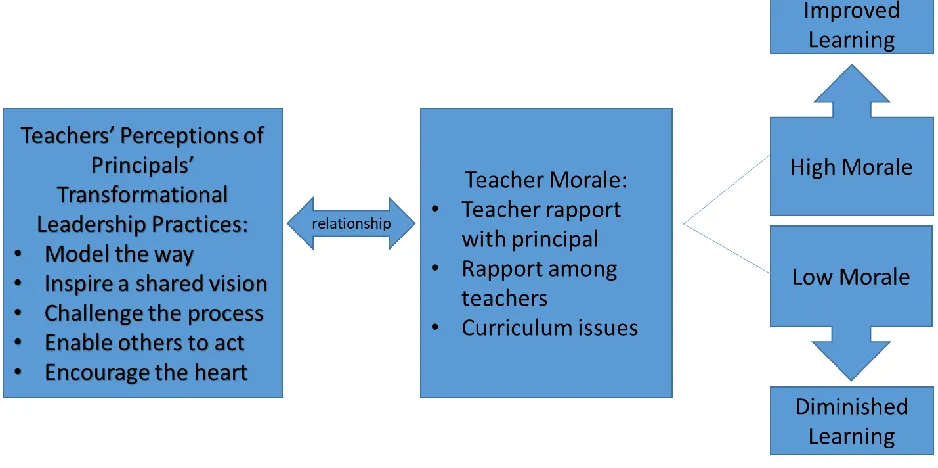
Figure 1. Conceptual Framework
Figure 1 shows the conceptual framework based on leadership practices and teacher morale. The
conceptual framework suggests how leadership behavior (independent variable), rooted in
transformational leadership behavior, may influence teacher morale (dependent variable), which
may be either high or low, affecting students’ learning. As shown in the diagram above,
leadership practices include five exemplary practices (Model the Way, Inspire a Shared Vision,
Challenge the Process, Enable Others to Act, and Encourage the Heart). Teacher morale includes
teacher rapport with principal, rapport among teachers, and curriculum issues. The relationship
between these two concepts (leadership practices and teacher morale) may prompt either high
teacher morale or low teacher morale. High teacher morale may lead to improved student
learning, and low teacher morale may lead to poor student learning. As will be discussed in the
literature review, leadership behavior may have a profound impact on teacher morale and,
For this study, Figure 1 represents the possible impacts of leadership practices on teacher
morale in elementary schools. Leadership Practices Inventory (LPI, 2003) by Kouzes and Posner
(2003) will be used to measure the presence of five practices of exemplary leadership behaviors,
including:
1. Model the Way
2. Inspire a Shared Vision
3. Challenge the Process
4. Enable Others to Act
5. Encourage the Heart
Lastly, teacher morale will be measured using the Purdue Teacher Opinionaire (PTO,
1980) for examining the morale of teachers in elementary schools.
Purpose of the Study
The purpose of this study is to examine the relationship between teachers’ perceptions of
principal transformational leadership practices and teacher morale in elementary schools.
Hypotheses
H0 : Teachers’ perceptions of principal transformational leadership practices are not correlated
with teacher morale.
H1 : Teachers’ perceptions of principal transformational leadership practices are correlated with
Significance of the Study
This study examines the relationship between teachers’ perceptions of principals’
transformational leadership behaviors and the morale of teachers in elementary schools. The
findings in this study might be significant for these reasons: The findings will serve as a guide to
educators in improving leadership skills in educational institutions. Secondly, the findings in this
study may help school leaders to improve the well-being of teachers, thereby improving student
achievements. Thirdly, if findings indicate a relationship between teachers’ perceptions of
principals’ transformational leadership practices and teacher morale, administrators may be able
to address those skills that will help to nurture and maintain teacher morale. Lastly, colleges and
universities that facilitate the learning of educational leadership and management can place
further emphasis on morale during instructions and internships.
Problem Statement
This quantitative study examines the relationship between teachers’ perceptions of
principals’ transformational leadership behaviors and teacher morale in elementary schools.
Morale of the teacher is considered an important internal state that affects what teachers do in the
classroom (Leithwood & McAdie, 2007). Moreover, there is general agreement that morale is an
integral part of any successful venture or endeavor (Bentley & Rempley, 1980). As such, it is
imperative to advance knowledge on nurturing and maintaining teacher morale. Administrators
and all stakeholders should be well equipped with the skills to nurture and maintain teacher
morale. Bearing this in mind, why should we worry about teacher morale? The Canadian
stress. Thus, there is evidence of an increase in teachers’ stress. As such, there is the need to
nurture teachers’ morale.
Definition of Terms and Important Concepts
To help the reader understand certain key terms, I have included the following list:
Leadership Practices Inventory (LPI): The LPI (Kouzes & Posner, 2000) consists of 30 questions answered on a 10-point Likert scale and suggests five categories of practices of
exemplary leaders. The observer form will be used in this study to enable teachers to report on
their principal’s daily practices.
Model the Way: Principals model the way if they apply their personal experiences to direct teachers’ actions appropriately and lead by example.
Inspire a Shared Vision: Principals are expected to share their enthusiasm about the vision of the school with the teachers and engage them to reach set objectives.
Challenge the Process: Principals should face challenges and not shy away from them.
According to Kouzes and Posner (2003), leaders should be proud of small achievements and aim
high.
Enable Others to Act: This practice implies that leaders should recognize the strength in teamwork; principals should encourage collaboration.
Encourage the Heart: In this practice, Kouzes and Posner (2003) conclude that principals should acknowledge every accomplishment of their teachers.
Purdue Teacher Opinionaire (PTO): Designed by Bentley and Rempel (1972), this survey instrument contains 100 questions ranked on a 4-point Likert scale to measure the morale of
Morale: Bentley and Rempel (1980) define morale as the level of commitment an individual display toward achieving personal and organizational goals.
School climate: According to Hoy and Miskel (2012), school climate is a relatively enduring quality of the school environment that is experienced by participants, affects their behavior, and
is based on their collective perceptions of behavior in schools. A school climate can be open or
close. When a school climate is open, principals and faculty act authentically, but when the
school climate is close, everyone simply does what they have to do without dedication and
commitment.
Leadership styles: According to Olagboye (2004), leadership styles are the various patterns of behaviors the principal exhibits in the process of directing the efforts of the faculty and staff
towards the achievement of organizational goals.
Transformational leadership: “Transformational leadership is an expansion of transactional
leadership that goes beyond simple exchanges and agreements. Transformational leaders are
proactive, raise the awareness levels of followers about inspirational collective interests, and help
followers achieve unusually high-performance outcomes” (Hoy & Miskel, 2012).
National Blue Ribbon Schools: A school is recognized as a National Blue Ribbon School if it achieves a very high learning standard or is making a remarkable improvement in closing the
achievement gap among student subgroups (U. S. Department of Education, 2017).
This chapter includes an introduction to the study, conceptual framework, the purpose of
the study, hypotheses, significance of the study, statement of the problem and definition of terms
for a clearer understanding of the study. The following chapter is the review of related literature,
1. Leadership practices
2. Types of leadership styles
3. Teacher morale
4. Factors that affect teacher morale
CHAPTER 2: LITERATURE REVIEW
“Scratch the surface of an excellent school and you are likely to find an excellent
principal. Peer into a failing school, and you will find weak leadership” (Leithwood and Riehl,
2003, p. 1). Leadership is a central theme in the conversation about improving K–12 education.
Researchers have oftentimes reported that school leadership, principal leadership in particular, is
primary in developing and sustaining those school level frames of reference believed important
for improving students learning (Hallinger & Heck, 1996; Rosenholtz, 1991). Furthermore,
qualities of leadership have intrigued scholars, prompting extensive studies about the importance
of leadership, defining its characteristics and types as well as methods that can help develop
leadership skills (Short & Greer, 1997). Additionally, Leithwood and Riehl (2003) argue that
leadership involves two roles: providing direction and exercising influence.
This chapter will review literature on topics that concern leadership behavior and teacher
morale. To this end, this review will address the following five themes:
Leadership behavior
Types of leadership styles
Teacher morale
Factors that affect teacher morale
The Significance of School Leadership
Bush (2014) stated that it is widely agreed that leadership is second only to classroom
teaching in its influence on student achievement. Leithwood, Harris, and Hopkins (2008) found
that school leaders improve teaching and learning indirectly and effectively through their
influence on staff encouragement, resolutions, and making the working environment conducive.
Davis, Darling-Hammond, LaPointe, and Meyerson (2005) in their study revealed that principals
play a vital and all-round role in setting the guidance for schools that are positive and rewarding
workplaces for teachers and fruitful learning environment for children. Eberts and Stone (1998)
noted principals also make a difference by setting clear values and goals that give priorities to
basic skill acquisition, taking responsibility for the appraisal of the attainment of desired values
and goals, arranging and taking part in staff development and in-service training programs, being
a consistent, decisive disciplinarian, and working with teachers to achieve an agreed upon values
and goals.
Leadership Practices
Effective principals must display effective leadership skills. Deal and Peterson (1999),
for instance, contend that a principal without good leadership skills will be unsuccessful. Kelly,
Thornton, and Daugherty (2005) suggest that morale will suffer if teachers see inconsistent
leadership practices from their principals because teachers and staff members yearn for a
working environment that is challenging as well as supportive. In fact, Rammer (2007) argues
that there are specific skills, traits, behaviors, and responsibilities that effective principals must
possess, such as delegating tasks, honesty, commitment, creativity, and good communication.
The issue with prescribing effective leadership skills for principals is that the word
being precisely defined (Yukl, 1998). Accordingly, definitions of the concept are almost as
numerous as the scholars who have engaged in its study, making it difficult for any principal to
fulfill everybody’s expectation of an effective leader. However, some generally accepted
characteristics can be used as the foundation for defining an effective leader. Hoy and Miskel
(2012), for instance, define leadership as a social process in which an individual or a group
influences behavior toward a shared goal, and Northouse (2010) also argues that leadership is a
method of influence, occurring in groups and including common goals. Thus, an effective leader
is one who can influence individuals or a group to achieve a common goal.
Avolio and Bass (2004), building on Burns’ (1978) work, identify three major types of
leadership styles: laissez-faire, transactional, and transformational. The challenge facing modern
organizations to meet with higher levels of performance, improved job-satisfaction, and
increased morale in associates has led to the need for exceptional quality of leadership (Eboka,
2016). The most prominent among these three types of leadership is the transformational
leadership style (Avolio & Bass, 2004; Burns, 1978). The transformational leadership style is the
focus of the current study because it is most relevant to educational sector (Bass, 1998; Bass &
Avolio, 1994; Burns, 1978; Leithwood, 1994). In addition, Nguni, Sleegers, and Denessen
(2006) studied the effects of transactional leadership and transformational leadership on teacher
morale. They found transformational leadership behavior to have a positive correlation to teacher
morale, whereas transactional did not.
Bass (1985) identifies four components of transformational leadership behavior: idealized
influence, inspirational motivation, intellectual stimulation, and individualized consideration.
These four components will be explained further under the transformational leadership style.
are to confront the challenges of the 21st century. Further, tshe 21st-century leadership role requires the principal to be patient, creative, and well-informed (Leithwood, 1994). For example,
individualized consideration means that the school principal must mind the needs of the
individual staff members, particularly those who seem left out. Intellectual stimulation requires
principals to help staff members solve problems using new methods. Inspirational motivation is
defined as using a skillful and high-spirited presence to effectively communicate high
expectations for teachers and students. Lastly, idealized influence is characterized by using
personal accomplishments and demonstrating character to provide a model for the behaviors of
teachers (Marzano, Waters, & McNulty, 2005). With this in mind, this review will now look at
the description of each type of leadership style and then focus on the transformational leadership
style, for the purpose of this study.
Types of Leadership Style
According to Olagboye (2004), leadership styles are the various patterns of behaviors
principals exhibit in the process of directing the efforts of the faculty and staff towards the
achievement of organizational goals. As stated earlier, this review will describe three leadership
styles (laissez-faire leadership style, transactional leadership style, and transformational
leadership style).
Laissez-faire Leadership. Bass (1998) describes this type of leadership as being void of
any transactions with followers. For example, laissez-faire leaders dodge responsibilities, fail to
make or even delay decisions, provide no feedback, and allow authority to remain inactive (Hoy
& Miskel, 2012). Hoy and Miskel (2012) describe this type of principal as one who sits in the
learning and teachers’ needs. One might wonder, is this type of leadership productive? Is it
passive or not effective?
Transactional Leadership. For Burns (1985), transactional leaders “approach followers
with an eye to exchanging one thing for another” (p. 11). Transactional leaders seek to propel
followers through an exchange process for services rendered (Hoy & Miskel, 2012).
Transactional leadership, according to Antonakis, Avolio, and Sivasubramaniam (2003), consists
of three components: (1) the contingent reward leadership, (2) active management by exception,
and (3) passive management by exception. Contingent reward leadership is when a leader
provides a tangible and intangible reward in exchange for subordinates’ efforts and performance.
In other words, this type of leadership behavior gives the subordinates things they want in
exchange for things leaders want (Kuhnert & Lewis, 1987). Active management by exception
refers to leaders’ use of correction or punishment as a response to unacceptable performance or
deviation from acceptable standards (Eboka, 2016). Sosik and Dionne (1997) suggest that leaders
who set standards and carefully monitor behavior exhibit the active management by exception
leadership style. Passive management by exception, according to Hoy and Miskel (2012), occurs
when a leader takes a passive approach to leadership by intervening only when a problem
becomes serious. Sosik and Dionne note that followers of this leadership style believe that their
job is to maintain the status quo. Bass and Riggio (2006) affirm that transactional leadership is
often the most effective in the majority of situations. Hoy and Miskel support this when they
confirm that effective leaders perform better when contingent reward behavior is a basis for their
leadership. However, Hoy and Miskel (2012) also note that when transactional leadership
behaviors are supported with a transformational leadership behavior, the result is high
Transformational Leadership. In 1978, Burns wrote about transformational leadership
and defines it as ways in which one elevates, mobilizes, inspires, and uplifts followers. Bass
(1985) argued that transformational leadership involves “proactive foresight, planning ahead, and
taking steps when necessary in anticipation of perceived opportunities and threats” (p. 215).
Transformational leadership is the leader’s ability to engage with followers in ways that raise
them to a higher level of motivation, performance, or morality (Harrison, 2011).
Transformational leaders focus on setting and achieving long-term goals while
increasing the intrinsic motivation of the individuals within the organization (Bass & Riggio,
2006). Howell and Avolio (1993) note that transformational leaders have a vision for the
organization and project that vision to members of an organization. Kouzes and Posner (2007)
list five items in their Leadership Practices Inventory, which exemplify effective leadership:
model the way, inspire a shared vision, challenge the process, enable others to act, and encourage
the heart. These behaviors reflect the characteristics of a transformational and transactional
leader, which is why the Leadership Practices Inventory is relevant to this study. Consequently,
this review will now examine these behaviors in detail.
“Modelling the Way” requires leaders to exemplify and practice the principles and model
the traits they expect their employees to uphold. Leaders must be models of the behavior they
expect of others by clarifying their beliefs, values, standards, ethics, and ideals. They must not
only be clear about their own personal values but also ensure a connection to a set of shared
values among the followers. Leaders who “Model the Way” should also reward and recognize
key values displayed by followers to emphasize the values leaders want to see (Kouzes &
Kouzes and Posner (2007) argue that leaders “Inspire a Shared Vision” by exhibiting the
desire to make things happen in the organization. Exemplary leaders are forward-looking and
believe firmly in their vision. Such leaders offer their vision and share a strategic plan with their
staff to meet this shared vision. These leaders are interested in doing something significant and
enlist their followers by also sharing the aspirations of the followers.
Leaders who “Challenge the Process” see themselves as innovators who are always ready
to step out into the unknown to search for opportunities to improve, develop, and create new
ideas that can move an organization and its members forward (Kouzes & Posner, 2007). These
leaders upset the status quo to dive into new possibilities. They are proactive and resilient. They
do not give in to objections or adversities. Exemplary leaders take risks with bold ideas because
nothing can be achieved by doing things the same way. They learn from mistakes and believe
that learning happens when people can discuss their successes and failures, share what went
wrong, and move up.
The same study established that leaders who “Enable Others to Act” build trust and
facilitate collaboration in an organization (Kouzes & Posner, 2007). They are passionate about
teamwork and see cooperation as the interpersonal route to success. Exemplary leaders consider
ideas from other people’s expertise and abilities. They are open to influence, which helps to
build trust and enables the staff to be more open to the leader's influence as well: trust begets
trust. When leaders enable others to act, followers feel powerful and confident enough to face
challenges. Leaders should also invest in staff training and development because it fosters
employee commitment.
Exemplary leaders are also able to “Encourage the Heart” according to Kouzes and
replenish staff strength (Kouzes & Posner, 2007). In addition, teamwork, trust, and
empowerment are unique features of leaders who “encourage the heart.” Leaders should make
sure to celebrate extraordinary accomplishments of individuals and teams in public. Doing this
helps to renew staff commitment and create a spirit of community.
More on transformational leadership, Hackman and Johnson (2003) reported that
transformational leaders are creative, interactive, empowering, and passionate. Transformational
leadership occurs when leaders are able to raise awareness and interests of employees to accept
the mission of the group, and the teachers are motivated to look beyond their own self-interest
for the good of the group (Avolio & Bass, 2004; Bass, 1990). Transformational leaders are
collaborative, goal-oriented, innovative, and committed to building leadership capacity (Bass,
1985). A transformational leader is able to help followers establish and understand goals and
provide focus on shared decision-making, collaboration, and collegiality (Pepper, 2010).
Leithwood and Beatty (2008) state that leadership success depends on using a clear set of
practices that allow teachers to become accomplished. Such practices include the principal
routinely visiting classrooms, monitoring student work, meeting with students, discussing
academics problems and progress, publicly and privately acknowledging student academic
success (Waters, Marzano, & McNulty, 2004). According to Spillane (2009), transformational
leaders must develop interactive relationships with faculty and staff to be an effective leader. He
further states that building positive relationships with followers assists in advancing leaders’
effectiveness. Transformational leaders should also enhance relationships with followers by
being transparent and avoiding favoritism. Rosenberg (2013) reports that there is a correlation
between principals who embrace transformational leadership and high teacher morale. With this
Dimensions of Transformational Leadership
Leithwood (1994) frames his transformational model of school leadership using the work
of Burns (1978), Bass (1985), and Bass and Avolio (1994). The model includes three leadership
dimensions:
Setting directions. Setting directions includes building a shared vision, developing consensus
about goals and priorities, and setting high expectations for teachers and students (Leithwood,
1994). Leithwood, Louis, Anderson, and Wahlstrom (2004) explain that people are motivated by
goals that they find personally compelling as well as challenging but achievable. They add that
such goals will enable individuals in the work place to have a sense of belonging (morale).
Developing people. Developing people includes providing support, intellectual stimulation, and
modeling important values and practices considered fundamental to the organization (Leithwood,
1994). Leithwood et al. (2004) report that the experience the individual staff have with the leader
influences their motivation, adding that the impact of this set of practices in an organization is
substantial.
Redesigning the organization. Redesigning the organization includes building a collaborative
process, creating and maintaining shared decision-making culture, modifying organizational
structures, and managing the environment (Leithwood, 1994). Leithwood et al. (2004) claim that
the contribution of schools to student learning rests on the motivation and capacities of teachers
and administrators, acting individually and collectively. Leithwood and Riehl (2003) note that
“while mastery of these leadership dimensions provides no guarantee that a leaders’s work will
Hoy and Miskel (2012) explained that transformational leadership is an extension of
transactional leadership because the transformational leadership goes beyond simple exchanges
and agreement. In a transformational leadership style, the leader is proactive, enlightens
followers about inspirational collective goals and objectives, and helps followers to reach
exceptional performance outcomes. To help the readers understand more about the
transformational leadership, this literature review will outline four categories of transformational
leadership behavior, drawing upon the work of Bass and Avolio (1994). These categories are the
same as Marzano et al.’s (2005) Four I’s. They described the categories as Idealized Influence,
Intellectual Stimulation, Individualized Consideration, and Inspirational Motivation. Bass and
Avolio also conceptualize transformational leadership behavior into four categories: idealized
influence, inspirational motivation, intellectual stimulation, and idealized consideration.
Idealized influence. The leader’s ability to establish and communicate a clear vision to
followers is key to being able to motivate followers to join the leader in realizing the vision that
has been established for the organization (Bass and Avolio, 1994). The idealized influence is also
referred to as “being charismatic” (Bass, 1985). Charismatic leaders excite and energize
followers because they are inspirational and driven with a can-do attitude (Bass, 1985).
Followers want to identify with charismatic leaders and place a high degree of trust and
confidence in their leaders (Bass, 1990). Transformational leaders frequently raise the bar and do
not accept the status quo, and they confidently take calculated risks and are able to get others to
join them on their vision of the future (Bass, 1985). Transformational leaders seek to challenge
and change the culture instead of working within the established culture. Their attitude
encapsulates the “If it ain’t broke, how can we make it better” attitude, and because they are
(Bass, 2008). Thus, charisma is essential to being successful as a transformational leader because
there is great power and influence that comes with being charismatic. According to Marzano et
al. (2005), an effective principal must provide a model for the behaviors of teachers by sharing
personal experiences. Hoy and Miskel (2012) state that idealized influence builds trust and
respect in followers and provides reasons for accepting changes in the ways individuals and
organization do their work.
Intellectual stimulation. “Leaders stimulate extra effort among their followers by means
of their intellectual stimulation” (Bass, 1985, p. 98). Empowering followers to seek new ways to
solve complicated problems is the foundation of intellectual stimulation (Bass, 1999).
Transformational leaders encourage continuous improvement by asking the right questions and
seeking solutions (Bass, 1985). They are able to show followers new ways of looking at old
problems; they see problems as challenges that can be solved with rational solutions (Bass,
1999). Marzano et al. (2005) argue that an effective school principal must help the staff to
initiate ideas for solving problems by deploying contemporary ideas. Avolio (1994) describes
intellectual stimulation as the ability of leaders to encourage followers to be more open and
willing to accept change. Nothing is too good, too fixed, too political, or too bureaucratic that it
cannot be contested, changed, or removed.
Individualized consideration. “Individuation means one-to-one contact and two-way
communication” (Bass, 1985, p. 97). Transformational leaders put an emphasis on relationships
and are skilled in meeting the individual needs of their employees. Transformational leaders pay
close attention to the needs of their employees and approach each individual differently.
Transformational leaders serve as mentors and seek to help others grow and develop, and
bringing out the best in employees (Bass, 1990; Dussault, Payette, and Leroux 2008). Marzano et
al. (2005) suggest that school leaders must listen to and consider the needs of individual staff
members, particularly those who feel neglected. Atwater and Bass (1994) also expound that
individualized consideration allows leaders to determine the strengths and weaknesses of others,
the knowledge of which will provide leaders with the tools required to help their followers reach
their potential.
Inspirational motivation. Being able to communicate the vision so that others are
inspired is also a critical component of transformational leadership. Bass (1985) suggested that
leaders who provide examples and patterns for the followers enhance their (followers)
confidence. Providing meaning and purpose for followers helps the organization remain focused
on achieving its vision despite any obstacles that may arise (Harrison, 2011). Transformational
leaders are able to change the organization to strengthen the school culture by appealing to high
ideals: this results in changing attitudes and challenging assumptions (Pepper, 2010). The ability
to positively impact the whole organization leads to increased teacher commitment, which is
critical in this rapidly changing, global world. The effective school principal, according to
Marzano et al. (2005), must communicate high expectations for teachers and students
(inspirational motivation). Atwater and Bass (1994) noted that inspirational motivation can
influence followers thinking and encourages followers to believe that the organization’s
challenges can be solved. Hence, team spirit, enthusiasm, optimism, goal commitment, and a
shared vision all blend well within the organization to yield maximum result Bass and Avolio
(1994).
Avolio (1994) states that without trust and commitment to the leaders, attempts to change
I’s are fundamental components for school principals if they are to be ready for challenges of 21st century leadership roles. In addition, transformational leadership style is appropriate for school
settings because transformational leadership emphasis on preparing employees to learn new
things, establishing new meaning and ways of thinking and transformational leadership style is
an effective tool in helping leaders break established norms and establish new norms that
transform school (Simsek, 2013).
Furthermore, transformational leadership style has been found to influence teacher
willingness (morale) to work towards improving teaching techniques and classroom management
(Espinoza, 2013). Transformational leadership style is particularly important in an educational
setting because of the way it helps teachers improve teaching techniques and classroom
management. In this section, the review described the three different leadership styles,
accentuating transformational leadership style. Next, the study will explain what makes a
teachers’ morale high or low and the consequences of each.
High and Low Teacher Morale
Morale has been defined in several ways. Kouzes and Posner (1980) define morale as
“the professional interest and enthusiasm that a person displays toward the achievement of
individual and group goals in a given job situation” (p. 2). In addition, they argue that high
morale “is evident when there is interest in and enthusiasm for the job” (p. 1). Leithwood (2006)
describes morale as a state of persevering hardship. Further, he defines good morale as a state of
hope or an optimistic view towards colleagues that is accompanied by enthusiasm. Similarly,
Washington and Watson (1976) conclude that for principals to be able to effectively develop,
They add that such principals must display courage, self-discipline, enthusiasm, be generous, and
believe in what they can do.
Furthermore, Hoy and Miskel (2012) state that morale refers to a sense of trust,
confidence, enthusiasm, and good rapport among teachers. They assert that when morale is high,
teachers perceive each other positively and feel fulfilled about their jobs. Bentley and Rempel
(1980) define teacher morale as the degree to which the needs of a person are satisfied and the
person’s perception of how their job situation brought them to a state of satisfaction. Similarly,
Bhella (1982) describe morale as the extent to which an employee’s needs are being met and the
extent of their overall work satisfaction. Koerner (1990) state that to develop high staff morale,
employees contributions must be acknowledged and appreciated, their professional knowledge
must be valued, and they must be given the freedom to make professional choices.
Hence, high morale can be achieved only when the process of achieving organizational
goals meets employee’s individual needs (Rowland, 2008). Whittaker, Whittaker, and Lumpa
(2000) assert that there is a connection between teacher morale, student learning, and teacher
retention. Eboka (2016) notes that teacher morale is critical to the success of any educational
setting. Mgbodile (2004) describes teachers as the greatest asset of a school, the catalyst that
spurs action in a school for the purpose of teaching and learning.Similarly, Betts (2001) reports
that there is a positive correlation between teacher morale and student achievement. Betts
suggests that administrators must continuously find ways to enhance the correlation.
In contrast, when teacher morale is low, students suffer (Norwood, 2016). Leithwood
(2006) suggests that poor morale is connected with cynicism, hopelessness, and lack of
enthusiasm. Low levels of satisfaction and morale can lead to decreased productivity and burnout
achievement. According to Lunenburg and Ornstein (2004), low teacher morale negatively
affects teachers’ productivity, and teachers with low morale become detached from their
students. The implication of these reports means that poor teacher morale will result in poor
student achievement. The Canadian Business and Current Affairs Database (Anonymous, 2005)
reports that accountability that works comes from encouraging teachers to develop professionally
and allowing them to use their professional judgement in teaching their students.
Leithwood (2006) believes that less effective teaching performance, teacher absenteeism,
and resistance to change are some teacher behaviors that are associated with poor morale.
According to Farber (1983), teachers who become burned out may be less sympathetic towards
students, have a lower tolerance for frustration in the classroom, be in class unprepared, plan to
leave the profession, feel emotionally or physically exhausted, feel anxious, irritable, depressed,
and, in general, feel less committed and dedicated to their work.
Tschannen-Moran and Tschannen-Moran (2014) report that when morale is low among
teachers, it is evident that one or more of the human universal needs are not being met. Evans
(1997) recounts the importance of morale and job satisfaction among teachers in the United
Kingdom. She conducted a case study over the course of four years to determine factors that
influenced teacher morale and teacher job satisfaction. The research results suggest that school
leadership and teachers’ perceptions of the equity of workload among colleagues were the
biggest influencers on morale and job satisfaction.
Factors Affecting Teacher Morale
Leithwood (2006) outlines several factors that can diminish teachers’ morale:
Teachers feeling that their workload is not fair compared to other teachers in their
Excessive class load
Excessive paper work
Burden of non-teaching demands like lunchroom supervision
Bus duty and hall monitoring
Split or multi-grade classes
Insufficient preparation time
Disruptive students
Inadequate levels of learning resources
Leithwood (2006) further confirms that elementary school teachers suffer stress and
burnout, which is caused by excessive parental expectations, extracurricular and supervisory
duties, and the variety of abilities and needs among elementary school students as well as
excessive course loads and continuous changes in curriculum, which are unique to elementary
school teachers. He also identifies some leadership behaviors that add to elementary school
teachers’ stress; poor leadership support, irregularities in leadership practices, unclear goals,
unrealistic vision, lack of follow-through, and a failure to provide essential educational
resources.
Likewise, Washington and Watson (1976) list some negative attitudes and practices that
principals may demonstrate and that can reduce teachers’ motivation:
Exhibiting a mistrust of teachers
Criticizing a teacher in the open
Allowing meetings to encroach on teachers personal time
Showing undue concern for trivial matters
Staying in the office with the door closed
Placing the entire blame for classroom failure on teachers
Evaluating teachers on one or two classroom visits only
Not allowing teachers to have input in decision-making process that will affect
them directly
They also outline behaviors that can improve teachers’ morale:
Clearly stating the teachers’ goals and professional expectations
Encouraging collaboration among teachers
Valuing and supporting both teachers and students’ safety
Setting high expectations for students
Providing a noticeable academic press for teachers
Washington and Watson (1976) also list some actions that principals can engage in to
improve teacher morale: taking responsibility for administrative actions, encouraging teachers’
professional growth, praising and giving acknowledgement when necessary, consistently
supporting teachers during conflict, paying attention to teachers’ physical comfort and other
related matters, and giving instructional supports to his teachers. In addition, Hughes (2013)
found that when morale is high and the faculty culture is accommodating, students achieve more
socially and academically, teachers are enthusiastic, and the school environment is healthy. It is
evident that teacher morale is a fundamental aspect in the education setting.
According to Miller (1981), teachers who have high morale tend to participate more
willingly in extracurricular activities, including staff development, parent-teacher association,
and parent-teacher conferences. Because morale is defined as the feelings workers have about
organization meets their needs and expectation, how teachers perceive themselves in the teaching
profession is a reflection of whether their needs are being met as desired. He added that teachers
may not feel happy about their job if their contributions are not recognized, they (teachers) have
poor administrative support, or limited resources impact their effectiveness in classroom
teaching. When issues like these occur, teacher morale diminishes because their perception is
that they are being neglected.
Likewise, in his study on teacher self-efficacy and student motivation, Ford (2012) found
that administrators and supervisors who persistently make efforts to increase staff morale achieve
the benefit from increased student achievement, increased teacher efficacy, increased collective
efficacy, and an overall positive working environment. Thornton and Daugherty (2005) explain
that if teachers’ perceive their principals’ leadership style as inconsistent, teacher morale will
also suffer.
Zaccaro (2007) contends that positive parent and teacher relationships support higher
teacher morale. In the same manner, the Education Commission of the States (2005) concludes
that teacher autonomy and administrative support, class size, and students issues, such as
attitudes, competence, discipline, and student economic status, are factors that lead to low
teacher morale. Likewise, Lankford, Loeb, and Wyckoff (2002) found that some teachers seek
districts where class sizes are smaller and where teaching is based on fostering, developing, and
inspiring students. George (2003) states that factors such as loss of interest in teaching, decreased
motivation, lack of collaboration with other teachers, depression, illnesses, and overwhelming
burnout are observed at lower level of morale.
Evans (1997) asserts that factors such as career status, low salary, and lack of
low teacher morale is attributed to extrinsic motivators, such as accountability, social issues in
the school community, teacher retention, a lack of quality leadership, and excessive non-teaching
tasks. Moreover, Brodinsky’s (1994) study reveals six factors that contribute to low teacher
morale: teacher attrition, low salaries, poor leadership, negligence from school community,
dilapidated structures. Hollinger (2010), likewise, cites major factors that affect morale in the
school setting: school leadership, workload, compensation, student behavior, and professional
development. Additionally, Leithwood (2006) contends that positive teacher morale is connected
to teachers’ perceptions of their workloads and opportunities for professional development.
Johnson and Birkeland (2003) also notes that teachers’ low morale occurs when teachers are
required to provide instruction outside their area of expertise when they earn low salaries, and
when they are not respected by others, all of which leads to high teacher turnover. They,
therefore, suggests that to promote high teacher morale, school leaders must provide fair
compensation and career opportunities, foster a positive school/working environment, establish a
chain of accountability, and avoid placing excessive workloads onto teachers.
Relationship between Leadership Behavior and Teacher Morale
Kelly (2005) studies the relationship between teachers’ perceptions of their principals’
leadership and the climate of the school. He concludes that teachers’ perceptions of their
principals’ effectiveness are positively related to the teachers’ perception of the overall school
climate. Teachers who perceive their principal to be fair and consistent in regards to how the
principal treated teachers rated the school climate to be higher than teachers who perceived their
principal to be inconsistent in the treatment of teachers (Kelly, 2005). Although school climate is
not the same as morale, school climate is an essential piece of research as Miller (1981) points
Ladd (2009) argues that teachers’ job satisfaction, and by extension teacher morale, is
impacted not only by working conditions in general but by leadership practices. He found that
working conditions and leadership practices also affect teacher retention rates (Brodinsky, 1994;
Dinham, 1994; Johnson & Birkeland, 2003). In addition, Evans and Johnson (1990) surveyed
middle and high school teachers. Although they received conflicting responses and could not
correlate principal behavior and teacher job satisfaction, they were able to conclude that principal
leadership did affect the stress level of teachers, which can negatively affect teacher morale
(Evans & Johnson, 1990).
Leithwood (2006) found that the manner in which teachers operate depends on their own
intrinsic motivation and the conditions of their work environment. He also states that teachers’
working conditions are students’ learning conditions and that working conditions—such as
crowded and inadequate facilities, a lack of resources, too much paperwork, and excessive
marking—can consequently inhibit teachers’ effectiveness. In addition, he suggests that, with
effective leadership, principals can increase beginning teachers’ morale by encouraging and
supporting them. Principals who are effective leaders should provide instructional guidance and
resources, clearly communicate expectations, acknowledge good work, and implement rules of
conduct for students (Leithwood, 2006).
School leadership is one factor that influences the condition of the school environment.
Washington and Watson (1976) state that teacher morale is not considered to be important in
administrative priorities. They argue that the principal plays a critical role in maintaining and
managing positive teacher morale. According to Washington and Watson (1976), in their article
“Positive teacher morale-The principal’s responsibility,” note that managing and keeping
attitude of a teacher with positive morale, thus: they are always eager to be in the school, they
show concern for school programs, they are active in school functions, they are willing to do
extra work, they are happy being a teacher, and they cooperate with the school in
school-community relationship.
Johnson and Birkeland (2003) conducted a descriptive study of 50 new public school
teachers in Massachusetts. These teachers were first interviewed in 1999 and subsequently in
2000 and again in 2001. These teachers were from diverse school settings, grade levels they
teach, their ages, and their educational backgrounds. Most importantly, the first reason given by
teachers who quit teaching or who moved was a feeling of ineffectiveness, which they attributed
to poor administration support, excessive teaching loads, and a lack of essential resources. The
teachers who continued to teach felt effective in their positions, although they stated that factors
such as low pay, lack of respect for the profession, and lack of teamwork among teachers would
hurt teacher morale. Levin (2008) suggests that high teacher morale correlates with high
students’ achievement.
Contrary to Johnson and Birkeland (2003), Raferty (2002) did not find a relationship
between teacher morale level and teacher turnover rates in her study that investigated the effects
of teacher morale on teachers. Furthermore, she claims that there is no significant relationship
between teachers’ morale level and their level of satisfaction with their principal. Even though
she recognizes that a number of factors influence teacher turnover, such as increased duties, time
constraint, low pay, and disruptive students, these factors significantly impact a teachers’ attitude
towards their job.
Eboka (2016) examines the influence of principals’ leadership on teacher morale. This
(active) leadership dimension of the transactional leadership style. This type of leadership style
shows that the principals acknowledge teachers’ effort and performance. Furthermore,
transactional principals conducted follow-ups with their teachers and, when necessary, made use
of punishment and correction to ensure appropriate standards are attained and maintained.
However, teachers perceive the transformational principals as being charismatic leaders with an
inspiring vision. The second finding in Eboka’s study suggested that the influence of
transactional leadership on teacher morale results in a moderate level of teacher morale, whereas
the influence of the transformational leadership on teachers’ morale results in a moderately high
level of teacher morale. Eboka concluded that teachers in a school with a transformational
principal experience a higher level of morale than teachers in a school with a transactional
principal.
Avolio and Bass (1997) support the finding that transformational leadership behavior
helps the leader to gain loyalty from subordinates compared to the transactional leadership.
Avolio and Bass’ finding is similar to Agar (2008) who proclaimed that the power of
transformational leadership is the ability of the leader to sustain the awareness of the teachers to
understand the organizational goals and to value those goals more than personal interests.
A 1997 report on job satisfaction by the National Center for Education Statistics revealed
many factors that contributed to higher teacher job satisfaction. Among them were the
involvement of a supportive administrative staff, leadership, better student behavior, more
teacher autonomy, and a safer, supportive school that promotes a positive atmosphere. It is
imperative that principals are aware that they affect teachers’ morale with the type of leadership
Koerner (1990) recognizes essential factors of leadership that influence teachers’ morale;
these factors are:
The principal should maintain good communication with the teachers
The principal should allow teachers to contribute to decision-making that directly
affects curriculum, instruction, and school climate
Recognize and appreciate teachers’ and students’ achievements
Encourage clear, shared goals
Promote a school climate that reflects a feeling of unity, pride, cooperation
acceptance of differences and security.
Give attention to professional needs such as salary and benefits
Endorse strong, supportive leadership; provide a well maintained physical
environment
Provide quality time for collegial interaction, encourage and reward risk taking,
innovation, and good teaching
Give attention to personal needs such as stress management, good health, and
social interaction
School leaders need to have a conscious awareness that they directly affect teachers’
morale (Houchard, 2005). Washington and Watson (1976) reinforced this thought by stating that
principals must realize that promoting high teacher morale does not just happen in the course of
daily activities. Morale must be cultivated, developed, and nurtured by creative and receptive
principals. Whitaker et al. (2000) added that principals must understand the nature and the
relationships that exist in a working environment and that good working environment are
must clearly know that they play a pivotal role in the success of a school and in the morale of the
individual members.
McKinney, Myron, and Cherie (2015) examine traits possessed by principals who
transformed school culture in National Blue Ribbon Schools. The results of the study suggest
that principals should invest time developing rapport with their teachers. They declared that the
principals’ leadership behaviors impact teacher morale and that the morale of teachers affects the
level of instructions delivered to students. McKinney et al. describe some behaviors they noticed
in successful principals as follows:
Developing cooperative relationships among teachers, actively listening to
teachers
Treating teachers and staff with respect and dignity
Supporting progressive decisions made by teachers
Improving staff members through professional development
Praising teachers and staff members for a job well done
Showing confidence in the ability of teachers and staff
Rewarding teachers for creative contributions
Publicly recognizing teachers who personify commitment
Celebrating school accomplishment
Showing support and appreciation for teachers and staff members
Brewer (2016), in his study on the relationship between teachers’ perceptions of school
leadership, teacher morale and teacher attendance in New York State, found that teachers’
perceptions of effective system leadership are a statistically significant relationship with
leadership have some impact on teacher morale. Brewer (2016) believes that school leaders
should promote and sustain a professional community where teachers feel supported, are
encouraged to contribute in decision-making process, and provided with relevant professional
development opportunities.
Houchard (2005) conducted a study on principal leadership, teacher morale, and student
achievement in seven middle schools in Mitchell County, North Carolina. This quantitative study
employed a survey design method. He utilized two survey instruments: the Purdue Teacher
Opinionaire (PTO) and the Leadership Practices Inventory (LPI). The PTO measures the factors
contributing to teacher morale, and the LPI (observer) was given to teachers to measure their
perceptions of their principal’s leadership behavior. Houchard found that satisfaction with
teaching had the highest level of morale whereas teacher salary had the lowest. Teachers in two
of the schools perceived principal leadership practices higher than did the principals themselves.
A significant relationship was shown to exist between the teacher morale factor of rapport with
principals and the principals’ leadership practices of enabling others to act and encouraging the
heart.
Hughes’ (2013) research on teacher perceptions and principal leadership behaviors on
teacher morale in high and low performing elementary schools in South Carolina found that
morale is rated higher in low performing schools even if leader behavior is rated higher in high
performing schools. There was a significant correlation between leadership behavior and teacher
morale. The significance was established at the .05 probability level. In his study, the researcher
used the Pearson product-moment correlation test and t-test for independent means. Two survey
instruments were used in the study: the Leadership Practices Inventory (LPI) and the Purdue
Ngunni, Sleegers, and Denessen (2006) analyzed the effects of transformational and
transactional leadership on teacher morale in primary schools in Tanzania. The focus was to
examine the relationship between principals and teachers, with an emphasis to find the effects of
the leadership style on teacher morale. According to Ngunni, Sleegers, and Denessen, the
regression analysis showed that the transformational leadership style had a strong effect on
teacher morale. In their study, transformational leadership had significant effects on transactional
leadership in the prediction. In essence, transformational leadership (which motivates through
empowerment) had a more positive effect on teacher morale than the transactional leadership
style (which motivates through rewards and punishments).
Rowland (2008) carried out a quantitative study on 471 middle school teachers to
examine the relationship between principal leadership behavior and the teachers’ morale. To
address the issue, the researcher employed a correlational research design. Two survey
instruments were used: the Purdue Teacher Opinionaire (PTO) and the Principal Leadership
Inventory (LPI). The results of this research revealed that the Inspire a shared vision, Encourage
the Heart, and Enable Others to Act showed a high positive relationship with teacher morale. The
leadership practice of Enable Others to Act showed the strongest positive correlation to teacher
morale.
This finding is similar to Houchard (2005) in that the leadership practice of Encourage
the Heart was significantly related to the morale factors of rapport with principal and rapport
among the teachers. Rowland (2008) indicated that although teachers have much more contact
with students than other educators and are highly aware of students’ needs, teachers are rarely a
Norwood (2016) examined and analyzed the relationship between principal practices and
teacher morale in one elementary/middle school and three high schools. This study used the
transformational leadership as its guide. The researcher used a non-experimental (quantitative)
correlation design. Norwood made use of two surveys: the Leadership Practices Inventory (LPI)
and the Purdue Teacher Opinionaire (PTO). Norwood found that the leadership practices of the
principals were not related to teacher morale in the urban schools in this study. This study found
that 82% of the teachers had low morale, which had nothing to do with the principal leadership
practice. Curricular issues and teacher salary were two key factors that contributed to low teacher
morale. Norwood concluded that the urban school district in this study should implement the
transformational leadership theory with fidelity. He noted that the transformational leadership
strategies will assist teachers, principals, and central office administrators to improve morale in
urban schools.
Martin’s (2000) research, “Relationship between elementary school principals leadership
behavior and teacher morale,” found a strong positive correlation between the elementary
principal leadership behavior and teacher morale in Hampton City Schools. The results
suggested that the leadership behavior (commitment to student behavior) had a strong positive
relationship with the factor of teacher rapport with principal (teacher morale). Two different
survey tools were used in this study: the Excellent Principal Inventory (EPI) and the Purdue
Teacher Opinionaire (PTO). This result is contrary to the findings of Norwood (2016). However,
the result is consistent with Brewer (2016), Zbikowski (1992), Ngunni, Sleegers, and Denessen
Bledsoe (2008) examined the impact of principal leadership behavior on teachers’ morale
in three middle schools in Tennessee. The study demonstrates that there is a moderately strong
relationship between the principal leadership behavior and the overall teacher morale. Positive
perceptions of the principal’s leadership practices were significantly associated with positive
perceptions of teacher morale. He added that teacher salary had the highest impact on teacher
morale. He used the Purdue Teacher Opinionaire (PTO) and the Leadership Practices Inventory
(LPI). He recommends conducting research with elementary schools because primary school
teachers’ morale might be impacted more by the leadership behaviors of their principal
compared to high school teachers.
Sherwood’s (2013) study, which investigated the relationship between elementary school
teachers’ morale and the leadership of the principal and how the principal’s behavior plays a role
in teacher morale. Sherwood analyzed principal behavior through the lens of the transformational
leadership theory, gathering data in a qualitative method through individual teacher and
administrator interviews. He found five common positive themes that principals and teachers
believe impacted teachers morale. These themes included teacher support, communication,
teamwork, creating a family culture, and shared leadership. He added that the following decrease
teacher morale: change or new initiatives, feeling devalued, and common core curriculum.
Rosenberg (2013) carried out a case study using a qualitative research approach to learn
about relationship between transformational leadership behavior and teacher morale at a rural
middle school. The individual interviews included 18 questions drawn from two well-validated
surveys: The Principal Leadership Inventory (Kouzes and Posner, 2002) and the Purdue Teacher
Opinionaire (Bentley and Rempel, 1980). This study found four themes related to administrator