Project Based Learning in Academics with
Engineering Research Methodology- Think
Critically and Practically
Satish P.Pise, Manaswini A. Parlikar, Gayatri S. Mujumdar, Sonali Mortale
Lecturer, Dept. of CSE, Sanjay Ghodawat Polytechnic, MH, India
Lecturer, Dept. of CSE, Pimpri Chinchwad Polytechnic, Akurdi, Pune, MH, India
Lecturer, Dept. of CSE, Pimpri Chinchwad Polytechnic, Akurdi, Pune, MH, India
I/c Head, Dept. of IT, Pimpri Chinchwad Polytechnic, Akurdi, Pune, India
ABSTRACT: The requirements of software development within an organization have undergone two major changes in the last several years like project based learning and research methodology. Before the widely use of data processing, application development and hands-on training, the output of software/design felt to be valuable to an organization was provided primarily by physical, logical means. With the introduction of computer programming languages the need for companies and educational organization for project based learning and software development using engineering research methods and other important information implement applications real time with hands on practical approach with live project outcomes. This types of cases are specially used in research implementation and learning new things from different sources for exact result oriented output within less period of time. The generic name for the collection of methods to develop and implement applications, guiding students, educators and researchers to “PBL-Engineering Research Methodology”
KEYWORDS: PBL, Innovation, Critical thinking, Problem solver, voyage of discovery, contextual challenges
I. INTRODUCTION
Project based learning (PBL) should be seen as a philosophy of teaching and learning rather than as another educational strategy. most of the companies and organization are refer hands-on training which helps researchers to understand core concept of development .It is a blueprint or framework for how education will be organized in the future and the field has been enriched by many sources overthe last ten years, as minds around the world have tried to envision how inquiry-based learning can succeed in the unfolding global age.
The contributors, as we would expect, include experts and practitioners in education who must grapple with standards and skills as the industrial system fades. But PBL canfulfill its promise only by tapping expertise from elsewhere.
Literature Survey
As part of academic education it is important to establish project based learning environment in classroom/laboratories. From last decade years we are continuously follow traditional teaching and learning system. But as per century move in new innovation technics learners are must follow the project based learning in academic systems with research methodology.
Traditional learning having so many barriers to grasp knowledge actually in classroom teacher can teach only 5% but as a part of facilitator our role is to provide 100% understanding level to students for they can analyze problem and think in critical situations.
Why use problem-based learning?
Project-based learning is introduced and continued for many reasons including:
Acquiring subject matter knowledge
Motivating students to learn
Developing students thinking skills
Developing students key skills relevant to employment e.g. interpersonal communication skills, information seeking skills and presentation skills
Fostering professional competence and confidence together with professional identity
Mirroring the interdisciplinary team process graduates will be using in work and research
Facilitating students learning how to learn
Encouraging students to integrate knowledge from different subjects, disciplines and sources
Linking theory and practice
Having a sense of belonging and friendship
Having fun
Expressing in operational form a philosophy of learning that is student-centered and problem-focused
Responding to research evidence on the benefits of PBL
Increasing competitiveness in the higher education market
Producing graduates that can hit the floor running at work after graduation etc.
Do we need Research?
"All progress is born of inquiry. Doubt is often better than overconfidence, for it leads to inquiry, and inquiry leads to invention"
Hudson Maxim
What is research? - A search for knowledge, resolve problem - A scientific and systematic search for significant information on a specific topic – A careful investigation through search for new facts and results in any branch of knowledge and output – A voyage of discovery – and so on.
Research is defining and redefining and solving existing problems, formulating hypothesis or suggested solutions; collecting, organizing, maintaining, evaluating data; making deductions and reaching conclusions/results; and finally testing the results carefully to determine whether they fit the hypothesis formulated.
Research is the pursuit of truth with the help of study, observation, comparison and experiment; the search for knowledge through objective and systematic method offinding solution to a problem is Research.
Broadly speaking, research refers to the systematic method consisting of enunciating the problem, formulating a hypothesis, collecting the facts or data, analyzing the facts and reaching certain conclusions either in the form of solution to the concerned problem or in certain generalizations for some theoretical formulation.
The purpose of research is to discover new answers to questions through the applications of scientific procedures. The main aim of research is to find out the expected truth which is hidden and which has not been discovered as yet. Research objectives fall into thefollowing broad groupings:
Known as exploratory or formative research studies
To determine the diagnostic research studies and evaluate error, problems and test it
To test a hypothesis of a causal relationship between variables (known ashypothesis-testing research studies)
Computer science includes a variety of topics relating to IT, which range from the abstract analysis of algorithms, formal grammars, reducing complexity and increasing integrity etc. to more concrete subjects like programming languages, software, and computer hardware.
As a scientific discipline, it differs significantly from and is often confused with mathematics formulas, programming algorithms, and computer engineering, although there is some degree of overlap with these and other fields.
II.RELATED WORK
Projects still tend to focus on teaching content ratherthan on acquiring skills and the habits of inquiry. Also, teachers are reluctant—or do notknow how—to place the power of learning in students’ hands. PBL is a learner/student-centered, inquiry-based process that succeeds when learners/students put their full resources behind a project implementation.
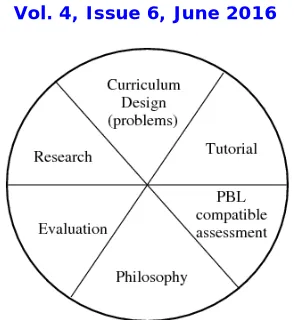
Figure 1: Project-based learning a total approach to learning: Turning the wheel of PBL
How do you get started?
Implementing PBL is introducing major curriculum change. Research indicates that the success factors in PBL include:
An understanding of the philosophy of PBL
A commitment to the philosophy of PBL
High quality problems
A major acceptance of the role change
An ability to model process skills
Assessment compatible with PBL
Substantial appropriate staff development
A pragmatic and realistic approach
Institutional and management support
2.1 Teach concepts, not standards.
PBL teachers/learners can get much better at designing information-rich projects that help students develop and demonstrate an essential programs, deep understanding of concepts/topics—the real goal of learning today. With the concept based approach, what may be considered the weakness of PBL—it de-emphasizes teaching facts and standards—no longer matters. Instead, focus on what PBL does best: Teach students to think and learn.
Conceptual research is that related to some abstract idea(s) or theory On the other hand, experimental (empirical) research relies on hands-on experiment or observation alone, often without due regard for system and theory. It is data-based science research, coming up with result which is capable of being verified by observation.
In such a research, the researcher must first provide himself with a working hypothesis or guess as to the probable expected results. He then works to get enough facts (data/meta data) to prove or disprove his hypothesis.
2.2 Teach critical thinking through contextual challenges
World engineering attributes and NBA attribute defines engineers must be critical thinker. Cognitive psychologists limit critical thinking to higher-order thinking, brain-based processes that can be taught/learn. But recent research indicates that critical thinking relies on a blend of attributes, including habits, attitudes, and emotional openness; thinking strategies; back ground knowledge; conceptual knowledge; criteria for judgment and thought process. All of these can be learned—synergistically—through well-designed projects that challenge students to solve meaningful realistic problems.
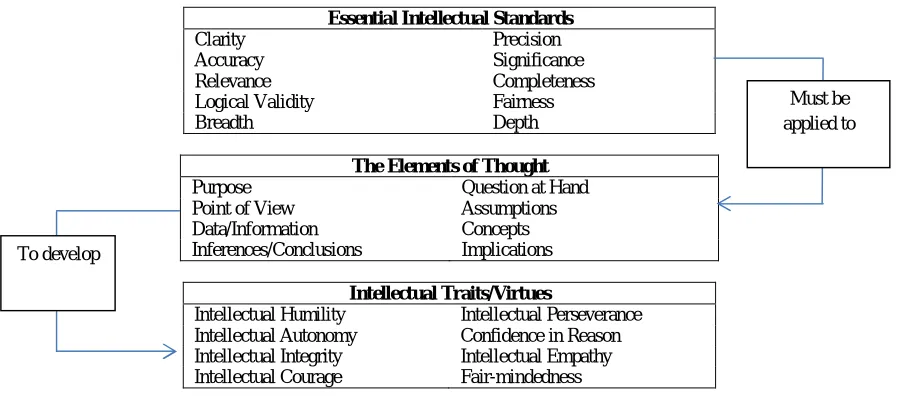
2.2.1 A Critical Thinking Model
Thinking as engineers requires a vocabulary of thinking and reasoning.
Essential Intellectual Standards
Clarity Precision
Accuracy Significance
Relevance Completeness
Logical Validity Fairness
Breadth Depth
The Elements of Thought
Purpose Question at Hand
Point of View Assumptions
Data/Information Concepts
Inferences/Conclusions Implications
Intellectual Traits/Virtues
Intellectual Humility Intellectual Perseverance
Intellectual Autonomy Confidence in Reason
Intellectual Integrity Intellectual Empathy
Intellectual Courage Fair-mindedness
Table 1: A Critical Thinking Model
The essence of a dissertation is critical thinking, not experimental data. Analysis and concepts form the heart of the work.
A dissertation does not repeat the details of critical thinking and analysis found in published sources.
2.3 Start with questions
This is another way of saying: Begin with the learner. Interms of Monday morning lesson plans, it means Start with questions, not curriculum. Questions, whether obviously relevant to students or made relevant through good teaching, engage today’s students.
Becoming an Active Reader and Listener:
It is very important to make the transition from the passive mode of learning that traditional lecture courses encourage to an active and critical learning style. Whenever one reads technical material, evaluates a piece of software, or listens to a research talk, should askhim/her these canonical questions:
From where did the author seem to draw the ideas? What exactly was accomplished by this piece of work? How does it seem to relate to other work in the field?
What would be the reasonable next step to build upon this work?
What ideas from related fields might be brought to bear upon this subject?
2.4 Emphasize innovation
PBL relies on a problem-solving process that requires students to learn and use information to find the solution. In the hands of an advanced practitioner of PBL, a project—from start to finish—is an exercise in critical thinking, collaboration, and demonstration of accomplishments. With this understanding, design projects around the core themes of innovation and creativity.
Must be applied to
Science Technology
Object unchangeable changeable
Principle of motion Inside outside
End knowing the general knowing the concrete
Activity theory end in itself end in something else
Innovation form discovery invention
Type of result law-like statements rule-like statements Table 2: Standard Distinctions between Science and Technology
2.4.1 Empirical Induction
In a simplified scheme, deductive inferences can be said to move from general statements to particular conclusions. Inductive inferences move from particular assertions to general conclusions.
Here is the generic form of an inductive argument: Every A we have observed is a B.
Therefore, every A is a B.
Many of scientific hypotheses are formulated via induction. Consider the following: Every instance of water (at sea level)8 we have observed has boiled at 100° Celsius. Therefore, all water (at sea level) boils at 100° Celsius.
It is important to note that even the best inductive argument will never offer 100% probability in support of its position. An inductive argument poses general statement in a way that it assumes a general domain for phenomena that are tested in some part of that domain.
2.4.2 Critical Thinking: Logical Argument
Reserve your right to think, for even to think wrongly is better than not to think at all.
-Hypatia, natural philosopher and mathematician
What is an argument? An argument is a statement logically inferred from premises. Neither an opinion nor a belief can qualify as an argument.
How do we analyze the soundness of an argument? It is a good practice to begin a critical analysis of an argument by isolating the conclusion. By examining the conclusion we find the point of the argument. The next step is examining of premises that the argument rests on.
It is important to note that some premises can be implied and not stated explicitly within theargument. We might call these premises assumed premises or underlying assumptions. Hereis yet another reason to reflect critically upon ideas. Many arguments would never be made ifthe arguer were forced to make explicit her assumptions; i.e. the underlying assumptions canbe extremely erratic!
Not all the discussions contain arguments consisting of a supporting premises and a conclusion. Discussions often contain statements that are not part of the argument. Such statements can be included in order to give necessary background information in support ofan argument.
2.4.3 Make Critical Thinking Explicit
Critical thinking is difficult to define, but the quality of the inquiry process through out the project will be greatly determined by your ability to make your expectations about critical thinking explicit. Your goal is to create a
community of thinkers who are addressing a meaningful challenge.
2.4.3.1 Background knowledge
2.4.3.2 Criteria for judgment
In judging various alternatives, students need to know if judgments are accurate, plausible, fair, and feasible.
2.4.3.3 Critical thinking vocabulary
Students need a vocabulary that enables them to make distinctions about the issues and the choices facing them. Teach terms such as inference; generalization; premise; conclusion; bias, and point of view.
2.4.3.4 Thinking strategies
Critical thinking is never a simple set of steps, but there are strategies or algorithms that can guide students. What procedures will they follow in making a decision? How will they organize their information? Can they put themselves in another role so they consider differing points of view?
2.4.3.4Habits of mind
These are the habits and values of a careful, conscientious thinker, such as being open-minded, fair-minded, independent, and curious. Help develop these habits in your classroom culture.
III.FORMULATING THE RESEARCH PROBLEM
Develop the Nucleus of an Idea there are two types of research problems, problems which relate to states of nature and those which relate to relationships between variables. In the beginning stage itself the scholar must single out the problem he/she wants to study, i.e., must decide the general area of interest or aspect of a subject-matter that he/she would like to inquire into.
How to Formulate Research Problem?
3.1 The Primary stage
Observation - The first step in the research process is that of the observation, research work starts with the observation which can be either unaided visual observation or guided and controlled observation.
Interest - As studied in the above paragraph, research starts with the observation and it leads to a curiosity to learn and gain more and more about what has been observed.
Crystallization - It can be defined as the process involving the designing of the definite form of research to be used in the study of the subject matter that has been observed. Formulating a research problem -It can belong to the category in which there can be relationships between various variables or it may belong to the other category, which is based on nature.
Primary Synopsis - Before starting with the actual study work, it is very necessary for a researcher to prepare a summary or a plan about the activities he has to perform in connection with research operation.
Conceptual Clarity - It is very much important for a researcher to have in depth knowledge and understanding of the subject or the topic he has to study as it helps a lot in achieving one’s goal and objectives in a much easier and also a comparatively much simpler way.
Documentation - The documents help in providing important information to a researcher, document is something in writing it can be a record, files or diaries etc. may be published or unpublished in nature.
3.2 Secondary stage
Research project planning - Involves selection of the future courses of action for conducting and directing a research project. A research project plan gives a rational approach to research by which one is able to decide in advance about what to do, how to do, when to do, where to do and who is to do a particular task in a specific activity.
Research Project formulation - After the planning of the project has been done the researcher follows this with a practical approach in order to carry out the project. This step of the secondary stage involves the systematic setting forth of the total research project, with an aim of conducting a systematic study.
Data collection - This step involves the in depth meaning for the concepts that are to be investigated and looks forward to data analysis, data requirement etc… Sources of understatement or overstatement should be avoided and the data should be free from any type of error. The data collection planning should be done or implemented in a very careful manner, with the help of specialist researchers. The data should be good and meaningful in nature should not only be a collection of words but should provide meaningful information.
rows this step also helps a great deal in the condensation of the data and also in the analysation of the relations, trends etc.
Data Analysis - The collected data is arranged according to some pattern or a particular format and this analysation of the data is done mainly to provide the data with a meaning. It is actually the computing of the some of the measures supported by the search for the relationship patterns, existing among the group of the data.
Testing of a hypothesis - This step of testing acts as the back bone of the data analysis. Various tests like “t” test, “z” test. Chi square test are used by the statisticians for the testing of the hypothesis.
Interpretation of results - It is very important that the results are interpreted into action recommendations and the results should be able to refer to a decision i.e. should help in drawing a conclusion.
3.3Conceptual vs. Experimental (or Empirical)
Conceptual research is that related to some abstract idea(s) or theory. It is generallyused by philosophers and thinkers to develop new concepts or to reinterpret existing ones. On the other hand, experimental (empirical) research relies on experiment or observation alone, often without due regard for system and theory. It is data-basedresearch, coming up with conclusions which are capable of being verified by observation or experiment. In such a research it is necessary to get at facts firsthand,at their source, and actively to go about doing certain things to stimulate theproduction of desired information. In such a research, the researcher must first provide himself with a working hypothesis or guess as to the probable results. Hethen works to get enough facts (data) to prove or disprove his hypothesis. He then sets up experimental designs which he thinks will manipulate the persons or thematerials concerned so as to bring forth the desired information leading to thehypothesis.
Such research is thus characterized by the experimenter's control overthe variables under study and his deliberate manipulation of one of them to study itseffects. Empirical research is appropriate when proof is sought that certainvariables affect other variables in some way. Evidence gathered throughexperiments or empirical studies is today considered to be the most powerfulsupport possible for a given hypothesis.
3.4Teach and assess collaboration and communication
The list of skills necessaryfor twenty-first-century life has lengthened. But collaboration and communicationare the core skills—and should be taught and assessed in every project. Studentscollaborate as part of their daily life; through projects, they can learn to collaboratepurposefully and respectfully.
Figure 2: Teaching-communication tools
IV. HOW TO APPROACH RESEARCH
It is clear that there are two basic approaches to research, viz., quantitative approach and the qualitative approach. The former involves the generation of data in quantitative form which can be subjected to rigorous quantitative analysis in a formal and rigorous fashion. This approach can be further sub-classified into inferential, experimental and simulation approaches research. The purpose of inferential approach to research is to form a data base from which to infer characteristics or relationships of population.
Experimental approach is characterized by much greater control over the research environment and in this case some variables are manipulated to observe their effect on other variables. Simulation approach involves the construction of an artificial environment within which relevant information and data can be generated.
This permits an observation of the dynamic behavior of a system (or its subsystem) under controlled conditions. Given the values of initial conditions, parameters and exogenous variables, a simulation is run to represent the behavior of the process over time. Simulation approach can also be useful in building models for understanding future conditions.
Qualitative approach to research is concerned with subjective assessment of attitudes, opinions and behavior. Research in such a situation is a function of researcher's insights and impressions.
4.1 Focus on quality not quantity
Quality of output will be depending on quality of work and learning approach to systematic productive thinking. During a project, provide every student with multiple opportunities to perform deep, quality work. PBL must be
Researcher Communication
designed around a process of excellence, using drafts, prototypes, peer protocols, thinking and brainstorming exercises, and clear performance standards.
4.2 Teach with pleasure, drive, passion, and purpose
Learn with pleasure not a pressure. In an unstable world, no amount of skills and knowledge will be sufficient without a foundation of personal strengths such as resilience, flexibility, persistence, empathy, and self-awareness. These attributes, not necessarily developed in an industrial school system, are now critical to peak performance.
Such intangible assets cannot be taught out of a textbook: they must be activated through experience. PBL offers that kind of experience if teachers use proven methods from the human performance field to liberate students’ passion, purpose, and engagement.
Passion and purpose describe your dedication and ability to achieve objectives in research.
4.3 Practice planet-craft
Designing projects that take students into deep, authentic realms and purposeful learning is a powerful motivator for excellence. Projects lend themselves to authentic work in the community, local or global, and now is the perfect time for teachers to plan projects with students to help them make a contribution to the world, as well as acquire core knowledge.
4.4 Learn from students/practitioner
No matter how confident educators feel about their curriculum and teaching methods, everything is on the table for negotiation with today’s students—and PBL allows students and teachers to create fruitful learning partnerships. Many new protocols and tools have evolved that enable teachers and students to collaborate as a learning community. Students can be trained in project design, and help set standards for their own performance.
4.5 Infuse PBL into engineering technology
The next decade will be decisive in terms of merging virtual schooling and technology tools with traditional concerns over content and accountability. How to infuse technology into education is no longer the question. Rather, PBL teachers must ask: How do I infuse PBL into technology?
This Guide offers the best ideas available by addressing hybrid or distance learning models for projects—and also discuss importing successful gamer practices into PBL.
V.STAGES IN RESEARCH EXECUTION PROCESS Formulating the research problem
Extensive literature survey
Developing the hypothesis
Preparing the research design
Determining sample design
Collecting the data
Execution of the project
Analysis of data
Hypothesis testing
Generalizations and interpretation
Preparation of the research report
5.1 From Projects to PBL
Seven principles are:
Identify the challenge At the core of a problem lies a challenge. You want to make the challenge both meaningful and doable. Criteria given here measure this.
Start with outputs As the instructional leader, you need to decide the tasks and outcomes of the project. Content objectives are project specific, but you will also want to include skills mastery and dispositions in your outcomes.
Build the assessment criteria The mantra of PBL is create and deliver. At the end of a project, students produce a result. The result is assessed against specific criteria established at the beginning of the project and defined in an assessment plan.
Enroll and engage A field-tested set of best practices will help you engage students in the project from the beginning. Starting right is the key to success at the end.
Focus on quality High-performance PBL relies on quality student work. In PBL, quality work results when student teams commit to purposeful collaboration and continuous improvement. Teaching teams to use proven tools and coaching teams to perform better are central to successful projects.
End with specific mastery The PBL process is a nonlinear problem-solving process. A good PBL teacher knows how to manage the work flow throughout the project and prepare students to present their best work at the end, including planning powerful exhibitions to public audiences. Most important, at the culmination of well-executed projects, students experience the feeling of mastery.
5.2 Take Charge of Standards
Many teachers have been beaten down by a rigid approach to teaching, including pacing guides, too many tests, or lack of autonomy in deciding their curriculum. But a different path is possible: Take charge of your standards.
How do you begin to take charge of standards? Here are seven suggestions:
View standards as outcomes Standards define what students should know and be able to do at the end of the year or the end of a unit. They are not meant to be items on a checklist to be “covered.” Reframe standards as key learning outcomes.
Identify the power standards Not all standards are equal. Go through your standards carefully and identify the critical information you want your students to know—not for tests, but for their ultimate success. Parts of your curriculum will inevitably be less relevant to their lives. For projects, choose standards that matter. Leave other standards to be taught through engaging activities, direct instruction, or worksheets. Power standards form the basis for projects that matter, which make schoosing them critical for the PBL teacher. Students must have compelling reasons for solving a problem.
Decide which standards are project-friendly Some standards inherently invite problem solving or questions. Look for standards that relate to current issues, headline news, or other relevant topics. A good project fueled by powerful concepts will address several key standards in your curriculum. Plus, in a well-designed, engaging project, students will touch upon many other standards even if the project doesn’t directly address them.
Use the U.S. Common Core StandardsThe recent (2010) Common Core Standards for the United States, adopted by more than forty states, focus on inquiry,depth, and less coverage. They are far more project-friendly than most state standards.
Teach important standards without projects If you have proven methods for teaching important standards, or if you feel that designing a project around certain standards is too difficult, then use what works. Students benefit from two to fourwell-designed projects each year. Other standards can be taught using normal instructional methods and active methods.
Think beyond lesson plans and units A project may fit nicely into a unit, or it may break down into a convenient set of lesson plans. But projects generally begin with concepts and ideas. Start with a good idea, then fit it into your unit— not the reverse. In fact, think of the project as your unit.
Use worksheets. In every discipline, practicing or memorizing a certain amount of information is appropriate. Look for standards that can be taught by simple, nontime-consuming methods.
5.3 Frame Projects with Concepts
A learner-centered, inquiry-based process results in better retention, more in-depth knowledge, and expanded curiosity Concepts offer other advantages for PBL:
5.3.2 Concepts help students identify patterns and connections between topicsor facts Our goal as global educators is to help young people learn, understand, and master rather than memorize and respond. Using concepts as the lens for a project helps teachers overcome an undue emphasis on facts and isolated topics for study.
5.3.3 Concepts are applicable across disciplines In today’s world, students need to learn the conventions, processes, and vocabulary of the discipline they are studying.
But disciplines increasingly overlap, and so should projects. For example, change applies to historical shifts in governments, evolutionary dynamics, character development, or thermodynamics. These connections and patterns make learning meaningful and help children answer the question: Why should I learn this? Also, since many concepts apply to more than one topic, a concept-based approach reduces the amountof material to be covered.
5.3.4 Concepts lead to questions Understanding concepts requires that they be filtered through a process of questioning, investigation, and reflection. In other words, factsand topics can be taught, but concepts must be learned. This shifts the focus to the learner and requires that teachers put in place a well-organized process for problemsolving, with support and feedback. That is the essence of PBL.
Through projects, students learn concepts and problem-solving skills. During the process, they also learn essential facts that prepare them for tests. But you often find that critical content or key pieces of information for mastering standards are missing in a project, or that students need specific exercises, problems, or vocabulary to succeed.
Prepare for these gaps by analyzing the project plan and adding lessonsto the project that teach specific content. Try to keep the lessons in context with the project. But if that’s too complicated, teach outside the process. Consider using the following techniques:
5.3.5 Direct instruction. Lecture can be easily incorporated into PBL. If direct instruction works, use it. But use it sparingly, not as your main method. Also, resist the temptation to teach students all the necessary details and facts prior to starting aproject. The idea of PBL is make them hungry to learn facts on their own.
5.3.6 Just in time” instructionPrior to beginning a project, either use your own judgmentor work with students to identify potential gaps in their knowledge or anticipateaspects of the project that will need more intensive instruction. Plan on brief burstsof direct instruction to fill the gaps in a timely way. Be prepared to present minilessonson the spot.
5.3.7WorkshopsPlan an in-class seminar or workshop for students who want tutoring orreview of a specific topic. Conduct the workshop in a corner of the classroom whileother students continue work on the project.
VI.TEACHING INNOVATION
Don’t confuse PBL and “cool” projects. PBL and technology are often confused.PBL relies on a well-designed, expertly crafted, and methodologically driven project design. Technology is the tool that supports inquiry and innovation.
6.1Don’t be dazzled Don’t let any work by students that uses the latest, dazzling innovations of the day to produce digital content be seen as a project. Don’t automatically consider that products created or displayed using digital resources are good. Asa PBL teacher, hold technology to the same standards you apply to other aspects ofthe curriculum. Products should be measurable and assessable, meet standards for literacy and numeracy, and be founded on core content.
6.2 Use the design cycle to assess technology. Creating a product using technology follows a design cycle of brainstorming, prototyping, testing, and delivery. Each stage can be assessed and reviewed, like drafts of an essay.
6.3 Use digital portfolios. Learning in the digital age is “process-oriented.” Use digital resources to summarize student learning and proficiency around broad standards and skill acquisition, as well as encourage reflection and meta-cognition.
6.4 Define “digital literacy” Traditional literacy comes in two grades: the ability to read basic information and the ability to decipher academic-level discourse. Basic digital literacy is the ability to text, network with friends, and use the Internet; premium digital literacy requires students to understand and use technological terms and analyze the underlying processes of technology. Don’t settle for basic.
6.5 Turn Groups into Teams
A good first step is to establish the difference between groups and teams. Five principles define a team:
6.5.1Commitment. Teams consist of individuals committed to the success of the team and to upholding their individual responsibilities to make the team work. If one individual fails to contribute, the team may fail.
6.5.3Focus on a common goal Groups focus on process; teams focus on achievement. Teams work best when the goal is well defined and doable. All teamwork begins with the end in mind: What do we need to create, produce or achieve?
6.5.4Ability to critique performance. Teams continuously improve by regularly reviewing objectives, measuring accomplishments, and deciding next steps. They learn from one another through objective praise and analysis.
6.5.5Acceptance of a process Teams operate by formal mechanisms and guidelines designed to foster efficiency, communication, and productivity.
VII. CONCLUSION
The conceptual theories in academic education now a days used in academic industry in over the world. Most of the acdemetian try to develop project based learnig in their envirment and provide hands-on training to students and this is challenging job for trainer. Project based learning is the approach of doing reseach work or practical handson training to enhance students or learners thinking ability. Which makes them ready for job. Most of the organizations recommands project based learning in their new commer employees for better understanding and improving problem solving skills. This will help for incresing quality of education and research productivity forstudents are get ready employeble in industry.
REFERENCES
1. Paul, R.W. and Elder, L., Critical Thinking: Tools for Taking Charge of Your Professional and Personal Life, Prentice-Hall, Upper Saddle, NJ, 2002
2. www.criticalthinking.org/resources [cited 10 May 2006]
3. http://classroomextension.com/primers/criticalthinking/ (Critical Thinking) 4. Engineering Research Methodology, Krishnan Nallaperumal, First Edition 5. Project Based Learning, Design and Coaching Guide, Thom Markham
6. Train the trainer handbook, Manual, 2005, Cochrane Health Promotion and Public Health Field 7. Foundation Skills in IT (FSIT), Facilitator’s Guide, NASSCOM
8. McMaster University where PBL began.http://www-fhs.mcmaster.ca/mhsi/problem-.htm 9. PBL Clearinghouse. http://www.mis4.udel.edu/Pbl/index.jsp
BIOGRAPHY
Mr. Satish P. Pisea lecturer in the Computer Science & Engineering Department, Sanjay Ghodawat Polytechnic, Atigre Kolhapur Affiliated to MSBTE, DTE, AICTE. He received Bachelor of Computer Engineering degree in 2011 from North Maharashtra University, Jalgaon, MS, India. His research interests are Computer Networks, Academic Improvement, Research Methodology, Open Source Applications etc.
Mrs. Manaswini A. Parlikara lecturer in Computer Department, Pimpri Chinchwad Polytechnic, Akurdi, Pune Affiliated to MSBTE, DTE, AICTE. She received Bachelor of Computer Science and Technology degree in 2002 from S.N.D.T. University, Mumbai, MS, India.
Mrs. Gayatri S. Mujumdar a lecturer in Computer Department, Pimpri Chinchwad Polytechnic, Akurdi, Pune Affiliated to MSBTE, DTE, AICTE. She received Bachelor of Computer Engineering degree in 2003 from Pune University, Pune, MS, India.