University of Windsor
University of Windsor
Scholarship at UWindsor
Scholarship at UWindsor
Electronic Theses and Dissertations
Theses, Dissertations, and Major Papers
Winter 2014
Cross-Layer Treatment of Mobility for Mobile Ad Hoc Networks
Cross-Layer Treatment of Mobility for Mobile Ad Hoc Networks
Kazi Atiqur Rahman
University of Windsor
Follow this and additional works at: https://scholar.uwindsor.ca/etd
Part of the Electrical and Computer Engineering Commons
Recommended Citation
Recommended Citation
Rahman, Kazi Atiqur, "Cross-Layer Treatment of Mobility for Mobile Ad Hoc Networks" (2014). Electronic Theses and Dissertations. 5034.
https://scholar.uwindsor.ca/etd/5034
This online database contains the full-text of PhD dissertations and Masters’ theses of University of Windsor students from 1954 forward. These documents are made available for personal study and research purposes only, in accordance with the Canadian Copyright Act and the Creative Commons license—CC BY-NC-ND (Attribution, Non-Commercial, No Derivative Works). Under this license, works must always be attributed to the copyright holder (original author), cannot be used for any commercial purposes, and may not be altered. Any other use would require the permission of the copyright holder. Students may inquire about withdrawing their dissertation and/or thesis from this database. For additional inquiries, please contact the repository administrator via email
Cross-Layer Treatment of Mobility for Mobile Ad Hoc Networks
By
Kazi Atiqur Rahman
A Dissertation
Submitted to the Faculty of Graduate Studies
through the Department of
Electrical and Computer Engineering
in Partial Fulfillment of the Requirements for
the Degree of
Doctor of Philosophy
at the University of Windsor
Windsor, Ontario, Canada
2013
Cross-Layer Treatment of Mobility for Mobile Ad Hoc Networks
by
Kazi Atiqur Rahman
APPROVED BY:
______________________________________________
Ala Al-Fuqaha, External Examiner
Western Michigan University
______________________________________________
Ziad Kobti
School of Computer Science
______________________________________________
Mohammed Khalid
Electrical and Computer Engineering
______________________________________________
Narayan Kar
Electrical and Computer Engineering
______________________________________________
Kemal E. Tepe, Advisor
Electrical and Computer Engineering
iii
DECLARATION OF CO-ATHORSHIP
I. Co-Authorship Declaration
I hereby declare that this thesis incorporates some materials part of which are results of joint researches. The investigations and evaluations done throughout this thesis used some technologies that were developed in the WiCIP research laboratory. The investigations were supported by collaborative help from my colleagues in WiCIP lab in the form of advice, critiques, and mentoring. This thesis also incorporates the outcome of joint research undertaken in collaboration with Khaja Shazzad, Dr. Nabih Jaber, William Cassidy, Kazi Aminur Rahman, and Matthias Lott under the supervision of Professor Dr. Kemal E. Tepe. In all cases, the key ideas, primary contributions, experimental designs, data analysis and interpretation, were performed by the author, and the contribution of co-authors was primarily through the provision of suggestions, comments, critiques, verification and other supports.
I am aware of the University of Windsor Senate Policy on Authorship and I certify that I have properly acknowledged the contribution of other researchers to my thesis, and have obtained written permission from each of the co-authors to include the above material(s) in my thesis.
I certify that, with the above qualification, this thesis, and the research to which it refers, is the product of my own work.
II. Declaration of Previous Publication
This thesis includes parts from 5 original papers that have been previously published/submitted for publication in peer reviewed journals, as follows:
Thesis
Chapter Publication
Part of Chapter 5
N. Jaber, K. A. Rahman, W.G. Cassidy, K. E. Tepe “Reliable MAC Layer Designs for Vehicular Networks”, 26th Queen’s Biennial Symposium on Communications, The Donald Gordon Centre, Queen’s University, Kingston, ON, Canada, May 27 – 29, 2012.
Part of Chapters 2 and 5
K.A. Rahman, N. Jaber, and K.E. Tepe, “Markov Analysis of the Mobile Hidden Station Problem in MANET”, The 7th IWCMC, Istanbul, Turkey, 05-08 July 2011.
Part of Chapters 5
K.A. Rahman, K.M. Shazzad, and K.E. Tepe, “Analyzing Sliding Frame Reservation-Aloha MAC Protocol against Mobile Hidden Station Problem in MANET”, The 24th CCECE, Niagara Falls, ON, Canada, 08-11 May 2011.
Part of
iv
and 5 MANET”, IEEE ISCI, Kuala Lumpur, Malaysia, 20-22 March 2011.
Part of Chapters 4 and 5
K.A. Rahman, M. Lott, K. Aminur Rahman, and K.E. Tepe, “Characterization of the Adverse Effect of Neighborhood Capture in MANET and on the way to a Remedy”, IEEE EIT, IEEE Xplore doi: 10.1109/EIT.2009.5189640, pages 344-348, Windsor, Ontario, Canada, June 2009.
I certify that the above material describes work completed during my registration as a graduate student at the University of Windsor.
I declare that, to the best of my knowledge, my thesis does not infringe upon anyone’s copyright nor violate any proprietary rights and that any ideas, techniques, quotations, or any other material from the work of other people included in my thesis, published or otherwise, are fully acknowledged in accordance with the standard referencing practice. Furthermore, to the extent that I have included copyrighted material that surpasses the bounds of fair dealing within the meaning of the Canada Copyright Act, I certify that I have obtained a written permission from the copyright owner(s) to include such material(s) in my thesis.
v
ABSTRACT
The current era of mobile communication is passing through the days of rapidly changing technologies. Such an evolving promising technology is mobile ad hoc networks (MANETs). The communications in ad hoc networks are adversely affected by the link failures in the network layer, and by the hidden station, mobile hidden station, neighborhood capture and asymmetric radio link problems in the MAC layer. All the problems are highly affected by mobility of the stations. If the degree of mobility of any station in a route increases, the route life time decreases. That causes frequent link failures, and results packet retransmissions, additional latency and packet loss. An algorithm to include mobility in a routing protocol to reduce packet losses in a MANET is proposed in this thesis. The proposed algorithm estimates the number of packets that can traverse through the route before it breaks because of mobility. The algorithm is implemented in dynamic source routing protocol, and simulated in Network Simulator-2. The MHS problem arises if a station is hidden due to mobility. Asymmetric/unequal radio links in can occur in MANETs/VANETs for many reasons such as hardware limitations, power saving protocols, shadowing effects, dynamic spectrum managements. A MAC protocol named extended reservation Aloha (ERA) is proposed which partially solves these problems. Then, using the concept of ERA, another MAC protocol named extended sliding frame reservation Aloha (ESFRA), which addresses all the above mentioned MAC problems, is proposed in this thesis.
As safety critical information dissemination in DSRC/WAVE systems requires reliability and robustness, a network-MAC cross-layer information dissemination protocol is proposed in this thesis to address those issues. Although the layered architecture is still a good candidate for any design of wireless networks, the researchers are looking for some optimizations by interaction between neighbor layers which is called layer design. So I proposed a network-MAC cross-layer algorithm, cross-cross-layer extended sliding frame reservation Aloha (CESFRA), which solves mobility related problems, confirms low and deterministic end-to-end delay, and is robust and reliable in safety critical information dissemination up to 3rd hop. Discrete time Markov chain
vi
DEDICATION
To my parents who always encourage me for higher studies, and keep me in their prayers.
To my wife and best friend "Shah Mst Nasrin Sultana" who stood beside me with her support all the way until this work was done.
vii
ACKNOWLEDGEMENTS
First of all, I would like to gratefully acknowledge the department of Electrical and Computer Engineering at University of Windsor, for giving me the opportunity to perform PhD here.
I would like to express my heartiest gratitude to Dr. Kemal E. Tepe, my advisor, for his ceaseless encouragement, intellectual advice and authentic guidance throughout the progress and final outcome of this thesis and also for sparing his valuable time for me in guidance during laboratory experiments and the preparation of this manuscript. I will always be indebted to him for all he has done for me, and it is a pleasure to acknowledge his guidance and support.
I feel a special gratitude and would like to acknowledge the advice and support from my supervisory committee members: Dr. Mohammed Khalid, Dr. Narayan Kar, and Dr. Ziad Kobti, for their valuable comments and for sharing their vast experiences with me in making my dissertation resourceful. I like to sincerely thank my external examiner: Dr. Ala Al-Fuqaha for agreeing to be my external examiner, and for his invaluably scholarly advice to complete my thesis.
I would like to thank my colleagues: Khaja Shazzad, Izhar Ahmed, Dr. Ishaq Gul Muhammad, Dr. Brajendra Kumar Singh, Dr. Nabih Jaber, William Cassidy, N.C. Doyle, Patrick Casey, Zahangir Toimoor, Ahmed El-Baba, Shawn Rupert, Sarab Al Rubeaai, Syed Sami, Mehmood Abd, Abdul Ghani Sayani Mohammad and Saneeha Ahmed in WiCIP LAB for their critical insights and enlightening discussions.
viii
TABLE OF CONTENTS
DECLARATION OF CO-ATHORSHIP ... iii
ABSTRACT ... v
DEDICATION ... vi
ACKNOWLEDGEMENTS ... vii
LIST OF FIGURES ... xi
LIST OF ABBREVIATIONS/SYMBOLS ... xiii
CHAPTER 1:
Introduction ... 1
1.1 Contributions ... 1
1.2 Thesis Organization ... 2
CHAPTER 2:
Problem Definition and Research Methodology ... 4
2.1 Link Failure Due to Mobility in MANET and Its Severity ... 4
2.2 Neighborhood Capture Problem in MANET ... 4
2.3 Mobile Hidden Station Problem in MANET or DSRC/WAVE Systems ... 5
2.4 Asymmetric Radio Link Problem in MANET/ VANET and Its Severity... 7
2.4.1 Asymmetric Radio Link Problem in MANET ... 7
2.4.2 Asymmetric Radio Link Problem in DSRC/WAVE Systems ... 7
2.5 Research Contributions and Methodology ... 8
2.5.1 Research Contributions ... 8
2.5.2 Research Methodology ... 9
CHAPTER 3:
Related Work ... 11
3.1 Review of the Impact of Mobility in the Network Layer ... 11
3.2 Review of the Behavior of Some Related MAC Protocols ... 11
CHAPTER 4:
Proposed Work ... 14
4.1 Proposed Work in the Network Layer ... 14
4.1.1 A Mobility Algorithm to Reduce Packet Loss ... 14
ix
4.1.1.2 Calculation of Adaptive Link Life Time ... 15
4.1.1.3 Mobility Algorithm ... 16
4.1.1.4 System Model and Implementation ... 19
4.2 Proposed Work in the MAC Layer ... 19
4.2.1 A View of Reservation ALOHA ... 19
4.2.2 The Proposed MAC Protocol: Extended R-Aloha (ERA) ... 20
4.2.3 The Proposed MAC Protocol: Extended Sliding Frame R-Aloha (ESFRA) ... 21
4.2.3.1 Sliding Frame Reservation-Aloha ... 21
4.2.3.2 Principles of Extended Sliding Frame R-Aloha ... 22
4.3 The Proposed Network-MAC Cross-Layer Algorithm ... 24
4.3.1 The Proposed Cross-Layer Based Algorithm ... 24
4.3.1.1 Construction of Cross-Layer Extended Sliding Frame R-Aloha ... 24
4.3.1.2 State Diagram of Slot Status in CESFRA ... 25
4.3.1.3 Information Dissemination Mechanism with CESFRA ... 26
CHAPTER 5:
Results and Analysis of the Proposed Approaches ... 28
5.1 Analysis of the Proposed Algorithm in the Network Layer ... 28
5.1.1 Investigation of the Mobility Algorithm on Dynamic Source Routing (DSR) Protocol ... 28
5.2 MAC Layer ... 31
5.2.1 Analysis of the Behavior of the Reservation Based Protocols (i.e. ERA, SFRA and ESFRA) and IEEE 802.11 with respect to the Neighborhood Capture Problem ... 31
5.2.2 Analysis of the Behavior of the Reservation Based Protocols (i.e. ERA and SFRA) to the Mobile Hidden Station Problem ... 36
5.2.3 Markov Analysis of IEEE 802.11, SFRA and ESFRA Considering the Effect of Mobile Hidden Station ... 40
5.2.3.1 Discrete Time Markov Chain Model for SFRA ... 41
5.2.3.2 Discrete Time Markov Chain Model for ESFRA ... 44
5.2.3.3 Discrete Time Markov Chain Model for IEEE 802.11 MAC with MHS. . 47
5.2.3.4 Results of Markov Analysis on MHS Problem: Comparative Behavior of IEEE 802.11, SFRA and ESFRA ... 49
5.2.4 Analysis of the Behavior of the Reservation Based Protocols (i.e. ERA and SFRA) to Asymmetric Radio Link Problem ... 51
5.3 Cross-layer ... 54
x
5.3.2 Markov Analysis of IEEE 802.11 Broadcast and CESFRA MAC Considering the Effect of Hidden Station and Mobile Hidden Station Problems in a
DSRC/WAVE Based VANET Scenario ... 59
5.3.2.1 Discrete Time Markov Chain Model for CESFRA MAC for DSRC/WAVE Highway Communication Scenario ... 59
5.3.2.2 Discrete Time Markov Chain Model for IEEE 802.11 Broadcast Considering HS and MHS Problems... 63
5.3.3 Justification of the Cross Layer Behavior of CESFRA in the DSRC/WAVE Systems ... 66
5.3.3.1 Cooperative Collision Warning/Avoidance in DSRC/WAVE Systems with CESFRA ... 66
5.3.3.2 Shadowing Effect and Asymmetric Radio Link Problem ... 67
5.3.3.3 Emergency Vehicle Warning - an Example ARL Scenario ... 67
5.3.3.4 Service - Toll Collection and Work Zone Warning - an Example ARL Scenario ... 68
CHAPTER 6:
Conclusion and Future Work ... 69
6.1 Conclusion ... 69
6.2 Future Work ... 70
6.2.1 Time Synchronization Among the Mobile Vehicles ... 70
6.2.2 Size of the Contention Domain ... 70
6.2.3 Privacy and Security Issues ... 71
REFERENCES ... 72
APPENDIX A
Elsevier and IEEE Reprint Permissions ... 76
xi
LIST OF FIGURES
Figure 2-1: Link breaking due to mobility in an ongoing communication. ... 4
Figure 2-2: Neighborhood capture scenario. ... 5
Figure 2-3: Data transmission scenario at the time of neighborhood capture. ... 5
Figure 2-4: Mobile hidden station scenario in VANET and MANET. ... 6
Figure 2-5: HS in an asymmetric radio link MANET scenario. ... 7
Figure 2-6: DSRC multichannel communication ranges (Copied from [22]). ... 7
Figure 2-7: HSs in an unequal/asymmetric link VANET scenario... 8
Figure 2-8: Research methodology and accomplishments. ... 9
Figure 3-1: Mobile hidden station scenario. ... 12
Figure 4-1: A scenario for calculating LLT. ... 14
Figure 4-2: A scenario for calculating ALLT for asymmetric radio links in a MANET. ... 16
Figure 4-3: Discarding unstable routes. ... 17
Figure 4-4: Flowchart for mobility assisted routing. ... 18
Figure 4-5: ERA to hidden station and exposed station. ... 20
Figure 4-6: Reservation scenario in R-Aloha. ... 20
Figure 4-7: Extended reservation scenario in ERA. ... 21
Figure 4-8: Sliding frame scenario of SFRA. ... 22
Figure 4-9: Sliding frame scenario of ESFRA. ... 23
Figure 4-10: The state diagram of the status of a slot in CESFRA... 25
Figure 4-11: CI Structure for information dissemination. ... 27
Figure 5-1: Packet delivery ratio versus speed. ... 28
Figure 5-2: Packet loss versus speed. ... 29
Figure 5-3: Average packet delay versus speed. ... 29
Figure 5-4: Effect of number of nodes on packet delivery ratio. ... 30
Figure 5-5: Effect of number of nodes on packet loss. ... 30
Figure 5-6: Effect of number of nodes on delay. ... 31
Figure 5-7: Neighborhood capture problem with example reservations of stations in a frame. ... 32
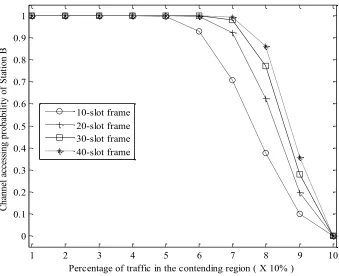
Figure 5-8: Channel accessing probability of B with the variation of the number of slots reserved by Station A and Station C... 34
Figure 5-9: Channel accessing probability of B with the variation of traffic in the contending area. ... 35
Figure 5-10: Comparison scenarios for different load and different frame size. ... 36
Figure 5-11: HS, ES and MHS in a MANET scenario. ... 36
Figure 5-12: Probability of successful transmission by Station A with the variation of number of slots reserved by A. ... 38
Figure 5-13: Probability of successful transmission with the variation of traffic in the contending area of A. ... 39
Figure 5-14: Severity of MHS problem in SFRA and ERA. ... 39
Figure 5-15: Probability of collision due to MHS, D with the variation of the number of slots reserved by A and D. ... 40
xii
Figure 5-17: Comparison of probability of collision. ... 50
Figure 5-18: Comparison of throughputs of IEEE 802.11, SFRA and ESFRA... 50
Figure 5-19: Comparison of total delay. ... 51
Figure 5-20: Probability of collision if SFRA is used as a MAC protocol in an asymmetric radio link scenario. ... 53
Figure 5-21: Probability of collision with the variation of the total number of mobile stations in the contending area of A. ... 54
Figure 5-22: Comparison of channel utilization considering the effect of MHS problem. ... 55
Figure 5-23: Comparison of average packet delay considering the effect of MHS problem. ... 55
Figure 5-24: Total number of successfully transmitted packets considering the effect of MHS problem. ... 56
Figure 5-25: Comparison of throughput considering the effect of MHS problem. ... 56
Figure 5-26: Effect of ARL problem on channel utilization. ... 57
Figure 5-27: Effect of ARL problem on average packet delay. ... 57
Figure 5-28: Effect of ARL problem on total number of packets... 58
Figure 5-29: Effect of ARL problem on throughput. ... 58
Figure 5-30: HSs and MHSs in a DSRC/WAVE based highway scenario. ... 59
Figure 5-31: Markov state diagrams CESFRA MAC and IEEE 802.11. ... 61
Figure 5-32: Effect of HSs and MHSs in DSRC/WAVE systems... 65
Figure 5-33: Cooperative collision warning with CESFRA. ... 67
Figure 5-34: Asymmetric radio link problem in a DSRC/WAVE systems based scenario with emergency vehicle. ... 67
xiii
LIST OF ABBREVIATIONS/SYMBOLS
ACK Acknowledgement
AFR Asynchronous fixed repetition
AFR-CS AFR by adding a carrier sensing (CS) mechanism ALLT Adaptive link life time
AODV Ad hoc on-demand distance vector APR Asynchronous p-persistent repetition ARL Asymmetric radio link
ATPB Adaptive M-ary tree algorithm with priority broadcast BC Basic channel
BSM Basic safety message b-slot Back-off slot CBR Constant bit rate CI Cross-layer information CLD Cross-layer design CTS Clear-to-send
CESFRA Cross-layer sliding frame reservation Aloha CVSS Cooperative vehicle safety system
DBTMA Dual busy tone multiple access DCF Distributed coordination function DSR Dynamic source routing
DSRC Dedicated short range communication DTMC Discrete time Markov chain
ERA Extended reservation Aloha ES Exposed station
ESFRA Extended sliding frame reservation aloha FI Frame information
GCR Global channel release HS Hidden station
xiv MAC Medium access control
MANET Mobile ad hoc network
MAOD Mobility assessment on-demand MHS Mobile hidden station
MSD Message set dictionary NC Neighborhood capture
Node/Station A user terminal or workstation or laptop or any ad hoc module NS-2 Network simulator 2
ODMRP On-demand multicast routing protocol OBU On-board unit
PHY Physical layer
POC Positive orthogonal codes R-Aloha Reservation Aloha RLT Route life time
RSSI Received signal strength indication RSU Road side unit
RTS Request-to-send
SAE Society of automotive engineers SF Sliding frame
SFR Synchronous fixed repetition SFRA Sliding frame reservation Aloha SPR Synchronous p-persistent repetition TCP Transport control protocol
TDD Time division duplex TDM Time division multiplexing TLLT Threshold link life time UDP User datagram protocol UI Upper layer information VANET Vehicular ad hoc network
1
CHAPTER 1:
INTRODUCTION
Demand for high bit rate is pushing the researchers in the field of wireless communication systems to think about short range communications instead of long range communication in some specific applications. Mobile ad hoc network/vehicular ad hoc network (MANET/VANET) is a short range communication paradigm that can meet the requirement of high bit rate. However, MANET/VANET will not be realizable if the packet loss due to mobility related problems are not solved. MANET/VANET is different from traditional local area network (LAN) or wireless LAN (WLAN) with their multi-hop networking in which the mobile hosts are routers and form dynamic connections with other hosts in their radio ranges (i.e. transmission ranges). These multi-hop topologies present many unavoidable challenges in the physical layer, medium access control (MAC) layer and network layer. Some of these potential challenges are dynamically changing routes, and continuously varying radio characteristics between communicating hosts. These challenges are amplified while considering multi-hop ad hoc networks where data transport is not constrained to a single wireless network link. It is found that the throughput of a multiple link route in an ad hoc network decreases drastically if the nodes are mobile. That is why it is a significant challenge to improve the performances of a MANET by overcoming problems at different communication layers. My research goal is to investigate problems in packet communication in MANET which evolves from mobility and mitigate these problems in order to improve the network throughput and latency.
1.1
Contributions
The contributions in this thesis can be broadly divided into three parts e.g. network layer contribution, MAC layer contribution and network-MAC cross-layer design contribution.
Since mobility is inevitable in MANETs, link failures are very common and cause packet loss as a consequence of inconsistent routes. Most of the on-demand routing protocols use route maintenance procedure to detect broken links and reroute packets. This increases packet delay. Packet losses and delays get worse when mobility increases. In order to mitigate unnecessary packet loss, a novel mobility algorithm is proposed in which the approximate route life time (RLT) is estimated, and this route is utilized only this amount time to limit the packet loss. The packet transmission is stopped after the route life time, then route discovery or alternative routes are used for the remaining packets.
2
solves the HS and NC problems, and partially solves the MHS and ARL problems. This is why, a second MAC protocol, called extended sliding frame reservation Aloha (ESFRA), is proposed which uses the concept of ERA and sliding frame R-Aloha (SFRA). ESFRA is particularly designed to solve the MHS problem in a MANET by including relative locations of transmitting stations in the packet frame information header. In addition to the MHS problem, ESFRA simultaneously solves the hidden station (HS), exposed station (ES), neighborhood capture, and asymmetric radio link problems. These proposed protocols are explained in Chapter 4.
According to the analyses in [10] and [11], the early CVSS solutions work well in low utilization cases (i.e. at low vehicle density). For crowded highways, the performance of a CVSS degrades significantly due to the DSRC channel congestion [2], [12]–[15]. The causes of this congestion is the dissemination of information by flooding, collisions due to hidden stations and mobile hidden stations, neighborhood capture problem, asymmetric radio link problem etc. So CVSS needs a robust and efficient information dissemination mechanism. Although flooding by broadcast is robust enough to disseminate redundant information, it requires more bandwidth and delay. This is why, it is necessary to design algorithms to reduce DSRC channel congestion and end-to-end delay by limiting high volume of broadcast messages and by solving the above mentioned problems (i.e. HS, MHS, NC, ARL etc.). In this thesis, I have presented a network-MAC cross-layer protocol named cross-layer extended sliding frame reservation Aloha (CESFRA) which is based on the concept of ESFRA [16]. CESFRA is a controlled broadcast mechanism where all the stations maintain their slot reservation by a sliding frame (SF) mechanism, and broadcast their packets in their pre-reserved slots in every frame. CESFRA manages the channel accessing, disseminates the safety critical information in a novel approach which solves MHS, ARL and NC problems and eliminates the congestion behavior of flooding approach. CESFRA also confirms end-to-end low deterministic delay, and increases robustness by redundancy of information. The DSRC/WAVE systems are designed to support various services of different transmission ranges (i.e. 1000 meter emergency vehicle alert messaging, 300 meter collision avoidance messaging etc.) which create the ARL problem and thus more collisions. CESFRA can disseminate any information up to the third hop without any routing. For example, the DSRC/WAVE systems uses 1000 meter transmission ranges for the emergency vehicle alert message whereas CESFRA disseminates it up to 900 meter using 300 meter transmission range. In case of the collision avoidance alert messaging, the DSRC/WAVE systems take care of only one hop (i.e. 300 meter) whereas CESFRA manages to disseminate the information up to the third hop (i.e. 900 meter). The analysis shows that CESFRA decreases the frame transmission delay, increases the throughput, and reduces the collision probabilities compared to IEEE 802.11 and SFRA. The improved performance is obtained at the expense of the synchronization compared to IEEE 802.11, but there is virtually no extra cost compared to SFRA.
1.2
Thesis Organization
3
4
CHAPTER 2:
PROBLEM DEFINITION AND
RESEARCH METHODOLOGY
2.1
Link Failure Due to Mobility in MANET and Its Severity
One of the major challenges in MANETs is link failures due to mobility [17]. Because nodes in a MANET act as routers for any ongoing packet communication and have limited transmission ranges, the communication links are broken, and packets are lost. This problem is amplified when a route constitutes several such links. If any of those links fails, the route breaks, which initiates series of undesirable events and outcomes. If how long a link is operational can be predicted, the routing protocol can use this to limit its use, which in turn reduce the packet loss in this link. It is assumed that every link remains connected for a limited time, called link life time (LLT), and a route has a limited life, called RLT. The RLT depends on the LLTs of the links that are constructed, that is why RTL can be taken as the lowest LLT in the route. When degree of mobility increases, LLTs and eventually RLTs decrease. That contributes to increase in packet losses and low throughputs in a MANET.
Figure 2-1: Link breaking due to mobility in an ongoing communication.
For example, Station A is communicating with C using B as a router and B is moving towards any direction as shown in Figure 2-1. If B moves outside the detection range of A or C or both, the communication link between A and C will be disconnected and some packets of the ongoing communication will be lost. A route or path from source to destination may constitute of several such links. The link which will remain connected for the lowest amount of time in a route will determine the life of that route termed as RLT. As degree of mobility in any topology increases, the RLT decreases and so the packet loss increases due the frequent breakage of links. Mobility is an inevitable property of a MANET. So, there is no other way but search good approaches for dealing mobility challenges like the packet loss.
2.2
Neighborhood Capture Problem in MANET
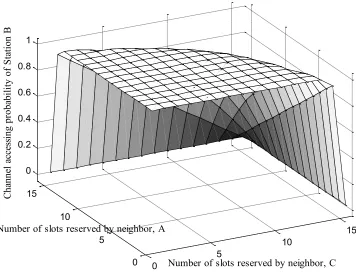
The neighborhood capture problem is observed in a multiple mobile station environment where one station is deprived of accessing the channel captured by its neighbor stations for long time. Let us try to understand the neighborhood capture problem with the scenario in Figure 2-2. This scenario contains six nodes where Node B is in the transmission range of both A and C which are out of the transmission ranges
A
B
C
5
of each other (i.e. the distance between A and C is greater than the transmission range). Moreover E is in the transmission range of A; D is in the transmission range of C; and F is in the transmission range of B.
Figure 2-3 illustrates a data transmission scenario. Suppose B has accessed the channel first and is transmitting data to F as shown in Figure 2-3. After the end of B’s transmission, the channel is free for any of the nodes A, B and C. Now C has data to transmit, and it starts to transmit. At this moment, B does not have a chance to transmit as it is in the transmission range of C, but A is free to use the channel as it is out of transmission range of C. Node A starts transmission as it has data to transmit now. At this moment, the situation of the channel is, if B wants to access the channel, B must have to wait until both A and C release the channel simultaneously, which is almost uncertain because of the variable length of the data transmissions of A and C or asynchronous transmissions. So B is severely affected by its neighbors A and C, and this phenomenon is called “Neighborhood Capture”.
A
E
B
C
D
F
Figure 2-2: Neighborhood capture scenario.
Figure 2-3: Data transmission scenario at the time of neighborhood capture.
2.3
Mobile Hidden Station Problem in MANET or DSRC/WAVE
Systems
6
communication with B with its transmission. Stations like D in the illustrated scenarios are called mobile hidden stations, because they are hidden first, but disturb receptions of the other transmissions when their transmissions interfere with the reception of others. MHSs can affect up to twenty five percent of the nodes in a VANET employed in a highway scenario, if a two-way highway accommodates equally probably distributed vehicle traffic, because stations moving in the opposite direction of the traffic will become MHSs to the stations on the other side of the highway [2]. Analysis provided in this thesis shows that MHSs severely degrade network performance. That is why a MAC protocol must have to solve the MHS problem in mobile networks. ESFRA is proposed to address the MHS problem. It significantly reduces performance degradations due to mobility. HS is solved using request to send (RTS) and clear to send (CTS) messages in the IEEE 802.11 MAC. However, RTS/CTS introduce the ES problem. ESFRA solves these four problems, namely MHS, NC, HS, and ES simultaneously to facilitate improved utilization of scarce mobile network resources. The proposed protocol is based on the sliding frame reservation Aloha (SFRA) [18][19]. Messages in the sliding frame mechanism of SFRA transfer control information up to the second hop neighbors [18]-[20], which is sufficient to solve HS and ES problems. This SFRA control information transfer mechanism alone does not solve the MHS problem because mobile stations at third hops away from the ongoing communication are not informed.
Range, A
Range, B
Range, D
data
data
K
J
H
E
D
G
A
C
I
B
F
J
Range, A
Range, B
Range, D
data
data
A
G
H
E
D
I
C
F
B
v
K
7
2.4
Asymmetric Radio Link Problem in MANET/ VANET and Its
Severity
2.4.1
Asymmetric Radio Link Problem in MANET
Asymmetric links are common in wireless networks [7][9][21]. Figure 2-5 illustrates a scenario to explain ARLs in a mobile network where Station A is sending packets to B, and C and D are HSs because of ARLs. Hardware limitations, power saving protocols, shadowing effects, dynamic spectrum managements causes ARLs in a wireless networks [7][9][21]. Let us consider using IEEE 802.11 MAC protocol in Figure 2-5, hence B’s CTS packet is heard by hidden Station C. As hidden, Station D is out of the transmission range of B, it does not hear B’s CTS, and so D can transmit packets and these packets can collide with A’s transmitted packets at B. Thus, HS problem due to the ARL is not addressed by IEEE 802.11 MAC.
A
Data
B
D, HS
rd
ra
r
bC, HS
Sender
1st Hop
2nd Hop
3rd Hop
Figure 2-5: HS in an asymmetric radio link MANET scenario.
2.4.2
Asymmetric Radio Link Problem in DSRC/WAVE Systems
The DSRC/WAVE systems use different transmission ranges and different data rates for different types of messages as shown in Figure 2-6 [22].
8
Figure 2-7: HSs in an unequal/asymmetric link VANET scenario.
Let us consider a VANET scenario in Figure 2-7 where the radio links are maintained according to the DSRC/WAVE systems. In DSRC systems, an ARL arises when the transmission power of a service channel is varied to support different services with different transmission ranges. For example toll collection service uses about 10 to 90 meters (m) transmission range where as road condition warning services, like work zone warning uses 90 to 300 m transmission range. Similarly, the control channel is used for emergency vehicle warning with transmission range up to 1000 m, and the basic safety message transmissions with transmission range of 300 m. In addition to transmission range differences, ARL can occur with shadowing such as experienced by the car behind the truck in Figure 2-7. In order to address the ARL problem, the control information is required to be distributed up to the 3rd hop nodes as illustrated in Figure 2-5. It is difficult to meet this requirement by an unsynchronized and distributed MAC protocol such as IEEE 802.11 MAC. Some of the synchronized and reservation-based MAC protocols can increase the performance of the network with problems related ARL such as SFRA in [18][19]. However SFRA does not solve ARL problem but reduced its impact in the performance. That is why I have investigated ESFRA proposed in [16] which provides a complete solution to problems caused by ARLs. Mainly, ESFRA passes the control information up to the 3rd hop, thus it eliminates problems related to ARL.
2.5
Research Contributions and Methodology
2.5.1
Research Contributions
- Short-term Objective Based Contributions:
Investigated packet losses due to link failures in MANETs/VANETS.
Developed algorithms to reduce packet losses due to link failures in MANETs/VANETS. Characterized and investigated the neighborhood capture problem in MANETs/VANETS. Characterized and investigated packet losses due to MHSs in MANETs/VANETS.
Developed a new MAC algorithm to solve the MHS and neighborhood capture problems in MANETs/VANETS.
Investigated the new MAC algorithm with discrete time Markov chain (DTMC). Investigated the new MAC algorithm in OMNeT++.
Investigated the cross-layer (i.e. network and MAC layer) behavior of the new MAC algorithm. - Major Contributions:
9
Developed a cross-layer scheme which constitutes the developed MAC algorithm as well as a network layer control on packet losses due to link failures.
2.5.2
Research Methodology
Figure 2-8: Research methodology and accomplishments.
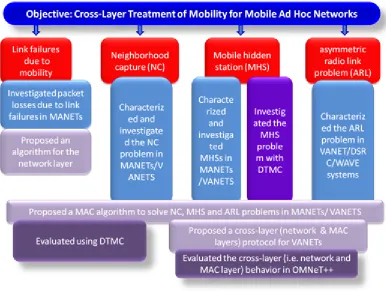
Step 1: Mobility causes packet losses in MANETS. I studied literatures to identify the factors affecting the packet communication when stations are mobile. I found two significant factors: link failures, and mobile hidden stations. Some other factors have drawn my attention along with mobility problems. Those are neighborhood capture and asymmetric/unequal radio link problems. All these four problems (See Figure 2-8) are investigated and solved throughout my research work.
Step 2: In this step, a mobility algorithm is developed in the network layer to reduce packet losses due to link failure [23]. The mobility algorithm is investigated in NS-2, and it was implemented with dynamic source routing (DSR) protocol. The algorithm is applicable to any on-demand routing protocol.
Step 3: The adverse effects of the neighborhood capture problem and mobile hidden station problems in the MAC layer of MANETs are characterized. The NC problem is analyzed using Combinatory theory [8]. The MHS problem is analyzed using both Combinatory theory [24] as well as DTMC [6]. The hidden station problem in a VANET is investigated in [25].
10
Step 5: CESFRA is proposed which is based on ESFRA. CESFRA MAC is evaluated in OMNeT++ with respect to the MHS and ARL problems [28]. The behavior of IEEE 802.11p broadcast and CESFRA MAC is analyzed using DTMC with respect to the criteria set in the DSRC/WAVE systems [28].
Step 6: Completion of the thesis.
11
CHAPTER 3:
RELATED WORK
The research work in this thesis is related to the network and MAC layers. So the literatures reviewed throughout this research work are divided into two sub-sections based on the related communication layers.
3.1
Review of the Impact of Mobility in the Network Layer
A part of this thesis is related to the impact of mobility in the network layer of wireless ad hoc networks. So, some of the mobility related papers are discussed in this sub-section. A model to compute an upper bound for the maximum network size in a MANET is proposed in [29]. According to the analysis presented in [29], a route would die due to mobility after a certain number of hops. A protocol is proposed in [30] for managing MANETs. In this protocol, a small subset of the network nodes, called backbone network, is selected based on the nodes’ statuses. The protocol in [30] operates in two phases: first the “most suitable” nodes are selected to serve as backbone nodes, and then a backbone network is formed by using these nodes. Topology dynamics is investigated in [31] based on the smooth mobility model. The smooth model generates smooth and microscopic nodal movements, and maintains a uniform spatial node distribution. The model predicts link existence based on the present distance between a pair of nodes and their relative speeds. The analysis in [31] reveals that the expected link life time decreases exponentially with increasing mobility. Results presented in [31] were not tested in any protocol. A mobility assessment on-demand (MAOD) routing protocol is proposed to select a stable route in order to enhance system throughput and performance [17]. MAOD is an on-demand routing protocol similar to dynamic source routing (DSR) protocol [32]. The difference between MAOD and DSR isin the path selection method. As MAOD takes the mobility of the hosts into consideration, it selects a more stable route than DSR. In MAOD, an error count parameter is used to measure mobility of a host. However, the error count method has problems in judging the mobility of the nodes because it does not indicate which node is mobile, the node itself or the nodes around it. Even if a node is static, it needs to increase its error count when its neighbors are mobile. A new measure of mobility in which each node estimates at regular time intervals its relative mobility with respect to its neighbors is proposed in [33]. A multicast scheme, on-demand multicast routing protocol (ODMRP) [34], has been recently proposed for MANETs. ODMRP is a reactive (on-demand) protocol that delivers packets to a destination in a mesh topology using scoped flooding of data. ODMRP proposes a method to predict the link expiration time, which is based on a more realistic propagation model, and uses received signal strength indication (RSSI). But, instantaneous RSSI values may not be reliable for fading channels since its fluctuations vary significantly in short time and distances.
3.2
Review of the Behavior of Some Related MAC Protocols
12
with V6’s packets to V7 because Station V4 did not receive any CTS, and it was unaware of V6’s transmission to V7.
Figure 3-1: Mobile hidden station scenario.
IEEE 802.11p is the most recent draft standard which is used in wireless access in vehicular environment (WAVE) [38][4]. Since IEEE 802.11p’s MAC is based on the distributed coordination function (DCF), which does not solve mobility related problems like MHS, or blocking problems like NC. Authors in [39] proposed an adaptive M-ary tree algorithm with priority broadcast (ATPB). This MAC scheme builds a tree that is assumed to be dynamic and adaptive, and prioritizes the stations according to their needs. ATPB is completely based on RTS/CTS, this is why it solves HS and ES problems, but cannot solve the MHS problem. Dual busy tone multiple access (DBTMA) is an asynchronous and distributed scheme, which was proposed in [40] and [41]. The total bandwidth is divided into three channels, one for the transmission of data, and the other two are for busy tones used to inform the neighbors of the sender and the receiver. Consequently, DBTMA creates a collision free zone up to a maximum of two hops from the sender just like IEEE 802.11. Thus it fails to address the NC and MHS problems. Interleaved MAC protocol is a distributed scheme which uses two frequency channels, one for RTS and DATA, and the other for CTS and acknowledgement (ACK) [42]. Thus it solves HS and ES problems, and decreases the blocking probability due to the NC problem, but it does not completely solve the MHS problem. Global channel release (GCR) is a synchronized distributed scheme in which all stations release the channel at the same time, and all contending stations have an equal chance to access the channel [43]. This requires slotting of the channel into super-frames and synchronization of all stations; the resulting protocol would be a slotted CSMA/CA [43]. That is why GCR solves the NC problem, and also solves HS and ES problems by creating a collision free zone similar to IEEE 802.11, but does not address the MHS problem. Synchronous reservation based scheme (i.e. ERA [8], SFRA [44] etc.) solves the access related HS, ES and NC problems, and reduces collisions due to MHSs. All the MAC schemes mentioned above solve HS and ES problems, only the synchronous MAC schemes mentioned above solve the NC problem. Synchronized reservation based MAC schemes mentioned above reduces collisions due to MHSs but do not fully solve the MHS problem. So synchronous reservation based schemes work better to address the MAC problems.
13
undesirable consequences. For example, principle of rate-adaptive MAC protocol [46] is to use higher transmission rates in a good quality channel. In this case, the higher rates are maintained by changing different modulation schemes. The authors in [45] showed that such schemes can have undesirable consequences for the higher layers. When rate-adaptive MAC is used with minimum hop routing, the performances get worse as minimum hop routing uses longer hops for which the signal strength is lower, and thus the rate-adaptive MAC will always choose low rates. The authors in [47], [48]and [49] discussed repetition based protocols for DSRC MAC. Those are asynchronous p-persistent repetition (APR) [47], asynchronous fixed repetition (AFR) [47], synchronous p-persistent repetition (SPR) [48], synchronous fixed repetition (SFR) [48], AFR by adding a carrier sensing (CS) mechanism (AFR-CS) [48], and positive orthogonal codes (POC) [49]. All these protocols are designed without considering the effect of hidden stations and mobile hidden stations which are inherent in vehicular ad hoc communications. The analysis in [48] shows that SPR and SFR perform better than asynchronous protocols (i.e. APR and AFR), and SFR performs better than SPR. The authors in [49] showed that POC works better than SFR. The authors in [50] analyzed the performances of SPR, SFR and POC protocols considering the effect of hidden stations, which shows that these protocols do not meet the minimum requirements for safety critical information dissemination. The authors proposed SFRA in [19], which is developed by CarTALK/FleetNet IVC system in Europe [51], one of the most promising protocols for distributed wireless networks [44]. The author in [52] analyzed the suitability of an R-Aloha based protocol for inter-vehicle communication in multi-hop networks. The dynamic behavior of SFRA is analyzed in [19], [44] and [53]. The authors in [26] analyzed the performance of SFRA considering the adverse effects of MHS and NC problems along with HS and ES problems. This analysis shows that SFRA reduces collisions due to MHSs, but it does not solve the MHS problem in MANETs/VANETs. I have quantitatively measured the behavior of SFRA with ARL problem in [21]. The analysis in [21] shows that the probability of collision increases with the increment of the number of transmitting stations while using SFRA as a MAC protocol. The probability of successful channel accessing is also severely affected by HSs due to ARLs. IEEE 802.11p is the most recent draft standard used in WAVE [12][13]. Since IEEE 802.11p’s MAC is based on the distributed coordination function, which does not solve mobility related problems like MHS, ARL and NC problem according to the analysis in [1], [6] and [8] respectively. Moreover, a quantitative approach presented in [54] shows that the broadcast performance of IEEE 802.11p is inefficient for short safety messaging in DSRC systems.
14
CHAPTER 4:
PROPOSED WORK
The research throughout this thesis is associated to network layer, MAC layer and network-MAC cross layer. So, the proposed work is divided into three sub-sections based on the layer basis contributions.
4.1
Proposed Work in the Network Layer
4.1.1
A Mobility Algorithm to Reduce Packet Loss
The duration of connectivity between two nodes is unlimited for static ad hoc networks whereas it changes with mobility in MANETs. Link failures are inevitable if the nodes are mobile, and get more severe when the mobility of nodes increases. Link failures increase packet loss considerably. In order to reduce the packet loss due to link failures, mobility needs to be integrated in routing protocols. This integration needs to be independent of routing protocols to have an effective solution. However, on-demand routing protocols (i.e. DSR [32], ad hoc on-demand distance vector (AODV) [55]) are considered as the candidate to apply the developed mobility algorithm. The algorithm is based on an efficient use of the duration of connectivity of two neighboring nodes in a route. This duration is called LLT throughout this thesis.
A (xa1, ya1)
v
aθ
a A (xa2, ya2)B(xb1, yb1)
B(xb2, yb2)
v
bθ
bs
r
Figure 4-1: A scenario for calculating LLT.
4.1.1.1 Calculation of Link Life Time
15
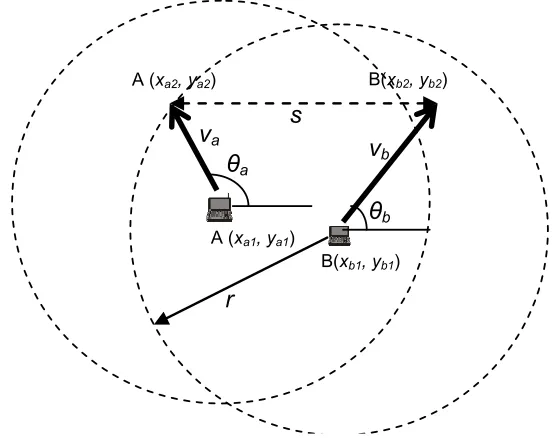
θa and θb, respectively. Their future locations are A(xa2,ya2) and B(xb2,yb2) after some time duration, . It is
assumed that nodes A and B are not changing directions within this time duration, .
If all the information related to their current locations, such as va, θa, vb, θb, xa1, ya1, xb1 and yb1 are
known, their future locations can be calculated using the provided information from known values by the following two functions.
A(xa2,ya2) = f (t, va, θa, xa1,ya1). (4.1.1)
B(xb2,yb2) = f (t, vb, θb, xb1,yb1). (4.1.2)
If the distance between A and B after time t is s, then
s2 = (xa2 – xb2)2 + (ya2 – yb2)2. (4.1.3)
A and B will be able to communicate with each other as long as they will remain within their transmission ranges, r. So, t = LLT if s ≤ r. After solving Equation (4.1.3) with s ≤ r and considering t = LLT, I get
LLT 2 2
2 2
2
2
)
(
)
(
)
(
c
a
bc
ad
r
c
a
cd
ab
, (4.1.4)where,
a
v
acos
a
v
bcos
b,b
x
a1
x
b1,c
v
asin
a
v
bsin
b, andd
y
a1
y
b1.4.1.1.2 Calculation of Adaptive Link Life Time
16
r
aa
A (xa1, ya1)
v
aθa
A (xa2, ya2)B(xb1, yb1)
B(xb2, yb2)
v
bθb
d
r
bFigure 4-2: A scenario for calculating ALLT for asymmetric radio links in a MANET.
In this work, the modified LLT is calculated using the smaller of the two radio ranges as the future distance (i.e. d) between the two mobile nodes. This modified LLT is termed as adaptive LLT (ALLT) throughout this document as it is adaptive to unequal radio ranges of the mobile nodes in any wireless network. I have applied the following algorithm along with the LLT calculation in the previous sub-section to calculate ALLT.
Let,
ra = f (A’s transmit power)
rb = f (B’s transmit power)
If ( rb < ra ) {
ALLT = f (LLT calculated with rb) else if ( ra < rb )
ALLT = f (LLT calculated with ra)
else
ALLT = f (LLT calculated with ra = rb = r)
}
4.1.1.3 Mobility Algorithm
17
delay and throughput. The proposed algorithm solves the mobility related routing problems and comprises the following 4 steps.
Step 1: Source estimates a minimum threshold link life time: In any on-demand routing protocol like DSR, routes that are used for sending data packets are discovered based on some requirements (i.e., routing metrics). In the proposed mobility algorithm, the source uses a minimum threshold link life time (TLLT) to discover more stable links and routes. The source estimates TLLT based on the nature of mobility (i.e. urban area or highway). Unlike highway, random mobility scenario prevails in urban area. Statistically more than twenty percent of the routes in a random mobility scenario die out within few seconds [57]. Routes in a highway mobility scenario are more stable compared to routes in a random mobility scenario. Thus, TLLT can be set higher for highways compared to a random mobility scenario. TLLT in a random mobility scenario can be set higher for low speeds compared to high speeds.
Step 2: Using TLLT in route discovery process to detect unstable routes: In case of any on-demand routing protocol, whenever the source has a packet to send, it searches a route in the route cache. If there is no route available in the cache, the node sends a route discovery packet to a desired destination. In the proposed algorithm, the source sends TLLT in the route discovery packet.
Figure 4-3: Discarding unstable routes.
Each node along the path toward the destination calculates its own LLT with the previous node, and compares the calculated LLT with the TLLT in the packet. If the calculated LLT is greater than the TLLT of the packet, this node becomes a part of the route. Otherwise, it is not included in the route. Figure 4-3 illustrates a simple scenario where the source sends a route discovery packet with TLLT = 5 seconds. MN 2 and MN 4 agree to be part of the route comparing their LLTs. But, MN 6 refrains becoming part of the route since its LLT is lower than the TLLT. The described provision prevents discovering routes that have less stable links.
18
RLTnet = RLT–troute. (4.1.5)
The source stores the RLTnet, and the troute in the route cache. troute is considered average latency between source and destination, which will be used to calculate how many packets are supposed to be successfully transferred from source to destination.
Step 4: Algorithm for reducing packet loss due to mobility using RLT: The route discovery process with mobility assisted routing is explained in Step 3. Whenever there is a packet to send, the source finds a route from the route cache, and sends an estimated number of packets that the respective route is able to deliver before breaking. Latency between source and destination, troute, is important as well. That is needed to estimate the number of packets that can be sent by the source to the destination. Let us assume Nest be the estimated number of packets to be sent through that route, and given by
Nest = RLTnet/ troute . (4.1.6)
According to Equation (4.1.6), the selected route remains alive during RLTnet, and within this RLTnet, the source will be able to send approximately Nest number of packets. If the source sends more than Nest
packets, the additional packets have higher probability of getting lost due to the broken route. After finding
Nest, the packets are sent in order. If there are more packets to be sent, the source finds an alternative route from the route cache, and repeats the process for this route by calculating its Nest. If there is no route available in the route cache, the source starts the route discovery process. Figure 4-4 provides the flowchart of the algorithm.
19 4.1.1.4 System Model and Implementation
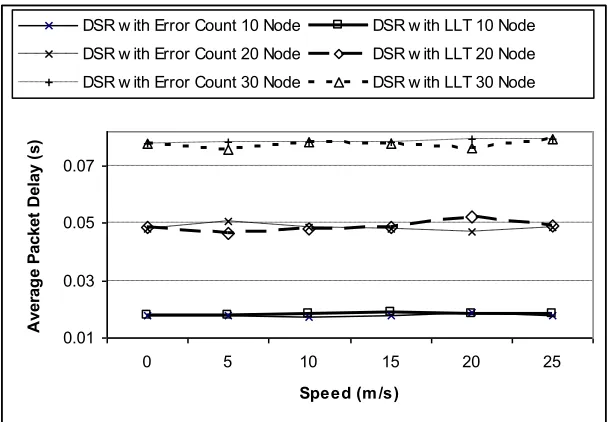
MANETs with 10, 20 and 30 nodes are considered for testing the proposed algorithm. Each node in this network is considered to be equipped with global positioning system (GPS) (or any other positioning service) which is capable of providing the current location, direction of movement, as well as the current velocity of the mobile node. Packet losses occur in two ways (i.e. due to link failures and due to collisions [58]), and the emphasis here is given to reduce packet losses due to link failures. I have created two routes from source to destination that can be broken and reconnected continuously. These scenarios were tested with Network Simulator version 2.33 (NS-2) [59] in SuSE linux. According to the implementation, each node is using an omni-directional antenna with a height of 1.5 meters. Two ray ground reflection propagation model is chosen for radio propagation, and the path loss factor is four. The nodes are sharing the same channel for the packet transmission, and IEEE 802.11 [60] is used as the multiple access technique. Constant bit rate (CBR) traffic is used as the traffic mode at the source, and it is producing 512 byte data packets. User datagram protocol (UDP) is used as a transport layer protocol. Loss monitor is used at the destinations to monitor and measure the observed parameters at the end of each transmission. The simulations were run 200 seconds each time. I have used DSR as a routing layer protocol, and DSR is combined with the proposed mobility algorithm. I have considered four modifications in the route discovery phase of DSR protocol. First, whenever a node receives a route discovery packet, it calculates LLT with its previous node. Second, each route discovery packet contains a TLLT value assigned by the source. Any node that receives a route discovery packet compares its calculated LLT with the TLLT in the packet, and drops the packet if the LLT is less than the TLLT. Third, the RLT of the discovered route is estimated with the minimum of the LLT values of the nodes along the route. Fourth, the destination calculates latency of each route, and sends this to the source through route reply packet. In data transmission phase, the source finds the shortest route according to the principle of DSR. Then, the source estimates the approximate number of packets to be sent using the RLT and latency of the corresponding route. That provision reduces packet loss due to link failures. I call this implementation “DSR with LLT”.
The proposed mobility algorithm in this section will be analyzed in Sub-section 5.1. The next sub-section contains the proposed algorithms in the MAC layer of a MANET/VANET.
4.2
Proposed Work in the MAC Layer
Some MAC problems (i.e. HS, ES, MHS, NC, ARL etc.) in the MAC layer of ad hoc networks can be solved with R-Aloha based MACs. Transmission of special type of control messages through the frames gives a very good opportunity to save the radio channel from neighborhood capture. The proposed MAC protocols are discussed in this sub-section. Before going to the proposed MAC protocols, a brief view of the Reservation Aloha is presented in the next sub-section.
4.2.1
A View of Reservation ALOHA
20
Unused, which means that it was empty (previously not used) or instantly vacant due to a collision among several packets. Used, which means that exactly one packet was transmitted in a slot and the packet was successfully received (it is assumed that the channel is error-free except for collisions).
The transmission rules in R-Aloha are as follows-
If slot had a successful transmission by user X in the previous frame, slot is not available to anyone except user X in the current frame. Slot is said to be reserved by user X. Note that user X has exclusive access to slot m as long as it continues to transmit a packet into in every frame.
Those slots in the last frame, which were unused, are available for contention by all users according to the adaptive algorithm.
4.2.2
The Proposed MAC Protocol: Extended R-Aloha (ERA)
The traditional R-Aloha is not enough to remove the access related problems (i.e. HS, ES and NC problems) in ad hoc networks. I have modified the R-Aloha, called extended reservation Aloha, to use it with ad hoc networks. The basic modifications that I have made to the traditional R-Aloha are described in the following three steps.
1) Two stations under a communication are using the same slot in different frames one after another. They are establishing a bi-directional TDD connection sharing the same slot in the consecutive frames. 2) Any of the two stations is using one slot and reserving the same slot in the subsequent frame which will
be used by the other station.
3) Any of the two stations using one slot in the current frame and reserving the same slot in the next two subsequent frames.
As shown in Figure 4-5, station A is transmitting to station B. Station C is out of detection range of A. So C may be a HS to A during ongoing communication. Again station D is inside the detection range of A. So D may be an ES to A during ongoing communication. ERA has been explained using the scenario in Figure 4-5, described how it solves the HS and ES problems, provided that the above three modifications are applied here.
D A B C
Data
ACK
Figure 4-5: ERA to hidden station and exposed station.
(1) If A and B use different slots in the same frame or different frames it is difficult to inform C about A’s reservation and D about B’s reservation. If A and B use the same slot in every frame one after another as shown in Figure 4-6, this problem is solved, and thus C knows about A’s reservation from B’s reservation.
1 2 3 4 m 1 2 3 4 m 1 2 3
A B A
fi fi+1 fi+2
Reservation
21
(2) Station A has seized slot 2 of frame i for the communication with station B. It is using this slot as well as reserving slot 2 of frame i+1 as shown in Figure 4-6 (follow the unidirectional arrow). According to modification (1) station B is bound to use the same slot (i.e. slot 2) in the frame i+1. So B is using slot 2 of frame i+1 and according to modification (2), it is reserving slot 2 of frame i+2.
According to modification (2), after A’s transmission using slot 2 of frame i, D knows about A’s reservation of slot 2 in frame i+1. When B sends acknowledgement to A using slot 2 of frame i+1, C works as ES, and there is no problem from D (HS to B). After B’s transmission using slot 2 of frame i+1, C knows about B’s reservation of slot 2 in frame i+2. When A sends data to B using slot 2 of frame i+2, D works as ES, and there is no problem from C (HS to A). If the transmission continues in this way, then it confirms the solution of the HS problem, but not of the ES problem.
1 2 3 4 m 1 2 3 4 m 1 2 3
A B A
fi fi+1 fi+2
Reservation
Figure 4-7: Extended reservation scenario in ERA.
(3) Station A has seized slot 2 of frame i for the communication with Station B. It is using this slot and reserving slot 2 of frame i+1 as well as slot 2 of frame i+2 at the same time as shown in Figure 4-7 (See the unidirectional arrow). All stations follow the same rules.
According to modification (3), after A’s transmission using slot 2 of frame i, D knows about A’s reservation of slot 2 in frames i+1 and i+2. When B sends acknowledgement to A using slot 2 of frame i+1, C works as ES and no problem from D (HS to B). After B’s transmission using slot 2 of frame i+1, C knows about B’s reservation of slot 2 in frames i+2 and i+3. When A sends data to B using slot 2 of frame i+2, there is no problem from D (ES to A) and C (HS to A). If the transmission continues in this way it confirms the solution of both HS and ES problems.
4.2.3
The Proposed MAC Protocol: Extended Sliding Frame R-Aloha (ESFRA)
ESFRA is based on SFRA, and accordingly SFRA will be briefly presented here in order to understand some reasons why ESFRA is superior for mobility.
4.2.3.1 Sliding Frame Reservation-Aloha
In SFRA protocol [18], the channel time is divided into time slots, which are grouped to form a frame. Each frame is assumed to contain N slots. The basic mechanism of the protocol is described in the following steps:
At start up, each station acquires one slot as its basic channel (BC) to transmit its packet, which contains a payload and a field called frame information (FI).
Stations reserve BCs as long as they are active. SFRA uses the FI field to distribute stations’ view of the statuses of the slots, whether the slots are busy or free. Each station records the statuses of the previous
N slots, which is called a sliding frame (SF).
At each slot, the received FI is used to update the statuses of the following N slots of the SF. In this way, a station knows the communication statuses of the stations up to 2 hops away. So, the stations positioned at least three hops apart can reuse the busy slots. With this, SFRA solves hidden and exposed station problems.
22
Figure 4-8 is provided to illustrate how SFRA works using a scenario. There are 4 stations in this scenario; the stations are labeled as S1, S2, S3, and S4; where S1 is sending data to S2, and S4 is moving
towards S3. Busy slots are labeled as “B”, and free slots are labeled as “FR”.
S
1S
2S
3S
4S
1S
2S
3S
4B
FR FR FR S
1B
FR FR
B
S
2B
FR FR
B
S
3FR FR FR
B
S
4S
1S
2S
3S
4f
zf
z+1FI-S
1FI-S
2FI-S
3FI-S
4Figure 4-8: Sliding frame scenario of SFRA.
Let us assume that all stations are using only their BCs for both FI and data transmissions. All the stations, S1, S2, S3, and S4, have reserved their BCs. S1’s FI informs all the stations around S1 about the slots
that are used by S1. Similarly, S2’s FI informs all the stations around S2 about the slots that are used by S2.
Thus, S2’s FI contains the statuses of the slots reserved by both S1 and S2. Also, as S3 receives S2’s FI, it
knows the slots used by S1 and S2. As a result S3, which is a hidden station to S1, avoids using those slots
for its transmission, which prevents the collisions at S2.
According to SFRA, S4 knows the slots used by Stations S2 and S3 from FI of S3 but it does not know
about S1’s reservation. While transmitting to any other station, S4 can move to the transmission range of S2,
which causes collisions at S2.
4.2.3.2 Principles of Extended Sliding Frame R-Aloha
ESFRA is based on SFRA, and designed to solve the MHS problem. However, the FIs in ESFRA uniquely inform relative positions of the stations in addition to the status of a slot. With this modification, stations learn if a busy slot belongs to an immediate neighboring station or to a station which is 2 or 3 hops away. Another modification introduced with ESFRA is the access to the free slot, where the free slots are open to contention to allow the mobile stations access to the medium. There can be collisions in this contention period but the collisions are contained in this free slot, and do not happen in the busy slots. With these modifications, ESFRA handles the mobility much better than SFRA. Properties of ESFRA are described as follows: