Improving Text Retrieval Precision and
Answer Accuracy in Question Answering Systems
Matthew W. Bilotti and Eric Nyberg Language Technologies Institute
Carnegie Mellon University 5000 Forbes Avenue Pittsburgh, PA 15213 USA
{ mbilotti, ehn }@cs.cmu.edu
Abstract
Question Answering (QA) systems are of-ten built modularly, with a text retrieval component feeding forward into an answer extraction component. Conventional wis-dom suggests that, the higher the quality of the retrieval results used as input to the an-swer extraction module, the better the ex-tracted answers, and hence system accu-racy, will be. This turns out to be a poor assumption, because text retrieval and an-swer extraction are tightly coupled. Im-provements in retrieval quality can be lost at the answer extraction module, which can not necessarily recognize the additional answer candidates provided by improved retrieval. Going forward, to improve ac-curacy on the QA task, systems will need greater coordination between text retrieval and answer extraction modules.
1 Introduction
The task of Question Answering (QA) involves taking a question phrased in natural human lan-guage and locating specific answers to that ques-tion expressed within a text collecques-tion. Regard-less of system architecture, or whether the sys-tem is operating over a closed text collection or the web, most QA systems use text retrieval as a first step to narrow the search space for the an-swer to the question to a subset of the text col-lection (Hirschman and Gaizauskas, 2001). The remainder of the QA process amounts to a gradual narrowing of the search space, using successively more finely-grained filters to extract, validate and present one or more answers to the question.
c
2008. Licensed under the Creative Commons
Attribution-Noncommercial-Share Alike 3.0 Unported
li-cense (http://creativecommons.org/licenses/by-nc-sa/3.0/). Some rights reserved.
Perhaps the most popular system architecture in the QA research community is the modular archi-tecture, in most variations of which, text retrieval is represented as a separate component, isolated by a software abstraction from question analysis and answer extraction mechanisms. The widely-accepted pipelined modular architecture imposes a strict linear ordering on the system’s control flow, with the analysis of the input question used as in-put to the text retrieval module, and the retrieved results feeding into the downstream answer extrac-tion components.
Proponents of the modular architecture naturally view the QA task as decomposable, and to a cer-tain extent, it is. The modules, however, can never be fully decoupled, because question analysis and answer extraction components, at least, depend on a common representation for answers and perhaps also a common set of text processing tools. This dependency is necessary to enable the answer ex-traction mechanism to determine whether answers exist in retrieved text, by analyzing it and compar-ing it against the question analysis module’s an-swer specification. In practice, the text retrieval component does not use the common representa-tion for scoring text; either the quesrepresenta-tion analysis module or an explicit query formulation compo-nent maps it into a representation queryable by the text retrieval component.
The pipelined modular QA system architecture also carries with it an assumption about the com-positionality of the components. It is easy to ob-serve that errors cascade as the QA process moves through downstream modules, and this leads to the intuition that maximizing performance of individ-ual modules minimizes the error at each stage of the pipeline, which, in turn, should maximize over-all end-to-end system accuracy.
It is a good idea to pause to question what this intuition is telling us. Is end-to-end QA system performance really a linear function of individual
[ARG0[PERSONJohn]] [TARGETloves] [ARG1[PERSONMary]]
Figure 1: Example OpenEphyra semantic representation for the sentence, John loves Mary. Note that John is identified as the ARG0, the agent, or doer, of the love action. Mary is identified as the ARG1, the patient, or to whom the love action is being done. Both John and Mary are also identified as PERSON
named entity types.
components? Is component performance really ad-ditive? This paper argues that the answer is no, not in general, and offers the counterexample of a high-precision text retrieval system that can check constraints against the common representation at retrieval time, which is integrated into a publicly-available pipelined modular QA system that is oth-erwise unchanged.
Ignoring the dependency between the answer extraction mechanism and the text retrieval com-ponent creates a problem. The answer extraction module is not able to handle the more sophisti-cated types of matches provided by the improved text retrieval module, and so it ignores them, leav-ing end-to-end system performance largely un-changed. The lesson learned is that a module im-proved in isolation does not necessarily provide an improvement in end-to-end system accuracy, and the paper concludes with recommendations for fur-ther research in bringing text retrieval and answer extraction closer together.
2 Improving Text Retrieval in Isolation
This section documents an attempt to improve the performance of a QA system by substituting its existing text retrieval component with for high-precision retrieval system capable of checking lin-guistic and semantic constraints at retrieval time.
2.1 The OpenEphyra QA System
OpenEphyra is the freely-available, open-source version of the Ephyra1 QA system (Schlaefer et al., 2006; Schlaefer et al., 2007). OpenEphyra is a pipelined modular QA system having four stages: question analysis, query generation, search and an-swer extraction and selection. OpenEphyra also includes support for answer projection, or the use of the web to find answers to the question, which are then used to find supporting text in the cor-pus. Answer projection support was disabled for the purposes of this paper.
1
See:http://www.ephyra.info
The common representation in OpenEphyra is a verb predicate-argument structure, augmented with named entity types, in which verb arguments are labeled with semantic roles in the style of Prop-Bank (Kingsbury et al., 2002). This feature re-quires the separate download2of a semantic parser called ASSERT (Pradhan et al., 2004), which was trained on PropBank. See Figure 1 for an example representation for the sentence, John loves Mary.
OpenEphyra comes packaged with standard baseline methods for answer extraction and se-lection. For example, it extracts answers from retrieved text based on named entity instances matching the expected answer type as determined by the question analysis module. It can also look for predicate-argument structures that match the question structure, and can extract the argument corresponding to the argument in the question rep-resenting the interrogative phrase. OpenEphyra’s default answer selection algorithm filters out an-swers containing question keyterms, merges sub-sets, and combines scores of duplicate answers.
2.2 Test Collection
The corpus used in this experiment is the AQUAINT corpus (Graff, 2002), the standard corpus for the TREC3 QA evaluations held in 2002 through 2005. The corpus was prepared using MXTerminator (Reynar and Ratnaparkhi, 1997) for sentence segmentation, BBN Identi-finder (Bikel et al., 1999) for named entity recog-nition, as well as the aforementioned ASSERT for identification of verb predicate-argument struc-tures and PropBank-style semantic role labeling of the arguments.
The test collection consists of 109 questions from the QA track at TREC 2002 with extensive document-level relevance judgments (Bilotti et al., 2004; Lin and Katz, 2006) over the AQUAINT corpus. A set of sentence-level judgments was
pre-2
See:http://www.cemantix.org
3
Existing query #combine[sentence]( #any:person first person reach south pole )
Top-ranked result Dufek became the first person to land an airplane at the South Pole. Second-ranked result He reached the North Pole in 1991.
High-precision query #combine[sentence]( #max( #combine[target]( scored #max( #combine[./arg1]( #any:person ))
#max( #combine[./arg2](
#max( #combine[target]( reach
#max( #combine[./arg1]( south pole )))))))))
Top-ranked result [ARG1Norwegian explorer [PERSONRoald Admundsen]] [TARGETbecomes]
(relevant) [ARG2[ARG0first man] to [TARGETreach] [ARG1[LOCATIONSouth Pole]]]
Figure 2: Retrieval comparison between OpenEphrya’s existing text retrieval component, and the high-precision version it was a replaced with, for question 1475, Who was the first person to reach the South Pole? Note that the top two results retrieved by the existing text retrieval component are not relevant, and the top result from the high-precision component is relevant. The existing component does retrieve this answer-bearing sentence, but ranks it third.
pared by manually determining whether each sen-tence matching the TREC-provided answer pattern for a given question was answer-bearing according to the definition that an answer-bearing sentence completely contains and supports the answer to the question, without requiring inference or aggrega-tion outside of that sentence. Quesaggrega-tions without any answer-bearing sentences were removed from the test collection, leaving 91 questions.
Questions were manually reformulated so that they contain predicates. For example, question 1432, Where is Devil’s Tower? was changed to Where is Devil’s Tower located?, because AS-SERT does not cover verbs, including be and have, that do not occur in its training data. Hand-corrected ASSERT parses for each question were were cached in the question analysis module. Re-formulated questions are used as input to both the existing and high-precision text retrieval modules, to avoid advantaging one system over the other.
2.3 High-Precision Text Retrieval
OpenEphyra’s existing text retrieval module was replaced with a high-precision text retrieval sys-tem based on a locally-modified version of the In-dri (Strohman et al., 2005) search engine, a part of the open-source Lemur toolkit4. While the existing version of the text retrieval component supports querying on keyterms, phrases and placeholders
4
See:http://www.lemurproject.org
for named entity types, the high-precision version also supports retrieval-time constraint-checking against the semantic representation based on verb predicate-argument structures, PropBank-style se-mantic role labels, and named entity recognition.
To make use of this expanded text retrieval ca-pability, OpenEphyra’s query formulation module was changed to source pre-prepared Indri queries that encode using structured query operators the predicate-argument and named entity constraints that match the answer-bearing sentences for each question. If questions have multiple queries asso-ciated with them, each query is evaluated individu-ally, with the resulting ranked lists fused by Round Robin (Voorhees et al., 1994). Round Robin, which merges ranked lists by taking the top-ranked element from each list in order followed by lower-ranking elements, was chosen because Indri, the underlying retrieval engine, gives different queries scores that are not comparable in general, making it difficult to choose a fusion method that uses re-trieval engine score as a feature.
se-mantic role labels and named entities are shown. The high-precision text retrieval module sup-ports storing of extents representing sentences, tar-get verbs and arguments and named entity types as fields in the index. At query time, con-straints on these fields can be checked using struc-tured query operators. The queries in Figure 2 are shown in Indri syntax. Both queries begin
with #combine[sentence], which instructs
Indri to score and rank sentence extents, rather than entire documents. The query for the ex-isting text retrieval component contains keyterms as well an #any:type operator that matches in-stances of the expected answer type, which in this case is person. The high-precision query encodes a verb predicate-argument structure. The nested
#combine[target]operator scores a sentence
by the predicate-argument structures it contains.
The#combine[./role]operators are used to
in-dicate constraints on specific argument roles. The dot-slash syntax tells Indri that the argument ex-tents are related to but not enclosed by the target extent. Throughout, the#maxoperator is used to select the best matching extent in the event that more than one satisfy the constraints.
Figure 3 compares average precision at the top twenty ranks over the entire question set between OpenEphyra’s existing text retrieval module and the high-precision text retrieval module, showing that the latter performs better.
2.4 Results
To determine what effect improving text retrieval quality has on the end-to-end QA system, it suf-fices to run the system on the entire test collection,
0 0.05 0.1 0.15 0.2 0.25 0.3 0.35 0.4 0.45 0.5
1 6 11 16
High-precision Existing
Rank
A
ve
ra
g
e
P
re
c
is
io
n
a
t
R
a
n
[image:4.595.81.284.573.702.2]k
Figure 3: Comparison of average precision at top twenty ranks between OpenEphyra’s existing text retrieval module, and the high-precision version that took its place.
replace the text retrieval component with the high-precision version while holding the other modules constant, and repeat the test run. Table 1 summa-rizes the MAP, average end-to-end system accu-racy (whether the top-ranked returned answer is correct), and the mean reciprocal rank (MRR) of the correct answer (one over the rank at which the correct answer is returned). If the correct answer to a question is returned beyond rank twenty, the reciprocal rank for that question is considered to be zero.
Table 1: Summary of end-to-end QA system ac-curacy and MRR when the existing text retrieval module is replaced with a high-precision version
Retrieval MAP Accuracy MRR
Existing 0.3234 0.1099 0.2080
High-precision 0.5487 0.1319 0.2020
Table 1 shows that, despite the improvement in average precision, the end-to-end system did not realize a significant improvement in accuracy or MRR. Viewed in the aggregate, the results are dis-couraging, because it seems that the performance gains realized after the text retrieval stage of the pipeline are lost in downstream answer extraction components.
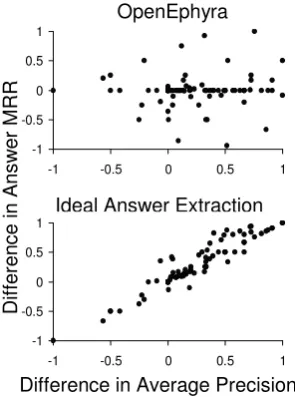
Figure 4 compares OpenEphyra both before and after the integration of the high-precision text re-trieval component on the basis of average precision and answer MRR. The horizontal axis plots the dif-ference in average precision; a value of positive one indicates that the high-precision version of the module was perfect, ranking all answer-bearing sentences at the top of the ranked list, and that the existing version retrieved no relevant text at all. Negative one indicates the reverse. The vertical axis plots the difference in answer MRR. As be-fore, positive one indicates that the high-precision component led the system to rank the correct an-swer first, and the existing component did not, and negative one indicates the reverse. The zero point on each axis is where the high-precision and ex-isting text retrieval components performed equally well.
cre--1 -0.5 0 0.5 1
-1 -0.5 0 0.5 1
Difference in Average Precision Ideal Answer Extraction
OpenEphyra
D
if
fe
re
n
c
e
i
n
A
n
s
w
e
r
M
R
R
-1 -0.5 0 0.5 1
[image:5.595.107.255.71.270.2]-1 -0.5 0 0.5 1
Figure 4: Scatter plot comparing the difference in average precision between the high-precision re-trieval component and the existing rere-trieval com-ponent on the horizontal axis, to the difference in answer MRR on the vertical axis. Ideally, there would be a high correlation between the two; as av-erage precision improves, so should answer MRR.
ated by assuming that the answer extraction mod-ule could successfully extract answers without er-ror from all answer-bearing sentences returned by the text retrieval component.
Interestingly, actual extraction performance, shown in the top portion of Figure 4, bears lit-tle resemblance to the ideal. Note the large con-centration of data points along the line represent-ing zero difference in answer MRR. This indicates that, regardless of improvement in average pre-cision of the results coming out of the retrieval module, the downstream answer extraction perfor-mance remains the same as it was when the ex-isting text retrieval component was in use. This occurs because the answer extraction module does not know how to extract answers from some of the types of answer-bearing sentences retrieved by the high-precision version of the retrieval module and not by the existing version.
There are several data points in the top right-hand quadrant of the top half of Figure 4, indicat-ing that for some questions, answer extraction was able to improve as average precision improved. This is likely due to better rankings for types of answer-bearing sentences that answer extraction already knows how to handle. Data points occur-ring in the lower right-hand portion of the graph
in-dicate depressed answer extraction performance as average precision is increasing. This phenomenon can be explained by the higher-precision text re-trieval module ranking answer-bearing sentences that answer extraction can not handle ahead of those that it can handle.
3 Failure Analysis
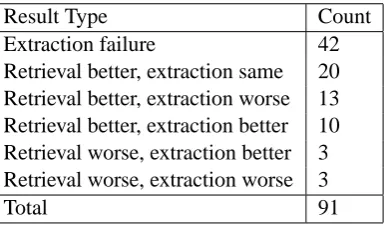
The results presented in the previous section con-firm that an improvement made to the text retrieval component, in isolation, without a corresponding improvement to the downstream answer extraction modules, can fail to translate into a corresponding improvement in end-to-end QA system accuracy. The increased average precision in the retrieved re-sults is coming in the form of answer-bearing sen-tences of types that the answer extraction machin-ery does not know how to handle. To address this gap in answer extraction coverage, it is first nec-essary to examine examples of the types of errors made by the OpenEphyra answer extraction mod-ule, summarized in Table 2.
Question 1497, What was the original name be-fore “The Star Spangled Banner”? is an exam-ple of a question for which OpenEphyra’s answer extraction machinery failed outright. An answer-bearing sentence was retrieved, however, contain-ing the answer inside a quoted phrase: His poem was titled “Defense of Fort M’Henry” and by November 1814 had been published as “The Star-Spangled Banner”. The expected answer type of this question does not match a commonly-used named entity type, so OpenEphrya’s named entity-based answer extractor found no candidates in this sentence. Predicate-argument structure-based an-swer extraction fails as well because the old and new names do not appear within the same struc-ture. Because OpenEphyra does not include sup-port for positing quoted phrases as answer candi-dates, no answer to this question can be found de-spite the fact that an answer-bearing sentence was retrieved.
Table 2: Summary of end-to-end QA system results on the question set
Result Type Count
Extraction failure 42
Retrieval better, extraction same 20 Retrieval better, extraction worse 13 Retrieval better, extraction better 10 Retrieval worse, extraction better 3 Retrieval worse, extraction worse 3
Total 91
moves up only one rank in the system output. For ten questions, extraction performance does improve as average precision improves. Ques-tion 1409, Which vintage rock and roll singer was known as “The Killer”? For each of these ques-tions, OpenEphyra’s existing text retrieval module could not rank an answer-bearing sentence highly or retrieve one at all. Adding the high-precision version of the text retrieval component solved this problem. In each case, named entity-based swer extraction was able extract the correct an-swer. These eleven questions range over a variety of answer types, and have little in common except for the fact that there are relatively few answer-bearing sentences in the corpus, and large numbers of documents matched by a bag-of-words query formulated using the keyterms from the question.
There are three questions for which extraction performance degrades as retrieval performance de-grades. Question 1463, What is the North Korean national anthem? is an example. In this case, there is only one relevant sentence, and, owing to an annotation error, it has a predicate-argument structure that is very generic, having North Korea as the only argument: Some of the North Korean coaches broke into tears as the North’s anthem, the Patriotic Song, played. The high-precision re-trieval component retrieved a large number of sen-tences matching the that predicate-argument struc-ture, but ranked the one answer-bearing sentence very low.
Some questions actually worsened in terms of the reciprocal rank of the correct answer when av-erage precision improved. An example is question 1504, Where is the Salton Sea? The high-precision text retrieval module ranked answer-bearing sen-tences such as The combination could go a long way to removing much of the pesticides, fertilizers, raw sewage carried by the river into the Salton Sea, the largest lake in California, but a failure
of the named entity recognition tool did not iden-tify California as an instance of the expected an-swer type, and therefore it was ignored. Sen-tences describing other seas near other locations provided answers such as Central Asia, Russia, Turkey and Ukraine that were ranked ahead of Cal-ifornia, which was eventually extracted from an-other answer-bearing sentence.
And finally, for some questions, high-precision retrieval was more of a hindrance than a help, retrieving more noise than answer-bearing sen-tences. A question for which this is true is ques-tion 1470, When did president Herbert Hoover die? The high-precision text retrieval module uses a predicate-argument structure to match the target verb die, theme Hoover and a date instance oc-curring in a temporal adjunct. Interestingly, the text collection contains a great deal of die struc-tures that match partially, including those referring to deaths of presidents of other nations, and those referring to the death of J. Edgar Hoover, who was not a U.S. president but the first director of the U.S. Federal Bureau of Investigation (FBI). False posi-tives such as these serve to push the true answer down on the ranked list of answers coming out of the QA system.
4 Improving Answer Extraction
The answer extraction and selection algorithms packaged with OpenEphyra are widely-accepted baselines, but are not sophisticated enough to extract answer candidates from the additional answer-bearing text retrieved by the high-precision text retrieval module, which can check linguistic and semantic constraints at query time.
year did South Dakota become a state? Given that the corpus consists of newswire text report-ing on current events, years that are contempo-rary to the corpus often co-occur with the ques-tion focus, as in the following sentence, Monaghan also seized about $87,000 from a Santee account in South Dakota in 1997. Of the top twenty an-swers returned for this question, all but four are contemporary to the corpus or in the future. Min-imal sanity-checking on candidate answers could save the system the embarrassment of returning a date in the future as the answer. Going one step further would involve using external sources to de-termine that 1997 is too recent to be the year a state was admitted to the union.
OpenEphyra’s predicate-argument structure-based answer extraction algorithm can avoid some of these noisy answers by comparing some constraints from the question against the retrieved text and only extracting answers if the constraints are satisfied. Consider question 1493, When was Davy Crockett born? One relevant sentence says Crockett was born Aug. 17, 1786, in what is now eastern Tennessee, and moved to Lawrenceburg in 1817. The SRL answer extraction algorithm extracts Aug. 17, 1786 because it is located in an argument labeled argm-tmp with respect to the verb, and ignores the other date in the sentence, 1817. The named entity-based answer extraction approach proposes both dates as answer candi-dates, but the redundancy-based answer selection prefers 1786.
The predicate-argument structure-based answer extraction algorithm is limited because it only ex-tracts arguments from text that shares the structure as the question. The high-precision text retrieval approach is actually able to retrieve additional answer-bearing sentences with different predicate-argument structures from the question, but answer extraction is not able to make use of it. Consider the sentence, At the time of his 100 point game with the Philadelphia Warriors in 1962, Chamberlain was renting an apartment in New York. Though this sentence answers the question What year did Wilt Chamberlain score 100 points?, its predicate-argument structure is different from that of the question, and predicate-argument structure-based answer extraction will ignore this result because it does not contain a score verb.
In addition to answer extraction, end-to-end per-formance could be improved by focusing on
an-swer selection. OpenEphyra does not include sup-port for sanity-checking the answers it returns, and its default answer selection mechanism is redundancy-based. As a result, nonsensical an-swers are occasionally retrieved, such as moon for question 1474, What is the lowest point on Earth? Sophisticated approaches, however, do ex-ist for answer validation and justification, includ-ing use of resources such as gazetteers and ontolo-gies (Buscaldi and Rosso, 2006), Wikipedia (Xu et al., 2002), the Web (Magnini et al., 2002), and combinations of the above (Ko et al., 2007).
5 Conclusions
This paper set out to challenge the assumption of compositionality in pipelined modular QA systems that suggests that an improvement in an individual module should lead to an improvement in the over-all end-to-end system performance. An attempt was made to validate the assumption by showing an improvement in the end-to-end system accu-racy of an off-the-shelf QA system by substitut-ing its existsubstitut-ing text retrieval component for a high-precision retrieval component capable of checking linguistic and semantic constraints at query time. End-to-end system accuracy remained roughly un-changed because the downstream answer extrac-tion components were not able to extract answers from the types of the answer-bearing sentences re-turned by the improved retrieval module.
The reality of QA systems is that there is a high level of coupling between the different system components. Ideally, text retrieval should have an understanding of the kinds of results that answer extraction is able to utilize to extract answers, and should not offer text beyond the capabilities of the downstream modules. Similarly, question analy-sis and answer extraction should be agreeing on a common representation for what constitutes an answer to the question so that answer extraction can use that information to locate answers in re-trieved text. When a retrieval module is available that is capable of making use of the semantic rep-resentation of the answer, it should do so, but an-swer extraction needs to know what it can assume about incoming results so that it does not have to re-check constraints already guaranteed to hold.
the answer is narrowed down to a subset of the text collection, anything not retrieved text can not be searched for answers in downstream modules. Equally important is the role of answer extraction. Even the most relevant retrieved text is useless to a QA system unless answers can be extracted from it. End-to-end QA system performance can not be improved by improving text retrieval quality in isolation. Improvements in answer extraction must keep pace with progress on text retrieval tech-niques to reduce errors resulting from a mismatch in capabilities. Going forward, research on the lin-guistic and semantic constraint-checking capabili-ties of text retrieval systems to support the QA task can drive research in answer extraction techniques, and in QA systems in general.
References
Bikel, D., R. Schwartz, and R. Weischedel. 1999. An algorithm that learns what’s in a name. Machine Learning, 34(1–3):211–231.
Bilotti, M., B. Katz, and J. Lin. 2004. What works bet-ter for question answering: Stemming or morpholog-ical query expansion? In Proceedings of the
Infor-mation Retrieval for Question Answering (IR4QA) Workshop at SIGIR 2004.
Bilotti, M., P. Ogilvie, J. Callan, and E. Nyberg. 2007. Structured retrieval for question answering. In
Pro-ceedings of the 30th Annual International ACM SI-GIR Conference on Research and Development in In-formation Retrieval.
Buscaldi, D. and P. Rosso. 2006. Mining knowledge from wikipedia for the question answering task. In
Proceedings of the International Conference on Lan-guage Resources and Evaluation.
Cui, H., R. Sun, K. Li, M. Kan, and T. Chua. 2005. Question answering passage retrieval using depen-dency relations. In Proceedings of the 28th Annual
International ACM SIGIR Conference on Research and Development in Information Retrieval.
Graff, D. 2002. The AQUAINT Corpus of English News Text. Linguistic Data Consortium (LDC). Cat.
No. LDC2002T31.
Hirschman, L. and R. Gaizauskas. 2001. Natural language question answering: The view from here.
Journal of Natural Language Engineering, Special Issue on Question Answering, Fall–Winter.
Kingsbury, P., M. Palmer, and M. Marcus. 2002. Adding semantic annotation to the penn treebank. In
Proceedings of the 2nd International Conference on Human Language Technology Research (HLT 2002).
Ko, J., L. Si, and E. Nyberg. 2007. A probabilistic graphical model for joint answer ranking in question answering. In Proceedings of the 30th Annual
Inter-national ACM SIGIR Conference on Research and Development in Information Retrieval.
Lin, J. and B. Katz. 2006. Building a reusable test col-lection for question answering. Journal of the
Amer-ican Society for Information Science and Technol-ogy, 57(7):851–861.
Magnini, B., M. Negri, R. Pervete, and H. Tanev. 2002. Comparing statistical and content-based techniques for answer validation on the web. In Proceedings of
the VIIIo Convegno AI*IA.
Narayanan, S. and S. Harabagiu. 2004. Question an-swering based on semantic structures. In
Proceed-ings of the 20th international conference on Compu-tational Linguistics.
Pradhan, S., W. Ward, K. Hacioglu, J. Martin, and D. Jurafsky. 2004. Shallow semantic parsing using support vector machines. In Proceedings of the
Hu-man Language Technology Conference of the North American Chapter of the Association for Computa-tional Linguistics (HLT-NAACL 2004).
Reynar, J. and A. Ratnaparkhi. 1997. A maximum en-tropy approach to identifying sentence boundaries. In Proceedings of the Fifth Conference on Applied
Natural Language Processing.
Schlaefer, N., P. Gieselmann, and G. Sautter. 2006. The ephyra qa system at trec 2006. In Proceedings
of the Fifteenth Text REtrieval Conference (TREC).
Schlaefer, N., J. Ko, J. Betteridge, G. Sautter, M. Pathak, and E. Nyberg. 2007. Semantic exten-sions of the ephyra qa system for trec 2007. In
Pro-ceedings of the Sixteenth Text REtrieval Conference (TREC).
Strohman, T., D. Metzler, H. Turtle, and W. B. Croft. 2005. Indri: A language model-based search engine for complex queries. In Proceedings of the
Interna-tional Conference on Intelligence Analysis.
Sun, R., J. Jiang, Y. Tan, H. Cui, T. Chua, and M. Kan. 2005. Using syntactic and semantic relation analysis in question answering. In Proceedings of the
Four-teenth Text REtrieval Conference (TREC-14).
Voorhees, E., N. Gupta, and B. Johnson-Laird. 1994. The collection fusion problem. In Proc. of TREC-3.
Xu, J., A. Licuanan, J. May, S. Miller, and R. Weischedel. 2002. Trec 2002 qa at bbn: Answer selection and confidence estimation. In Proceedings