‘Deep’ Grammatical Relations for Semantic Interpretation
Mark McConville and Myroslava O. Dzikovska Institute for Communicating and Collaborative Systems
School of Informatics, University of Edinburgh
Informatics Forum, 10 Crichton Street, Edinburgh, EH8 9AB, Scotland
{Mark.McConville,M.Dzikovska}@ed.ac.uk
Abstract
In this paper, we evaluate five distinct sys-tems of labelled grammatical dependency against the kind of input we require for se-mantic interpretation, in particular for the deep semantic interpreter underlying a tu-torial dialogue system. We focus on the following linguistic phenomena: passive, control and raising, noun modifiers, and meaningful vs. non-meaningful preposi-tions. We conclude that no one system provides all the features that we require, although each such feature is contained within at least one of the competing sys-tems.
1 Introduction
The aim of the work reported in this paper is to evaluate the extent to which proposed systems of grammatical relations (GRs) reflect the kinds of deep linguistic knowledge required for semantic interpretation, in particular for deriving semantic representations suitable for domain reasoning in dialogue systems.
Grammatical relations either produced by or ex-tracted from the output of wide-coverage syntactic parsers are currently used as input to shallow se-mantic parsers, which identify sese-mantic relations that exist between predicators (typically verbs) and their dependents (Gildea and Jurafsky, 2002; Erk and Pad´o, 2006). Predicate-argument structure identified in this way can then be used in tasks like information extraction (Surdeanu et al., 2003) and question answering (Kaisser and Webber, 2007).
c
2008. Licensed under the Creative Commons Attribution-Noncommercial-Share Alike 3.0 Unported li-cense (http://creativecommons.org/licenses/by-nc-sa/3.0/). Some rights reserved.
However, wide-coverage stochastic parsers are only rarely used in dialogue systems. Tradi-tionally, interpretation modules of dialogue sys-tems utilise specialised parsers and semantic in-terpreters handcrafted to a small domain (Seneff, 1992; Chang et al., 2002), or wide coverage deep parsers (Allen et al., 2007; Jordan et al., 2006; Wolska and Kruijff-Korbayov´a, 2003; Callaway et al., 2007; Kay et al., 1994). Unlike in information retrieval and question answering tasks, the system often needs to be connected to a knowledge base which represents the state of the world, and must be able to convert user utterances into knowledge base queries. In addition to identifying predicate-argument relationships, such systems need to sup-port a variety of tasks, for example resolution of pronouns and anaphors, and interpreting negation, quantification, tense and modality.
While deep parsers produce precise seman-tic representations appropriate for such reason-ing, they suffer from robustness problems. Wide-coverage dependency parsers could potentially provide a more robust alternative, provided that their output is easy to convert into semantic rep-resentations for reasoning.
Section 2 introduces the kind of deep linguis-tic processing application which motivates our ap-proach to grammatical relations. Section 3 de-fines some underlying principles behind the kind of ‘deep’ GR system we have in mind. The remain-der of the paper discusses a number of linguistic phenomena in detail, and evaluates how well vari-ous systems of GR representation from the depen-dency parsing literature capture the kind of linguis-tic insights required for interface with reasoning — passive (section 4), raising and control (section 5), noun modification (section 6) and syntactic versus semantic prepositions (section 7).
2 Motivation
As an example application that requires deep pars-ing consider a tutorial dialogue system that inter-prets students’ answers to factual questions (e.g.
Which bulbs will be lit in this circuit?) as well as explanation questions (e.g. Explain your rea-soning!). It has been argued previously (Wolska and Kruijff-Korbayov´a, 2004; Ros´e et al., 2003) that tutorial dialogue systems require deep under-standing of student explanations, which can have significantly more complex structure than database queries in the information-seeking domain. In our application, if a student is asked for an explana-tion, his or her input has to be passed through the domain knowledge base to verify its factual cor-rectness, and a separate process verifies that all relations mentioned in the explanation are correct and relevant. For example, imagine that the stu-dent says the following:
(1) The bulbs in circuits 1 and 3 will be lit because they are in closed paths with the batteries.
Here, the system has to verify two things: (a) that the facts are correct (bulbs in circuits 1 and 3 will be lit, and each of those bulbs is in a closed path with a battery); and (b) that the reason is valid — being in a closed path with a battery is a necessary and sufficient condition for a bulb to be lit.
This task is particularly interesting because it combines characteristics of deep and shallow inter-pretation tasks. On the one hand, the fact-checking mechanism requires a connection to the database. Thus, both pronouns and definite noun phrases need to be resolved to the objects they represent in the knowledge base, and first-order logic formulas representing utterance content need to be checked against the system knowledge. This task is simi-lar to natural language interfaces to databases, or knowledge acquisition interfaces that convert lan-guage into knowledge base statements (Yeh et al., 2005). On the other hand, with respect to rea-son checking, human tutors have indicated that they would accept an answer simply if a student produces the key concepts and relations between them, even if the answer is not strictly logically equivalent to the ideal answer (Dzikovska et al., 2008). Human tutors tend to be especially lenient if a student is asked a generic question, likeWhat is the definition of voltage?, which does not refer to specific objects in the knowledge base. Thus, a
simpler matching mechanism is used to check the reasons, making this task more similar to an infor-mation retrieval task requiring shallower process-ing, i.e. that the predicate-argument relations are retrieved correctly (though negation still remains important).
Thus, while a specific task is used to motivate our evaluation, the conclusions would be applica-ble to a variety of systems, including both deep and shallow semantic interpreters.
For the purposes of this evaluation, we discuss features of grammatical representation relevant to two subtasks critical for the system: (a) identify-ing predicate-argument structure; and (b) resolvidentify-ing anaphora.
The extraction of predicate-argument relations is a common requirement for both shallow and deep semantic tasks. For example, for the stu-dent input in example (1) we may expect some-thing like:1
(2) (LightBulb b1) (LightBulb b2) (lit b1 true) (lit b2 true) (Path P3) (closed P3 true) (contains P3 b1) (Path P4)
(closed P4 true) (contains P4 b2)
Resolving anaphora, on the other hand, is par-ticularly important for the kind of deep seman-tic processing used in dialogue systems. Implicit in the above representation is the fact that the definite noun phrase the bulbs in circuits 1 and 3 was resolved to domain constants b1 and b3, and indefinite references to paths were replaced by Skolem constantsP3andP4. The reference reso-lution process requires detailed knowledge of noun phrase structure, including information about re-strictive modification, and this is the second focus of our evaluation.
Ideally, we would like a dependency parser to produce grammatical relations that can be con-verted into such semantic representations with minimal effort, thus minimising the number of spe-cific rules used to convert individual relations. We discuss the principles underlying such representa-tions in more detail in the next section.
1We used a simplified representation of quantifiers that
3 Deep grammatical relations
We formulatedfourprinciples for deep grammati-cal relations representation.
Firstly, grammatical relations should, whenever possible, reflect relations between the predicators (i.e. content words as opposed to function words) in a sentence. In addition, the same relation should correspond to the same role assignment. For exam-ple, the deep GRs in passive constructions should be the same as those in the active equivalents (see section 4), and the analysis of a control verb construction like John persuaded Mary to dance
should make it clear that there is a ‘subject’ GR fromdancetoMarysimilar to that in the implied sentenceMary danced(see section 5).
Secondly, a GR should, whenever possible, ap-pear only if there is a an explicit selectional restric-tion link between the words. For example, in a raising verb construction likeJohn expects Mary to dance, there should benoGR from the raising verb
expects to its object Mary (see section 5). Also, where a preposition functions strictly as a syntac-tic role marker, as in the constructionJohn relies
onMary, it should have no place in the GR anal-ysis; rather there should be a direct link from the verb to the embedded noun phrase (see section 7).
Thirdly, the GRs should preserve evidence of syntactic modification to enable reference resolu-tion. To understand why this is important, take the following two examples:
(3) The lit bulb is in a closed path. The bulb in a closed path is lit.
From a pure predicate-argument structure perspec-tive, these two sentences share exactly the same deep GRs:2
(4) ext(lit,bulb)
ext(in-closed-path,bulb)
However, from the perspective of reference resolu-tion, the two sentences are very different. For the first example, this process involves first finding the lit bulb and then verifying that it is in a closed path, whereas for the second we need to find the bulb in a closed path and verify that it is lit. This differ-ence can be captured by assigning the following additional deep GRs to the first example:
2The representation is simplified for reasons of exposition.
The GRs should be interpreted as follows: extdenotes the external argument of an adjective or preposition, ncmod a non-clausal restrictive modifier, anddetthe determiner of a noun.
(5) det(bulb,the) ncmod(bulb,lit)
And the following GRs are added to the analysis of the second example:
(6) det(bulb,the)
ncmod(bulb,in-closed-path)
Now the two analyses are formally distinct: (a) the first is rooted at predicatein a closed pathand the second atlit; and (b) the definite external argument
the bulbtakes scope over the modifierlitin the first but overin a closed pathin the second. Noun mod-ification is discussed in section 6.
Finally, the set of grammatical relations should make it easy to identify and separate out con-structions which are largely dependent on seman-tic/world knowledge, such as N-N modification, so that separate models and evaluations can be con-ducted as necessary.
4 Passive
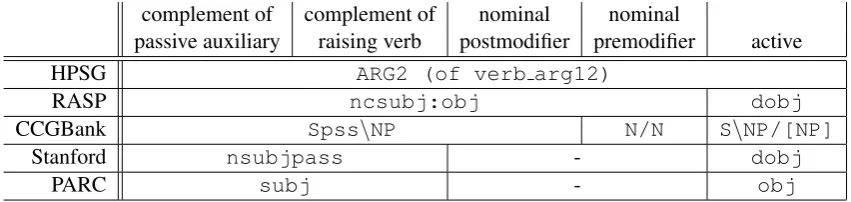
The shared task dataset contains numerous passive participles, most of which can be classified into the following four groups depending on how the par-ticiple is used: (a) complement of passive auxiliary e.g.Tax induction isactivatedby the RelA subunit; (b) complement of raising verb e.g. The adminis-tration doesn’t seemmovedby the arguments; (c) nominal postmodifier e.g.the genes involved in T-cell growth; and (d) nominal premodifier e.g. the proposed rules.
In all these cases, our system for deep gram-matical relation annotation requires: (a) that there is a relation from the passive partici-ple to the deep object; and (b) that this rela-tion be the same as in the corresponding ac-tive declaraac-tive construction, so that predicate-argument structure can be straightforwardly de-rived. Thus, for example, the analysis ofTax in-duction isactivatedby the RelA subunitwill con-tain the GRdobj(activated,induction), and that of the proposed rules will include
dobj(proposed,rules), wheredobjis the relation between a transitive verb and its (deep) di-rect object.
complement of complement of nominal nominal
passive auxiliary raising verb postmodifier premodifier active
HPSG ARG2 (of verb arg12)
RASP ncsubj:obj dobj
CCGBank Spss\NP N/N S\NP/[NP]
Stanford nsubjpass - dobj
[image:4.595.86.512.71.172.2]PARC subj - obj
Table 1: Representation of deep objects in passive and active
if such a GR exists.3 The five GR representations compared are:
HPSG predicate-argument structures extracted from the University of Tokyo HPSG Treebank (Miyao, 2006)
RASP grammatical relations as output by the RASP parser (Briscoe et al., 2006)
CCGBank predicate-argument dependencies ex-tracted from CCGBank (Hockenmaier and Steedman, 2007)
Stanford grammatical relations output by the Stanford Parser (de Marneffe et al., 2006)
PARC dependency structures used in the annota-tion of DepBank (King et al., 2003)
The first four columns in Table 1 represent, for each of the four uses of passive participles listed above, the grammatical relation, if any, which typ-ically joins a passive participle to its deep object. The rightmost column presents the label used for this relation in equivalent active clauses. Adjacent columns have been collapsed where the same GR is used for both uses. The ideal system would have the same GR listed in each of the five columns.
The grammatical relations used in the Stan-ford, PARC and RASP systems are atomic labels like subj, obj etc, although the latter system does allow for a limited range of composite GRs likencsubj:obj (a non-clausal surface subject which realises a deep object). In the HPSG sys-tem, verbal subjects and objects are represented as ARG1 and ARG2 respectively of strict transi-tive verb typeverb arg12. Finally, the GRs as-sumed in CCGBank consist of a lexical category (e.g. the strict transitive verb categoryS\NP/NP) with one argument emphasised. I assume the 3The relations presented for HPSG and CCG are those for
passive participle ofstricttransitive verbs.
following notational convenience for those cate-gories which contain specify more than one argu-ment — the emphasised arguargu-ment is surrounded by square brackets. Thus, subject and object of a strict transitive verb are denotedS\[NP]/NPand
S\NP/[NP]respectively.
With respect to Table 1, note that: (a) in the CCGbank dependency representation, although prenominal passive participlesare linked to their deep object (i.e. the modified noun), this relation is just one of generic noun premodification (i.e.
N/N) and is thus irrelevant to the kind of predicate-argument relation we are interested in; (b) in the PARC and Stanford dependency representations, there is no GR from noun-modifying passive par-ticiples to their deep objects, just generic modifica-tion relamodifica-tions in the opposite direcmodifica-tion; and (c) in PARC, passive participles are themselves marked as being passive, thus allowing a subsequent inter-pretation module to normalise the deep grammati-cal relations if desired.
If we are interested in a system of deep gram-matical role annotation which allows for the rep-resentation of normalised GRs for passive partici-ples in all their uses, then the HPSG Treebank for-mat is more appropriate than the other schemes, since it uniformly uses deep GRs for both ac-tive and passive verb constructions. The RASP representation comes a close second, only requir-ing a small amount of postprocessrequir-ing to convert
ncsubj:objrelations intodobjones. In addi-tion, both the CCGBank and the Stanford notation distinguish two kinds of surface subject — those which realise deep subjects, and those which re-alise passivised deep objects.
5 Control
complements adjuncts raising
HPSG 3 3 5
RASP 3 3 5
CCGbank 3 3 5
Stanford 3 5 3
[image:5.595.73.293.71.158.2]PARC 5 5 5
Table 2: Representation of controlled subjects and raising
be partitioned into the following three classes: (a) complements of subject control verbs e.g. The ac-cumulation of nuclear c-Relactstoinhibitits own continued production; (b) complements of subject raising verbs e.g.The administrationseems moved
by arguments that . . .; and (c) subject controlled adjuncts e.g.Alex de Castro has stopped by toslip
six cards to the Great Man Himself.
In all these cases, our deep grammatical role an-notation requires that there be a subject relation (or an object relation in the case of a passive par-ticiple) from the infinitive/participle to the surface subject (or surface object in the case of object con-trol) of the controlling verb/adjective. For exam-ple, the analysis of Tax acts indirectly by induc-ing the action of various host transcription fac-torswill contain both the GRssbj(acts,Tax)
andsbj(inducing,Tax). In addition, we also want to distinguish ‘raising’ verbs and adjectives from control structures. Thus, in the analysis of
The administration seems moved by arguments that . . ., we want a (deep) object relation from
moved to administration, but we don’t want any
relation fromseemstoadministration.
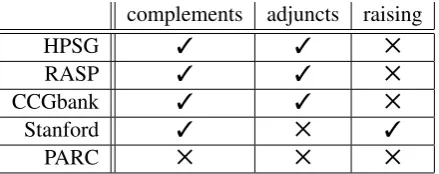
We again evaluated the various GR-based output formats according to these features. The results are presented in Table 2, where for each representation format (the rows) we determine: (a) whether a verb with an understood subject which is acomplement
of the matrix verb is linked directly to its relevant subject (column 1); (b) whether a verb with an un-derstood subject which is a controlled adjunct of the matrix verb is linked directly to its relevant subject (column 2); and (c) whether raising verbs are non-linked to their surface subjects (column 3). Note that the Stanford dependency represen-tation is the only format which distinguishes be-tween raising and control. This distinction is made
both structurally and in terms of the name assigned to the relevant dependent — controlled subjects are distinguished from all other subjects (includ-ing raised ones) by hav(includ-ing the labelxsubjrather than justnsubj.4
The ideal GR representation format would have a tick in each of the three columns in Table 2. It is clear that no single representation covers all of our desiderata for a deep grammatical relation treat-ment of control/raising, but each feature we require is provided by at least one format.
6 Nominal modifiers
The dataset contains numerous prenominal modi-fiers5, subdivided into the following three groups: (a) attributive adjectives e.g. a fewnotable excep-tions; (b) verb participles e.g. theproposedrules; and (c) nouns e.g.acarsalesman.
In order to ensure an adequate representation of basic predicate-argument structure, our system of deep grammatical annotation first of all requires that, from each prenominal adjective or verb, there is an appropriate relationtothe modified noun, of the same type as in the corresponding predicative usage. For example, assuming that He proposed the ruleshas a direct object relation fromproposed
torules, the same relation should occur in the anal-ysis ofthe proposed rules.Similarly, ifThe excep-tions are notableis analysed as having an external argument relation fromnotabletoexceptions, then the same should happen in the case ofa few no-table exceptions. However, this does not appear to hold for prenominal nouns, since the relation be-tween the two is not simply one of predication — a car salesman is not a salesman who ‘is’ a car, but rather a salesman who is ‘associated’ with cars in some way. Thus we would not want the same relation to be used here.6
Secondly, in order to ensure a straightforward interface with reference resolution, we need a modification relation going in the opposite direc-4We have judged that CCGBank does not make the
rele-vant distinction between raising and control verbs based on the dependency representations contained in the shared task dataset. For example, for the example sentenceThe adminis-tration seem moved by the fact that . . ., a CCG subject relation isspecified from the raising verbseemto its surface subject administration.
5We focus on prenominal modifiers in order to keep the
exposition simple. Similar remarks are valid for postnominal restrictive modifiers as well.
6Presumably the same goes for attributive adjectives
which lack corresponding predicative uses, e.g. theformer
tion,fromthe modified nountoeach (restrictive) modifier, as argued in section 2. Thus, a complete GR representation of a noun phrase like notable exceptionswould be cyclical, for example: (7) ext(notable,exceptions)
ncmod(exceptions,notable)
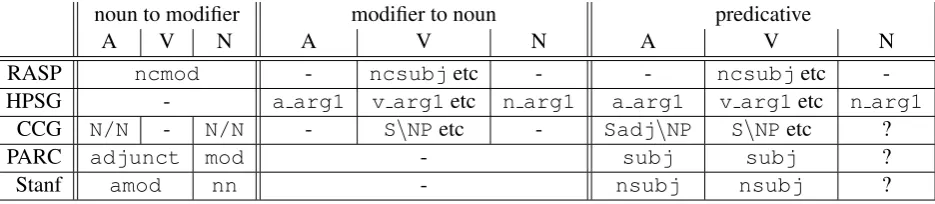
We evaluated the various GR-based output formats according to these desiderata. The results are pre-sented in Table 3. For each annotation scheme (the rows), we first present the relation (if any) which goesfromthe modified nountoeach kind of pmodifier (adjective, verb participle and noun re-spectively).7 The middle three columns contain the relation (if any) which goestothe nounfromeach kind of modifier. Finally, the last three columns give the corresponding predicative relation used in the annotation scheme, for example in construc-tions likeThe exceptions are notable,He proposed the rules, or Herbie is a car. Where it is un-clear whether a particular format encodes the re-lation between a predicative noun and its subject, we mark this as ‘?’ in the last column.
Ideally, what we want is a representation where: (a) there is a GR in all nine columns (with the pos-sible exception of the ‘noun modifier to noun’ one (column 6)); (b) the corresponding relations in the middle and righthand sections are identical,except
for ‘noun modifier to noun’ (column 6) and ‘pred-icative noun’ (the last column) which should be distinct, since the relation between a noun modifier and its head noun is not simply one of predication. It is clear that no one representation is perfect, though every feature we require is present in at least one representation system. Note in particu-lar that the HPSG, PARC and Stanford systems are acyclic — the former only has ‘modifier to noun’ links, while the latter two only have ‘noun to mod-ifier’ ones. The RASP format is cyclic, at least for prenominal participles — in the proposed rules, there is a modifier relation fromrulestoproposed, as well as a deep object relation fromproposedto
rules, the same relation that would be found in the corresponding predicativethe rules were proposed. Note finally that the PARC and Stanford repre-sentations distinguish between prenominal adjec-tives and nouns, in terms of the name of the rele-vant modifier GR. This corresponds well with our 7Note that theN/Nlinks in the CCG representation
actu-ally go from the modifier to the noun. However, they have been included in the set of ‘noun to modifier’ relations since they are formally modifier categories (i.e. of the formX/X).
preference for a GR system where we can evalu-ate modules of N-N disambiguation (e.g. luxury car salesman) in isolation from other aspects of prenominal structure.
7 Prepositions
All five grammatical relations formats treat prepo-sition phrases in pretty much the same way: (a) there is a GR link from the head of which the PP is a complement or modifier to the preposition it-self (the HPSG representation has this link going in the opposite direction for PP modifiers, but the principle is the same); and (b) there is a link from the preposition to its complement NP. For example, the noun phraseexperts in Congressis annotated as follows:
(8) ncmod(experts,in) dobj(in,Congress)
The only PPs which have been handled differently are agentiveby-PPs of passive participles, which are either normalised or treated using a special, construction-specific GR.
Note however that all prepositions are not equal when it comes down to representing the predicate-argument structure of a sentence. In a nutshell, some prepositions are predicators (e.g. experts
inCongress) whereas others are simply syntactic role markers (e.g. a workout of the Suns). Ide-ally, we would want a GR system which marks this distinction, for example by annotating pred-icator prepositions as lexical heads and ignoring role-marking prepositions altogether. The only GR scheme which attempts to make this distinc-tion is the PARC system, which has aptype fea-ture for every preposition with two possible val-ues,semanticandnon-semantic. However, this does not appear to have been annotated consis-tently in the PARC dataset — the only examples of non-semantic prepositions are agentive by-PPs of passive participles.
8 Conclusion
noun to modifier modifier to noun predicative
A V N A V N A V N
RASP ncmod - ncsubjetc - - ncsubjetc
-HPSG - a arg1 v arg1etc n arg1 a arg1 v arg1etc n arg1
CCG N/N - N/N - S\NPetc - Sadj\NP S\NPetc ?
PARC adjunct mod - subj subj ?
[image:7.595.75.543.72.174.2]Stanf amod nn - nsubj nsubj ?
Table 3: Representation of prenominal modifiers
i.e. passive, control and raising, noun modifica-tion, and meaningful vs. non-meaningful prepo-sitions. We conclude that none of the proposed GR annotation schemes contains everything we re-quire for deep semantic processing, although each of the features/distinctions we included in our list of desiderata is provided by at least one system.
Many of the deep syntactic phenomena dis-cussed here are known issues for shallow seman-tic tasks like semanseman-tic role labelling. For exam-ple, passive constructions are a recognised source of noise in semantic role labelling systems (Gildea and Jurafsky, 2002), and resolving controlled sub-jects provides more data for training models of se-lectional restrictions, which are known to be useful features for role labelling. More generally, Chen and Rambow (2003) demonstrate that a focus on ‘deep’ syntactic features results in a more accurate stochastic semantic role labeller than using surface information alone.
Note also that the deep grammatical role rep-resentation proposed here is meant to be ‘theory-neutral’, in the sense that it was not influenced by any one of the competing grammar formalisms to the exclusion of the others. Indeed, it should be a straightforward task to write a grammar using either the HPSG, LFG, CCG or RASP-style un-derlying formalism which can produce an output representation consisting of deep relations, con-structed in a purely compositional manner. Indeed, the syntactic phenomena discussed in this paper are those which form the basis of numerous in-troductory textbooks on English generative syntax (Haegeman, 1994; Sag and Wasow, 1999; Bres-nan, 2000). In addition, the phenomena which form the basis of the analysis in this paper were among those which had been the focus of a sig-nificant amount of attention in the development of the semantic interpretation system underlying our domain-independent tutorial dialogue system. Other issues which were considered, but for which
we lack space to discuss in detail include: (a) ex-pletive pronouns should be ignored, i.e. the subject pronouns in ‘impersonal’ verb constructions likeIt is rainingorIt’s great that John loves Maryshould not be seen as the target of deep grammatical lations; (b) unbounded dependencies should be re-solved, i.e. in the relative clausethe woman Bill thinks John lovesthere should be an object relation between the embedded verblovesand its extracted object woman; (c) restrictive and non-restrictive modification (including apposition) should be dis-tinguished, since the latter is not relevant for refer-ence resolution; and (d) certain subsentential con-junctions need to be compiled out (for examples likeelectronic, computer and building products).
Finally, we recognise that, in many cases, it is possible to transform parser representations into our desired format. For example, if the parser out-put tells us that a given verb form is a passive participle, we can use this information to remap the surface relations, thus retrieving the underlying predicate-argument structure. However, we pre-fer a system where this kind of post-processing is not needed. Reasons for this include the in-creased potential for error in a system relying on post-processing rules, as well as the need to have both detailed documentation for how each parser output format handles particular constructions, as well as a comprehensive mapping schema between representations. Having a community standard for GR-based parser output is an essential element of future parsing technology, and to be practically useful in a range of semantic interpretation tasks, this standard should involve ‘deep’ syntactic dis-tinctions of the kind discussed in this paper. 9 Acknowledgements
References
Allen, James, Myroslava Dzikovska, Mehdi Manshadi, and Mary Swift. 2007. Deep linguistic processing for spoken dialogue systems. InProceedings of the ACL’07 Workshop on Deep Linguistic Processing. Bos, Johan and Tetsushi Oka. 2002. An
inference-based approach to dialogue system design. In Pro-ceedings of COLING’02.
Bresnan, Joan. 2000.Lexical-Functional Syntax. Basil Blackwell.
Briscoe, Ted, John Carroll, and Rebecca Watson. 2006. The second release of the RASP system. In Pro-ceedings of the COLING/ACL’06 Interactive Presen-tation Sessions.
Callaway, Charles B., Myroslava Dzikovska, Elaine Farrow, Manuel Marques-Pita, Colin Matheson, and Johanna D. Moore. 2007. The Beetle and BeeDiff tutoring systems. InProceedings of SLaTE’07. Chang, N., J. Feldman, R. Porzel, and K. Sanders.
2002. Scaling cognitive linguistics: Formalisms for language understanding. In Proceedings of ScaNaLU’02.
Chen, John and Owen Rambow. 2003. Use of deep linguistic features for the recognition and labeling of semantic arguments. InProceedings of EMNLP’03. Copestake, Ann, Dan Flickinger, Carl Pollard, and
Ivan A. Sag. 2005. Minimal Recursion Semantics: An Introduction. Research on Language and Com-putation, 3:281–332.
de Marneffe, Marie-Catherine, Bill MacCartney, and Christopher D. Manning. 2006. Generating typed dependency parses from phrase structure parses. In Proceedings of LREC’06.
Dzikovska, Myroslava O., Gwendolyn E. Campbell, Charles B. Callaway, Natalie B. Steinhauser, Elaine Farrow, Johanna D. Moore, Leslie A. Butler, and Colin Matheson. 2008. Diagnosing natural lan-guage answers to support adaptive tutoring. In Pro-ceedings of FLAIRS’08 special track on Intelligent Tutoring Systems.
Erk, Katrin and Sebastian Pad´o. 2006. SHAL
-MANESER- a toolchain for shallow semantic
pars-ing. InProceedings of LREC’06.
Gildea, Daniel and Daniel Jurafsky. 2002. Automatic labeling of semantic roles. Computational Linguis-tics, 28(3).
Haegeman, Liliane. 1994.Introduction to Government and Binding Theory. Basil Blackwell, 2nd edition edition.
Hockenmaier, Julia and Mark Steedman. 2007. CCG-bank: a corpus of CCG derivations and dependency structures extracted from the Penn Treebank. Com-putational Linguistics, 33(3).
Jordan, Pamela, Maxim Makatchev, Umarani Pap-puswamy, Kurt VanLehn, and Patricia Albacete. 2006. A natural language tutorial dialogue system for physics. InProceedings of FLAIRS’06.
Kaisser, Michael and Bonnie Webber. 2007. Question answering based on semantic roles. InProceedings of the ACL’07 Workshop on Deep Linguistic Pro-cessing.
Kay, Martin, Jean Mark Gawron, and Peter Norvig. 1994. Verbmobil: A Translation System for Face-To-Face Dialog. CSLI Press, Stanford, CA.
King, Tracy Holloway, Richard Crouch, Stefan Rie-zler, Mary Dalrymple, and Ronald M. Kaplan. 2003. The PARC 700 dependency bank. InProceedings of EACL’03.
Miyao, Yusuke. 2006. From Linguistic Theory to Syn-tactic Analysis: Corpus-Oriented Grammar Devel-opment and Feature Forest Model. Ph.D. thesis, Uni-versity of Tokyo.
Ros´e, C. P., D. Bhembe, S. Siler, R. Srivastava, and K. VanLehn. 2003. The role of why questions in ef-fective human tutoring. InProceedings of AIED’03. Sag, Ivan A. and Thomas Wasow. 1999.Syntactic
The-ory: A Formal Introduction. CSLI.
Seneff, Stephanie. 1992. TINA: A natural language system for spoken language applications. Computa-tional Linguistics, 18(1).
Surdeanu, Mihai, Sanda M. Harabagiu, John Williams, and Paul Aarseth. 2003. Using predicate-argument structures for information extraction. InProceedings of ACL’03.
Wolska, Magdalena and Ivana Kruijff-Korbayov´a. 2003. Issues in the interpretation of input in mathe-matical dialogs. In Duchier, Denys, editor,Prospects and advances in the syntax/semantics interface. Lorraine-Saarland Workshop Series proceedings. Wolska, Magdalena and Ivana Kruijff-Korbayov´a.
2004. Analysis of mixed natural and symbolic lan-guage input in mathematical dialogs. InProceedings of ACL’04.