Computing translation units and quantifying parallelism
in parallel dependency treebanks
Matthias Buch-Kromann ISV Computational Linguistics Group
Copenhagen Business School [email protected]
Abstract
The linguistic quality of a parallel tree-bank depends crucially on the parallelism between the source and target language an-notations. We propose a linguistic notion of translation units and a quantitative mea-sure of parallelism for parallel dependency treebanks, and demonstrate how the pro-posed translation units and parallelism mea-sure can be used to compute transfer rules, spot annotation errors, and compare differ-ent annotation schemes with respect to each other. The proposal is evaluated on the 100,000 word Copenhagen Danish-English Dependency Treebank.
1 Introduction
Parallel treebanks are increasingly seen as a valuable resource for many different tasks, including machine translation, word alignment, translation studies and contrastive linguistics ( ˇCmejrek et al., 2004; Cyrus, 2006; Hansen-Schirra et al., 2006). However, the usefulness of a parallel treebank for these purposes is directly correlated with the degree of syntactic parallelism in the treebank. Some non-parallelism is inevitable because two languages always differ with respect to their syntactic structure. But non-parallelism can also be the result of differences in the linguistic analyses of the source text and target text, eg, with respect to whether noun phrases are headed by nouns or determiners, whether conjunc-tions are headed by the first conjunct or the coordi-nator, whether prepositions are analyzed as heads or adjuncts in prepositional phrases, etc.
In this paper, we focus on parallel dependency treebanks that consist of source texts and trans-lations annotated with dependency analyses and word-alignments. These requirements are directly satisfied by the analytical layer of the Prague Czech-English Dependency Treebank ( ˇCmejrek et al., 2004) and by the dependency layer of the Copenhagen Danish-English Dependency Treebank (Buch-Kromann et al., 2007). The requirements are also indirectly satisifed by parallel treebanks with a constituent layer and a word alignment, eg (Han et al., 2002; Cyrus, 2006; Hansen-Schirra et al., 2006; Samuelsson and Volk, 2006), since it is possible to transform constituent structures into dependency structures — a procedure used in the CoNLL shared tasks in 2006 and 2007 (Buchholz and Marsi, 2006). Finally, it is worth pointing out that the requirements are also met by any corpus equipped with two dif-ferent dependency annotations since a text is always trivially word-aligned with itself. The methods pro-posed in the paper therefore apply to a wide range of parallel treebanks, as well as to comparing two monolingual treebank annotations with each other.
The paper is structured as follows. In section 2, we define our notions of word alignments and de-pendencies. In section 3, we define our notion of translation units and state an algorithm for comput-ing the translation units in a parallel dependency treebank. Finally, in sections 4, 5 and 6, we demon-strate how translation units can be used to compute transfer rules, quantify parallelism, spot annotation errors, and compare monolingual and bilingual an-notation schemes with respect to each other.
Complement roles Adjunct roles aobj adjectival object appa parenthetical apposition avobj adverbial object appr restrictive apposition conj conjunct of coordinator coord coordination dobj direct object list unanalyzed sequence expl expletive subject mod modifier
iobj indirect object modo dobj-oriented modifier lobj locative-directional obj. modp parenthetical modifier nobj nominal object modr restrictive modifier numa additive numeral mods subject-oriented mod. numm multiplicative numeral name additional proper name part verbal particle namef additional first name pobj prepositional object namel additional last name possd possessed in genitives pnct punctuation modifier pred subject/object predicate rel relative clause qobj quotation object title title of person
subj subject xpl explification (colon)
vobj verbal object
Figure 1: The main dependency roles in the dependency framework Discontinuous Grammar.
2 Word alignments and dependencies
In our linguistic analyses, we will assume that a word alignmentW↔W0encodes a translational cor-respondence between the word clustersWandW0in
the source text and target text, ie, the word align-ment expresses the human intuition that the subset
W of words in the source text corresponds roughly in meaning or function to the subsetW0of words in
the target text. The translations may contain addi-tions or deleaddi-tions, ie,W andW0may be empty.
We also assume that a dependency edge g r
−→d
encodes a complement or adjunct relation between a wordg(thegovernor) and a complement or adjunct phrase headed by the wordd(thedependent), where the edge labelrspecifies the complement or adjunct dependency role.1 As an illustration of how
comple-ment and adjunct relations can be encoded by means of dependency roles, the most important dependency roles used in the dependency framework Discontin-uous Grammar (Buch-Kromann, 2006) are shown in Figure 1. Finally, we will assume that the depen-dencies form a tree (or a forest). The tree may be non-projective, ie, it may contain crossing branches (technically, a dependency g r
−→d is projective if
1Following standard dependency theoretic assumptions, we will assume the following differences between complement and adjunct relations: (a) complements are lexically licensed by their governor, whereas adjuncts license their adjunct governor; (b) in the functor-argument structure, complements act as ar-guments of their governor, whereas adjuncts act as modifiers of their governor; (c) a governor can have several adjuncts with the same adjunct role, whereas no two complements of the same governor can have the same complement role.
X X
skal must
kun only
koncentrere concentrate
sig self
om about
Y Y
subj mod vobj dobj pobj nobj
X has to concentrate only on Y
subj dobj vobj mod pobjnobj
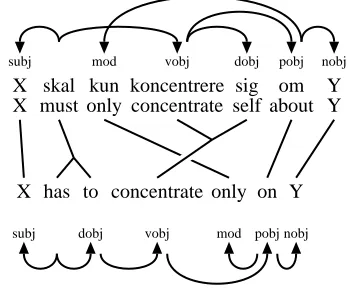
Figure 2: Parallel dependency treebank analysis with word alignment and two monolingual depen-dency analyses.
and only ifgis a transitive governor of all the words betweengandd).
headed by “on” is analyzed as a prepositional ob-ject of the verb “concentrate.” In the Danish de-pendency analysis, the dede-pendency between the ad-verbial “kun” (“only”) and its prepositional gover-nor “om” (“about”) is non-projective because “om” does not dominate the words “koncentrere” (“con-centrate”) and “selv” (“self”).
Dependency analyses differ from phrase-structure analyses in that phrases are a derived notion: in a de-pendency tree, each word has a derived phrase that consists of all the words that can be reached from the word by following the arrows. For example, the En-glish word “concentrate” heads the phrase “concen-trate only on Y,” and the Danish word “om” heads the discontinuous phrase “kun. . .om Y.”
If a parallel dependency analysis is well-formed, in a sense to be made clear in the following sec-tion, each alignment edge corresponds to what we will call a translation unit. Intuitively, given an aligment edge W↔W0, we can create the
cor-responding translation unit by taking the source and target subtrees headed by the words in W
and W0, deleting all parallel adjuncts of W↔W0,
and replacing all remaining parallel dependents ofW↔W0 with variables x
1, . . . ,xn and x01, . . . ,x0n.
The resulting translation unit will be denoted by
T(x1, . . . ,xn)↔T0(x01, . . . ,x0n), where T and T0
de-note the source and target dependency trees in the translation unit. For convenience, we will some-times use vector notation and write T(x)↔T0(x0)
instead ofT(x1, . . . ,xn)↔T0(x0
1, . . . ,x0n).
Dependen-cies are usually defined as relations between words, but by an abuse of terminology, we will say that a worddis adependentof an alignment edgeW↔W0
providedd is a dependent of some word inW∪W0
anddis not itself contained inW∪W0.
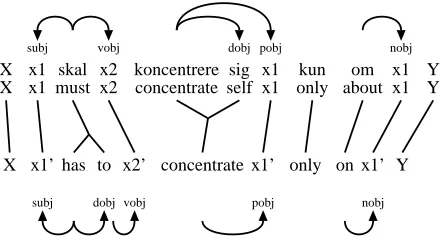
Figure 3 shows the six translation units that can be derived from the parallel dependency analysis in Figure 2, by means of the procedure outlined above. Each translation unit can be interpreted as a bidi-rectional translation rules: eg, the second translation unit in Figure 3 can be interpreted as a translation rule stating that a Danish dependency tree with ter-minals “x1skalx2” can be translated into an English
dependency tree with terminals “x0
1has tox02” where
the English phrasesx0
1,x02are translations of the
Dan-ish phrasesx1,x2, and vice versa.
In the following section, we will go deeper into X X
x1 x1
skal must
x2 x2
koncentrere concentrate
sig self
x1 x1
kun only
om about
x1 x1
Y Y
subj vobj dobj pobj nobj
X x1’ has to x2’ concentrate x1’ only on x1’ Y
subj dobj vobj pobj nobj
Figure 3: The six translation units derived from the parallel dependency analysis in Figure 2.
the definition and interpretation of these rules. In particular, unlike the essentially context-free trans-lation rules used in frameworks such as (Quirk et al., 2005; Ding, 2006; Chiang, 2007), we will not assume that the words in the translation rules are or-dered, and that the translation rules can only be used in a way that leads to projective dependency trees.
3 Translation units within a simple dependency-based translation model
In many parallel treebanks, word alignments and syntactic annotations are created independently of each other, and there is therefore no guarantee that the word or phrase alignments coincide with any meaningful notion of translation units. To rectify this problem, we need to define a notion of trans-lation units that links the word alignments and the source and target dependency analysis in a meaning-ful way, and we need to specify a procedure for con-structing a meaningful set of word alignments from the actual treebank annotation.
non-projectivity is not directly compatible with context-free grammar, and parallel dependency treebanks tend to encode non-projective dependencies directly, the context-free SMT models are not directly appli-cable to parallel dependency treebanks in general. But the context-free SMT models are an important inspiration for the simple dependency-based trans-lation model and notion of transtrans-lation units that we will present below.
In our translation model, we will for simplicity as-sume that both the source dependency analysis and the target dependency analysis are unordered trees, ie, dependency transfer and word ordering are mod-elled as two separate processes. In this paper, we only look at the dependency transfer and ignore the word ordering, as well as the probabilistic modelling of the rules for transfer and word ordering. There are three kinds of translation rules in the model:
A. Complement ruleshave the formT(x)↔T0(x0)
where T(x) is a source dependency tree with vari-ablesx= (x1, . . . ,xn),T0(x0)is a target dependency
tree with variablesx0= (x01, . . . ,xn0), the words inT
are aligned to the words inT0, and the variablesx
k,x0k
denote parallel source and target subtrees. The rule states that a source treeT(x)can be transferred into a target tree T0(x0) by transferring the source
sub-trees inxinto the target subtrees inx0.
B. Adjunct rules have the form (x a
←−T(y))↔
(x0 a0
←−T0(y0)) where T(y) is a source dependency tree,T0(y0)is a target dependency tree, andx,x0are
variables that denote parallel adjunct subtrees with adjunct rolesa,a0, respectively. The rule states that
given a translation unitT(y)↔T(y0), ana-adjunct
of any word inT can be translated into ana0-adjunct
of any word inT0.2
C. Addition/deletion rules have the formT(y)↔
(x0 a0
←−T0(y0))and(x←−a T(y))↔T0(y0)wherex,x0 are variables that denote adjunct subtrees, anda,a0
are adjunct relations. The addition rule states that an adjunct subtreex0 can be introduced into the
tar-get treeT0in a translation unitT(y)↔T(y0)without
any corresponding adjunct in the source treeT. Sim-ilarly, the deletion rule states that the adjunct subtree
2In the form stated here, adjunct rules obviously overgener-ate because they do not place any restrictions on the words inT0
that the target adjunct can attach to. In a full-fledged translation model, the adjunct rules must be augmented with a probabilistic model that can keep track of these restrictions.
X X
skal must
kun only
koncentrere concentrate
sig self
om about
Y Y
subj mod vobj dobj pobj nobj
X has to concentrate only on Y
subj dobj vobj mod pobjnobj
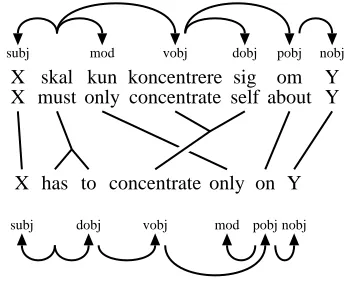
Figure 4: Parallel dependency analysis that is in-compatible with our translation model.
xin the source treeT does not have to correspond to any adjunct in the target treeT0.3
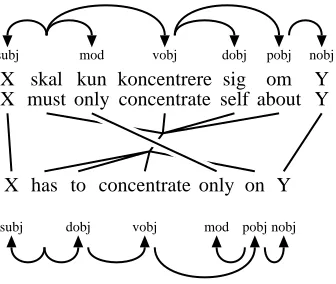
The translation model places severe restrictions on the parallel dependency annotations. For exam-ple, the annotation in Figure 4 is incompatible with our proposed translation model with respect to the adjunct “only’, since “only” attaches to the verb “skal/must” in the Danish analysis, but attaches to the preposition “on” in the English analysis — ie, it does not satisfy a requirement that follows implicitly from the adjunct rule: that corresponding source and target adjunct governors must belong to the same translation unit. In our example, there are two ways of rectifying the problem: we can (a) correct the de-pendency analysis as shown in Figure 2, or (b) cor-rect the word alignment as shown in Figure 5.
It can be shown that our translation model trans-lates into the following four requirements on paral-lel analyses — ie, the requirements are necessary and sufficient for ensuring that the linguistic anno-tations are compatible with our translation model. In the following, two words are said to becoaligned
if they belong to the same alignment edge. A de-pendency edged r
←−gis calledinternal ifd andg are coaligned, andexternalotherwise. A wordwis calledsingularif it fails to be coaligned with at least one word in the other language.
Requirement I. The internal dependencies within a translation unit must form two connected trees.Ie,
X X
skal must
kun only
koncentrere concentrate
sig self
om about
Y Y
subj mod vobj dobj pobj nobj
X has to concentrate only on Y
subj dobj vobj mod pobjnobj
Figure 5: Making the analysis from Figure 4 com-patible with our translation model by changing the alignment edges.
in an alignmentW↔W0, the internal dependencies
withinW must form a connected source tree, and similarly forW0.
Requirement II. The external dependencies be-tween translation units must form an acyclic graph.
Ie, in an alignmentW↔W0, no wordw∈W can be
coaligned with an external transitive dependent of any word inW0, and vice versa.
Requirement III. Parallel external governors must be aligned to each other. Ie, if two nodes n,n0 are
coaligned with external governor edgesn r
←−gand
n0 r0
←−g0, thengandg0must be coaligned.
Requirement IV. The graph contains no singular external complements.If the source wordcis a com-plement of governorgandcis not coaligned to any target word, thencandgmust be coaligned to each other; and similarly for target complements.
A graph that satisfies all four requirements is said to be well-formed with respect to our translation model. It can be shown that we can always trans-form an ill-trans-formed graphGinto a well-formed graph
G0 by merging alignment edges;G0 is then called a
reductionofG, and a reduction with a minimal num-ber of mergings is called aminimal reductionofG. In a well-formed graph, we will refer to an align-ment edge and its associated source and target de-pendency tree as atranslation unit.
It can be shown that minimal reductions can be computed by means of the algorithm shown in Fig-ure 6.4 The body of the for-loop in Figure 6 ensures
4In the algorithm,Gis viewed as a directed graph that con-tains the source and target dependencies, and alignment edges
procedureminimal-reduction(graphG)
merge each alignment edge in G with itself (ie, ensure int. connectedness & ext. acyclicity)
foreach W↔W0in bottom-up orderdo
merge W↔W0with all of its external
singular complements merge all external governors of W↔W0
returnthe modified graph G
Figure 6: Algorithm for computing the minimal re-duction of a graphG.
Requirements III (coaligned external governors) and IV (no singular complements), and the merging op-eration is designed so that it ensures Requirements I (internal connectedness) and II (acyclicity).5
The ill-formed analysis in Figure 4 has the mini-mal reduction shown in Figure 2, whereas the anal-yses in Figure 2 and 5 are well-formed, ie, they are their own minimal reductions. In the remainder of the paper, we will describe how minimal reductions and translation units can be used for extracting trans-fer rules, detecting annotation errors, and comparing different annotation schemes with each other.
4 Extracting transfer rules and quantifying parallelism
The complement, adjunct, and addition/deletion rules in our simple dependency transfer model can be read off directly from the minimal reductions. Figure 7 shows the three complement rules induced from Figure 4 via the minimal reduction in Figure 5. Figure 8 (repeated from Figure 3) shows the six complement rules induced from the alternative anal-ysis in Figure 2.
We have tested the extraction procedure on a large scale by applying it to the 100,000 word Copenhagen Danish-English Dependency Treebank (Buch-Kromann et al., 2007). Figure 9 shows the percentage of translation units with size at least n
W↔W0are viewed as short-hands for the set of all bidirectional
edges that link two distinct nodes inW∪W0.
5The merging operation performs three steps: (a) replace two alignment edgesW1↔W10 andW2↔W20 with their union
W↔W0 whereW =W1∪W2 and W0=W10∪W20; (b) merge
X
subj vobj dobj pobj nobj
X x1’ has to concentrate on x2’ Y
subj dobj vobj pobj nobj
Figure 7: The three complement rules induced from Figure 4 via the minimal reduction in Figure 5.
X
subj vobj dobj pobj nobj
X x1’ has to x2’ concentrate x1’ only on x1’ Y
subj dobj vobj pobj nobj
Figure 8: The six complement rules induced from the minimal reduction in Figure 2 (repeated from Figure 3).
translation unit size n percent
Figure 9: The percentage of translation units in the Copenhagen Danish-English Dependency Treebank with size at leastn, plotted on normal and logarith-mic scales.
in the parallel treebank, where the size of a transla-tion unit is measured as the number of nodes in the associated complement transfer rule. The extracted transfer rules are useful for many purposes, includ-ing machine translation, lexicography, contrastive
linguistics, and translation studies, but describing these applications is outside the scope of this paper.
5 Spotting annotation errors
To the human annotator who must check the word-aligned dependency analyses in a parallel depen-dency treebank, the analyses in Figure 2 and Fig-ure 4 look almost identical. However, from the in-duced translation units and the associated comple-ment rules shown above, it would have been im-mediately obvious to the annotator that the sis in Figure 2 is significantly better than the analy-sis in Figure 4. This suggests that we can increase the quality of the human annotation in parallel tree-bank projects by designing annotation tools that con-tinuously compute the induced translation units and present them visibly to the human annotator.
From a linguistic point of view, it can be expected that errors in the dependency annotation will often show up as non-parallelism that results in a large induced translation unit. So in a parallel depen-dency treebank, we can identify the most egregious examples of non-parallelism errors automatically by computing the induced translation units, and sorting them with respect to their size; the largest translation units will then have a high probability of being the result of annotation errors.
To confirm our linguistic expectation that large translation units are often caused by annotation er-rors, we have selected a sample of 75 translation units from the Copenhagen Danish-English Depen-dency Treebank, distributed more or less uniformly with respect to translation unit size in order to ensure that all translation unit sizes are sampled evenly. We have then hand-checked each translation unit care-fully in order to determine whether the translation unit contains any annotation errors or not, giving us a data set of the form (C,N) where N is the size of the translation unit andC indicates whether the translation unit is correct (C=1) or not (C =0). Figure 10 shows our maximum likelihood estimate of the conditional probabilityP(C=1|N=n)that a translation unit with size nis correct.6 From the
6In order to estimate the conditional probability p(n) =
esti-translation unit size n est. percent
correct tunits with size = n
normal scale (solid line)
logarithmic scale (dotted line)
0% 10% 20% 30% 40% 50% 60% 70% 80% 90% 100%
2 10 20 30 40 50
100%
10%
1%
0.1%
0.01%
0.001%
Figure 10: The estimated percentage of translation units with sizenthat are correct, plotted on normal and logarithmic scales.
graph, we see that the correctness rate decreases quickly withn. For example, only 55% of all trans-lation units with size 10 are correct, and only 13% of all translation units with size 20 are correct. Thus, the statistics confirm that large translation units are often caused by annotation errors in the treebank, so focusing the effort on large translation units can make the postediting more cost-efficient. This also suggests that when developing algorithms for auto-matic annotation of parallel dependency treebanks, the algorithms can improve their accuracy by penal-izing large translation units.
6 Comparing annotation schemes
Translation units can also be used to compare dif-ferent annotation schemes. This is relevant in par-allel treebank projects where there are several pos-sible annotation schemes for one of the languages — eg, because there is more than one treebank or rule-based parser for that language. In this situa-tion, we have the freedom of choosing the anno-tation schemes for the source and target languages so that they maximize the parallelism between the source and target language annotations. To make an informed choice, we can create a small pilot parallel treebank for each annotation scheme, and compare
mates are ˆα=0.99 and ˆβ=1.77 with confidence value 0.87, ie, if a data setDwith the same translation unit sizes is generated randomly from the distribution ˆp(n) =αˆnβˆ, then the conditional likelihood ofDwill be larger than the likelihood of our observed data set in 87% of the cases. This means that a two-sided test does not reject that the data are generated from the estimated distribution ˆp(n).
the treebank annotations qualitatively by looking at their induced translation units, and quantitatively by looking at their average translation unit size. The best choice of annotation schemes is then the com-bination that leads to the smallest and most sensible translation units.
Since texts are always trivially word-aligned with themselves, the same procedure applies to monolin-gual corpora where we want to compare two differ-ent dependency annotations with each other. In this setup, structural differences between the two mono-lingual annotation schemes will show up as large translation units. While these structural differences between annotation schemes could have been re-vealed by careful manual inspection, the automatic computation of translation units speeds up the pro-cess of identifying the differences. The method also suggests that the conversion from one annotation scheme to another can be viewed as a machine trans-lation problem — that is, if we can create a machine translation algorithm that learns to translate from one language to another on the basis of a parallel dependency treebank, then this algorithm can also be used to convert from one dependency annotation scheme to another, given a training corpus that has been annotated with both annotation schemes.
7 Conclusion
8 Acknowledgments
The work was supported by two grants from the Danish Research Council for the Humanities. Thanks to the anonymous reviewers for their help-ful comments.
References
Matthias Buch-Kromann, J¨urgen Wedekind, and Jakob Elming. 2007. The Copenhagen Danish-English
De-pendency Treebank. http://www.id.cbs.dk/∼
mbk/ddt-en.
Matthias Buch-Kromann. 2006. Discontinuous
Grammar. A dependency-based model of human
parsing and language learning. Dr.ling.merc.
dissertation, Copenhagen Business School.
http://www.id.cbs.dk/∼mbk/thesis.
Sabine Buchholz and Erwin Marsi. 2006. CoNLL-X shared task on Multilingual Dependency Parsing. In
Proc. CoNLL-2006.
A. Cahill, M. Burke, R. O’Donovan, J. van Genabith, and A. Way. 2004. Long-distance dependency resolution in automatically acquired wide-coverage PCFG-based
LFG approximations. InProc. of ACL-2004.
David Chiang. 2007. Hierarchical phrase-based
transla-tion. Computational Linguistics, 33(2).
Martin ˇCmejrek, Jan Cuˇr´ın, Jiˇr´ı Havelka, Jan Hajiˇc, and Vladislav Kuboˇn. 2004. Prague Czech-English De-pendency Treebank. Syntactically annotated resources
for machine translation. InProc. LREC-2004.
Lea Cyrus. 2006. Building a resource for studying
trans-lation shifts. InProc. LREC-2006.
Yuan Ding and Martha Palmer. 2005. Machine transla-tion using Probabilistic Synchronous Dependency
In-sertion Grammars. InProc. ACL-2005.
Yuan Ding. 2006. Machine translation using
Prob-abilistic Synchronous Dependency Insertion
Gram-mars. Ph.D. thesis, Univ. of Pennsylvania.
Michel Galley, Mark Hopkins, Kevin Knight, and Daniel
Marcu. 2004. What’s in a translation rule? InProc.
HLT/NAACL-2004.
Chung-hye Han, Na-Rae Han, Eon-Suk Ko, and Martha Palmer. 2002. Development and evaluation of a
Ko-rean treebank and its application to NLP. In Proc.
LREC-2002.
Silvia Hansen-Schirra, Stella Neumann, and Mihaela Vela. 2006. Multi-dimensional annotation and align-ment in an English-German translation corpus. In
Proc. NLPXML-2006.
Philipp Koehn, Franz Josef Och, and Daniel Marcu.
2003. Statistical phrase-based translation. In Proc.
HLT/NAACL-2003.
Daniel Marcu, Wei Wang, Abdessamad Echihabi, and Kevin Knight. 2006. SPMT: Statistical machine trans-lation with syntactified target language phrases. In
Proc. EMNLP-2006.
Franz Josef Och and Hermann Ney. 2003. A system-atic comparison of various statistical alignment mod-els. Computational Linguistics, 29(1):19–51.
Chris Quirk, Arul Menezes, and Colin Cherry. 2005. De-pendency treelet translation: Syntactically informed
phrasal SMT. InProc. ACL-2005.
Yvonne Samuelsson and Martin Volk. 2006. Phrase
alignment in parallel treebanks. InProc. TLT-2006.
K. Uchimoto, Y. Zhang, K. Sudo, M. Murata, S. Sekine, and H. Isahara. 2004. Multilingual aligned parallel treebank corpus reflecting contextual information and
its applications. InProc. MLR-2004.
Kenji Yamada and Kevin Knight. 2001. A syntax-based