Evaluating algorithms for the Generation of Referring Expressions
using a balanced corpus
Albert Gatt and Ielka van der Sluis and Kees van Deemter
Department of Computing Science University of Aberdeen
{agatt,ivdsluis,kvdeemte}@csd.abdn.ac.uk
Abstract
Despite being the focus of intensive research,
eval-uationof algorithms that generate referring
expres-sions is still in its infancy. We describe a corpus-based evaluation methodology, applied to a number of classic algorithms in this area. The methodology focuses on balance and semantic transparency to enable comparison of human and algorithmic out-put. Although the Incremental Algorithm emerges as the best match, we found that its dependency on manually-set parameters makes its performance dif-ficult to predict.
1 Introduction
The current state of the art in the Generation of Referring Expressions (GRE) is dominated by ver-sions of the Incremental Algorithm (IA) of Dale and Reiter (1995). Focusing on the generation of “first-mention” definite descriptions, Dale and Re-iter compared theIAto a number of its predecessors, including a Full Brevity (FB) algorithm, which gen-erates descriptions of minimal length, and a Greedy algorithm (GR), which approximates Full Brevity (Dale, 1989). In doing so, the authors focused on Content Determination (CD, which is the purely se-mantic part ofGRE), and on a description’s ability to
identifya referent for a hearer. Under this problem
definition, GRE algorithms take as input a Knowl-edge Base (KB), which lists domain entities and their properties (often represented as attribute-value pairs), together with a set of intended referents,R. The output ofCDis a distinguishing description of R, that is, a logical form which distinguishes this set from its distractors.
Dale and Reiter argued that the IA was a supe-rior model, and predicted that it would be the
bet-ter match to human referential behaviour.1 This was due in part to the way the IA searches for a distinguishing description by performing gradient descent along a predetermined list of domain at-tributes, called thepreference order, whose ranking reflects general or domain-specific preferences (see
§4.1).
The Incremental Algorithm has served as a start-ing point for later models (Horacek, 1997; Kelleher and Kruijff, 2006), and has also served as a yard-stick against which to compare other approaches (Gardent, 2002; Jordan and Walker, 2005). De-spite its influence, few empirical evaluations have focused on the IA. Evaluation is even more desir-able given the dependency of the algorithm on a preference order, which can radically change its be-haviour, so that in a domain withnattributes, there are in principlen!different algorithms.
This paper is concerned with applying a corpus-based methodology to evaluate content determina-tion forGRE, comparing the three classic algorithms that formed the basis for Dale and Reiter’s (1995) contribution, adapted to also deal with pluralities and gradable properties.
1.1 Requirements forGREevaluation
One of the problems with evaluating GRE is that it interfaces with several other sub-tasks of NLG including, among others, realisation and discourse coherence (especially where anaphoric reference is concerned). On the other hand, a large amount of work in the area has focused on the semantic heart of the problem. Given identification as the
over-1Dale and Reiter also observed that
arching goal of such algorithms, a crucial ques-tion concerns the extent to which their choice of content from the available attributes for a referent matches that produced by a speaker in a comrable situation. This is the main focus of this pa-per, whose evaluation methodology therefore tar-gets content determination, abstracting away from issues of lexical choice and realisation. A corpus-based evaluation of a content determinationGRE al-gorithm requires a resource that satisfies the follow-ing desiderata.
Semantic transparency: The human ‘gold stan-dard’ descriptions in the corpus need to be paired with a domain representation so that, as far as pos-sible, an algorithm is exposed to the same domain as an author. To evaluate content determination, descriptions need to be semantically annotated, ab-stacting away from variations in syntax and lexical-isation. For example,the right-facing sofaandthe
settee which is oriented towards the rightare, from
the point of view of a content determination proce-dure, semantically equivalent.
Pragmatic transparency: Ideally, the communica-tive intention underlying corpus descriptions should match those for which an algorithm was designed. If an algorithm is primarily aimed at identification, then human gold-standards should, as far as possi-ble, be restricted to this intention.
Balance: To assess the extent to which an al-gorithm matches human performance, the corpus should contain an equal number of instances where each attribute is required. Only in this way would the claim thatalgorithmXmatches humans on
con-tent y% of the timebe reliable2.
These desiderata suggest that the way forward in evaluation in this area is to design controlled studies for corpus construction. The rest of this paper de-scribes the construction of such a corpus, and the re-sults of an evaluation that addressed the differences betweenIAand its predecessors against human de-scriptions in domains of varying complexity, con-taining both singular and plural descriptions. The study also aimed to contribute to a growing debate in the NLG community, on the evaluation of NLG
2
For example, the IAoverspecifies descriptions by select-ing attributes not strictly required for identification, because of its preference order. A claim that this feature improves perfor-mance implies that the relative priority of attributes is impor-tant. To be reliable, such a claim would have to be made against a corpus in which ‘preferred’ and ‘dispreferred’ attributes were required the same number of times.
systems, arguing in favour of the careful construc-tion ofbalancedandtransparentcorpora to serve as resources forNLG.
2 Related work
We are aware of three studies onGREevaluation, all of which compare theIAto some alternative models. Two of these (Jordan and Walker, 2005; Gupta and Stent, 2005) used the COCONUT dialogue corpus. The third (Viethen and Dale, 2006) used a small cor-pus collected in a monologue setting. These studies meet the transparency requirements to different de-grees. Though COCONUT dialogues were elicited against a well-defined domain, Jordan (2000) has emphasised that reference, inCOCONUT, was often intended to satisfy intentions over and above iden-tification. Gupta and Stent used an evaluation met-ric that included aspects of the syntactic structure of descriptions (specifically, modifier placement), thus arguably obscuring the role of content determina-tion (CD).
Our approach is closest in spirit to that of Viethen and Dale, who elicited descriptions from people in a setting where identification was the sole commu-nicative aim. However, in the case of theIA, the au-thors averaged over24 different preference orders, potentially averaging over24 very different incar-nations of the algorithm and masking the impact of any one order. Similarly, neither Jordan/Walker nor Gupta/Stent are explicit about the determination of the preference order for theIAin their studies. No obvious attempts were made to make sure that the corpora in question were semantically balanced.
One question that these studies raise relates to how human-authored and automatically generated descriptions should be compared. For instance, both Jordan/Walker and Viethen/Dale use a measure of recall. This indicates the coverage of an algorithm in relation to a corpus, but does not measure the de-gree of similarity between a description generated by an algorithm and a description in the corpus, punishing all mismatches with equal severity.
3 TheTUNAcorpus
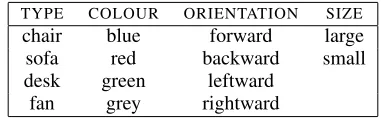
TYPE COLOUR ORIENTATION SIZE
chair blue forward large
sofa red backward small
desk green leftward
[image:3.612.88.280.71.130.2]fan grey rightward
Table 1: Non-numeric attributes in the domains
which represents the simpler of the two domains, consisting of digitally constructed pictures of ob-jects with well-defined properties. Therefore, it pro-vides a good test case for the algorithms evaluated, since it allows us to probe into a number of issues that arise even with straightforwardly describable objects. The ‘people’ sub-corpus is more complex, since the objects are real photographs and afford an author with many descriptive alternatives. We ex-plicitly compare the results of the present evaluation with a similar study on the ‘people’ sub-corpus, in
§5.
3.1 Materials, design and procedure
The furniture sub-corpus consists of 900 descrip-tions from45 native or fluent speakers of English. Participants described objects in20trials, each cor-responding to a domain where there were one or two clearly marked target referents (thetarget set) and six distractor objects, placed in a 3(row) ×
5(column) grid. Pictures of the objects represented combinations of values of the four attributes shown in the top panel of Table 1. In a pilot study involv-ing19participants, we found that instances in which descriptions used semantic content beyond that in-dicated in the Table were extremely rare with these simple objects. In each trial, the horizontal and ver-tical position of the objects is represented using two numeric-valued attributes,X-DIM (row) andY-DIM (column). Their value was randomly determined with every fresh trial. Approximately half the cor-pus descriptions include locative expressions3. We will refer to this as the +LOC dataset, containing 412descriptions from 26 authors. The other half, the −LOC dataset (444 descriptions; 27 authors), consists of descriptions using only COLOUR, SIZE andORIENTATION, apart fromTYPE.
Participants were exposed to the20trials in ran-domised order; in each case, they typed a descrip-tion for the target set. They were told that they
3
This was manipulated as a second, between-subjects fac-tor. Participants were randomly placed in groups which varied in whether they could use location or not, and in whether the communicative situation was fault-critical or not. For more de-tails, we refer to van Deemteret al.(2006).
would be interacting with a language-understanding program which would remove the referents from the domain, based on their description. Identifica-tion was emphasised as the primary goal of tions. Each time a participant submitted a descrip-tion, one or two objects were automatically removed from the domain by a function which had been pre-set to remove the wrong objects on approximately one-fourth of the trials. This was intended to make the interaction seem more natural. We discuss an evaluation of this methodology in§3.3.
The trials in the experiment were balanced. For each possible combination of the attributes in Ta-ble 1, there was an equal number of domains in which an identifying description of the target(s) re-quired the use of those attributes. We refer to this as the minimal description(MD) of the target set. For example, there was a domain in which a target could be minimally distinguished by usingCOLOUR and SIZE. TYPE was never included in the mini-mal description, leaving7possible attribute combi-nations. The experiment manipulated one within-subjects variable, Cardinality/Similarity (3 levels):
Singular(SG): 7domains contained a single refer-ent
Plural/Similar(PS): 6 domains had two referents, which had identical values on theMDattributes. For example, both targets might be blue in a domain where the minimally distinguishing description con-sisted ofCOLOUR.
Plural/Dissimilar(PD): In the remaining 7 Plural trials, the targets had different values of the mini-mally distinguishing attributes.
Plural referents were taken into account because plurality is pervasive in NL discourse. The litera-ture (e.g. Gardent (2002)) suggests that they can be treated adequately by minor variations of the classic GREalgorithms (as long as the descriptions in ques-tion refer distributively, cf. Stone (2000)), which is something we considered worth testing.
3.2 Corpus annotation
<ENTITY type=target’>
<ATTRIBUTE name=‘orientation’ value=‘right’ /> <ATTRIBUTE name=‘type’ value=‘sofa’ /> <ATTRIBUTE name=‘size’ value=‘large’ /> ...
</ENTITY>
<ENTITY type=‘target’>
<ATTRIBUTE name=‘colour’ value=‘red’ /> <ATTRIBUTE name=‘type’ value=‘desk’ /> <ATTRIBUTE name=‘size’ value=‘small’ /> ...
</ENTITY>
(a)Fragment of a domain
<DESCRIPTION num=‘plural’> <DESCRIPTION num=‘singular’>
<ATTRIBUTE name=‘size’ value=‘large’>large</ATTRIBUTE> <ATTRIBUTE name=‘type’ value=‘sofa’>settee</ATTRIBUTE> <ATTRIBUTE name=‘orientation’ value=‘right’> at oblique angle</ATTRIBUTE>
</DESCRIPTION> and
<DESCRIPTION num=‘singular’>
<ATTRIBUTE name=‘size’ value=‘small’>small</ATTRIBUTE> <ATTRIBUTE name=‘type’ value=‘desk’>desk</ATTRIBUTE> </DESCRIPTION>
</DESCRIPTION>
(b)‘large settee at oblique angle and small desk’
Figure 1: Corpus annotation examples
Figure 1(b) shows the annotation of a plural de-scription. ATTRIBUTE tags enclose segments of a description corresponding to properties, withname
and value attributes which constitute a seman-tic representation compatible with the domain, ab-stracting away from lexical variation. For example, in Figure 1(b), the expression at an oblique angle is tagged as ORIENTATION, with the value right-ward. If a part of a description could not be re-solved against the domain representation, it was en-closed in anATTRIBUTEtag with the valueother
forname. Consistent with our pilot study, this was only necessary in39descriptions (3.2%).
The DESCRIPTIONtag in Figure 1(b) indicates the logical form of a description. Thus, Figure 1(b) is apluraldescription enclosing twosingular
ones. Correspondingly, the logical form of each embedded description is a conjunction of attributes, while the two sibling descriptions are disjoined:
(large∧sofa∧right)∨(small∧desk).
3.3 Annotator reliability and experimental validity
The reliability of the annotation scheme was eval-uated in a study involving two independent annota-tors (hereafterAandB), both postgraduate students with an interest in NLG, who used the same anno-tation manual (van der Sluis et al., 2006). They were given a stratified random sample of 270 de-scriptions,2 from each Cardinality/Similarity con-dition, from each author in the corpus. To estimate inter-annotator agreement, we compared their anno-tations against the consensus labelling made by the
present authors, using a version of the Dice coef-ficient. Let D1 and D2 be two descriptions, and
att(D) be the attributes in any descriptionD. The coefficient, which ranges between0(no agreement) and 1 (perfect agreement) is calculated as in (1). Because descriptions could contain more than one instance of an attribute (e.g. Figure 1(b) contains two instances ofSIZE), the sets of attributes for this comparison were represented as multisets.
dice(D1, D2) =
2× |att(D1)∩att(D2)| |att(D1)|+|att(D2)| (1)
In the present context, Dice is more appropriate than agreement measures (such as the κ statistic) which rely on predefined categories in which dis-crete events can be classified. The ‘events’ in the corpus are NL expressions, each of which is ‘clas-sified’ in several ways (depending on how many at-tributes a description expresses), and it was up to an annotator’s judgment, given the instructions, to select those segments and mark them up.
Both annotators showed a high mean agreement with the authors, as indicated by their mean and modal (most frequent) scores (A:: mean = 0.93, mode = 1 (74.4%); B: mean = 0.92; mode = 1 (73%)). They also evinced substantial agree-ment among themselves (mean = 0.89, mode = 1 (71.1%)). These results suggest that the anno-tation scheme used is replicable to a high degree, and that independent annotators are likely to pro-duce very similar semantic markup.
should take into account the number of attributes that an algorithm omits in relation to the human gold standard, and the number of attributes that it in-cludes. We also evaluated the validity of the experi-mental setup. Since communicating with a machine may have biased participants, they were asked, dur-ing a debriefdur-ing phase, to assess the performance of their virtual interlocutor, by indicating agreement to the statementThe system performed well on this
task. Of the5response categories, ranging from1
strongly disagreeto5(strongly agree),34
individ-uals selected agree orstrongly agree while no one selectedstrongly disagree. The mean score was3.9.
4 Evaluating the algorithms
The three algorithms mentioned in§1 can be charac-terised as search problems (Bohnet and Dale, 2005) which differ primarily in the way they structure a search space populated byKBproperties:
Full Brevity (FB): Finds the smallest distinguishing combination of properties.
Greedy (GR): Adds properties to a description, al-ways selecting the property with the greatest dis-criminatory power.
Incremental (IA): Performs gradient descent along a predefined list of properties. Like GR, IA incre-mentally adds properties to a description until it is distinguishing.
The evaluation was carried out separately for the
−LOCand+LOCdatasets introduced in§3.1. Algo-rithms were compared to a random baseline (RAND) which selected a property randomly, and added it to a description if it removed distractors and was true of the referents. In the −LOC dataset, only GRandIAwere compared, becauseGRandFBgive identical output4. By contrast, the +LOC dataset,
where there are5attributes includingX-DIMandY -DIM, and the values of the locative attributes were randomly determined in all domains, there is much greater scope for variation.
All four algorithms also included TYPE by de-fault. AddingTYPE, despite its lack of contrastive value, was the norm in the corpus descriptions (93.5%). While the IA always adds TYPE, as pro-posed by Dale and Reiter (1995), we applied the
4This is because objects were distinguishable on the basis of three attributes. When only1or2attributes suffice to distin-guish an object,GRandFBalways return identical output. In the case of3attributes,GRandFBare identical in the present corpus because the minimal description consists of all the prop-erties that have some discriminatory value.
same trick to FB and GR to avoid penalising their performance unnecessarily. In addition, we ex-tended each algorithm in two ways:
Plurality: To cover the plural descriptions in the corpus, we used the algorithm of (van Deemter, 2002), which is an extension to the IA. The algo-rithm first searches through theKBto find a distin-guishing conjunction of properties, failing which, it searches through disjunctions of increasing length until a distinguishing description is found. FBand GRcan easily be extended in the same way.
Gradable properties: Locative expressions in the corpus are essentially gradable. For instance, the
table on the leftcould be used even if the table was
located in the right half of the grid, as long as it was the leftmost table. van Deemter (2006) pro-posed an algorithm to deal with such gradable prop-erties, which can use any of theGREalgorithms (FB, GR, IA). Gradable properties are represented in the formhA = ni, for examplehX-DIM = 3i(i.e., the property of being located in the middle column of the grid). This equality is converted into a num-ber of inequalities of the formshX-DIM > miand
hX-DIM < m’i. For example, in a domain with 2 objects, in column 2 and 3, this results in the in-equalitieshX-DIM>2iandhX-DIM<4i. Inequal-ities are used by aGREalgorithm in the same way as other properties. A postprocessing phase transforms them into superlative form. For example, if a refer-ent is idrefer-entified by hTYPE : sofai ∧ hX-DIM > 2i, this yields a combination expressible as “the right-most sofa”, or “the sofa on the right”.
4.1 Preference orders for the IA
In assessing the impact of preference orders on the IA, we compare some psycholinguistically-motivated versions to a baseline version which re-verses the hypothesised trends. In what follows, we denote a preference order using the first letter of the attributes shown in Table 1.
Psycholinguists have shown that attributes such as COLOURare included in descriptions of objects even when they are not required (Pechmann, 1989; Eikmeyer and Ahls`en, 1996). Attributes such as SIZE, which require comparison to other objects, are more likely to be omitted (Belke and Meyer, 2002). Based on this research, we hypothesise a ‘best’ pref-erence order for the IA (IA-BEST1) in the −LOC
dataset, and a reverse baseline order (IA-BASE1):
−LOC +LOC
IA-BEST1 IA-BASE1 GR/FB IA-BEST2 IA-BEST3 IA-BEST4 IA-BASE2 FB GR
Mean .83 .75 .79 .64 .61 .63 .54 .57 .58
Mode 1 .67 .8 .67 .67 .67 .67 .67 .67
PRP 24.1 7.4 18.7 10 4.6 3.9 1.7 6.6 5.8
tS 7.002∗ −5.850∗ 3.333∗ 3.934∗ 2.313 3.406 .705 .242 .544
[image:6.612.80.535.71.153.2]tI 4.632∗ −1.797 1.169 4.574∗ 3.352∗ 4.313∗ 1.776 1.286 1.900
Table 2: Comparison to the Random Baseline (∗p < .05)
IA-BASE1: S>>O>>C
In the more complex+LOCdataset, the inclusion of the numeric-valued X-DIM andY-DIM increases the number of attributes to 5. Arts (2004) found that locatives in the vertical dimension were much more frequent than those in the horizontal (see also Kelleher and Kruijff (2006)). Two different de-scriptive patterns dominate her data: Either Y-DIM and COLOUR are strongly preferred and X-DIM is strongly dispreferred, orY-DIMandX-DIMare both highly preferred. This leaves us with three groups of preference orders, namely CY >> {O,S} >> X, YXC >> {O,S}, and Y,C >> {O,S} >> X. Assuming that ORIENTATION preceeds SIZE (which involves comparisons), three promising or-ders emerge, with a baseline, IA-BASE2, which is
predicted to perform much worse.
IA-BEST2: C>>Y>>O>>S>>X
IA-BEST3: Y>>X>>C>>O>>S
IA-BEST4: Y>>C>>O>>S>>X
IA-BASE2: X>>O>>S>>Y>>C
4.2 Differences between algorithms
Table 2 displays mean and modal (most frequent) scores of each algorithm, as well as the perfect
re-call percentage(PRP: the proportion of Dice scores
of 1). Pairwise t-tests comparing each algorithm toRANDare reported using subjects (tS) and items
(tI) as sources of variance. These figures average
over all three Cardinality/Similarity conditions; we return to the differences between these below.
With the exception ofIA-BASE, the different ver-sions of IA performed best on both datasets. In the simpler −LOC dataset, IA-BEST1 achieved a
modal score of1 24%of the time. Both the modal score and thePRP ofGR/FB were lower. OnlyIA -BEST1 was significantly better thanRAND both by
subjects and items. This suggests that while IA -BEST1reflects overall preferences, and increases the
likelihood with which a preferred attribute is in-cluded in a description, a consideration of the rela-tive discriminatory power of a property, or the over-all brevity of a description, does not reflect human tendencies.
A comparison of IA-BEST1 to FB/GR on this
dataset showed that the IAwas significantly better, though this only approached significance by items. (tS = 2.972,p = .006;tI(19) = 2.117,p = .08).
Though this ostensibly supports the claim of Dale and Reiter (Dale and Reiter, 1995), it should be dis-cussed in the light of the performance ofIA-BASE1,
which performed significantlyworsethanRANDby subjects, as shown in Table 2, indicating a very sub-stantial impact of the attribute order.
In the+LOCdataset, there is an overall decline in performance. The much poorer performance of FB andGRon this dataset (neither is better thanRAND) is due to their not selecting preferred attributes with the same frequency as the better-performing orders of the IA, since the chances of selecting them are contingent on their discriminatory power.
A comparison ofGRtoFBrevealed that the small difference in their mean scores was not significant (t1(24) = .773, ns; t2(19) = 1.455, ns).
Pair-wise contrasts involving IA-BEST2 showed that it
performed significantly better than both FB (tS = 4.235, p < .05; tI = −2.539, ns) and GR (tS = 4.092, p < .05; tI = 2.091, ns), though only
by subjects. This was also the case for IA-BEST4
against FB(tS = 3.845,p =.01;tI = 2.248,ns),
though not againstGR(tS= 3.072,ns;tI= 1.723,
ns). None of the comparisons involvingIA-BEST3
reached significance. Once again, the performance of the IA on the more complex dataset displays a strong dependency on the predetermined attribute order.
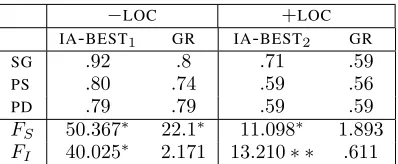
4.3 Plurals and similarity
−LOC +LOC IA-BEST1 GR IA-BEST2 GR
SG .92 .8 .71 .59
PS .80 .74 .59 .56
PD .79 .79 .59 .59
FS 50.367∗ 22.1∗ 11.098∗ 1.893
[image:7.612.86.285.70.152.2]FI 40.025∗ 2.171 13.210∗ ∗ .611
Table 3:Effect of Cardinality/Similarity∗p < .001
IA-BEST1andIA-BEST2, and onGR(which did not
differ from FB in +LOC). As Table 3 shows, the algorithms’ performance declined dramatically on the plural data; the difference between the Singu-lar (SG), Plural Similar (PS) and Plural Dissimilar (PD) domains is confirmed by a one-way ANOVA with Cardinality/Similarity as independent variable, though this is not significant forGRin+LOC.
With PS domains (where the minimally required description is always a conjunction), van Deemter’s algorithm will succeed at first pass, without need-ing to search through combinations, except that a disjunction is required for TYPE values (e.g. 2a, below). People tend to be more redundant, be-cause they partition a set if its elements have differ-ent values of TYPE, describing each element sepa-rately (2b). In thePDcondition, the main problem is that the notion of ‘preference’ becomes problematic once the search space is populated by combinations of attributes, rather than literals.
(2) (a) desk∨fan∧red∧large∧forward
(b) the large red desk facing forward and the large red fan facing forward
5 The People Domain
Like most work in GRE, the preceding results fo-cus on very simple objects, with attributes such as colour. With complex objects, the relevant proper-ties are not always easy to ascertain. Similarly, we expect less agreement between corpus annotators and we expectGREalgorithms to perform worse on complex domains, compared to those where objects are simple and stylised. A separate study on the ‘people’ sub-corpus described in§3 was conducted, using the same overall setup as the present study. In this section, we briefly discuss our main findings in this sub-corpus. A more detailed comparison of the evaluation results on the furniture domain with par-allel results on the people domain is reported else-where.
The targets in the people corpus differ from their distractors only in whether they had a beard (HAS
-BEARD), wore glasses (HASGLASSES) and/or were young or old (AGE). But as expected, speakers used other attributes than the ones that are necessary to identify the photographed people. As a result de-scriptions include, for instance, whether a referent wears a tie, or has a certain hairstyle. To be able to match the descriptions with the domain representa-tion a total of 9 attributes were defined per photo-graph. The first indication that complexity results in much higher variation comes from results on an-notator agreement on this data, with the same anno-tators discussed in §3.3. Though again suggesting a high degree of replicability, the figures indicate greater difficulty in annotating complex data (A: mean = .84, mode = 1(41.1%); B: mean = .78; mode= 1(36.3%)).
Another problem is that complex objects, with several attributes, give rise to several possible ders, making it difficult to determine preference or-ders for the IA a priori, particularly since, unlike attributes such as COLOUR and SIZE, there is lit-tle psycholinguistic data on reference with attributes such asHASHAIR. Although in the ‘people’ domain there exists a particular IAalgorithm that performs better than theGRalgorithm, only a few of the pos-sible preference orders yield significantly better re-sults thanGR. When comparing the mean scores of the best IAs from both domains, the bestIA in the furniture domain performed much better than the bestIAin the people domain. Their mean scores dif-fer substantially: while IA-BEST1 obtained a mean
of.83on furniture descriptions, the best-performing order on the ‘people’ corpus had a mean of.69, with a lower recall percentage score of21.3%.
6 Conclusions
In recent years, GREhas extended considerably be-yond what was seen as its remit a decade ago, for example by taking linguistic context into ac-count (Krahmer and Theune, 2002; Siddharthan and Copestake, 2004). We have been conservative by focusing on three classic algorithms discussed in Dale and Reiter (1995), with straightforward exten-sions to plurals and gradables.
support this view. This evaluation took a
speaker-orientedperspective. Areader-orientedperspective
might yield different results. This is our main target for future follow-ups of this work.
One lesson to be drawn from this study is of a practical nature. Suppose aGREalgorithm were re-quired for anNLGsystem, to be deployed in a novel domain. If theIAis the prime candidate, which pref-erence order should be chosen? Psycholinguistic principles can be good predictors, but an application may involve attributes whose degree of preference is unknown. Investigating how the subjects/authors of interest behave requires time and resources, in the absence of which, an algorithm like GR (suit-ably adapted to make sure that theTYPEattribute is represented) may be a better bet.
Finding correct preference orders is comparable to a situation wherein a doctor has a choice of two medicines with which to fight the flu. One of these (nicknamedGR) produces reasonable results against all variants of the flu; the success of the other (called IA) depends crucially on a balancing of ingredients that differs from case to case. Finding the right bal-ance is an art rather than a science. – This, we feel, is the situation inGREtoday.
7 Acknowledgements
Thanks to Richard Power, Ehud Reiter, Ross Turner, Imtiaz Khan and Emiel Krahmer for helpful com-ments. This work forms part of the TUNA project (www.csd.abdn.ac.uk/research/tuna/), supported byEPSRCgrant GR/S13330/01.
References
A. Arts. 2004. Overspecification in Instructive Texts. Ph.D. thesis, University of Tilburg. E. Belke and A. Meyer. 2002. Tracking the time
course of multidimensional stimulus discrimina-tion. European Journal of Cognitive Psychology, 14(2):237–266.
B. Bohnet and R. Dale. 2005. Viewing referring expression generation as search. InProc. IJCAI-05.
R. Dale and E. Reiter. 1995. Computational inter-pretation of the Gricean maxims in the genera-tion of referring expressions. Cognitive Science, 19(8):233–263.
Robert Dale. 1989. Cooking up referring expres-sions. InProc. ACL-89.
H. J. Eikmeyer and E. Ahls`en. 1996. The cognitive
process of referring to an object. In Proc. 16th Scandinavian Conference on Linguistics.
C. Gardent. 2002. Generating minimal definite de-scriptions. InProc. ACL-02.
S. Gupta and A. J. Stent. 2005. Automatic evalua-tion of referring expression generaevalua-tion using cor-pora. InProc. 1st Workshop on Using Corpora in NLG.
H. Horacek. 1997. An algorithm for generating ref-erential descriptions with flexible interfaces. In Proc. ACL-97.
P. W. Jordan and M. Walker. 2005. Learning con-tent selection rules for generating object descrip-tions in dialogue. Journal of Artificial Intelli-gence Research, 24:157–194.
P. W. Jordan. 2000. Influences on attribute selec-tion in redescripselec-tions: A corpus study. In Proc. CogSci-00.
J. D. Kelleher and G-J Kruijff. 2006. Incremental generation of spatial referring expressions in sit-uated dialog. InProc. ACL-COLING-06.
E. Krahmer and M. Theune. 2002. Efficient context-sensitive generation of referring expres-sions. In Kees van Deemter and Rodger Kibble, editors,Information Sharing. Stanford: CSLI. T. Pechmann. 1989. Incremental speech
produc-tion and referential overspecificaproduc-tion. Linguis-tics, 27:89–110.
A. Siddharthan and A. Copestake. 2004. Gener-ating referring expressions in open domains. In Proc. ACL-04.
M. Stone. 2000. On identifying sets. In Proc. INLG-00.
K. van Deemter, I. van der Sluis, and A. Gatt. 2006. Building a semantically transparent corpus for the generation of referring expressions. InProc. INLG-06.
K. van Deemter. 2002. Generating referring ex-pressions: Boolean extensions of the incremental algorithm. Computational Linguistics, 28(1):37– 52.
K. van Deemter. 2006. Generating referring ex-pressions that contain gradable properties. Com-putational Linguistics. to appear.
I. van der Sluis, A. Gatt, and K. van Deemter. 2006. Manual for the TUNA corpus: Referring expressions in two domains. Technical Report AUCS/TR0705, University of Aberdeen.