Available Online atwww.ijcsmc.com
International Journal of Computer Science and Mobile Computing
A Monthly Journal of Computer Science and Information Technology
ISSN 2320–088X
IMPACT FACTOR: 5.258
IJCSMC, Vol. 5, Issue. 7, July 2016, pg.245 – 252
Achieving Data Confidentiality by Usage of
Hybrid Cloud and Deduplication
Guljar P. Shaikh
1, Prof. S.D.Chaudhary
2, Prof. P.S.Paygude
3¹,2,3 Department of Information Technology, India
1
[email protected]; [email protected]; 3 [email protected]
Abstract— Now a day’s Data storage over cloud has been very fresh and popular technology. It offers you to store your large amount of data with less cost estimation and to retrieve that stored information anytime from cloud; so it mostly likes by people and researchers. But problem faced by many of the data storage systems is that storing duplicate copies of files having no use. So main confront to cloud services is that managing that ever-increasing quantity of data having only unique information or data copies. For making scalable data management, new technique or term comes in picture which is called as deduplication. In this term deduplication, it stores only unique file rather than keeping multiple copies of the data which having indistinguishable data. Maintaining data privacy and its secrecy is key term considered in any cloud environment. Providing data confidentiality for users or the owners is mainly accomplished by using method Convergent encryption as an alternative to the previous encryption technique. The concept named Duplicate Check which is used for penetrating the records that are duplicated and those are based on results which only stores unique contents. We have shown experimental results that gives us less utilization of storage space and simultaneously consuming less Network bandwidth.
Keywords— Deduplication, Security, confidentiality, duplication authorized check, Convergent Encryption, hybrid cloud.
I. INTRODUCTION
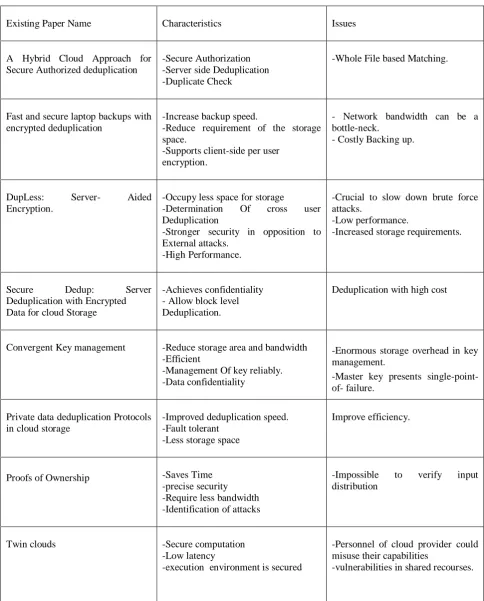
This has been done in hierarchical way of finding scope in every article and then we have summarized it for identifying existing issues and then we acknowledged proper solution for solving those issues by using different deduplication techniques.
TABLE. I.
TABULATED LITERATURE SURVEY
Existing Paper Name Characteristics Issues
A Hybrid Cloud Approach for Secure Authorized deduplication
-Secure Authorization -Server side Deduplication -Duplicate Check
-Whole File based Matching.
Fast and secure laptop backups with encrypted deduplication
-Increase backup speed.
-Reduce requirement of the storage space.
-Supports client-side per user encryption.
- Network bandwidth can be a bottle-neck.
- Costly Backing up.
DupLess: Server- Aided Encryption.
-Occupy less space for storage
-Determination Of cross user Deduplication
-Stronger security in opposition to External attacks.
-High Performance.
-Crucial to slow down brute force attacks.
-Low performance.
-Increased storage requirements.
Secure Dedup: Server Deduplication with Encrypted Data for cloud Storage
-Achieves confidentiality - Allow block level Deduplication.
Deduplication with high cost
Convergent Key management -Reduce storage area and bandwidth -Efficient
-Management Of key reliably. -Data confidentiality
-Enormous storage overhead in key management.
-Master key presents single-point-of- failure.
Private data deduplication Protocols in cloud storage
-Improved deduplication speed. -Fault tolerant
-Less storage space
Improve efficiency.
Proofs of Ownership -Saves Time -precise security -Require less bandwidth -Identification of attacks
-Impossible to verify input distribution
Twin clouds -Secure computation -Low latency
-execution environment is secured
-Personnel of cloud provider could misuse their capabilities
-vulnerabilities in shared recourses.
Data Deduplication Scheme for cloud computing
-Improves the speed of data deduplication
- Integrity for files.
Cloud storage server will regard all blocks as a new blocks and may store all blocks, resulting in storing duplicate blocks.
Weak leakage –resilient client side Deduplication of
encrypted data in cloud storage
-Secure client –side deduplication scheme.
- Cross-user security.
Encryption methods are not semantically secure
III. NOVEL APPROACH FOR DATA DEDUPLICATION
Ever since the utilization of storage competence has grown to be a significant matter in storage over cloud, erasing replicated information can use less space for storing files and it leading to more efficient techniques. This makes things easier and enhances process of management of data. Deduplication is a technique for using minimum storage space which is simply storing just distinctive data. Deduplication algorithm identifies duplicated data in comparison with stored data in storage by make use of hash values. And this Hashing reduces the complexity because the hash size is so lesser than the data. So in simple way we can say that the process of Deduplication decreases expense of storing the data since it make use of smaller disks and so less disk purchase will be required.
Figure 1. Architecture of Secured deduplication
A.
Steps:
i. Token Request for file uploading.
a. User send request to private cloud for File Token. b. Private cloud generates File token and done File tagging c. Then result is sent to user.
ii. Response to user.
iii. User sends Request for uploading and downloading files.
a. Request is forwarded to private cloud it checks for possible deduplication and response back.
B.
Architecture Explained:
i.
S-CSP: Storage provider it is entity which makes available storage services of data inside a public cloud. S-CSP offers outsourcing data services and then it stores that data in support of users of the data. All the files uploaded by the users are captured in SCSP by its nature of File type, file Tag and individual File Token generated at time of upload request.ii. Users: The users are the people who wish to outsource their data in public cloud to S-CSP then it access that stored data later whenever required. In this system of storage, a user uploads only unique single files by applying deduplication approaches although it is impossible for them to upload any duplicated data files as those files are denied by private cloud only on upload request by checking duplicate check constraints.
iii. Private Cloud: Private cloud concept initiated for smooth the progress of consumer’s secure utilization of service provided by the cloud. It acts as a bridge between the owner of File and a public cloud. All operations performed on File like file tagging, token generation, duplicate checking and generation of secrete keys are executed on private cloud. As per its results the response for file originality is given to cloud.
iv. Public cloud: Public cloud is similar to S–CSP where the user uploads and downloads their files. Whenever the user wants to download a particular file asks for the secret key and this key is generated as well as stored in private cloud and that has been sent to their registered email address or phone no for providing more security to the files. Every user can access its corresponding files if file token is equivalent with that token which is stored at the S-CSP server. In case of duplication; Reference pointer has been generated and that File reference for downloading given to users.
Operation of public Cloud: 1. File Uploading. 2. File Downloading.
C. Advantages:
i. Maintain data confidentiality. ii. Stores large data in structured way.
iii. It builds less overhead comparatively usual operations on file. iv. Provide more Security for files.
IV. RESULTS
A. Storage Space
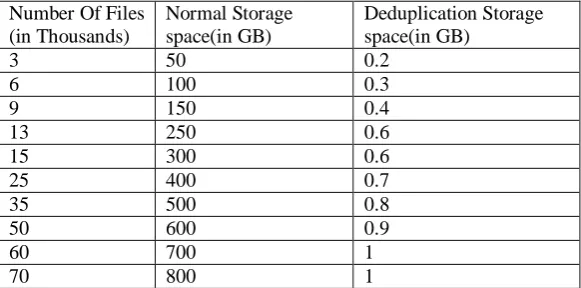
Before deduplication technique comes into scene there was issue faced by many of user that problem is storing data over cloud and consuming more Space over there. So Deduplication is invented to consume less space and more storage of data. We have shown the difference between required spaces with normal storage and with deduplication storage.
TABLE. II.
REPRESENTATION OF SPACE
Number Of Files (in Thousands)
Normal Storage space(in GB)
Deduplication Storage space(in GB)
3 50 0.2
6 100 0.3
9 150 0.4
13 250 0.6
15 300 0.6
25 400 0.7
35 500 0.8
50 600 0.9
60 700 1
Figure.2. Analysis of Storage space
B.
Execution time
:
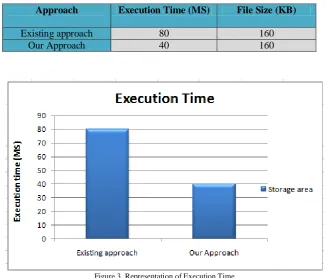
The execution time for uploading any file includes duplication check and encryption of file is as shown in below figure. The graph analysis for execution time shown
TABLE. III.
REPRESENTATION OF EXECUTION TIME
Approach Execution Time (MS) File Size (KB)
Existing approach 80 160 Our Approach 40 160
Figure.3. Representation of Execution Time
C. File Size:
We have shown result of File size in aspects of:
D. Security:
For enhanced verification and authorization we have designed a two-step authentication:
ii. By Encrypting File
V. CONCLUSION
We have designed system in consideration of single cloud for storage, in future we can also do duplication on Email or on Phone details. Also we can try for new technology like Hadoop and map-reduce for checking performance.
R
EFERENCES
[1] Guljar P. Shaikh,S. D. Chaudhary, Priyanka Paygude and Debnath Bhattacharyya, “Achieving Secure Deduplication by Using Private Cloud and Public Cloud”, In International Journal of Security and Its Applications Vol. 10, No. 5, 2016, pp.17-26.
[2] Jin Li,yan kit li,xiaofengchen, patrickP.C.lee and wenjing lou,“A Hybrid Cloud Approach for Secure Authorized Deduplication”, In IEEE Transactions on Parallel and Distributed Systems, April 7,2015,pp 1206 – 1216, DOI:10.1109/TPDS.2014.2318320.
[3] MihirBellare, SriramKeelveedhi, and Thomas Ristenpart, “Dupless: Serveraided encryption for deduplicated storage”, In USENIX Security Symposium, Washington DC, August 14-16, 2013, pp 179-194.
[4] MihirBellare, SriramKeelveedhi, and Thomas Ristenpart, “Message-locked encryption and secure deduplication”, in proceedings of EUROCRYPT, Athens Greece, March 3, 2013, pp 296–312.
[5] ShaiHalevi, Danny Harnik, Benny Pinkas, and Alexandra Shulman-Peleg, “Proofs of ownership in remote storage systems”. In Proceedings of the 18thACM Conference on Computer and Communications Security, Hangzhou, China, 2011,pp 491–500.
[6] Guljar P. Shaikh, “De-duplication with Authorization in Hybrid Cloud Approach for Security”, in International Journal of Computer Sciences and Engineering(IJCSE), Volume-4, Special Issue-4, June 2016.
[7] S. Bugiel, S. Nurnberger, A. Sadeghi, and T. Schneider. “Twin clouds: An architecture for secure cloud computing”. In Workshopon Cryptography and Security in Clouds (WCSC 2011), 2011.
[8] Jin Li, XiaofengChen,MingqiangLi,Jingwei Li and Patrick P. C. Lee, “Secure Deduplication with Efficient and Reliable Convergent Key Management”, In IEEE Transactions on Parallel and Distributed Systems, May 12, 2014.pp 1615 –1625, DOI: 10.1109/TPDS.2013.284.
[9] J. Yuan and S. Yu. “Secure and constant cost public cloud storage auditing with deduplication”. IACR Cryptology ePrint Archive, 2013:149, 2013.
[10] M. Bellare, C. Namprempre, and G. Neven, “Security proofs foridentity-based identification and signature schemes,” J.Cryptol.,vol. 22, no. 1, pp. 1–61, 2009.
[11] P. Anderson and L. Zhang, “Fast and secure laptop backups with encrypted de-duplication,” in Proc. 24th International Conference Large Installation System Admin., 2010, pp. 29–40.
[12] W. K. Ng, Y. Wen, and H. Zhu, “Private data deduplication protocols in cloud storage,” in Proc. 27th Annual ACM Symp. Appl. Computer, 2012, pp. 441–446.
[13] Qinlu He, Zhanhuai Li, Xiao Zhang, “Data Deduplication Techniques”, in International Conference on Future Information Technology and Management Engineering China, 2010, pp.43-433.