Available Online atwww.ijcsmc.com
International Journal of Computer Science and Mobile Computing
A Monthly Journal of Computer Science and Information Technology
ISSN 2320–088X
IJCSMC, Vol. 3, Issue. 3, March 2014, pg.359 – 363
RESEARCH ARTICLE
Watermarking Scheme for Colour Images
Using Hidden Markov Model
Mr. Kanchan Mahajan
Prof. Mahendrakumar Rai
ME (Software Systems) P.G. Comp. Sc.& Engg.
SRIT, Jabalpur SRIT, Jabalpur
[email protected] [email protected]
Abstract— Robustness, imperceptibility and high capacity simultaneously is of great importance in digital watermarking. This paper presents a new informed image watermarking scheme with high robustness and simplified complexity at an information rate of 1/64 bit/pixel. This paper uses HMM model for finding exact embedding strength in an image. HMM model in wavelet domain is successfully implemented on gray scale images, this paper extend the same concept for colour images. According to simulation results, this watermarking schema is robust under common attacks like Gaussian noise and compression and rotation attacks.
Keywords— Colour images, HMM model, Informed domain, wavelet domain
I. INTRODUCTION
Digital watermarking has received increasing attention in recent years. Distribution of movies, music,
and images is now faster and easier via computer technology, especially on the Internet. Hence, content
owners are concerned about illegal copying of their content. Watermarking and cryptography are two standard
multimedia security methods. However, cryptography is not an effective method because it does not provide
permanent protection for the multimedia content after delivery to consumers.
In digital watermarking we would focus on robust image watermarking algorithms in transform
domain like DCT, DWT, and SVD. The DWT (Discrete Wavelet Transform) separates an image into a lower
resolution approximation image (LL) as well as horizontal (HL), vertical (LH) and diagonal (HH) detail
components. One of the many advantages over the wavelet transform is that that it is believed to more
accurately model aspects of the HVS as compared to the FFT or DCT. Embedding watermarks in these
regions allow us to increase the robustness of our watermark, at little to no additional impact on image
quality
.
II. HMMINWAVELET DOMAIN
The wavelet transform is an atomic decomposition that represents a signal z(t) in terms of shifted and
Form an orthonormal basis, and we have the signal representation
Z ( t ) = wj,k „ $ j , k ( t ) , wj,k = / z ( t ) „$;,k(t) dtj. Eq. (1).
We seek a model that characterizes wavelet coefficients as Gaussian mixtures with mutually
dependent hidden state variables. Using the wavelet Locality property, we expect the state variables to have
local dependencies. Since graphs are efficient at expressing local dependencies, we use graphs for modelling
the coefficients of a wavelet transform.
The Locality and Multiresolution properties of the wavelet transform suggest three simple ways to “connect the dots” representing the wavelet coefficients in a graph with no dependencies between wavelet
state variables,a graph linking wavelet state variables across time using chains, and a graph linking wavelet
state variables across scale using trees.
Figure1: Probabilistic graphs for modelling the statistical dependencies of the coefficients of a wavelet transform.
III. Proposed System
FIGURE 2:PROPOSED METHODOLOGY Take Message
Image
Take Host Image
Resize Image Resize Image
Separate message image in RGB channels
Separate message image in RGB channels
Convert Into Wavelet Domain
Form HMM model
Embed the Message into Red, Green, and Blue Channels separately
Train HMM model in Wavelet Domain separately for each
channel
Apply Attacks on watermarked image
The figure above shows the proposed methodology for the paper, in this a color image is taken as a host image and divided into its RGB components, then an image is selected as message image, the message image can be either colour or gray scale. The message image is also divided into its RGB components. The host image is then converted into wavelet domain. A HMM model is formed for the training; it is then trained in a wavelet domain separately for each channel that is HH, LH, and HL. The embedding process is done then after on the trained channels in Red, green and blue channels separately. The embedding process has the information rate as 1/64 per pixel. Some standard image processing attacks are applied on the watermarked image to check its robustness for various attacks. The watermark extraction process is carried out to recover the original message image and host image.
IV. EXPERIMENTAL RESULTS AND ANALYSIS
In this section, we give the experimental settings, measure the watermarked images in terms of peak signal-to-noise ratio (PSNR) and normalized co-relation (NC). We evaluate the performance of the proposed algorithm by comparing the performance between the proposed HMM-based informed watermarking and DCT n DWT algorithm in [3].
A. Experimental Settings
In our simulation, we test vast amount of 512 * 512 bit colour images with different types of characteristics.
The message image is also selected such as gray scale or colour image having different characteristics. Each image is decomposed into a three-level wavelet pyramid.
B. Performance
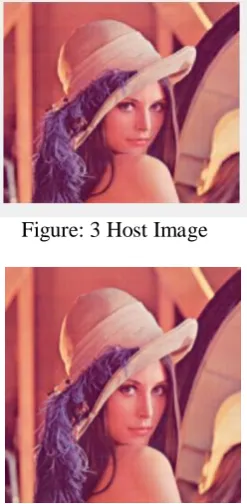
The standard lena image is taken as a host image as given in fig (3), and message image is selected as given in fig (4). The watermarked image is after the process of embedding is given in fig (5). The various parameters calculated on the watermarked images which are mentioned below.
Figure: 3 Host Image Figure: 4 Message Image.
Figure 5: Watermarked image
The various image processing attacks has been applied on the watermarked image, to generate following parameters Peak signal to noise ratio (PSNR) and Normalized Co-relation (NC).
NC value for lena under 10% guassian noise= 0.9396, NC value for lena under 20% guassian noise= 0.9396, NC value for lena under JPEG compression = 0.9396.
C. Comparison
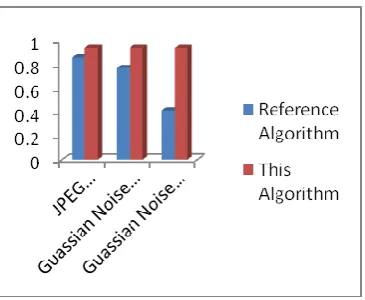
To further examine the performance of the proposed algorithm, we compare the proposed HMM-based informed watermarking for colour images with the Colour Image Copyright Protection Digital Watermarking Algorithm Based on DWT & DCT. For comparing the two algorithms the lena standard image is selected as source image, the bar chart diagrams observed are given as follows. Fig (6) shows the comparison for PSNR values under different attacks. Fig (7)
0 20 40 60
Reference Algorithm
This Algorithm
Figure 6:- Comparison for PSNR values. Figure 7:- Comparison for NC values.
The observed results are explained as follows, the algorithm implemented in this paper performs better than the previous algorithm which is used for colour image watermarking. The PSNR value is much higher than the reference algorithm which suggests that the watermarking has high robustness as compared to previous one. The NC value is also much better than reference algorithm which suggests that the host image quality is not degraded and the watermarked image is almost similar to original host image. The above two values also gives us a conclusion that the watermarked image has no effect on it of various attacks such as guassian noise, compression and rotation.
V. CONCLUSION
In this paper an efficient method for performing an informed watermarking on the colour images in the wavelet domain using hidden markov model is presented.The hidden markov model training is used for training and finding exact embedding strength vector in image for embedding message in to it. The HMM model used is efficient in this purpose this system is performing better than the existing system and it can be extended for the purpose of watermarking of color images. The system however is not performing very well when we apply cropping attacks to the watermark image.
REFERENCES
[1] Chuntao Wang, Member, IEEE, Jiangqun Ni, Member, IEEE, and Jiwu Huang, Senior Member, IEEE, “An Informed Watermarking Scheme Using Hidden Markov Model in the Wavelet Domain.”,” IEEE TRANSACTIONS ON
INFORMATION FORENSICS AND SECURITY, VOL. 7, NO. 3, JUNE 2012.”
[2] Mingwei Zhao Yanzhong Dang Institute of Systems Engineering Dalian University of Technology Dalian, China.” Color Image Copyright Protection Digital Watermarking Algorithm Based on DWT & DCT”,”
978-1-4244-2108-4/08/$25.00 © 2008 IEEE”
[3] Al-Gindy, H. Al-Ahmad, R. Qahwaji and A. Tawfik, Faculty of Engineering, Ajman University of Science and
UAE, School of Informatics, University of Bradford, UK” Watermarking of Colour Images in the DCT Domain Using Y Channel”,” 978-1-4244-3806-8/09/$25.00 © 2009 IEEE”
[4] Daniel Ramage,” Hidden Markov Models Fundamentals”,” CS229 Section Notes December 1, 2007”.
[5] Matthew S. Crouse and Richard G. Baraniuk * Robert D. Nowak Dept. of Electrical and Computer Engineering Dept.
of Electrical Engineering Michigan State University East Lansing, MI 48824 Rice University Houston, TX 77251,”
Hidden Markov Models for Wavelet-Based Signal Processing”,” 1058-6393197 $10.00 0 1997 IEEE”
[6] Q. Du, “Color image digital watermarking algorithm based on DCT and quantifying,” in Journal of Soochow
university, 2006, vol. 26, pp. 47-51.
[7] S. Z. Yu, “A color image-adptive watermark based on wavelet
[8] B. Verma, S. Jain, D. P. Agarwal, and A. Phadikar, "A new colorimage watermarking scheme," Infocomp, Journal of
computer Science, vol. 5, pp. 37-42, 2006.
[9] X. Li and X. Xue, "Improved robust watermarking in DCT domain for color images," in 18th International
Conference on Advanced Information Networking Applications (AINA04), 2004.
[10] S. Armeni, D. Christodoulakis, I. Kostopoulos, Y. Stamatiou, and M. Xenos, "A transparent watermarking method
for color images," in 1st IEEE Balkan Conference On Signal Processing, Communications, Circuits, and Systems,
Maslak, Istanbul, Turkey, 2000.
[11] Andrea Abrardo, Member, IEEE, and Mauro Barni, Member, IEEE,” Informed Watermarking by Means of