the basic units
Fernando Francisco Castafios
Abstract
Despite the importance of the speech act as an analytic category, a general com-prehensive definition of it that allows for methodical definitions of particular acts has not been provided. As a consequence, large areas of language use are often treated inadequately, both in learning research and in course planning. Among other problems, applied linguists presuppose different dimensions in dis-course and their codings of utterances are insufficiently reliable. Therefore, valid comparisons regarding their empirical results or their design proposals are often impossible.
The lack of definitions ESOL work requires is intimately associated to a defective understanding of the nature of acts. Existing classifications separate akin acts and group diverse ones together. To clarify the confusions, it is neces-sary to distinguish sharply acts which make present, create or modify knowledge from acts that set deontic conditions, ie acts like defining, classifying and
generalizing from acts like ordering, requesting and inviting. The first kind, which are referred to here as dissertation acts, are not a subtype of illocutionary acts, as has previously been considered. Rather, they constitute a category at the same hierarchical leveL
The distinction is shown to be fundamental following the same approaches that Strawson, Austin, Searle and Widdowson used to establish the sentence, the proposition and the speech act as independent units. The discussion leads to two general definitions of illocutionary and dissertation acts, which postulate a fixed number of parameters for each. Sets of conceivable values for every parameter are also delimited. Hence, a given combination of values determines a particular
act, and all possible acts are determinable.
Abstract 2
Preface
6
PART I
Chapter 1
INADEQUATE CATEGORIES 10
Chapter 2
PROBLEMS IN CLASSROOM DISCOURSE RESEARCH 25
Chapter 3
THE STUDY OF DISSERTATION ACTS IN THE
CONTEXT OF ACADEMIC LANGUAGE RESEARCH 40
PART II
Chapter 4
THE BASIC CATEGORIES OF DISCOURSE
66
Chapter 5
IDENTITY CRITERIA:
THE STRA WSON-SEARLE APPROACH 85
Chapter 6
THE POINT OF DISSERTATION: AUSTIN'S APPROACH 97
Chapter 7
PART III
Chapter 8
ILLOCUTION REVISITED
Chapter 9
DISSERTATION
Chapter 10
IMPLICATIONS AND APPLICATIONS
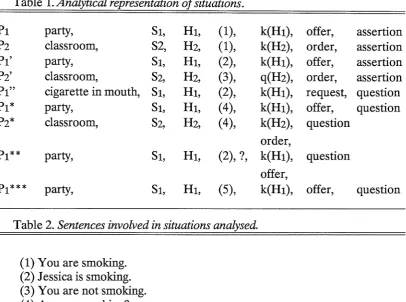
Tables and Illustrations Table 1
Analytical representation of situations
Table 2
Sentences involved in situations analysed
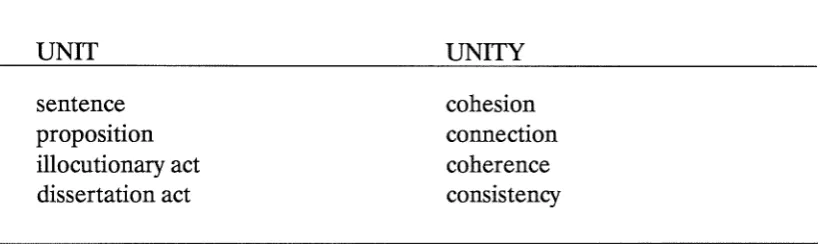
Table 3
Units and sorts of unity
Table 4
The basic categories of discourse analysis
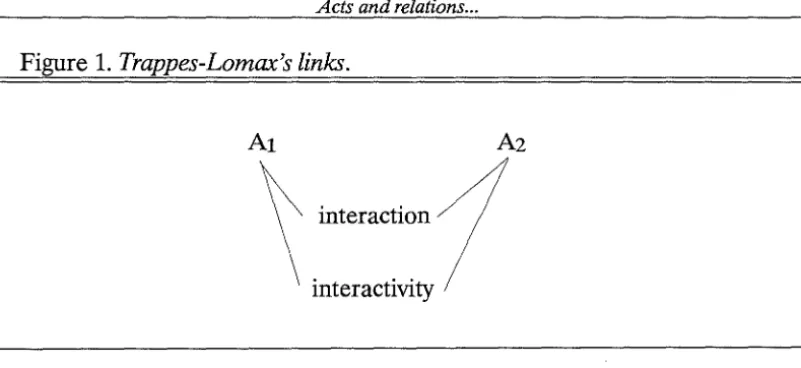
Figure 1
Trappes-Lomax's links
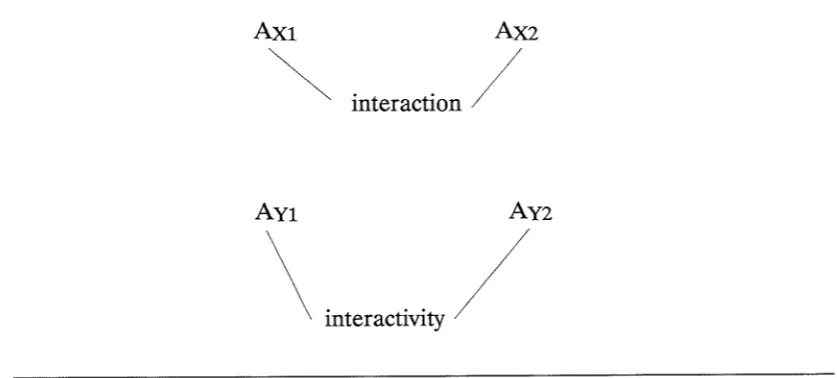
Figure 2
Alternative representation of links
Figure 3
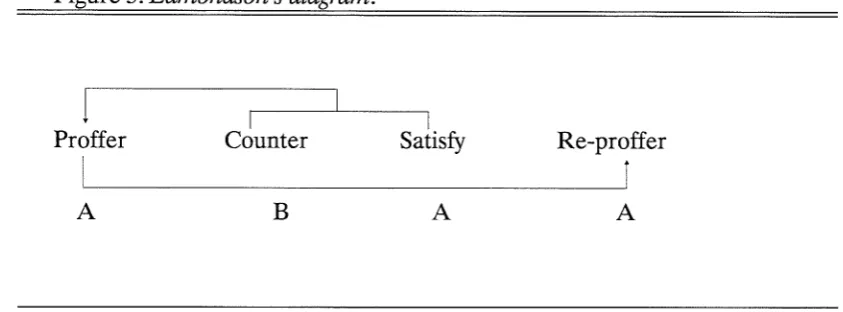
Edmondson's diagram
140
165
190
93
93
120
134
127
128
human linguistic communication is the illocutionary act, then the most important form of the original question will be, 'How many categories of illocutionary acts are there?'
Preface
At some moment, in the course of studying what happened in a classroom where English was being taught, I realized that some of the concepts which guided my work were confused and, therefore, the data I was recording could not be reli-able. I soon found the same problem in another context, the analysis of certain pieces of scientific prose which my English students had to read. When I began to think about the matter, I came to see that its clarification would require a revision of the sources of such concepts. I also envisaged that this would, for a period at least, be somewhat removed from my initial concerns. However, as the concepts are central to language teaching in various ways, I decided to pursue the exploration: its results should not only indicate how to carry out classroom and prose studies with more confidence, but could also suggest better ways of doing my work as a course designer and teacher.
I believe the decision, which led me to write this Ph.D. thesis, was a fortunate one. The substantive contribution of the research reported is a modest one: it shows that a group of entities previously considered a subclass of another group constitute a sundry category. Nevertheless, it shows a principled, economical and comprehensive manner of stating the hundreds of functions of utterances EFL researchers and designers are interested in. Furthermore, the discussions that es-tablish the distinction clarify a number of important issues in our field.
Another way of expressing the central idea is to state that the domain of ex-position and argumentation and the domain of personal interaction are governed by relatively independent principles. If this is not established clearly, one can easily attribute principles of one domain to the other. In fact, this kind of invalid judgement is the source of the unreliability mentioned in the first paragraph. Of course, it can be argued that the two domains interrelate in actual discourse, but it is necessary to establish their autonomy before we can ask any questions about their interrelations.
The complexity of discourse recognized in the previous paragraph provides the background to manifest a second reason for undertaking the revision: to show that theory and analysis can not only be useful, but are sometimes neces-sary. Applied linguistics is distrustful of abstraction; and this is understandable, because research (even in neighbouring areas, like second language acquisition) often presupposes a relevance to language teaching which it does not necessarily have. However, without a careful consideration of our basic conceptual frameworks, we will always be at the double risk of not profiting from the full potential of good ideas and of multiplying mistakes.
I have, on the whole, found satisfaction in the scrutiny of arguments. But even if the task has not always been intrinsically gratifying, it has provided other dividends. A proper exposition of my claim, that there are two fundamentally dif-ferent speech act types, required an examination of three units commonly employed in discourse analysis: the utterance, the sentence, and the proposition. Placing the two acts in relation to these units produced a framework that allows one to locate a wide variety of studies vis-a-vis each other, in terms of their scope, and to assess their internal validity with relative ease.
If we note that a syllabus is a text that has to be realized as discourse in the classroom, one could also describe the framework as a tool to generate the con-tent of the text and to give form to the discourse. In fact, the final chapter indi-cates possible ways of using the framework for such purposes.
his-Castafios
tory of beliefs or the sociology of political institutions, although I cannot show precisely how. For this reason, there was no unified background knowledge upon which I could rely, except that which is present in common academic English.
I have, therefore, not used any technical terminology at the beginning of any chapter, except that already presented or developed in previous ones. I have also attempted to give the meanings of those terms that it has been necessary to intro-duce, if not always by defining them succinctly, at least by establishing distinc-tions between them and exemplifying their application. This has resulted in some sections being perhaps a little lengthier than some readers would prefer. I re-quest their patience.
Due to various events that affected the course of my life, I had to postpone the completion of this work on several occasions. But, whenever I have been able to devote my attention to the issues it deals with, I have enjoyed the benefits of discussing them with wonderful friends, such as Guy Aston, Virginia Swisher and Devon Woods. In those periods I have also had invaluable support from The Na-tional Autonomous University of Mexico, The British Council and the Hornby Trust Foundation.
I am particularly indebted to Henry Widdowson. In 1977, he saw both the strengths and the weaknesses of my early thinking on discourse and gave me the best advice I could have had about ways of pursuing my academic interests. As this thesis supervisor he has been serious, clever and sympathetic.
The conditions under which I worked at the University of London have been excellent and the environment at the Institute of Education has been very stimulating.
Throughout, I have had the invaluable model of Matilde Luna's intellectual achievement.
For all these reasons, I knew I had to finish, and am glad I have.
Chapter 1
INADEQUATE CATEGORIES
This is a thesis in the area of discourse theory. It specifically deals with a central theme in this area: the units of discourse analysis. Its purpose is to distinguish one such unit from the others and, in the process of doing so, clarify the others.
This chapter introduces the whole thesis. It stresses the importance of dis-course analysis in language teaching. It also presents the justification for under-taking a study on discourse units: analysis is valid only to the extent that identification is reliable. And it outlines the stucture and content of the disserta-tion.
The chapter can also be regarded as the first one in a series of three, which discuss validity problems in important research. They reveal that analyses often compare entities which are not commensurable. Thus, they show a better under-standing of the nature of such entities is needed, and indicate the main issues that have to be solved. In this way, they delimit the subject matter of the follow-ing chapters, which are grouped in another two parts.
Discourse analysis and language teaching
The point of discourse analysis is to recognize in language levels of organiza-tion different from grammar. For a discourse analyst, in applied linguistics, knowing a language is not only being able to compose grammatically correct sen-tences. It is, above all, being able to use the language. Being able to use it to say that this is so, that that is such and such. And being able to use it to invite, insult, protest, request, forgive ... to perform acts. Being proficient is being able to say and being able to act.
Discourse analysis, thus, requires basic units of analysis different from the sentence. Actually, two such units have been used, sometimes besides the sen-tence and sometimes instead of the sensen-tence: the proposition and the illocution-ary act, which correspond to the saying and acting referred to above.
A fourth unit
I claim that a fourth unit is needed. I call it 'dissertation act'. It seems to me one must distinguish sharply between illocution and dissertation. Ordering, request-ing, inviting - these are illocutionary acts. Asserting, hypothesizing and for-mulating a question are dissertation acts. Definition, classification, generalization and so on are kinds of assertions, that is to say, dissertation acts.
The proposal being made is that dissertation acts are not subtypes of illocu-tionary acts, as has been considered in philosophy and in applied linguistics. Rather, they constitute a category at the same hierarchical leveL
Castafios
Reappraisal: a need
What is the justification for an applied linguist's devoting his work to such theoretical issues? An answer to those questions has already been hinted at: the issues concern matters which have been central to the language teacher's think-ing about language for the past twenty years; it is reasonable to expect that im-provements in our views about these matters will have important consequences for our teaching. If, for example, it is shown, as I intend to do in the second part of this thesis, that sentences, propositions and acts are relatively autonomous among themselves, then the case for presenting the student with and engaging her in language where the different kinds of units are at interplay will be strengthened. In terms which are perhaps simpler for those in the field, the necessity of authentic language will be underlined; it will be shown that it is logi-cally impossible for someone to fully grasp what a sentence is if the relationships which it has with the proposition and the act that normally accompany it are eliminated. By the same token, the warning - by Widdowson (1990) - not to equate second language acquisition with the acquisition of a second grammar will be supported. At the same time, however, the reasons that have led teachers to isolate the units at certain points will become evident. In other words, the con-sideration of a sentence in its own terms, a legacy of old methods which has per-sisted in actual practice, in spite of its having been rejected in theory, will cease to be justified only on the wisdom of eclecticism and will become a principled ac-tivity. That is, a combination of ways of teaching that emphasize communication and ways that focus on grammar will be suggested in a coherent manner. But the suggestion will also include foci on propositions and acts.
areas in the domain of acts are often ignored or treated inadequately. It would, indeed, seem that we need a comprehensive definition of the illocutionary act. I believe we do not yet have one because we have not delimited its nature, and that distinguishing the dissertation act from it, will allow us to do so.
The problem of clarity: the case of writing studies
The underexploitation of the basic units is manifested in different ways in dif-ferent areas of application. Let us take the evaluation of learners' writing as an example. Holistic assessment by experienced teachers is very often the most valid form of marking students' essays. In fact, this type of judgement must be the ultimate operational definition of text quality in educational settings, i.e. it must be the external referent in predictive validity studies of other measures. How-ever, it is not always completely reliable, and sometimes it leads to two com-parable pieces of work being assigned different grades by the same teacher. It would seem that the criteria that underlie the assessment are not applied consis-tently. Another problem in this area is that, for certain purposes, eg certification, it may be necessary to ensure equivalence of markings by various teachers, which the subjective nature of the evaluation does not guarantee. For these reasons, as well as for others concerning the diagnosis of student difficulties and the judging of large numbers of essays, it is desirable to make the underlying criteria explicit or, perhaps even more so, in order to achieve both validity and reliability, to define systematic marking procedures which correlate highly with holistic measures. Although it could be argued that such goals had not been perceived very neatly in the field of foreign languages until relatively recent years3, and not been formulated succinctly before Pery-Woodley did so in a review article pub-lished in 1991, it is also possible to show that, at least since the early 1970s there have been discussions in this direction (see eg Hunt 1970).
Castafios
students said and the acts they performed, and, therefore, could not reflect the overall organization of a text and, in turn, could not correspond to any holistic as-sessments. In other words, there was a lack of correspondence between the aim of the research and the conceptual scheme that served as the basis for analyzing the data.
Although more recent research does not exhibit such gross mismatches be-tween purpose and perspective, they are not completely free from the problem. Pery-Woodley, who thinks that now "the elaboration of a coherent framework and of relevant analytical tools is an essential task", takes propositional relations as the manifestation of act structure (1991:78). As will be shown in other chap-ters (mainly those of part II), according to the philosophical investigations that gave origin to the notions of proposition and act, their association cannot be that of one manifesting the other; it follows from this that neither could relations in the domain of one be an epiphenomenon of structures in that of the other. We see that even someone who is aware of the effect of conceptual confusions on the analysis entangles the fundamental concepts in the area. This would seem to in-dicate a need to review the creation of the notions and their establishment in the field of applied linguistics, referring in particular to relations.
The problem of comparability: the case of conversation studies
Another area of application is the study of conversations in which learners par-ticipate. In the late 1970s, E. Hatch claimed that syntax develops out of conversa-tion (Hatch 1978a, Hatch 1978b). This lead to various works on how learners talk among themselves (eg Scarcella and Higa 1981), how teachers talk to them (eg Long and Sato 1983) and how they talk with teachers (eg Ellis 1984) and with other people outside the classroom (eg Long 1983). Among other results, these works show how an incipient syntactic construction by a learner can be com-pleted by her interlocutor and then be retaken by her, sometimes to expand it further, thus the final horizontal construction being, as it were, the product of vertical building.
interactional modifications will occur, and that these will: a) allow them to un-derstand what is said, b) provide feedback on their own linguistic production, c) offer them opportunities to modify their developing grammatical system, and d) direct their attention to new grammatical patterns which they will later internal-Ize.
It might be convenient to extend this line of thinking a little. What happens when somebody attempts to communicate in another language could conduce to learning, but the wrong interactional conditions might be obstructive of learning. The logic that explains the first point can lead us to see the second one. If the learner is not allowed to interrupt his interlocutor, will he be able to take her ut-terances and build on them? If there are not enough links to his previous knowledge, will he understand what is being said? If there is no need to agree (or disagree) about what is being proposed, will he get sufficient feedback on his lin-guistic production? If he cannot afford to be wrong, will he really have oppor-tunities to modify and develop his grammatical system? And if the content of the discourse is not interesting and demanding, will there be any reasons to pay at-tention to new grammatical patterns?
Research on conversation could obviously open exciting developments in teaching technique. It could, for instance, show us how it is convenient to focus on grammar or which forms of feedback are more effective. However, before detailed recommendations of these sorts could be really useful, they would have to be related to a global view of conversation dynamics, because the elements of conversation may take on different values depending on the conversation they are part of. It has been shown, for example, that modifications which sometimes seem to help the learner, such as those which occur when someone asks for a clarification, can also be an indication of a frustrating and pedagogically un-desirable interaction (Aston 1986).
Castanos
Unfortunately, at this moment it is not easy to conceive the global view that we need to interpret discourse elements and to study the effect of various inter-ventions in discourse. The bases to construct such a view are not very reliable. In the research literature, sometimes it is not even clear if what is being identified with similar names is one phenomenon, various phenomena of the same sort or very different phenomena. Pica (1987), for example, distinguishes finely between a clarification request and a confirmation check (although both are forms of as-king the interlocutor to provide additional information that will ensure com-prehension). By contrast, Ellis (1992) includes under requests a wide variety of acts which are often distinguished from these, such as orders.
Actually, researchers have compared and contrasted units which should belong in different taxonomical levels without being sufficiently aware of it. This can be illustrated by a recent review by Kasper and Merete (1991) of methods used in studies specifically concerned with speech acts performed by or ad-dressed to non-native speakers of a language. Here, acts like the expression of an emotion or the provision of embarrassing information, are taken alongside re-quests and disapprovals. That is, very general categories, like rere-quests, are as-sumed to be comparable to more specific categories, like the provision of a particular type of information.
What is also wrongly assumed to be comparable is the nature of the acts. That is, not only the levels, but also the branches of the taxonomy are confused. This is worrying. The founder of the philosophical school I referred to earlier,
J.L. Austin, had already distinguished illocutionary acts (which have a social or civil effect) from acts that have a psychological effect - which he called "per-locutionary" acts. Moreover, he explicitly warned his readers not to define the former in terms of the latter (Austin 1962: 101-104). The point he was making is that illocutionary acts and perlocutionary acts are unrelatable at the basic level of their definitions, although, of course, they interplay in discourse. In other words, perlocutionary acts are not (sub )types of illocutionary acts, as Kasper and Merete's comparison presupposes.
Fundamental character of problems
grounds for such a reply. For example, when they delimit their scope, they ex-clude "Studies addressing conversational management, discourse organization, or sociolinguistic aspects ... " (p. 216), in order, one would imagine, to deal only with what they suppose are pure speech acts. And yet, they classify acts precisely according to features of conversational management and discourse organization. One of their first groupings is into initiating and responding acts (pp. 226-8). Furthermore, their classification is not always rigorous: they include complaints
in the first group and promises in the second, and, surely, complaints can follow other acts and promises can initiate exchanges.
Here, it is convenient to note one type of issues that must be addressed in the kind of basic revision I am advocating. Do we want a basic classification of acts like promises or complaints to depend on their positions in a discourse (or in a discourse structure), eg on whether they are initiating or responding acts? The
last remark in the previous paragraph indicates that we probably do not; we want to allow for the possibility of acts to occur in different structural positions, and find out empirically which ones they actually occupy. This shows that it is neces-sary to reflect upon the notions behind our classifications, because they may preclude us from seeing important phenomena, or enable us to do so.
Going back to Kasper and Merete's review, the comparison mistakes might be due to carelessness. But that is not their only cause. They reflect some fun-damental problems which are also exhibited in the work of other authors. Let us take, for example, Austin's caution sign not to confuse illocution with perlocu-tion. As I will show in a later chapter, this seems not to have been noticed by Brown and Yule (1983) either. Theirs is a rather careful work, and it is con-sidered a key text in the discourse analysis literature. Therefore, one wonders if the importance of the distinction between illocution and perlocution is not per-ceived because it was not stated with sufficient strength. I believe this might well be the case, and I think that what Austin's legacy lacks is a properly delimiting general definition of the illocutionary act, which can be systematically related to specific definitions of different illocutionary acts. This would prevent the
misidentification of perlocutionary acts as illocutionary acts.
The problems underlying the mistakes mentioned produce uncertainties, and
Castafios
... no attempt will be made to follow any particular theory of discourse or to utilise any specific descriptive framework. Politzer (1980) has argued that for pedagogical purposes discourse analysis needs to be 'motivational' rather than 'structural' and that this requires a higher level of speculation than most discourse analysts encompass. In line with this view, the descriptions offered are eclectic, drawing on techniques from different approaches according to whatever seems best suited to throw light on the developmental process itself.
(Ellis 1984: 101)
Unfortunately, although studies where theory has this role can be insightful -and Ellis's is insightful -, they cannot be replicated because their analyses of data cannot be corroborated:
This framework is designed to provide a basis for discussion, not to code the interactions ...
(Ellis 1984: 102. My emphasis.)
If data are assigned to categories, but not coded as belonging in them, how does someone else, beside Ellis, know when some datum should be counted as what? In other words, if there are two different interpretations of the same data, one by Ellis and one by another person, how do we know if he or she made a simple mistake (that can be corrected) or if she is right and the enquiry is, in the first place, misguided? And, if the assignment of features of different types of interac-tions in the classroom is the basis for comparing and contrasting those types, as in Ellis's work, what do the comparisons mean?
Sometimes, conclusions can be granted by insuring comparability through ex-perimental control. This is, for example, what Blum-Kulka, House and Kasper
(1987) achieved by defining requests only in operational terms:
We identify as a request sequence all the utterance(s) involved in the turn completing the dialogue in the DCT [Discourse-Completion Test]. For example:
"Judith, I missed class yesterday, do you think I could borrow your notes? I promise to return them tomorrow."
The cost is high, though: a size issue is introduced. Sequences consisting of dif-ferent numbers of acts will be considered as equal, and acts, properly, will not be recorded. In the example above, the promise which is part of the request quence has been missed; and the whole sequence is taken as comparable to se-quences without a promise.
There is another problem here. The control measure might interfere with what is being observed, and, in the words of Kasper and Merete (1991), it:
... might well preclude access to precisely the kinds of conversational and interpersonal phenomena that might shed light on the pragmatics of IL [interlanguage] use and development.
(p.245)
In other words, experimental control cannot substitute for theoretical clarity. If we are interested in the possibility of generalizing experimental results to real life, we must tell how experimental and real life conditions are related and, therefore, we must be able to study directly some real life discourse.
Castaiios
Inconsistency or inapplicability of seemingly good act-based systems has led several researchers to question the very point of using acts as units (see eg Brown and Yule 1983). A number of apparently insurmountable problems have been raised, such as establishing how many acts there are in a given subcategory (for a review of such problems, see Flowerdew 1990).
However, as will be shown in the third part of this thesis, the formulation it-self of the questioning has been partly affected by the same confusions that un-derlie the problems. For example, in more than one occasion it has involved adducing, as negative evidence, a failure to recognize as illocutionary acts en-tities which do not at all belong in the category, such as perlocutionary acts (see above). So, the questioning is not really an argument to abandon the idea of acts, as might seem to be the case, but has to be taken as an argument in favour of clarifying the confusions.
Conclusion
In sum, useful pedagogical recommendations and evaluation schemes could be derived from discourse studies, if we had a global view of discourse dynamics that told us which elements counted as what when. But before we can conceive such a view, we require theoretical clarity about the units we employ to analyse discourse, in order to guarantee that observations be replicable by different re-searchers and comparisons be meaningful across different situations.
In particular, work on the nature and the defining elements of speech acts is needed. It ought to consider them vis-a-vis sentences and propositions and it ought to deal with relations among speech acts. That need is what justifies this thesis.
of these matters, it ceased being a major philosophical area. Furthermore, when aspects of it are reconsidered it is not with the type of aim we have, namely to produce valid, reliable, and useful schemes to study discourse empirically or design syllabi.
To take another example, linguists who study units larger than the sentence, led perhaps by an interest in co-reference, deal mainly with the propositional domain of discourse, and consider speech acts only marginally, without seeking a comprehensive and systematic account of them. The same can be said about scholars carrying out psychologically oriented studies on comprehension or production. On the other hand, social scientists (such as political sociologists) who have emiched their views with the notion of speech acts, do not regard the acts as units for detailed codings of discourse; rather, they use the notion in general discussions of properly sociological themes, such as the constitution of collective agents.
Structure of the thesis
The last comments indicate that a good strategy to begin the work we need to do could be to locate sources of difficulty in our field with more precision. This is the strategy I followed. I first identified problems in two research areas of ap-plied linguistics: classroom interaction and specialized language.
The following two chapters, which, together with the present one constitute Part I of the thesis, are dedicated to those two areas. Chapter 2 considers the kinds of coding conventions required for classroom research and discusses the methodological decisions the researcher has to make. It shows the practical need for distinguishing utterances from sentences and these from propositions and acts, and it singles out one of the key problems in the area: determining how many acts can be performed simultaneously with one utterance.
theoreti-Castaiios
cal research in the area is to establish the defining elements of acts. The view of discourse embodied in the proposals is projected to identify new areas of re-search, with foci on text constellations and delayed comprehension.
At certain points in both Chapter 2 and Chapter 3, the importance of the re-search problems for teaching practice is noted. For example, it is shown that the distinction between illocutionary and dissertation acts could be very useful in dis-tinguishing ESP (English for Specific Purposes) from general English courses in terms of discourse objectives. At the level of more basic pedagogical decisions, it is argued that the systematic view of acts advocated will allow us to properly define the target communicative competence of a course (as opposed to merely listing final performance repertoires for it).
At the end of these two chapters, I claim that the problems identified there can only be solved if the distinction between illocutionary acts and dissertation acts is well established first. Part II of the thesis, which consists of chapters 4, 5, 6 and 7, proves the two are indeed separate, basic types.
Chapter 4 simultaneously presents a summarized review of the approaches that have been followed to establish discourse analysis units and a synthesis of the arguments that distinguish dissertation from illocutionary acts following each approach. Chapter 5 is a detailed discussion of the arguments according to the first approach, the one Peter Straws on followed to distinguish the sentence from the proposition - and, later, John Searle used to distinguish the illocutionary act from both, the sentence and the proposition. Chapter 6 develops, also in a detailed fashion, the arguments according to the second approach, the one which allowed John Austin to present and explore the idea of illocutionary acts. And Chapter 7 follows the approach used by Henry Widdowson to introduce the idea in the field of applied linguistics.
Part III is devoted to implications and applications of the distinction and the arguments that establish it. It consists of three chapters. The first one, Chapter 8, concentrates on illocution, and depicts it as deontic intervention. It ends with one general definition of illocutionary acts which has the form of a formula that can be transformed into particular definitions of different acts, by substitution of its elements.
Chapter 9 concentrates on dissertation, and treats it as epistemic interven-tion. The elements of dissertation are represented in another definitional for-mula, which, like that for illocution, allows for a systematic and comprehensive coverage of particular acts.
These two chapters, 8 and 9, solve the two central, theoretical problems that were identified in chapters 2 and 3, and they answer the most important objec-tions to speech act theory in the discourse analysis literature. They also note how the notions of illocution and dissertation developed here could be used in the classification of classroom activities and exercises.
Chapter 10 is devoted to research and design proposals which stem from the two general formulae of the previous chapters. It outlines an ambitious programme to study speech acts comprehensively and it shows how to overcome the kinds of validity problems and confusions that have been mentioned here, eg in relation to conversation analysis. It also presents three syllabus organization principles, that would allow us to make micro, intermediate and macro specifica-tions, by concentrating, respectively, on speech act elements, speech acts, and speech act sequences. The chapter ends with an exposition of ideas on teaching methods and approaches, which derive from the syllabus design proposals and which take into account the several observations about teaching that were made throughout the thesis. Their aim is to improve communicative teaching and in-corporate reflection into this type of methodology in a principled (rather than an
ad-hoc) manner.
The epilogue contains some comments on the benefits theory and analysis
Chapter 1 notes
1. In broad terms, communicative language teaching defmes situations in which the student has to use language in order to achieve goals (or pretended goals) which mirror those of participants in communicative exchanges outside the classroom. Activities in this kind of teaching typically include conversations where students adopt different situational roles, such as those of successful salesman, lost tourist, or angry wife. They often also include solving problems, cooperatively or competitively, by obtaining and providing information which in the beginning is distributed differentially. (Most of tje positions that initiated this comunicative approach are expressed in Brumfit and Johnson 1979.)
2. Error analysis aimed at accounting for students' systematic errors in terms of productive grammatical rules (Corder 1967) which constitute an 'aproximative' (Nemser 1971) or 'interlanguage' (Selinker 1972) system. As Pery-Woodly (1991) has put it, the importance of error analysis is that it presented the learner as an agent, rather than as a mere recepient of language learning.
PROBLEMS IN CLASSROOM DISCOURSE RESEARCH
In Chapter 1, I showed we need a general, comprehensive definition of the il-locutionary act from which definitions of particular acts can be derived sys-tematically. This lack has caused large areas in the domain of acts to be ignored or treated inadequately, both in research on language learning processes and in activities that directly condition language teaching, such as course design and stu-dent evaluation.
I also indicated that the problem of defining the illocutionary act in the way necessary for EFL work is intimately associated to the problems of identifying its nature and establishing how it relates to sentences and propositions. Besides, I claimed that a key step in the solution of these problems would be to sharply dis-tinguish illocutionary acts from dissertation acts.
Castafios
Classroom research
In the mid 1960's, classroom observation was introduced in language teaching re-search, mainly by a small number of teacher trainers interested in adapting Flanders's 1960 interaction analysis system1 for its use in the language classroom (see eg Moskowitz 1967 or Rothfarb 1970), as is shown in Allwright's com-prehensive assessment of the fields development (Allwright 1988: 85).
The first descriptive schemes consisted of single short lists of categories ex-clusive of each other. A list would typically include one category for interven-tions that initiate a series or cycle of exchanges and another for interveninterven-tions that follow up other interventions. In one scheme, Bellack's, these are called 'soliciting' and 'responding', respectively (Bellack et al1966). Examples of these are the utterances numbered, for present purposes, as (1) and (2), which are taken from the experiment corpus referred to.
(1) Teacher: Do you know anything about elephants?
(2) Student: They are big.
Lists could also include a category for interventions that set the scene and open or close interactions. In the same scheme, this is called 'structuring'. An ex-ample of it is:
(3) Teacher: Today we are going to discuss whether man is completely dif-ferent from other animals or not.
Often a scheme would group aside comments together with non-verbal reac-tions. For Bellack et al, these are 'reacting'. An example is the laughter that fol-lowed (2) in the corpus transcription (not included in the fragment above).
un-derstanding learning, but might well be absolutely necessary for developing a sound knowledge of teaching.
The systems were, indeed, so important in the constitution of classroom re-search as a field of applied linguistics that, as will be evident below, traces of them are still present in other systems. But they had severe limitations. Some of these can easily be seen in the examples given above. Different kinds of reactions were not distinguished and, therefore, their potential value as linguistic input (or output) could not even be considered. Likewise, the conflating of opening and closing interventions could not allow a researcher to even raise the question of whether students could understand or perform openings. In more general terms, the schemes provided impressions of the classroom's atmosphere and some data that seemed to indicate the type of skewed tendencies mentioned (in relation to questions and answers); but they did not really record linguistic activity, which should be the object of study for a language classroom analyst.
In the mid 70's, often under the influence of functional linguistics, which in some cases was rather indirect, coding systems became a little more sensitive to language use. Thus, Barnes and Todd (1975), for example, grouped categories under the headings 'social skills' and 'logical processes'.
The Xochimilco study
Castaiios
At first, two existing coding systems were applied to data gathered under ex-perimental conditions. These were Bellack's, which has already been mentioned, and Moskowitz's, which is another single list system and consists of seven
categories for designating teacher behaviour, two for student behaviour, and three for silence, confusion and laughter (Moskowitz 1967). Although their use yielded interesting results 4, it was found that they did not capture the variety of acts students were performing, and a brief examination of the transcriptions indi-cated that it was precisely here that important differences between the two class-room situations might lie. Therefore, the team decided to construct a new coding scheme, which was called Embryonic Category System (ECS), in order to show the intention of stimulating its growth. As will be evident, the work had a strong speech act orientation.
Unlike Bellack's or Moskowitz's schemes, the ECS had three lists of categories: 'pedagogical moves', 'social skills' and 'rhetorical acts' (Long et al 1976: 144-145). The first heading grouped 17 categories, including, for example, 'student focuses discussion' and 'student asks for clarification'. The second head-ing comprised 13 categories, among which were 'student competes for the floor' and 'student invites participation by other students'. The last heading had 14 categories, which include 'student hypothesizes' and 'student classifies'.
The following excerpt exemplifies the application of the system. It is taken
from the transcript of a discussion on the differences between man and animals produced by a pair of students in the absence of a teacher.
241 S9: Urn. Yes.!Because urn the animals don't urn urn the animals urn don't change the environment of the earth urn ...
P14/P1O,R3
The figure on the left (241) numbers the intervention within the sequence transcribed. The next label (S9) identifies the student speaking. The codes at the right below the intervention belong to the ECS. Here, the comma is used to indi-cate that PlO and R3 occurred simultaneously and the diagonal to show that P14
occurred previously.
(Wnic.n.
5~Q.e.t fie.c.o.-k.
The results5 obtained from the application of the ECS showed important dif-ferences between the two classroom situations, and thus indicate it was a good idea to compare them in terms of the numbers and kinds of acts performed. They also indicate the distinctions presupposed by grouping acts in separate lists are crucial.
The value of a system like the ECS, in turn, shows that the kinds of analysis problems which are faced when using it merit special attention. We now turn to these.
The issue of multiple coding
The comma and diagonal conventions exemplified in the coding of intervention 241 reflect the following methodological decisions: an intervention may consist of one or several utterances; for every utterance at least one coding category must be applied; more than one category can be used to code an utterance if, and only if, they belong in different lists. These decisions, in turn, imply a position with respect to the problem that utterances in free-flowing talk often seem to realize more than one kind of act at the same time.
The problem is of considerable importance: if an utterance realizes two acts, and only one category could be applied to it, then either of the two acts may be coded. Inconsistencies of that sort are found, for example, in the application, by Sinclair and Coulthard, of a coding system6 (1975) which was to become the pivot for the development of an important approach to the study of spoken dis-course in general (Coulthard and Montgomery (1981). Let us take, for instance, two very similar utterances, which are identified here as (4) and (5).
(4) You're shouting out though.
(5) Somebody's shouting out at the back.
(In Sinclair and Coulthard 1975: 93-94)
Castanos
because Sinclair and Coulthard's categories are defined mainly in terms of struc-tural positions. (5) is the head of an opening move, but (4) is the post-head ele-ment in a follow up move. The fact that both acts count as a request to stop shouting (Edmondson 1981: 69) cannot therefore be captured by the analysis. It might be convenient to recall, as an aside note, that in Chapter 1 we saw a prior reason for having structure-independent definitions of basic categories: to allow for empirical verification of which positions the categories actually occupy.
Now, recognizing Edmondson's point would not completely solve Sinclair and Coulthard's inconsistency. Defining 'directive' in such a way that it can be applied to (4) independently of its position (which is the solution suggested by Edmondson) does not automatically make the definition of 'comment' inap-plicable to the same utterance. Moreover, the proposal requires answers to two further questions: why keep the definition of 'comment' in structure-dependent terms and make that of 'directive' structure-independent? Why, indeed, not treat both (4) and (5) as comments, rather than both as directives? What is being asked can perhaps be approached from a slightly different angle: is it not that each utterance is simultaneously a comment and a directive?
In other words, the coding inconsistency seems to reveal that discourse develops in two parallel dimensions, and that comments belong in one and direc-tives in the other. Sinclair and Coulthard's approach could, then, have two problems: defining acts in terms of structural positions and dealing with two dimensions as if they were only one.
What is being focused on is the number of basic units of analysis. Sinclair and Coulthard's system has only one unit, namely, the act; the ECS has three: the pedagogical move, the social skill, and the rhetorical act. How many units are needed?
Let us suppose we used a scheme with two units, developed eg after Barnes and Todd's distinction between social skills and logical processes. Let us further suppose that there really were three parallel dimensions in classroom discourse. What would the consequence of our system choice be? We would, of course, have the same kinds of inconsistencies we have noted above, but their effects would be multiplied. We would sometimes record a third type act as a first type
And what would the consequence of the opposite mistake be? What would happen if we adopted a three unit system and there were only two dimensions? We would then count more acts than we really had. This, I now believe, was an unfortunate source of error in the Xochimilco study. 'Student uses evidence to challenge an assertion', which belongs in the pedagogical acts list, for example, sometimes was the second count of an act which should have been registered onl/ as 'student contradicts', a category in the social skills list.
Having either less or more basic units in a system than there are dimensions in discourse will, then, distort any statistics we obtain from its application, be-cause it will produce inconsistent identification of the categories instantiated.
Related issues
The question about the number of basic acts is related to the issue of determin-ing which acts are mutually exclusive. As has been made explicit above, we want
it to be possible for acts in one list to occur simultaneously with acts in another. By the same token, we want only one act from anyone list to occur at a given moment.
There are good methodological reasons for linking the number of basic acts to exclusion principles. The categories of a coding system must be precisely relatable to their exponents. This requirement, which is part of a very influential statement by Sinclair and Coulthard (1975: 15-16) on the criteria a coding system must satisfy8, should not need any further substantiation. If it is not observed,
codings are subject to the kinds of objections I raised in Chapter 1.
N ow, if categories within a single dimension are not mutually exclusive, then they cannot be precisely relatable to their exponents, as I have shown with the help of various examples. Conversely, if two categories are not mutually ex-clusive, then they must belong in different dimensions. Hence, one question it is advisable to ask when devising a system is: which categories are mutually
ex-clusive?
Castafios
or those in Barnes and Todd's scheme, reflect an intention to group together acts which have some basic point in common. In accordance with this intention, the ECS lists 'student hypothesizes' and 'student makes an observation' under the same heading, namely 'rhetorical acts'; likewise, it lists 'student initiates discussion' and 'student focuses discussion' together, under 'pedagogical moves'.
The intention is, of course, sound. An ontologically valid taxonomy is neces-sary before we can make meaningful generalizations. It does not make much sense, for example, to predicate anything about Bellack's 'reacting' acts, because they mix incomparable entities, like laughter and aside comments.
Moreover, a proper taxonomy would allow us to make linguistically interest-ing observations, because they would reflect significant choices. To illustrate the point negatively, let us take two categories from the ECS. 'Student makes explicit reference to other's contribution' and 'student encourages other' are both listed under 'social skills', as if they represented alternative options for the speaker.
Although the merits of ontologically valid taxonomies are clear, and perhaps obvious, these are not easy to devise. To show the problem, let us consider two more pairs of categories from the ECS. Are 'student jokes' and 'student avoids discussion', both listed under social skills, really comparable? Are 'student ini-tiates discussion' and 'student concludes', a pedagogical move and a rhetorical act in the system, basically different? It would be impossible to answer such questions now. We need to know what the point of social skills is, what rhetorical acts are by nature, what pedagogical moves could in essence be. But that knowledge is at present unavailable.
A question we should ask before devising a coding system is, then: what is the nature of our basic categories? And if the units in case are acts, the question would take this form: what is the point of our basic acts?
in-augurated speech act theory (1962); see, for example, page 20, or note 1 on page 6. This is also what Searle (1969: 24) and Widdowson (1978: 22-23) do, more clearly and succinctly. The point is that, as Sinclair and Coulthard (1975: 28-30) show, using different terminology, sentences of the same kind, eg interrogative sentences, can be used to realize different acts, eg an order or an offer of help, as in (6) and (7), which are fabricated.
(6) Boss: can you come here?
(7) Boy scout: can you manage?
In other words, there is no one to one correspondence between types of sen-tences and types of acts. It is this lack of correspondence which gives sense to the distinction and makes it necessary. But, if the opposition between sentences and acts makes sense, it must be because they are alike in some respect. And their sameness lies precisely in their both being units of discourse. As Widdowson (1978-23) points out, they both are used in reports, ie in answers to questions like 'What did he say?'
A question we would, then, do well to keep in mind when devising a basic framework for understanding discourse is the following: how do sentences and acts stand in relation to each other? This will be specifically addressed in Part II of the thesis.
From a conceptual point of view, it is as necessary to include the proposition as the sentence. By a proposition is meant the association of a referent and a predicate. Thus if my uncle's name is Jose, both (8) and (9) (which are fabri-cated) express the same proposition.
(8) My uncle is eating.
(9) Jose is eating.
Castaiios
contrast between propositions and acts enlightens the latter, as can be seen in Searle 1969: 24 or in Widdowson 1978: 23, from which the following possible reports are taken:
She promised that her husband would return the parcel tomorrow.
She mentioned in passing that her husband would return the parcel tomor-row.
Here, we have the same proposition: that her husband would return the par-cel. But we also have different acts: 'promise' and 'mention', in Widdowson's terms. Thus, we see that an act should not be confused with the so called content of an utterance, and that in its description we must specify who is committed to what kinds of things because of the utterance. This will be kept in mind throughout the thesis and developed properly in Chapter 8.
One reason I see, from the coding problems perspective, for considering sen-tences and propositions alongside acts is that categories often are, inadvertedly, compounds of features belonging to the three units. Let us consider some categories in the ECS. 'Student reformulates previous own or other's assertion' is used to code utterances such as the second one in the following pair taken from the Xochimilco corpus (final part of intervention 150 and intervention 151):
(10) Student 4: for man if man transforms the conditions
(11) Student 5: well man can transform nature
Clearly, the point is that (11) and (10) express the same proposition with dif-ferent sentences. This must definitely be captured, but using the said category to do so may be misleading in two ways. On the one hand, an assertion is an act, rather than a sentence. On the other hand, while (11) is truly an assertion, (10) is a hypothesis. In other words, the fact that the reformulation involves changes from an affirmative to a conditional sentence and from an act of asserting to an act of hypothesizing are lost in the coding.
the same proposition as (10). The point is that, in any case, an awareness of the act, the sentence and the proposition as different units of discourse would result in much better descriptions of our data.
Other two categories in the ECS are 'student asks for information' and 'stu-dent asks for information about the target language'. They are supposed to be the labels of different acts (in the pedagogical moves list). That is, they are sup-posed to be co-hyponyms, in the same way that 'student asks for clarification' and 'student clarifies' oppose each other. But, if we consider the two categories from the point of view of a framework that includes propositions, we will then see that they are both the same act, viz a request, but the propositional arguments in-volved belong in different semantic spheres. Putting it in another way, if we were to use hybrid categories consciously, 'student asks for information' should be a superordinate and 'student asks for information about the target language' should be one of its hyponyms.
Speech acts and language teaching
In this light, it can be useful to make two points more directly related to teaching. As is well known, one central concern of communicative approaches has been to devise syllabi in terms of speech acts (often referred to as 'functions'). However, the results often exhibit the same types of problems that have been considered here.
It is not uncommon for the organization of a syllabus to suggest given speech acts have common features when they do not actually share any. This occurs, for instance, when a lesson's objective is really to teach sentences with the verb 'to be' and the lesson is labelled "Introductions and descriptions". Among other problems, this confuses the equative and the ascriptive uses of the verb.
Another undesirable effect of syllabi constructed on the basis of current views can be to direct students' attention to the linguistic realization of
Castanos
how to answer requests, but in fact are only devoted to place names or space prepositions.
What is perhaps more important, as the nature of acts is not well understood, there is no guarantee that the aims of the discourses they constitute will be well conceived or evaluated. Using Barnes and Todd's terms, if we expect our stu-dents to show their social skills while performing a given activity, but this really demands more attention to logical processes, we can mistakenly conclude that the students are not profiting from the lesson.
This kind of misjudgement is shown, eg, in comments by Ellis (1984: 107-109) about an episode involving a beginner student. The teacher's goal was to familiarize the pupils with the Green Cross Code. After explaining the basic regulations, and apparently because questioning was unsuccessful, she invites Anan to mime how to cross the road. Ellis's transcription of the episode shows Anan understood the explanation perfectly well:
12. T. Yes, but why can't you see? (The Portuguese boy is
expected to imagine chairs representing cars.)
13. P. Two cars.
14. T. There's two cars. 15. Right.
16. So what do you do? 17. What do you do?
18. P. Walk.
19. T. Walk, yes.
(Ellis 1984: 108)
It is not very difficult to explain why I and Ellis see something different in his transcription. In another lesson which is highly regarded by him (1984: 112-113) nothing half as complex as understanding the Green Cross Code is required. Here the propositional density is very low, the vocabulary is very limited and most of the students utterances are mere repetitions. However, the episode could be described as a rich social interaction. It involves the teacher negotiating a change of activity, ordering certain actions, and offering and giving kitchen utensils. Moreover, the students agree, comply, request and receive. It is this which calls Ellis's attention. And it is this which the first episode does not have.
In short, in both cases Ellis observes one dimension of discourse and is un-aware of the other. It is, of course, possible to make the converse mistake, ie to see only explanations, descriptions and reasons, and disregard requests, offerings and agreements. In fact, this is a major problem when teaching and exposition are conceived as synonymous.
It is important, then, to understand the nature of acts, so that different dimensions of discourse can be recognized and teaching can be adequately focused.
Summary of basic questions
In this chapter, I have discussed some methodological decisions required by classroom interaction research, which are exemplified by the diagonal and comma conventions in the coding scheme developed at Xochimilco. I have shown that such decisions embody basic theoretical positions, eg about the same-ness in nature of the acts in a list.
This discussion indicates that empirically based analyses of classroom interac-tion might be essential to understand learning and teaching. But it also demonstrates the need to deal with a question prior to analysis: how to describe teacher's and student's utterances.
Castafios
It is unfortunate that those questions have not been discussed sufficiently, be-cause their answers determine the kind of analysis that can be produced and con-dition the degree of validity that can be attained. The lack of good answers results, for example, in unreliable frequency counts. It also causes us to inadver-tedly mix simple and compound categories. And it means teaching can easily be misguided.
1. As Chaudron (1988: 14-15) points out, under the influence of sociological investigations of group processes, Flanders (1960) developed a system to register the "social meanings" of classroom interactions and the classroom "climate", using labels such as 'direct' or 'indirect'.
2. The members of the Xochimilco research team were Michael Long, Leslie Adams, Marilyn McLean and Fernando Castaiios.
3. It is of interest to note that other researchers had in the past also found the descriptive problem occupying a great part of their attention (see Jarvis 1968, Nearhoof 1969, or Wragg 1970).
4. Thanks to the application of Bellack's and Moskovitz's systems, it was shown that some of the effects that tended to be attributed to classroom organization might actually be due to the type of task or the teaching style (Long et al 1976). Although perhaps this was not made sufficiently
explicit, it means the latter variables were as worth investigating as the former.
5. The analysis made possible by the ECS shows, fIrst, that the total number of acts performed by students in the small group condition was signifIcantly greater (p.01) than the number performed by students in the lockstep condition. Furthermore, the quantitative difference was signifIcant for each of the three major act classes established (p.01, p.05 and p.05 respectively). Secondly, the variety within two classes of acts, pedagogical moves and social skills, was also significantly greater (both at the p.Ol level) for the small group situation. However, there was as much variety of rhetorical acts in the lockstep situation as in the pair work.
6. Sinclair and Coulthard's 1975 system is an attempt to model the structure of discourse. Its categories are treated as names for constituents of larger units, and these form a hierarchy of fIve 'ranks': 'lesson', 'transaction', 'exchange', 'move' and 'act'.
7. The observation about pedagogical moves duplicating acts in the social skills list of the ECS does not imply a rejection in principle of multiple coding; it merely points to a danger that has to be avoided - by properly establishing the number of lists and carefully defIning the acts in each list.
Chapter 3
THE STUDY OF DISSERTATION ACTS IN THE CONTEXT OF ACADEMIC LANGUAGE RESEARCH
This chapter has two purposes. The first one is to expose the problems that re-searchers have had defining dissertation acts, ie acts like classification and iden-tification, which have been of particular interest to analysts of academic discourse. The second purpose is to examine a definition of definitions.
The two purposes are interrelated. An initial consideration of the problems will indicate what should be aimed at when attempting to define an operation such as definition. The discussion of its definition will, in turn, provide a framework to state the main problems precisely and will also point to a possible solution.
The argumentation will lead us to appreciate the need to establish certain distinctions before devising schemes to code academic discourse. It will show, for example, that the origin of some problems is the confusion of acts and act rela-tions, namely, of categories such as 'observation', on the one hand, and 'exemplification', on the other.
The discussion will also raise the question of whether dissertation acts are il-locutionary acts or not. At this point, the elements in the definition of definitions will be contrasted to the standard characterizations of illocutionary acts.
The chapter will, thus, contribute to indicate the topics that ought to be dealt with when attempting to establish the nature of acts. It is, therefore, complemen-tary to Chapter 1.
comprehen-sion, whose understanding could improve the teaching of English for Academic Purposes significantly.
ESP research: early developments
Scholars interested in the teaching of English as a second or foreign language have distinguished academic English from general English at least since the for-ties.
In this decade, Michael West began recording the differences in the frequen-cy of occurrence which the most common English words have in scientific prose and in texts written for a wide public.
With time, researchers interested in this kind of work divided scientific texts by area and also studied history and law texts. Later on, they counted not only words, but grammatical structures as welL The aim was to identify the most basic and most important linguistic elements for all learners.
In the sixties, the aims were inverted: instead of concentrating on the charac-terization of a word or structure by recording the domains in which it appeared, the emphasis was placed on the description of a variety of English by identifying its frequent words or structures. Rather than identifying common core English, statistical studies now had the purpose of establishing specialized Englishes. This trend, which developed until the mid seventies, repeated the history of basic English corpora delimitation; initially, the aim was to describe broad varieties -eg 'technical English' - and, with time, the object of study was more narrowly defined - eg, as 'medical English'.
Castaiios
In the second part, publications included: "A study of engineering English vocabulary" (Puangmali 1976); Some syntactic properties of English law language (Gustaffson 1975); "Introduction to a paper on the language of administration and public relations" (Hughes 1974). Again, research in this current was some-times conducted specifically to provide a basis for materials development; a good example is an analysis of the vocabulary and structures in a large corpus of texts for medical students performed by M. Horzella et al (1977).
One would have thought that a central concern in the following years could have been to combine the interest in comparing the language of different dis-ciplines, implicit in the studies of the fifties, with the interest in describing in detail aspects of the language of one discipline, shown in the early and mid seventies. Surely, this would not have been too ambitious an objective, given the increase in the number of applied linguists and the progress in computational hard- and software. However, interest in frequency studies decayed very consid-erably for a number of years.
Later work
Probably nowadays the two most important schools of thought in specialized lan-guage research and teaching for specific purposes design are those represented by Trimble 1985 and Swales 1990. The former is often referred to as gram-matico-rhetorical approach or University of Washington EST Program. The lat-ter is identified with genre analysis.
As shown below, both, the grammatico-rhetorical approach and the genre analysis schools, declare that the relationship between discourse purpose and dissertation act sequencing is one of their central concerns, although disserta-tion acts are not referred to with the phrase "dissertadisserta-tion act" - in fact, the word "act" is not used at all by Trimble or Swales -.
"presenting new theory". The second level comprises general functions that develop the objectives, and include, eg "reporting past research" or "stating the problem". The third level is one of specific functions that develop the general ones, and it covers "definition" and "classification", among other acts.
For Swales: "A geme comprises a class of communicative events, the mem-bers of which share some communicative purposes ... Communicative purpose is both a privileged criterion and one that operates to keep the scope of a geme as here conceived on comparable rhetorical action" (1990: 58). Actually, this author has two kinds of purposes in mind. As they are not explicitly distinguished, it might be convenient to call them 'cognitive' and 'social'. The first, which are somewhat akin to Trimble's objectives, are what the following remarks are about:
The [oral] presentation may report on work in progress or offer a preliminary trial of new ideas.
(Swales 1990: 178)
.. .in certain gemes ... the writer has the right to withdraw from the contract to consider the reader because of an overriding imperative to be 'true' to the complexity of subject matter or to the subtlety of thought and imagination ...
(Swales 1990: 63)
What I am calling social objectives can roughly be conceived as relating to the addressor's identity and position in a research community. A conceptualization of this sort is behind the following statements:
The first significant point to emerge is that the public story as told in the drafts is a reversed, rather than revised, version of what actually took place within the confines of the laboratory.