A Simple End-to-End Secure Logging System
Tobias Pulls[0000−0001−6459−8409] Band Rasmus Dahlberg[0000−0003−0840−5072] Dept. of Mathematics and Computer Science, Karlstad University, Sweden
Abstract. We present Steady: an end-to-end secure logging system en-gineered to be simple in terms of design, implementation, and assump-tions for real-world use. Steady gets its name from being based on a steady (heart)beat of events from a forward-secure device sent over an untrusted network through untrusted relays to a trusted collector. Prop-erties include optional encryption and compression (with loss of confi-dentiality but significant gain in goodput), detection of tampering, re-lays that can function in unidirectional networks (e.g., as part of a data diode), cost-effective use of cloud services for relays, and publicly verifi-able proofs of event authenticity. The design is formalized and security proven in the standard model. Our prototype implementation (≈2,200 loc) shows reliable goodput of over 1M events/s (≈160 MiB/s) for a re-alistic dataset with commodity hardware for a device on a GigE network using 16 MiB of memory connected to a relay running at Amazon EC2.
Keywords: Secure Logging·Protocols·Applied Cryptography.
1
Introduction
Logs play a vital role during the operational phase of systems by providing a communication channel that gives insights into how systems are operating, such as informing about errors, warnings, or potential security events. Such informa-tion have far reaching implicainforma-tions in today’s increasingly digitalised world, for example in criminal cases due to so-called Data Retention laws mandating log-ging for law-enforcement purposes1or for general auditing of systems [12]. Due to the increasing number of systems in operation, logs are often transported over a network—potentially stored temporarily by one or more relays—to be collected for centralised analysis that correlate logs, e.g., by using a security in-formation and event management (SIEM) system. The centralised system serves as the primary means of monitoring operations. Absence of logs from a system expected to be operating is a case for concern and typically closely monitored.
Because logs are important they have to be secured and the literature con-tains a number of contributions onsecure logging, addressing a wide-range of as-pects ranging from schemes for efficient integrity protection to complete systems
1
that typically considers log confidentiality in addition to integrity protection. Secure loggingschemes that do not provide confidentiality typically have to be combined at least with some form of transport security (e.g., TLS) to provide comparable security properties to secure loggingsystems. Further, some secure logging systems that encrypt logs still need other properties from transport se-curity protocols for real-world use, such as replay protection or communication partner authenticity.
In this paper, we present a secure logging system based on several obser-vations made earlier. First, our system is named Steady because it relies on a steady (heart)beat of new log events from the generating system for some of its security properties. As mentioned before, monitoring uptime of critical systems is already common. Second, Steady supports untrusted relays for intermediate storage during log transport. This opens up for using public cloud services as relays. Further, for real-world deployment Steady does not rely on any other transport security protocol like TLS for its security properties. Finally, Steady supports efficient publicly verifiable proofs of event authenticity to support use-cases where third-parties need to verify the authenticity of logged events.
Our contributions are:
– The design of a simple secure logging system named Steady that supports untrusted relays and that bases part of its security on the time between blocks of events (Section2). The system can be used with a data diode in high security settings and is well suited for outsourcing to cloud providers.
– A formal definition of Steady with proofs of security in the standard model for event secrecy, event integrity, delayed event deletion-detection, and un-forgeable proofs of event authenticity (Sections3-4). The security reduces to standard properties of the primitives for hashing, signing, and encrypting.
– A prototype implementation in C and Go instantiated using primitives from libsodium for a 128-bit security level together with a performance evaluation focused on event generation for different relay locations (Section 5). Our evaluation shows reliable goodput of over 1M events/s (≈160 MiB/s) for a realistic dataset with commodity hardware for a device on a GigE network using 16 MiB of memory connected to a relay running at Amazon EC2. Besides the sections referenced above, related work is presented in Section6 and Section 7 concludes this paper. AppendixA contains a full version of our verification algorithm and AppendixBand extension for private proofs.
2
Overview of Steady
Figure1 shows our setting with three different types of systems:
Device a forward-secure system that generates events as part of a log.
Relay an untrusted system that stores events temporarily. A relay has finite
storage, so events must be dropped due to space constraints.
Device events Relay events Collector
verify
Fig. 1: The setting of Steady with device, relay, and collector systems.
Without loss of generality we consider a single relay but stress that Steady supports multiple relays by cascading writes (as shown later).
2.1 Threat Model
Our ultimate goal is end-to-end security from device to collector while consider-ing all relays and the network as active adversaries durconsider-ing loggconsider-ing. The collector is assumed to be trusted. Further, we consider the device forward secure: it is initially trusted from setup up until a point in timet when an adversary com-promises the device. We only aim to secure events generated a deltaδtimeprior to compromise: this is because we base some security properties of Steady on heartbeats of new blocks from the device. For example, ift= 120 seconds since setup andδ= 10 seconds, then events generated beforet−δ= 110 seconds after setup are fully protected. We stress that δ is user-configurable and a practical trade-off (discussed later in Section4) that enables us to make Steady simple.
2.2 Properties and Requirements
Informally, events should not be possible to tamper with and optionally also con-fidential (encrypted). It should be possible to buffer events at the device and op-tionally compress them, despite leaking information2. Compression and
encryp-tion are opencryp-tional because in some settings encrypencryp-tion may not be needed—e.g., if traffic is wrapped in some other secure transport protocol—and compression typically gives a significant throughput improvement. Regardless of encryption or compression, it should be possible to produce an independent proof of each event that be used to convince a third party of the authenticity of the event.
Beyond being untrusted, relays should be able to have fixed storage for sake of operational concerns (e.g., to fit all relayed data in memory) and to be able to optimally use Cloud Service Providers like Amazon EC2. After setup we want no direct communication between device and collector: this ensures that a relay can be part of a unidirectional network for high-security (air-gapped) settings.
2.3 Setup and Policy Creation
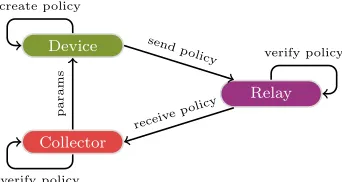
Figure 2 shows the setup of Steady. It starts with the collector generating a public key (pub) that is sent to the device together with a timeout value and
2
the minimum storage space for its relay. The timeout specified the maximum amount of time between events from the device, described further later. The device commits to the parameters by creating a signed policy with a key-pair that has been verified to belong to the device out of band. A policy is valid for the lifetime of logging. The policy is propagated to the untrusted relay. The relay verifies that the storage parameter in the policy is acceptable and that the signature is valid. Finally, the collector polls the relay for the policy and verifies it. Each entity has its respective state (defined later), where notably the private and signing keys are only known to the respective entities that generated them.
Device
Collector
Relay
params
create policy
send
policy verify policy
receive p olicy
verify policy
Fig. 2: The setup of Steady resulting in a signed policy of parameters.
2.4 Device Logging and Creating Blocks
The device generates a block of events periodically, at least when the timeout triggers. Blocks are given an incrementalindex by the device together with other metadata such as a timestamp, a signature, and the root of a Merkle tree over all events [11]. A more precise definition is given later. Events are kept in a queue as shown in Figure 3 before being included in a block. Several events in the same block makes compression more efficient and amortises costs related to cryptographic operations during block generation and network transport.
Bi
. . .
Bnwrite block(s)
create block
Events
dequeue enqueue
drop
Fig. 3: The device’s event and block generation flow.
blocks not yet written to the relay. While it is possible for the device to recreate blocks not yet written to the relay, it is relatively costly to do so. Any metadata to report to the collector about dropped events can be sent as part of an event.
2.5 Writing to and Reading From a Relay
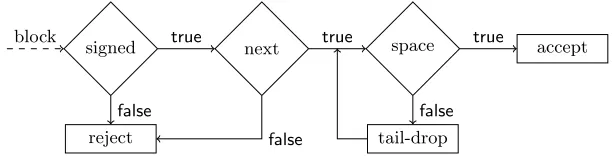
When a device writes one or more blocks to the relay, the relay first sorts the blocks based on index, and then processes one block at the time as shown in Figure 4. The relay verifies the signature on the block and only accepts if the block has been signed with the same key as the policy. Then it ensures that the block is the next (in terms of index) block based on the previous block and if so makes space for the block before accepting (storing) it. To keep at most the minimum storage space in the policy, the relay stores a (FIFO) queue of blocks.
signed next space accept
tail-drop reject
true true true
false false
false block
Fig. 4: The relay’s event write flow.
Aread from the relay is done based on a supplied block index by traversing the queue and sending each block with an equal or greater index. Because a relay is defined as a FIFO queue with read and write operations, multiple relays can be used where writes cascade and the collector reads from the last relay.
2.6 Collector Verification
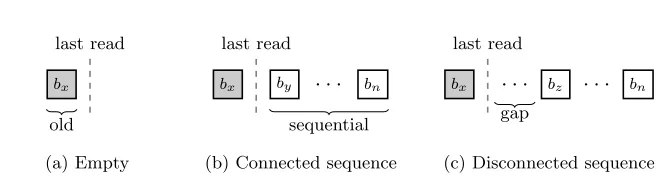
The collector periodically polls for new blocks from the relay based on the latest read block index in its state. Because each block is signed we know that events within it cannot be tampered with, so verification focuses on ensuring we get the expected blocks. Figure 5 shows the three possible correct cases when reading from a relay (with read index y): (a) no new blocks, (b) a sequence of new blocks directly following the last read block (x+ 1 =y), or (c) a disconnected sequence. Based on the above three cases we sketch a verification algorithmverifythat verifies that we read the expected blocks from the relay:
Empty Valid if the time since the last block is less then the timeout.
Connected sequence Valid if the timestamp of the most recent returned block
is timely given the current time at the collector and the timeout.
Disconnected sequence Same as the connected sequence case with the
bx
last read
old
(a) Empty
bx
last read
by
. . .
bnsequential
(b) Connected sequence
bx
last read
. . .
bz. . .
bngap
(c) Disconnected sequence
Fig. 5: The three possiblecorrect cases when reading blocks.
The formally defined algorithm is in AppendixA.
2.7 Proof Generation and Verification for Event Authenticity
As mentioned in Section2.4, each block is signed by the device and contains the root of a Merkle tree over all events in the block. A proof of event authenticity is simply a Merkle audit path to an event in question and metadata from the block to verify the signed root from the device. Verifying the proof involves verifying the signature and comparing the computed Merkle root from the audit path to the one signed by the device.
3
Formal Model of Steady
We formally model Steady, starting with core definitions and the logging scheme in Section3.1followed by properties in Section3.2.
3.1 Core Definitions and the Logging Scheme
We define a policy (Definition1), block (Definition2), and proof (Definition3).
Definition 1 (Policy). Given a public keypub, a signing key-pair (sk,vk), a timeout t, a minimum space s, the current time τ, and a policy identifierk, a policy P is defined as:
{k,vk,pub, t, s, τ, σ}
whereσ is a signature usingsk over all other values.
Nothing prevents the relay from storing more blocks than the minimum space s. The policy identifier k should be unique per device. The timeout t
is the maximum period of time (inclusive) between blocks being created by the device. The current time τ is included as relevant metadata and a reference for when the first block should be expected the latest (relative tot).
compressionfc, the size of the previous block`p, an initialization vectorIV, and the current timeτ, a blockB is defined as:
i, `c, `p,Hk(p), φ←Hk ik`ck`pkHk(p)kfekfc
, ι←HIV(r), τ, σ, p
where σ ← Sig(sk, φkιkτ) and `c is the resulting size of the current block. We refer to φas the block header hash andι the root hash.
Note thatHkis a keyed hash function—where the key puts the hashes of different blocks belonging to different policies into different domains—and that the root hash is keyed withIVinstead ofk(to make proofs smaller, no need to sharek). We need the previous block size`pin the verification algorithm, see AppendixA. Based on a chosen or guessed e, an adversary can reconstruct the Merkle tree root r0 and check if it matches r ∈ B. Since this would violate event secrecy (defined later), a block includes H(rkIV) instead of r itself. IV is part of the encrypted payload. Note that the signature does not directly coverp, and that the block sans the payload is constant size. This enables a block to be efficiently streamed, such that the verifier can verify the signature using only the block header and then know how large the remainder of the block should be (using
`c). The hash of the payload (H(p)) in the header authenticates it once read. Finally, the structure ensures compact proofs of event authenticity that does not leak block metadata3.
Definition 3 (Proof of event authenticity). Given a blockB and an event
e∈B, a proof Π is defined as:
n
IV, φ, τ, σ,#»heo
whereσ∈B and #»he is a Merkle audit path toethat enables the computation of
ι usingIV, which in turn is signed byσ together withτ and φ.
Having defined a policy, block, and proof we can now define a Steady logging scheme (Definition4):
Definition 4 (Steady scheme). Given a security parameterλ, a time-skew
security parameterδ, an encryption key-pair(priv,pub), a signing key-pair(sk,vk), and a policyP, we define a collector stateScas{δ,priv, P, i, τ}, a device stateSd
as{pub,sk, P, i, τ, `p}, and a relay state Sr as{P,B }. Here i is the (expected)
next block index, τ the time of the most recent block, `p the size of the previ-ous block, and B a sequence of blocks; initially i is set to 0, `p to 0, B to an empty sequence, and τ to the creation time of P. A Steady scheme S is com-posed of seven algorithms{setup,block,read,write,verify,proofGen,proofVer}that are polynomial in space and time:
3
The block metadatai,`c, and`p are hashed together with the hash of the payload
– Sc, Sd, Sr←setup(λ, δ, t, τ, s): given two security parametersλandδ, a
time-out t ∈ N, the current time τ, and a space s ∈ N, setup runs (priv,pub) ←$KGen(1λ) and (sk,vk)←$KGen(1λ). Next, a policy P is generated from k←$1λ,pub,(sk,vk),t,τ, ands. The output is the initial statesSc,Sd,Sr.
– B, S0
d ← block(Sd,e, τ, fe, fc): given a device state Sd, a list of events e,
the current timeτ, an encryption flag fe, and a compression flag fc, block generates the next block B based on Sd, τ, and the flags. The output is B
and a refreshed stateSd0 such thati0 =i+ 1, `0p=`c, andτ0 =τ.
– β ← read(Sr, i): given a relay state{P,B } ← Sr and a block index i, read
outputs a sequence of blocksβ ← {Bj|Bj∈ B ∧j≥i}.
– Sr0←write(Sr, β): given a relay state{P,B } ←Sr and a connected sequence
of blocks β, write outputs a refreshed state Sr0 with B0 ⊆ B ∪β. B0 should
contain at least as many of the most recent blocks as implied by the minimum space parameter inP.
– α, Sc0 ←verify(Sc,B, τ): given a collector stateSc, a sequence of blocksB, and
the current timeτ,verifydetermines with respect toSc andτ if everyB ∈ B
is a valid block and that no block is missing. The output is an answer α← {false,true}together with a refreshed stateSc0 that matchesi+ 1andτ from
the most recent valid block.
– Π←proofGen(B, e, Sc): given a blockB, an evente∈B and collector state
Sc used to retrieve and verifyB,proofGenoutputs a membership proofΠ.
– α←proofVer(Π, e,vk): given a proof Π, an event e, and a verification key
vk,proofVeroutputs an answerα← {false,true}that istrueiffΠ shows that
vkauthenticatese, otherwisefalse.
3.2 Properties
For the following correctness and security definitions, we define a helper algo-rithm{false,true} ← check(Sr, τ) that outputs true iff the state Sr is without
deletions that violate the policyP ∈Sr given the (correct) current timeτ.
Definition 5 (Correctness). LetSbe an instance of the Steady logging scheme
{setup,block,read,write,verify,proofGen,proofVer}. For all λ, δ, s, t ∈ N, policy creation time τ, and Sc, Sd, Sr ← setup(λ, δ, t, τ, s) that are followed by
poly-nomially many invocations of block, write, and verify to obtain a sequence of blocks B and the intermediate statesSc, Sd, Sr, thenS is correct iff:
P r
∀e∈ ∀B ←read(Sr, i∈Sc) :check(Sr, τ)∧ ¬verify(Sc,B, τ)
∨¬proofVer Π ←proofGen(B, e, Sc), e,vk∈Sc
≤negl(λ)
In the following security definitions, we consider an adversary that controls an instance of the Steady scheme adaptively. Whereas access to Sris unlimited
withwrite, the statesScandSdcan only be influenced through oracle access:
– B←oblock(e, fe, fc): given a list of eventse, encryption flagfe, and com-pression flagfc,oblockrunsblockwith the provided input, the most recent device stateSd (kept by the oracle), and the correct current time. Returns
– α←overify(B): given a sequence of blocksB,overifyruns verifywithB, the most recent collector stateSc, and the current timeτ. Returns the answerα.
– e,IV←odec(B): given a blockB with an encrypted payload,odecdecrypts the payload inB and returns the list of eventseandIV.
For event secrecy (Definition 6), an oracle B ← oblock∗b(e0,e1) is defined that outputs the next blockB fromeb usingoblockwithfe=true, whereb is a secret challenge bit. In order to prevent size correlations,oblock∗bonly acceptsei of equally many events that match pair-wise in size andfc=false. The adversary may not useodecto decrypt any block fromoblock∗b (as in IND-CPA).
Definition 6 (Event secrecy). For all λ, δ ∈ N and PPT adversaries A, a
Steady scheme provides computational secrecy of an event’s content iff:
1
2|Pr[Exp
es
A(λ, δ) = 1|b= 0 ] + Pr[Exp
es
A(λ, δ) = 1|b= 1 ]−1| ≤negl(λ)
ExpesA(λ, δ):
1: t, τ, s, Sa← A(λ, δ)
2: Sc, Sd, Sr←setup(λ, δ, t, τ, s), b←${0,1}
3: b0← Aoblock,oblock∗b,read,write,overify,odec (Sr, Sa)
4: returnb=? b0
For event integrity (Definition 7), we define an algorithm {false,true} ←
valid(P, B, e, e0) that uses verify as a subroutine. The output is true iff B is a block for the policyP whene∈B and after replacing the evente∈B withe0.
Definition 7 (Event integrity). For allλ, δ∈NandPPT adversariesA, a
Steady scheme provides integrity of an event’s content iff:
PrExpeiA(λ, δ) = 1≤negl(λ)
ExpeiA(λ, δ):
1: fe, fc, t, τ, s, Sa← A(λ, δ)
2: Sc, Sd, Sr←setup(λ, δ, t, τ, s)
3: B, e, e0← Aoblock,read,write,overify,odec (Sr, Sa)
4: returne6=e0∧valid(P∈Sc, B, e, e 0
)
For delayed event deletion detection (Definition8), the adversary gets con-trol over the setup parameters except for the current timeτ. After polynomial invocations to the listed oracles, the adversary outputs a state of the relaySr, a
positive time duration ∆ that represents the expired time after setup, and the duration x since τ when the latest (in terms of index) block was modified or deleted in Sr. The adversary wins if she can modify or delete with more than
negligible probability one or more blocks from Sr without detection by verify
thatoverifyis not available to the adversary: we remove this capability to ensure that the call toreadusingScreads all blocks inSr forverifyto verify4.
Definition 8 (Delayed event deletion detection). For all λ, δ ∈ N and
PPT adversaries A, a Steady scheme provides delayed event deletion detection iff:
PrhExpdeddA (λ, δ) = 1i≤negl(λ)
ExpdeddA (λ, δ):
1: fe, fc, t, s, Sa← A(λ, δ)
2: Sc, Sd, Sr←setup(λ, δ, t, τ, s), whereτ is the correct current time
3: Sr, ∆, x← Aoblock,read,write,odec(Sr, Sa)
4: return¬check(Sr, τ+∆) ∧verify
Sc,read(Sr, i∈Sc), τ+∆
∧x > t+δ
For unforgeable proofs of event authenticity (Definition9), the adversary has to output an eventeand a valid proofΠ fore, whereehas not been part of any of the blocksBgenerated by the adversary as part of calls to oracleoblock.
Definition 9 (Unforgeable proofs of event authenticity). For allλ, δ∈N
and PPT adversaries A, a Steady scheme provides unforgeable proofs of event authenticity iff:
PrhExpufpA (λ, δ) = 1i≤negl(λ)
ExpufpA (λ, δ):
1: fe, fc, t, τ, s, Sa← A(λ, δ)
2: Sc, Sd, Sr←setup(λ, δ, t, τ, s)
3: B, e, Π← Aoblock,read,write,overify,odec(Sr, Sa)
4: returne /∈ B ∧proofVer(Π, e,vk∈P ∈Sc)
4
Security of Steady
4.1 Assumptions
Lemma 1. In a Merkle tree, the security of an audit path reduces to the collision resistance of the underlying hash function H.
Proof (sketch). This follows from the work of Merkle [11] and Blumet al. [1].
4
4.2 Properties and Proofs
The formally definedverifyalgorithm is in the AppendixA.
Theorem 1 (Correctness). Steady is correct as in Definition5.
Proof (sketch). For the first part of Definition5, regarding verification, all pos-sible (valid) blocks are per definition generated by calls toblock, written to the relay with write, and returned by read from a valid Sr given time τ. This
im-plies that blocks are timely, form a validsequence, and the size is at least the size in the policy, soverifyaccepts with probability 1 for all possible blocks. For the second part of Definition5, regarding proofs, this follows trivially from the definitions ofproofGenandproofVer.
Theorem 2 (Event secrecy). For an IND-CPA secure public-key encryption
scheme and a pre-image resistant hash function, Steady provides computational secrecy of events as in Definition6.
Proof (sketch). The events have been encrypted together with a uniformly ran-dom IV using an IND-CPA secure public-key encryption scheme. This ensures that the payload itself is not a distinguisher. Further, as part of the block B
fromoblock∗, (i, `p, τ) are independent of the events in the block. The root hash
ιis done with a pre-image resistant hash function, where the root of the Merkle tree is combined with a uniformly random IV before being hashed. The payload hash, block headerφ, and signatureσoperate on the encrypted events. ut Event secrecy, per definition, is only provided when encryption is enabled and compression is disabled. Further, because of the use of public-key encryption, Steady also provides forward secrecy upon compromise of a device and its state.
Corollary 1 (Forward event secrecy). For an IND-CPA secure public-key
encryption scheme and a pre-image resistant hash function, Steady provides com-putational forward secrecy of events in blocks.
Theorem 3 (Event Integrity). Given an existentially unforgeable signature
scheme and a collision resistant hash function, Steady provides computational integrity of events as defined in Definition 7.
Proof (sketch). An existentially unforgeable signature scheme prohibits forgery of different messages. This means that every signed block B will include an authentic Merkle tree root that cannot be replaced by the adversary, and each event e∈B will thus be fixed by an audit path in the block’s Merkle tree. The security of an audit path reduces to the collision resistance of the underlying
hash function (Lemma1). ut
Theorem 4 (Unforgeable Proofs of Event Authenticity). Given an
Proof (sketch).Proof verification consists of verifying an audit path in a Merkle tree and that the root of the Merkle tree is signed. The security of an audit path reduces to the collision resistance of the underlying hash function (Lemma 1)
and the signature is existentially unforgeable. ut
Theorem 5 (Delayed event deletion detection). Given an existentially
unforgeable signature scheme and a collision resistant hash function, Steady pro-vides delayed event deletion detection as defined in Definition8.
Proof (sketch). Within blocks, events cannot be deleted because each event is fixed by an audit path in a Merkle tree (Lemma1) where the root is signed with an existentially unforgeable signature. Therefore we need to show that blocks cannot be deleted without detection.
With a correct collector stateSc generated through setup or oracle calls to
overify, readreturns a sequence of blocks B. The authenticity and integrity of blocks are protected by an existentially unforgeable signature. The verification algorithmverifysortsBwith valid signatures into a (not necessarily connected) sequence (B0. . . Bn) based on block indexi, and removes any duplicates or old blocks (index <requested index toread). There are then three possible cases:
Case 1 len (B0. . . Bn)
= 0:readreturned no new blocks.
Case 2 len (B0. . . Bn)>0∧B0i =Sic:readprovided one or more new blocks
and the first block is the block directly after the previous read.
Case 3 len (B0. . . Bn)
>0∧B0i 6=Sic:readprovided one or more new blocks
and the first block isnot the block directly after the previous read.
Note that forExpdeddA (λ, δ) to returntruethenx > t+δ, meaning that at least
t+δ time must have expired since the latest block was deleted or modified by the adversary. Further, the policy specifies that (i) a block should be produced at least after t time since the latest block, and (ii) the relay should store at leastsspace of the most recent blocks. If a block has been deleted fromSrsuch
that check returns false, then the policy has been violated at time τ+∆ (per definition). Therefore either of the two, or both, parts of the policy have been violated. Returning to the three possible cases in the paragraph above:
Case 1 The timely check will detect any deleted block because (i)t+δ time
has expired, (ii) the time in the collector’s state is based on an existentially unforgeable signature in the last verified block, and (iii) the provided current timeτ+∆ is the same as forcheck.
Case 2 In addition to atimelycheck—but in this case based on the time in the latest new block instead of state—verify also checks that all blocks form a connected sequence from the block in state to the latest block. All blocks are signed with an existentially unforgeable signature.
Case 3 In addition to a timelycheck of the latest new block,verifychecks that all new blocks form a connected sequence, and that the size of the new blocks together with the size of the prior block (B`p
u t
Theorem 5 covers block deletion as defined in Definition 8 when reading blocks from the relay that the adversary completely controls. Further, per defi-nition writechecks for a monotonically increasing block index, therefore replay attacks are irrelevantafter setup (Corollary2).
Corollary 2 (Relay replay attacks). Given an existentially unforgeable
sig-nature scheme, writes and reads in Steady are secure from replay attacks.
4.3 Relay Flushing and Device Forward Security
Note that the delayed event deletion detection, as defined in Definition 8, is limited in several ways. First, deletion detection is delayed by the timeouttand time-skewδparameters. Benign delays due to, e.g., network effects or clock drift between device and collector, risks causing false positives with a time-based deletion detection mechanism. We therefore introduce a security parameter δ
that specifies the acceptable delay for the collector, trading delayed deletion detection for reduced false positives.
Further, because the relay only is required to keep finite storage, this opens up another venue for an adversary to “flush” a relay (Corollary 3). We stress that this is fundamental restriction in the setting.
Corollary 3 (Relay flushing).An adversary with the capability to trigger the device to create new blocks can flush blocks from the relay that have yet to be read by the collector. Accordingly, a relay’s minimum storage capacity and the collector’s reading frequency must be treated as security parameters.
In the setting of finite storage relays, forward event integrity and forward (delayed) event deletion detection are less relevant: if the collector does not read (fast enough) an adversary can flush the relay, and if a device blocks or discards new events when storage is full (or not read) then this is either a severe denial-of-service vector or just a precondition for an adversary to trigger before launching an attack she does not want detected (the same outcome as being able to compromise and delete events).
Corollary 4 (Collector reads and device forward security).If the
collec-tor continuously reads from the relay, then the timeout and time-skew parameters give an upper bound for the time the adversary has in undetectably modifying or deleting events that have yet been read by the collector.
5
Performance Evaluation
encryption5. The device is implemented6 in C (c11) in 987 loc (as reported by cloc) using libsodium7 for crypto primitives and LZ48 for compression. The
relay and a minimal collector are implemented9in Go in 1239 loc.
For our performance evaluation focused on event goodput we used 1 GiB of syslog events (6,472,046 events, mean size 164.9±39.7 bytes) of the Dartmouth campus CRAWDAD dataset [9]. The device was run on an [email protected] CPU with 16 GiB DDR3@1600MHz memory and a 1 Gib/s Internet connection. It was limited to using one (logical) core for block creation. We hosted the relay at two locations: on a laptop connected through a 1 Gib/s LAN (mean 0.4±0.2 ms latency) and at an Amazon EC2 instance type m5.large in Frankfurt with a up to 10 Gib/s connection (mean 29.8±0.2 ms latency). The relay is never CPU bound due to little computation needed to verify blocks (see Figure4).
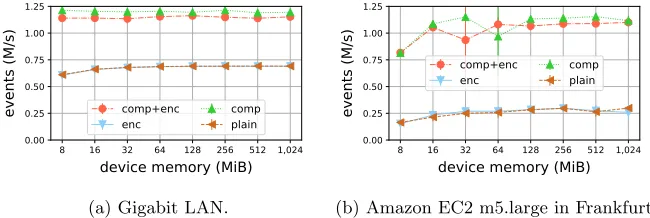
Figure6 shows the results of our performance evaluation. Compression en-ables a device with only 16 MiB of memory to sustain over 1M events/s (over 160MiB/s) regardless of relay location or use of encryption. Without compres-sion the increased latency to the relay has a significant impact on goodput, likely because the connection between the device and relay is saturated. Device memory beyond 16 MiB has little or no impact on goodput.
8 16 32 64 128 256 512 1,024
device memory (MiB)
0.000.25 0.50 0.75 1.00 1.25
events (M/s)
comp+encenc compplain
(a) Gigabit LAN.
8 16 32 64 128 256 512 1,024
device memory (MiB)
0.000.25 0.50 0.75 1.00 1.25
events (M/s)
comp+enc
enc compplain
(b) Amazon EC2 m5.large in Frankfurt.
Fig. 6: Events per second as a function of device memory for two relay locations.
6
Related Work
Reasoning about event membership in logs and consistency of logs can use (evolv-ing) Merkle trees [11], as done by Crosby and Wallach [4]. Publicly verifiable schemes (as defined by Holt [6])—that enables membership verification of an
5
NaCl box (https://nacl.cr.yp.to/box.html) uses Salsa20 and Poly1305, we use AES256-GCM instead for the hardware speed-up on selected platforms.
6
https://github.com/pylls/steady-c, Apache 2.0 license.
7 https://libsodium.org/, accessed 2018-08-05. 8
https://lz4.github.io/lz4/, accessed 2018-08-05.
9
event in a log with only public information—typically use signatures on events. Schneier and Kelsey proposed a forward-secure logging system that protects the integrity and confidentiality of events on a per-event basis using MACs and encryption [12]. Grouping events is an important part of providing pro-tection againsttruncation attacks (deletion detection), e.g., as done by Ma and Tsudik [10]. Forward-secure sequential aggregate signatures—introduced in the context of secure logging by Ma and Tsudik [10] and built upon by a number of works, e.g., [15,16]—aggregates signatures over sequential messages into one compact signature instead of individual signatures per message to save storage space and bandwidth. Hartung et al. proposed a provably-secure logging scheme that is also fault-tolerant: the scheme can tolerate a number of manipulated log entries (determined a priori) without invalidating the signature [5]. Steady uses one signature per block over the root of a Merkle tree: more efficient in terms of bandwidth and operations than one signature per message, but more fragile.
Notably, the secure logging system PillarBox by Bowerset al.[2] is both com-plementary and related to Steady in several ways. Both PillarBox and Steady buffers events before transmitting them. The verification algorithm used by Pil-larBox uses a “gchecker” to look for missing events, similar to Steady’s ap-proach to looking for blocks (Figure5). As complementary, PillarBox focuses on device compromise, providing integrity of all events buffered prior to compromise and optionally also provides “stealth”: hiding the existence of events generated prior to compromise in the buffer. They report event generation in the order of 100,000 events/s (on older hardware). Unlike PillarBox, Steady supports relays, has optional compression, and publicly verifiable proofs of even authenticity.
There are a number of logging systems that use trusted hardware—such as TPM, Intel SGX, and GlobalPlatform TEE—as a basis for system security, also on intermediate systems like our relays [7,13,14]. Steady is software-based.
7
Conclusions
We presented Steady, a simple secure logging system that supports intermediate storage on untrusted relays. Steady is formalised and security proven in the standard model based on vanilla cryptographic primitives and assumptions. The goal of our work was to construct a practical logging system, that does not require other security protocols (e.g., TLS for transport) and that would be reasonably easy to implement and audit. Our performance evaluation which uses a≈2,200 loc implementation shows significant goodput on resource-constrained devices when the relay is hosted at a popular commercial cloud provider, especially if compression is used. While compression may leak information despite the use of encryption it can be arguably a worthwhile trade-off in many settings.
Acknowledgments. We would like to thank Christian Gotare, Anders Lid´en,
References
1. Blum, M., Evans, W.S., Gemmell, P., Kannan, S., Naor, M.: Checking the correct-ness of memories. Algorithmica12(2/3), 225–244 (1994)
2. Bowers, K.D., Hart, C., Juels, A., Triandopoulos, N.: PillarBox: Combating next-generation malware with fast forward-secure logging. In: RAID (2014)
3. Buldas, A., Truu, A., Laanoja, R., Gerhards, R.: Efficient record-level keyless sig-natures for audit logs. In: NordSec 2014. pp. 149–164 (2014)
4. Crosby, S.A., Wallach, D.S.: Efficient data structures for tamper-evident logging. In: Monrose, F. (ed.) 18th USENIX Security Symposium, Montreal, Canada, Au-gust 10-14, 2009, Proceedings. pp. 317–334. USENIX Association (2009)
5. Hartung, G., Kaidel, B., Koch, A., Koch, J., Hartmann, D.: Practical and robust secure logging from fault-tolerant sequential aggregate signatures. In: ProvSec 2017
6. Holt, J.E.: Logcrypt: forward security and public verification for secure audit logs. In: The proceedings of AusGrid and AISW 2006
7. Karande, V., Bauman, E., Lin, Z., Khan, L.: SGX-Log: Securing system logs with SGX. In: AsiaCCS 2017
8. Kelsey, J.: Compression and information leakage of plaintext. In: FSE 2002
9. Kotz, D., Henderson, T., Abyzov, I., Yeo, J.: CRAWDAD dataset dart-mouth/campus (v. 2009-09-09). Downloaded from https://crawdad.org/ dartmouth/campus/20090909(Sep 2009)
10. Ma, D., Tsudik, G.: A new approach to secure logging. TOS5(1), 2:1–2:21 (2009)
11. Merkle, R.C.: A digital signature based on a conventional encryption function. In: CRYPTO 1987
12. Schneier, B., Kelsey, J.: Cryptographic Support for Secure Logs on Untrusted Ma-chines. In: USENIX Security Symposium. pp. 53–62. USENIX (1998)
13. Shepherd, C., Akram, R.N., Markantonakis, K.: EmLog: Tamper-resistant system logging for constrained devices with TEEs. In: WISTP 2017
14. Sinha, A., Jia, L., England, P., Lorch, J.R.: Continuous tamper-proof logging using TPM 2.0. In: TRUST 2014
15. Yavuz, A.A., Ning, P.: BAF: an efficient publicly verifiable secure audit logging scheme for distributed systems. In: ACSAC 2009
16. Yavuz, A.A., Ning, P., Reiter, M.K.: Efficient, compromise resilient and append-only cryptographic schemes for secure audit logging. In: FC 2012
A
Collector Verification Algorithm
verify(Sc,B, τ)
1: (B0. . . Bn)←sort(B)//Bi0≥S
i
c, signatures valid, duplicate blocks removed 2: α←validate (B0. . . Bn), τ, Sτc, t∈P, s∈P, S
i
c
3: if α∧len (B0. . . Bn)
>0thenSci←B
i n+ 1, S
t
c ←B
τ n
4: returnα, Sc
validate (B0. . . Bn), τ, T, t, s, N
1: if len (B0. . . Bn)= 0then
2: return timely(τ, T, t, δ)
1: returnτ−T ≤t+δ 3: elseifBi0=N then
4: returntimely(τ, Bnτ, t, δ)∧ seq (B0. . . Bn)
1: i←Bi0
2: forB in(B1. . . Bn) do
3: if Bi6=i+ 1then returnfalse 4: i←i+ 1
5: returntrue 5: returntimely(τ, Bτn, t, δ)∧seq (B0. . . Bn)
∧size (B0. . . Bn)
+B`p
0 > s
B
Extension for Private Proofs
Our proofs of event authenticity (Definition3) consists in part of a Merkle audit path from a signed root to the event. The audit path contains the hashes of other events. In settings where the contents of events can be guessed (brute-forced) with non-negligible probability the audit path therefore leaks information about other events than the event which the audit path fixes. Similar to the approach of Buldaset al.[3], we can ensure that proofs do not leak the contents of other events by blinding each leaf in the Merkle tree with a derived value. In our case, we can derive blinding values from the blockIV. Our extension for private proofs makes the following changes to Steady:
– During block creation, the device usesIVto computebi=HIV(i) as a blinding
prefix when computing the hash of leaf with index i(H(l||bi||v), where l is the leaf prefix as common in Merkle trees andv the value of the event).
– The root is blinded withbr, wherer=n+ 1 for a tree withnleafs.
– In proofs of event authenticity, replaceIVwith the blinding value to compute the signed rootbr and the blinding value for eventbe.