SIMON
Zhan Chen1, Ning Wang2,3, and Xiaoyun Wang2,3,4*
1 Department of Computer Science and Technology,
Tsinghua University, Beijing 100084, China
2 Key Laboratory of Cryptologic Technology and Information Security,
Ministry of Education, Shandong University, Jinan 250100, China 3 School of Mathematics, Shandong University, Jinan 250100, China
wangning [email protected]
4 Institute of Advanced Study, Tsinghua University, Beijing 100084, China
Abstract
Impossible differential is a useful method for cryptanalysis. SIMON is a light weight block cipher that has attracted lots of attention ever since its publication in 2013. In this paper we propose impossible differential attack on five versions of SIMON, using bit conditions to minimize key bits guessed. We calculate keybits and give the exact attack results.
Keywords:SIMON, impossible differential, bit condition
1
Introduction
SIMON [1] is a family of block ciphers designed by the U.S. National Security Agency (NSA) in 2013. It is designed to have excellent performance on both hardware and software [2]. It has a feistel structure and 5 different block sizes with different key lengths. Ever since its publica-tion, SIMON has attracted much cryptanalysis such as differential analysis [3] [4] [5] [6], linear cryptananlysis [7] [8], impossible differential and zero-correlation linear hull cryptanalysis [7] [9]. Impossible differential attacks were independently introduced by Knudsen [10] and Biham et al. [11], the aim of impossible differential cryptanalysis is to use differentials that never occur to eliminate wrong key candidates that result in such a differential.
This paper is organized as follows. We give a brief description of SIMON and some notation-s in notation-section 2. In notation-section 3, we exprenotation-snotation-s a unotation-seful property of SIMON concerning bit conditionnotation-s
which is used in our attack. In section 4 we give a 19-round impossible differential attack on SI-MON32. In section 5 we mount 20-round impossible differential attack on SIMON48/72. Section 6 concludes the paper.
2
A brief description of Simon
SIMON is a feistel structure block cipher with block size2nwheren∈ {16,24,32,48,64}, and key sizemnwherem∈ {2,3,4}, usually denoted as SIMON2n/mn. We list some notations as follows:
• Xi[n, . . . ,2n−1,0, . . . , n−1]: the input of thei-th round
• Li[n, . . . ,2n−1]: the left half of thei-th round input
• Ri[0, . . . , n−1]: the right half of thei-th round input
• 4Xi: the difference of two inputsXiandXi0
• ki[0, . . . , n−1]: the subkey of thei-th round
• X≪r: the left rotation ofXbyrbits
• ⊕: bitwise exclusive OR
• ∩: bitwise AND
• %: modular operation
All versions of SIMON with corresponding numbers of rounds are listed in Table 1.
Table 1: The 10 versions of SIMON
Block size (2n) Key size (mn) Number of rounds
32 64 32
48 72 36
96 36
64 96 42
128 44
96 96 52
144 54
128
128 68
192 69
256 72
Simon uses a simple round functionF(x) = (x≪1)∩(x≪8)⊕(x≪2). The plaintext is(L0, R0). After roundi,(Li, Ri)are updated to(Li+1, Ri+1)as follows:
Li+1=F(Li)⊕Ri⊕ki
The output of the last round(LNr, RNr)yields the ciphertext.
The key schedules generate a sequence of Nr subkeys {k0, . . . , kNr−1}. The procedure
d-iffers, depending on the value m. The firstm subkeys are initialized by the master key. For i=m, . . . , Nr−1,
ki =c⊕(zj)i−m⊕ki−m⊕Yi−m⊕(Yi−m≪1),
where
Yi−m =
ki−m+1 ≪3, ifm= 2, ki−m+2 ≪3, ifm= 3, ki−m+3 ≪3⊕ki−m+1, ifm= 4.
Herec= 2n−4andzj is a version-dependent constant sequence. For more details refer to [2].
3
Some Observations of Bit Property
Observation 1 (from [12])Let4x=x⊕x0,4y=y⊕y0, then
(x∩y)⊕(x0∩y) =4x∩y
(x∩y)⊕(x∩y0) =x∩ 4y
(x∩y)⊕(x0∩y0) = (x∩ 4y)⊕(4x∩y)⊕(4x∩ 4y)
Observation 2 (from [3])Given two inputsXiandXi0of thei-th round, the difference of output
4Xi+1 can be computed without any information of subkeys. Each bit of the difference4Xi+2
can be computed with no more than one key bits, depending on two bits of4Xi+1.
We know from the round function that
Xi+1[j+n] =Xi[(j+ 1)%n+n]∩Xi[(j+ 8)%n+n]⊕Xi[(j+ 2)%n+n]⊕Xi[j]⊕Ki[j],
so
4Xi+1[j+n] =(4Xi[(j+ 1)%n+n]∩Xi[(j+ 8)%n+n])
⊕(Xi[(j+ 1)%n+n]∩ 4Xi[(j+ 8)%n+n])
⊕(4Xi[(j+ 1)%n+n]∩ 4Xi[(j+ 8)%n+n])
⊕ 4Xi[(j+ 2)%n+n]⊕ 4Xi[j].
When computing4Xi+2[j+n]we need the value(4Xi+1[(j+ 1)%n+n]),4Xi+1[(j+ 8)%n+ n]).
If(4Xi+1[(j+1)%n+n],4Xi+1[(j+8)%n+n]) = (0,0),then4Xi+2[j+n]can be computed without any keybits.
If(4Xi+1[(j+ 1)%n+n],4Xi+1[(j+ 8)%n+n]) = (0,1),then onlyXi+1[(j+ 1)%n+n] is needed, we only have to guesski+1[(j+ 1)%n].
If(4Xi+1[(j+ 1)%n+n],4Xi+1[(j+ 8)%n+n]) = (1,0),then onlyXi+1[(j+ 8)%n+n]
is needed, we only have to guesski+1[(j+ 8)%n].
If (4Xi+1[(j + 1)%n+ n],4Xi+1[(j + 8)%n+n]) = (1,1), then we only have to guess
ki+1[(j+ 1)%n]⊕ki+1[(j+ 8)%n].
4
Impossible Differential Attack on SIMON32/64
We use a impossible differential characteristic of 11 rounds. This path is that, given input dif-ference4X = [0000,0000,0000,0000,0000,0000,0000,0001], after 11 SIMON32/64 rounds, the output difference cannot be like this:[0000,0000,1000,0000,0000,0000,0000,0000]or this:
[0000,0010,0000,0000,0000,0000,0000,0000].Here we should note that, the input difference or output difference must have at least one non-zero bit. Since only zero difference propagates into zero difference, and the plaintext pairs or ciphertext pairs we use all have non-zero difference. Us-ing a potential zero input difference or output difference may result in better attack than it should be.
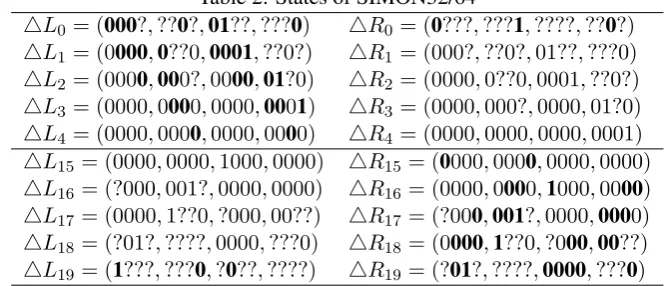
We add four rounds on top and four rounds at the bottom of the first impossible differential path, and present attack on 19 rounds SIMON32/64. The state of each round is listed in Table 2 :
Table 2: States of SIMON32/64
4L0= (000?,??0?,01??,???0) 4R0 = (0???,???1,????,??0?)
4L1= (0000,0??0,0001,??0?) 4R1 = (000?,??0?,01??,???0)
4L2= (0000,000?,0000,01?0) 4R2 = (0000,0??0,0001,??0?)
4L3= (0000,0000,0000,0001) 4R3 = (0000,000?,0000,01?0)
4L4= (0000,0000,0000,0000) 4R4 = (0000,0000,0000,0001)
4L15= (0000,0000,1000,0000) 4R15= (0000,0000,0000,0000)
4L16= (?000,001?,0000,0000) 4R16= (0000,0000,1000,0000)
4L17= (0000,1??0,?000,00??) 4R17= (?000,001?,0000,0000)
4L18= (?01?,????,0000,???0) 4R18= (0000,1??0,?000,00??)
4L19= (1???,???0,?0??,????) 4R19= (?01?,????,0000,???0)
4.1 Procedure of the attack
Step 1 We build structures as follows: there are 10 necessary conditions on the plaintext, we divide all the232plaintexts into210parts, with 10 bitsX0[0,7,14,16,17,18,22,24,25,31]
fixed for each part and other 22 bits traversing. Because 4X1 can be computed without
any key bits, we can use this property for data collection. There are 11 conditions on4X1,
only 8 of them need to be considered. The other 3 are certain to hold. By round function definition, we build 8 equationsX1[j+n] =X0[(j+ 1)%n+n]∩X0[(j+ 8)%n+n]⊕ X0[(j + 2)%n+n]⊕X0[j] forX1[17,18,19,20,24,25,26,27] and solve the equation
system. So for each of the210parts, we obtain28structures with 10 bits ofX0and 8 bits of X1 fixed and other 14 bits traversing. In total we get218structures.
Step 2 Two structures with three different bits X0[25,7], X1[27] can form 228 pairs. The 232
plaintexts can form217+1 structures which is217+28 = 245 pairs. Encrypt these pairs and choose pairs whose ciphertexts have zero difference at4X19[23,25,1,8,9,10,11,15]and non-zero difference at4X19[16,2], the expected number of pairs left is245−10= 235.
Step 3 Compute 8 bits difference 4X18[1,2,3,4,10,11,12,13]for the remaining pairs, and
235×2−8= 227.
Step 4 We want4L2 = (0000,000?,0000,01?0).
1, From property 2, 0 = 4X2[19] = X1[20] ⊕ 4X1[21] ⊕ 4X1[3], where X1[20] = X0[21]∩X0[28]⊕X0[22]⊕X0[4]⊕k0[4]. Sok0[4]has one value.
2, From property 2,4X2[20] = (X1[21]∩ 4X1[28])⊕(4X1[21]∩X1[28])⊕(4X1[21]∩ 4X1[28])⊕ 4X1[22]⊕ 4X1[4].
If(4X1[21],4X1[28]) = (0,0), and if4X1[22]⊕ 4X1[4] = 1then these discard these
pairs. If4X1[22]⊕ 4X1[4] = 0, thenk0[5,12]has 4 values.
If(4X1[21],4X1[28]) = (0,1)then 4X2[20] = X1[21] ⊕ 4X1[22]⊕ 4X1[4] where X1[21] =X0[22]∩X0[29]⊕X0[23]⊕X0[5]⊕k0[5], thenk0[5]has 1 value.
If(4X1[21],4X1[28]) = (1,0), then4X2[20] = X1[28]⊕ 4X1[22]⊕ 4X1[4] where X1[28] =X0[29]∩X0[20]⊕X0[30]⊕X0[12]⊕k0[12], thenk0[12]has 1 value.
If(4X1[21],4X1[28]) = (1,1), then4X2[20] = X1[21]⊕X1[28]⊕1⊕ 4X1[22]⊕
4X1[4], sok0[5]⊕k0[12]has 1 value.
For all the above circumstances, discard the pairs that do not meet requirement, there are
227×(1−1
8)left.k0[5,12]has 16
7 values.
3, From property 2,4X2[21] = (X1[22]∩ 4X1[29])⊕(4X1[22]∩X1[29])⊕(4X1[22]∩
4X1[29])⊕ 4X1[23]⊕ 4X1[5]
Similarly, discard unnecessary pairs there are227×(1−18)2left.k0[6,13]has 167 values.
4, From property 2,4X2[26] =X1[18]⊕ 4X1[28]⊕ 4X1[10] =X1[18]. AndX1[18] = X0[19]∩X0[26]⊕X0[20]⊕X0[2]⊕k0[2]. Sok0[2]has 1 value.
5, From property 2, if4X1[28] = 1then4X2[27] =X1[19]⊕ 4X1[29]⊕ 4X1[11],k0[3]
has 1 value.
If4X1[28] = 0then4X2[27] =4X1[29]⊕ 4X1[11]. If4X1[29]⊕ 4X1[11] = 1then
discard these pairs. If4X1[29]⊕ 4X1[11] = 0thenk0[3]has 2 values.
After discarding unnecessary pairs there are227×(1−18)2×(1−14)left.k0[3]has43values.
6, Similarly about4X2[28], after discarding unnecessary pairs there are227×(1− 18)2× (1−1
4)
2left.k
0[3]has 43 values.
7, Similarly about4X2[29], after discarding unnecessary pairs there are227×(1− 18)2× (1−14)3= 225.37left.k0[14]has43 values.
In this step, 8 key bits have in total1× 16 7 ×
16 7 ×1×
4 3 × 4 3 = 4049 441 values.
Step 5 We want4R17= (?000,001?,0000,0000).
As is done in step 4, we discard pairs that do not help in our attack, and calculate keybits. There are 225.37×(1− 14)3 ×(1− 18)2 = 224.15 pairs left and 8 key bits have in total
1×4 3 ×
4 3 ×
4 3×1×
16 7 × 16 7 = 16384 1323 values.
Step 6 As for4L3 = (0000,0000,0000,0001), there are224.15×(1−18)×(1−14)2= 223.127
Step 7 As forR16= (0000,0000,1000,0000), there are2x×(1−14)2×(1−18)pairs left and
the 10 key bits have in total2×4 3 ×
16 3 ×2×
16 7 =
4096
63 values.
Step 8 As forR15= (0000,0000,0000,0000), 6 key bits have in total 32 possible values.
Step 9 As for4L4 = (0000,0000,0000,0000), 6 key bits have in total 32 possible values.
Step 10 In the end we have227×(1−14)10×(1−18)6 = 221.693pairs left. The 49 key bits have in total 4096441 × 16384
1323 × 384
7 × 4096
63 ×32×32 = 2
28.646possible values.
That is to say each pair can sieve out228.646 wrong key bits. There remains249×(1−
228.646 249 )2
21.693
= 249×2−3.65= 245.35key candidates.
Step 11 Above is the sieving results of the first impossible differential path. We add four rounds on top and bottom of the second impossible differential path. The number of key bits in-volved is also 49. 44 of them appeared for the first path. So the245.3544-bit keys together
with the other 5-bit keys of the second path is the remaining key candidates.
Similarly we sieve the key candidates using the second path, in the end, the number of remaining keys is245.35+5×(1− 228.646
245.35+5)2 21.693
= 250.35−1.431 = 248.919. That is to say, the total 54-bit keys are left with248.919.
The right key is definitely included in the remaining keys. We have guessed 54 bits, only have to traverse 10 bit equivalent bits to compute the master key, and test on 2 pairs of plaintexts.
4.2 Complexity analysis
The data complexity is232known plaintexts. The memory complexity is the storing of remaining key candidates in step 11, which is 248.919×54/32 = 249.674 states. The time complexity is also dominated by Step 11. In step 11, the time complexity is248.919×210 = 258.919 19-round SIMON32.
5
Impossible Differential Attacks on SIMON48/72
The 12-round impossible differential path we use is that, given input difference[(0000,0000,0000, 0000,0000,0000),(1000,0000,0000,0000,0000,0000)], after 12 round SIMON48 the output d-ifference cannot be:[(0100,0000,0000,0000,0000,0000),(0000,0000,0000,0000,0000,0000)].
We add four rounds on top and four rounds at the bottom, and present attack on 20-round SIMON48/72. The state of each round is listed in the following Table 3:
5.1 Procedure of the attack
Step 1 Same as done for SIMON32/64, we build232structures and form263pairs. Choose pairs
Table 3: States of SIMON48/72
4L0= (?000,00??,0000,???0,?01?,??0?) 4R0 = (1000,???0,?0??,????,????,????)
4L1= (?000,0000,?000,00??,0000,1??0) 4R1 = (?000,00??,0000,???0,?01?,??0?)
4L2= (0000,0000,0000,0000,?000,001?) 4R2 = (1000,0000,?000,00??,0000,1??0)
4L3= (1000,0000,0000,0000,0000,0000) 4R3 = (0000,0000,0000,0000,?000,001?)
4L4= (0000,0000,0000,0000,0000,0000) 4R4 = (1000,0000,0000,0000,0000,0000)
4L16= (0100,0000,0000,0000,0000,0000) 4R16= (0000,0000,0000,0000,0000,0000)
4L17= (?000,0000,0000,0000,0?00,0001) 4R17= (0100,0000,0000,0000,0000,0000)
4L18= (0100,0000,0?00,000?,?000,01??) 4R18= (?000,0000,0000,0000,0?00,0001)
4L19= (??00,000?,?000,0???,0?01,???0) 4R19= (0100,0000,0?00,000?,?000,01??)
4L20= (?100,0???,0?0?,????,????,????) 4R20= (??00,000?,?000,0???,0?01,???0)
Step 2 For4X2,4X3,4X4and4X18,4X17, X16, discard pairs that are helpful to the attack,
and compute average key bits solved for each pair. In the end we get231×(1−14)14×(1−
1 8)
6 = 224.034pairs left. The 64-bit key has on average238.966values.
That is, each pair can sieve out238.966wrong keys. There remains264×(1−238.966 264 )2
24.034 = 263.278 keys. Sadly we cannot use a second impossible differential path to sieve out more wrong keys because a cumulation of involved key bits of two paths will exceed 72 bits.
Step 3 The right key is definitely included in the remaining keys. We have guessed 64 bits, and have to traverse 8 equivalent key bits to compute master key and test on two pairs of plaintexts.
5.2 Complexity analysis
The data complexity is248known plaintexts. The memory complexity is the storing of remaining key candidates in step 2, which is 263.278 ×64/48 = 263.393 states. The time complexity is
263.278×28 = 271.27820-round SIMON48.
6
Conclusion
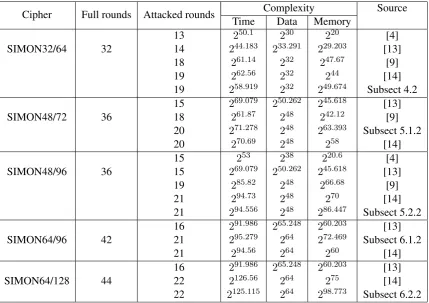
For SIMON48/96, SIMON64/96 and SIMON64/128, only one impossible differential path can be used for the attack. We present impossible differential attacks on SIMON32, SIMON48 AND SIMON96 with bit-wise precision in this paper. Table 4 is a comparison of previous results and our new results. We have done a detailed calculation of key bits involved, this means no better attack can be obtained other than this.
References
Table 4: Summary of impossible differential attacks on SIMON
Cipher Full rounds Attacked rounds Complexity Source Time Data Memory
SIMON32/64 32
13 250.1 230 220 [4] 14 244.183 233.291 229.203 [13] 18 261.14 232 247.67 [9] 19 262.56 232 244 [14] 19 258.919 232 249.674 Subsect 4.2
SIMON48/72 36
15 269.079 250.262 245.618 [13] 18 261.87 248 242.12 [9] 20 271.278 248 263.393 Subsect 5.1.2 20 270.69 248 258 [14]
SIMON48/96 36
15 253 238 220.6 [4]
15 269.079 250.262 245.618 [13] 19 285.82 248 266.68 [9] 21 294.73 248 270 [14]
21 294.556 248 286.447 Subsect 5.2.2
SIMON64/96 42
16 291.986 265.248 260.203 [13] 21 295.279 264 272.469 Subsect 6.1.2 21 294.56 264 260 [14]
SIMON64/128 44
16 291.986 265.248 260.203 [13] 22 2126.56 264 275 [14] 22 2125.115 264 298.773 Subsect 6.2.2
[2] Beaulieu, R., Shors, D., Smith, J., Treatman-Clark, S., Weeks, B., Wingers, L. (2013). The SIMON and SPECK Families of Lightweight Block Ciphers. IACR Cryptology ePrint Archive, 2013, 404.
[3] Ning Wang, Xiaoyun Wang, KetingJia, and Jingyuan Zhao. Differential Attacks on Reduced SIMON Versions with Dynamic Key-Guessing Techniques. Technical report, Cryptology ePrint Archive, Report 2014/448, 2014.
[4] Abed, F., List, E., Lucks, S., Wenzel, J. (2013). Differential and linear cryptanalysis of reduced-round SIMON. Cryptology ePrint Archive, Report 2013/526.
[5] Biryukov, A., Roy, A., Velichkov, V. (2014). Differential analysis of block ciphers SIMON and SPECK. In International Workshop on Fast Software Encryption-FSE.
[6] Sun, S., Hu, L., Wang, P., Qiao, K., Ma, X., Song, L. (2014). Automatic security evaluation and (related-key) differential characteristic search: Application to SIMON, PRESENT, LBlock, DES (L) and other bit-oriented block ciphers. In Advances in Cryptology-ASIACRYPT 2014 (pp. 158-178). Springer Berlin Heidelberg.
In Radio Frequency Identification: Security and Privacy Issues (pp. 90-107). Springer Interna-tional Publishing.
[8] Alizadeh, J., Alkhzaimi, H. A., Aref, M. R., Bagheri, N., Gauravaram, P., Lauridsen, M. M. Improved linear cryptanalysis of round reduced SIMON. IACR Cryptology ePrint Archive, Reprot 2014/681, 2014. http://eprint. iacr. org/2014/681. pdf.
[9] Wang, Q., Liu, Z., Varıcı, K., Sasaki, Y., Rijmen, V., Todo, Y. (2014). Cryptanalysis of Reduced-round SIMON32 and SIMON48. In Progress in Cryptology–INDOCRYPT 2014 (pp. 143-160). Springer International Publishing.
[10] Knudsen, L. (1998). DEAL-a 128-bit block cipher. complexity, 258(2).
[11] Biham, E., Biryukov, A., Shamir, A. (1999, January). Cryptanalysis of Skipjack reduced to 31 rounds using impossible differentials. In Advances in Cryptology-Eurocrypt’99 (pp. 12-23). Springer Berlin Heidelberg.
[12] K¨uhn, U. (2002, January). Improved cryptanalysis of MISTY1. In Fast Software Encryption (pp. 61-75). Springer Berlin Heidelberg.
[13] AlKhzaimi, H., Lauridsen, M. M. (2013). Cryptanalysis of the SIMON Family of Block Ciphers. IACR Cryptology ePrint Archive, 2013, 543.