Available Online atwww.ijcsmc.com
International Journal of Computer Science and Mobile Computing
A Monthly Journal of Computer Science and Information Technology
ISSN 2320–088X
IMPACT FACTOR: 6.017
IJCSMC, Vol. 7, Issue. 9, September 2018, pg.29 – 36
Does E-Learning Give a Better
Result than Traditional Learning?
Mohammed Fadhil Odhaib
Directorate of Education in Thi Qar, Iraq [email protected]
Abstract— The method of the learning change with the time and advancement in the world. But with the change in learning methods the increase in the learning choices, it becomes highly difficult for the learners to know that which learning method is more effective and improves their skills. Many of the studies stated that e-learning is far better than the traditional learning while some stated that traditional learning is better. So, because of this rising conflict this study examines which learning method is better and analyze is the e-learning method is better than the method of traditional e-learning in order to help learners, educators, and the institutions to adopt the best method. To examine we compare the benefits of both the learning methods and also the need for and the changing trend of the market and use the interview approach for collecting the data. The literature study also proved much helpful in constructing the result of this study. From all the analyses the review of the literature and interview responses revealed that e-learning is better learning method than the traditional learning and much gives better results according to students and the learners. The result reveal that e-learning offer various benefits like it is convenient, learner can learn from anywhere at any time, engagement level of the learners is also high in it, the cost is low, flexibility is high, offer the learners to learn new skills with managing their professional and personal life effectively, allow learners to take lecture number of times through audio-video recording of lectures, provide access to update the content, ensure quick delivery of the lessons, high consistency, scalability, less influence on the environment and positive impact on the organization profitability because of its effectiveness. All of these are not available in traditional learning and reduce its effectiveness in this global and complex world. Therefore, it is stated that because of all these benefits its adoption among the students and organizations all over the world enhance as compared to traditional learning.
Keywords— E-Learning, traditional learning, adoption, technique, technologies.
I. INTRODUCTION
The debates regarding the better learning style are as old as the e-learning begin. The e-learning starts when the institutions feel that it’s good for the distance education. As through the use of the internet as the medium, the students become able to learn and get an education from anywhere in the world. It is also an obvious fact that making the modifications to the educational field is not the modest task. The nonconformities from the traditional method of learning are often encountered with the struggle.
is seen its adoption in all education pillars from the business system of learning to the higher education system of learning to the K-12 status schooling. Leaders of the e-learning introduce the effective methods by which the e-learning become better than the traditional learning [5].
With the change in learning methods the increase in the learning choices, it becomes highly difficult for the learners to know that which learning method is more effective and improves their skills. These days the e-learning gain the high popularity as compared to traditional classroom or institutional e-learning. The time saving or convenient trend is the major purpose for an adoption of the e-learning. The advancement in an infrastructure of technology and the globalization changes the learning concepts and structure. It is seen that nowadays, most of the people and the organization prefer to use the e-learning approach as compared to the traditional learning because of its various benefits like ease of learning, learning from anywhere in the world, low cost, etc.
In 2012, the news related to the e-learning was considered as much big when the chief of international the e-learning association the Dr. David Guralnick claimed that e-learning method is a more efficient method of learning as compared to the traditional learning. It is more effective in engaging the learner than the traditional learning. But many of the authors disagreed with his claim and stated that traditional learning is better because in this the physical interaction exist that help the learners to learn the things and discuss the points more easily [17].
In these two learning methods there exists a massive difference on the bases of which some state that traditional learning is better and some claimed that e-learning is better. These difference related to the convenience like in the e-learning the convenience is high as in the e-learning people can learn at any time, and from anywhere in the world through the use of online learning sources and internet whereas in the traditional learning the physical interaction exists students and teachers can interact physically [9].
On the other hand, it is observed that the e-learning foster the pertinent interactions and healthy communication through the discussion boards, forums, video calls, chat and other forms of the unified communication. By this students also get the benefit of having the tutorial and the recording of video and audio that help them to recall the things later. While when the traditional knowledge is seen it provide the instant exchange of knowledge, enhance socialization, skill development and learners able to get the immediate feedback [15].
Most of the students in this competitive and complex business world where experience and learning both matters a lot for attaining the successful professional career. In this, it is essential that the educators considered the changes that happen each day in the business world and for improving the skills of the students that support them in attaining high success in the professional life it is essential that educational institutions must provide the knowledge of the necessary tools to the students [2].
Because of the business need the students and the educational institutions prefer the e-learning because by this their time saves as they learn when they have time and no need to follow the strict timetable and no need to go to any specific location for learning they can learn anywhere and anytime when they have time. Consequently, through this, the students and the business learners become able to learn new skills and get the education easily along with managing their job and personal life effectively. Therefore, because of all these advantages of the e-learning, it is considered better than the traditional classroom learning [1].
II. PROBLEM STATEMENT
The efficiency of an e-learning and a traditional learning is the controversial issue, so it is essential to learn which learning method is more effective to help the businesses and the educational institutions to get more benefit by using the effective learning method that improves the learner's engagement, skills, and capabilities. This study is conducted to answer this essential point that is; what are the challenges of traditional learning and how e-learning solve these issues?
A. Objective and Aim of the Study
B. Research Questions
Following are the research question of the study
1. Is e-learning overcome the challenges and issue of traditional learning? 2. Is e-learning is more convenient and flexible than traditional learning? 3. Is traditional learning improves the interpersonal skills better than e-learning? 4. Is e-learning is adopted more because of no requirement of physical availability? 5. Which learning method is more costly?
C. Scope of Study
The finding of this research study will be utilized not merely to improve the design of the courses on basics of the operational amplifiers and major skills but also serve as a platform that supports the development of more effective and greater learning outcomes in all fields like engineering, medical, business, etc. Generally, more of the investigation is needed to authenticate the available findings in an e-learning method; this research study will assist as the precursory information and evidence as regards of effectiveness and the flexibility of an e-learning in the arena of education and business training and learning courses.
III.LITERATURE REVIEW
In the 21st century, a modern global world is experiencing the vital renovation to an information society. This dynamic change promises the essential variations in all of the aspects of the individual’s lives including the social interaction, knowledge dissemination, business practices, media, political engagement, health, education, entertainment and the leisure [8]. With the growing demand of the higher education and the requirement of the technical knowledge and other skills that improves the decision making requires businesses and the educators to give the learners the easy way of learning and always seeking for the ways that improve the quality of the learning service like adoption of the e-learning whose cost is less and convenience is high as compared to the traditional learning [18].
Various studies are conducted to analyze the significance of the e-learning and its difference from the traditional learning. The study that is conducted in Jorden that examine is e-learning is more essential than the traditional learning revealed that e-learning enhances the skills and the scores (GPA) of the students and also enhance their engagement opposed to the traditional learning where no flexibility is present, and that reduce the GPA of the students. So, the result of this study proves that e-learning is better than the traditional institutional learning [1].
Modern technologies advancement have created the new stage for advancing the education and the learning of individuals and enhance their practical as well as analytical skills [12]. The E-learning gained the popularity because of the potential advantages of the personalized instruction, it allowing the learners to modify the content and pace of the course according to individual’s needs, decrease the cost of learning, increase the availability of the information and data to the remote learners and facilitate the regular updating of the learning content that is not possible in traditional learning because of high cost material of learning in traditional learning. Therefore, according to this study result, it is revealed that e-learning is far better than the traditional learning [16].
In spite of rapid growth and numerous benefits still, a lot of students and the institutions prefer the traditional classroom learning. Many of the studies stated that traditional learning is better because it involves the physical interaction that is missing in e-learning. As in the traditional classroom learning the students and learners give a presentation and take part in the discussion and also communicate verbally with one another this physical interaction the interpersonal skills improves and develop the student's verbal communication skills [14].
A. Transformation Between Traditional Learning and E-Learning
There exist numerous transformation between the e-learning and a traditional learning some of them is that in traditional learning the physical availability is mandatory while in the e-learning no physical availability required. In e-learning, the lecture will be repeated unlimited time while in traditional learning the lecture is repeated one time. In traditional learning, the control is in the hand of lecturer whereas in e-learning the learners have the full control [7]. The other major difference is that in e-learning the feedback will be attained when another person is online or programmed response occur while in the traditional learning the feedback is received immediately [13]. In the traditional learning, the instructor led the lecture and generates lecture content whereas in the e-learning the self-study is done and lectures are generated by the individual themselves. In the traditional learning, the participation is limited to the availability while in e-learning it is unlimited [11].
B. How E-Learning Gain Importance in The World
With the time the e-learning gains the importance in the world, and many of the business organizations and the educational institutional begin the online learning courses to facilitate the learners. The advancement in the technological infrastructure and the increase in the usage of the electronic devices in all fields the learning method also changes. People use the various electronic devices like laptop, PC’s, internet and different software’s and blogs, etc. to learn new skills and improve their learning. The convenience and flexibility of the e-learning also enhance its significance because in it students don’t need to attend the class they become able to learn the international courses online through the use of electronic devices and internet. Its cost is also low and overcome the issues of the traditional learning. It also promotes the distance study as by this the student get a degree from any of the international university without going to aboard, so it’s much effective like ACCA and the CA degrees. All these enhance its significance and adoption in the world [3].
C. Issues in Traditional Learning
There exist some issues in the traditional learning that reduce its adoption over the time, and because of these issues, the massive amount of the students and the business learners start adopting the e-learning approach to learn new skills. One of the major issues is that it requires the physical availability of the learners at the learning place. The other issues include less flexibility, low engagement level, limited to instructor generated concepts, not much effective learning material and no option of learning the lecture repeatedly.
D. The Benefits of The E-Learning
The benefits of a e-learning are as follows its convenient, highly flexible, allow the learners to learn from anywhere at any time, engagement level of the learners is also high in it, the cost is low, offer the learners to learn new skills with managing their professional and personal life effectively, written communication improves, allow learners to take lecture number of times through audio-video recording of lectures, provide access to update the content, ensure quick delivery of the lessons, high consistency, scalability, less influence on the environment and positive impact on the organization profitability because of its effectiveness [10].
IV.METHODOLOGY
questions are constructed related to e-learning and traditional learning. The sample include 40 individuals male and female that belong to students who studied in college and universities and learners who work in organization and attain training to improve their skills.
A. Hypotheses
The research hypotheses is design to answer the research questions that is constructed in this research. Following are the research hypotheses of this study:
H1: The relationship between study cost and both type of study methods.
H2: The impact of globalization and advancement in technology on adoption of e-learning and traditional learning method.
H3: The impact of flexibility and convenience on e-learning. H4: The impact of physical availability on both learning method.
H5: The association between improving communication skill with both learning method. H6: The influence of both learning method process on engagement of learners.
B. Study Process
The study process in both the method of the learning is different as in traditional method the physical presence is important while in the e-learning no physical presence happen learners use the other virtual sources to learn things like a discussion board, audio-video lectures, etc. The overview of both methods along with their process is discussed below for better understanding.
C. Traditional learning overview and process
Traditional learning is one where the students and the learners learn the things primary from an instructor and from the resources like books, audio, journals and the tapes. It is an active mode of the learning in which the learners get the quick response of their queries. In it, the interaction between the students and teachers is face-to-face and physical that helps the students to learn the lesson actively that is delivered by a teacher. The process involves that the student/learners and teachers/trainer physically attend and present at the learning place like the school, college and training centers and delivered the lecture. The material is conveyed to the learners through the teachers and in it the teachers direct and controls the students. The concepts are delivered at one time [6].
D. The E-learning overview and process
Fig. 3 The E-Learning process
V. ANALYSIS AND RESULTS
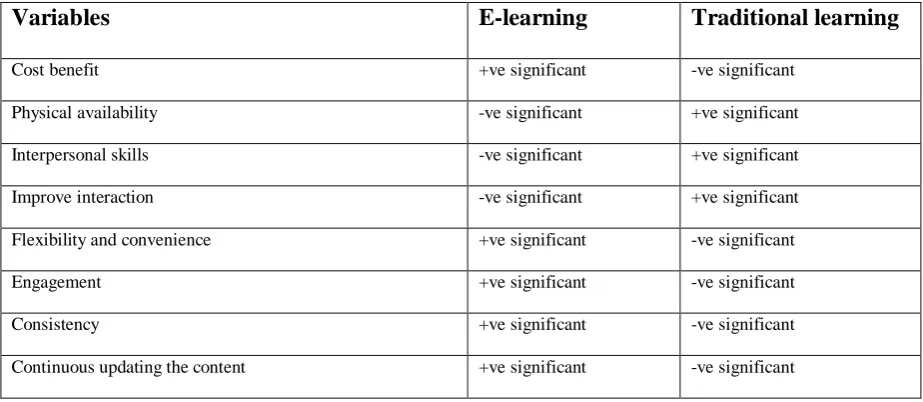
From the review of the past studies and the responses of the interview it is reveal that physical availability has significant impact on both the learning style but in the positive direction. As in the e-learning there is no need of physical availability this enhance its adoption whereas in case of the traditional learning the physical availability is mandatory that reduce its adoption. The study result also show that flexibility and convenience has significant positive association with e-learning and improves its popularity while it has significant negative association with traditional learning because in it the convenience and flexibility is minimal as control is in the hand of instructor not in learner or student hand like in e-learning.
When the cost is measured the result of the study reveals that the cost is low in e-learning while it’s high in traditional learning because of high cost material and other cost like transportation and institutional high fee structure. The result of the study also reveals that there is e-learning has significant positive relationship with advancement in technology and globalization and has significant negative association with traditional learning. When the variable engagement is viewed the result of the data disclose that in e-learning the engagement of the learner and student is high as compared to traditional learning. The outcome of the study indicates that consistency and continuous updating of content is high in e-learning and low in traditional learning method. Finally the result study identify that traditional learning has significant positive association with improving interpersonal skills like communication whereas the e-learning as significant negative relation with it because of no face-to-face interaction.
TABLEI
RESULTS OF COMPARISON BETWEEN E-LEARNING & TRADITIONAL LEARNING BASED ON VARIABLES
Variables
E-learning
Traditional learning
Cost benefit +ve significant -ve significant
Physical availability -ve significant +ve significant
Interpersonal skills -ve significant +ve significant
Improve interaction -ve significant +ve significant
Flexibility and convenience +ve significant -ve significant
Engagement +ve significant -ve significant
Consistency +ve significant -ve significant
VI.DISCUSSION
The result of the study shows that the e-learning exhibited better agreeability and the performance in the survey and the quizzes respectively. It indicates that the engagement of the learners is high in e-learning as compared to the traditional learning. It also reveals that the consistency and the development of skills better in e-learning. The study result concluded that the graphical lessons that attain in the e-learning technique would have a considerable impact on the excessive acceptance of the learning method of e-learning. Consequently, the study outcome reveals that e-learning gives a better result than the traditional learning as the grades of the students are better in it because of its convenience, unlimited time access of lecture and availability of the variety of the resources to learn concepts more effectively.
VII. CONCLUSION
In academia and organizations, it seems that numerous lecturers and leaders are still pleased with utilizing the traditional lecturing techniques. Promoting the usage of the e-learning method requires the appropriate understanding of the difference between the e-learning with the traditional learning. This study by comparing both method benefits and review of the literature studies examine that is e-learning provides better outcome and grades than the traditional learning. The interviews are conducted from students of educational institutions and the business organization employees who learn new skills. The questions related to e-learning and traditional learning its benefits and preference is asked from the interviewees to examine which learning method is preferred by people and which give better result. From all the examination it is revealed that e-learning is better learning method than the traditional learning and offers much better results in all fields whether business skills development or educational courses because of various benefits like it is convenient, learner can learn from anywhere at any time, engagement level of the learners is also high in it, the cost is low, flexibility is high, offer the learners to learn new skills with managing their professional and personal life effectively, written communication improves, allow learners to take lecture number of times through audio-video recording of lectures, provide access to update the content, ensure quick delivery of the lessons, high consistency, scalability, less influence on the environment and positive impact on the organization profitability because of its effectiveness.
The e-learning exhibited better agreeability and the performance in the survey and the quizzes respectively. The study concluded that the graphical lessons that attain in the e-learning technique would have a considerable impact on the excessive acceptance of the learning method of e-learning. Consequently, it is stated that because of all these benefits its adoption among the students and organizations all over the world enhance as compared to traditional learning. The finding of this research study will be utilized not merely to improve the design of the courses on basics of the operational amplifiers and major skills but also serve as a platform that supports the development of more effective and greater learning outcomes in all fields like engineering, medical, business, etc. Generally, more of the investigation is needed to authenticate the available findings in an e-learning method; this research study will assist as the precursory information and evidence as regards of effectiveness and the flexibility of an e-learning in the arena of education and business training and learning courses.
R
EFERENCES
[1] AL-Omari, A. A., & Salameh, K. M. (2012). E-learning versus Traditional Learning as Perceived by Undergraduate Students in Jordanian Universities. E–Learning and Digital Media, 9(2).
[2] Alsaaty, F. M., Carter, E., Abrahams, D., & Alshameri, F. (2016). Traditional Versus Online Learning in Institutions of Higher Education: Minority Business Students’ Perceptions. Business and Management
Research, 5(2). Retrieved from
https://www.researchgate.net/publication/303404556_Traditional_Versus_Online_Learning_in_Institution s_of_Higher_Education_Minority_Business_Students'_Perceptions
[3] Arkorful, V., & Abaidoo, N. (2015). The role of e-learning, advantages and disadvantages of its adoption in higher education. International Journal of Instructional Technology and Distance Learning, 12(1).
[4] Dr., S. S. (2015). Learning Outcomes in an online vs traditional course. International Journal for the Scholarship of Teaching and Learning.
[5] Garrison, D. R. (2011). E-Learning in the 21st Century. Routledge.
[6] Jonassen, D., & Land, S. (2012). Theoretical Foundations of Learning Environments. Routledge.
[8] Li, F., Qi, J., Wang, G., & Wang, X. (2014). Traditional Classroom vs E-learning in Higher Education: Difference between Students' Behavioral Engagement. International Journal of Emerging Technologies in Learning, 9(2).
[9] Nourian, A., Ebnahmadi, A., Akbarzadeh, A., & Khoshnevisan, M. H. (2012). Comparison of E-learning and Traditional Classroom Instruction of Dental Public Health for Dental Students of Shahid Beheshti Dental School during 2010-2011. Journal Dental School, 30(3), 174-183.
[10] Phillips, R., McNaught, C., & Kennedy, G. (2011). Evaluating e-Learning. Routledge.
[11] Rondon, S., Sassi, F. C., & Andrade, C. R. (2013). Computer game-based and traditional learning method: a comparison regarding students’ knowledge retention. BMC Medical Education.
[12] Saini, K., Wahid, D. A., & Purohi, D. G. (2014). Traditional Learning versus Web Based Learning: Performance Analysis. International Journal of Computer Science and Information Technologies, 5(4). Retrieved from http://ijcsit.com/docs/Volume%205/vol5issue04/ijcsit2014050479.pdf
[13] Sarrab, M., Alzahrani, A., Alwan, N. A., & Alfarraj, O. (2014). From traditional learning into mobile learning in education at the university level: undergraduate students perspective. International Journal of Mobile Learning and Organisation, 8(3-4).
[14] Sethughes. (2012). Why Traditional Classroom Learning is Better than Online Courses. Retrieved from Owlcation: https://owlcation.com/academia/Why-Traditional-Classroom-Learning-is-Better-than-Online-Courses
[15] Singh, A. K., Yusoff, M. A., & oo, N. W. (2010). A Comparative Study between Traditional Learning and ELearning. Teaching & Learning Open Forum. Retrieved from Teaching & Learning Open Forum. [16] Vaona, Banzi, Kwag, Rigon, Cereda, Pecoraro, . . . Moja. (2018). Is e-learning more effective than
traditional learning for health professionals? Retrieved from Cochrane:
http://www.cochrane.org/CD011736/EPOC_e-learning-more-effective-traditional-learning-health-professionals
[17] Virtual College. (2012). E-learning 'can be better than traditional education'. Retrieved from https://www.virtual-college.co.uk/news/virtual-college/2012/02/elearning-can-be-better-than-traditional-education