FFSSE: Flexible Forward Secure Searchable Encryption with
Efficient Performance
Zheli Liu, Siyi Lv, Yu Wei
1, Jin Li
2, Joseph K. Liu
3, and Yang Xiang
41
College of Computer and Control Engineering, Nankai University, China
2School of Computer Science, Guangzhou University, China
3
Department of Computer Science, the Monesh University, Australia
4Department of Computer Science, Swinburne University, Australia
Abstract
Searchable Symmetric Encryption (SSE) has been widely applied in the design of encrypted database for exact queries or even range queries in practice. In spite of its efficiency and functionalities, it always suffers from information leakages. Some recent attacks point out that forward privacy is the desirable security goal. However, there are only a very small number of schemes achieving this security. In this paper, we propose a new flexible forward secure SSE scheme, denoted as “FFSSE”, which has the best performance in the literature, namely with fast search operation, fast token generation andO(1) update complexity. It also supports both add and delete operations in the unique instance. Technically, we exploit a novel “key-based blocks chain” technique based on symmetric cryptographic primitive, which can be deployed in arbitrary index tree structures or key-value structures directly to provide forward privacy. In order to reduce the storage on the client side, we further propose an efficient permutation technique (with similar function as trapdoor permutation) to support the re-construction of the search tokens. Experiments show that our scheme is 4×, 300× and 300× faster than the Σoφoς (the state-of-the-art forward private SSE scheme proposed in CCS 2016) in search, update and token generation, respectively. Security analysis shows that our scheme is secure.
1
Introduction
Along with the popularity of outsourcing data to the cloud, data privacy becomes a critical consideration. To protect the privacy, users usually encrypt data before uploading them to database or storage server. However, encryption breaks the data availabilities, such that keyword search, range query or other functions cannot be directly applied over the ciphertext. To address the above issues, some cryptographic techniques have been proposed. Among them, searchable encryption (SE) is the mechanism to allow querying of the encrypted data without leaking data privacy to the cloud server.
Searchable Symmetric Encryption (SSE) is designed on symmetric cryptographic primitives and thus has very good performance (when compared to public key searchable encryption [1–3]). It allows a client to store encrypted documents on a server, then to retrieve all documents containing a certain keyword (or collection of keywords) at a later point. To do so, most efficient SSE schemes work in the following way: First, the client computes a search tokentcorresponding to the queried keywordkand sendstto the server. By using
t, the server retrieves the documents identifiers containing the keyword w, then sends back them. (These document identifiers need not be the actual file name. They can be instead of the pointers to the encrypted files or even encrypted index of documents/records stored in the server.) The client then downloads the appropriate documents according to its requirements.
the SQL equality queries (=, !=, IN, NOT IN, etc) when the values in the column are not unique. Recently, some researches [6, 7, 28–30] have been proposed to apply SSE to support rich queries, like conjunctive query [10], range query [11], and so on. Moreover, ARX [5] has applied SSE to provide equality query over the encrypted NoSQL databases.
1.1
Leakages and attacks of SSE
Although SSE can protect the privacy of the data content to a certain level, the deterministic encryption used in SSE makes the cloud server easy to observe the repeated queries and other leakages, which are modeled assize patterns,query patterns andaccess patterns:
• Size pattern[12]. It means that a server can know the number of keyword-document pairs of the stored data. Some of the SSE schemes may also leak the total number of messages and/or the total number of keywords.
• Search pattern [13]. It means that a server can know the repeated deterministic tokens. If the server can also know a repeated query, it is also called as “query pattern”.
• Access pattern [13]. It means that a server can know the search results, including matching document identifiers of a keyword search and the document identifiers of the added/deleted documents.
Generally, these leakages can be mitigated by utilizing an oblivious RAM (ORAM) [18, 19]. Unfortunate-ly, ORAM usually brings the massive storage space, huge bandwidth cost and lots of interactions between the user and the server for each keyword search. Thus, for the consideration of efficiency, almost all the existing works assume these leakage patterns are allowable under real-ideal [13], universal composable (UC) [25, 26], or other specific security models.
Potential attacks based on these leakages have not been thoroughly analyzed and exploited until inference attack conducted by Islam et al. [14] in 2012. However, in order to let the inference attack be successful, a server needs to know the content of all the original messages. In 2015, Cash et al. [15] studied more effective leakage-abuse attacks, in which count attack is used for query recovery by abusing co-occurrence patterns of keywords and size pattern. In 2016, Zhang et al. [16] studied file-injection attacks by abusing the file-access patterns. By injecting files to the client, the malicious server can know the query privacy even the plaintext of encrypted document. Kellaris et al. [17] developed the first attack against systems leaking onlycommunication volume, in whichcommunication volumemeans the server learns the number of returned items of a query. This attack can be even applied to the SSE schemes based on fully homomorphic encryption (FHE) or ORAM.
1.2
Need of forward privacy
The above attacks showed that even small leakage can be leveraged by an attacker to reveal the client’s queries. Especially in the dynamic database, the server could inject new document to the client to obtain more advantages. Zhang et al. [16] showed that the file-injection attack can be devastating. They actually consider both adaptive and non-adaptive attacks. The adaptive attack refers to whether the server injects documents before or after the client’s query is made. It is more effective, however, it cannot be applied to the forward secure schemes, which achieve the forward privacy [12]. This fact highlights the importance of forward privacy in any real-world deployment.
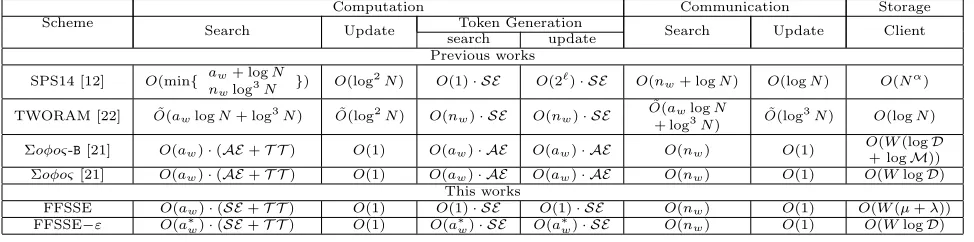
Table 1: Comparison with typical forward private SSE schemes. N is the number of entries (i.e. the number of keyword-document pairs) in the database, whileWis the number of distinct keywords,Dis the number of documents, andMis the length of search token. Thenwis the size of the search result set for keywordw, andawis the number of times the queried keywordw
was historically added and deleted to the database,a∗wis theawwith a maximum value CT (whena∗wis bigger than CT, it will be 1),
`is the first empty level which contains 2`blocks. DenoteAEas asymmetric encryption,SEas symmetric encryption,µas the length
of data identifier,λas the security parameters andT T as tree traverse operation. Scheme
Computation Communication Storage Search Update Token Generation Search Update Client
search update Previous works SPS14 [12] O(min{ anw+ logN
wlog3N }
) O(log2N) O(1)· SE O(2`)· SE O(n
w+ logN) O(logN) O(Nα)
TWORAM [22] O˜(awlogN+ log3N) O˜(log2N) O(nw)· SE O(nw)· SE
˜ O(awlogN
+ log3N) O˜(log3N) O(logN)
Σoφoς-B[21] O(aw)·(AE+T T) O(1) O(aw)· AE O(aw)· AE O(nw) O(1)
O(W(logD
+ logM)) Σoφoς[21] O(aw)·(AE+T T) O(1) O(aw)· AE O(aw)· AE O(nw) O(1) O(WlogD)
This works
FFSSE O(aw)·(SE+T T) O(1) O(1)· SE O(1)· SE O(nw) O(1) O(W(µ+λ))
FFSSE−ε O(a∗w)·(SE+T T) O(1) O(a∗w)· SE O(a∗w)· SE O(nw) O(1) O(WlogD)
1.3
Motivation
The Σoφoς protocol proposed by Bost [21] in 2016 is the first efficient forward private SSE scheme to our knowledge. Its construction is based on the inverted index. For each element in the indexed listLw=(ind0,
· · ·, indn) of keyword w, Σoφoς encrypts it and stores it at a (logical) location. Its idea is simple: for
preventing the malicious server from knowing where the newly added document belongs to, it generates the storage location based on the inverse of a one-way trapdoor permutation (TDP), which can only be performed in the client side with his/her private key. During the search operation, the protocol allows the server to re-compute these storage positions based on the evaluation of permutation using the public information. By this way, it achieves the optimalO(1) update complexity andO(aw) search computation complexity, where
aw denotes the number of times the queried keywordwwas historically added to the database.
The outstanding contribution of Σoφoςis exploiting a novel design of efficient forward private SSE without using ORAM. It inspires us to study similar techniques with higher performance and broader application scopes, aiming at improving the following limitations of Σoφoς:
• Asymmetric primitive. The TDP technique in Σoφoςrelies on the asymmetric cryptographic primitive, namely, the search operation requires O(aw) times asymmetric encryptions and decryptions
(imple-mented by RSA). As we all know, asymmetric primitive is more expensive than symmetric primitive. Therefore we focus on how to exploit the new technique based on symmetric cryptographic primitive which has the same effect as TDP, as to further improve its performance;
• Dependence on token generation rule. The storage position in Σoφoς must be generated based on the repeated operation by the private key of the asymmetric primitive. That is, it specifies the token generation rule. If we regard the (local) position (even the token) as the index, the index generation must rely on the token generation rule. So that, the TDP in Σoφoς conflicts with the storage structure with its own index generation rule. This limitation would limit its application scopes. Therefore we also focus onhow to exploit the new technique independent of token generation rule, to provide forward private security for the existing structures with its own index generation rule.
1.4
Our Contributions
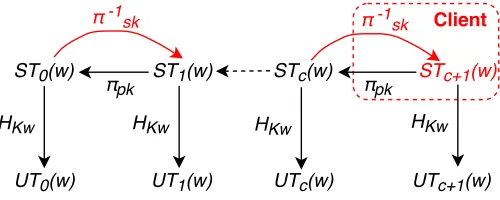
Figure 1: Trapdoor permutation (TDP) technique. Operations inredcan only be done by the client, using the secret key
sk.
(100×search and at least 300×update than Σoφoς) through experiments, owing to the adopted symmetric cryptographic primitive; 2) FFSSE has the most efficient token generation among all the forward private SSE schemes.
In addition to the basic scheme, we propose an improved scheme, denoted as FFSSE-ε, to further reduce the client storage to the same as Σoφoς. We remove the tree traverse operations and reduce the number of nodes in the index tree, by dynamic merging the document identifiers of the same keyword. Compared to Σoφoς, the search, update and token generation of FFSSE-ε improve 60×, 200×and 200×respectively through experiments.
Technically, we exploit: 1) a novel “key-based blocks chain” (KBBC) method based on symmetric crypto-graphic primitive. Apart from the good performance, it does not rely on the index generation rule, so that it can be deployed in arbitrary index tree structures or key-value structures to provide forward private security; 2) an efficient permutation technique (with similar function as TPD), denoted as “ε-sTDP”. It adopts KBBC technique to link the blocks and achieve the forward privacy. Meanwhile, it applies the one-way permutation
P (not necessary to have a trapdoor and can be instantiated by symmetric cryptographic primitive) instead of TDP to re-generate the tokens and reduce the client storage. It is similar to the usage of TDP in Σoφoς, but has a higher performance.
2
Related work
2.1
Searchable symmetric encryption
The first practical searchable encryption scheme was introduced by Song et al. [9] in 2000, using only symmetric primitives. Later, known as Symmetric Searchable Encryption (SSE) schemes, several schemes based on this similar concept were proposed. There are two kinds of SSE scheme, static one and dynamic one. Because the static SSE doesn’t support dynamically adding or deleting keyword-document pairs after initializing the database or storage system, recent researches mainly focus on the constructions of dynamic SSE.
Among the design approaches of SSE, approach based on inverted index is used widely. In this approach, an index is in the form of (key,value), where thekeyis a keyword and thevalueconsists of a list of document identifiers associated with the keyword. Compared to other approaches, it achieves the sublinear search time. This is because searching for a keyword immediately returns the list of document identifiers matching the keyword. In 2006, Curtmola et al. [13] firstly introduced this approach, and subsequent schemes are proposed by Kamara et al. [24], Kurosawa and Ohtaki [25], Cash et al. [8], Naveed et al. [26], Stefanov et al. [12] and Bost [21], and so on.
2.2
Trapdoor permutation technique
We review the trapdoor one-way permutations described in [27]. A trapdoor permutation family Qover a groupD comprises the following three algorithms:
• Generate(1λ) is a randomized generation algorithm. Its input is 1λ and its output is the description
sof a permutation along with the corresponding trapdoort.
• Evaluate(s, x) is a deterministic algorithm. Its inputs are the permutation description sand a value
x∈D. Its outputs isa∈D, the image ofxunder the permutation.
• Invert(s, t, a) is a deterministic algorithm. Its inputs are the permutation descriptions, the trapdoor
t and a valuea∈D. It outputs the preimage ofaunder the permutation.
The output of theGeneratealgorithm is a probability distribution Π on permutations, therefore (π, π−1)←R−
Π, whereπis a permutation andπ−1 is the inverse permutation. For a permutation with the description of
s, we haveInvert(s, t, Evaluate(s, x)) =x.
Definition 1. The advantage of algorithm A in inverting a trapdoor permutation family is:
AdvInvert
A =P[x= A(s, Evaluate(s, x)) : (s, t)
R
←−Generate, x←R−D].
TDP in Σoφoς. In Σoφoς, TDP is built by the asymmetric primitive. As shown in Figure 1, only the client who owes the trapdoor (private keysk) can generate the permutation, but the server who owes the public info (public keypk) can evaluate this permutation. We can also see that the permutation about wis built by encrypting a random valueST0(w) for many times using the trapdoorsk (i.e.,π−sk1), meanwhile, it can
be retrieved by decrypting the last one using the public infopk (i.e.,πpk).
The Σoφoς uses the TDP to construct a forward secure SSE. Most specially, for each keywordw, there is a permutation over the set which contains the search tokens of keywordwdenoted byD(w). The client maintains a countercand its search tokenSTc(w) for each keywordw. When adds a keyword-document pair
for keywordw, the client will first produce a search token by STc+1(w)←πsk−1(STc(w)), and then produce
a storage position (called as update token) U Tc+1(w) using a keyed hash. Finally update its client state
and store the document identifier intoU Tc+1(w) in the server. Since the latest search token is stored in the
client, the malicious server cannot know where theU Tc+1(w) is produced from.
3
Preliminaries
3.1
Notations
Denote negl(λ) as a negligible function, whereλis the security parameter. Denotex←−$ X asxis uniformly sampled from the finite setX. In general, the symmetric key is theλ bits string uniformly sampled from
{0,1}λ. DenoteE
k(m) as the symmetric encryption of the messagemby the keyk,Dk(c) as the symmetric
decryption of the ciphertextc by the keyk. DenoteF as the symmetric encryption scheme selected in the real construction. Moreover, denote H(k, m) as a keyed hash function with the key k and messagem as inputs.
DenoteWas the keyword set andWas the number of distinct keywords (W=|W|). DenoteWx⊆ {0,1}∗
as the x-th keyword, and thus W = SWi=1Wi. Denote D as the document set and D as the number of
documents (D=|D|); Denoteindx∈ {0,1}µ as thex-th document identifier with the bit length ofµ, and
thusD= (indi)Di=1.
In general, we denotewas the keyword,awas the number of times the queried keywordwwas historically
added anddeleted to the database DB, andnw as the size of search results for keywordw. Denote DB(w)
3.2
Dynamic searchable symmetric encryption
We review the general definition ofdynamic searchable encryption schemein [21],DSSE = (Setup,Search,Update), containing an algorithm and two client-server protocols:
• Setup(DB): it is an algorithm for setting up the whole encrypted database supporting keyword search. It takes a database DB as input, outputs a pair (EDB,K, σ), where EDB is the encrypted database,
K is the secret key contained by the client andσis the client’s state.
• Search(K,q,σ; EDB) = (SearchC(K,σ,q), SearchS(EDB)): it is a client-server protocol for
perform-ing a search query. The SearchC(K,σ,q) in the client takes the keyKand its stateσas inputs, outputs
a query q; the SearchS(EDB) in the server takes the EDB as input, outputs the results as document
identifiers matching the query q. For single-keyword search schemes, a search query is restricted to a unique keywordw.
• Update(K,σ,op,in; EDB) = (UpdateC(K,σ,op,in), UpdateS(EDB)): it is a client-server protocol
supporting update operations of a document. The update operations are taken from the set{add,del}, meaning, respectively, the addition and the deletion of a document/keyword pair. To do these update operations, the client takes inputs as the keyK, an operatorop, client’s stateσand an inputinparsed as the index indand a setW of keywords; while the server takes the EDB as input.
3.3
Forward privacy security
Leakage definition. Define L = (LSetup, LSearch, LU pdate) as the leakage function, describing what
protocols in F F SSE leak to the adversary. More formally, the leakage function L will keep as state the
query list Q: the list of all queries issued so far, and for a search query on keywordw, entries are (i, w) , or for an opupdate query with input in, entries are (i,op,in). The integer i is a timestamp, initially set to 0, and it increments with the query times. Definesp(x) andqp(x) respectively denote the search and query patterns, formally
sp(x) = {j: (j, x)∈Q}(only matches search queries)
qp(x) = {j: (j, x)∈Qor
(j,op,in) andxappears inin }.
Forward privacy. We review the definition of forward privacy described in [21].
Definition 2. AL-adaptively-secure SSE schemeΣis forward private if the update leakage functionLU pdate
can be written as
LU pdate(op,in) =L0(op,{(ind
i, ui)})
where {(indi, ui)} is the set of modified documents paired with the number ui of modified keywords for the
updated documentindi.
3.4
Key-based blocks chain
Before giving the details of our SSE protocol, we first present our proposed “key-based blocks chain” (KBBC) technique to link arbitrary number of data blocks in a setBas a chainCwhile hiding their relations. Define
Bas the data blocks set,B={b0,· · ·,bn}and|B|=n. DenoteCas a chain built over the subsetBinB, i.e.,
B ⊆B. Denote nc as the number of chains over the set B. Assume a block can only belong to one chain,
then 1≤nc ≤n.
Block definitions. We define three types of blocks: head block, tail block and internal block, which are the first block, last block and other blocks in a chain C, denoted by C.head, C.tail and C.internal, respectively. For each data blockbin setB, define it asb=(id,value,key,ptr), whereidandvalueare data
identifier and data value of this block, the ptr and key are data identifier and encryption key of its next block. Denoteb.idas theidof blockb and others are similar.
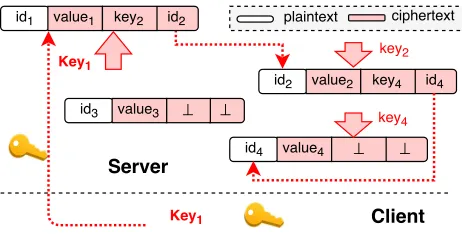
Figure 2: An example of key-based blocks chain. There are four blocks with data identifiers ofid1,id2,id3andid4, whose
encryption keys arekey1,key2,key3andkey4respectively. Thehead blockin the chain is theid1whose encryption key is maintained
in the client; theid2is ainternal blockand its key is stored in the previous blockid1; thetail blockis theid4, whose key is stored in
the previous blockid2, however, itsptrvalue is⊥because it is the end of this chain.
• Init(): it initializes a blocks chain. It takes none input but outputs a descriptionCfor this chain.
• AddHead(C, id, value,1λ): it adds a head block to the chain. It takes chain descriptionC, the block
identifierid, block valuevalueand security parameter 1λ as inputs, and outputs a new head blockb.
It has four steps: 1) generate a block asb=(id,value,C.head.key,C.head.id); 2) sample a random key
k from{0,1}λ; 3) utilizesk to encrypt contents of blockbexceptid; 4) storebin the server.
• Retrieve(C, id, k): it retrieves a next block in the chain. It takes the chain descriptionC, block identifier
id and block keyk as inputs, and outputs the identifier and encryption key of the next block. It has tree steps: 1) find the blockbby its identifierid; 2) decrypt blockbby its keyk; 3) output the obtained identifierb.ptr and keyb.key.
Build a blocks chain. To build a blocks chain, we first execute Init() to initialize the chain C; then, for each blockbi∈ B (B ⊆B,0≤i≤ |B| −1), we execute AddHead(C, bi.id,bi.value, 1λ) repeatedly, until
all blocks are added to the chainC. In fact, its idea is very simple: to link the blocks, theptrandkeyof a block are set to the data identifier and encryption key of its next block (but for thetail block, they are set to ⊥); to hide the relations, the identifier and encryption key of each block are encrypted and stored in its previous block (but for thehead block, they are stored in the client). Figure 2 shows an example of a chain built from blocks with identifiers ofid1, id2 andid4.
Forward privacy. The KBBC algorithms are simple but powerful. Obviously, it can provide forward privacy for the newly added block, because its next block identifier is encrypted by a random key stored in the client.
Theorem 1. (AddHead leaks no information). DefineLS= (LRetrieveS ,LAddHeadS ), where
LRetrieve
S = (nc, numc,Hist(C)), LAddHeadS =⊥.
KBBC is LS−f orward−privacy.
Proof. IfC has already been retrieved, the adversary knows the number of blocks which have already been in C (denote as numC) and the history of C including id, value, key of the retrieved blocks (denote as Hist(C)). If all the chains of Bhave been retrieved, it leaks the number of chains over the setB(denote as
nc). Therefore,
LRetrieve
S = (nc, numc,Hist(C)).
According to the algorithm KBBC.AddHead, when we add a newhead block toCwhich has already been retrieved, we will generate a new block asb=(id∗, value∗, C.head.key, C.head.id), which is encrypted by a new keykstored in client side. Without the keyk, the adversary can not decryptb, so that the addedhead block and blocks ofCare indistinguishable. Moreover, the adversary can only know that we add a block into
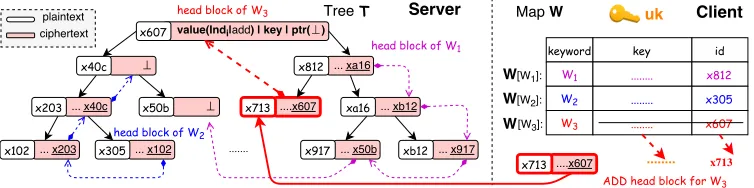
Figure 3: Storage structure and operations of FFSSE. There are three keywords (W1, W2and W3) and their inverted
index lists (LW1,LW2 andLW3) in adatabase DB. The client stores the encryption key, identifier ofhead block of each list and a
counter in the mapW. The server stores each document identifier in these lists into thevaluepart of a data block in a node of the treeT. The root node shows the whole parts of a data block.
LAddHead
S =⊥,
the adversary cannot get any advantage to learn more additional information throughAddHeadoperation.
Independent of index generation rule. In KBBC, the index (data identifier) can be generated by random selection or some algorithms according to application requirements. Compared to TDP in Σoφoς, it is an important characteristic, which allows building a chain with forward privacy over the existing structures with its own index generation rule. It is more flexible and may therefore be valuable for some other designs with the consideration of forward security.
In fact, we can regard each block as a “key-value” structure, where theid with clear text is thekey, which may be the index or position in the concrete storage structure, other encrypted parts are thevalue. So that, KBBC can be applied in most popular index tree (like AVL, B-tree) or key-value storage structures, to provide the forward private security. In other words, it is suitable for both relational databases and NoSQL databases.
4
The FFSSE construction
In this section, we describe our proposed forward secure searchable encryption scheme (denoted as “FFSSE”), which is based on our “key-based blocks chain”.
4.1
Storage structure
Like the Σoφoς, we consider the SSE construction with inverted index scheme (such as [13] and derived works). For each keywordw∈W, denote Lwas an indexed list to store the document identifiers (ind0,· · ·,
indnw) containing the keywordw, wherenw is the size ofLw, that is,nw=|Lw|.
In the cloud server, we adopt the binary search tree T as an example (other index tree or key-value structures are also OK) to store the data blocks defined in Section 3.4. Each node stores a data block. We denote T[id] as the node indexed by id, andT[id].data as the stored data. Each element (document identifier) in the list Lw is stored in thevalue part of a data block. All the elements in every indexed list
are stored into the treeT, based on the “key-based blocks chain” described in Section 3.4. As a result, there are totalW inverted lists containingN nodes stored in theT, whose depth is logN.
In the client, we adopt a map W to store the state of each keyword. The keyword state of w can be defined as the tuples of stw=(id,key), where idandkey are data identifier and encryption key of thehead
block in the inverted list Lw. The default value of idis ⊥. For a keyword w∈W, W[w] is mapped to its
statestw.
the add operation but “indkdel” denotes the delete operation for document ind, where “k” denotes the concatenation of two strings. See the root node in treeT of Figure 3 for an example. In practice, theopcan be defined as a byte, for example, 0 for add but 1 for del. Moreover, besides the mapW, the client should securely store the secrete keyuk.
4.2
Our construction
Algorithm 1 FFSSE: Forward private SSE scheme supporting both add and delete operation
Setup()
1: uk←− {$ 0,1}λ
2: W←empty map, T ←empty tree
Search(w, σ; EDB)
Client:
1: (id, key)←(W[w].id,W[w].key)
2: Send token (id, key) to the server.
Server:
3: S←empty set, i←0
4: repeat
5: b←Dkey(T[id].data)
6: id←b.ptr 7: key←b.key 8: indkop←b.value 9: S[i++]←indkop 10: until (b.ptr==⊥)
11: S←M erge(S)
// merge the same indwithadd anddel operations
12: Send each indin Sto the client.
Update(op, w, ind, σ; EDB)
Client:
1: (id, key)←(W[w].id,W[w].key)
2: r ←− {$ 0,1}λ
3: id∗ ←H(uk, r)
4: key∗←KeyGen(1λ)
5: b←(id∗, Ekey∗(“indkop”kkeykid)) 6: W[w].id←id∗
7: W[w].key←key∗
8: Send blockb to the server.
Server:
9: Insert block binto the treeT.
Algorithm 1 gives the formal description of our FFSSE scheme. It allows only insertion of data block into treeT, and supports bothadd anddelete operations of keyword-document pairs. In the pseudo code,His a keyed hash functions whose output isµbits long. EncryptionEk(m) and decryptionDk(c) are implemented
by an IND-CPA (indistinguishability against the chosen plaintext attack) secure symmetric cryptographic primitive.
Update operation. When the client wants to update (add or delete, denoted asop) a document (with identifierind) matchingw, it runs KBBC.AddHead(Lw,·). More specifically, it firstly products a new data
block b, whose identifier is generated based on a random value sampled from {0,1}λ. The b.valueis set to
respectively, that is, encryption key and data identifier of current head block. Then, the client samples a symmetric key key∗ with KeyGen(1λ) function, and utilizes it to encrypt the value, keyand ptr. Next, it sends the blockbto the server, and updates the state of keywordwasW[w].id=b.idandW[w].key=key∗.
Finally, the server will insert this block into the treeT to finish this process. Figure 3 shows the details of inserting a new keyword-document pair into the inverted list ofW3.
Search operation. When the client performs a search query onw, it will issue a search tokentthat will allow the server to retrieve the document identifiers matchingw. To do so, the client can only generate the search token as the keyword state stored in the map W[w], i.e.,t←(W[w].id,W[w].key). After receiving the search token t, the server can retrieve the blocks chain one by one by running KBBC.Retrieve(Lw, ·)
repeatedly, until thetail blockis visited. For each node in the chain, the server decrypts itsvalueand obtains the stored document identifier. If a document identifier has both theadd and del operators, it should be ignored. In Algorithm 1, a function M ergeis defined to merge the same document identifier with different operations. In the end, the server returns all the document identifiers matchingwto the client to finish this process.
Correctness. The correctness of FFSSE is quite straightforward. Like that in Σoφoς, the only issue is collision among the data identifieridgenerated fromHwith input (uk,r). We can relate the correctness to the collision resistance of H. The output of Hisµbits long. In practice,µshould satisfy the condition that
N2/2µ is negligible in the security parameterλ. Let N
max be the maximum number of keyword-document
pairs which the database can support. Therefore, settingµ=λ+ 2 logNmaxis thoughtful.
4.3
Security analysis
The adaptive security of FFSSE can be proven in the Random Oracle Model.
Theorem 2. (Adaptive security of FFSSE). Define LS = (LSearchS ,L U pdate
S ), where
LSearch
S = (sp(w),Hist(w)),L
U pdate
S (op, w, ind) =⊥.
FFSSE is LS−adaptive−secure.
Proof. Letλbe the security parameter. Deriving some games from real world game will help to prove the theorem.
Game G0. TheG0 is the real world FFSSE security gameSSERealAF F SSE(λ). That is to say,
P[SSERealF F SSEA (λ) = 1] =P[G0= 1].
Game G1. Algorithm 2 formally describes G1, and introduces an intermediate game G1, by including
the additional boxed lines. In theUpdateprotocol, instead of calling hash functionHto generate the new
id∗, we pick random strings when it is confronted to a new keyword w. For hash functionH, if an entry is accessed for the first time, it is first randomly chosen and then returned; if an entry has been accessed, then it will return the result which has returned before. Formally, for the first time,id0←H(uk, r),id0 is a random result; when accessr for next time, it will still return the resultid0. The point of G1 is to ensure
the consistency of H0s transcript. In G1 , hash function H will always program to two same results for
the same input. If random numberr doesn’t appear in hash functionH0s transcript,G1 randomly chooses
id, otherwise, id will be set to the related value in theH0s transcript. Then, G1 lazily programs the RO
when needed by the search protocol or by an adversary’s query, so it makes sure the consistence of output. Because of it, inG1 andG0, the output of hash functionHis indistinguishable. Therefore,
P[G0= 1] =P[G1= 1],
G1 andG1are also indistinguishable unless the flag is set to true, formally speaking,
The possibility of random numberrgets the same random number is negligible. Furthermore, symmetric encryptionEk(m) and decryptionDk(c) are IND-CPA. Therefore,
P[f lag is set to true in G1] =AdvHIN D−CP A(λ) is negligible.
Based on the above analysis,
P[G0= 1]−P[G1= 1] =P[G1= 1]−P[G1= 1]
≤AdvHIN D−CP A(λ).
Algorithm 2Game G1 and Game G1. Boxed code is included in G1 only
Setup()
1: uk←− {$ 0,1}λ
2: W←empty map,T ←empty tree
3: f lag=f alse
Search(w, σ; EDB)
Client:
1: (id0, . . . , idn, cnt)←W[w]
2: if(id0, . . . , idn, cnt) =⊥
3: return∅
4: (ind0kop0, . . . , indcntkopcnt)←Hist(w)
5: key←W[w].key
6: Send token (id, key) to the server.
Server:
7: S←empty set
8: H(uk, ri) ← W[w].id
9: f or i= 0to cnt
10: blki←Dkey(T[id].data)
11: idi←blki.ptr 12: keyi←blki.key
13: indkop←blki.value
14: S[i]←indkop
15: H(uk, ri) ← idi
16: S←M erge(S)
17: Send eachindinSto the client.
Update(op, w, ind, σ; EDB)
Client:
1: id ←W[w].id
2: key ←W[w].key
3: r←− {$ 0,1}λ 4: id∗ ← {0,1}µ
5: if H(uk, r)6=⊥ then
6: f lag←true, id∗←H(uk, r)
7: end if
8: key∗←KeyGen(1λ)
9: newBlk←(id∗, Ekey∗(“indkop”kkeykid))
10: W[w].id←id∗
11: W[w].key←key∗
12: W[w].cnt++
13: SendnewBlkto the server.
Server:
14: InsertnewBlkinto the treeT.
H(uk, r)
1: t←H(uk, r)
2: if t=⊥then
3: t←$− {0,1}λ 4: if ∃id∈W[w]
5: f lag←true, t←H(uk, r)
6: end if
7: end if
8: return t
Game G2. In Algorithm 3, we remove the code which has nothing to do with the hash function H.
Therefore, Algorithm 3 are single roundtrip protocols.
For eachupdateoperation, we output fresh random strings. Forsearchoperation, we get nextidfrom the current block. Forkey, if an entry ofWis accessed for the first time,G2will randomly pick it, otherwise,
P[G1= 1]−P[G2= 1] = 0.
Algorithm 3Game G2
Setup()
1: uk←− {$ 0,1}λ
2: W←empty map,T ←empty tree
3: u←0
4: Updates←empty map
Search(w, σ; EDB)
Client:
1: id0←W[w]
2: key←W[w].key
3: [(u0, ind0), . . . ,(ucnt, indcnt)]←Updates[w]
4: if cnt= 0then
5: return∅
6: end if
7: f or i= 0 to cnt do
8: P rogram H s.t. H(uk, ri)←idi
9: idi+1←blki.ptr
10: end f or
11: Send token (id, key) to the server.
Update(op, w, ind, σ; EDB)
Client:
1: Append (u, ind) to Updates[w]
2: id ←W[w].id
3: key ←W[w].key
4: r←− {$ 0,1}λ 5: id∗←− {$ 0,1}µ
6: key∗←KeyGen(1λ)
7: newBlk←(id∗, Ekey∗(“indkop”kkeykid))
8: W[w].id←id∗
9: W[w].key←key∗
10: W[w].cnt++
11: SendnewBlkto the server.
12: u=u+ 1
The Simulator. we can divide the code ofG2into two parts, one is the leakage function and the other
is the simulator. Algorithm 4 describes the simulator. SSEIdealF F SSE
A,S,LS andG2are identical. Therefore, P[G2= 1]−P[SSEIdealA,S,F F SSELS (λ) = 1] = 0.
Conclusion. Combine the contributions which come fromG0, G1, G2 andS, we can conclude that
P[SSERealF F SSE
A (λ) = 1]−P[SSEIdealA,S,F F SSELS (λ) = 1]≤Adv
IN D−CP A
H (λ),
by stating that H is a hash function, symmetric encryption Ek(m) and decryption Dk(c) are
IND-CPA.
4.4
Comparison with
Σ
oφoς
In this section, we briefly discuss the comparison between FFSSE and Σoφoς-Bwhose client storage is not reduced.
Computational performance. For the search and update operation in the server, both the FFSSE and Σoφoς-Bhave the same computational complexities:O(aw) for search,O(1) for update and token generation.
But from a practical point of view, FFSSE has a better performance than Σoφoς-B, because their primitives are different: symmetric encryption scheme is in FFSSE while public key encryption scheme is in Σoφoς-B.
Algorithm 4Simulator S
Setup()
1: uk←− {$ 0,1}λ
2: W←empty map,T ←empty tree
3: u←0
Search(w, σ; EDB)
Client:
1: id←W[w].id
2: key←W[w].key
3: if cnt= 0then
4: return∅
5: end if
6: Send token (id, key) to the server.
Update(op, w, ind, σ; EDB)
Client:
1: id ←W[w].id
2: key ←W[w].key
3: r←− {$ 0,1}λ 4: id∗←− {$ 0,1}µ
5: key∗←KeyGen(1λ)
6: newBlk←(id∗, Ekey∗(“indkop”kkeykid))
7: W[w].id←id∗
8: W[w].key←key∗
9: W[w].cnt++
10: SendnewBlkto the server.
11: u=u+ 1
5
An improved construction
To further reduce the client storage and improve the performances of search operation, we introduce an improved FFSSE scheme, called “FFSSE-ε”.
5.1
Intuitions
Reducing client storage. In Σoφoς-B, the client storage is O(W(log|M|+ logD)), where D is number of documents and M is the length of search token. When M is big, which is a 2048 bits integer for a reasonable level of security, this can be a problem on constrained devices. Thus, Σoφoς scheme reduces the client storage to O(WlogD) by using a re-computation method based on trapdoor permutation (TDP)π. In FFSSE, the client storage isO(W(µ+λ)), that is, for each keywordw, there areµ-bit data identifier and
λ-bit encryption key in its client state. This can also be a problem on constrained devices. We can reduce the client state toO(WlogD) by preserving only the counter, like that in Σoφoς. For the data identifier and encryption key, we can re-compute them instead of storing them.
Challenge. In order to remove the search token (idandkeyofhead block) for storage reduction, we must re-generate them. However, this will lead to the contradiction withindex generation rule independence of FFSSE. Even if we have to provide re-generation rule, we can’t use TDP technique, because of its performance problem that we try to solve in this paper. It comes to the challenge then: how can we design a similar TDP technique with both the efficient performance and the ability of token re-generation?
Improving search performance. For a keyword w, there are total aw nodes storing the document
identifier and its operator in the treeT. So, asearchprotocol contains totalawtree traverse operations and
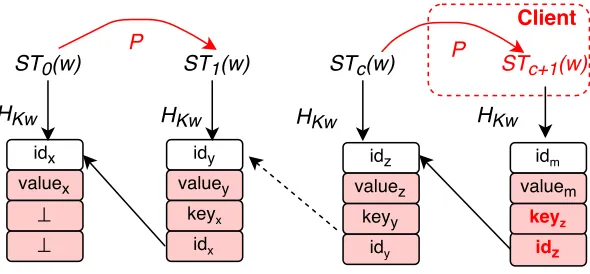
Figure 4: Theε-sTDP. A one-way permutation (red) is performed in the client, while its inverse is simulated by the key-based blocks chain. It is similar to the usage of TDP, so that we call it as “an efficient permutation similar to TDP”.
5.2
The
ε
-sTDP technique
Basic idea. In order to obtain a good performance and forward security, we still apply the KBBC to link the blocks and hide their relations. But for token re-generation, because the security requires the output domain to be the same as the input domain in the random oracle (in Theorem 2), we utilize a one-way permutationP (not necessary to have a trapdoor) instead of TDP to recompute the tokens. Obviously, this is not a strict trapdoor permutation, but it is very similar to the usage of TDP in Σoφoς. That is why we call it as “ε-sTDP”, which means “an efficient permutation similar to TDP”.
Considering the performance, we suggest to instantiate the permutation P by using symmetric cryp-tographic primitive (such as block cipher). For convenience, we define the one-way permutation P as
P : {0,1}µ → {0,1}µ, and denote P
kρ(x) as a keyed permutation with the key kρ and message x as
in-puts. Thus, for eachx←− {$ 0,1}µ, we have|P
kρ(x)|=|x|.
The ε-sTDP. Figure 4 shows the details ofε-sTDP. For each keywordw, the client randomly generates aST0(w) and stores a countercwith default value 0. When adding a data block, the client will first compute
its identifier by: STc+1(w)← Pkρ(STc(w)); id←HKw(STc+1(w)). Then, based on KBBC, the client sets
the data identifier and encryption key of the next block and encrypts them. The search token is still the (id, key) of thehead block, which is re-computed by the client.
5.3
Our construction
Algorithm 5 gives the formal description of our improved forward private scheme, “FFSSE-ε”. We still use
W[w] to store the keyword state, but there is only a counter cnt (default value is -1) after client storage reduction. We define a constant valueCT for dynamic adjustment.
Re-generation of search token. For re-computing the search token, we first pseudo-randomly generate
ST0(w) from w(or a unique identifieriw≤ W). Like that in Σoφoς, it is easy to do from a PRFG:W → {0,1}µ by computingST
0(w)← G(iw).
Then, to recompute the search token with the counterc, we can easily computeSTc(w) fromST0(w) and
c by iteratingP for ctimes, that is, STc(w)← Pkcρ(ST0(w)). After obtaining theSTc(w), we can generate
the id of search token as HKw(STc(w)), where Kw is computed by the user’s secret key uk and w. For
the other partkey of search token, we can generate hash keyKw∗ by user’s secret key uk∗ and utilize it to compute the key as HK∗
w(STc(w)). As a result, the search token is (HKw(STc(w)), HKw∗(STc(w))). We
denote this re-generation process asReGen(w, c) which takeswandcas inputs.
Algorithm 5 FFSSE-ε: Forward private SSE scheme supporting dynamic adjustment
Setup()
1: uk←− {$ 0,1}λ, uk∗ $
←− {0,1}λ
2: kρ←KeyGen(1λ)
3: W←empty map, T ←empty tree
Search(w, σ; EDB)
Client:
1: (id, key) ←ReGen(w,W[w].cnt)
2: Send token (id, key) to the server.
Server:
3: S←empty set, i←0
4: repeat
5: b←Dkey(T[id].data)
6: id←b.ptr 7: key←b.key 8: indkop←b.value 9: S[i++]←indkop 10: until (b.ptr==⊥)
11: S←M erge(S)
// merge the same indwithadd anddel operations
12: Send each indin Sto the client.
Client:
13: if W[w].cntmodCT == 0then
14: DynamicAdjust(w)
15: end if
Update(op, w, ind, σ; EDB)
Client:
1: (id, key)←ReGen(w,W[w].cnt) 2: W[w].cnt++
3: (id∗, key∗)←ReGen(w,W[w].cnt)
4: b←(id∗, Ekey∗(“indkop”kkeykid)) 5: Send blockb to the server.
Server:
6: Insert block binto the treeT.
ReGen(w, c)
1: if W[w].cnt==-1then
2: id← ⊥, key← ⊥
3: else
4: Kw← F(uk, w)
5: Kw∗ ← F(uk∗, w)
6: ST0(w)← G(iw)
7: if W[w].cnt==0then
8: id←H(Kw, ST0(w)), key←H(Kw∗, ST0(w))
9: else
10: STc(w)← Pkcρ(ST0(w))
11: id←H(Kw, STc(w)), key←H(Kw∗, STc(w))
12: end if
13: end if
algorithm 5, we only represent the above client-server protocol as the function DynamicAdjust with the inputw.
Obviously, based on dynamic adjustment, the FFSSE-εcan freely eliminate the same document identifier with bothadd anddelete operators in different nodes, reduce the total number of nodes in the treeT from
O(Waw) to O(W), and improve the search performance by reducing about aw traverse operations of the
tree.
Theorem 3. FFSSE-εisLS−adaptive−secure.
5.4
Comparison with
Σ
oφoς
In this section, we briefly discuss the comparison between FFSSE-ε and Σoφoς, whose client storages are both reduced toO(WlogD).
Dynamic adjustment. This character is used in this paper, to emphasize that the SSE scheme can adjust the elements stored in the cloud server for the consideration of efficiency. It is obvious that FFSSE-ε
supports dynamic adjustment for search performance, while Σoφoς does not.
Computational performance. Although the same computational complexities,O(aw) for search and
O(1) for update, FFSSE-ε has a better performance than Σoφoς caused by the adopted symmetric crypto-graphic primitive and dynamic adjustment. As for token generation with complexity ofO(aw), FFSSE-εis
obviously better than Σoφoς caused by theε-sTDP mechanism.
Functionalities and leakages. Compare to Σoφoς, FFSSE-ε utilizes ε-sTDP instead of traditional TDP to hide the connection between the newly added nodes and the existing nodes. However, thesearch
and update protocols of these two schemes still have the same processes. They both store the keyword states in the client and send the search or update token to the server. And thus, they actually have the same functionalities and leakages.
6
Experiments and evaluations
The goal of our experiments is to compare the performance between FFSSEs (FFSSE and FFSSE-ε) and the first efficient forward private SSE scheme Σoφoς. Generally, a complete search/update operation consists of search/update in server side and token generation in client side. Considering token generation has its own rule in different scheme, we separate a complete operation into two parts, that in server and that in client.
6.1
Implementation details
We implemented FFSSEs’ core functions and benchmarks in C/C++, using about 1000 lines of codes. All of the cryptographic primitives implementation in FFSSEs use the third party’s code provided by Σoφoς [21]’s open source code. For keyed hash function, we use HMAC. The keyed permutation P and symmetric encryption are instantiated using AES in counter mode. For the FFSSE-ε, we setCT as 75.
Experiment environments. To provide the same experimental environments, we use the same keyword-document pairs generation rules that Σoφoς does. Also, we use RocksDB as underlying server side’s storage to store treeT since mapTin Σoφoς is stored using this database. To note that, aside from the chosen for pairs generation rules and cryptographic components, we drop RPC machinery in implementation and don’t take timings of underlying database operations into account. These considerations attempt to guarantee the accurate measurements and comparison of search, update and token generation operations for both our schemes and Σoφoς’s.
We run our experiments on a desktop computer with a single Inter Core i7-7700 3.60HZ CPU, 2GB of RAM running on ubuntu 14.0.4. Our codes have been opened in GitHub: https://github.com/liuzheli/FFSE.
Parameter. For our schemes, we set λ, the length of symmetric keys, to 256 bits. The Nmax, the
maximum number of keyword-document pairs, is determined by concrete benchmarks ranging from 140 to 14000000. The length of identifiers, µ, can be set from λ and Nmax according to the above-mentioned
0 5 0 1 0 0 1 5 0 2 0 0 2 5 0 3 0 0 3 5 0 4 0 0
0
2 0 0 4 0 0 6 0 0 8 0 0 5 0 0 0 0 1 0 0 0 0 0 1 5 0 0 0 0 2 0 0 0 0 0 2 5 0 0 0 0 3 0 0 0 0 0
Σοϕος
- B
F F S S E
E
x
e
c
u
ti
o
n
t
im
e
(
c
p
u
c
lo
c
k
)
L e n g t h o f i n v e r t e d i n d e x l i s t
F F S S E -
ε
Σοϕος
Figure 5: Comparison of token generation in update operation. X-axis is the number of times that keywordwhas been queried, i.e.,aw.
6.2
Evaluation
Token generation. We evaluated the performances of token generation algorithms in update operation. Figure 5 shows the experiment results. We can conclude that our token generation algorithms have sig-nificantly better performance than Σoφoςs’. For two basic schemes, FFSSE is at least 300× faster than Σoφoς-B, because Σoφoς-Brequires RSA-based private key encryption operation but FFSSE only uses sym-metric encryption operations. For two improved schemes with the same size of client storage, FFSSE-εis at least 200×faster than Σoφoς, since it is based on symmetric encryption scheme. Moreover, as the number of documents in the indexed list increases, the execution time of FFSSE-ε does not increase, owing to the dynamic adjustment (CT=75). Specially, we can see that the token generation in the client is very expensive for Σoφoς when the length of indexed list is long.
SSE operations. We evaluated execution times of completed search and update operations to compare performances of different schemes. We tested each scheme on the basis of the same keyword-document pairs, the same keyword sets and the same benchmarks. Concretely, we first run the update operation benchmarks and construct the databases at the same time. Then run the search operation benchmarks on them. Actually, our benchmarks are the same as those in Σoφoς. The experiment results can be shown in Figure 6 and Figure 7. We can conclude that no matter search or update operation, FFSSEs have significantly better performance than Σoφoςs, derived from their different cryptographic primitives.
About search operation, FFSSE is average 4×better than Σoφoς-B. Despite our search algorithm only contains symmetric key encryption, the reason why our advantage is not obvious is due to the facts: there is no token generation operation, and RSA public key-based evaluation in Σoφoς-Bis only 5× slower than symmetric encryption in FFSSE. But for two improved schemes, FFSSE-εis average 60×better than Σoφoς. After reducing client storage, token generation operation must be executed in the client. Because Σoφoς
uses RSA private key-based token generation, it is much slower than that in FFSSE-ε.
About update operation, the differences in their performances stem mainly from the token generation and block encryption. Two basic schemes require less computation about token generation, but two improved schemes must re-generate them for client storage reduction. We can see that FFSSE is average 300×better than Σoφoς-B, FFSSE-εis average 200×better than Σoφoς.
re-1 0 0 1 0 0 0 1 0 0 0 0 1 0 0 0 0 0 1 0
1 0 0 1 0 0 0 1 0 0 0 0 1 0 0 0 0 0 1 0 0 0 0 0 0
F F S S E
F F S S E -ε
E x e c u ti o n t im e ( c p u c lo c k )
k e y w o r d / d o c u m e n t p a i r s Σοϕος- B
Σοϕος
Figure 6: Comparison of search operation. Average execution time of search operation over database with 140000 keyword-document pairs.
1 02 1 03 1 04 1 05 1 06 1 07
0
5 0 0 1 0 0 0 1 2 0 0 0 0 1 4 0 0 0 0 1 6 0 0 0 0 1 8 0 0 0 0 2 0 0 0 0 0 2 2 0 0 0 0 2 4 0 0 0 0 2 6 0 0 0 0 2 8 0 0 0 0 3 0 0 0 0 0
Σοϕος
Σοϕος- B
F F S S E -ε
F F S S E
E x e c u ti o n t im e ( c p u c lo c k )
k e y w o r d / d o c u m e n t p a i r s
Figure 7: Comparison of update operation. Average execution time of up-date operation over database with 140000 keyword-document pairs.
0
5 0 0 1 0 0 0 1 5 0 0 2 0 0 0 2 5 0 0 3 0 0 0 3 5 0 0 4 0 0 0 4 5 0 0 1 5 0 0 0 0 1 5 5 0 0 0 1 6 0 0 0 0
F F S S E -ε Σοϕος
E x e c u ti o n t im e ( c p u c lo c k )
c l i e n t s e r v e r
Σοϕος- B
F F S S E
S S E s c h e m e s
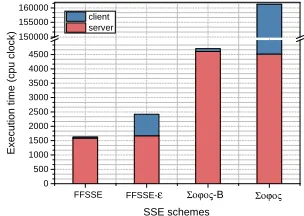
Figure 8: Execution time distribu-tion of search operadistribu-tion. Search time (|Lw| = 130) over database with 140000
keyword-document pairs.
generate tokens in the client, two basic schemes take more than 95% of the time to perform the server-side operations. For FFSSE-ε, the client-side operations take less time than server-side operations, because dynamic adjustment of FFSSE-ε reduces the number of encryption in token generation process. But for Σoφoς, it takes lots of time in the client for the RSA private key-based token generation.
7
Conclusion
We focus on how to improve the performance of forward secure searchable encryption schemes. Until now, the state-of-the-art forward private SSE scheme is Σoφoς proposed in CCS 2016, however, it relies on the asymmetric cryptographic primitive. In this paper, we exploit a key-based blocks chain technique which is based on symmetric cryptographic primitive, and apply it to design a more efficient forward secure SSE scheme, named FFSSE. The proposed key-based blocks chain is independent of index generation rule, so that it is more flexible than TDP in Σoφoς. It may be valuable for some other designs with the consideration of forward security. In our future work, we plan to study how to design the forward secure order-preserving encryption scheme based on key-based blocks chain technique.
Acknowledgment
This work was supported by the National Natural Science Foundation of China (No. 61672300), and National Natural Science Foundation of Tianjin (No. 16JCYBJC15500).
References
[1] Z. Fu, X. Wu, Q. Wang, K. Ren, “Enabling Central Keyword-Based Semantic Extension Search Over Encrypted Outsourced Data”, inIEEE Transactions on Information Forensics and Security, 12(12), pp. 2986-2997, 2017. [2] Z. Fu, X. Wu, C. Guan, X. Sun, K. Ren, “Toward efficient multi-keyword fuzzy search over encrypted outsourced
data with accuracy improvement”, in IEEE Transactions on Information Forensics and Security, 11(12), pp. 2706-2716, 2016.
[4] R. A. Popa, C. Redfield, N. Zeldovich, H. Balakrishnan, “CryptDB: protecting confidentiality with encrypted query processing”, inSOSP, pp. 85-100, 2011.
[5] R. Poddar, T. Boelter, R. A. Popa, “Arx: A Strongly Encrypted Database System”, inIACR Cryptology ePrint Archive, 2016.
[6] S. Faber, S. Jarecki, H. Krawczyk, Q. Nguyen, M. Rosu, and M. Steiner, “Rich queries on encrypted data: Beyond exact matches”, inESORICS, 2015.
[7] Z. Fu, F. Huang, K. Ren, J. Weng, C. Wang, “Privacy-Preserving Smart Semantic Search Based on Conceptual Graphs Over Encrypted Outsourced Data”, inIEEE Transactions on Information Forensics and Security, 12(8), pp. 1874-1884, 2017.
[8] D. Cash, J. Jaeger, S. Jarecki, C. S. Jutla, H. Krawczyk, M. C. Rosu, M. Steiner, “Dynamic Searchable Encryption in Very-Large Databases: Data Structures and Implementation”, inNDSS, Vol. 14, pp. 23-26, 2014.
[9] D. X. Song, D. Wagner, A. Perrig, “Practical techniques for searches on encrypted data”. InS&P, 2000. [10] R. Li, A. X. Liu, “Adaptively secure conjunctive query processing over encrypted data for cloud computing”, in
ICDE, pp. 697-708, 2017.
[11] I. Demertzis, S. Papadopoulos, O. Papapetrou, A. Deligiannakis, M. Garofalakis, “Practical private range search revisited”, inSIGMOD, pp. 185-198, 2016.
[12] E. Stefanov, C. Papamanthou, E. Shi, “Practical Dynamic Searchable Encryption with Small Leakage”, inNDSS, pp. 23-26, 2014.
[13] R. Curtmola, J. Garay, S. Kamara, R. Ostrovsky, “Searchable symmetric encryption: improved definitions and efficient constructions”, inCCS, 2006.
[14] M. S. Islam, M. Kuzu, M. Kantarcioglu, “Access Pattern disclosure on Searchable Encryption: Ramification, Attack and Mitigation”, inNDSS, 2012.
[15] D. Cash, P. Grubbs, J. Perry, T. Ristenpart, “Leakage-abuse attacks against searchable encryption”, in CCS, pp. 668-679, 2015.
[16] Y. Zhang, J. Katz, C. Papamanthou, “All Your Queries Are Belong to Us: The Power of File-Injection Attacks on Searchable Encryption”, inUSENIX Security, 2016.
[17] G. Kellaris, G. Kollios, K. Nissim, A. O’Neill, “Generic attacks on secure outsourced databases”, inCCS, pp. 1329-1340, 2016.
[18] L. Ren, C. Fletcher, A. Kwon, E. Stefanov, E. Shi, M. van Dijk, and S. Devadas, “Constants Count: Practical Improvements to Oblivious RAM”, inUSENIX Security, 2015.
[19] X. Wang, H. Chan, E. Shi, “Circuit oram: On tightness of the goldreich-ostrovsky lower bound”, inCCS, pp. 850-861, 2015.
[20] Y. C. Chang, M. Mitzenmacher, “Privacy preserving keyword searches on remote encrypted data”, inACNS, pp. 442-455, 2005.
[21] R. Bost, “Σoφoς−Forward Secure Searchable Encryption”, inCCS, 2016.
[22] S. Garg, P. Mohassel, C. Papamanthou, “TWORAM: Round-optimal oblivious RAM with applications to search-able encryption”, inCrypto, 2016.
[23] R. W. Lai, S. S. Chow, “Forward-Secure Searchable Encryption on Labeled Bipartite Graphs”, in ACNS, pp. 478-497, 2017.
[25] K. Kurosawa, Y. Ohtaki, “UC-Secure Searchable Symmetric Encryption”, inFinancial Cryptography, Vol. 7397, pp. 285-298, 2012.
[26] M. Naveed, M. Prabhakaran, C. A. Gunter, “Dynamic searchable encryption via blind storage”, in S&P, pp. 639-654, 2014.
[27] A. Lysyanskaya, S. Micali, L. Reyzin, H. Shacham, “Sequential aggregate signatures from trapdoor permuta-tions”, inEurocrypt, Vol. 3027, pp. 74-90, 2004.
[28] Q. Wang, M. He, M. Du, S. S. Chow, R. W. Lai, Q. Zou, “Searchable encryption over feature-rich data”, in IEEE Transactions on Dependable and Secure Computing, 2016.
[29] Y. Yang, X. Liu, R. H. Deng, Y. Li, “Lightweight Sharable and Traceable Secure Mobile Health System”, in IEEE Transactions on Dependable and Secure Computing, 2017.