and Technology (lICIST 2015)
An Enhanced Receiver-Based Ad hoc On-Demand Routing Protocols for Mobile
Ad hoc Networks
Abdulaziz Al-Nahari1*, Mohd. Murtadha Mohamad1, Raja Zahilah1
1Faculty of Computing Universiti Teknologi Malaysia 81310, Johor Bahru, Malaysia
* Corresponding author: [email protected]
Abstract
In high mobility and high traffic load network situations, the delay time is affected with high end-to-end delay in reactive routing protocols such as AODV. In this paper we proposed an enhanced receiver-based AODV (ERB-AODV) routing protocol by improving the maintenance phase in AODV. ERB-AODV protocol focuses on decreasing the end-to-end delay and the control overhead in high mobility and traffic load. The receiver node uses a controller agent to update the sender node of the current available path. The agent works depend on the history of receiving data packets. Using glomosim, the ERB-ADOV protocol outperforms the AODV protocol in high mobility and traffic load. Results show that, in high mobility, the delay is decreased by 81% and the control overhead is decreased by 77%.
Keywords.
Mobile Ad hoc Network; reactive routing protocol; AODV; glomosimIntroduction
Mobile ad-hoc networks (MANETs) consist of a set of devices with wireless facility (nodes) that are connected together through wireless links. This type of network is suitable in applications with limited resources and time. Examples of applications in MANETs are include military, rescue and emergency, conferences and meetings. MANET is easy to deploy in fast and simple ways as it requires only two or more mobile nodes [1]. In addition to MANET, there are different types of ad hoc networks, which are wireless sensor network (WSN) [2, 3], vehicular networks (VANET) [4], and underwater wireless networks [5]. With these networks and with the absence of a base station, each node acts as a router that manages the network. It learns about the network and communicates with other nodes by responding with different data/control packets. As nodes have limited resources (i.e. limited battery life, memory, bandwidth), the communication life between them is limited and depends on the network environment (for example: static, dynamic, dense, congested, etc.).
Ad hoc on-demand distance vector (AODV) [6] routing protocol is a reactive routing protocol that starts when a sender node has data to send to another node, which is the receiver node. In this case, the sender will broadcast a request packet for the route, RREQ, to discover the path. The receiver node, upon receiving the request packet will send a unicast reply packet, RREP, which follows the reverse path through the upstream nodes toward the source node to start sending data packets. When a link has broken in the route, the intermediate node sends a route error packet, RRER, to inform the sender node of the problem. The sender node starts the discovery phase again if demanded to find new path to the receiver node. Limitation of AODV protocol is as follows: during the discovery phase, if the reply packet faced problems reaching the sender, the sender must start the discovery process all over again which increases the overhead in high mobility and high traffic load and affects the network performance especially in terms of increasing network delay. In addition, reliability to find new paths with less network flooding to discover a new path becomes one of the important challenges which has attracted researchers in improving distance vector routing protocols [7, 8]. Different protocols try to improve the AODV by focusing on the network QoS such as delay, bandwidth, or decreasing the control overhead. Examples of these protocols are in [9, 10], and a review for QoS protocols can be found in [11]. These protocols may not work efficiently when the network is less reliable with the limited resources of the network or with high mobility.
IICIST 2015 Proceedings 378
.The authors in [13] have suggested to do bidirectional repair process, to improve the maintenance phase in ad hoc on-demand routing protocol, by allowing the intermediate nodes to send error packets to both end nodes, i.e. source and destination nodes. The destination node along with sender node, broadcast a reverse RREQ packets. The control packets will not be farther broadcasted when intersected in an intermediate node. The intermediate node then send reply packet to update the nodes in the path toward the sender. However, even with the use of the receiver node in discovery or maintenance processes, the distance vector on-demand single paths routing protocols suffer from high end-to-end delay in high mobility conditions and traffic load [14].
Therefore, in this paper, the Enhanced Receiver-Based Routing Protocol (ERB-AODV) protocol tries to decrease the delay and overhead in high mobility and traffic load. The idea is to face the congestion be sending broadcast from the receiver during the demand of the receiver to send data. These packets will travel through uncongested nodes and find available paths with less repairing time as in other on-demand protocols. The receiver role is to update the sender of the currently available path that can be used. As a result, the path acquisition time is decreased and the overhead is also decreased. This paper enhanced (RB-AODV)[12] protocol by decreasing the number of control packets issued by the receiver for updating the sender for the new path. This is by tracking the received data packets during a specified time.
The flow of this paper is outlined as follows: section 2 explains the ER-AODV routing protocol. Section presents the simulation results. Section 4 concludes the paper works.
Enhanced Receiver-Based AODV Routing Protocol
Sending broadcast control packets from the receiver to the sender will decrease the control overhead in the network as proven in R-AODV protocol for minimizing the overhead during the discovery process. The proposed ERBAODV is using this mechanism in maintenance phase to reduce the overhead especially in high mobility and high traffic load networks. In such condition, paths currently in use are vulnerable to breakage and the sender node will broadcast the network looking for new a path.
Another advantage is that the broadcast packets , issued by receiver node, given the chance to decrease the time needed to discover new path, and hence the delay time is less compared to ordinary mechanisms such in AODV protocol. The source node uses the current active path when receiving first control packet. The proposed ERB_AODV protocol follows the same AODV routing protocol with two main phases, discovery phase and maintenance phase.
Discovery Phase
Maintenance Phase
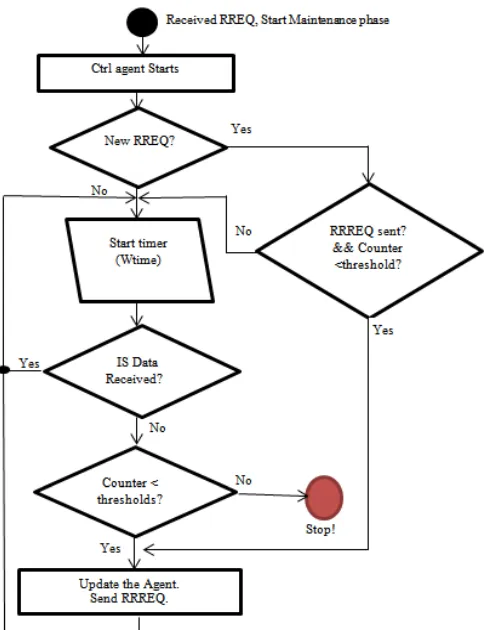
In this phase, when the first session was created between the sender and receiver nodes through the discovery phase, the receiver node started controlling communication status. This is done by designing the receiver controller agent (Rec_Ctrl) as shown in Table 1. The receiver node starts a timer known as waiting time (Wtime) when sending the reply packet. The purpose of this timer is to check the number of times the receiver node receives data packets. If the receiver did not receive any data packets during this time (dataReceivedFlag =0), then the receiver node broadcasts a receiver route request packet (RRREQ) looking for a path to connect with the sender node as depicted in Figure 1. The isSent will be set to 1, and the agent will re-establish the Wtime again. isSent is used here to determine if the agent must be restarted even when receiving new request packets. A value of 1 means the agent is in the action of communicating with the sender node and will broadcast the RRREQ when Wtime expires. If zero, the receiver node has stopped broadcasting the RRREQ packets. The RRREQ acts like the RREQ in the discovery phase. Upon receiving the first RRREQ packet by the sender node, the sender starts using this new path to send data packets directly.
Table 1: Rec-Ctrl agent Rec-Ctrl variables role
dataReceivedFlag Indicate if there is data received
Counter Count the number of sent RRREQ
isSent Indicate if already sent RRREQ
Wtime Period of time waiting to receive data packets
Cthreshold Maximum number of sent RRREQ without receiving data packets of each Wtime
In Equation 1, the Wtime is calculated as follows:
(1)
where x is used to define the number of times we need to wait to receive data packets.
IICIST 2015 Proceedings 380
If the receiver node has received any data packets during Wtime timer, then it will start the Wtime again without sending the RRREQ packet. The agent here assumes that the current connection still working with no problem. If after Wtime expires and there is no data received, the RRREQ packet will be broadcasted through the network. The controller will stop sending the update packets when the counter reaches Cthreshold. The agent learns there are no need for another connection and waits for new session to start.
The reason for not receiving data packets could be either the sender finished sending data packets, or there is a problem in the active path. It is assumed that the intermediate nodes stop sending error packets to the sender node in the case of error. Error packets increase the overhead in the network and also increase the delay time to find a path. The error notifications will be used when deal with multipath in future works.
Results and Discussion
The simulation is used to test and verify the proposed protocol is GloMosim [15]. The simulation configuration is shown in Table 2. The experiment is to evaluate the performance of ERB-AODV and RB-AODV in different mobility conditions and to compare it with AODV protocol.
Table 2: Simulation configuration parameters
п®¿³»¬»® Ò¿³»
Ì»®®¿·² -·¦»
Ò«³¾»® ±º ²±¼»-
Ó±¾·´·¬§ ³±¼»´
Ó¿¨·³«³ Í°»»¼
п«-» ¬·³» Ì®¿ºº·½ ¹»²»®¿¬±®
п½µ»¬ -·¦»
Ì®¿ºº·½ -°»»¼
ɬ·³»ø¨÷
Parameter value
1000x1000 50 RWP 10 m/s 0s, 5s, and
10 s
CBR 512 Bytes 8 pkt/s 8
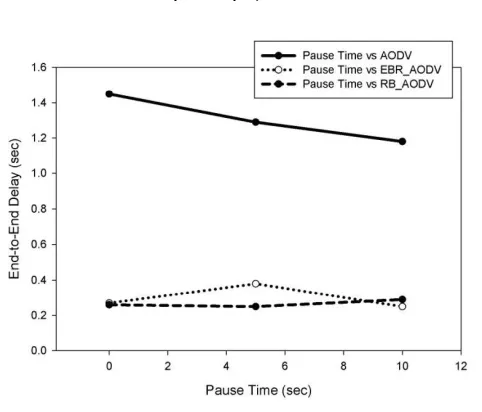
The routing protocols that are tested: AODV, RB-AODV, and the proposed protocol ERB-AODV. The performance metrics used are the delay, and control overhead. The improvement of proposed protocol compared to AODV protocol is measured using the formula:
(2)
Figure 2: End-to-End delay with varied pausing time
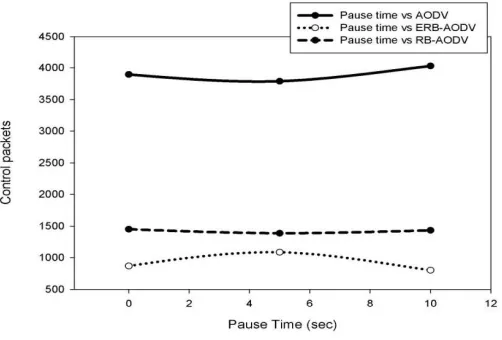
Figure 3: Control overhead with varied pausing time
The average control overhead as shown in Figure 3 verifies that RB-AODV broadcasts more control packets than ERB-AODV. The former broadcasts the update packets from the receiver node after each Wtime expires, whereas ERB-AODV only broadcasts control packets when there is no data packet received during the Wtime period. The improvement obtained by ERB-AODV protocol is that the control overhead is decreased by 77% at pause time 0 sec, and 80% at pause time 10 sec, when compared with AODV protocol.
Conclusion
In this paper, we illustrated the effects of high mobility and traffic load on network performance in MANETs using AODV protocol. We focused on decreasing end-to-end delay and control overhead caused in congested network by proposing an ERB-AODV routing protocol. ERB-AODV protocol proposed enhanced maintenance phase in AODV protocol. The results show that ERB-AODV protocol improved the network performance when compared with the standard AODV protocol. The results show that, the end-to-end delay is decreased by 81% compared to AODV in high mobility. And control overhead is decreased by 77%. Updating the source with new available path before the current used path is broken is important in decreasing the delay and control overhead. For future work, we will focus on enhancing the PDR and study the improvement on performance by selecting multiple paths from update packets.
ACKNOWLEDGMENT
This work has been funded by the Fundamental Research Grant Scheme (Title: Colour Code Scheduling in Beacon Selection Framework for Mobile Positioning in Multiblock Workspace) under project no. R.J130000.7828.4F644) and Ministry of
Education (MOE).
References
1. Murthy, C.S.R. and B. Manoj, Ad hoc wireless networks: Architectures and protocols. 2004: Pearson education.
2. Guo, W. and W. Zhang, A survey on intelligent routing protocols in wireless sensor networks. Journal of Network and Computer Applications, 2014. 38(1): p. 185-201.
3. Sara, G.S. and D. Sridharan, Routing in mobile wireless sensor network: A survey. Telecommunication Systems, 2014. 57(1): p. 51-79.
4. Sharef, B.T., R.A. Alsaqour, and M. Ismail, Vehicular communication ad hoc routing protocols: A survey. Journal of Network and Computer Applications, 2014. 40(1): p. 363-396.
5. Kheirabadi, M.T. and M.M. Mohamad, Greedy routing in underwater acoustic sensor networks: A survey. International Journal of Distributed Sensor Networks, 2013. 2013.
IICIST 2015 Proceedings 382 9. Hu, C.-C., Delay-sensitive routing in multi-rate MANETs. Journal of Parallel and Distributed Computing, 2011. 71(1): p. 53-61. 10. Zhu, C. and M.S. Corson. QoS routing for mobile ad hoc networks. in INFOCOM 2002. Twenty-First Annual Joint Conference of the
IEEE Computer and Communications Societies. Proceedings. IEEE. 2002. IEEE.
11. Asokan, R. A review of Quality of Service (QoS) routing protocols for mobile Ad hoc networks. in Wireless Communication and Sensor Computing, 2010. ICWCSC 2010. International Conference on. 2010. IEEE.
12. Al-Nahari, A., M.M. Mohamad, and S. Al-Sharaeh. Receiver-based AODV routing protocol for MANETs. in Intelligent Systems Design and Applications (ISDA), 2013 13th International Conference on. 2013.
13. Huang, S.C. and H.Y. Chang, A Bidirectional Route Repair Method for Wireless Mobile Ad Hoc Networks. The Computer Journal, 2014. 58: p. 338--353.
14. Marina, M.K. and S.R. Das, Ad hoc on demand multipath distance vector routing. Wireless Communications and Mobile Computing, 2006. 6(7): p. 969-988.