NEXT GENERATION BANKING: ISSUES AND CHALLENGES
Dr. Rajesh Pal Associate Professor Department of Economics Mahatma Gandhi Kashi Vidyapith
Varanasi – 221002 U.P. (India)
Abstract
The next decade in banking will see both evolution and revolution. Banks must reinvent themselves, not just to respond the pressures of today, but to be flexible enough to offer products and services that match the customers’ needs, especially the increasing demand of Gen Y, or millennials. Bank will focus on great reach and profitability rather than revenue. They will emphasise on the production of new products and services that aligned to emerging client needs. In order to serve customers in a cost effective manner, they will go for using technology like internet and mobile banking which helps banks to serve the masses and under-banked areas. The paper is based on secondary data. The paper analysis the issues and challenges that banks are going to face in the future in serving customers, especially Gen Y. The paper finds that internet and mobile banking will not only serve the masses but also helps banks to reduce their cost in achieving the objective of financial inclusion. The paper also finds out solution for attracting new customers and retaining old customers.
Keywords: Gen Y, millennials, on-boarding, Project Blue.
Introduction
For generations, banking was nearly impenetrable to outside agencies. Customers have to wait for long hours at the bank counters for getting a draft or for withdrawing their own money. Today, banking customers have choice. Today it happens in hours. The banks have shed their traditional functions and have been innovating, improving and coming out with new types of the services to cater to the emerging needs of their customers of new generations. In the last few years, it is no wonder that the banking sector has seen a virtual cornucopia of new products: credit cards, tele-banking, Automatic Teller Machines - TMs, quick collection facilities for outstation cheques, retail EFT, Electronic Clearing Services - ECS - Debit and Credit for repetitive payments like dividend, interest, utility bills, mobile banking, Internet banking, etc. Now there are indications of moving towards the introduction of smart cards, debit cards, on-line banking for e-commerce and financial EDI for straight through processing (Talwar). Electronic fund transfer has been introduced in some of the new generation banks and a few large public sector banks. Cheque clearances within and across major commercial cities are taking place at greater speed. "Any Place Deposit" schemes and Any Time Money have become the order of the day. The old private sector banks are learning new tricks of the trade; the public sector banks are waking up from their slumber; and every bank has come to realise that the name of the game is in service to the customer (Yerran).
Regulations are forcing the banks to adopt better operational strategies and upgrade their skills. The system is also witnessing the integration of the financial markets. Externally, the happening in the international markets are having their implications on the markets and the players. All these are making the operational environment more volatile and hence challenging for the Indian banks. The Indian banks have nevertheless, withstood all these challenges and are becoming more adaptive to the changing environment (www.actmindia.org). However, there is no dearth of challenges. The banking industry has to live up to a range of high expectation of several stakeholders. People have seen the economy grow much faster in the past 10 years than it did earlier, and deliver visible benefits to a large number of people. This has understandably raised the expectations of all sections, especially those who have benefited less. Our people are now much more aware of what is possible, and they will settle for no less (Government of India, 2013: 01). There are hopes of rapid growth, inclusive growth, sustainable growth, wealth creation, trickle down of wealth, plenty of jobs, better living standards, quality infrastructure, world class companies, world class convenient banking, and access to basic banking facilities. The banks must rise to these challenges of meeting these high expectations.
saving and investments (www.youtheconomicopportunities.org). The competitive battleground for success of banking industry depends on customer satisfaction and customer experience. In financial institutions, especially banking industry, power is moving from financial institutions to customers. Consumers now insist on how, when and where they are going to be served. Banks must compete not only on customer service, but also on the overall customer experience. Innovation in banking technology represents another huge change for bankers (Steinharter). India has better banking system in place vis-a-vis other developing countries but there are several issues and challenges that need to be ironed out.
Issues and Challenges
We have made considerable progress in implementing banking and financial sector reforms. Nevertheless, the level of non-performing assets (NPAs) continues be high by international standards. All banks have to prepare for a tightening of the prudential norms, as they have to follow Basel Accord III, which has been designed to address of the weakness of the past crisis and to make the banking system stronger and efficient enough to face any risk. The major thrust area of Basel III is improvement of quantity and quality of capital of banks, with stronger supervision, risk management and disclosure standards. Indian banking is very susceptible to financial market turbulence, especially in the equity market. Upgrading technical skills, technology, research and human capital, developing effective ‘front-office’ strategies and fortifying internal rules of governance and responsibility assumes a renewed priority in the fast changing scenario. Banks and financial institutions have to prepare for changes in the regulatory framework towards a more focussed, comprehensive and efficient environment that eschews regulatory forbearance. Legal reforms accordingly will have to ascend the hierarchy of priorities in the reform process.
banking services such as peer-to peer lending. Besides, wider range of services, it has also increased the voices of customers. Any customers can damage the goodwill of any bank through social media (PwC, 2012: 12).
Digitalisation of banking services is now pervasive across all customer segments, globally, especially so for the Gen Y (in India this is the age group between 18 to 35 years). The group is at the threshold of deciding primary banking relationships (the quality of the digital offering is an important factor in their decision process). Banks have to act now to attract these customers. The digital strategies will need to move beyond cost reduction objectives to do this (PwC, 2012: 17).
Another challenge before banks is achieving inclusive growth. High growth that coexists with rising inequality will become unsustainable at some point. Inclusive growth is not possible without financial inclusion. Thus, RBI has made achieving 100 per cent financial inclusion as its main target and asking every bank to achieve this target in a phased manner. The rationale behind this is that access to finance, along with fair and transparent products/services, is a source of empowerment and allows people to participate more effectively in the economic and social process. The dream of inclusive growth cannot be realised unless we properly educate and make employable the future generation of youth and create millions of micro-entrepreneurs across the country (Chakrabarty, 2011). With the evolution of credit crisis, the global banking landscape has gone changed, leaving issues of trust, customer attrition, brand loyalty, and the resulting revenue declines trailing in its wake.
In order to achieve the goal of financial inclusion, banks have to serve new customers – the unbanked in the emerging world and the underserved in the emerging and developed worlds. Banks have to develop tailor-made products to serve the evolving needs of customers and find new ways to finance large infrastructure projects. They will also have to partner with other financial institutions, as well as non-banks, to leverage new technologies and generate fees. In addition, they will have to re-engineer to optimize efficiency and productivity, particularly in developed markets (Global Banking Outlook, 2015: 34).
Next Generation Customer On-boarding
reduce attrition while improving sales and marketing campaign effectiveness (Solution Paper: Financial Service, 2010: 03).
On-boarding is a great challenge that banks are facing in today’s market. A robust on-boarding process enable banks to take control of the customer experience during the critical first year. The recipe for overcoming on-boarding challenges is as follows (Solution Paper: Financial Services, 2010: 04):
1. Open Account – First Day: This includes: Name and address validation; Client identity compliance; Need-based selling/profiling; and
Need analysis based on segmentation and location 2. Orient Follow Up – First 1-2 Weeks:
Thank you letter;
Customised welcome kit;
Offer communication and service options; and Set-up e-message and e-statements.
3. Cross-Sell and Up-Sell – First 2-3 Months Customised statements;
Incentive programmes for up-selling and cross-selling; Education materials; and
Notify any new plan options.
By overcoming the challenges of on-boarding, banks will not only attract new customers but also retain old customers besides earning revenue and deposits. This strategy helps banks to gain edge over the competition, and both in the minds and hearts of the customers. As all financial institutions know that it is cheaper to retain good customer than to acquire new customers, hence, banks must focus on on-boarding strategies to serve Gen Y customers.
Transforming Banking: Growth, Opportunities, and Threats
The next decade in banking will see both evolution and revolution. Transformation is necessary because banks face an array of stakeholder pressures (i.e., governments and regulators, customers, investors, and staff). At the same time they are facing the pressures of changing demand of Gen Y. The banking industry cannot help but be influenced by four “megatrends” that will cut across all sectors (Global Banking Outlook, 2015: 02):
1. A global market place; 2. Digital business;
3. Demographic shifts; and 4. A changing workforce.
The demographics are compelling. By 2025, the population of Africa and Asia will increase by 350 million and 450 million, respectively. This population will lead an increasingly urban life style and will increase demand for credit – especially to finance the purchase of cars and homes. Economic growth in the emerging economy will offer opportunities for banks to grow.
The competition in both commercial banking and investment banking has become very intense. In retail banking there has been revolution in the provision of financial services to businesses. Some of the greatest innovation in the past decade has been in payments. Alongside PayPal, which has grown into one of the world’s largest financial services organizations, a host of new innovators have emerged. Payments to small business that used to require a check can now be made by card. In lending and investments, a number of peer-to-peer (P2P) lending firms have emerged. There is also increased competition from full-service banks. Alongside P2P lending firms, other companies have emerged, including organizations that broker finance between institutional lenders and SMEs through online exchanges and organizations that provide supplier finance and offer online factoring and invoice discounting. Some non-financial companies are also tapping the market directly (Global Banking Outlook, 2015:13). This array of new entrants into retail banking is already forcing traditional banks to respond by providing improved customer services and using social media to listen to their increasing demand and producing product and service that match the needs of Gen Y. Banks will need to make the investments in technology to meet these demands or risk losing business.
Competition among investment banks is also increasing. Only those banks will survive which operate on sufficient scale. The only way to survive is to build partnerships or acquisitions.
Drivers for Future Growth
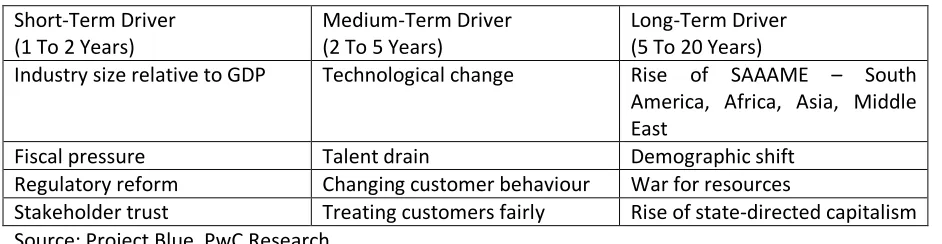
According to the framework developed by PricewaterhouseCoopers Pvt Ltd (PwC) global trends coupled with the local realities will drive the progress of Indian banks. The framework developed by the Pwc is known as Project Blue2. The Project Blue assesses the future of financial services and considers the major trends that are reshaping the global economy and transforming the consumer behaviour, businesses and governments (PwC, 2012: 10-11). The research of PwC has set the broader set of driver that has potential to change the industry. These drivers are shown in the Table 1:
Table 1: Set of Drivers that has Potential to Change the Industry Short-Term Driver
(1 To 2 Years)
Medium-Term Driver (2 To 5 Years)
Long-Term Driver (5 To 20 Years)
Industry size relative to GDP Technological change Rise of SAAAME – South America, Africa, Asia, Middle East
Fiscal pressure Talent drain Demographic shift
Regulatory reform Changing customer behaviour War for resources
Stakeholder trust Treating customers fairly Rise of state-directed capitalism Source: Project Blue, PwC Research
1. Technological change will help banks to reach out to the remotest area and spread their services to the masses in a cost effective manner. It will also promote the goals of financial inclusive growth of the Reserve Bank of India;
2. In the competitive era, bank will attract high qualified customers in order to serve the needs of changing customer behaviour and expanding their services to the masses;
3. Banks will have to run their business activities as per the needs of the changing customer behaviour. Today’s customers are aware of their needs and are becoming more demanding with the time;
4. Customers must be treated fairly and banks must ensure transparency in service charges. The long term drivers for future growth for Indian banks will be a natural progression from the medium terms drivers for future growth.
Solution
The global usage of internet, social media, and mobile usage in banking are increasing fast. Banks need to understand customer segments, their usage of social media from a technology and interaction perspective and their implications. Since social media provides an interactive and low cost medium to broadcast messages, and helps in identifying dissatisfied customers, banks can use it in attracting new customers and retaining old customers at very low costs. Banks can use the channel to create innovative products and services that reflect real time consumer demand. Banks have to focus on mobile banking because for the emerging markets, mobile provides basic banking facilities to previously under-banked market. Financial services are required to focus on innovations and provide digital solutions to Gen Y customers as expectation grows faster.
Financial institutions must focus on improving efficiency ratio and cross sell and up sell opportunities, while instituting successful process to bring and keep customers on board. In each of these cases, the success lies in growing revenue and deposits without additional expenses and at the same time banks have to keep their customers satisfied and able to obtain their loyalty and attract new customers.
Banks must move to customer-driven approach that requires banks to rationalise and simplify their product sets but have dynamic attributes (i.e., interest rates or fees) associated with them. EY’s Global Consumer Banking Survey 2014 suggests that banks that can achieve it will be able to win an increased share of wallet (see Figure 1). However, achieving it will require reform of banks’ internal systems, processes, operations and culture. Combination of simpler businesses and rationalized product sets should give these institutions a better understanding of profitability, enabling them to completely transform their customer offerings (Global Banking Outlook, 2015:13). By adopting customer-driven approach, banks will be able to reduce cost of operation and increase profitability along with providing customers with differentiated products.
customers. In future technology will take control of banking functions. The challenge for the industry is to shift the balance of technology spends between technology driven by customer and investment priorities to drive internal change and protect against non-traditional competitor.
Before the financial crisis, one global bank had in excess of 5,000 legal entities across the globe. Such a structure is expensive to maintain. In the era of intense competition, banks have to simplify their structure, but they must do so in a way that helps achieving efficient growth. Banks have to develop operations that support competitiveness, innovations, growth, and flexibility across
back-middle-front-office functions.
Conclusion
Bank will need to connect with an ever-expanding portfolio of business partners. And they will need to engage customers in new, powerful and sustainable ways. The rewards will be significant for those banks that can rise to these new challenges. For those that fail to do so, the future may be less bright. Managing drivers for future growth will provide an opportunity to get success in the competitive era and changing behaviour of the Gen Y. Banks have to become more customer-centric in order to retain old customers and attract new customers. Banks have to align their product and service offerings as per the needs of customers. The bottom line is that banks must have to improve the customer experience to keep customers happy, satisfied, and loyal.
Notes
1. Millennials are referred to those who were born in and after 2000, and cannot live without internet. The age group of these millennials lies between 18-35 years.
2. According to the framework developed by PricewaterhouseCoopers Pvt Ltd (PwC) global trends coupled with the local realities will drive the progress of Indian banks. The framework developed by the Pwc is known as Project Blue. The Project Blue assesses the future of financial services and considers the major trends that are reshaping the global economy and transforming the consumer behaviour, businesses and governments.
References
Talwar, speech delivered by Mr.S.P.Talwar, Dy.Governor, RBI at IDRBT, Hyderabad. Yerran, Raju, Faculty, Administrative Staff College of India, http://kannanpersonal.com. www.actmindia.org, "Indian Banking: Withstanding the Challenges" -
http://www.actmindia.org/pages/alm/jan-cs.htm.
Government of India, 2013, XII Five Year Plan 2012 – 2017, Faster, More Inclusive and Sustainable Growth, Vol. I, Planning Commission, Government of India.
http://www.youtheconomicopportunities.org.
Steinharter, Mike, “Next Generation Banking: Changes in the Industry,” http://www.csc.com/banking/publications).
Efma, 2015 “Next Generation SME Banking – The future of SME revenue growth opportunity in the digitalisation era,” September 2015, axis corporate.
PwC, 2012, Indian Chambers of Commerce, 2012, “Searching for new frontiers of growth Indian banks,” 4th ICC Banking Summit, 18th May 2012, PricewaterhouseCoopers Pvt Ltd, PwC.
Chakrabarty, K. C. 2011, “Challenges for Next Generation Banking,” Address by Dr K C Chakrabarty, Deputy Governor of the Reserve Bank of India, at the Indian Chamber of Commerce and Industry, Coimbatore, 25 June 2011, BIS Central Bankers’ Speeches).